Introduction
Exposure to drugs with anticholinergic activity increases the occurrence of a wide range of peripheral and central adverse effects. Peripheral adverse effects such as dry mouth, dry eyes, blurred vision, urinary retention, and constipation may have a significant impact on daily life (Cicala, Barbieri, Spina, & de Leon, Reference Cicala, Barbieri, Spina and de Leon2019; Cohen, Reference Cohen2017; Reference Nielsen, Munk-Jorgensen, Skadhede and CorrellNielsen, Munk-Jorgensen, Skadhede, & Correll, 2011; Reference Ogino, Miyamoto, Miyake and YamaguchiOgino, Miyamoto, Miyake, & Yamaguchi, 2014; Reference Rudolph, Salow, Angelini and McGlincheyRudolph, Salow, Angelini, & McGlinchey, 2008; Salahudeen, Duffull, & Nishtala, Reference Salahudeen, Duffull and Nishtala2015). Central adverse effects of drugs with anticholinergic activity, mostly confusion and cognitive deficits, may also have a marked impact on functioning (Ancelin et al., Reference Ancelin, Artero, Portet, Dupuy, Touchon and Ritchie2006; Campbell et al., Reference Campbell, Boustani, Limbil, Ott, Fox, Maidment and Gulati2009; Rudolph et al., Reference Rudolph, Salow, Angelini and McGlinchey2008).
Persons with schizophrenia are potentially exposed to high-anticholinergic load due to the frequent use of antiparkinsonian drugs prescribed for extra-pyramidal side-effects but also of many other psychotropic drugs with anticholinergic effects (Reference Duran, Azermai and Vander SticheleDuran, Azermai, & Vander Stichele, 2013; Montastruc et al., Reference Montastruc, Benevent, Touafchia, Chebane, Araujo, Guitton-Bondon and Montastruc2018; Reference Pristed, Correll and NielsenPristed, Correll, & Nielsen, 2017; Salahudeen et al., Reference Salahudeen, Duffull and Nishtala2015; Su et al., Reference Su, Yan, Li, Xiang, Shu, Yu and Si2017). The negative effect of high-anticholinergic load on quality of life (QoL) has been documented in elderly persons from the general population (Cossette et al., Reference Cossette, Bagna, Sene, Sirois, Lefebvre, Germain and Payette2017). It is likely that such an effect is also present in persons with schizophrenia (Chakos et al., Reference Chakos, Glick, Miller, Hamner, Miller, Patel and Rosenheck2006) but very few studies have explored this issue. A study on the European Schizophrenia Cohort found that the anticholinergic load of antipsychotics was associated with both poor physical and mental scores of health-related QoL (Bebbington et al., Reference Bebbington, Angermeyer, Azorin, Marwaha, Marteau and Toumi2009). It is hence of interest to further investigate the impact of anticholinergic load on functioning, particularly in schizophrenia patients engaged in psychosocial rehabilitation.
The detrimental impact of anticholinergic drugs on cognitive performances has been widely documented (Ang et al., Reference Ang, Abdul Rashid, Lam, Rapisarda, Kraus, Keefe and Lee2017; Ballesteros et al., Reference Ballesteros, Sanchez-Torres, Lopez-Ilundain, Cabrera, Lobo, Gonzalez-Pinto and Group2018; Chakos et al., Reference Chakos, Glick, Miller, Hamner, Miller, Patel and Rosenheck2006; Eum et al., Reference Eum, Hill, Rubin, Carnahan, Reilly, Ivleva and Bishop2017; McGurk et al., Reference McGurk, Green, Wirshing, Wirshing, Marder, Mintz and Kern2004; Reference Minzenberg, Poole, Benton and VinogradovMinzenberg, Poole, Benton, & Vinogradov, 2004; Strauss, Reynolds, Jayaram, & Tune, Reference Strauss, Reynolds, Jayaram and Tune1990). Given the well-established link between cognitive deficits and poor functional outcome (Green, Reference Green2016; Reference Green, Kern, Braff and MintzGreen, Kern, Braff, & Mintz, 2000; Lysaker, Hamm, Hasson-Ohayon, Pattison, & Leonhardt, Reference Lysaker, Hamm, Hasson-Ohayon, Pattison and Leonhardt2018; Prouteau et al., Reference Prouteau, Verdoux, Briand, Lesage, Lalonde, Nicole and Stip2005), the lower cognitive performance of schizophrenia patients exposed to drugs with anticholinergic activity is a clinical issue of great concern. Although there is a large body of literature on the cognitive impact of anticholinergic drugs, few studies have explored whether high-anticholinergic load may hamper psychosocial rehabilitation in persons with schizophrenia. A randomized-controlled trial (RCT) in 55 schizophrenia outpatients treated with computerized cognitive training v. computer games found that cognitive improvement was negatively associated with serum anticholinergic activity in the intervention group (Vinogradov et al., Reference Vinogradov, Fisher, Warm, Holland, Kirshner and Pollock2009). Another RCT in 46 schizophrenia patients mandated to a locked residential rehabilitation center showed that cognitive training blunted the negative impact of anticholinergic load on verbal memory (Joshi et al., Reference Joshi, Thomas, Hochberger, Bismark, Treichler, Molina and Light2019). An observational prospective study carried out in 70 patients admitted to forensic units reported that participation in and benefit from psychosocial programs were negatively associated with high-anticholinergic load, and that this association was mediated by lower cognitive performance (O'Reilly et al., Reference O'Reilly, O'Connell, Donohoe, Coyle, O'Sullivan, Azvee and Kennedy2016). As these studies were performed on small samples of selected patients accepting to participate in RCT or admitted to forensic units, little is known about the impact of anticholinergic load on persons with schizophrenia participating in rehabilitation programs in less selected settings.
The aim of the current study was to explore the associations between anticholinergic load of psychotropic treatment and functioning or cognitive performances of persons with schizophrenia spectrum disorders engaged in psychosocial rehabilitation.
Subjects and methods
Population
The study was carried out in the REHABase cohort including persons with serious mental illness or autism spectrum disorder referred to the six centers of a French psychosocial rehabilitation network (Franck et al., Reference Franck, Bon, Dekerle, Plasse, Massoubre, Pommier and Dubreucq2019; Verdoux et al., Reference Verdoux, Quiles, Cervello, Dubreucq, Bon, Massoubre and Franck2019). The rehabilitation plan care proposed to these patients has already been fully described (Franck et al., Reference Franck, Bon, Dekerle, Plasse, Massoubre, Pommier and Dubreucq2019). Briefly, clinically stabilized patients are referred to the centers by public mental health services, private psychiatrists, or any other private practitioner, or are self-referred. They benefit from a functional and cognitive standardized evaluation performed by a multidisciplinary team (psychiatrists, nurses, neuropsychologists, and social workers) in order to establish a personalized rehabilitation care plan. Care in the rehabilitation center is proposed over a 1-year period to patients who do not have access to specific rehabilitation care interventions in their usual mental health care settings (for instance, cognitive remediation, social skills training, vocational rehabilitation, etc.). A standardized electronic case report form is used to collect demographic, clinical, functioning, and cognitive data. Regular group meetings are held to monitor quality control and ensure good inter-rater reliability (Franck et al., Reference Franck, Bon, Dekerle, Plasse, Massoubre, Pommier and Dubreucq2019).
The current study performed using data collected at baseline assessment was restricted for patients included in November 2019 and fulfilling the following inclusion criteria: (i) Global Assessment of Functioning (GAF) (American Psychiatric Association, 2000) score <61 (Jaaskelainen et al., Reference Jaaskelainen, Juola, Hirvonen, McGrath, Saha, Isohanni and Miettunen2013) (criteria required for inclusion in the REHABase); (ii) DSM-5 (American Psychiatric Association, 2013) diagnosis of schizophrenia spectrum disorder (schizophrenia, schizoaffective disorder, schizophreniform disorder, delusional disorder, and unspecified psychotic disorder) based upon clinical interview performed by a psychiatrist; and (iii) information collected on psychotropic treatment at baseline assessment.
The study obtained the authorizations required under French legislation (French National Advisory Committee for the Treatment of Information in Health Research, 16.060bis; French National Computing and Freedom Committee, DR-2017-268).
Clinical and functioning measures
In the current study, we used data collected in the REHABase on the following scales:
(i) Clinical Global Impression severity (CGI-S) scale (Guy, Reference Guy1976): clinician-rated severity of illness (score 1–7; high score indicates greater severity).
(ii) GAF scale (American Psychiatric Association, 2000): clinician-rated global measure of psychological, social, and occupational functioning (score 1–100; high score indicates better functioning).
(iii) STage Of Recovery Instrument (STORI) (Andresen, Caputi, & Oades, Reference Andresen, Caputi and Oades2006), French version by Golay & Favrod (unpublished): 50-item self-administered questionnaire assessing the stage of recovery for 10 groups of five items (Moratorium, Awareness, Preparation, Rebuilding, and Growth). The stage with the highest total is rated as the person's stage of recovery (score 1–5; high score indicates better recovery).
(iv) Schizophrenia Quality of Life-18 (S-QoL18) (Boyer et al., Reference Boyer, Simeoni, Loundou, D'Amato, Reine, Lancon and Auquier2010): 18-item self-administered questionnaire (score 0–100; high score indicates better QoL).
(v) Warwick–Edinburgh Mental Well-Being Scale (WEMWBS) (Tennant et al., Reference Tennant, Hiller, Fishwick, Platt, Joseph, Weich and Stewart-Brown2007), French version (Trousselard et al., Reference Trousselard, Steiler, Dutheil, Claverie, Canini, Fenouillet and Franck2016): 14-item self-administered questionnaire assessing individual's state of mental well-being (score 14–70; high score indicates better well-being).
(vi) Medication Adherence Rating Scale (MARS) (Thompson, Kulkarni, & Sergejew, Reference Thompson, Kulkarni and Sergejew2000), French version (Misdrahi, Verdoux, Llorca, & Bayle, Reference Misdrahi, Verdoux, Llorca and Bayle2004): 10-item self-administered questionnaire (score 0–10; high score indicates better adherence).
Cognitive measures
We used data collected in the REHABase on the following cognitive measures:
(i) The digit span of the Wechsler Adult Intelligence scale 3rd edition (WAIS-III) (Wechsler, Reference Wechsler1997) was used to measure verbal short-term memory and verbal working memory. The participant hears a sequence of digits (numbers) of increasing length and is asked to recall each sequence in the correct order (forward digit recall) for verbal short-term memory and in reverse order (backward digit recall) for verbal working memory (score 1–19; high score indicates better memory performance).
(ii) The Rappel Libre/Rappel Indicé 16 Test (RL/RI 16) was used to assess episodic memory (Van der Linden, Reference Van der Linden2004). This test is based upon the procedure developed by Grober and colleagues (Grober, Buschke, Crystal, Bang, & Dresner, Reference Grober, Buschke, Crystal, Bang and Dresner1988). The participant is first presented a list of four words and has to identify and read them according to their semantic categories. Then he/she has to repeat the four words although the sheet is hidden. The same procedure is consecutively applied to four series of four words. A free recall of the 16 words is followed by a cued recall (semantic category) for words not mentioned in the free recall sequence. After three rounds of free and cued recall of the list of 16 words, immediate free and cued recall scores are calculated based upon the number of correct words (score 0–48, high score indicates better memory performance). Another round of free and cued recall is performed after 20 min giving delayed free and cued recall scores (score 0–16; high score indicates better memory performance).
(iii) The D2-Revised (D2-R) was used to measure selective attention. The test consists of 14 rows (trials), each with 60 randomly mixed ‘p’ and ‘d’ letters marked with one, two, three, or four small dashes (Brickenkamp & Zillmer, Reference Brickenkamp and Zillmer1998). The target symbol is a ‘d’ with two dashes (hence ‘d2’). The participant is instructed to cancel out as many target symbols as possible, moving from left to right, with a time limit of 20 s/trial. Three subscores are calculated: CC measures the global capacity of concentration (total number of items scanned minus error and omissions scores; high score indicates better performance); CCT measures processing speed (total number of processed items; high score indicates better performance); E% measures precision in data processing (errors + omissions × 100/CCT; lower score indicates better performance).
(iv) The Multiple Errands Test (Martin, Reference Martin1972) modified version (Fournier, Demazieres-Pelletier, Favier, Lemoine, & Gros, Reference Fournier, Demazieres-Pelletier, Favier, Lemoine and Gros2015) was used to assess executive abilities in everyday functioning through a number of real-world tasks. Using a neighborhood map, the participant is asked to find a route for shopping by respecting instructions and rules regarding transport (using logical routes to save time, for instance) and schedules of the places to visit. Two scores are obtained: ‘completion time’ assessing the time (min) taken to complete the itinerary; ‘total error score’ assessing the numbers of errors (logical errors, useless detour and schedule respect).
Anticholinergic activity
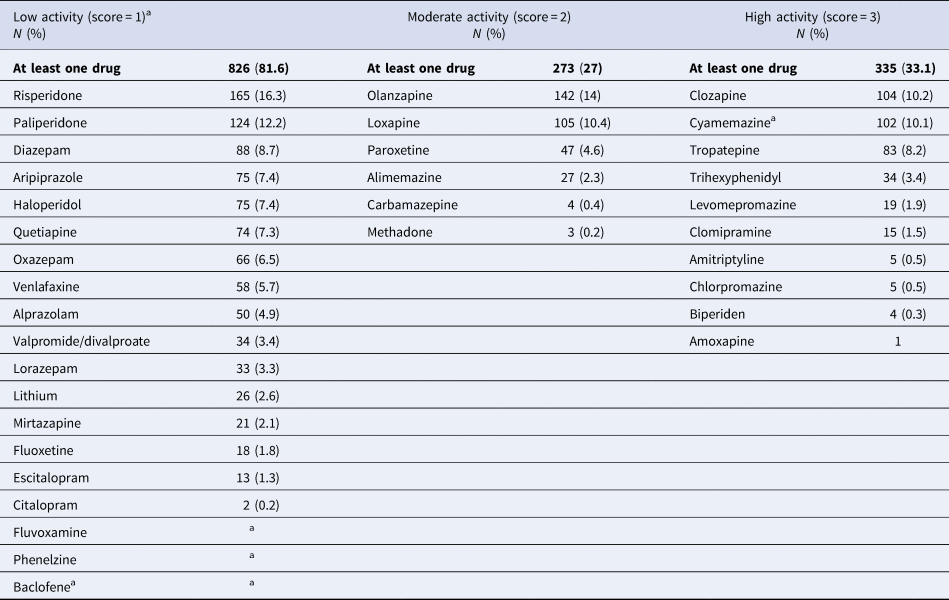
There is no consensus on how to score anticholinergic activity. Some studies used serum anticholinergic activity (Minzenberg et al., Reference Minzenberg, Poole, Benton and Vinogradov2004; Vinogradov et al., Reference Vinogradov, Fisher, Warm, Holland, Kirshner and Pollock2009) and most were based upon various scales listing the anticholinergic load of drugs. In the current study, we used the composite-rating scale developed by Salahudeen et al., ranking the anticholinergic activity of 195 drugs derived from seven published scales (Salahudeen et al., Reference Salahudeen, Duffull and Nishtala2015). This scale was used since it is the most recent and exhaustive review on this issue and because it ranks anticholinergic activity on three levels giving better precision. The few drugs not listed in this scale (see Table 2) were rated using the scale of Durán et al., also derived from seven published scales, ranking the anticholinergic activity of 225 drugs on two levels (Duran et al., Reference Duran, Azermai and Vander Stichele2013).
The anticholinergic load of each psychotropic drug prescribed at baseline assessment was rated as low, moderate, or high (score range: 1–3) according to the Salahudeen et al.'s composite-rating scale, and as low v. high (score 1 v. 3 in the current study) according to the Durán et al.'s scale. Total anticholinergic score was calculated by summing the scores obtained for all psychotropic drugs used at baseline.
Statistical analyses
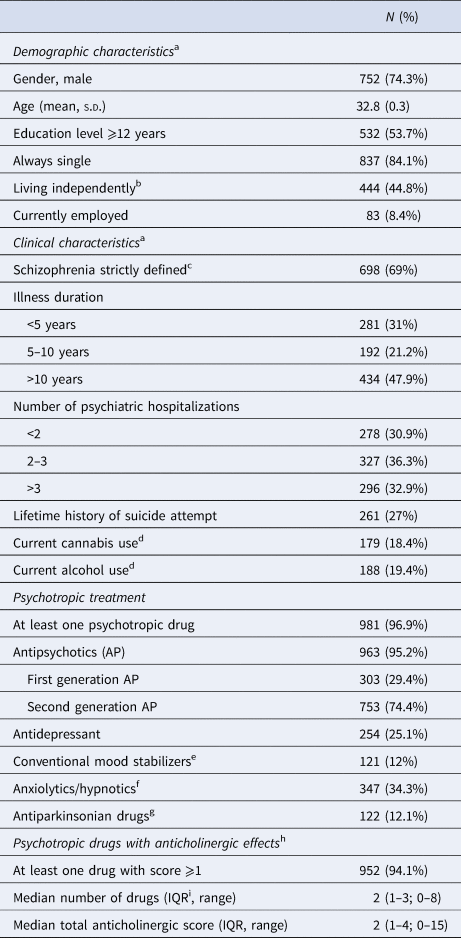
The demographic and clinical characteristics of participants with and without missing data for functioning and cognitive measures were compared using univariate analyses (χ2 test and Student's t test). Multiple logistic regression analyses giving adjusted odds ratio (OR) and 95% confidence intervals (95% CIs) were used to explore the associations between anticholinergic load and functioning or cognitive characteristics. Total anticholinergic score was categorized as ‘low’ (<3) v. ‘high’ (⩾3) according to the median in the sample (Table 1). The functioning and cognitive measures were also categorized as ‘low’ v. ‘high’ according to the medians (Table 3). For each measure, the reference category was ‘high’ functioning or cognitive performance. Hence, the logistic regressions explored whether persons exposed to ‘high’ anticholinergic load were more likely to present with poor functioning or poor cognitive performance compared to those exposed to ‘low’ load.
Characteristics of patients (n = 1012)

a Numbers lower than total number of subjects are due to missing data.
b Living alone or in couple with his/her own residence v. ‘other’.
c Schizophrenia v. other psychotic disorders.
d Any current use of substance as assessment of substance use disorder criteria was not standardized.
e Lithium and anticonvulsants with marketing authorization for mood disorders.
f Benzodiazepines and hydroxyzine.
g Trihexyphenidyl, biperiden, and tropatepine.
h Rated using Salahudeen et al.'s and Durán et al.'s scales (see text and Table 2).
i Interquartile range.
All the associations were adjusted for the following a priori defined potential confounding factors (categorizations based upon the distribution of the characteristics in the sample): (i) demographic characteristics: age, gender, and educational level (<12 v. ⩾12 years), (ii) clinical characteristics: diagnosis of schizophrenia v. other non-affective psychotic disorders, duration of illness (<5, 5–10, >10 years), number of psychiatric hospitalizations (<2, 2–3, >3), CGI-S score, current use of alcohol or cannabis (any current use of the substance as the assessment of substance use disorder criteria was not standardized).
Since the analyses were based upon dichotomization of ordinal or continuous variables (anticholinergic score and functioning/cognitive measures), we performed multiple linear regression analyses giving adjusted regression coefficients (β) and 95% CIs in order to explore the associations between anticholinergic score and functioning/cognitive measures considered as continuous variables. Cognitive measures were transformed into standard equivalent (Z-scores). The analyses were performed using STATA® 13.
Results
Population
Of the 2584 persons included in the REHABase in November 2019, 1017 (39.9%) presented with a diagnosis of schizophrenia spectrum disorder. Information was collected on psychotropic treatment at baseline assessment for 1012 (99.5%) participants, constituting the sample under study. Their demographic and clinical characteristics are described in Table 1: most participants were male, single, and unemployed, with a chronic course of illness. Nearly all participants used psychotropic drugs and second-generation antipsychotics were the most frequently prescribed drugs.
Anticholinergic load
A very high proportion of participants (94%) were exposed to at least one drug with anticholinergic effects and half of them used at least two such drugs (maximum n = 8) (Table 1). These drugs categorized according to their anticholinergic score are listed in Table 2. Irrespective of the score, the most frequently prescribed were risperidone, paliperidone, olanzapine, and loxapine. One out of three patients was exposed to at least one drug with high-anticholinergic activity (score = 3), the most frequently prescribed being clozapine, cyamemazine, and tropatepine.
Scores of psychotropic drugs with anticholinergic activity

a Rated using Salahudeen et al.'s scale except for baclofen and cyamemazine rated using Durán et al.'s scale (see text).
Impact of anticholinergic load on functioning and cognition
Data for at least one functional measure were available for 911 (90%) patients and for at least one cognitive measure for 625 (61.8%) patients (numbers of patients without missing data for each measure are given in Table 3). Patients with missing data for all functional measures or all cognitive measures did not differ significantly from those without regarding the characteristics listed in Table 1 (data not shown).
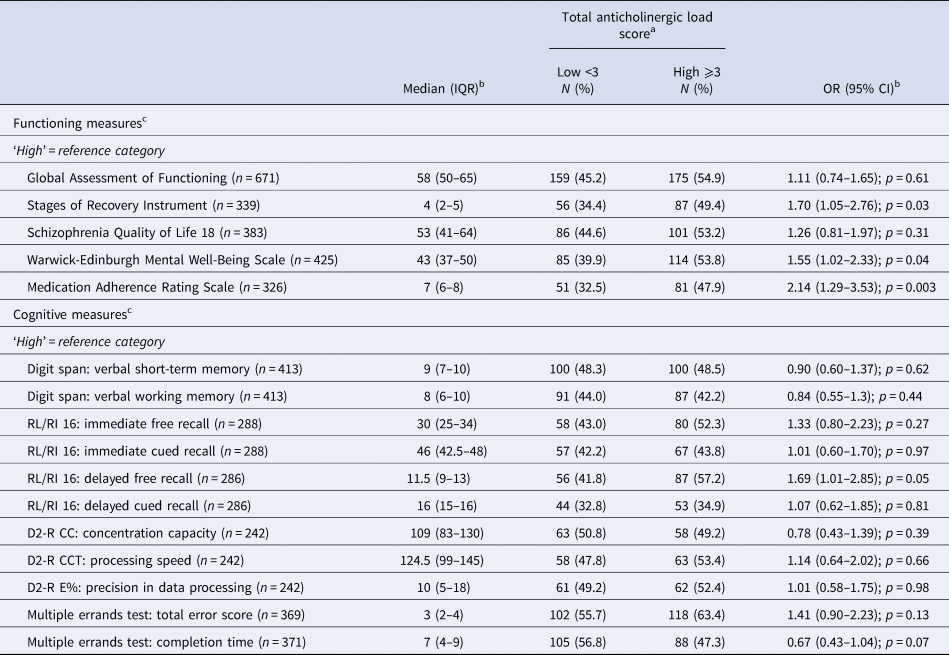
Functioning and cognitive characteristics associated with total anticholinergic score: multivariate regression analyses

a Rated using Salahudeen et al.'s and Durán et al.'s scales (see text and Table 2) and categorized according to the median.
b OR (95% CI) estimating the likelihood that persons exposed to ‘high’-anticholinergic load are more prone to present with poor functioning or poor cognitive performance compared to those exposed to ‘low’ load. All ORs are adjusted for age, gender, education level, illness duration, number of psychiatric hospitalizations, CGI score, alcohol use, cannabis use, schizophrenia v. other psychotic disorders.
c For each scale, median (interquartile range) are calculated for subsamples without missing data on variables of interest (including adjustment variables). Functioning and cognitive measures are categorized as ‘high’ v. ‘low’ according to the median in these samples. The frequencies of persons with ‘low’ functioning or cognitive measures are given in the columns ‘high’- and ‘low’-anticholinergic score.
The findings of the multivariate analyses exploring the associations between anticholinergic load score and functioning/cognitive measures are reported in Table 3. Compared to persons with low-anticholinergic score, persons exposed to high-anticholinergic load score (⩾3) were 1.7 times more likely to present with lower stage of recovery (49% v. 34%), 1.5 times more likely to present with poor mental well-being (54% v. 40%) and 2.1 times more likely to present with poor medication adherence (48% v. 33%). Regarding cognitive performance, poor delayed-episodic memory was 1.7 times more frequent in persons exposed to high-anticholinergic load score (57% v. 42%). An association was found at trend level between high-anticholinergic load score and lower completion time score on the test exploring executive abilities, persons with high load were 0.7 times more likely to have poor performance (i.e. 1.5 times more likely to have better performance; 47% v. 57%). No significant association was found with the other measures.
We performed sensitivity analyses in order to explore whether these associations were better explained by other characteristics not adjusted for in the initial models. First, we restricted the analyses to persons not exposed to antiparkinsonian drugs (trihexyphenidyl, biperiden, and tropatepine) (n = 890), as prescription of these drugs with high-anticholinergic activity may be a proxy of high-antipsychotic dosage and/or illness severity. The strength of the association between anticholinergic load and delayed-episodic memory was reduced (OR = 1.43, 95% CI 0.82–2.50, p = 0.21) whereas those of other associations were unchanged (stage of recovery: OR = 1.77, 95% CI 1.04–2.98, p = 0.03; mental well-being: OR = 1.49, 95% CI 0.96–2.30, p = 0.07; medication adherence: OR = 2.27, 95% CI 1.33–3.89, p = 0.003; multiple errands test completion time: OR = 0.59, 95% CI 0.37–0.96, p = 0.03). Second, we restricted the analyses to persons not exposed to clozapine use (n = 908) for comparable reasons (high-anticholinergic activity and proxy of illness severity) (Verdoux et al., Reference Verdoux, Quiles, Cervello, Dubreucq, Bon, Massoubre and Franck2019). The strengths of the associations were unchanged (stage of recovery: OR = 1.78, 95% CI 1.04–3.01, p = 0.03; mental well-being: OR = 1.56, 95% CI 1.0–2.43, p = 0.05; medication adherence: OR = 2.23, 95% CI 1.31–3.79, p = 0.003; delayed-episodic memory: OR = 1.74, 95% CI 0.99–3.07, p = 0.05); multiple errands test completion time: OR = 0.60, 95% CI 0.38–0.95, p = 0.03). Third, we further adjusted the associations with cognitive measures for use of anxiolytic/hypnotic drugs (at least one at baseline assessment) to control for their impact on memory. The strength of the association with poor delayed-episodic memory increased (OR = 2.06, 95% CI 1.18–3.6, p = 0.01), whereas that of the association with completion time at the multiple errands test decreased (OR = 0.74, 95% CI 0.46–1.17, p = 0.19).
Finally, multiple linear regression analyses were performed in order to explore the associations between anticholinergic score and functioning/cognitive measures considered as continuous variables (online Supplementary Table 1). High-anticholinergic load score was significantly associated with poor mental well-being. Regarding cognitive measures, high-anticholinergic load score was significantly associated with lower completion time score on the test exploring executive abilities and at trend level with poorer delayed-episodic memory. No significant association was found with the other measures.
Discussion
Main findings
Of the 1012 participants with schizophrenia spectrum disorder attending a French national network of psychosocial rehabilitation centers, half used at least two psychotropic drugs with anticholinergic activity and one out of three was prescribed at least one psychotropic drug with high-anticholinergic activity. Persons exposed to high-anticholinergic load score (⩾3) were significantly more likely to present with lower stage of recovery, poor mental well-being, and poor self-rated medication adherence. Regarding cognitive measures, they presented more frequently with poor delayed-episodic memory and at trend level with faster completion of the test exploring executive abilities.
Interpretation of findings
Studies measuring exposure to drugs with anticholinergic effects in schizophrenia patients were most often focused on antiparkinsonian drugs prescribed for extra-pyramidal side effects (Chakos et al., Reference Chakos, Glick, Miller, Hamner, Miller, Patel and Rosenheck2006; Pristed et al., Reference Pristed, Correll and Nielsen2017; Su et al., Reference Su, Yan, Li, Xiang, Shu, Yu and Si2017). The frequency ranged from 5.7% in a population-based Danish study (Pristed et al., Reference Pristed, Correll and Nielsen2017) to 27.4% in a Chinese study carried out in a large sample recruited in psychiatric hospitals (Su et al., Reference Su, Yan, Li, Xiang, Shu, Yu and Si2017). In the current study, 12% of participants were prescribed antiparkinsonian drugs. In a previous study in the REHABase sample, we showed that the indications for antiparkinsonian drugs should be optimized in this population: 9% of clozapine users were prescribed such drugs, yet this co-prescription has no pharmacological rationale and increases the risk of potentially lethal adverse drug reactions (Verdoux et al., Reference Verdoux, Quiles, Cervello, Dubreucq, Bon, Massoubre and Franck2019). As highlighted in the current study, antiparkinsonian drugs represent only the tip of the iceberg of psychotropic drugs with anticholinergic activities prescribed to schizophrenia patients. Optimization of psychotropic treatment also concerns psychotropic polyprescription, as half of the participants used at least two drugs with anticholinergic activity. Antipsychotic prescribing practices should be especially targeted, loxapine, or cyamemazine being among the most frequently prescribed drugs with anticholinergic activity (10% each). In France, these antipsychotics are usually co-prescribed with another first- or second-generation antipsychotic for their anxiolytic/sedative effects, yet there is very limited evidence regarding their benefits (Huhn et al., Reference Huhn, Nikolakopoulou, Schneider-Thoma, Krause, Samara, Peter and Leucht2019).
Schizophrenia patients exposed to anticholinergic drugs frequently complain of their peripheral adverse effects such as dry mouth, blurred vision, and constipation. However, little is known about the impact of these adverse effects on daily-life functioning (Bebbington et al., Reference Bebbington, Angermeyer, Azorin, Marwaha, Marteau and Toumi2009). In the current study, higher anticholinergic load was associated with lower stage of recovery and lower well-being. We also found that participants exposed to high-anticholinergic load were two times more likely to self-report poor medication adherence, which is a well-documented negative consequence of exposure to adverse effects (Garcia et al., Reference Garcia, Martinez-Cengotitabengoa, Lopez-Zurbano, Zorrilla, Lopez, Vieta and Gonzalez-Pinto2016). As our study was cross-sectional, the findings should be interpreted with caution regarding the existence of a causal link between exposure to anticholinergic activity and outcome characteristics. Indeed, high-anticholinergic load may be a proxy of illness severity. However, the associations with functioning variables were not modified after excluding persons using antiparkinsonian drugs or clozapine, which are markers of high-antipsychotic dosage and/or symptom severity. Furthermore, prior prospective studies carried out in psychosocial rehabilitation settings consistently reported that high-anticholinergic load had a negative impact on functional prognosis (Joshi et al., Reference Joshi, Thomas, Hochberger, Bismark, Treichler, Molina and Light2019; O'Reilly et al., Reference O'Reilly, O'Connell, Donohoe, Coyle, O'Sullivan, Azvee and Kennedy2016; Vinogradov et al., Reference Vinogradov, Fisher, Warm, Holland, Kirshner and Pollock2009).
The negative impact of anticholinergic load on verbal memory performance is the most consistent finding reported by studies carried out in persons with schizophrenia (Ballesteros et al., Reference Ballesteros, Sanchez-Torres, Lopez-Ilundain, Cabrera, Lobo, Gonzalez-Pinto and Group2018; Eum et al., Reference Eum, Hill, Rubin, Carnahan, Reilly, Ivleva and Bishop2017; Joshi et al., Reference Joshi, Thomas, Hochberger, Bismark, Treichler, Molina and Light2019; McGurk et al., Reference McGurk, Green, Wirshing, Wirshing, Marder, Mintz and Kern2004; Minzenberg et al., Reference Minzenberg, Poole, Benton and Vinogradov2004; Strauss et al., Reference Strauss, Reynolds, Jayaram and Tune1990). We replicated this association in the current study with regard to delayed-episodic memory, as no association was found with verbal short-term and working memory. The link between anticholinergic load and memory performance was stronger after adjustment for anxiolytic use. This may reflect a more specific measure of the impact of anticholinergic drugs after adjustment, as different pathophysiological mechanisms underlie the memory deficits induced by the two pharmacological classes (Billioti de Gage et al., Reference Billioti de Gage, Moride, Ducruet, Kurth, Verdoux, Tournier and Begaud2014; Vinogradov et al., Reference Vinogradov, Fisher, Warm, Holland, Kirshner and Pollock2009). Conversely, the strength of the association between anticholinergic load and delayed-episodic memory was weaker in persons not using antiparkinsonian drugs (proxy of higher doses of antipsychotics). Such a finding may be explained by residual confounding related to symptom severity or by an independent negative impact of high-antipsychotic doses on memory performance. High-anticholinergic load was also associated with better performance on the time component of the executive test. A similar pattern was reported in a study by Strauss and colleagues, who observed lower verbal memory performance and better reaction time in schizophrenia patients with high-anticholinergic load (Strauss et al., Reference Strauss, Reynolds, Jayaram and Tune1990). The improved performance on the time component may be explained by the lower severity/frequency of extra-pyramidal symptoms in persons exposed to high-anticholinergic load. We did not replicate the link between high-anticholinergic load and lower attention performance reported by some prior studies (Ang et al., Reference Ang, Abdul Rashid, Lam, Rapisarda, Kraus, Keefe and Lee2017; Eum et al., Reference Eum, Hill, Rubin, Carnahan, Reilly, Ivleva and Bishop2017; Minzenberg et al., Reference Minzenberg, Poole, Benton and Vinogradov2004; Ogino et al., Reference Ogino, Miyamoto, Tenjin, Kitajima, Ojima, Miyake and Yamaguchi2011). Methodological differences in the attentional tests may explain this discrepancy. The association between anticholinergic load and attentional performance may be less robust than that with memory performance and hence more sensitive to the method of measure.
Limitations
The findings should be interpreted in light of potential limitations. First, the anticholinergic score did not take non-psychotropic drugs into account as information on these drugs was not systematically collected by the rehabilitation centers. This may have contributed to attenuating rather than increasing the strength of associations due to random misclassification of anticholinergic load. Second, persons referred to the psychosocial rehabilitation centers are not representative of the whole population of persons with schizophrenia spectrum disorders presenting with rehabilitation needs. Third, functioning and cognitive measures were not systematically entered in the REHABase for all patients attending the rehabilitation centers, mostly for logistic reasons. Although patients with missing data did not differ significantly from those without, we cannot exclude that missing data may have affected the findings. Fourth, the associations were not adjusted for psychopathological measures of psychotic symptoms, as such scales were seldom completed in the database. Although adjustment was performed for clinical proxies of symptom severity (CGI-S, number of admissions, duration of illness, and comorbid substance use), we could not adjust for severity of positive or negative symptoms or for doses of antipsychotics. Hence, we cannot exclude a systematic bias, as higher anticholinergic load may be a marker of more severe symptoms with no causal association with functioning or cognition (Minzenberg et al., Reference Minzenberg, Poole, Benton and Vinogradov2004). Finally, as already emphasized, there is no consensus on how to score anticholinergic activity. We cannot exclude that different findings would have been obtained with another scale measuring anticholinergic burden, as it is rated with often remarkably differing values from one scale to another for widely prescribed psychotropic drugs such as quetiapine, olanzapine, or paroxetine, for instance. Further development of scales specifically designed for schizophrenia patients should be encouraged, as well as further studies including other independent measures of anticholinergic load (dry mouth, constipation, etc.) in the same sample to establish the clinically relevance of scales measuring anticholinergic activity.
Conclusion
The functional and cognitive impact of anticholinergic load should be considered in any psychosocial rehabilitation plan. Optimization of psychotropic treatment is a prerequisite to reducing this load. Medication review may be of interest to reach this objective (Lupu, Clinebell, Gannon, Ellison, & Chengappa, Reference Lupu, Clinebell, Gannon, Ellison and Chengappa2017). A study carried out in a small sample of patients with schizophrenia showed that discontinuation of biperiden contributed to improved QoL, attention, and processing speed (Ogino et al., Reference Ogino, Miyamoto, Tenjin, Kitajima, Ojima, Miyake and Yamaguchi2011). If the treatment cannot be modified, patients should be encouraged to report adverse effects, as mental health professionals may underestimate their occurrence and their impact (Hellewell, Reference Hellewell2002; Hodge & Jespersen, Reference Hodge and Jespersen2008). Patients should also be informed about the existence of management strategies. Improving psychiatrists' knowledge about the deleterious impact of anticholinergic load is hence of clinical relevance to promote psychosocial rehabilitation.
Supplementary material
The supplementary material for this article can be found at https://doi.org/10.1017/S0033291720001403.
Acknowledgements
The authors thank all the members of the REHABase Network for their help in data collection and Ray Cooke for supervising the English of this manuscript. They acknowledge the reviewers of a previous version of the manuscript for their thoughtful comments.
Financial support
This work was funded by Auvergne-Rhône-Alpes and Nouvelle-Aquitaine Regional Health Agencies.
Conflict of interest
The authors declare that there are no conflicts of interest in relation to the subject of this study.
Ethical standards
The authors assert that all procedures contributing to this work comply with the ethical standards of the relevant national and institutional committees on human experimentation and with the Helsinki Declaration of 1975, as revised in 2008.