Introduction
The prevalence of HIV in Malawi differs by gender; nationally, HIV prevalence is currently estimated to be 10.8% among women and 6.4% among men (NSO & ICF Macro, 2017). The disparity begins among the young population: among 15- to 19-year-olds, HIV prevalence is 3.3% for women and 1.0% for men. Among 20- to 24-year-olds, HIV prevalence is 6.4% for women and 1.1% for men (NSO & ICF Macro, 2017). These numbers represent an improvement for men since 2010, when HIV prevalence for this age group was estimated to be 2.8%, but there has been no improvement for women (in 2010, prevalence was also 6.4%) (NSO & ICF Macro, 2011). Gender disparities are even more pronounced in the southern region of the country; in the southern Zomba district, HIV prevalence among women aged 14–49 is 16.8%, compared with 9.3% among men (NSO & ICF Macro, 2017).
Given such disparities, efforts to increase HIV knowledge and awareness among young women are crucial. Higher levels of HIV awareness may manifest in lower risky sexual behaviour, a critical factor in the causal pathway for HIV. As has been documented using multilevel conceptual frameworks in the sub-Saharan African context, various factors may contribute to higher levels of HIV knowledge and awareness. For example, at the individual level, a woman’s educational attainment, perceived HIV risk or age may all contribute (Ukwuani et al., Reference Ukwuani, Tsui and Suchindran2003; Stephenson, Reference Stephenson2009; Benefo, Reference Benefo2010; Chiao, Reference Chiao2010). A woman’s history of pregnancy and likely subsequent exposure to prevention of mother-to-child-transmission (PMTCT) programmes may also play a role (Ngome & Odimegwu, Reference Ngome and Odimegwu2014). The level of education in the household a woman grew up in could also contribute, as well as her health facility’s capacity to deliver voluntary counselling and testing (VCT) services (Painter, Reference Painter2001; Bunnell et al., Reference Bunnell, Ekwaru, Solberg, Wamai, Bikaako-Kajura and Were2006; Van Stam et al., Reference Van Stam, Michielsen, Stroeken and Zijlstra2014). However, the roles of these factors have not been fully explored using a multilevel approach within the context of Malawi.
The objective of this study was to add a multilevel perspective to the existing literature by examining individual, household and health facility factors related to HIV awareness and their associations with risky sexual behaviour among young women in Zomba district, Malawi.
Methods
Conceptual framework
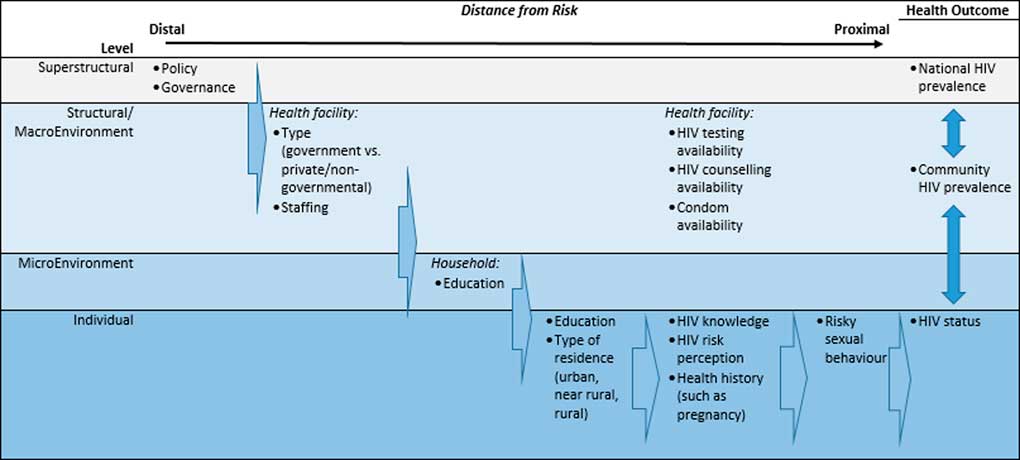
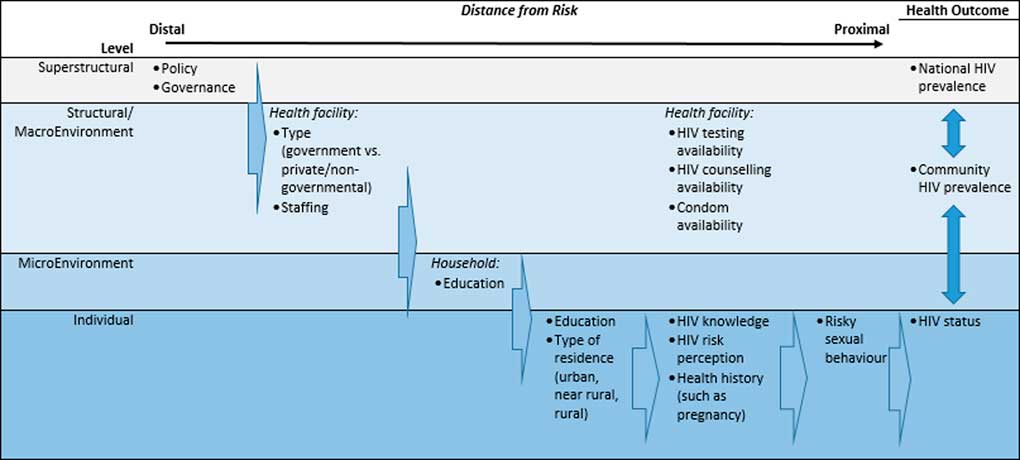
The study design and analyses were guided by a conceptual framework adapted from work by Barnett and Whiteside (Reference Barnett and Whiteside2006) and Sweat and Denison (Reference Sweat and Denison1995) (Fig. 1). In this framework, factors that influence HIV awareness and that may lead to the outcome of interest – risky sexual behavior – are represented in relation to HIV status at four different levels: superstructural, structural/macro-environmental, micro-environmental and individual. These factors occur at varying distances from risky sexual behaviour, ranging from distal to proximal. Indicators from all but the superstructural level were included in this study.
Conceptual framework of the multilevel factors contributing to knowledge and awareness around risky sexual behaviour and HIV status. Adapted from work by Barnett and Whiteside (Reference Barnett and Whiteside2006), as well as Sweat and Denison (Reference Sweat and Denison1995).
Study design and data source
Secondary analysis was carried out on cross-sectional data from the Schooling, Income, and Health Risk (SIHR) study, originally carried out among never-married women aged 13–22 in Zomba district, Malawi, by Baird et al. (Reference Baird, Garfein, McIntosh and Özler2012). A full description of the study methodology is available elsewhere (Baird et al., Reference Baird, Garfein, McIntosh and Özler2012). Briefly, a randomized controlled trial of a cash transfer intervention was carried out in 176 randomly selected enumeration areas (EAs; approximately 4–5 villages) of Zomba district among two strata of unmarried young women: those enrolled in school at baseline of the SIHR study (referred to throughout as ‘schoolgirls’) and those who were school dropouts at baseline (referred to throughout as ‘dropouts’) (Baird et al., Reference Baird, Garfein, McIntosh and Özler2012). The baseline survey (Round 1) was conducted in 2007. After programme implementation began and allocation to intervention or control group was completed, a follow-up survey (Round 2) was conducted approximately 12 months after Round 1 in 2008; during Round 2, data were also collected from the health facilities serving the EAs included in the SIHR study. The analyses presented here were limited to participants in the control group with data at Round 2, which consisted of 1407 schoolgirls and 407 dropouts in 88 EAs served by seventeen health facilities. (It should be noted that the terms ‘schoolgirls’ and ‘dropouts’ refer to the participants’ status at baseline of the SIHR study, and may not be representative of participants’ school enrolment status at Round 2. For example, participants who were dropouts at baseline may have returned to school by Round 2.)
Measures
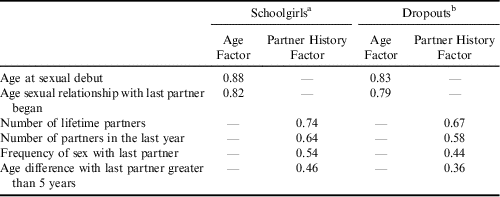
Risky sexual behaviour was operationalized using four different outcomes. The primary outcomes of interest were if the individual had ever had sex and, for those who reported sexual activity, if the individual consistently used condoms. Recognizing these outcomes might represent an over-simplified approach to risky sexual behaviour, additional experimental indices for sexually active participants were created using exploratory factor analysis. Variables loaded onto two distinct factors (see Table 1): one related to partner history (which included number of lifetime partners, number of partners in the last year, frequency of sex with last partner and an age difference with last partner of greater than 5 years), referred to as the Partner History Factor, and one related to age (woman’s age at sexual debut and age when sexual relationship with last partner began), referred to as the Age Factor. To create a standardized score for each index, a z-score (with a mean of 0 and a standard deviation of 1) for the values of each variable was computed. The score for each factor was then generated by taking the mean of these z-scores (Grice, Reference Grice2001; DiStefano et al., Reference DiStefano, Zhu and Mîndrilă2009). Since, for the original age variables, lower ages indicated higher risk, the Age Factor score was reverse-coded whereby a higher Age Factor score indicated higher risk.
Age and Partner History factor loadings, by school enrolment status of young women at baseline, SIHR study, Zomba district, Malawi
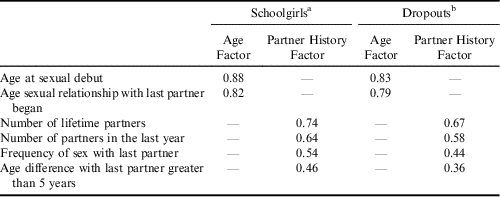
The factor loadings were estimated using Exploratory Factor Analysis (EFA) with Principal Factor Analysis and Varimax rotation. The number of Eigenvalues greater than 1 was used as the criterion for determining how many factors to retain. EFA was performed separately for the schoolgirl and dropout strata. Only participants indicating they were sexually active were included in the EFA.
a Eigenvalues: 2.05 and 1.15.
b Eigenvalues: 1.52 and 1.13.
Independent variables included participant’s highest level of education (primary school vs secondary or higher), age (measured continuously), HIV literacy, HIV risk perception (none/low vs medium/high), highest level of education in the respondent’s household of origin (primary school vs secondary or higher) and type of residence. HIV literacy was based on four ‘true or false answer’ survey questions related to AIDS transmission and treatment; a maximum score of 4 was possible. Residence was categorized as ‘urban’, ‘near-rural’ (residing within 16 km of an urban centre) or ‘far-rural’ (residing more than 16 km from the urban centre). Since, due to outreach efforts, PMTCT programming is widespread throughout Malawi and participation may increase HIV awareness, history of pregnancy was controlled for in all models, except for those examining whether participants had ever had sex. Age was excluded from analysis examining Age Factor score as an outcome. Facility-level covariates included the number of VCT counsellors employed and the type of health care facility (government vs private/non-governmental). If a participant was served by more than one health facility with differing numbers of VCT counsellors, data from the facility with the highest number of VCT counsellors were used. If a participant was served by two health facilities that employed the same number of VCT counsellors, the government facility was used.
Participants were linked to health facilities utilizing the EA they resided in at baseline of the SIHR study. With two exceptions, the cross-sectional data set utilized for analysis was composed of information from Round 2 of the SIHR study. The first exception was related to educational attainment of the household of origin. Because some participants were married between Rounds 1 and 2 of survey administration, results reported in the Round 1 survey were used for this variable, since it gave a more accurate description of the households the young women grew up in. The second exception was related to characteristics of last sexual partner. If a participant reported ever having sex in Round 2 but had not had a partner in the last 12 months (and therefore information related to the most recent sexual partner was not present in Round 2), information on the last partner reported in the Round 1 survey was used.
Statistical analysis
The sampling strategy in Baird et al. (Reference Baird, Garfein, McIntosh and Özler2012) considered baseline schoolgirls and baseline dropouts as separate strata, so that procedure was followed here. Descriptive statistics included frequency distributions or means with standard deviations (SDs) and ranges. Given the hierarchical nature of the data, multilevel regression models were used (multilevel logistic regression for binary outcomes and multilevel linear regression for continuous outcomes). Initially, an empty model was estimated (using the GLIMMIX procedure for binary outcomes and the MIXED procedure for continuous outcomes) in order to partition the variance and calculate the intra-class correlation coefficient (ICC). Next, a random intercepts model was estimated, using health facility as the level of the random effect. Where the multilevel regression models did not converge, regression with cluster-robust standard errors (using the SURVEYLOGISTIC procedure for binary outcomes and the SURVEYREG procedure for continuous outcomes) was carried out in three separate models, the first including only individual covariates, the second including only health facility covariates and the third including both individual and health facility covariates (McNeish et al., Reference McNeish, Stapleton and Silverman2017). Multilevel models converged only for analysis related to the Partner History Factor score among the schoolgirl stratum; logistic or linear regression with cluster-robust standard errors was used for all other models. In all models, weights were used to account for SIHR sampling design. The statistical program SAS 9.4 (Cary, NC, USA) was used for all analyses.
Results
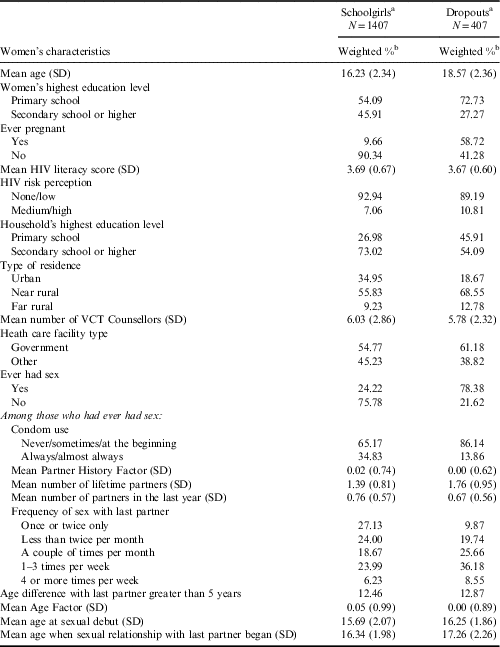
Table 2 presents the descriptive statistics of the study sample of young women by school enrolment status. When compared with schoolgirls, dropouts were older, less educated (achieving primary school as their highest level of education), more likely to have ever been pregnant, have higher levels of HIV literacy and perceived risk, come from less-educated households and reside in near-rural or far-rural areas. They were also more likely to be served by government health facilities and facilities with fewer VCT counsellors, on average. The schoolgirls were less likely to have ever had sex and more likely to use condoms; compared with dropouts, there was greater variation in Age Factor scores among schoolgirls. Participants were served by a total of seventeen health facilities.
Characteristics of young women in the control group at Round 2 of the SIHR study, Zomba district, Malawi
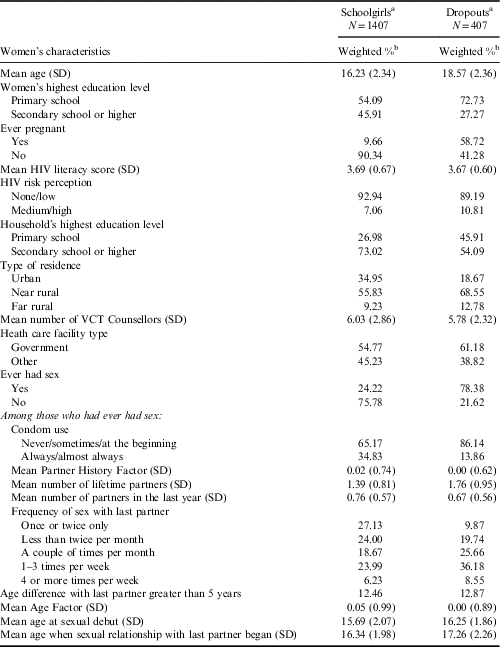
SD=Standard Deviation; VCT=Voluntary Counselling and Testing.
a Indicates school enrolment status at baseline of the SIHR study.
b Weighting was used to account for the sampling design of the SIHR study.
Schoolgirls
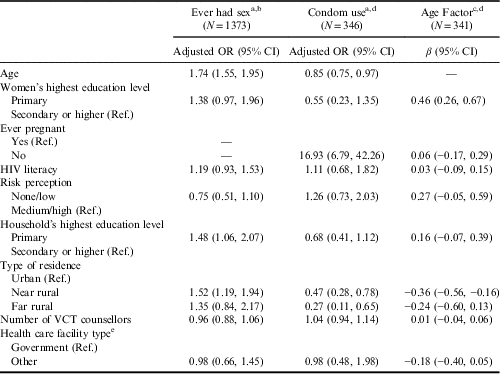
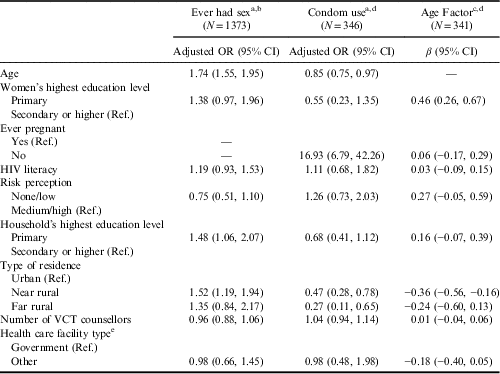
Table 3 shows the associations between individual and health facility factors and the risky sexual behaviour factors ‘ever having sex’, ‘condom use’ and ‘Age Factor score’. The final model for ever having sex included 1373 observations (observations were dropped from the final model if they had incomplete information on the variables included). With each additional year of age, schoolgirls had 74% higher odds of becoming sexually active (OR=1.74; 95% CI: 1.55, 1.95). Young women from households where the highest level of education was primary school had approximately 50% higher odds of ever having sex compared with those from households where the highest level of education was secondary school or higher (OR=1.48; 95% CI: 1.06, 2.07). Similarly, those residing in near-rural areas had a higher odds of ever having sex (OR=1.52; 95% CI: 1.19, 1.94) compared with those residing in urban areas.
Associations between multilevel factors and risky sexual behaviour outcomes among young women in the schoolgirl stratum of the SIHR study, Zomba district, Malawi
OR=Odds Ratio; CI=Confidence Interval; VCT=Voluntary Counselling and Testing.
a Model estimated using logistic regression with cluster-robust standard errors.
b Thirty-four observations were dropped from the final model due to incomplete information on the variables included.
c Model estimated using linear regression with cluster-robust standard errors.
d A total of 393 women indicated they had ever had sex. A complete case analysis was completed; observations were dropped from the models if they had incomplete information on the variables included.
e If a woman was served by more than one health facility with differing numbers of VCT counsellors, data on facility type from the facility with the highest number of VCT counsellors were used. If a participant was served by two health facilities that employed the same number of VCT counsellors, the government facility was used. A sensitivity analysis using private facilities as the tie-breaker was conducted. Only four observations were affected, and there were virtually no changes in the estimates.
The final model for condom use included 346 observations (393 respondents indicated they had ever had sex; observations were dropped from the final model if they had incomplete information on the variables included). Among schoolgirls who were sexually active, increasing age reduced the odds of condom use (OR=0.85; 95% CI: 0.75, 0.97). Those who had never been pregnant were almost seventeen times more likely to use condoms compared with those who had been pregnant (OR=16.93; 95% CI: 6.79, 42.26). Those residing in near-rural and far-rural areas were considerably less likely to use condoms consistently than those residing in urban areas, with ORs of 0.47 (95% CI: 0.28, 0.78) and 0.27 (95% CI: 0.11, 0.65), respectively.
The final model for the Age Factor score included 341 observations. Those with primary school as their highest level of education had an Age Factor score of 0.46 SDs above those achieving secondary school or higher (95% CI: 0.26, 0.67), indicating higher risk. Those residing in near-rural areas had a significantly lower Age Factor score of 0.36 SDs below those residing in urban areas (95% CI: −0.56, −0.16), indicating lower risk.
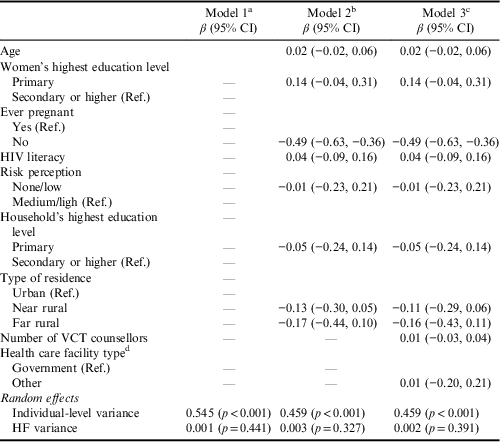
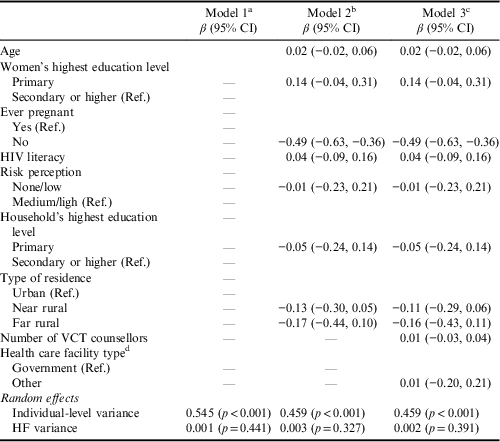
Table 4 shows estimates produced by the multilevel models for the Partner History Factor score. The final model for this score included 342 observations. Participants who had never been pregnant scored approximately half of a standard deviation below those who had been pregnant on the Partner History Factor score (β=−0.49; 95% CI: −0.63, −0.36), indicating lower risk.
Associations between multilevel factors and Partner History Factor score among young women in the schoolgirl stratum of the SIHR study, Zomba district, Malawi
CI=Confidence Interval; VCT=Voluntary Counselling and Testing.
a Empty model; ICC=0.008.
b Random intercepts model with individual covariates.
c Random intercepts model with both individual and health facility covariates. Estimates of fixed effects were generally consistent with estimates from linear regression with cluster-robust standard errors; confidence intervals varied slightly but statistical significance did not change. In the final model, N=342. A total of 393 respondents indicated they had ever had sex. A complete case analysis was completed; observations were dropped from the models if they had incomplete information on the variables included.
d If a woman was served by more than one health facility with differing numbers of VCT counsellors, data on facility type from the facility with the highest number of VCT counsellors were used. If a participant was served by two health facilities that employed the same number of VCT counsellors, the government facility was used. A sensitivity analysis using private facilities as the tie-breaker was conducted. Only four observations were affected, and there were virtually no changes in the estimates.
Dropouts
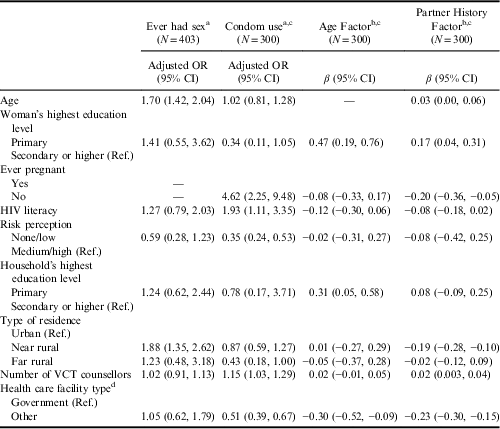
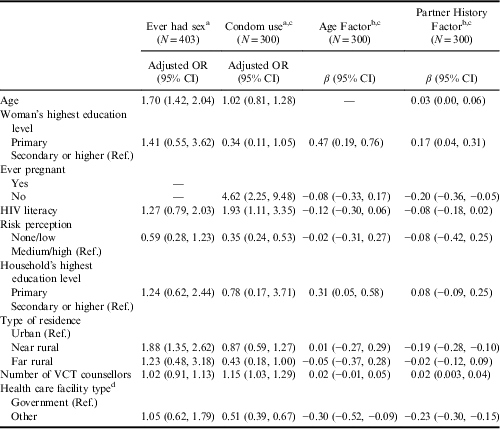
Table 5 shows the associations between individual and health facility factors and the various risky sexual behaviour outcomes. The final models examining associations between factors related to HIV awareness and ever having sex among the dropout stratum included 403 observations. Among the dropout stratum young women had 70% higher odds of becoming sexually active with each additional year of age (OR=1.70; 95% CI: 1.42−2.04). Those residing in a near-rural area had 88% higher odds of ever having sex compared with those residing in urban areas (OR=1.88; 95% CI: 1.35, 2.62).
Associations between multilevel factors and risky sexual behaviour outcomes among young women in the school dropout stratum of the SIHR study, Zomba district, Malawi
OR=Odds Ratio; CI=Confidence Interval; VCT=Voluntary Counselling and Testing.
a Model estimated using logistic regression with cluster-robust standard errors.
b Model estimated using linear regression with cluster-robust standard errors.
c A total of 319 respondents indicated they had ever had sex. A complete case analysis was completed; observations were dropped from the models if they had incomplete information on the variables included.
d If a woman was served by more than one health facility with differing numbers of VCT counsellors, data on facility type from the facility with the highest number of VCT counsellors were used. If a participant was served by two health facilities that employed the same number of VCT counsellors, the government facility was used. A sensitivity analysis using private facilities as the tie-breaker was conducted. Only four observations were affected, and there were virtually no changes in the estimates.
The final model examining the associations between factors related to HIV awareness and consistent condom use included 300 observations (319 respondents indicated they had ever had sex; observations were dropped from the final model if they had incomplete information on the variables included). Those who had never been pregnant had approximately five times the odds of condom use compared with those who had been pregnant (OR=4.62; 95% CI: 2.25, 9.48). An increasing HIV literacy score increased the odds of consistent condom use (OR=1.93; 95% CI: 1.11, 3.35) and those with low levels of HIV risk perception were less likely to use condoms compared with those with medium or high risk perceptions (OR=0.35; 95% CI: 0.24, 0.53). Dropouts were also more likely to use condoms consistently as the number of VCT counsellors in the health facility they were served by increased (OR=1.15; 95% CI: 1.03, 1.29), and had decreased odds of consistent condom use if served by private or non-governmental health facilities (OR=0.51; 95% CI: 0.39, 0.67).
The final models examining Age Factor and Partner History Factor scores included 300 observations. Those with primary school as their highest level of education had an Age Factor score of 0.47 SDs above those achieving secondary school or higher (95% CI: 0.19, 0.76), indicating higher risk. Similarly, those from households with primary school as their highest level of education had an Age Factor score of 0.31 SDs above those achieving secondary school or higher (95% CI: 0.05, 0.58). Those served by private or non-governmental health facilities had lower Age Factor scores compared with those served by government facilities (β=−0.30; 95% CI: −0.52, −0.09), indicating lower risk.
Participants with a primary school education had a Partner History Factor score of 0.17 SDs greater than those with a secondary school education or greater (95% CI: 0.04, 0.31). Those who had never been pregnant had a Partner History Factor score of 0.20 SDs below those who had been pregnant (β=−0.20; 95% CI: −0.36, −0.05), and those residing in near-rural areas had a similarly lower score compared with those residing in urban areas (β=−0.19; 95% CI: −0.28, −0.10). Dropouts had a slightly increased Partner History Factor score as the number of VCT counsellors in the health facility they were served by increased (β=0.02; 95% CI: 0.003, 0.04). Those served by private or non-governmental health facilities had a Partner History Factor score of 0.23 SDs below those served by a government facility (95% CI: −0.30, −0.15).
Discussion
This study found that both strata of young women in Zomba district, Malawi, had increased odds of ever having sex with increasing age. In addition, lower educational achievement was found to be associated with higher Age Factor scores (indicating higher risk), and a history of pregnancy was found to be associated with condom use and an increased Partner History Factor score (also indicating higher risk). However, the importance of contextual factors differed by strata. For schoolgirls, lower household education was associated with higher odds of ever having sex. Near-rural residence was associated with ever having sex, and both near- and far-rural residence were associated with lower odds of condom use compared with urban residence. For dropouts, lower household education was associated with riskier Age Factor scores, near-rural residence was associated with ever having sex and health facility characteristics were associated with condom use, Partner History Factor score and Age Factor score.
The findings related to formal educational attainment and condom use are supported by those of other studies conducted in sub-Saharan Africa, highlighted by a recent review by Zuilkowski and Jukes (Reference Zuilkowski and Jukes2012), although there is no clear consensus on the association between education and other measures of risky sexual behaviour (such as sexual debut). The findings on riskier sexual behaviour (lower odds of condom use and higher Partner History Factor scores) among participants who had ever been pregnant partially aligned with the findings of Mugo et al. (Reference Mugo, Heffron, Donnell, Wald, Were and Rees2011), who found riskier sexual behaviour among pregnant women. These findings warrant further exploration and may present an opportunity for intervention. While extensive PMTCT efforts have been undertaken in Malawi (van Lettow et al., Reference van Lettow, Bedell, Landes, Gawa, Gatto and Mayuni2011; Cataldo et al., Reference Cataldo, Chiwaula, Nkhata, van Lettow, Kasende and Rosenberg2017), it is possible that women receiving educational benefits from these efforts are largely HIV positive already and are therefore specifically targeted by PMTCT programmes. It is critical that high-quality educational programmes related to risky sexual behaviour and condom use be provided to all pregnant women, not just those who have tested positive for HIV.
Among the dropout stratum, there were seemingly conflicting results related to type of health facility. While those served by private/non-governmental health facilities were less likely to use condoms consistently, they had better outcomes on the risky sexual behaviour indices: slightly lower scores on the Age and Partner History Factors. This may be due to differences in services and risk communication strategies utilized by types of facilities. For example, faith-based facilities may focus more on the ‘abstinence’ and ‘be faithful’ elements of the ABC (abstinence, be faithful, use condoms) HIV prevention strategy, while government facilities may focus more on promoting condom use (Okware et al., Reference Okware, Kinsman, Onyango, Opio and Kaggwa2005; Santelli et al., Reference Santelli, Speizer and Edelstein2013). While better scores on the risky sexual behaviour indices are desirable, they are unlikely to outweigh the close to 50% lower odds of using condoms among those served by private/non-governmental facilities, since condom use represents direct prevention of HIV transmission. On the other hand, different types of communities may give rise to different types of facilities; the differences observed may simply be due to community differences rather than facility types. Further research is needed to fully explore these nuanced findings.
Findings related to area of residence were also mixed. While near-rural residence was associated with higher odds of ever having sex and lower odds of condom use, within the schoolgirl stratum it was associated with a lower Age Factor score and within the dropout stratum it was associated with lower Partner History Factor scores, indicating lower risk when compared with the reference group of urban residents. The literature on the association between area of residence and risky sexual behaviour is mixed (Voeten et al., Reference Voeten, Egesah and Habbema2004; Dodoo et al., Reference Dodoo, Zulu and Ezeh2007). The data presented here suggest that area of residence may impact different aspects of risky sexual behaviour; however, exploring the underlying reasons for these differences is beyond the scope of this paper. Future research should seek to understand these associations more extensively.
To the authors’ knowledge, this is the only study to date to have examined the multilevel influence of health facility characteristics on risky sexual behaviour in sub-Saharan Africa. Given their potential reach, health facilities provide a unique platform for behavioural interventions. The finding that health facility characteristics were only associated with risky sexual behaviour among the dropout stratum is particularly interesting; health facilities may fill a void when formal education is limited. Associations between services offered and behavioural outcomes warrant exploration. Additionally, while other studies have utilized multilevel analysis to examine risky sexual behaviour in Malawi (Uthman et al., Reference Uthman, Moradi and Lawoko2009; Robertson et al., Reference Robertson, Gregson and Garnett2010; Stephenson, Reference Stephenson2010; Uthman et al., Reference Uthman, Lawoko and Moradi2010; Andersson et al., Reference Andersson, Paredes-Solís, Milne, Omer, Marokoane, Laetsang and Cockcroft2012; Hung et al., Reference Hung, Scott, Ricciotti, Johnson and Tsai2012; Uchudi et al., Reference Uchudi, Magadi and Mostazir2012; Kamndaya et al., Reference Kamndaya, Kazembe, Vearey, Kabiru and Thomas2015; Magadi & Uchudi, Reference Magadi and Uchudi2015), this is the first multilevel study, to the authors’ knowledge, to have utilized indices for assessing risky sexual behaviour. There are many aspects of risky sexual behaviour that defy measurement by only examining the presence of any sexual activity or the use of condoms. The use of indices represents an attempt to move away from oversimplified constructs of risky sexual behaviour.
There are several limitations to this study. First, the risky sexual behaviour indices presented here were experimental and require further validation using data from other studies, collected in settings both similar to, and different from, this study sample. Future studies might use data from sources such as Demographic and Health Surveys to do so. Additionally, it should be noted that pregnancy may be an outcome of risky sexual behaviour, not vice versa. However, given the potential for participation in PMTCT programming to influence HIV awareness, the authors opted to include it in the conceptual framework. As indicated by the 95% CIs, estimates related to the association between pregnancy history and condom use had poor precision; this was probably due to limited power, particularly among schoolgirls, because a relatively small proportion of them had ever been pregnant (Table 1). Furthermore, there were a relatively low number of health facilities available for analysis (seventeen); low variation of the outcomes across this limited number of facilities may have contributed to the multilevel models not converging. Finally, scores on the risky sexual behaviour indices were only estimated for respondents who had complete information on all components and final models included participants who had complete information on all variables; this may have introduced some bias into the results and limited the precision of estimates.
In conclusion, while age, educational status and pregnancy history were found to be associated with measures of risky sexual behaviour among both the schoolgirl and dropout strata, the types of contextual factors influencing risky sexual behaviour varied between the two groups. Dropouts had decreased odds of consistent condom use but less risky Age and Partner History Factor scores if served by private or non-governmental health facilities. Future research is needed to fully elucidate reasons for increased risky sexual behaviour among women who have been pregnant and to explore differences in services provided by government and private/non-governmental health facilities.
Ethical Approval. This study was reviewed and approved by the Florida International University Institutional Review Board. The authors assert that all procedures contributing to this work comply with the ethical standards of the relevant national and institutional committees on human experimentation and with the Helsinki Declaration of 1975, as revised in 2008.
Conflicts of Interest. The authors have no conflicts of interest to declare.
Funding. This research received no specific grant from any funding agency, commercial entity or not-for-profit organization.