Kawasaki disease is predominantly a disease of children younger than 5 years of age and characterised by acute fever and systemic vasculitis that usually presents as persistent fever, bilateral conjunctival congestion, acute non-purulent cervical lymphadenopathy, polymorphous exanthema, and/or changes in the lips, oral cavity, and peripheral extremities. Kawasaki disease may also involve the cardiovascular, digestive, and renal systems with associated complications. 1 Some patients may experience decreased blood pressure or even shock during the acute phase of the disease and may require treatment in the ICU.Reference Dominguez, Friedman, Seewald, Anderson, Willis and Glodé 2 Kawasaki disease with haemodynamic instability, characterised by either systolic blood pressure ⩾20% below normal or low perfusion, has been defined as Kawasaki disease shock syndrome.Reference Kanegaye, Wilder and Molkara 3 The reported incidence of Kawasaki disease shock syndrome among patients with Kawasaki disease ranges from 1.9 to 7.0%.Reference Kanegaye, Wilder and Molkara 3 – Reference Lin, Fu, Huang, Huang and Wu 6 The pathogenesis underlying the haemodynamic changes in patients with Kawasaki disease shock syndrome remains unclear. Therefore, in the present study of patients with Kawasaki disease, we compared the clinical features and risk factors between patients with and without Kawasaki disease shock syndrome treated in our hospital.
Methods
Patients
The records of all patients admitted to our hospital for Kawasaki disease shock syndrome from January 2009 to June 2016 were reviewed. All patients met the diagnostic criteria for Kawasaki disease shock syndromeReference Kanegaye, Wilder and Molkara 3 and required initiation of volume expansion, infusion of vasoactive agents, or transfer to an intensive care setting. The diagnostic criteria were sustained systolic hypotension of <60 mmHg for infants aged 0–28 days, <70 mmHg for infants aged 1–12 months, <70+[2×age] mmHg for children aged 1–10 years, and ⩽90 mmHg for children aged >10 years; a ⩾20% decrease in systolic blood pressure from baseline; clinical signs of poor perfusion such as tachycardia, prolonged capillary filling time, cool extremities, diminished pulse, and oliguria; or mental status changes not accounted for by other conditions such as fever or ambient temperature. For each patient with Kawasaki disease shock syndrome, we identified four season-matched control patients from date of admission ±2 weeks, diagnosed with Kawasaki disease with normal blood pressure and admitted as close in time as possible to the patients with Kawasaki disease shock syndrome. Kawasaki disease was diagnosed according to the American Heart Association criteria.Reference Newburger, Takahashi and Gerber 7 Patients who met the fever criterion and at least four of the five principal criteria were classified as having complete Kawasaki disease, and patients who met fewer than four principal clinical criteria, excluding illnesses with clinical features similar to those of Kawasaki disease, were classified as having incomplete Kawasaki disease.Reference Shin and Lee 7 Among patients without Kawasaki disease shock syndrome, 54 and 14 had complete and incomplete Kawasaki disease, respectively; among patients with Kawasaki disease shock syndrome, 15 and two patients had complete and incomplete Kawasaki disease, respectively.
Data collection
The following patient data were collected: demographic characteristics like age and sex, clinical manifestations, blood pressure calculated as average of three measurements of femoral blood pressure in the right arm as well as invasive measurement of blood pressure in the femoral or radial artery during some critical conditions, treatment-related data including the incidence of intravenous immunoglobulin resistance and use of vasoactive drugs, and the incidence of coronary artery lesions. Left ventricular ejection fraction readings were collected for all patients with Kawasaki disease shock syndrome. All patients with Kawasaki disease shock syndrome underwent echocardiography during the acute and recovery period. Among the 17 patients with Kawasaki disease shock syndrome, 14 patients underwent echocardiography before shock onset, two patients underwent echocardiography 1 day after shock onset, and one patient underwent echocardiography 2 days after shock onset.
The following laboratory data were measured before intravenous immunoglobulin treatment: the white blood cell count, neutrophil count, percentage of neutrophils, platelet count, and concentrations of alanine aminotransferase, aspartate transaminase, haemoglobin, C-reactive protein, albumin, sodium, potassium, fibrinogen, d-dimers, N-terminal prohormone of brain natriuretic peptide, and cardiac troponin I.
Statistical methods
Normally distributed quantitative data are reported as mean±SD and were compared by t-tests. Non-normally distributed quantitative data are reported as median and interquartile range and were compared by rank-sum tests. Categorical data are reported as number and percentage and were compared by χ2 tests. Correlations between the factors of interest and Kawasaki disease shock syndrome were analysed by logistic regression. Stratification analysis was used to further evaluate the correlation between the left ventricular ejection fraction and Kawasaki disease shock syndrome under different clinical conditions. Factors showing significant differences between groups were used for stratification, with cut-off values calculated from the Youden index according to the receiver operating characteristic curves. All statistical analyses were performed using SPSS 19.0 software, and p<0.05 was considered statistically significant.
Results
Basic characteristics of patients
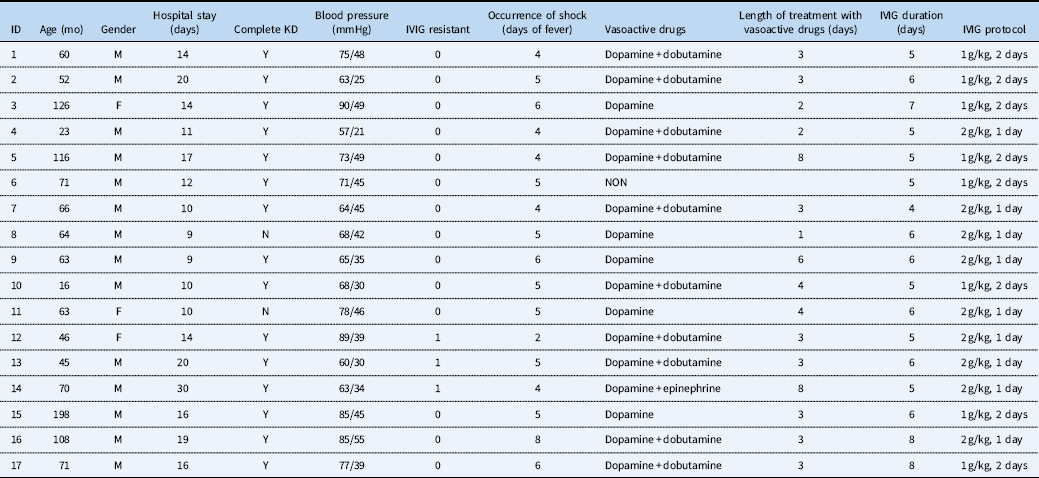
In total, 1147 patients diagnosed with Kawasaki disease were admitted to our hospital from January 2009 to June 2016. Of these patients, 17 (1.2%) met the diagnostic criteria for Kawasaki disease shock syndrome, and 68 patients with Kawasaki disease were identified as the control group. Patients with Kawasaki disease shock syndrome developed shock around 5 days after disease onset in the range of 4–5.5 days. Only one patient experienced remission after fluid resuscitation; the other 16 (94%) patients with Kawasaki disease shock syndrome were treated with vasoactive drugs like dopamine, dobutamine, and/or epinephrine in the range of 3–4 days for a median of 3 days. All patients with Kawasaki disease shock syndrome received aspirin at 30–50 mg/kg and high-dose intravenous immunoglobulin treatment starting at a mean of 6 days after disease onset, with a range from 5 to 6 days, either on the same day or 1 day after the development of shock. Only one patient developed shock after intravenous immunoglobulin treatment. Patients who were resistant to intravenous immunoglobulin treatment received a second infusion of intravenous immunoglobulin at a dose of 2 g/kg. No patients received steroid treatment. The characteristics of the patients with Kawasaki disease shock syndrome are shown in Table 1.
Clinical features of the 17 patients diagnosed with Kawasaki shock syndrome.

F=female; IVIG=intravenous immunoglobulin; KD=Kawasaki disease; M=male; N=No; Y=Yes
One patient was IVIG resistant
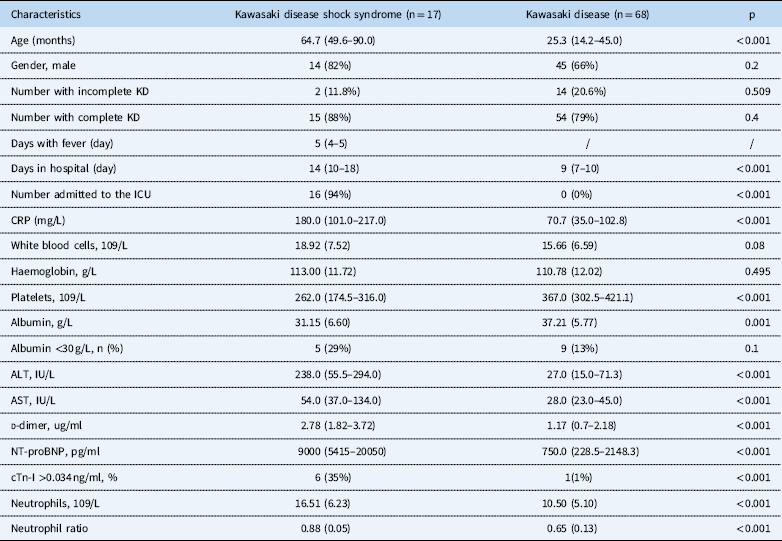
Patients with Kawasaki disease shock syndrome were older than those without Kawasaki disease shock syndrome of 64.7 versus 25.3 months, respectively (p<0.001) and had a longer hospitalisation period of 14 versus 9 days, respectively (p<0.001). Patients with Kawasaki disease shock syndrome were also more likely to be resistant to intravenous immunoglobulin (18 versus 3%, p=0.021). No significant difference was observed in the proportion of incomplete Kawasaki disease between patients with and without Kawasaki disease shock syndrome (11.8 versus 20.6%, respectively; p=0.509). There was also no significant difference in sex between the groups (Table 2).
Characteristics of patients in the Kawasaki disease shock syndrome group and Kawasaki disease control group.

ALT=alanine aminotransferase; AST=aspartate transaminase; CRP=C-reactive protein; cTn-I=cardiac troponin I; ICU=intensive care unit; KD=Kawasaki disease; NT-proBNP=N-terminal prohormone of brain natriuretic peptide
Normally distributed quantitative data are reported as mean (SD) and were compared by t-tests. Non-normally distributed quantitative data are reported as median (interquartile range) and were compared by rank-sum tests
Laboratory characteristics
The platelet count and serum concentrations of albumin, sodium, and potassium were lower in the Kawasaki disease shock syndrome than non-Kawasaki disease shock syndrome group. In contrast, the neutrophil count, neutrophil ratio, and concentrations of alanine aminotransferase, aspartate transaminase, d-dimers, fibrinogen, C-reactive protein, cardiac troponin I, and N-terminal prohormone of brain natriuretic peptide were higher in the Kawasaki disease shock syndrome group. The percentage of patients with an albumin concentration <30 g/L was higher in the Kawasaki disease shock syndrome than control group (29 versus 13%, respectively), although the difference was not statistically significant (Table 2).
Echocardiography
Echocardiography results
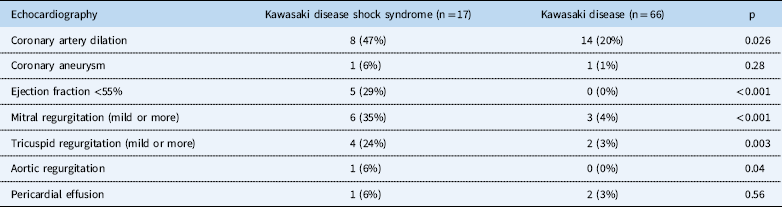
The results showed five patients had a left ventricular ejection fraction of <55%, and four of them had undergone echocardiography before shock onset; one patient underwent echocardiography on the day of shock onset. The left ventricular ejection fraction data were not available for two children in the non-Kawasaki disease shock syndrome group. Echocardiography showed that the incidence of coronary artery lesions was higher in the Kawasaki disease shock syndrome than control group (47 versus 20%, respectively; p=0.026), but the proportion of coronary aneurysms was similar in both groups (6 versus 1%, p=0.28). Significantly more patients with Kawasaki disease shock syndrome than without had a left ventricular ejection fraction of <55% (29 versus 0%, respectively; p<0.05). Patients in the Kawasaki disease shock syndrome group were also more likely to have mild or higher valve regurgitation, including mitral, tricuspid, and aortic valve regurgitation, but the difference between the groups was not significant (Table 3). All patients’ left ventricular ejection fraction returned to normal within 1 week after shock onset.
Echocardiography results of patients in the Kawasaki disease shock syndrome group and Kawasaki disease control group.

Correlation between left ventricular ejection fraction and Kawasaki disease shock syndrome
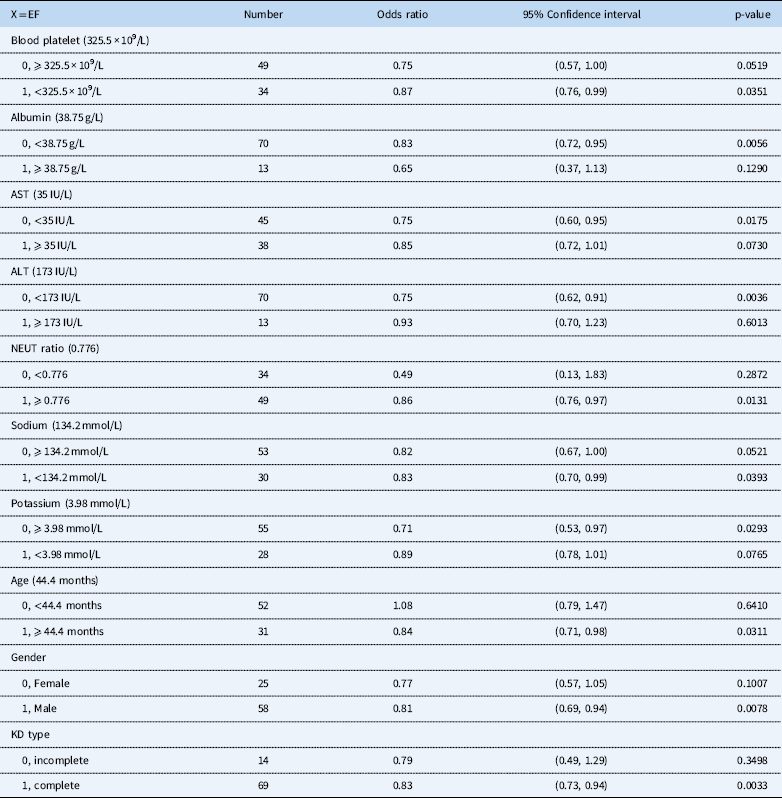
We tested the correlation between the left ventricular ejection fraction and Kawasaki disease shock syndrome by logistic regression analysis and found that the incidence of Kawasaki disease shock syndrome decreased as the left ventricular ejection fraction increased (odds ratio=0.82, 95% confidence interval=0.73–0.93, p=0.0019), suggesting that a decreased left ventricular ejection fraction was associated with the development of Kawasaki disease shock syndrome. A decreased left ventricular ejection fraction still played an important role in Kawasaki disease shock syndrome after controlling for sex, age, and the cardiac troponin I concentration with odds ratio=0.848, 95% confidence interval=0.706–1.018 (p>0.05), but the effect was not significant (Table 4). Stratification analysis indicated that the odds ratio of the left ventricular ejection fraction was <1 for all patients except those aged <44.4 months, suggesting that an increased left ventricular ejection fraction may reduce the possibility of developing Kawasaki disease shock syndrome under different clinical conditions of Kawasaki disease (Table 5).
Logistic regression analysis of the correlation between the left ventricular ejection fraction and Kawasaki disease shock syndrome.

EF, ejection fraction
Results are reported as odds ratio (95% confidence interval) with p value
Model I: not adjusted for any factors
Model II: adjusted for age group and sex
Model III: adjusted for age group, sex, and cardiac troponin I concentration
Stratification analysis of the correlation between the left ventricular ejection fraction and Kawasaki disease shock syndrome.

ALT=alanine transaminase; AST=aspartate transaminase; EF=ejection fraction; KD=Kawasaki disease; NEUT=neutrophil
Discussion
Kawasaki disease is a type of non-specific systemic vasculitis occurring mainly in children. Coronary artery lesions represent serious complications of Kawasaki disease and are the most common cause of acquired heart disease in children.Reference Newburger, Takahashi and Gerber 7
Kawasaki disease shock syndrome has been defined as Kawasaki disease accompanied by either a systolic blood pressure ⩾20% lower than normal or low perfusion. Kawasaki disease shock syndrome is relatively rare, with a worldwide incidence of 1.9–7.0% among patients with Kawasaki disease,Reference Kanegaye, Wilder and Molkara 3 – Reference Lin, Fu, Huang, Huang and Wu 6 although the incidence of Kawasaki disease shock syndrome in the current study was slightly lower at 1.2%. Among children with Kawasaki disease, those with Kawasaki disease shock syndrome are reportedly older than those without Kawasaki disease shock syndrome and have a higher proportion of neutrophils, higher C-reactive protein level, lower platelet count, lower haemoglobin concentration, higher incidence of coronary artery lesions, and higher incidence of resistance to intravenous immunoglobulin.Reference Kanegaye, Wilder and Molkara 3 – Reference Lin, Fu, Huang, Huang and Wu 6
The cause of the decreased blood pressure in patients with Kawasaki disease remains unclear, but it may be associated with various factors including capillary leakage or abnormal inflammatory cytokines. Persistent protein leakage can cause plasma extravasation and a reduced albumin concentration, leading to decreased intravascular volume, vascular collapse, and a reduction in blood pressure, 1 , Reference Shin and Lee 8 , Reference Gatterre, Oualha and Dupic 9 which may further promote the occurrence and development of shock. Among patients with Kawasaki disease, the lower serum albumin, sodium, and potassium concentrations observed in patients with than without Kawasaki disease shock syndrome may be related to protein leakage caused by vascular inflammation and water retention in the acute phase. Mild hyponatremia has been suggested to be an important predictor of acute illnesses.Reference Poddighe 10 In addition, Schuster et alReference Schuster, Palac, Innocentini, Rowley, Young and Shulman 11 showed that the presence of hyponatremia is associated with the presence of shock. However, the association between moderate/severe hyponatremia and Kawasaki disease shock syndrome remains unclear; further studies are necessary to assess whether the presence of moderate/severe hyponatremia may be used to predict Kawasaki disease shock syndrome.
In the present study, we also found that patients with Kawasaki disease shock syndrome were older than those in the control group (64.7 versus 25.3 months, respectively; p<0.001). This finding may be due to the higher proportion of patients with classic Kawasaki disease among those with Kawasaki disease shock syndrome. One might speculate that older children could develop a stronger systemic inflammatory response leading to both typical symptoms of Kawasaki disease and severe vasculitis and myocyte dysfunction, which contribute to the development of Kawasaki disease shock syndrome. A previous study showed that children with incomplete Kawasaki disease were more likely to develop Kawasaki disease shock syndrome.Reference Gámez-González, Murata and Muñoz-Ramírez 12 In the present study, however, the number of patients with incomplete Kawasaki disease among those with and without Kawasaki disease shock syndrome was two (11.8%) and 14 (20.6%), respectively, and there was no significant difference in the proportion of patients with incomplete Kawasaki disease between the two groups. The above-mentioned study was a retrospective study; therefore, patients with shock syndrome may present initially with atypical features but finally develop complete Kawasaki disease, and these patients were identified as having complete Kawasaki disease in the present study. Therefore, the proportion of patients with incomplete Kawasaki disease among those with Kawasaki disease shock syndrome was lower than previously reported.
More severe inflammation and abnormal immune responses may also contribute to the occurrence and development of shock in patients with Kawasaki disease shock syndrome.Reference Dominguez, Friedman, Seewald, Anderson, Willis and Glodé 2 , Reference Kanegaye, Wilder and Molkara 3 , Reference Gatterre, Oualha and Dupic 9 , Reference Druey and Greipp 13 The current results showed that the C-reactive protein level, neutrophil count, and neutrophil ratio were all significantly higher in the Kawasaki disease shock syndrome than control group, suggesting the presence of more severe inflammation in patients with Kawasaki disease shock syndrome. Intravenous immunoglobulin has a generalised anti-inflammatory effect with reductions in fever and acute markers of inflammation, which can modulate cytokine levels and production and downregulate antibody synthesis. In the present study, however, one patient experienced shock after intravenous immunoglobulin treatment. The reasons for this are unclear and merit additional investigation.
Only one of the 17 patients with Kawasaki disease shock syndrome was cured of shock by increasing their blood volume, while the remaining 16 patients required vasoactive drugs. These results indicate that the shock was not caused by inadequate blood volume alone. In addition, the incidence of a decreased left ventricular ejection fraction was significantly higher in the Kawasaki disease shock syndrome than control group. Gatterre et alReference Gatterre, Oualha and Dupic 9 also reported cardiac systolic dysfunction in some patients with Kawasaki disease shock syndrome. We analysed the correlation between the left ventricular ejection fraction and Kawasaki disease shock syndrome using logistic regression and stratification analyses, both of which supported an association between a decreased left ventricular ejection fraction and Kawasaki disease shock syndrome under different conditions of Kawasaki disease. Among the 17 patients with Kawasaki disease shock syndrome, 14 patients underwent echocardiography before shock onset, and it is suggested that decreased left ventricular ejection fraction may contribute to the development of Kawasaki disease shock syndrome, but further studies are needed to confirm these findings. The percentage of patients with a cardiac troponin I concentration of >50 mg/L in the current study was significantly higher in the Kawasaki disease shock syndrome than control group, and few patients with Kawasaki disease had an elevated cardiac troponin I concentration,Reference Li, Jiang, Zheng, Sun and Fu 14 , Reference Checchia, Borensztajn and Shulman 15 suggesting that Kawasaki disease shock syndrome is associated with myocardial injury. Overexpression of proinflammatory cytokines and myocardial injury may lead to myocardial contractile dysfunction, resulting in decreased blood pressure.
Cardiac ultrasound showed that diastolic regurgitation of the descending aorta during the acute phase may play an important role in the occurrence and progression of shock.Reference Flynn, Kowalski and Burgner 16 Similarly, we found that compared with the control group, patients in the Kawasaki disease shock syndrome group had significantly higher mitral, tricuspid, and aortic valve regurgitation. However, no patient developed severe regurgitation, suggesting that further studies are needed to determine the types of severe regurgitation that can contribute to the development of shock.
In the absence of complete Kawasaki disease, it is difficult to make a definitive diagnosis of Kawasaki disease shock syndrome in patients who develop shock, and there is currently no predictive scoring system for Kawasaki disease shock syndrome. Among the 17 patients with Kawasaki disease shock syndrome in our study, 13 (76%) met one of the following criteria: N-terminal prohormone of brain natriuretic peptide concentration of >6300 pg/ml (we selected a cut-off point on the receiver operating characteristic curve that had high specificity and good sensitivity), cardiac troponin I concentration of >0.034 ng/ml, or left ventricular ejection fraction of <55%. In contrast, only five of 68 patients (7%) in the control group met one of these criteria, and seven (41%) patients with Kawasaki disease shock syndrome met two of the criteria compared with none in the control group, and four patients with Kawasaki disease shock syndrome met all three criteria. Cardiac injury markers are more specific than indicators of inflammation. Patients with Kawasaki disease who present with clinical signs of poor perfusion, such as tachycardia, prolonged capillary filling time, cool extremities, diminished pulse, and oliguria, should thus undergo close monitoring of their blood pressure with close attention to echocardiography and laboratory examination results.
We conclude that the higher degree of inflammation in patients with Kawasaki disease can lead to cardiac dysfunction and severe vasculitis, which may contribute to the development of Kawasaki disease shock syndrome. The presence of a decreased left ventricular ejection fraction may help in the early identification of Kawasaki disease shock syndrome, and significant abnormalities in the above-mentioned perfusion signs during the course of Kawasaki disease should alert clinicians to the possibility of Kawasaki disease shock syndrome. Further multi-centre studies with larger numbers of patients are needed to clarify the characteristics of patients with Kawasaki disease shock syndrome.
Acknowledgements
None.
Financial Support
The project supported by National Natural Science Foundation for young scientists (81502893), Zhejiang Provincial Natural Science Foundation for youth of China (LQ15H020006, LQ16H020008) and Projects of Medical and Health Technology Program in Zhejiang province (2014KYA139).
Conflicts of Interest
None.
Ethical Standards
This study was approved by the Ethical Board of Wenzhou Medical University, Zhejiang, China. Informed consent was signed by the parents of all patients.