

Introduction
In October 2005, as riots swept across the banlieues of Paris and other French cities, President Jacques Chirac turned to his highest-ranking military adviser with a provocative question: could the army be sent in to restore order? General Henri Bentégeat, then chief of the defence staff, did not hesitate. ‘If you decide to deploy the armed forces to control the rioters, I will resign’, he warned.Footnote 1 Chirac backed down, and the French army remained in its barracks. A few years earlier in Italy, however, the response to a similar question had been very different. When the prime minister asked the army chief of staff whether deploying troops in Sardinia to support the police against a wave of kidnappings was feasible, the general replied simply: ‘It is possible and feasible.’Footnote 2 Within weeks, soldiers were patrolling the countryside alongside the Carabinieri. Yet if we shift the time frame, the contrast appears inverted. Between 1995 and 1998, the French army itself expressed strong support for an expanded internal role, and the government decided to proceed with large-scale deployments against terrorism, sending hundreds of soldiers into the streets.Footnote 3 By contrast, in 2022, at the height of the war in Ukraine, senior Italian military officers staunchly opposed increasing troop numbers for the domestic operation Strade Sicure. The government disregarded their objections and raised the deployment from 5,000 to 7,000 soldiers.Footnote 4
As these episodes show, the reaction of the highest-ranking officers directly involved in political–military interaction – hereafter referred to as senior military leaders (SMLs) – to political demands for domestic security operations is highly variable, differing both across services and countries and over time within the same service. At times, SMLs resist, framing policing tasks as incompatible with professional soldiering; at other times, they promote them as fully consistent with military identity and capabilities. Explaining how SMLs react to demands for domestic policing is relevant for two main reasons. First, it sheds light more generally on how armed forces respond to political demands for different types of missions – a central issue in civil–military relations, as such reactions can significantly shape both political decisions and the modalities through which missions are carried out.Footnote 5 Second, domestic policing is itself a particularly important empirical domain: despite being widespread across countries, it remains highly controversial.Footnote 6 Unlike other types of military missions, their use has frequently generated tensions between political authorities and the armed forces and, in some cases, negative consequences for citizens and democratic governance.Footnote 7
Reflecting its importance, the issue figures prominently in the civil–military scholarly literature. Studies based on a constructivist perspective argue that SMLs’ reactions to such demands depend on military role conceptions, defined as the ‘shared view, held within one service or across the armed forces, regarding the proper purpose of the military organisation and of military power in international relations’.Footnote 8 However, these accounts also acknowledge that role conceptions tend to evolve slowly over time and therefore struggle to explain the frequent and rapid empirical oscillations observed in SMLs’ attitudes.Footnote 9 Other works adopt a more rationalist perspective, arguing that variation in SMLs’ responses is driven by corporate or organisational considerations: military leaders support domestic deployments when these help increase the organisation’s resources – in terms of funding, visibility, and political influence – and resist them when they do not.Footnote 10 Yet these approaches largely neglect the role of professional identities and role conceptions, and the consequences that missions perceived as inappropriate by a large share of the organisation may have on the armed forces themselves. As a result, existing scholarship lacks a theory capable of jointly accounting for both organisational and ideational factors in shaping SMLs’ responses to domestic policing tasks.
To fill this gap, this article proposes a theoretical framework that integrates pragmatic organisational considerations with ideational factors to explain SMLs’ reactions to political demands. The framework conceptualises the armed forces as organisations engaged in a continual search for organisational equilibrium, that is, a balance between the inducements they offer to those who control the resources they need to survive – government and uniformed personnel – and the contributions they obtain in return – money and labour.Footnote 11 In this view, SMLs’ attitudes towards domestic policing missions are interpreted as strategic instruments for maintaining that equilibrium: they are used to shape both the flow of resources from government and the supply of labour from service members. Accordingly, attitudes towards policing reflect not only the pursuit of external resources but also the need to satisfy and retain uniformed personnel. Pragmatic considerations primarily affect access to external resources, whereas role conceptions and professional identities shape internal ones, namely personnel satisfaction. It is the combination of these costs that determines the response to political demands. These responses are articulated in the mission-definition process and shift when a mission no longer sustains organisational equilibrium: resistance emerges when professional misfit and personnel costs outweigh resource gains and support when the calculus is reversed.
The article provides a first empirical assessment of the proposed framework through a longitudinal analysis of the Italian army SMLs’ approach to a major domestic policing operation, Strade Sicure (‘Safe Streets’, hereafter OSS), between 2008 and 2024. The Italian case provides a particularly suitable setting for this analysis, as it offers a long temporal horizon that allows for the systematic study of variation in SMLs’ attitudes over time. During this period, the operation was repeatedly renewed and adjusted amid changing economic, security, and organisational contexts, resulting in multiple instances of political demands directed at the armed forces. Moreover, the content and scope of these demands varied significantly, ranging from limited support roles to more sustained and visible deployments.Footnote 12 This combination of temporal depth, repeated interactions, and variation in both context and mission characteristics makes the case especially well suited to examining how and why SMLs’ reactions evolve.
The analysis is primarily based on a qualitative discourse analysis of SMLs’ statements across seven distinct communication channels, including parliamentary hearings, military journals, official documents, and media interviews. This is complemented by fifteen semi-structured interviews with retired senior military leaders, conducted to corroborate and refine the findings emerging from the discourse analysis.
Literature review
The armed forces’ approach to policing is a well-studied issue in the civil–military relations literature. Cold War–era literature tended to treat the military’s attitude towards policing in rather simplified terms, positing that professionalism predisposes soldiers to view domestic policing negatively. Seminal studies in civil–military relations implicitly or explicitly cast policing as low-prestige and misaligned with soldiers’ skills when compared to warfighting, and therefore as something professional soldiers inherently resist.Footnote 13 From this professional perspective, deviation from combat-related functions is considered inherently undesirable, and organisational cultures are expected to resist such assignments.Footnote 14
Other strands of scholarship challenge this view. Drawing on constructivist explanations, they argue that soldiers’ attitudes towards non-military roles are not fixed. Rather, it depends on their professional socialisation.Footnote 15 Numerous studies, for example, show that in Latin America, armed forces often consider themselves competent in such tasks because military academies, shaped in part by US security assistance programmes, teach and normalise internal security and policing roles as legitimate components of the profession.Footnote 16 Other authors adopt the same constructivist approach but deploy different concepts, most prominently ‘role conception’, namely, the organisation’s internal view of what constitutes an appropriate mission set.Footnote 17 Accordingly, when role conceptions expand to include internal security as a legitimate mission, resistance diminishes, and advocacy becomes more likely; when they remain narrowly combat-centric, policing tasks are framed as peripheral, low-prestige, and best avoided.
However, role conception–based explanations face two main limitations. First, the same authors acknowledge that role conceptions evolve only gradually over time. As ‘shared views’ about the proper purpose of the military, they are relatively deep and stable, making it difficult to explain the frequent and rapid empirical oscillations observed in the introduction. Second, armed forces do not always act in line with what they consider their ‘proper’ role. They may support or accept misaligned missions for pragmatic reasons, for instance, to secure resources, with the expectation that such tasks are temporary. While constructivist scholars recognise that ‘the military might enter into bargaining processes in which they make demands in exchange for carrying out undesired tasks’,Footnote 18 they do not specify when such bargaining prevails over role conceptions.
An alternative, more rationalist perspective, by contrast, explains SMLs’ attitudes in terms of organisational interests and resource considerations. These accounts recognise that, for pragmatic reasons, SMLs may come to support such missions.Footnote 19 Three explanations are advanced here. One strand, rooted in research on democratic transitions, sees internal-security roles as prerogatives that enable the military to retain political influence.Footnote 20 A second bureaucratic strand links attitudes to resource considerations: domestic missions can shield budgets and end strength.Footnote 21 A third strand emphasises symbolic resources and legitimation. From this perspective, domestic missions are not only instruments for securing budgets; they are also stages on which the armed forces perform public authority, cultivate societal trust, and renew their social contract with citizens.Footnote 22
However, this second line of scholarship also presents two important limitations. First, it largely brackets ideational variables, such as role conceptions, and focuses instead on resource dynamics. In doing so, it overlooks the organisational consequences of assigning missions that are not supported within the force. Second, these approaches treat the military as a unitary actor primarily concerned with external resources, while paying limited attention to service members’ preferences and reactions. Yet assigning tasks widely perceived as inappropriate can generate high internal costs, undermining morale, cohesion, and personnel willingness to contribute, whereas professionally valued missions tend to have the opposite effect.Footnote 23 Since service members constitute a core organisational resource, neglecting the factors that shape their behaviour leads to an incomplete account of military preferences. While related approaches, such as bureaucratic politics accounts, emphasise internal fragmentation and competing interests within organisations, they do not specify how these dynamics translate into systematic variation in military attitudes over time, nor how they interact with internal organisational constraints.Footnote 24
Taken together, these limitations suggest the need for a framework that integrates ideational and rationalist explanations. Existing scholarship either treats these factors as competing explanations or leaves their interaction underspecified. The next section develops a framework that explains how conceptions of the military’s proper role and resource considerations jointly shape SMLs’ responses to political demands for domestic policing. The framework does not seek to replace existing ideational or rationalist accounts. Rather, it specifies how these two sets of mechanisms jointly shape SMLs’ responses to political demands for domestic policing.
Theoretical framework
As organisations, armies are coalitions of individuals and groups that contribute in exchange for inducements.Footnote 25 Each participant remains within the organisation only as long as the inducements offered are at least as great as the contributions required. The contributions of the various participants constitute the resources from which the organisation derives the inducements it offers. Consequently, an organisation remains ‘solvent’ and continues to exist only as long as contributions are sufficient to produce inducements large enough to secure continued participation.Footnote 26 The survival of the organisation, therefore, depends on maintaining organisational equilibrium, that is, a balance between what the organisation provides (inducements) and what it receives (contributions). As March and Simon note, ‘equilibrium reflects the organisation’s success in arranging payments to its participants adequate to motivate their continued participation’.Footnote 27
Each participant in the organisation is satisfied as long as the difference between inducements and contributions is positive. When this balance approaches zero, dissatisfaction emerges. This does not necessarily trigger an immediate exit but generates indifference and, more importantly, a search for alternatives. If participants identify another opportunity with a more favourable inducement–contribution balance, they will eventually leave. Hence, the decision of an individual or group to contribute to the organisation depends on two factors: (a) the perceived desirability of leaving the organisation and (b) the perceived ease of movement from it.Footnote 28
Participants in the army’s coalition are of two types. The first type is the service member – in organisational theory, the equivalent of the employee.Footnote 29 Service members’ primary contribution is labour. This is a critical resource for the army because it enables the execution of its missions, which, in turn, serve as an inducement for other participants. As anticipated, service members’ willingness to provide labour depends on the perceived desirability of movement from the organisation. This rests primarily on the individual’s satisfaction with the job.Footnote 30 The literature on job satisfaction points to two broad determinants (see Table 1).Footnote 31 First, the conformity of the job characteristics to the self-characterisation held by the individual. The greater the disparity between reality and the ego-ideal held by the individual, the lower the level of satisfaction. Within professional organisations such as armies, service members’ self-characterisation is primarily shaped by their level of professional knowledge.Footnote 32 Job satisfaction depends on the extent to which assigned tasks allow individuals to employ and develop this expertise. Highly professionalised personnel derive little satisfaction from routine or non-specialised tasks, particularly when these fall outside their field of competence.Footnote 33 As a result, assigning non-professionalising activities reduces job satisfaction and weakens members’ willingness to contribute labour.Footnote 34 Although dissatisfaction can be offset through material inducements, such as higher pay, this increases labour costs.Footnote 35 Armies, therefore, have an incentive to allocate professionalising tasks to their members, as this is a less costly way to sustain labour contributions.Footnote 36
Determinants of service members’ perceived desirability and ease of movement from the army, and their effects on participants’ decision to exit or remain.

Table 1 Long description
Factors are grouped into perceived desirability of movement and perceived ease of movement, with columns for determinant and effects. For perceived desirability of movement, determinants include conformity of job characteristics to self characterisation, covering tasks and salary, and compatibility of work with other role requirements, covering work life balance. The listed effect for desirability is that higher mismatch leads to lower satisfaction and then higher desirability of movement. For perceived ease of movement, the determinant is mainly the state of the economy. The listed effect for ease is that more external opportunities lead to higher ease of movement.
The second element shaping individuals’ satisfaction with their job is the compatibility of work requirements with the requirements of other roles. Footnote 37 The greater this compatibility, the higher the level of satisfaction. As March and Simon note, ‘problems arise when the requirements of the job deviate significantly from the expectation of an 8-hour day and 5-day week, a holiday on Sunday, and normal daylight hours’.Footnote 38 The perceived desirability of movement will be greater among soldiers who work more than expected, have no time to spend with their families, or lack time to rest. In the context of armies, this means that overusing service members risks reducing their satisfaction, as several studies have noted.Footnote 39 This is particularly true among older personnel, who are more likely to have significant family obligations, and when deployments involve non-professionalising tasks.
Concerning the perceived ease of movement from the organisation, under nearly all conditions, the most accurate single determinant of this factor is the state of the economy.Footnote 40 This is because perceived ease of movement crucially depends on the availability of jobs for which one is qualified (and willing to accept) in organisations visible to them. There are other factors at play, including individual characteristics (e.g., age, social status, level of specialisation) and organisational characteristics (prestige, visibility). Still, they play secondary roles in relation to the economy’s status.
The second key participant in the army’s coalition is the government, here understood as a coalition of governing parties.Footnote 41 In organisational theory terms, they represent the organisation’s client. The government’s primary contribution to the army is financial resources. To secure this vital support, government parties demand an appropriate inducement from the army. For governing parties, the central objective is to win elections, and since electoral success depends on votes, the most important inducement the army can offer is the prospect of generating or safeguarding political support, that is, votes.Footnote 42 The utility of the inducement, therefore, depends on its effect on governing parties’ political support. This is accomplished by satisfying citizens’ demands on the most salient issues. In general terms, two are the most salient issues for governing parties (see Table 2). The first is economic performance. A well-established body of literature shows that economic conditions are a crucial determinant of electoral outcomes in democracies.Footnote 43 The second major issue is security, especially on the internal dimension. Research on law-and-order and security voting shows that parties are often judged on their ability to guarantee public safety, manage crime, and respond to perceived threats such as immigration or terrorism.Footnote 44
Determinants of the government’s perceived desirability of movement in relation to the army’s inducements.

Table 2 Long description
Three columns list Factor, Determinant, and Effects. Two factors are described: perceived desirability of movement and perceived ease of movement. For perceived desirability of movement, determinants are issue saliency and the Armys effectiveness as perceived by the party, including capacity to deliver, ideological coherence, and efficiency. Effects for this factor state that higher salience leads to greater value assigned to the Armys inducement, and higher effectiveness leads to greater utility of the Armys inducement. For perceived ease of movement, the determinant is the presence of more effective alternative providers. The effect for this factor states that availability of alternatives leads to lower utility of the Armys inducement.
For the government, the perceived desirability of movement depends on three factors. The first is the importance of inducement to party survival, understood as the salience of the specific issues affected by the army’s contribution. Issue saliency is therefore a crucial determinant of the government’s perceived desirability of movement. Since salience varies across constituencies, it depends on not only contextual conditions (the threat environment, the state of the economy, unemployment, etc.) but also the type of party. Different parties assign different levels of utility to the same inducement offered by the army because the perceived importance of an issue varies across their constituencies.Footnote 45 The second factor is the army’s perceived effectiveness in meeting the governing party’s criteria. Even if the military seeks to address a highly salient issue, failure to do so effectively will not translate into political support. The third component is ideological coherence.Footnote 46 Parties hold different philosophies regarding the appropriate orientation of policy. Army action must therefore align with the party’s ideological understanding of security. For instance, a harsh, rigid law-and-order approach may reduce crime but be rejected by certain parties because it conflicts with their conception of security.Footnote 47 Finally, effectiveness also depends on efficiency, that is, the overall cost of the army’s contribution. Governing parties operate with finite resources and are therefore inclined to favour inducements that deliver visible results while minimising financial expenditure.
When it comes to the perceived desirability of movement, this factor depends on the presence of alternative organisations that can offer inducements more attractive to the government. An inducement may be considered more attractive if the alternative organisation can deliver it more effectively, meaning that it is either more capable, faster, more ideologically coherent, or less costly.
The situation presented above shows that the army has two main problems.Footnote 48 First, the problem of dependence. Since the organisation needs the government’s funding and the labour of service members and cannot find alternatives, it must continuously ensure that its participants have a positive inducement–contribution balance. Second, the problem of conflicting demands. To ensure contributions, armies must provide positive inducements to the parties and service members, but in many cases, service members’ requests do not necessarily coincide with those of the government parties. The government might ask the army to carry out domestic duties. Still, these duties generally fail to satisfy the recruits, who would like to engage in professional, well-paid work. Because an organisation survives only to the extent that it creates and maintains the coalition of support necessary for its operation, the existence of competing demands is a problem.
Addressing these twin problems is the army’s core managerial task.Footnote 49 This responsibility falls to the army’s SMLs, whose primary interest is ensuring the army’s survival.Footnote 50 As organisational entrepreneurs, they are less concerned with the intrinsic value of specific missions or tasks than with the organisation’s continued viability.Footnote 51 Their logic is fundamentally opportunistic: they are willing to endorse, redefine, or abandon missions as circumstances change, insofar as doing so helps preserve the organisation and its resource base. To achieve this, they must continuously balance the competing demands of service members and governing parties, securing both labour and financial resources. Only by effectively managing this dual challenge can managers maintain the organisation’s equilibrium.
Missions, attitudes, and organisational equilibrium
Missions are crucial to the army’s organisational equilibrium.Footnote 52 This is because missions constitute a vital source of inducements for the organisation’s two principal contributors: government parties and service members. For the former, missions enable the government to deliver services to citizens and thereby secure votes. These services are typically external and internal security, though the armed forces may also provide other services, such as assistance during public disasters, education, or logistic capacity. For the latter, missions are a fundamental source of professional satisfaction for service members. Yet missions can also produce dissatisfaction for both contributors. A mission that lacks public support can erode the government’s popular backing. In contrast, a mission misaligned with soldiers’ professional knowledge, or one that employs them too intensively, can likewise prompt them to leave the organisation. Army managers must therefore manage missions in ways that preserve organisational equilibrium.
Clearly, army managers do not determine the missions. These are assigned by the political authorities. What managers can do is shape political choices by using information.Footnote 53 As domain experts, officers possess the technical knowledge to assess feasibility, costs, risks, and likely effects.Footnote 54 By selectively presenting, framing, and timing that information, they can exploit informational asymmetries to steer decisions towards their preferred options.Footnote 55 Accordingly, the stance adopted towards any given mission is best understood as an administrative decision made by senior leaders to preserve organisational equilibrium.
Army managers can use information to pursue three ends (see Table 3).Footnote 56 First, they can claim greater or lesser ability to undertake a mission by foregrounding capacity data – for example, readiness, legal constraints, or competing deployments. Beyond raw numbers, senior leaders also make jurisdictional and competence claims: they can define a task as inside or outside the army’s core business, appropriate or inappropriate for professional soldiers, and consistent or inconsistent with doctrine, statutory mandates, and existing training. In short, capacity signalling and boundary-setting work together to shift principals’ expectations about feasibility, risk, and professional fit. Second, they can shape perceived effectiveness by selectively releasing results: highlighting after-action reviews, pilot deployments, response times, and deterrence indicators to present a mission as successful and professionally valuable or, conversely, stressing incidents, opportunity costs, and skill-mismatch to cast doubt on it. Third, they can help formulate participants’ inducement requests, above all, the government’s, by framing the threat environment. For example, stating that a country’s primary threats come from the sea invites demands for maritime security missions (and associated resources), whereas emphasising land-based threats channels demand towards territorial and land security.
Armies’ options for the strategic use of information.

Table 3 Long description
Two columns list Strategy and Description for three approaches to using information strategically. Boundary-setting and capacity signalling is described as putting capacity data up front to signal more or less ability to take on the task and to define the mission as more or less appropriate. Shape perceived effectiveness is described as choosing assessment criteria and selectively highlighting positive or negative results to frame the mission as effective or valuable, or as risky or misaligned. Steer inducement requests is described as framing the threat environment in strategy documents to channel demand toward certain missions.
The theoretical framework implies that, to understand changes in senior military leaders’ attitudes towards military policing, it is necessary to examine both the political context – namely, the parties in government and their priorities – and the internal conditions of the armed forces, particularly those affecting service members. The framework specifies how policing missions affect organisational equilibrium: when their impact is negative, SMLs tend to adopt a critical or resistant stance; when it is positive, they are more likely to adopt a supportive one.
Research design
To explore the plausibility of the proposed theoretical framework, the study employs a single-case qualitative research design. The case is the Italian army’s evolving stance towards OSS, a domestic policing mission launched in 2008 and still ongoing. This long-running operation provides substantial within-case variation in organisational equilibrium over time, while the mission’s institutional framework remains relatively stable. It is therefore particularly well suited to assess whether and how changes in the inducement–contribution balance are associated with shifts in the army’s informational posture towards domestic policing.
The article examines how variation in the army’s organisational equilibrium (the independent variable) influences SMLs’ approach to domestic policing (the dependent variable). Organisational equilibrium is examined by observing two key dimensions for each organisational contributor (service members and governing parties): the perceived desirability of movement and the perceived ease of movement. For service members, the perceived desirability of movement is operationalised through (a) the congruence between job characteristics and professional self-conceptions – namely, task fit and pay adequacy – and (b) the compatibility between military work and other role requirements (work–life balance). The perceived ease of movement is proxied by macroeconomic conditions (e.g., unemployment trends, wage dynamics, and the availability of public and private security employment), which serve as indicators of external labour-market opportunities.
For governing parties, the perceived desirability of movement is operationalised through (a) issue salience (media coverage, parliamentary attention, and public opinion on internal security) and (b) the perceived effectiveness of the army along three dimensions: capacity to deliver (citizens’ opinion on the operation), ideological coherence (consistency with party identity and frames), and efficiency (cost per effect). The perceived ease of movement is proxied through the presence, capacity, and legitimacy of alternative security providers, above all, the police.
The dependent variable – SMLs’ reactions to political demands for domestic policing operations – is observed through variation over time in the use of three informational strategies by army SMLs: boundary-setting and capacity signalling; shaping perceived effectiveness; and steering inducement claims. In this analysis, SMLs are defined as the highest-ranking leaders who interact directly with political institutions – chiefs of staff of the armed forces and three-star (and above) generals. Empirically, these informational strategies are operationalised through three analytical categories. First, the formulation of the requirements captures how army leaders steer inducement claims by defining the security scenario and articulating its implications for the army’s missions and tasks. Second, the organisation’s capacity reflects boundary-setting dynamics through which leaders signal whether the army can sustain its existing commitments and expand its involvement in domestic policing operations. Third, the effectiveness of the organisation captures efforts at shaping perceived effectiveness by framing the outcomes of domestic deployments and their impact on the armed forces. The valence (advocacy vs. resistance), intensity, and timing of these signals are coded longitudinally and traced against shifts in the two inducement–contribution balances.
To study these informational strategies, the article employs a qualitative discourse analysis based on a purposive selection of sources (see Figure 1). Sources were selected according to three criteria. First, they exhibit temporal consistency, enabling longitudinal comparisons. Second, they are authored by senior army leadership rather than lower-ranking officers, thereby capturing the strategic discourse of organisational decision makers. Third, they are publicly available, ensuring transparency and replicability. Accordingly, purely internal doctrinal materials – such as classified documents or doctrine intended exclusively for internal use – were excluded from the corpus. Because these materials are designed for internal circulation rather than public communication, they are not suitable for capturing the public-facing strategic discourse through which senior army leaders signal, justify, and contest the army’s domestic employment.
Sources Used in the Empirical Analysis.

Figure 1 Long description
The table presents the seven types of sources examined in the study. It contains five columns: source number, type of source, description of the source, publication frequency, and analytical approach. Source 1 is the, an annual document addressed to the public and intended to promote the values of the Army. It frequently focuses on historical events. The full documents were systematically read and subjected to qualitative discourse analysis. Source 2 is the, an annual official report produced by the Army General Staff. It provides a comprehensive overview of the state of the Army, including quantitative data, organizational information, and detailed accounts of activities conducted during the reporting period. The full documents were systematically read and subjected to qualitative discourse analysis. Source is the, the Army’s official journal, published four to six times per year. Full issues were systematically read and subjected to qualitative discourse analysis. Source 4 consists of: statements by senior Army leaders, holding ranks from NATO OF-6 to OF-10, delivered before the Defence Committees of the Chamber of Deputies or the Senate following formal summons by the committees. Their frequency is irregular, although generally at least one hearing takes place each year. Full transcripts were systematically read and subjected to qualitative discourse analysis. Source 5 consists of articles published in and, the two most widely read newspapers in Italy. Both newspapers are published daily. For each year, an archival search was conducted to identify all items containing either of the following combinations of keywords: “Army” AND “Operation Strade Sicure”; or “Army” AND “General” AND the name of the Chief of the Army General Staff. All identified articles were read in full and analysed qualitatively. Source 6 comprises. These are irregularly published short-format media interviews, public statements, and ceremonial speeches delivered by senior Army leaders–most frequently the Chief of the Army General Staff–to local newspapers, radio stations, and television broadcasters. These interventions typically address current security issues, operational deployments, institutional roles, and the domestic use of the Army, and are characterized by a high degree of contextual immediacy. For each year, a Google search was conducted on the first 50 results containing either of the following combinations of keywords: “Army” AND “Operation Strade Sicure”; or “Army” AND “General” AND “interview.” All identified items were read in full and analysed qualitatively. Source 7 consists of produced by the Army General Staff, either independently or with the support of external actors such as research centres. These documents are not doctrinal; rather, they address specific operational needs. They generally depict an operational scenario from which requirements for the Army are derived. Their publication frequency is irregular. The full documents were systematically read and subjected to qualitative discourse analysis.
These materials are complemented by fifteen semi-structured interviews with retired Italian army SMLs (two NATO OF-8, eight NATO OF-7, five NATO OF-6). The interviews are used primarily to corroborate and contextualise the findings of the discourse analysis, rather than as an independent source of evidence. The article presents a synthesis of the discourse analysis, while the complete results are reported in the Appendix.
Empirical analysis
The empirical analysis examines two distinct phases in the army’s stance towards domestic policing: an advocacy phase (2008–18) and an opposition phase (2018–24). Within each phase, the analysis proceeds along three steps. First, it reconstructs the evolution of OSS to establish the operational and political context. Second, it assesses the army’s organisational equilibrium by analysing the inducement–contribution balance vis-à-vis service members and governing parties. Third, it analyses how army SMLs deploy informational strategies, tracing how changes in organisational equilibrium translate into different approaches towards OSS.
Phase I (2008–18): Advocacy
The operation
In July 2008, the newly elected Italian government ordered the army to launch a domestic policing operation, OSS. The operation involved deploying 3,500 personnel in major cities and migrant reception centres. Soldiers performed routine police duties, such as static surveillance and patrols, with limited police powers. Its main purpose was to increase the population’s perception of security.Footnote 57
The government’s decision was primarily political. The right-wing coalition had just won an election centred on public safety, promising concrete measures to enhance security.Footnote 58 However, it faced significant financial constraints, as the economic crisis had forced cuts in public spending, including in the police sector, preventing any increase in staffing. Using the army thus allowed the government to deliver on its promises at low cost.Footnote 59
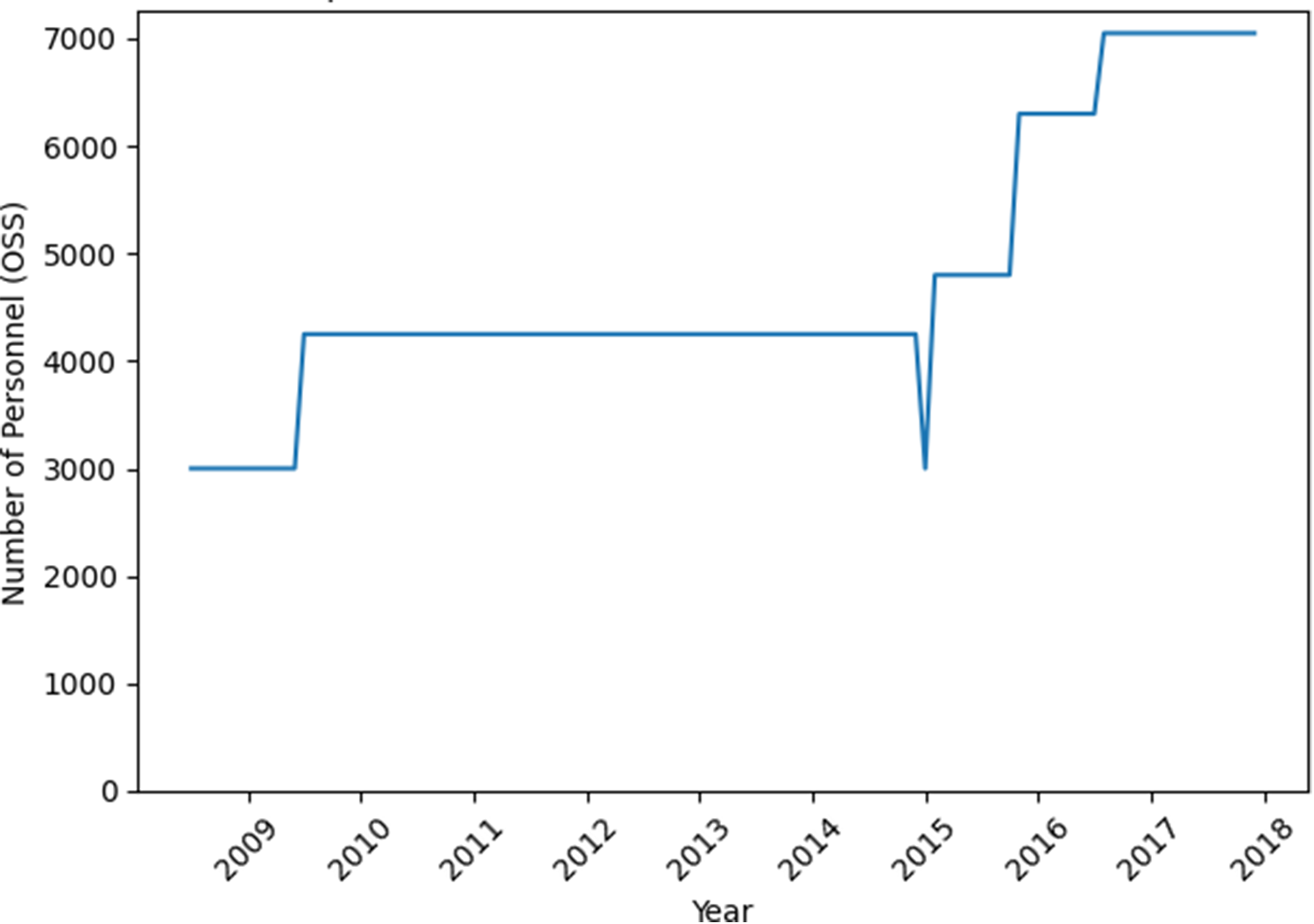
In the following years, incentives to maintain the deployment strengthened. Although the security situation remained stable, public opinion continued to express insecurity and appreciation for soldiers’ presence.Footnote 60 Withdrawing troops would have required replacing them with police officers, which was financially unfeasible. After 2011, as the crisis worsened, the government increased the contingent by 1,250 units. The technocratic government that replaced it prioritised fiscal discipline and maintained the deployment. In 2013, a left-wing government initially sought to reduce troop numbers, but rising security challenges – first migration, then terrorism – sustained public demand for security. Constrained by tight finances, even left-wing executives maintained and eventually expanded the deployment, raising troop levels to 6,000 (Figure 2).
Army Personnel Deployed in Operation Strade Sicure (2008–2018).

The army’s organisational equilibrium
In 2008, when OSS began, the army’s inducement–contribution balance to its service members remained favourable. Both the perceived desirability of movement and the army’s ease of movement were relatively low. Regarding the former, duties assigned to uniformed personnel aligned closely with professional identity. At the start of 2008, the army had roughly 6,200 deployed abroad – approximately 1,700 in Kosovo, 2,300 in Lebanon, and 1,800 in Afghanistan.Footnote 61 These deployments were highly professional and well remunerated, and thus attractive to service members. Training was strongly combat-oriented, given the nature of external deployments, and was therefore professionally rewarding. The operational tempo (OPTEMPO) was sustainable, as approximately 6,200 soldiers deployed abroad out of a total force of 109,703 personnel, about 1 in 18, were engaged in operations. This supported a reasonable work–life balance. Moreover, the force was relatively young – the average age was around thirty – so many had limited family obligations, which further eased rotations and improved perceived work–life balance.Footnote 62 Another indicator of service members’ low desirability of movement was the army’s strong performance in recruitment and retention. In 2008, the army recorded an excellent ratio of applications per available position for officers (51:1) and, even more so for non-commissioned officers (178:1), while the ratio for enlisted personnel was adequate (2.3:1).Footnote 63
Deteriorating economic conditions further facilitated recruitment. As the crisis deepened, enlistment increased significantly, precisely because recruitment in Italy was predominantly occupational. For many applicants, the army offered a stable source of income and employment amid growing economic uncertainty. Most recruits, across all categories, came from the poorest regions of the country – those with the highest unemployment rates. In 2008, 89 per cent of applicants originated from the south (71 per cent) and the centre (18 per cent), the areas with lower per-capita income.Footnote 64
In addition to the low desirability of movement, soldiers were motivated to stay because they faced low ease of movement.Footnote 65 The reason was that in Italy, members of the armed forces faced significant difficulties finding employment outside the military.Footnote 66 Military-to-civilian transitions were rare, and the army lacked effective mechanisms to expand outplacement opportunities.Footnote 67 The effects of the economic crisis, which were already being felt in Italy, made the transition from the armed forces even more difficult. The government had, in fact, begun cutting public spending and reducing public-sector employment opportunities.Footnote 68 This context strengthened managerial leverage, as limited external alternatives allowed the organisation to resist many demands from service members without triggering large-scale departures.
Although the army was relatively effective in securing personnel contributions, its relationship with governing parties was far more problematic. The first issue was the army’s inability to obtain adequate resources for training and maintenance. The army faced a severe expenditure imbalance, with a growing share of the budget devoted to personnel costs (salaries) at the expense of operations (training and maintenance). In 2004, 63.5 per cent of the army’s funds were allocated to personnel, 15.41 per cent to investment, and 21.09 per cent to operations. By 2008, the distribution had shifted further, with 73.71 per cent devoted to personnel, 18.76 per cent to investment, and only 7.53 per cent to operations.Footnote 69 The latter category had become especially critical: according to the army, insufficient funding meant that 73 per cent of operational needs went unmet.Footnote 70 According to the chief of the army general staff, funding levels had fallen so low that ‘only partial training could be guaranteed for units scheduled for deployment to operational theatres’.Footnote 71 The second problem was the steady reduction in personnel. In just four years, the army had lost more than 10,000 troops – equivalent to 8.4 per cent of its total force – and the governing parties had no plans to halt the decline.Footnote 72
This imbalance in the army’s relationship with governing parties was further compounded by its limited ability to pursue organisational survival through alliance-building.Footnote 73 While alliance-building represents a plausible alternative strategy, in the Italian case, the army faced structural constraints that limited its feasibility. More generally, the Italian armed forces have historically displayed limited political influence due to institutional, professional, and cultural factors.Footnote 74 Institutionally, the military lacks formalised channels for regular interaction with political decision makers. Professionally, it has limited representation in key positions within politics, public administration, and major economic sectors, reducing opportunities to build influential networks.Footnote 75 This is compounded by relatively weak political expertise. Culturally, these dynamics are reinforced by a tradition of restraint towards civilian authority rooted in Italy’s post-war civil–military settlement.Footnote 76 Furthermore, the army faced greater difficulty in building alliances within the armed forces. Resource scarcity fostered a competitive rather than cooperative environment – a pattern also observed in other countries – particularly in its relations with the Carabinieri and, to a lesser extent, the navy. In addition, unlike the navy and the air force – both able to rely on strong ties with major defence-industrial actors such as Fincantieri and Finmeccanica (now Leonardo) – the army was unable to create strong alliances within the defence industry, as land producers’ enterprises such as Iveco Defence Vehicles were more limited in scope and political leverage.Footnote 77
Overall, in 2008, the army’s organisational equilibrium was fragile. It maintained a favourable inducement–contribution balance with its service members. Still, it struggled to remain attractive to the government, resulting in resource shortfalls, especially in training and maintenance, and a steady decline in personnel. Moreover, it had limited means to rebalance this imbalance by relying on other actors, as opportunities for effective alliance-building were constrained.
In this context, OSS represented an attractive option for the army’s SMLs to stabilise the service’s organisational equilibrium. In relation to the governing parties, such an operation offered the prospect of increasing the army’s contribution – in other words, its access to resources – for several reasons.Footnote 78 From the perspective of the desirability of movement, the army’s deployment increased the attractiveness of relying on the military for governing parties. First, it addressed their strong need to improve public perceptions of security.Footnote 79 Second, the parties knew that the army was effective in performing this role, as public surveys showed that previous domestic policing operations had proved particularly popular.Footnote 80 Third, from an economic standpoint, the operation was highly cost-effective. During an economic crisis and public spending cuts, it enabled the government to reduce the number of police officers without lowering perceived security levels.Footnote 81 From the perspective of ease of movement, the context also made it difficult for the parties to terminate the operation once it had been launched. Ending it would have required replacing deployed soldiers with police officers; otherwise, the perceived level of security would have declined, imposing a high political cost.
In relation to its service members, however, the operation worsened the inducement–contribution balance. Senior leadership knew that the mission was unpopular among the ranks, who viewed it as poorly aligned with their professional skills.Footnote 82 This perception reflected a role conception strongly centred on warfighting and international operations, around which both military academy training and unit-level preparation were structured.Footnote 83 It also increased the OPTEMPO, reducing soldiers’ opportunities for rest and recovery. Moreover, the operation was poorly remunerated – significantly less than deployments abroad – yet it still required geographic displacement and separation from family for comparable periods. OSS, therefore, raised the perceived desirability of movement. Nevertheless, the impact remained moderate, as the overall force was still relatively large – 109,703 personnel – and the deployment itself was limited in scale, involving about 3,500 troops, corresponding to a ratio of 1:31. As for the ease of movement, the operation had little direct impact.
In the years following the launch of the operation, this situation remained stable. The army’s organisational equilibrium was configured in such a way that OSS continued to represent a convenient choice for the army’s managers. Political parties also remained highly attracted to the operation and, therefore, were willing to allocate additional resources to the army to conduct it. On one hand, this was because the salience of the security issue never declined in the following years – in fact, for many years it only increased. National surveys confirm that Italians continued to regard security as a priority, despite the constant presence of soldiers in the streets.Footnote 84 This was due to not only crime, which had been the dominant concern in 2008, but also the issue of irregular immigration, which by 2013 and 2014 had become truly central,Footnote 85 and, after 2014, to the terrorist threat, following the attacks in France, Belgium, and the United Kingdom.
On the other hand, the operation proved effective, efficient, and popular across the political spectrum. Its effectiveness was demonstrated by the total absence of incidents or problems caused by the armed forces and the appreciation expressed for their work by all police institutions.Footnote 86 Its efficiency was attested by official state bodies, such as the Court of Auditors, which in 2013 declared that the operation saved tens of millions of euros by reducing the use of police personnel.Footnote 87 Moreover, even if political parties had wanted to rely on the police instead, this alternative was difficult (low ease of movement), as it required hiring new personnel, which was nearly impossible during an economic crisis and after years of staff reductions.
Regarding service members, the situation remained broadly stable until 2013–14, though it gradually became more demanding. Soldiers continued to view the operation unfavourably,Footnote 88 but the relatively limited number of troops involved compared to the total force, the temporary decline in overseas missions, and, above all, the persistence of the deep economic crisis ensured that their overall contribution remained substantially guaranteed. Between 2014 and 2017, pressures on personnel increased for three main reasons. First, the number of foreign missions began to rise again even as the army was still undergoing a numerical reduction, leading to a faster increase in OPTEMPO. Second, OSS expanded significantly in response to terrorist attacks, further burdening the system. Third, as the economic crisis gradually eased, movement outside the organisation became easier. These developments made the inducement–contribution balance somewhat less favourable from the perspective of service members, as reflected in the first mild signs of bottom-up discontent,Footnote 89 growing unease voiced by some retired senior leaders,Footnote 90 and emerging recruitment difficulties.Footnote 91 Nevertheless, these shifts were insufficient to fundamentally alter the leadership’s overall calculus, which continued to view the level of contribution as broadly sustainable.
Overall, until 2016–17, the operation continued to generate net benefits for army leaders. In a context of resource scarcity, limited managerial slack, and few viable alternative strategies – such as effective alliance-building – OSS functioned as a lever to secure additional funding and political support, despite its drawbacks for the ranks. Accordingly, from 2016–18, the army’s leadership maintained a positive informational posture, as reflected in its public communications once the operation was underway.
The strategies used by the armyFootnote 92
Formulation of the requirements. Across 2008–17 policy texts, the Italian army depicts a hybrid threat environment that blurs the lines between external and internal security, emphasising adaptability and the ability to operate both abroad and at home in support of the police. The Army Operating Concept 2010–2030 explicitly links future scenarios to required capabilities, highlighting expeditionary operations and sustained domestic support as defining features of the previous decade and anticipating instability from irregular migration, transnational crime, and social tensions. It outlines scenarios ranging from national defence to OSS-like missions.
Subsequent documents – Linee di sviluppo evolutivo e innovativo dello strumento militare terrestre (2015) and Il futuro dell’Esercito Italiano tra opportunità e incognite (2016) – reinforce the need for versatile capabilities suited to both concurrent external and domestic demands. This framing is echoed in Rivista Militare (4/2009), where two general staff colonels doctrinally justified OSS, arguing that the distinction between defence and security had become increasingly blurred in a non-linear operational environment that could extend to national territory. Together, these texts normalise domestic support within the army’s reference scenario.
Capacity of the organisation. Between 2008 and 2017, army leaders and official documents consistently portrayed OSS as both legitimate and within the army’s capabilities, relying on two core arguments. First, historical continuity: senior officers maintained that the army had long performed comparable domestic tasks. In parliament, General Ramponi referred to public order duties from the 1950s to post-earthquake patrols, while General Rossi cited operations such as Vespri Siciliani and Partenope to rebut doubts about soldiers acting as public-security agents. In 2010, the chief of staff described OSS as the latest in a long tradition of domestic support to the police. Second, leaders emphasised professional fit through expeditionary experience. Soldiers ‘tested’ abroad were portrayed as versatile and able to transfer skills to the homeland. The 2008 Army Report highlighted adaptability and professionalism, and the chief of staff explicitly compared patrols in Afghanistan and Naples to underscore this transferability. In sum, the army framed OSS as both appropriate and competently executed, invoking precedent and adaptability to legitimise sustained domestic deployment.
Effectiveness of the operation. On effects, the army highlights two dimensions. First, public security: in parliamentary hearings and official publications, it points to patrol hours, checkpoints, seizures, arrests, and response times as evidence of a positive impact on crime. Serving officers echoed this view in Rivista Militare: in issue 6/2009, Colonel Masiello argued that the operation improved citizens’ sense of security and that its results against organised and petty crime justified the additional effort. These indicators are persuasive regarding outputs and perceptions, though they do not, by themselves, establish causality.
Second, civil–military relations: the army claimed that OSS brought soldiers closer to citizens, strengthening trust, visibility, and daily contact – benefits linked to enhanced legitimacy and, indirectly, to recruitment and retention. A special issue of Rivista Militare even presented this rapprochement with the public as a key achievement of the operation.
Overall, between 2008 and 2017, the army adopted a coherent justificatory strategy that embedded OSS within its strategic requirements, portrayed it as fully consistent with its professional capabilities, and framed it as effective in both security and civil–military terms.
Phase II (2018–24): Opposition
The operation
In 2018, Italy’s general elections brought to power the first populist government in the Republic’s history, formed by the Five Star Movement (Movimento 5 Stelle; M5S) and the League (Lega).Footnote 93 At the time, improving economic conditions would, in principle, have allowed an increase in police recruitment. Nevertheless, the government’s approach to OSS remained positive, largely due to the League’s strong presence in the executive – especially at the Ministry of the Interior – and its hard-line stance on public security.
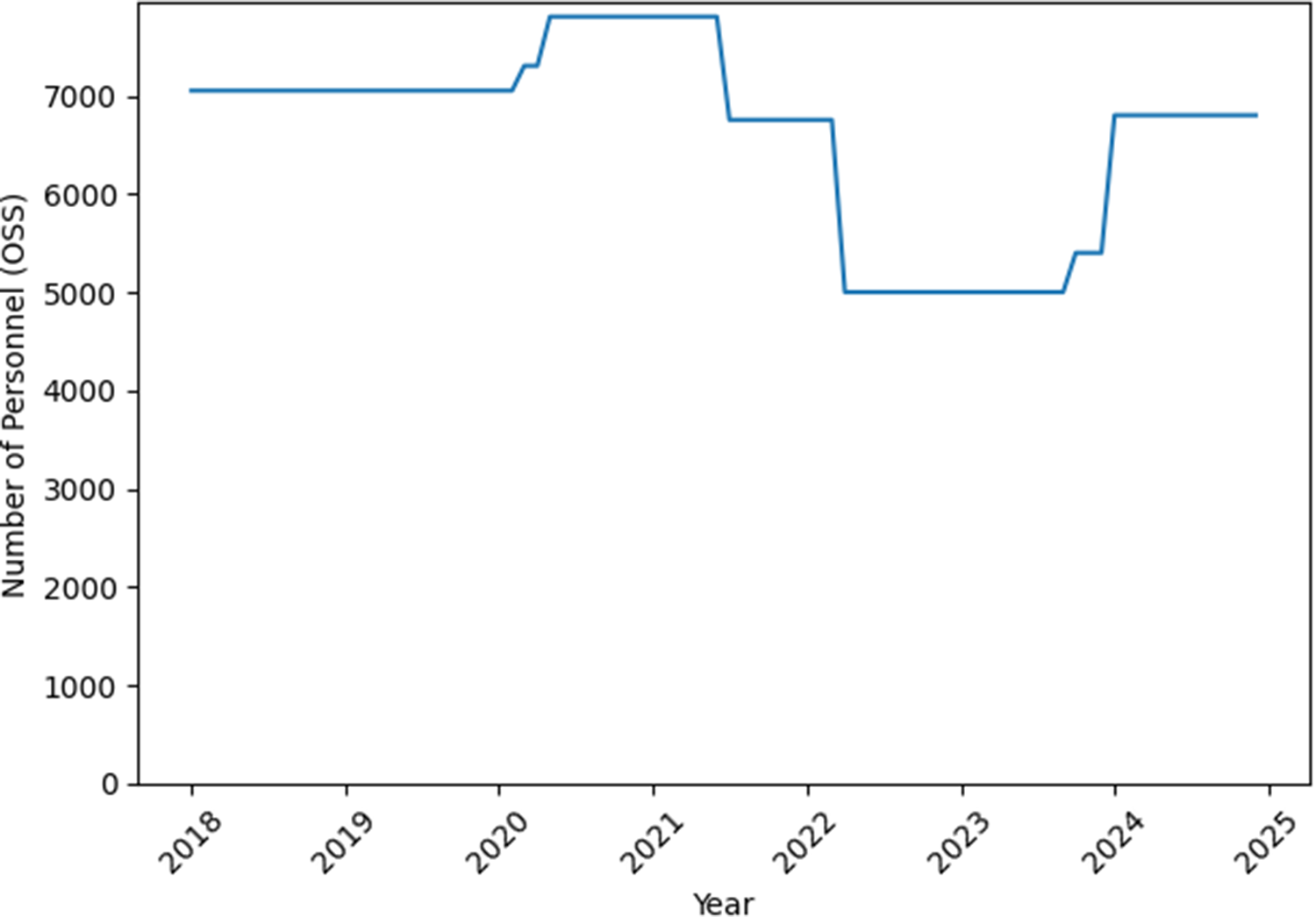
Only a few months after taking office, however, the League withdrew its support and a new cabinet was formed with the backing of the Democratic Party (Partito Democratico; PD). With the League no longer in government, and given both improved economic conditions and the PD’s long-standing opposition to domestic military deployment, the new executive began reducing the OSS contingent. This retrenchment was short-lived. The outbreak of the Covid-19 pandemic halted the downsizing and led to renewed expansion, as the armed forces were mobilised again for internal security and public order tasks (see Figure 3).
Army Personnel Deployed in Operation Strade Sicure (2018-2025).

By 2021, as Italy emerged from the pandemic, around 7,000 soldiers were deployed under OSS. The government ordered a reduction, but the 2022 general elections again shifted the political landscape. A right-wing coalition led by Fratelli d’Italia, together with Forza Italia and the League, came to power. These parties – especially Fratelli d’Italia and the League – strongly supported domestic military deployment and quickly expanded the operation. Even the outbreak of the war in Ukraine and the renewed focus on external defence did not lead the government to scale back the military presence on the streets.
The army’s organisational equilibrium
By 2018, the Italian army’s organisational equilibrium showed signs of gradual transformation. In its relationship with service members, the army managers were beginning to face a more demanding environment. From the perspective of the perceived desirability of movement, several trends converged to make OSS increasingly problematic. First, the continued reduction in personnel strength meant that domestic deployments progressively became the army’s primary form of employment. Between 2013 and 2018, the army had already lost an additional 2,983 personnel (−2.9 per cent of the total force). Between 2018 and 2024, the decline accelerated further: total personnel fell from 99,877 to 93,388, a reduction of 6,489 troops (approximately 6.5 per cent). At the same time, the OSS contingent increased substantially. It rose from 4,050 personnel in 2013 to nearly 7,050 in 2019, before stabilising at around 6,800 in 2024.Footnote 94 As a result, OPTEMPO increased sharply. Demographic dynamics further exacerbated this trend. The force had aged significantly: within the enlisted ranks – traditionally the youngest segment of the force – the average age of personnel had risen to approximately thirty-seven years, and by 2023, it had increased further to around forty years.Footnote 95 By this stage, the army counted 98,887 personnel in total, of whom only 3,298 were deployed abroad, while more than 7,000 were assigned to OSS.
At the same time, OSS had become a more demanding mission for soldiers. The terrorist threat led to heavier equipment and more restrictive rules of engagement, further worsening working conditions. These factors were compounded by the routine and repetitive nature of the tasks, which soldiers widely perceived as demotivating and professionally unrewarding.Footnote 96 Not coincidentally, during these years, criticism from the ranks – by then widespread and increasingly vocalFootnote 97 – triggered a parliamentary fact-finding inquiry. The hearings brought to the surface the depth of dissatisfaction among service members. They made visible the growing disconnect between the mission and the expectations and well-being of the ranks.Footnote 98
At the same time, external conditions were shifting in ways that affected soldiers’ perceived ease of movement. As economic conditions improved, unemployment declined, and alternative employment opportunities expanded. Italy’s GDP growth improved from −1.7 per cent in 2013 to +0.9 per cent by 2018. Between 2018 and 2024, the economy continued to grow, albeit at a modest pace, with GDP expanding by about +0.7 per cent in 2024. At the same time, labour-market conditions strengthened: the unemployment rate, which was around 10–11 per cent in 2018, fell steadily over the following years, dropping to about 6–7 per cent by 2024–25 as employment rates rose.Footnote 99 These trends progressively widened soldiers’ outside options and reduced the opportunity costs associated with leaving the armed forces, further weakening the army’s ability to secure personnel contributions.Footnote 100 In short, both the desirability and ease of movement increased, eroding the army’s capacity to secure its personnel’s contributions.
As economic conditions improved and internal discontent grew, clear signs of a recruitment crisis emerged from 2016 onward. Although applications initially remained stable – around 50,000 for roughly 8,000 positions annually – the share of candidates failing to report to selection centres rose sharply, from 20 per cent in 2013 to 63 per cent in 2018, peaking at 65 per cent in 2017. In 2016, despite about 7,000 positions being opened, only just over 5,300 recruits were enlisted, producing a significant shortfall that partially recurred in subsequent years. This marked a clear break from the past: in 2012, all 12,000 available positions had been filled.Footnote 101 The trend worsened thereafter, with total applications declining from around 64,000 in 2018 to 46,494 in 2022 and 38,181 in 2024, confirming the structural nature of the crisis.Footnote 102 Even if these figures appear substantial in absolute terms, they are far more concerning when combined with the very high no-show rates observed in previous years.Footnote 103
About political parties, the picture changed. On the one hand, a set of factors emerged that reduced parties’ perceived desirability of movement towards the army. First, the shift in the international context brought growing pressure from NATO to increase defence spending. As a result, the army could count on additional resources without relying on OSS as its primary lever. Second, the increased salience of migration, combined with the advent of the Trump administration and reduced US engagement in North Africa and the Middle East, compelled Italy to adjust its external military posture. External deployments expanded significantly, with the army securing new funding to deploy troops to Africa, the Sahel, and the Middle East. Over this period, the number of personnel deployed abroad increased to approximately 3,300 troops.Footnote 104
This does not imply that OSS lost its political appeal. Even during these years, OSS continued to ensure a stable and visible contribution by the armed forces at a time when security remained a highly salient issue and when fiscal constraints were still binding. The operation also remained difficult to terminate, since ending it would have required replacing soldiers with police officers, a politically and financially costly option. Compared to 2018, however, OSS had become less essential for the army, as alternative factors increasingly reduced the parties’ perceived desirability of movement towards the operation.
With respect to ease of movement, political leaders could now rely on additional resources to strengthen police forces as an alternative to military deployment. This approach – promoted in particular by Defence Minister Guerini and former Prime Minister Renzi – aimed to rebalance internal security responsibilities away from the armed forces. Although this strategy was ultimately disrupted by successive crises, first terrorism and then the pandemic, it nonetheless indicates that the ease of movement for political actors had increased relative to earlier periods.
Within this new equilibrium, OSS gradually ceased to be advantageous for the army and increasingly became a liability. The operation contributed to personnel difficulties, accelerated separations, crowded out training activities, and clashed with a force posture increasingly oriented towards external operations. While OSS continued to generate some additional funding, the organisational and personnel costs it imposed now outweighed these benefits. The army now had new, more effective instruments to secure resources, most notably following the outbreak of the war in Ukraine. For the army, this translated into unprecedented appropriations – including a €23 billion package to renew the armoured forces – and additional operational commitments.
In sum, between 2018 and 2024, OSS became progressively less advantageous for the army’s senior leadership: vis-à-vis governing parties, the operation continued to generate political benefits, but no longer of a vital nature; vis-à-vis service members, it had by then acquired a clearly negative balance in terms of organisational equilibrium.
The strategy used by the army
Formulation of the requirements. From 2018 onward, army policy texts and senior leaders’ speeches gradually shifted in emphasis. Internal security does not disappear, but it becomes progressively less central, while growing attention is devoted to high-intensity conflict and collective defence. From 2020–21 onward, this reorientation becomes more explicit, with a clear return to conventional warfighting as the reference scenario. Documents increasingly stress peer competition, Article 5 readiness, NATO deterrence on the eastern flank, and multi-domain operations. Accordingly, priorities focus on brigade readiness, long-range fires, air defence, mobility and counter-mobility, C2 digitisation, and logistics depth.
This shift marks a gradual departure from the earlier ‘security–defence continuum’. Domestic support to the police is reframed as ancillary and time-bound, while the army’s core mission is reasserted as generating combat-credible forces and meeting NATO readiness targets.
Capacity of the organisation. In this phase, army leaders recalibrate the narrative on appropriateness and capacity. They first stress the deep mismatch in competencies between any overseas mission and OSS. As General Ceravolo put it,
Doing public order in Italy – dealing with our own citizens – is not the same as serving in Afghanistan or Iraq. You cannot just flip a switch and change employment mode; at home, there is a risk of over-reaction, abroad of under-reaction – we are human beings, not programmed machines.
He added that ‘soldiers want to perform activities inherent to their training and mindset, or to be on quick-reaction footing for a terrorist attack’. The emphasis shifts from interchangeable versatility to the non-transferability of skills (de-escalation, evidence handling, crowd management, graduated use of force under tight legal constraints) and to the opportunity costs of warfighting readiness when troops spend long rotations on static guard duty.
Second, leaders highlight material and sustainment shortfalls: insufficient, fit-for-purpose accommodation for rotating units; inadequate fleets and mission-specific equipment; and the cumulative strain of 24/7 manning on maintenance, leave, and training calendars. The message is that sustained domestic patrolling degrades readiness by crowding out live fire, combined-arms, and collective training windows, disrupting rotations, and driving up personnel fatigue and separations.
Finally, they reframe the status of OSS: what earlier had been normalised as ‘continuity’ is now presented as contingent and exceptional – an emergency instrument to be time-bounded, not a routine assignment. In short, capacity signalling turns from ‘we can and should’ to ‘we can only at significant cost’, underscoring that extended domestic employment sits outside the army’s core business and is unsustainable without harming professional fit and combat preparedness.
Effects of the operation. In this phase, senior leaders pivot to effects that had previously been subordinated. First is training and readiness. OSS prevents units from completing the collective training gates required for warfighting: company–battalion live fire, combined-arms integration, and NATO readiness certifications slip or are truncated. Long, static rotations crowd out simulators and field exercises, disrupt rotation plans, and create skill atrophy in mission-essential tasks. Commanders also highlight equipment wear and availability: continuous urban patrolling accelerates vehicle mileage and maintenance cycles, ties up scarce spares, and leaves platforms unavailable during expeditionary preparation windows.
Second is motivation, retention, and well-being. Leaders report growing dissatisfaction with repetitive, low-autonomy tasks that are perceived as misaligned with soldiers’ training and identity. Shift work and prolonged urban postings strain work–life balance; the monotony and visibility of the mission increase stress, while legal exposure for minor incidents raises perceived career risk. The result is a drag on retention (more voluntary separations, especially among NCOs and junior officers) and a recruitment-branding problem: a force that advertises warfighting credibility but deploys large numbers for static guarding sends mixed signals to potential recruits.
The overall narrative thus reverses emphasis. Where earlier messaging highlighted security outputs and rapprochement with the public, leaders now stress degradation in readiness and personnel costs as the dominant effects. OSS, they argue, delivers diminishing returns in legitimacy while imposing mounting penalties on training, equipment, morale, and retention – costs incompatible with a posture centred on conventional warfighting and NATO collective defence.
Conclusion
This article explains why senior military leaders (SMLs) sometimes support and at other times resist political demands for domestic security operations. Existing civil–military relations scholarship has offered two main explanations: constructivist accounts, which argue that reactions depend on whether military actors perceive such operations as appropriate, and pragmatic accounts, which instead emphasise calculations about resources. The former struggles to explain the rapid empirical oscillations observed in SMLs’ attitudes, while the latter largely neglects ideational variables and the consequences that professionally contested missions may have on the armed forces.
To reconcile these perspectives, this article has proposed a framework grounded in organisational theory that incorporates both dimensions. It conceptualises the armed forces as coalitions that must continuously maintain organisational equilibrium – a balance between the inducements offered to and the contributions received from their two principal resource providers: government (funding) and service members (labour). In this view, attitudes towards domestic policing are neither simply expressions of professional identity nor reducible to resource opportunism. Rather, they are managerial strategies aimed at protecting the inducement–contribution balance on both fronts. Senior leaders are expected to advocate domestic policing when such missions help secure political and financial support while remaining tolerable for personnel; conversely, they are expected to resist when personnel and readiness costs begin to outweigh resource benefits, or when alternative resource streams reduce the mission’s marginal utility. In this framework, pragmatic incentives matter because they shape the perceived organisational gains from mission acceptance. Still, role conceptions also matter because they determine the internal costs of domestic policing in terms of satisfaction, retention, and willingness to contribute.
The framework has been tested using the case of Italian army SMLs’ reactions to political demands to conduct the domestic security operation Strade Sicure (OSS). The analysis shows that, initially, under conditions of fiscal constraint and limited external labour-market opportunities, SMLs supported the mission to stabilise political backing and protect resources. Although the operation was unpopular among personnel and conflicted with prevailing role conceptions, exit costs remained high, leading most service members to remain within the organisation. Over time, however, the expansion of the operation generated growing discontent, while changes in both the domestic and international contexts created opportunities for dissatisfied personnel to leave the organisation. For SMLs, internal costs thus became progressively more difficult to sustain. As a result, from around 2017–18 onward – and especially after the Russian invasion of Ukraine – senior leaders increasingly framed the mission as detrimental to readiness and pressed for its retrenchment.
The analysis of the Italian case clearly shows how neither of the two existing theoretical approaches, taken in isolation, can explain the observed variation. As demonstrated, the Italian army did not fundamentally change its role conceptions: OSS was consistently viewed as inappropriate, was never institutionalised, and did not significantly shape training practices. Yet for several years, the army actively supported the mission, and at one point it also changed its position. At the same time, a purely pragmatic explanation is also insufficient. The army consistently had material incentives to sustain the operation. However, without accounting for the effects of a professionally contested mission on personnel, it is not possible to explain the shift in senior leaders’ attitudes. The framework proposed here, by contrast, combines these two dimensions and provides a clear explanation for the observed empirical variation.
The findings should be interpreted with appropriate caution. The article relies on a single case study, which allows for detailed process tracing but does not permit strong claims of generalisability. Rather than providing a definitive test, the Italian case serves as an exploratory assessment of the proposed framework. At the same time, the framework has implications beyond the study of domestic policing. None of its core concepts is specific to policing tasks, and the underlying logic can be applied to a broader range of military missions. Likewise, the framework is not limited to the army. Because it does not rely on assumptions unique to a single service, it can also be used to analyse how other branches of the armed forces respond to political demands. What varies across contexts is not the underlying mechanism, but the type and magnitude of the organisational effects generated by different missions.
Several avenues for future research follow. First, the framework should be tested across additional cases and services to assess its generalisability and to identify the conditions under which informational strategies succeed or fail in shaping political choices. Second, its implications should be explored in explicitly inter-organisational settings, including inter-service rivalry and bargaining with police forces, where competition over missions and jurisdictions may further condition equilibrium dynamics. Finally, more systematic measurement of the personnel side of the equilibrium – task fit, operational tempo, and outside options – would help specify the thresholds at which professional resistance becomes binding. Together, these extensions would clarify when pragmatism overrides role conceptions and professional resistance, and what the consequences are.
Supplementary material
The supplementary material for this article can be found at https://doi.org/10.1017/eis.2026.10090.
Acknowledgements
A previous version of this article was presented at the Biennial International Conference of the Inter-University Seminar on Armed Forces and Society (IUS), held 24–6 October 2025, in Reston, Virginia. I thank the discussant and participants for their helpful comments and suggestions. I am also grateful to Professor Marco Di Giulio (University of Genoa) for valuable feedback on earlier drafts.
Matteo Mazziotti di Celso is a postdoctoral researcher at the Institut de recherche stratégique de l’École militaire (IRSEM).




 Open access

