Introduction
Escalation of tensions and conflicts arising from intractable, unresolved maritime territorial and sovereignty disputes in the South China Sea have led many scholars and commentators to describe the disputes as a regional security flashpoint with the possibility to erupt into sudden and violent skirmishes (Kraska and Pedrozo, Reference Kraska and Pedrozo2013: 313; Emmers, Reference Emmers2007: 1; Carpenter and Wiencek, Reference Carpenter, Wiencek, Carpenter and Wiencek2000: 10; Garver, Reference Garver1992). But at no time has this popular assumption been more profoundly relevant in the context of the regional stability and security of Southeast Asia than in recent years. China's renewed aggressiveness in strengthening its ‘indisputable’ sovereignty claims over the entire contested territories and adjacent waters of the Spratly Islands, compounded by its preponderant military strength and willingness to exercise it, have arguably been the main sources of concern, not only to other disputing parties, but also to the United States (US), its security partners, and close allies, such as Australia and Japan (Studeman, Reference Studeman1998; Storey, Reference Storey1999; Thayer, Reference Thayer2011; Jiang Zhang, Reference Zhang2013; Jones and Smith, Reference Jones and Smith2015).
This shifting of China's foreign policy-orientation is a visible departure from Beijing's diplomatic charm offensive and rapprochement during the 2000s.Footnote 1 China's conciliatory approach towards its rival claimants, the members of the Association of Southeast Asian Nations (ASEAN), is substantiated in two important documents signed by the ASEAN members and China in 2002 and 2003 respectively: (i) the Declaration on the Conduct of Parties in the South China Sea (DOC),Footnote 2 and (ii) the Treaty of Amity and Cooperation in Southeast Asia.Footnote 3 Even so, as conflict has become more prevalent particularly since 2009, vehement protests and angry backlashes by rival claimants over Beijing's strong-arm tactics in asserting its claims have exacerbated the already existing tension over the South China Sea.Footnote 4 What is most alarming about the disputes, and the broader implications for regional security and stability, is that unless the disputes are managed constructively and amicably, any pre-meditated aggressive actions by belligerent States in asserting their claims are likely to trigger the risk of (or even actual) military confrontation. Such concern is well founded. Historically, both China and Vietnam have engaged previously in military skirmishes over the ownership of islands and reefs in the Paracel Island groups in 1974 and 1988;Footnote 5 at a time when the Peoples Liberation Army Navy (PLAN) was still viewed as at the infant stage of its modernization process (Li Mingjiang, Reference Mingjiang and Chachavalpongpun2014a: 132).
China intensified land reclamation activities and building of military facilities in the contested maritime features in the South China Sea have been highlighted and examined not only in print and by online media, but also in government reports (O'Connor and Hardy, Reference O'Connor and Hardy2015; Watkins, Reference Watkins2015; Lubold, Reference Lubold2015; Office of the Secretary of Defences, 2015). There are several underlying reasons behind Beijing's actions. A number of observers have suggested that these assertive postures are intended to strengthen the legitimacy of the country's sovereignty claims over the features and the surrounding waters (Chung, Reference Chung2004; Dolven et al., Reference Dolven, Elsea, Lawrence, O'Rourke and Rinehart2015; Odom and Nankivell, Reference Odom and Nankivell2015). Furthermore, fortified military bases and enlarged artificial islands are not only expected to serve as a forward operating base for the People's Liberation Army's (PLA) naval and air force units, but also to enhance Chinese capability to monitor maritime traffic in this semi-enclosed sea (Joyner, Reference Joyner and Singh1999: 54; Baron, Reference Baron2015; Glaser, Reference Glaser, Hiebert, Nguyen and Poling2015: 35–6). Hence, such desirable goals can only be materialized with the establishment of a network of far-flung air and sea military garrisons across the contested Spratly Islands chains (Tiezzi, Reference Tiezzi2015).
For Vietnam and the Philippines, China's increasing aggression in asserting its claims over the South China Sea could likely threaten their national security and sovereignty. Perhaps one of the explanations behind their strong reactions to China lies in the areas where these aggressive operations are concentrated. Over the last decade, empirical evidence suggests that the areas where Beijing's perceived provocative actions took place – naval patrolling, sand dredging, stationing of garrison force and constructing military installation – were predominantly concentrated on maritime features and within the waters claimed by Vietnam and the Philippines. Not surprisingly, among all the ASEAN claimant States, both countries are arguably the most vocal in criticizing and expressing their displeasure over China's perceived provocative actions and intimidation in the South China Sea (Ravindran, Reference Ravindran2012: 109; Zhao Hong, Reference Hong2013; Grudgings, Reference Grudgings2014; Parameswaran, Reference Parameswaran2014; Abbugao, Reference Abbugao2015; Reuters, Reference Reuters2015a). Such is the rivalry and animosity over China's assertiveness that both countries are inevitably caught in a series of separate, but much publicized, incidents of diplomatic disputes, confrontation at sea, and political backlash with Beijing. Numerous events could substantiate this point. Perhaps the most notable one is the recurring incidents of alleged collision involving Vietnamese fishing boats and Chinese Coast Guard vessels in the vicinity of their contested Paracel Islands in 2014.Footnote 6 The fallout from these incidents not only prompted Hanoi to lodge diplomatic protests against China (Perlez, 2014), but also triggered violent anti-China protests and riots, with several Chinese and foreign-owned factories being burned.Footnote 7
As has been the case with Vietnam, the Philippines government has also been involved in a series of bitter diplomatic and verbal disputes over Beijing's systematic programs of island building and military asset installations. To fortify China's claims in various maritime features, Beijing has embarked on extensive sand dredging projects on islands, islets, reefs, and shoals contested by the Philippines, notably Mischief Reef, Subi Reef, and Scarborough Shoal (Francisco and Mogato, 2013; Storey, Reference Storey2015; De Castro, Reference DeCastro2015).Footnote 8 Such provocative moves have strained Sino-Philippine relations, pushing the Philippine government to counter China's alleged aggressive and assertive claims by bringing the case to the Permanent Court of Arbitration (PCA) in 2013 without the latter's consent.Footnote 9 On 12 July 2016, the PCA rendered its judgment in favour of the Philippines (PCA, 2016).
In addition to Vietnam and the Philippines, Malaysia is another member State of ASEAN embroiled in a long-standing maritime territorial and sovereignty disputes with China over the Spratly Islands. However, publicized clashes between Malaysia and China in the diplomatic and political spheres are noticeably rare (Bentley, Reference Bentley2015). In contrast, separate incidents of verbal clashes, diplomatic protests, and standoffs involving China and the Philippines or between China and Vietnam have been the subject of extensive international and regional media coverage (Perlez, Reference Perlez2014; Florcruz, Reference Florcruz2014; Heydarian, Reference Heydarian2014; Helman, Reference Helman2015; Minh and Brunnstrom, Reference Minh and Brunnstrom2016). As will be elaborated on below, Malaysia has traditionally been reluctant to publically antagonize Beijing by pursuing a similar belligerent stance to that adopted by its fellow ASEAN claimants. To date, Malaysia has yet to be drawn into high profile incidents of political and diplomatic clashes with China over competing sovereignty and territorial claims in the Spratly Islands.
Nonetheless, this state of affairs is likely to change in the foreseeable future. Evidence has been mounting in recent years that Beijing is increasingly pursuing a more proactive and confrontational strategy to assert its claims to a major part of the South China Sea, otherwise known as the nine-dash line claim area. The area includes, for example, a vast area that is being contested by Malaysia. Coincidently, this is a vast expansive area wherein lie most of the maritime features and spaces that make up Malaysia's territorial claims and exclusive economic zone (EEZ). Hassan (Reference Hassan2015) noticed that since 2011 incidents of China's assertive behaviours in Malaysian waters have occurred with increasing frequency, the most recent being the removal of Malaysian territorial markers in the Luconia and Erica Reefs (Thayer, Reference Thayer2015), and a series of patrols and military exercises conducted by Chinese Navy and Coastguard vessels in the vicinity of Malaysia's claimed James Shoal (Laeng, Reference Laeng2015; Reuters, 2014).Footnote 10
Beijing's deeper interest to engage in a much tougher and uncompromising stance in defending its sovereignty in the South China Sea is not going to go away anytime soon (Li Mingjian, Reference Mingjiang2014b: 135–6; Saleem, Reference Saleem2000: 564). And as aptly observed by Parameswaran (Reference Parameswaran2015c), Chinese encroachment into Malaysia's waters in the Spratly Islands is becoming ‘bolder and more frequent over the past few years’. Moving forward, the Malaysian government needs to reassess the country's readiness to deal with possible security threats arising from China's increasing aggression, and, subsequently, adjust its current conciliatory approach in dealing with such aggression. Therefore, this article aims to provide an insight into Malaysia's external behaviour and actions in response to China's growing assertiveness towards the South China Sea disputes. To this end, the aim of this article is achieved through a twofold approach. First, it examines Malaysia's overlapping claims with those of China to maritime features and waters, with a focus on the Spratly Islands group. Finally, the article provides an explorative analysis of Malaysia's rationalist stance in response to China's assertiveness, particularly under the current administration of Prime Minister Najib Tun Razak. It also examines the motivations, intentions, and basis of this particular external posture.
Malaysia's claims
In sharp contrast to the Chinese assertion that it has ‘indisputable’ sovereignty over the entire contested islands, atolls, islets, and their surrounding maritime areas within its infamous nine-dash line claims in the South China Sea,Footnote 11 Malaysia claims only a few of the maritime features, all of which are predominantly situated in the southern portions of the Spratly archipelagos. Physically, these remote features consist of tiny islets, oceanic atolls, cays, shoals and coral reefs. Such is the remoteness of these scattered features that Malaysia's largest fortified outpost in the South China Sea – Swallow Reef (Pulau Layang-Layang)Footnote 12 – is located nearly 343 kilometres (km) northwest of Kota Kinabalu, the capital city of the east Malaysian state of Sabah (Rahman, Reference Rahman2007). Most of these maritime features are fully or partly above water only at low tide in their natural state.
Several analysts have suggested that the number of Malaysia's claimed maritime features in the Spratly Islands varies, ranging from five to 12 features (Valencia et al., Reference Valencia, van Dyke and Ludwig1997: 36–7; Chung, Reference Chung2004: 104–6; Shicun Wu, Reference Wu2013: 139–42; Basiron, Reference Basiron, Ho and Bateman2012: 73). Nonetheless, the exact number of these features that are currently occupied by military forces, either from Malaysia or rival claimants, can be ascertained. These particular features are Mariveles Reef (Terumbu Mantanani), Ardasier Reef (Terumbu Ubi), Swallow Reef (Terumbu Layang-Layang), Dallas Reef (Terumbu Laya), Erica Reef (Terumbu Siput), Investigator Reef (Terumbu Peninjau), Amboyna Cay (Pulau Amboyna Kecil), Barque Canada Reef (Terumbu Perahu), and Commodore Reef (Terumbu Laksamana). The first six are occupied by Malaysia, while the rest are occupied either by Vietnam or the Philippines.Footnote 13 Vietnam has occupied Amboyna Cay (Pulau Amboyna Kecil) and Barque Canada Reef (Terumbu Perahu) since 1979 and 1987, respectively; while Commodore Reef has been occupied by the Philippines since 1978. In addition, there are five maritime features in the Spratly Islands group that are presently unoccupied but allegedly controlled or administered by Malaysia. These features include Royal Charlotte Reef (Terumbu Semarang Barat Besar), North Luconia Shoals (Gugusan Beting Raja Jarum), Louisa Reef (Terumbu Semarang Barat Kecil), South Luconia Shoals (Gugusan Beting Patinggi Ali), and James Shoal (Beting Serupai). In total, it can be argued that Malaysia, as of December 2015, has claimed 14 islands and small maritime features in the Spratly Island.
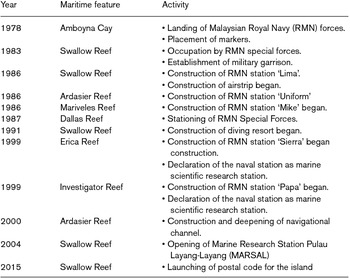
To further reinforce and bolster its sovereignty claims over these contested maritime features, Malaysia has also carried out a wide range of activities. Spanning nearly four decades, such activities include the erection, purportedly in 1978, of a monument in what is now Vietnamese-occupied Amboyna Cay.Footnote 14 Such long-term, purposeful activities have been an integral part of the Malaysia's pre-emptive strategy not only to avert other rival claimants from occupying contested features, but also to gain a favourable and stronger position in future diplomatic negotiation with China (Chung, Reference Chung, Bateman and Emmers2009). Such activities are also intended to create greater evidentiary support to legally booster its claims (Shicun Wu, Reference Wu2013: 143; Ko Swan Sik et al., Reference Sik, Pinto and Syatauw1996: 348). Table 2.1 provides a brief chronology of the activities carried out by Malaysia to bolster its claims over the above-mentioned maritime features.
Chronology of Malaysia's efforts to consolidate its claim in the Spratly Islands

Note: The table was prepared by Mohd Nizam Basiron, a Malaysian expert in maritime policy. The table was part of his presentation slides during MIMA Conference on the South China Sea, which was held from 12–13 December 2011 in Kuala Lumpur.
Source: Basiron (Reference Basiron2011); adapted from Mahadzir (Reference Mahadzir and Chachavalpongpun2014), Chung (Reference Chung2004), Prescott (Reference Prescott2010) and Valencia (Reference Valencia, van Dyke and Ludwig1997).
As shown in Table 2.1, the activities undertaken by Malaysia include displaying the flag of the country, placement of territorial markers, and stationing military personnel. Other activities aim at bolstering its claims and showing ‘effective control’ over the occupied features including building an airstrip, constructing tourist facilities, establishing a marine and scientific research station, and creating a special postal code.Footnote 15 Claimants’ perceived possession of the maritime features by virtue of seizure and building of permanent structures would make, in the opinion of Chung (Reference Chung, Bateman and Emmers2009), ‘[their] dislodgement by diplomatic, legal military or moral pressure, a difficult task’ (p. 102).
Available documentary evidence suggests that the Malaysian government has arranged a series of tour visits for government officials and journalists to its occupied maritime features, most notably the Swallow Reef. These visits not only involved the general public but also extended to the royalty. Starting in 1991, for example, journalists were invited to visit the recently completed resort facility and airstrip on this man-made island to promote tourism. On 22 May of the following year, his Majesty the King of Malaysia, Sultan Azlan Shah and the queen, accompanied by the chief of Royal Malaysian Navy (RMN) Mohamad Shariff Ishak, paid a royal visit to the same island (New Straits Times, 1992). From 2007 to 2009, the Malaysian Ministry of Defence organized on several occasions media tours to observe military operations in East Malaysia. Among the tour's itinerary included media visits to the Swallow Reef (Rahman, Reference Rahman2007). Several factors may have prompted the Malaysian government to take such actions. First, with regard to the 1991 media visit to Swallow Reef, one commentator suggested that the arranged visit reveals Malaysia's intention to prove that the reef is above water at high tide and can sustain economic life by itself, and, hence, meet the minimum requirements of Article 121(3) of the 1982 United Nations Convention on the Law of the Sea (LOSC) to generate its own EEZ (Chien Chung, Reference Chung, Tien and Cheng2000: 267). Secondly, such acts could be interpreted as Malaysia's attempts to exercise sovereignty, subsequently boosting its claims to the maritime features it occupies. The basis of its claims over the contested features in the South China Sea is largely premised on the principle of geographical contiguity (Cordner, Reference Cordner1994: 67–78). The Malaysian government argues that all these insular features are located within the boundaries of its declared continental shelf. These boundaries are depicted in the 1979 Malaysia New Map (or in Malay language, Peta Baru Malaysia 1979).Footnote 16 As will be discussed below, the legality of the claims is not without problems, a factor which eventually pushed the country to opt for political and diplomatic solutions to the disputes.
Malaysia's policy stance
Since Mahathir Mohamed's premiership (1981–2003) to the administration of current Prime Minster Najib Razak (2009–present), it can be observed that Malaysian government has maintained a consistent foreign policy posture and with little subtle changes when handling issues pertaining to overlapping territorial and sovereignty claims in the South China Sea. As will be elaborated below, Malaysia has traditionally relied on low-key, conciliatory diplomacy as the cornerstone of its foreign policy response to China's assertive behaviour in the dispute. By analysing Malaysia's foreign policy behaviour at bilateral and regional level, one can identify the country's foreign policy orientation in dealing with China's aggressive behaviours in the Spratly Islands. Three key assumptions underpin this external policy orientation and will be examined and elaborated in the succeeding paragraphs. The determinant factors behind these rationalist foreign policy postures will also be identified. The focus is then shifted to discussion on Malaysia's current stance towards Beijing's perceived provocative actions in the South China Sea under the Najib administration.
Pursuit of a peaceful and amicable solution
Malaysia has long held a view that any aggressive or provocative actions from rival claimants to the Spratly Islands dispute, including China, should be addressed and resolved amicably and peacefully. Public expression of this official position can be traced to several sources. Noteworthy examples include Parliamentary Hansards, and press releases obtained from the relevant government ministries. Malaysia's official position to pursue peaceful dispute resolution is reaffirmed by senior ministers and recorded in the Parliamentary Hansards. In October 2012, for example, Datuk Richard Riot Anak Jaem, then the country's Second Deputy Minister of Foreign Affairs, made the following statement at the Lower House during the question and answer session:
Malaysia's stand is that the issue of overlapping claims in the South China Sea should be resolved peacefully through negotiations and consultations between States that make the claim. . . without threatening the use of force in line with the international law, including the 1982 United Nations Convention on the Law of the Sea. (Hansard, 2012: 42)
It is argued that the Malaysian government is clearly committed to resolving its overlapping territorial claims in the South China Sea via diplomatic channels. This position has always been clear and consistent, as was affirmed by Dato Seri Reezal Merican, Deputy Minister of Ministry of Foreign Affairs of Malaysia during a Parliamentary debate session in 2015. He stated that the disputes must be resolved peacefully among the claimants based on the principle of international law. If the claimant States failed to reach any diplomatic settlement, Deputy Minister Reezal urged them to engage international third party adjudication mechanisms, such as the International Court of Justice (ICJ) or the International Tribunal on the Law of the Sea (ITLOS) (Hansard, 2015: 41). Nevertheless, as will be elaborated below, it is unlikely that the Malaysian government, due to a number of reasons, will resolve its territorial disputes in the South China Sea through adjudication procedure.
Other sources on the official position of the Malaysian government, to pursue non-confrontational means for territorial dispute resolution, can be drawn from press release statements accessible from selected government ministry websites, for example the website of the Ministry of Foreign Affairs, Malaysia (MFA). Malaysia's Minister of Foreign Affairs, Anifah Aman, during a luncheon for the ASEAN Heads of Mission in Kuala Lumpur in June 2012, acknowledged that Malaysia firmly believes that the issues of overlapping territorial claims should be addressed peacefully based ‘on dialogue and discussions amongst the countries concerned, and in accordance with the recognized principles of international law, such as the [LOSC]’ (MFA, 2012a). The same position was reiterated in the Ministry's press release following the 13th ASEAN+3, Foreign Ministers’ Meeting at the Peace Palace, Phnom Penh, Cambodia in July of the same year (MFA, 2012b) and again during ASEAN Ministerial Meeting to prepare for the 22nd ASEAN Summit at Bandar Seri Begawan, Brunei Darussalam in April 2013.
Malaysia has been proactive in garnering the support of its rival claimants to manage and resolve territorial disputes in the South China Sea peacefully. Nowhere is this attitude more visible than at the ASEAN level. Over the last decade, the Malaysian government has aggressively pushed for workable regional mechanisms in the form of multilateral dialogue and consultation directed towards peaceful resolution of the dispute. Of the many existing ASEAN-driven mechanisms, ASEAN Regional Forums (ARFs), ASEAN Ministerial Meetings, and the ASEAN Summit are perceived to be the most important mechanisms through which the Malaysian government has actively promoted its own agenda. Through these multilateral mechanisms, the country has encouraged its fellow ASEAN claimants and China to engage in a sustained process of negotiation, consultation, and dialogue for the peaceful management and resolution of territorial disputes. For instance, at the ARF meeting in Brunei Darussalam in 2013, Minister Anifah Aman underscored the importance for the disputes on the South China Sea to be addressed via peaceful dialogue and a negotiation process based on the principles of international law (MFA, 2013; Malaysia National Secretariat, 2013). In that same year, he reiterated Malaysia's official stance during the Special ASEAN–China Foreign Ministers Meeting in Beijing that ASEAN members and China should manage the South China Sea disputes in a rational way through dialogue and consultation (The Malaysian Insider, 2014).
Scholarly analysis of China's policy actions and intents to resolve the South China Sea dispute has drawn attention to Beijing's policy preference to pursue a ‘dual track approach’ (Xinhua, Reference Xinhua2015; Chau Bao Nguyen, Reference Nguyen2015; Parameswaran, Reference Parameswaran2015d). As such, there are subtle signs, particularly since the late 1990s when China became increasingly conscious of the need to actively engage ASEAN members at the multilateral level while at the same time unilaterally strengthening its claims through various assertive activities.Footnote 17 This particular approach is epitomized by Beijing's long-held insistence on resolving the dispute on a bilateral basis in tandem with its willingness to engage in formal and informal multilateral dialogue and consultation mechanisms, including those within ASEAN framework. These mechanisms include ARFs, ASEAN–China Foreign Minister Meeting, and ASEAN+3, as well as informal mechanisms such as the Indonesia-initiated Workshop on Managing Potential Conflicts in the South China Sea (Djalal, Reference Djalal2001). Over time, coinciding with its rising coercive behaviours is the tendency of the Chinese government to forge constant and close interactions between ASEAN members through various multilateral diplomatic avenues. These regular engagements have acted as a catalyst for regional cooperation aimed at cultivating confidence building and mutual trust (Weissmann, Reference Weissmann and Chachavalpongpun2014: 54). It was observed that ASEAN, according to one Chinese scholar, Jing-Dong Yuan, ‘has been instrumental in engaging China and sensitizing Beijing to the values of the so-called ASEAN Way’ (Reference Yuan2006, 24). Beijing will likely to continue to value this parallel track of engagement as a means of diffusing tension and hostility that stem from its own assertive behaviours in the South China Sea.
Attaining the ultimate goal of peace building between China and ASEAN countries through a multilateral process is also made possible by the growing economic interdependence and shared geo-political interests. Beijing is increasingly developing economic ties with the three ASEAN claimants involved in the South China Sea dispute (Bloomberg, 2014). Malaysia is the one of the beneficiaries from this strong bilateral economic interaction. In 2013, for example, the volume of combined bilateral trade between China and Malaysia was 106 billion US dollars, making Malaysia the largest ASEAN trading partner for China for the sixth consecutive year (China Daily, 2014). From the realist perspective, it is in the best interest of the Malaysian government not to jeopardize its ties with China by adopting the kind of hostile stance that has caused the strained relationship between China other rival ASEAN claimants, Vietnam and the Philippines in particular.
Malaysia's inclination to handle its conflict with China over the issues of the South China Sea in a non-confrontational and conciliatory manner is arguably compatible with the aspiration and spirit embodied in the DOC. Malaysia has publically expressed its commitment to support ‘the spirit and letter’ of the DOC (MFA, 2012b). Relevantly, this multilateral instrument contains provision that explicitly recognizes the necessity for the contracting parties to promote a peaceful, friendly, and harmonious environment in the South China Sea.Footnote 18 As argued by many analysts, DOC is intended to serve as a reference point to guide the behaviour of claimant States in the dispute and to stop tensions from escalating into military conflict (Koh, Reference Koh2013: 422; Nguyen Phuong Binh and Luan Thuy Duong, Reference Binh, Duong, Siddique and Kumar2003: 89). In this sense, there is the expectation, at least on the Malaysian side, that this non-binding instrument provides a suitable platform to enhance understanding among claimants on the expected behaviour in dealing with the territorial conflict, as well as to lay a strong foundation for long-term regional stability. History has shown that Malaysia and its fellow ASEAN members generally respect and adhere to certain principles of the ASEAN Way of conflict prevention. Of relevance, there are two particular behavioural principles of the ASEAN Way that have traditionally attained a pre-eminence in the foreign policy posture of ASEAN claimants, including Malaysia: first, refraining from the use of force for dispute settlement, and, second, respecting the other State's sovereignty (Damiri, Reference Damiri2012: 5; Leviter, Reference Leviter2010: 161). This is demonstrated in their desire to ease tension and manage the disputes with China in a peaceful manner through their participation, as mentioned above, in multilateral negotiations, consultations, and dialogues.
The DOC, however, falls short of attaining its intended goals of mitigating tension and standoffs arising from the fallout caused by unilateral acts by the claimants. In implying the view made by Ralf Emmers (Reference Emmers2002: 3) that the DOC is basically ‘an interim accord’, the instrument concerned arguably has its own disadvantages. The soft nature status of DOC has been proven to be insufficient to achieve its intended goals of ‘exerting pressure on fellow signatories to move towards implementation’ (Valencia, Reference Valencia, Thuy, Minh and Tra2010: 23). Rather than legally compelling individual claimants to refrain from engaging in any forms of provocative or hostile actions, it seems that the Declaration ‘merely played the role of imposing moral constraints on relevant parties’ (Li Mingjiang, Reference Mingjiang2014b). In fact, there is little evidence to suggest that the claimant parties have fully complied with the Declaration. Some observers maintain that the symptomatic shortcomings of this political instrument are evident from the persistent violation of the instrument over the last ten years. Exemplifying such violations is the intensification of physical constructions and militarization activities on the contested islands, reefs, and other maritime features by the claimant States (Jones, Reference Jones2010; Huy Duong, Reference Duong2015).
An additional reason for the non-compliance with DOC correlates with the regional geopolitical dynamism within the ASEAN setting. Li Mingjiang (Reference Mingjiang2014b), for example, opined that ‘the relative stable situation in the South China Sea before 2008 gave little incentive for the claimant parties, individually or collectively, to take serious steps to implement the DOC’. In spite of the fact that the DOC had been successful in some ways to temporarily halt hostilities and diplomatic clashes among the claimants, DOC was deemed to be ineffective in defusing escalation of tensions emanating from Beijing's renewed provocative actions to boost its sovereignty claims. The problem is further compounded by mutual distrust and heated rhetoric among the claimants (Garcia, Reference Garcia2014: 23). The failure of DOC to prevent conflict among claimants prompted Storey (Reference Storey2011) to boldly declare that the instrument as a ‘dead letter’ or as being ‘on life support’.
Conscious of the possibility that the mounting tensions, exacerbated by claimants’ unilateral moves to bolster their claims, could spiral into armed conflict, Malaysia and other ASEAN members, along with China, agreed to expedite talks on a legally binding framework to manage and regulate the behaviour of claimants in the South China Sea. Nevertheless, the adoption of a legally binding Code of Conduct (COC) remained elusive, characterized by prolonged and intermittent consultation and negotiation processes between ASEAN members and China (Thayer, Reference Thayer2013: 82). Although the initial idea of COC was officially sanctioned at the 29th ASEAN Ministerial Meeting in 1996 in Jakarta (Tran Truong Thuy, Reference Thuy2011: 3), it was not until 2014 that ASEAN members and China made a positive move by resuming their formal discussions towards the implementation of DOC and eventual adoption of a COC. A series of meetings were held in Singapore from the 17 to 18 of March during the 10th ASEAN–China Joint Working Group on the Implementation of the Declaration on the Conduct of Parties in the South China Sea.
One may argue that the timing of Malaysia's strong push for the conclusion of COC through multilateral efforts was a calculated move. There are several explanations behind Malaysia's position. To begin with, the push coincided with repeated incidents of encroachment of Chinese naval ships in waters within the vicinity of Malaysia's claimed James Shoal. The call for a conclusion of COC may have been an attempt by Putrajaya to use this legally binding code to exert stronger peer pressure on Beijing and would thus stop Beijing from engaging in any future provocative behaviour in the area. The Malaysian government is aware of the fact that the country's low key response to China's intrusion through diplomatic channels has failed to stop Beijing from pursuing its assertive activities in the Malaysian waters. The increasing presence of Chinese military and civilian vessels in maritime areas further south of the South China Sea, such as around South Luconia Shoals and James Shoal, has potential ramifications in altering the dynamics of Sino-Malaysia relations. As argued by a senior analyst attached to a prominent Malaysia-based research organization, Lockman (Reference Lockman2015: 4), this development:
could likely lead of growing frequency of contact between [the two countries’] navies and coast guards in the South China Sea. It increasingly exposes bilateral ties to the occasional need for quick decisions and the possibility of miscalculations by those commanding the ships on both sides. This is one of the reasons why it is crucial for all the countries concerned to reach an agreement on a set of minimum standards of behaviour in the South China Sea: a Code of Conduct (COC).
Secondly, Putrajaya hoped that the adoption of such an instrument would potentially reap much more benefits than through direct negotiations with Beijing. The latter, as noted earlier, is adamant that the intractable dispute in the South China Sea should be resolved through bilateral negotiation with the relevant claimants (Valencia, Reference Valencia1995: 62; Wu Xinbo, Reference Xinbo and Zhao2004: 64; Tran Truong Thuy, Reference Thuy, Thuy, Minh and Tra2010: 120; Thayer, Reference Thayer2013: 75, Reference Thayer, Song and Keyuan2014b: 44). As there was apparently little progress in halting China's increasing assertiveness in staking its claims to waters claimed by Malaysia, it seemed that the only realistic path for the Malaysian government to take was to advocate for multilateral negotiation towards a conclusion of CoC. One could argue that Malaysian officials are in favour of a legally binding CoC as it is the only instrument they see as being likely to exert greater diplomatic and moral pressure to curb China from carrying out its assertive activities in Malaysian waters.
Malaysia's call for the negotiation process to be expedited for the conclusion a formal CoC is in line with the stance adopted by its fellow ASEAN claimants: the Philippines and Vietnam (The Straits Times, 2015). This unified stance, however, has never been a norm. Since the late 1990s, ASEAN members on many occasions were divided over the issue of formalizing a legally binding CoC. Historically, Malaysia's interests and actions within ASEAN have often deviated from the aspirations of its fellow members. Of particular relevance is the fact that Malaysia's initial push for an informal CoC, which began in the late 1990s, was contrary to the prevailing position of its rival claimants at that time. This was particularly so during the ASEAN Summit in Hanoi in 1998. Both the Philippine and Vietnamese governments had launched a strong diplomatic push towards the adoption of a detailed, legally binding multilateral CoC (Tran Truong Thuy, Reference Thuy, Thuy, Minh and Tra2010). At a time when its rival claimants had worked hard to push for a legally binding multilateral COC, Malaysia was more inclined to advocate for a more informal non-binding instrument to govern the behaviour of claimants. The country was not alone in pushing for such a document. The Malaysian government, under Mahathir's administration, and Beijing were in agreement to rally ASEAN members to support their course towards a multilateral political declaration. Both countries insisted that such an instrument was more likely to serve as a platform for broadening and facilitating tangible cooperation and confidence building among the claimant parties.
The process of multilateral diplomacy towards the adoption of a regional instrument to defuse tension among claimants over the South China Sea dispute is not a recent phenomenon. Much of the groundwork of establishing a useful platform for facilitating dialogue and consultation has been laid out since the early 1990s. Both claimants and non-claimants have participated in a series of ASEAN-related meetings designed to promote and facilitate confidence building measures. Underscoring this are a number of multilateral forums and workshops. Among these, the regional mechanisms, the ASEAN Regional Forum (ARF), and the Indonesia-initiated track-2 workshops are perhaps the most important for dialogue and consultation, and are aimed at easing tension and maintaining stability in the South China Sea region (Hai Dang Vu, Reference Vu and Rayfuse2015: 415; Tran Truong Thuy, Reference Thuy2011: 3).
Needless to say, the above-mentioned regional mechanisms have arguably failed to enable Malaysia and fellow ASEAN members from forging a unified stance to counter China's assertive actions. With this failure have come new questions on the functional effectiveness of these mechanisms to govern the behaviours of claimants, which might lead to the escalation of tension and conflict. On the diplomatic front, ASEAN unity is often difficult to achieve, and this is manifested in the numerous regional events (Basiron, Reference Basiron2011). One prime example is the unprecedented failure of ASEAN to issue a joint communiqué at the conclusion of the 45th ASEAN Foreign Ministers Meeting in Phnom Penh, Cambodia in July 2012 – a first since the inception of this regional organization in 1967. The South China Sea dispute has frequently divided ASEAN, partly due to the failure of its member to reach consensus when dealing with a myriad of issues relevant to the dispute which could lead to tensions. On more than one occasion in ASEAN history, Malaysia and other ASEAN claimants, Vietnam and the Philippines in particular, failed to present a united front against China's assertive behaviours in the Spratly Islands (Thayer, Reference Thayer, Song and Keyuan2014b; Hellendorff and Kellner, Reference Hellendorff and Kellner2014). This divergent stance is in contrast to the much publicized pledge of ASEAN members to forge ASEAN solidarity, a commitment which was explicitly expressed, for example, in the 2003 Treaty of Amity and Cooperation in Southeast Asia (i.e. Articles 1 and 2). It is this lack of consensus among the ASEAN community that perhaps explains their failure to neutralize China's sizeable influence on other economically weak and smaller non-claimant ASEAN members of ASEAN members (e.g. Laos, Myanmar, and Cambodia). Beijing in turn capitalizes on this influence to serve its own interest.
Several commentators affirm that a divided and weak ASEAN – partly due to internal discord within the organization – would likely serve China's own interests (Bower, Reference Bower2012; Jones and Smith, Reference Jones and Smith2015). Consistent with this ‘divide and conquer’ strategy, Beijing fully intends to manipulate this regional disunity to its own advantage at the expense of its rival ASEAN claimants. This argument is further reinforced by an analysis made by Ghoshal (Reference Ghoshal2011: 1):
ASEAN countries are in reality divided over their approach towards China, as well as over the way to diffuse tension in the region. Each member country looks at China from the point of view of their national interests – whether it perceives China as a threat or as a source of economic benefit. As a result, ASEAN's position on political and strategic issue vis-à-vis China is rather weak.
Hence, it is in the best interest of Putrajaya to lead fellow ASEAN members in overcoming their differing views and attitudes and, subsequently, to pave the way for a common stance on the issues relating to the South China Sea, particularly in response to China's perceived aggressive approach.Footnote 19 Pursuing this goal is not without its own challenges. In evaluating Malaysia's chairmanship of ASEAN, Das (Reference Das2015) was of view that the consensus among ASEAN members on China remains elusive. He argued that the underlying ‘reason cited for such failure was China's insistence on blocking any mention of its assertiveness in the South China Sea, while the US refusal to support any statement without mention of the territorial dispute’.
Malaysia's is seemingly reluctant to adopt a military approach when dealing with China's provocative actions in the South China Sea. From Malaysia's point of view, this policy option is best illustrated in Malaysia's National Defence Policy. Malaysia expressively renounces ‘the use of threat and application of force as a means of settling international conflict and advocates and practice the peaceful resolution of disputes’ (Ministry of Defence Malaysia, 2008: 1). In countering China's assertive actions, Malaysia has traditionally adopted a non-militaristic stance for a number of reasons, including disparities in terms of military capabilities and the costs involved in defending and asserting their claims over the contested maritime features. At this moment, what might have restricted Malaysia's option to forcefully defend all of its claims to maritime features is that the country has yet to possess a formidable naval and paramilitary force to effectively operate in a vast, treacherous maritime frontier, such as the South China Sea. A further consideration, intertwined with Malaysia's vulnerability in this semi-enclosed sea, lies in the operational challenges confronted by the Malaysian Royal Navy (RMN) and the Malaysian Maritime Law Enforcement Agency (MMEA). Located predominantly in the southern sector of the South China Sea, off the East Malaysian States of Sarawak and Sabah, these maritime areas constitute the largest portions of Malaysia's EEZ, with a combined size accounting for approximately 250,000 km² or 46% of the total size of the country's EEZ (Jamon, Reference Jamon2009). Both of the federal enforcement agencies face difficulties in monitoring and protecting potentially enormous oil and gas deposits, as well fisheries resources in the country's expansive EEZ.Footnote 20
This being the case, it probably will not be in Malaysia's best interest to engage in military action to protect ownership claims over minuscule, remote maritime features, such as James Shoal and South Luconia Shoals, against a powerful adversary such as China. Malaysia's senior military officers are arguably mindful and very aware that China possesses the largest naval forces among all the claimants, as acknowledged by a security analyst, Omar Saleem (Reference Saleem2000: 543), ‘China has the greatest military ability to seize the Spratly Islands’. In this sense, Malaysia's strong preference to adopt a cautious approach when dealing with Beijing's assertiveness in the South China Sea shows pragmatism, an approach that is shaped and influenced by its relatively inferior military capability and difficult maritime terrain to operate, coupled with the country's continuing high dependency on China's economic investment and trade.Footnote 21
Downplaying China's assertive posture
Downplaying China's assertive activities in the South China Sea has been one of the hallmarks of Malaysia's foreign policy in recent years. This proposition is particularly manifested in recent commentaries on the country's reaction to Chinese naval incursions into Malaysia's maritime territory (Chen, Reference Chen2013; Yep and Hall, Reference Yep and Hall2014; Grudgings, Reference Grudgings2014; Tiezzi, Reference Tiezzi2014; Parameswaran, Reference Parameswaran2015c). Comments made by Malaysian government officials suggest that the country is more inclined to just accommodate and even restrain public condemnation of China. A point of case is Malaysia's muted reaction to the repeated incidents of excursion by Chinese warships around the waters of James Shoal.Footnote 22
It is argued that avoiding open confrontation with Beijing over the issue of conflicting claims in the South China Sea is what distinguishes Malaysia's foreign policy posture from the norm practiced by its fellow ASEAN claimants – Vietnam and the Philippines. As noted earlier, both Hanoi and Manila have displayed willingness to publically criticize Beijing for its alleged aggression in the contested area. On the other hand, Malaysia is more inclined to adopt a different approach when dealing with China's assertiveness. Putrajaya's policy has been relatively cautious, with strong preference for quiet diplomacy (Lockman, Reference Lockman2015: 4). Based on the observation made by Parameswaran (Reference Parameswaran2015a), Malaysia's subtle response to China is ‘a sharp contrast to the more outspoken approaches adopted by the Philippines and Vietnam’. Malaysia's foreign policy therefore has been to resist being drawn into potentially unpleasant diplomatic spates with China.
Rather than openly criticizing China's alleged aggression in the South China Sea, Malaysian officials appear to recognize the value of shrugging off any perceived threat emanating from such aggression to its national security. It has become a norm to see Malaysian government officials publically dismiss any assertive behaviour by Beijing that could be viewed as an act of provocation that could threaten Malaysia's sovereignty. One notable example is the response made in 2011 by Ahmad Zahid Hamidi, the then Malaysian Defence Minister, to foreign media reports regarding China's repeated assertive actions in the South China Sea. He insisted that China was not an aggressive State but rather only wanted its presence in the disputed waters to be known (Bernama, 2011). Putrajaya seems to be cognizant of the possibility of Beijing's retaliation. For Malaysia, there is so much at stake, economically and politically, if the bilateral relations are jeopardized.
Additional press responses by Malaysian senior officials could give a clearer picture of the country's passive reactions over China's repeated assertive actions in the South China Sea. Commenting on the intrusion by Chinese military vessels near James Shoal within Malaysia's EEZ in March 2013, Defence Minister, Dato’ Seri Hishammuddin Hussein Onn, stated that there is no need for Malaysia to worry about the Chinese vessels patrolling, ‘as long as China's intention is not to go to war’ (Chen, Reference Chen2013). In the following year, RMN Chief, Abdul Aziz Jaafar went to extra lengths to downplay press reports of similar incidents involving Chinese military excursions in and close to the waters of the same shoal. In his reaction published by a leading local English newspaper on 29 January 2014, the navy chief expressively denied foreign media reports on the presence of a flotilla of PLAN warships conducting military exercises in the waters adjacent to James Shoal (New Straits Times, 2014). He instead claimed that the alleged exercise actually took place 1,000-nautical mile (nm) away from Malaysia's 200-nm EEZ (Oorjitham, Reference Oorjitham2014; Thayer, Reference Thayer2014a). Nearly a month later, his statement was negated by the chief of the Malaysian armed forces, General Tan Sri Zulkifeli Mohd Zin. However, General Zulkifeli, who confirmed the press reports regarding the presence of Chinese flotilla in the vicinity of James Shoal, categorically claimed that the PLAN warships were merely following an innocent passage regime (Thayer, Reference Thayer2015: 25).
A more recent example of contradictory press statements made by senior government officials involved the encroachment of a flotilla of Chinese fishing boats in the Malaysian waters, off the coast of Sarawak. The incident was first reported on 24 March 2016 when Shahidan Kassim, Minister in the Prime Minister's Department, disclosed to the media that more than 100 Chinese fishing boats had been detected intruding into Malaysia's EEZ waters near the contested South Luconia Shoals (Bernama, 2016a; Lee Seok Hwai, Reference Hwai2016). He further added that assets from both the RMN and MMEA had been deployed to the areas to monitor the situation. Contrary to the claim made by Shahidan Kassim, Dato’ Seri Hishammuddin Hussein Onn, and RMN chief Datuk Seri Ahmad Kamarulzaman Ahmad Badaruddin publically refuted media claims of alleged trespassing by Chinese fishing boats into the country's waters (Bernama, 2016b; Zulfakar, Reference Zulfakar2016; Maritime Executive, 2016). Despite these denials, MMEA director-general Datuk Ahmad Puzi Ab Kahar in a press conference was adamant that the trespassing incident did occur as his Agency had managed to collect visual evidence indicating the presence of a large fleet of Chinese fishing boats in those waters (Malaymail Online, 2016; Teoh, Reference Teoh2016).
What caused the above contradictory statements issued by senior figures from the federal ministry and military? One likely reason is the absence of an effective procedure or mechanism to direct coordinated official media response from senior government officials and high-ranking military officers pertaining to national security matters. The existence of this type of procedure or mechanism would certainly be useful to ensure a common stance from the Malaysian government in its response to any Chinese's maritime incursion.
Malaysia's tendency to keep a low profile and adopt a moderate approach is due to a number of factors. Firstly, such an approach is closely intertwined with the country's desire to retain various tangible economic benefits that are drawn from its close economic and politically cordial relations with China (Lockman, Reference Lockman2013; Green et al., Reference Green, Hicks, Cancian, Cooper and Schaus2016: 95). In this regard, it seems that Malaysia is behaving as a rationalist agent, chiefly motivated by a pragmatic economic and political incentive reaped from such relations. This is particularly so as the country's national security is linked directly with its socio-economic progress (Shamsuddin et al., Reference Shamsuddin, Liaw and Ridzuan2015). Forging sustained and close Sino-Malaysia economic ties has long been the main focus of Malaysia's policy makers. Among all ten ASEAN countries, Malaysia was China's biggest trading partner from 2008 to 2014. As reported by Niam Seet Wei (Reference Wei2015), based on the data released by the General Administration of Customs China (GAC), trade between the two countries reached US$102 billion in 2014, albeit that it was ‘down 3.8% as compared to a 11.8% hike registered in 2013’. Due to this strong economic dependency, it is likely that Malaysia will continue to favour options short of an overt hostile response to Beijing's alleged aggression in the South China Sea. In the end, the ultimate goal of Malaysia's foreign policy is to avoid any possible loss of trade opportunities that may potentially arise from alienating Beijing.
Secondly, Malaysia's willingness to exercise upmost restraint from openly making derisive remarks against China's recent perceived aggression in the South China Sea may have been driven partly by a conscious decision made by the ruling elites to solidify and sustain regime legitimacy and political survival. The decision unit that determines Malaysia's foreign policy on China's is mainly concentrated in a group of Malay-dominated ruling political and military elites, headed by the Prime Minister himself. The country's subdued diplomatic response can be best explained through the lens of the Regime Legitimation (RL) framework. Malaysian scholars, such as Kuik Cheng-Chwee (Reference Cheng-Chwee2008), have adopted this framework to explain the hedging strategy adopted by Malaysia when dealing with rising China. In his argument, the variant of policy choices is partly determined by the ruling elites’ prioritization of legitimization. He then elaborates based on a hypothetical setting:
if the elite current legitimation relies more on the imperative of prosperity-maximizing than security-seeking, then the state is expected to highlight economic and political benefits that can be tapped from the power, while downplaying any security concerns it may have about the giant. (Kuik Cheng-Chwee, Reference Cheng-Chwee2008: 162–3)
In the context of repeated intrusions of Chinese naval and coastguard vessels in waters adjacent to James Shoal, a key attribute of Malaysia's restrained diplomatic approach arguably lies in the tendency of Malaysian elites to strive for a stronger trade and political relationship with China, a much needed relationship which is vital to the country's economic growth. As noted above, China has been Malaysia's largest trading partner for the last five years. In light of the current economic downturn, it is imperative for Malaysia to continue receiving Beijing's economic and political support. Both are vital to strengthening the legitimacy and constituency bases of the Barisan National (BN) government, helmed by Prime Minister Najib Razak. In recent years, political legitimacy and reputation of the multi-ethnic BN-led government has arguably been shaken by growing public discontent over the failure of the administration to address several core areas, most notably the rising cost of living, devaluation of the Malaysian ringgit, and imposition of the goods and services tax (GST) (Zurairi AR et al., Reference Zurairi, Ging and Tan2015). According to an independent survey carried out by the Merdeka Center, in January 2015, Najib's approval ratings as Prime Minister plunged to the second lowest level since he took office in 2009 (Merdeka Center, 2015). Furthermore, allegations implicating Najib's involvement in a financial scandal in the debt-ridden government investment firm, Malaysia Development Berhad (MDB), proved costly to his already perceived flagging reputation, albeit that the embattled Najib still continues to show his tenacity to fight for his political survival.
By softening their stance on the increasing encroachment into Malaysian EEZ waters by the Chinese, it appears that BN-led ruling elites have been more than willing to please Beijing. China's continuing trade and investment support remains critical to Malaysia's economic prosperity, particularly during the anticipated current global economic slowdown. Capitalizing on the existing close economic and political ties between the two countries is an upmost priority for the Malaysian government as part of its two-pronged strategy – boosting the country's overall economic development and concurrently strengthening the party's legitimacy among its electoral bases. Maintaining the close ties between the two countries might be one of the reasons why Malaysian leaders have been visibly distancing themselves from publically condemning Chinese military incursions into the Malaysian waters. It is counterproductive to Malaysia's interests if the country publically displays a confrontational stance against China, as such an action could lead to Beijing's retaliation, which in turn might not only be harmful to Malaysia's economic interests but also to the legitimacy of the ruling elites.
Adopting a legal process as a last option for dispute resolution
It is highly improbable that Malaysia will opt for judicial proceedings for the resolution of maritime territorial disputes in the South China Sea in the immediate future. Rather than relying on a third-party dispute settlement mechanism, Malaysian leaders seem to have a long-held view that a diplomatic process is a realistic means of managing and containing the dispute and of stopping it from spiralling into a costly military conflict. In the context of the Spratly Islands dispute, Malaysia in practice has shown a strong inclination to pursue ‘parallel’ approach – bilateral and multilateral diplomatic engagements with its rival claimants. The Malaysian government has been willing to deal with outstanding and emerging issues on the dispute with other claimant parties separately, be it with its ASEAN counterparts or China. At the same time, embracing multilateralism for conflict management has been a cornerstone of Malaysia's foreign policy for several decades, a practice which will not stop anytime soon, particularly within the ASEAN framework (e.g. ARF and ASEAN Ministerial Summit). Even then, one scholar was sceptical of the motivation behind this policy choice, suggesting that Malaysia (and China) ‘continue paying lip-service to the cause of multilateralism’ (Liow, Reference Liow, Leong and Ku2005: 294). The fact is that Malaysia's active support for multilateral engagement at the regional level does not necessarily convey the impression that Putrajaya has totally ceased from pursuing bilateral negotiations with China to resolve their overlapping claims to the Spratly Islands (Nong Hong, Reference Hong2012: 141). Malaysian leaders publically expressed their conviction that it is possible to achieve a long-lasting solution to the dispute, but with a precondition that relevant claimants should not stray from the path of dialogue and peaceful resolution of conflicts. This is confirmed by Dato' Seri Shahidan Kassim, Deputy Minister of the Prime Minister's Department when replying to the questions posed by two Parliamentary representatives in March 2014. Malaysia's position, he stressed, is to engage in dialogue and negotiations as a peaceful means in dealing not only with the South China Sea dispute in particular, but Chinese recent incursions into the country's maritime waters and features in general (Hansard, 2014: 22).
From the context of Malaysia's experience, the chance of its bilateral territorial and sovereignty dispute being resolved in a peaceful manner is arguably much higher than a dispute involving multiple parties, such as the Spratly islands dispute. Historical analysis has shown that this is particularly the case with respect to overlapping maritime boundary limits involving Malaysia and another ASEAN member. When Malaysia and Indonesia were caught up in a wrangle over the delimitation of a common territorial sea boundary in the Straits of Malacca in the late 1960s, the two neighbouring States deemed that peaceful resolution of the dispute, by way of bilateral negotiations, was preferable (Ahmad and Kelana, Reference Ahmad and Kelana2005). This foreign policy preference was displayed in the Malaysian–Indonesian foreign policy strategy in the early post-Confrontation years. On 17 March 1970, for example, both the Malaysian and Indonesian governments concluded an agreement to delimit their common territorial sea boundary in the Straits of Malacca after a series of extensive negotiations.Footnote 23
Suffice it to emphasize that the adoption of a diplomatic approach to peaceful resolution is not universally applicable for every existing maritime territorial dispute. Unlike bilateral issues, disputes over the sovereignty of islands involving multiple claimant States are often complex, sensitive, and difficult to resolve. This situation is compounded by disparate national interests, agendas, and the spatial size of claimant States, as well as their different degrees of geopolitical influence and economic prowess. This is particularly true in the case of the South China Sea dispute. Over the last two decades, most of the claimant States, particularly the smaller ones have shown their reluctance to be involved in diplomatic negotiations with the larger disputing parties on a bilateral basis. Underpinning the probable reason for the reservations in pursuing bilateral negotiations is the likelihood that a larger States, such as China, with military supremacy could diplomatically overpower a smaller claimant State, most notably the tiny Sultanate State of Brunei (Nong Hong, Reference Hong2012: 1; Keck, Reference Keck2014; Snyder, Reference Snyder1996). It would be detrimental for a small claimant State to simply concede at the negotiation table to the demands and conditions stipulated by its larger, powerful neighbour. Furthermore, smaller States have long deliberately resisted to succumbing to the pressure tactics adopted by larger rival claimants for fear of losing their international credibility. Acquiescence to the demands made by larger and more powerful claimants might place the ruling governments of these smaller States in an uncomfortable position, subjecting them to potentially public condemnation for their failure either to stand up against a powerful foreign nation or to defend its national interests and sovereignty.
Besides avoiding legally binding dispute settlement proceedings, either through adjudication and arbitration, the Malaysian government over the past decade has insisted on direct negotiations with the disputing State without interference from third parties, especially non-claimant States. The Malaysian government appears to mirror Beijing's policy preference of rejecting any moves by certain States to ‘internationalize’ the South China Sea issue (Chang, Reference Chang2014). The Philippines government in particular has proactively pushed for the ‘internationalization’ of the dispute. It is widely acknowledged that Manila has rigorously sought for direct intervention from extra-regional powers, namely the US (Bercovitch and Oishi, Reference Bercovitch and Oishi2010: 119; Emmers, Reference Emmers2007: 6).Footnote 24 Such a push by the Philippines was welcomed by the US government, at a time when the Obama administration had launched a foreign policy posture known as the US ‘pivot’ or ‘rebalance’ to Asia. In the face of China's growing status as a regional superpower, the re-strengthening of Philippine–US security relations is critical to the latter's strategic interests. Reinforcing these bilateral relationships constitutes part of the US strategy for boasting its political–economic ties and geopolitical influence in Asia-Pacific through increased allocation of military, diplomatic, and economic resources in the region (Campbell and Andrews, Reference Campbell and Andrews2013; The United States Congress, 2012; Glaser and Billingsley, 2012). The US certainly has a vital interest at stake in these regional waters. The importance of peace and stability in the South China Sea to the US cannot be understated as it is critical to enabling unimpeded access of its naval and commercial fleets to a critical network of sea line communications (SLOCs). Thus, this semi-enclosed sea has and will remain crucial for US military strategic movements as a transit point connecting its military bases that are scattered across the Asia-Pacific waters.
Of late, China's hardened stance on the South China Sea dispute provides impetus for the US to push for extensive diplomatic efforts for forging economic and security cooperation between the ASEAN members in order to rejuvenate its strategic participation and military presence in the Asia-Pacific region (Diola, Reference Diola2014). Alarmed by China's intensified militarization and construction of numerous artificial islands and reefs that it controls, the US and its allies have publically voiced their concerns over possible infringement of freedom of navigation in the vicinity of these islands and reefs, pressing for China and other disputing parties to avoid compromising regional stability by refraining from taking any unilateral actions in backing their respective claims (Wong and Perlez, Reference Wong and Perlez2015). Seeking to calm the situation, Beijing has traditionally engaged in public diplomacy initiatives. For instance, China's Foreign Ministry spokesperson, Lu Kang, in a statement in June 2015 reassured rival claimants and the US in particular that the reclamation works in the disputed islands ‘are not targeted at any other country, do not affect the freedom of navigation and overflights enjoyed by all countries in accordance with international law in the South China Sea’.Footnote 25 Regardless of its rhetorical statements in supporting freedom of navigation in the area, Beijing did react angrily to the presence of USS Lassen, a US Navy guided missile destroyer, in waters within 12 miles of China's constructed artificial islands of the Subi Reef.Footnote 26 Under the pretext of ‘US Freedom of Navigation Program’, this recent deployment of the destroyer forms an integral element of the broad strategy of the US to challenge what it perceives as China's ‘excessive’ maritime territorial claims, and to protect and secure its legitimate rights of exercising freedom of navigation and overflights.Footnote 27
Coming back to Malaysia's position in dealings over the South China Sea dispute, Malaysia's Prime Minister, Najib Tun Razak, during an interview session with the local press in 2014, reiterated the country's position of urging other claimants not to ‘internationalize’ the disputes. Instead, such disputes should be resolved without any outside interference, particularly from any States that do not have direct sovereignty or territorial claim over the Spratly Islands (The Star, 2014b). As such, only the disputing parties should be the ones directly involved in the negotiating process for dispute settlement, and not non-claimant States.
Malaysia's seeming reluctance to resort to third-party compulsory dispute settlement processes epitomizes a deviation from the country's previous practices of submitting its maritime disputes to an international adjudication and arbitration body for compulsory dispute settlement. This is evident from the period of late the 1990s to early 2000s. Malaysia and its neighbours, Singapore and Indonesia, jointly submitted two separate cases of overlapping sovereignty claims to islands to the ICJ for adjudication. This is particular so with respect to the sovereignty status of Pulau Ligitan and Pulau Sipadan (Malaysia vs. Indonesia) and the sovereignty of Pedra Branca/Pulau Batu Puteh, Middle Rock, and South Ledge (Malaysia vs. Singapore).Footnote 28 What prompted the disputing parties to seek judicial proceedings before the ICJ was their intractable failure to resolve their respective disputes amicably after an exhaustive consultation and negotiation process. By way of example, prior to the joint submission of the Sipadan and Ligitan case to the ICJ in 1998, the Malaysian and Indonesian governments were involved in six Joint Commission Meetings, and at least three Special Working Group Meetings (Kelana and Askandar, Reference Kelana and Askandar2002). Subsequently, through the signing of a special agreement, all of the aforementioned disputing parties mutually agreed to judicially settle their respective cases by bringing them to the ICJ.Footnote 29 To date, the ICJ is the only international adjudication instrument engaged by Malaysia to seek settlement for its contentious dispute over maritime sovereignty with its fellow ASEAN members.
It may be noted that Malaysia had also turned to ITLOS for arbitration. This was with regard to environmental issues linked to Singapore's land reclamation projects around the Straits of Johor.Footnote 30 It is worth noting that the country is not the only ASEAN claimant that has submitted its maritime-related dispute to an arbitration tribunal for resolution. In a landmark move, never before initiated by any claimant State involved in the South China Sea dispute, the Philippines government, under President Benigno S. Aquino III, went to an international arbitration tribunal instituted under Annex VII of the LOSC to resolve its contentious maritime territorial dispute with China. On 22 January 2013, the Philippine government unilaterally filed an arbitration case against China, where the Permanent Court of Arbitration acts as the registry for the proceedings (PCA, 2014). In response to the move made by the Philippines, China notified the court through a note verbale that it refused to accept or participate in the arbitration proceedings (PCA, 2014). Interestingly, several ASEAN members were largely caught by surprise by the move initiated by the Philippines government, as it was carried out without prior consultation with members.
Philippines’ willingness to resort to third-party arbitration proceedings is unprecedented, but, more importantly, it posed a question on whether the country could fully obtain the desired outcome through such proceedings. This is due to the fact that intellectual discourses abound on the challenges confronting claimant States of attaining final resolution for maritime territorial disputes through a purely legal process (Dzurek, Reference Dzurek and Schofield1996: 55; Snyder, Reference Snyder1996: 1–2; Kaye, Reference Kaye1998: 24). Arguably, one of the rationales behind Malaysia's reluctance to seek a legal solution to the dispute can be traced back to the questionable legal basis of its territorial claim to the Spratly Islands. As noted earlier, Malaysia's sovereignty claim over the maritime features among the Spratly Islands group is largely grounded on the principle of geographical contiguity. At the root of the problem lies the legalistic interpretation directed to such basis. Malaysia primarily based its claim on the principle of State's acquisition of sovereignty over island formations arising from the natural prolongation of the continental shelf (Valencia et al., Reference Valencia, van Dyke and Ludwig1997: 37). From an international law point of view, Christopher C. Joyner bluntly asserted that such inference is ‘misguided and flawed’ (Reference Joyner and Singh1999: 63). As far as customary practices and the LOSC are concerned, many scholars questioned the legal validity of the inferred straight baseline system used to measure Malaysia's continental shelf limits as depicted in the 1979 Malaysia New Map (Aik, Reference Aik2013: 37; Chung, Reference Chung2004: 130–1; Haller-Trost, Reference Haller-Trost1998: 225–6). The Map also shows a number of insular maritime features in the Spratly Islands groups claimed by Malaysia. Further complicating the legality of Malaysia's claim over the contested waters and continental shelf in the South China Sea (as well as other claimants’ claim) are the ambiguities, gaps, and discrepancies of the legal provisions contained in the LOSC (Bateman, Reference Bateman and Sherwood1994: 144). Rightly or wrongly, the Malaysian government since Mahathir's administration has long been adamant that the above occupied maritime features in the Spratly Islands are not only under its territory, but also intend to utilize them for peaceful purpose (The Strait Times, 1988a: 8, 1988b: 11).
Responding to China's increasing assertiveness: Malaysia's cautious and calculated move under Najib's administration
The striking pattern of Malaysia's relatively subtle foreign policy posture towards China's growing assertiveness under Najib's administration is grounded on a number of influencing factors. One possible factor in shaping Malaysia's non-confrontational behaviour in international affairs is premised on domestic political considerations. The basis of the decisions by Najib's government to pursue this particular foreign policy behaviour is likely directed from a calculated, rational strategy, aimed at preserving political legitimacy and credibility of BN-ruling elites. Further influencing this decision is the prevalent setting of Malaysia's increasing reliance on China's trade and investment.
Beside economic and trade relations, political, social, and cultural ties between Malaysia and China have arguably strengthened and deepened under the leadership of Prime Minister, Najib Tun Razak. There can be no illusions that even Najib himself is fully aware of this state of affairs, a situation that he could exploit for his own political gain amid the on-going criticism levelled against him over a myriad of domestic issues as noted previously (e.g. 1MDB scandal, rising cost of living). During an APEC meeting in Manila in 2015, Najib stated that the Malaysia–China relations under his administration was the best in its history, a sentiment shared by Chinese President Xi Jinping (Zulfakar, Reference Zulfakar2015). This close and cordial bilateral relationship has grown from strength to strength, thanks to the legacy traced back to the culmination of bold initiatives carried out by Najib's father, Tun Abdul Razak, the second Prime Minister of Malaysia (1970 to 1976). Under Abdul Razak administration, Malaysia became the first ASEAN member to establish diplomatic relations with China on 31 May 1974. The push to forge stronger and friendlier Sino-Malaysia relations by him continues till today under his son's administration. Najib's personal contacts with Chinese leaders are one of the relevant explanatory factors paving the way for cementing closer cordial ties between the two countries. A strong supporter of closer engagement with Beijing, Prime Minister Najib and his cabinet members felt that any issue arising from Chinese recent maritime incursions could still be resolved diplomatically and amicably, without resorting to judiciary process or military aggression. A striking pattern has emerged in Malaysia's foreign policy posture under Najib's administration, which favours maintaining the country's long-standing cordial relations with China at all costs, despite the fact that the latter has become increasingly assertive in Malaysian waters. It seems that political support and economic gains accrued from the continuation of friendly Sino-Malaysia relations, is highly valued by Najib's administration. Hence, this explains the reason behind Malaysia non-confrontational approach in reacting to China's alleged aggression in the South China Sea.
Regardless of the present state of relations between Malaysia and China, the challenge confronted by Prime Minister Najib and his cabinet members is on how to effectively deal with China's increasing maritime incursions in Malaysian waters. His administration appears to be determined to avoid adopting any belligerent stance against such incursions, which could alienate Beijing and subsequently disrupt its bilateral relations. As noted previously, Malaysia has shown its willingness to adopt a parallel approach in dealing with the issues of the South China Sea dispute. Putrajaya in particular has long pursued a multi-pronged strategy within and outside the ASEAN framework, with the ultimate goal to protect its national interests and sovereignty. Under Najib's premiership, the Malaysian government generally has downplayed China's threat to its maritime sovereignty, but this did not stop it from engaging in diplomatic, security, and legal initiatives to safeguard its own territorial claims in the South China Sea (Parameswaran, Reference Parameswaran2015b). Intensifying patrolling and surveillance activities, upgrading defense capability through asset procurement, and restructuring operational framework are some of the strategies which figured prominently in Malaysia's policy priorities under Najib's administration (Cory, Reference Cory2014). However, the procurement and deployment of assets alone may not be sufficient to defend the country's maritime sovereignty in the South China Sea, especially in the context of China's recent encroachment into remote areas such as South Luconia Shoals. Bentley (Reference Bentley2015), for example, argued that besides assets, ‘it will also require more difficult strategic decisions and increased operational planning surrounding “grey zone” contingencies with Chinese forces in these areas, something that is almost non-existent at present in Malaysia’.
In the wake of deadly incursions of Sulu militants in Lahad Datu, Sabah, and a series of encroachments by Chinese naval and paramilitary forces in Malaysia's EEZ near James Shoal in 2013 and 2014, Putrajaya has undertaken an unprecedented move to strengthen its defences in both land and maritime jurisdictional domains in the eastern corridor of Malaysia. The recent intention of the Malaysian government to construct a new naval base close to China's claims and the establishment of Marine Corps best illustrates the changing external policy posture adopted by Najib's administration on China's increasing aggression, albeit that budgetary constraints might hamper the effective execution of these strategies.Footnote 31 On 10 October 2013, Malaysia Defence Minister Hishammuddin, Tun Hussein, issued a press statement stating that Malaysia planned to establish a new Marine Corps unit with the objective to defend the state's eastern seaboard from any future incursion (Mahadzir, Reference Mahadzir and Chachavalpongpun2014). He also announced the construction of a new naval base in the Bintulu Division of Sarawak, approximately 80 kilometres away from James Shoal (Callick, Reference Callick2013; Malaysia Today, 2013). The moves can be interpreted as part of the country's strategy to protect its vast oil reserves and major offshore fishing grounds in the surrounding maritime frontier.Footnote 32 Quoting from Tang Siew Mun, a Malaysian specialist in international relations, the planned construction of a new naval base and the establishment of a marine corps not only represent a ‘revolutionary and ground-breaking move for Malaysia’ but also a clear sign that the country is committed to protecting itself from any attack to its sovereignty and interests (The Malaysian Insider, 2013). Furthermore, while the reasoning behind Malaysia's announcement of the moves did not unequivocally refer to China's aggression in Malaysian jurisdictional waters, Parameswaran (Reference Parameswaran2014) suggested that the close proximity of the base and the timing of the announcement might imply Putrajaya's initiatives to counter China's recent maritime incursions.
Other domestic factors may have also influenced the decision made by the Najib administration to carry out such moves. One such factor is linked to the apprehension among some government officials of possible fallout arising from Malaysia's reluctance to take a firmer stance against increased China's perceived aggression. Already under scrutiny in the aftermath of Lahad Datu terrorist incident, alleged inaction by the federal government to adequately protect Sabah and the surrounding maritime frontier has become the subject of criticism and source of concern among the local public and politicians alike (Borneo Post Online, 2014). Any repeated incidents of Chinese intrusion in the Malaysian EEZ waters could further undermine the credibility and competency of Najib's government to defend the country's maritime territorial integrity and sovereignty.
Under Najib's administration, it is a common trend to see senior Malaysian government officials follow their predecessors at regional high level meetings and conferences and publicly and persistently stress the paramount importance of the South China Sea dispute being resolved in a peaceful manner for the sake of regional stability. In a speech read by Malaysia's Home Minister Ahmad Zahid Hamidi on behalf of Prime Minister Najib at the opening of the 28th Asia Pacific Roundtable in Kuala Lumpur, he urged the all disputing parties to the South China Sea to ‘hold steadfast to the principles of non-use of force and the peaceful settlement of disputes’ (The Star, 2014a). When Malaysia took over the revolving chairmanship of ASEAN in 2015, a similar call for a peaceful resolution to the disputes was made by Minister Anifah Aman during the 26th ASEAN Summit meeting in April of the same year (Anis et al., Reference Anis, Ahmad, Hamdan, Yunus, Sivanandam and Fadzil2015).
Malaysia cherished the strategic value of this rotated position. In the opinion of one Malaysian analyst, Mohamed Jawhar Hassan, this position offers ‘an opportunity [for the country] to exercise some influence on the process of regional cooperation and shape outcomes’ (2015: 32) It also provided Prime Minister Najib with the opportunity to play a more proactive and strong leadership role in shaping the attitudes and behaviours of fellow ASEAN claimants over the South China Sea dispute in general and towards China's intensified assertiveness in particular.Footnote 33 As noted earlier, both the Philippines and Vietnam have long taken a different foreign policy stance from Malaysia in response to China's irredentism. Even so, this does not preclude the Malaysian government from giving support to the initiatives made by the two countries and other ASEAN members to expedite the push for a legally binding instrument to regulate the conduct of disputing parties in the South China Sea. Even before Malaysia officially assumed the ASEAN chairmanship, the country and its fellow ASEAN members had previously called for the hastening of resumption of talks towards the drafting of a compulsory CoC in the South China Sea. The call was articulated in the text of the ASEAN Foreign Ministers’ Statement on the Current Developments in the South China Sea, which was released on 10 May 2014 in Nay Pyi Taw, Myanmar, and again in a Joint Communique issued on 10 August of the same year during 47th ASEAN Ministerial Meeting.
Despite Beijing's alleged provocative actions in the South China Sea, it is observable that the Malaysian government's traditional policy preference is to avoid adopting a tougher stance against China's assertiveness. Nevertheless, it remains to be seen whether this trend will continue to be sustained under Najib's administration. Public outcry over the Malaysian government's inaction over Chinese navy incursions into waters around James Shoal has further eroded public confidence in Najib's administration. Not surprisingly, there have been examples whereby top civilian and military leaders openly protested or condemned China's provocative naval actions in the vicinity of maritime features contested by the two countries. In a rare public statement made during the Xiangshan Forum in Beijing in 2015, Malaysian Armed Forces Chief, General Tan Sri Zulkefli Mohd Zin, openly criticized ‘unwarranted provocation’ by the Chinese over its constructions on the disputed islands of the South China Sea (The Star, 2015; McHugh, Reference McHugh2015). Malaysia is indeed walking on a tightrope as far as its dealing with China are concerned. On the one hand, it needs to assure the Malaysian public that the country, under the leadership of Najib, is ready and determined to defend its maritime territorial integrity from foreign encroachments and military threats, and, on the other, that its hardening stance towards China's aggression will not compromise their long-standing cordial and close bilateral trade and political relations, which undoubtedly benefit both sides.
Conclusion
From the foregoing discussion, it is apparent that each individual ASEAN claimant in the South China Sea dispute has adopted a different set of approaches in reaction to China's alleged aggression and assertiveness in the South China Sea. In recent years, it appears that Malaysia's response on China's assertive behaviour is somewhat firmer and more public. Despite this unusually tougher stance, Malaysia remains relatively the most passive of all the claimants. For Malaysia, what is practicable, at least at present, is to protect its national interests by means of forging close and friendly relations with its biggest and powerful rival claimant in the dispute – China. The conciliatory attitude of the Malaysian government against China's assertiveness, as opposed to the hardened stance adopted by Vietnam and Philippines, can be examined from two angles. Firstly, the motivation behind Malaysia's action is to secure continued economic prosperity and development derived from the existence of good neighbourly relations with China. Secondly, Malaysia considers the possible economic cost of aggressive engagement with China as unbearable and unsustainable if Beijing then retaliated. This is reflected in the way the Malaysian government, under Najib's administration, has been reacting to the repeated incidents of China's maritime incursions around James Shoal since 2013, and more recently, the encroachment of nearly 100 fishing boats in the waters around South Luconia Shoals. Nevertheless, this does not suggest that the Malaysian government's decision to adopt a passive, low-profile diplomatic approach in reacting to the dispute has prevented it from engaging in alternative strategies to protect its national interests and maritime sovereignty. Along with the increased patrolling activities, stationing of a garrison force and constructing military installation, it has increased the allocation of its military budget to boost security in the eastern corridor of the state of Sabah.
The main issue here is that of ‘Goliath versus David’. No amount of pressure, both multilateral and unilateral, will likely deter China from continuing asserting its claims on the Spratly Islands in assertive manner as there are no formidable challengers in Southeast Asia at present. The Philippines, in particular, has been trying to influence the US to intervene in the issue, while at the same time resorting to third-party adjudication proceedings for dispute resolution. There is, however, limitations to such a move as China would go to any lengths to thwart and subvert any external interventions on the dispute. It needs to be reiterated further that as long as continuing economic prosperity still dominates the basis of determining Malaysia's rationalist approach to its external relations, the country is not in a favourable position to force Beijing to cease from engaging in any form of provocative activities aimed at strengthening its sovereignty claims in the South China Sea. In addition, China and Malaysia are not on the same global power pedestal. Hence, Malaysia's response in relation to the South China Sea dispute is a product of policy prudence to avert unfavourable economic retaliation unwarranted military confrontation or with a powerful State such as China.
About the Authors
Mohammad Zaki Ahmad, Ph.D. is Deputy Dean at the School of International Studies (SOIS), Universiti Utara Malaysia. Dr Zaki's current research interests include maritime-related foreign policy, responsible fisheries, law of the sea, and IUU fishing.
Mohd Azizuddin Mohd Sani, Ph.D. is Professor in Politics and International Relations at the School of International Studies (SOIS), Universiti Utara Malaysia. His research interests focus on four areas: (i) democratization, (ii) civil liberties, (iii) human rights, and (iv) media politics.