

1 INTRODUCTION
Few claims seem to be as uncontested within the development debate as the importance of schooling for the prosperity of nations. The new growth theory emphasizes the role of human capital in increasing economic output. Also, recent studies suggest that investments in education are among the most effective tools for pulling individuals out of the poverty trap or reducing social inequalities within countries. Furthermore, it has been argued that educated citizens are politically more engaged and better prepared to hold politicians accountable for their actions.
If human capital is so important for explaining economic growth, inequality, poverty and political accountability, what are the factors driving the production of educational policies, the accumulation of human capital and the distributional conflicts over different schooling levels? Surprisingly, this question has only received scant attention from the development literature. Following Gary Becker’s (Reference Becker1964) seminal work, economists frequently refer to the costs and returns from schooling when explaining different levels of human capital. Political scientists emphasize the role of electoral competition for the provision of broadly targeted educational policies. Within the field of political economy, scholars stress the political power distribution and the predominance of private interests over public purposes in the formulation and implementation of educational policies. Much of this existing literature, however, can be criticized for largely ignoring distributional conflicts over different educational levels and arguing in a rather static and unhistorical fashion.
Recently, a growing body of literature has focused on structural factors when analyzing educational outcomes. Among these factors, modernization and globalization are frequently cited. One important element, however, has been neglected: nations’ agrarian production system. Whether a country’s agriculture is characterized by large plantations based on cheap hired labor or rather organized around family farming may have left long-lasting footprints on its educational systems. Although some macrocomparative studies have analyzed this issue in one or another way (Lindert Reference Lindert2004a; Erickson and Vollrath Reference Erickson and Vollrath2004; Galor et al. Reference Galor, Moav and Vollrath2009; Wegenast Reference Wegenast2009), the causal mechanisms linking agrarian production systems to human capital formation have been largely omitted. In a first attempt to address this shortcoming, this paper probes more deeply into the relationship between agrarian structure and education, trying to capture large landowners’ attitudes toward mass schooling. For this purpose, it will concentrate on Brazil’s landowning elites, providing both qualitative and quantitative evidence for the proposed claim.
The analysis reaffirms that agriculture shaped regional development processes by having long-lasting effects on educational policies. It is claimed that regions exhibiting a plantation-style agrarian structure tend to neglect broadly targeted educational policies, spending disproportionately more on higher education for the elite. The results of both descriptive as well as inferential statistical analyses point out that federal units with high degrees of land inequality and an agrarian economy historically based on the cultivation of crops grown on large plantations show lower schooling coverage, an inferior instruction quality and spend less on education. In contrast, states exhibiting a history of smaller family-owned farms were among the first to develop an encompassing school system featuring better educational indicators.
Different causal mechanisms may explain the proposed relationship. The paper’s main argument suggests that Brazil’s politically influential agrarian elite had no interest in the promotion of schooling. Most likely, large landowners were reluctant to subsidize the education of the masses by paying higher taxes. Not only would expanded education cost more through taxes, but education could lead rural workers to seek better-paid jobs in the developing urban sector, threatening the supply of a cheap labor force. In addition, keeping the biggest share of the population illiterate would guarantee landlords’ monopoly over the decision-making process, given the existence of suffrage laws based on literacy. Furthermore, it would hamper individuals’ capacity for political mobilization and articulation. Finally, school visits would keep the young population from working on landowners’ fields.
The paper proceeds in the following way: the next section briefly reviews the existing literature, pointing to the paper’s proposed theoretical as well as empirical contribution and elaborating on the case selection criteria. Subsequently, the possible mechanisms lying behind the relationship between agrarian structure and educational outcomes will be elucidated. Section four refers to some instances of Brazil’s history of education and describes landlords’ instruments of political domination. States’ different agrarian structures are presented subsequently. A descriptive analysis of 19th century schooling data within and across single states as well as a depiction of more recent data revealing a path-dependence in agrarian structure and educational performance are presented in the following part. Section seven summarizes the results of cross-sectional regression analyses on a range of educational indicators for the 21st century. The final section concludes by highlighting the main findings and pointing to areas of future research.
2 LITERATURE REVIEW, EMPIRICAL CONTRIBUTION AND CASE SELECTION
Different authors have analyzed how landownership structures might exert a persistent influence on the politics of societies. Barrington Moore (Reference Moore1966) was among the first scholars to consider agrarian class relations as a predictor of political transformation processes. Studying regime transitions, Moore explained European democratic breakdowns with the existence of large landholdings and the survival of a powerful class of landowners into the period of modernization. Subsequently, other scholars linked patterns of land inequality to change or resilience of political regimes. Stressing the social control patterns of regions characterized by high rural inequality, Rueschemeyer et al. (Reference Rueschemeyer, Huber and Stephens1992), for example, argue that small- and medium-scale agriculture is conducive to democratization, whereas countries with large landholdings are inimical to democratic transition.
More recently, Acemoglu and Robinson (Reference Acemoglu and Robinson2000, Reference Acemoglu and Robinson2006) and Boix (Reference Boix2003) emphasized the role of redistribution when assessing the impact of land inequality on regime outcomes. In their work, landlords — as owners of immobile assets — would face greater threats of taxation and expropriation, if democratization were to occur. Thus, they try to impede the opening up of the political system. Boix (Reference Boix2003, p. 40) goes as far as stating that «[T]he absence of landlordism constitutes a necessary precondition for the triumph of democracy.»
Closely related to the papers cited above is the influential work of Stanley Engerman and Kenneth Sokoloff (Reference Engerman and Sokoloff1997, Reference Engerman and Sokoloff2005) linking initial factor endowments to different paths of development within the Americas. Stressing the role of geography for the development of nations, the authors link geographic conditions to particular paths of colonization, which, according to them, translated into different institutional arrangements. Their main claim is that Latin America’s land endowments encouraged the production of commodities featuring economies of scale and the employment of slave labor — so called cash crops. This initial inequality led to the development of institutional structures that advantaged members of elite classes, conferring them with more political influence and better access to economic opportunities. These institutions perpetuated the high levels of inequality and contributed to the persistence of poor development in the long run.
Despite the role attributed to land inequality for nations’ development process, the effect of agrarian structures on the distinct patterns of human capital accumulation remains underexplored by the literature. This is remarkable because, as early as 1959, Douglass North acknowledged a link between agrarian production patterns and education. According to the author, a landowner under the unequal plantation agrarian type «will be extremely reluctant to devote his tax monies to expenditures for education or research other than that related to the staple commodity» (North Reference North1959, p. 946).
Among the few studies connecting educational outcomes with agrarian structures, three cross-national analyses and two recent case studies can be pointed out. Lindert (Reference Lindert2004a, Reference Lindert2004b) considers various factors explaining student enrollment in primary school between 1881 and 1937. By using the share of men who voted as proxy for landed interest power, the author employs cross-sectional regression analysis and concludes that much of the blame for delaying the expansion of primary education resided in powerful landed elites «opposed to schooling the masses at tax payer expenses» (Lindert 2004b, p. 33). Studying education across the New World from 1800 to 1925, Mariscal and Sokoloff (Reference Mariscal and Sokoloff2000) find that differences in land inequality explain differences in public provision of schooling, arguing that land disparities create collective action problems within the political units responsible for education funding. Wegenast (Reference Wegenast2009) uses countries’ export composition to proxy for the agrarian structure and concludes that the export of cash crops has led countries to underinvest in secondary schooling and partly explains the educational differences found between Asia and Latin America.
In a case study of Indian districts, Banerjee and Iyer (Reference Banerjee and Iyer2005) demonstrate that areas in which property rights were historically given to landlords received significantly lower investments in health and education. Although very insightful and methodologically innovative, the paper does not further explore the reasons for the lack of educational spending within the Indian districts typically dominated by landlordsFootnote 1. Galor et al. (Reference Galor, Moav and Vollrath2009) find a negative effect of land inequality on education expenditure using cross-sectional data on the United States from the beginning of the 20th century. The authors claim that capitalists benefited from the accumulation of human capital by the masses, while landlords were «the prime hurdle for industrial development and social mobility» (Ibid, p. 173).
As is evident from the discussed literature, empirical documentation of the relationship between agrarian structure and education is limited. Furthermore, no previous study seems to be able to distinguish which mechanisms are at work. Most of the scholars settle for providing assumptions that may explain the statistical correlation. So far, authors have, for example, failed to look into landlords’ attitudes toward educational expansion in greater detail.
With their economy based primarily on agricultural products for several centuries and their inherent variation of agrarian structures, the Brazilian states provide a rich setting for further assessing the relationship between agriculture and education. Despite the historical importance of agriculture for the Brazilian economy, the impact of structural variables such as the agrarian production system or the country’s schooling performance remain unexplored. To the best of the current author’s knowledge, Naritomi et al. (Reference Naritomi, Soares and Assuncao2007) offer the first attempt to associate episodes of Brazilian agrarian production with institutional quality and provision of public goods. The authors show that municipalities affected by the rent-seeking cycles of the colonial period («sugarcane cycle» and «gold cycle») feature worse institutions and less broadly targeted public policies.
In line with the last paper, this study attempts to address the gap in the current development literature by asking whether the agrarian production system has a lasting impact on educational policies. Answering this question within a single-country context is particularly useful for different reasons. Foremost, it reduces the complexity of having to deal with different institutional arrangements (e.g. legal, electoral or constitutive system) or macrosocial forces such as multiple colonizers, which is a typical drawback of cross-country approachesFootnote 2. Apart from relatively constant macroinstitutional variables, we have detailed information about how agrarian structure and schooling might have coevolved. Thus, potential problems arising from the omitted variable bias or endogeneity are minimized.
Finally, the question of why Brazil was selected to test the proposed hypotheses at a subnational level must be addressed. Since the early 19th century, responsibility for funding primary and secondary schooling falls mainly to the states and municipalities, with educational indicators varying substantially across the federal units. Also, agrarian products have dominated the Brazilian production and export structure throughout history. Concerning the states’ landownership patterns, there is enough variation to possibly justify differences within observable educational outcomes. In states such as Espírito Santo, Santa Catarina or Paraná, for example, factor endowments and the settlement process led to an agrarian structure based on smaller properties. In contrast, provinces hosting the sugarcane or coffee cycle share a common history of land disparities and powerful agrarian interests. A final practical reason concerns the availability of historical as well as more recent state-level data. Brazil is probably one of the few developing countries to have kept records of its educational figures during the 19th century and reports reliable data for the past decades.
3 THE ARGUMENTS
As outlined in the last section, large landowners are believed to have historically exerted considerable political influence over the policymaking process, blocking large transformation processes such as democratization. Max Weber (Reference Weber1917), for example, blamed east Prussian Junkers for much of Prussia’s political ills. Following this line of reasoning, the present paper focuses on rural class relations and attributes the lack of schooling opportunities to the special interests of a politically influential landowning elite. It assumes that landlords have high incentives to influence public policyFootnote 3. The variation in levels of political power, resulting from diverging agrarian structures, may predict educational outcomes.
Different political economy arguments are presented in order to explain landed elites’ resistance toward mass education. Considering that the expansion of schooling is a costly undertaking requiring public money and that human capital is not necessarily complementary to plantation work, landlords had no interest in financing the education of the masses through higher taxation. Lindert (Reference Lindert2004b, p. 33), for example, argues that where «political voice was restricted to those holding substantial property, poor children got little help from the taxpayers.» Another economic reason for keeping the population uneducated was landlords’ dependence on the constant supply of cheap labor. Educated workers could emigrate to the emerging urban sector, leading to a shortage of labor and an increase in salaries (see Galor et al. Reference Galor, Moav and Vollrath2009). In addition, school visits would keep the young population from working on landowners’ fields.
Politically, landlords tried to maintain their monopoly over the decision-making process by restricting the population’s access to schooling. In Brazil, for example, suffrage laws were conditioned on literacy by the «Lei Saraiva» in 1881 and remained unchanged until 1988. Given that 70 per cent of the total population over 9 years of age was illiterate in 1920 (see Engerman and Sokoloff Reference Engerman and Sokoloff2001; Table 4), restricting the franchise and keeping workers uneducated was certainly an effective tool to avoid political competition. Furthermore, it is known from political sociology that education is conducive to political mobilization and participation (see Downs Reference Downs1957 or Brady et al. Reference Brady, Verba and Schlozman1995)Footnote 4. Thus, by blocking the expansion of the schooling system, the agrarian elite constrained workers’ ability to overcome their collective action problem, preventing them from mobilizing to seek better working conditions and more political empowerment.
Apart from the opposition coming from the landowning class, it can be expected that family-type agriculture based on smaller plots is conducive to the accumulation of human capital due to other reasons of an individual, socioeconomic nature. Since land is frequently used as a collateral asset to gain capital market access, rural property owners can better afford to send their children to schoolFootnote 5. Owning land titles also increases the likelihood of agriculture investments. Compared to landless hired laborers or tenants, land owners are more likely to invest in their property, for example, by buying modern technology such as tractors or fertilizers, as shown by Galiani and Schargrodsky (Reference Galiani and Schargrodsky2006). Furthermore, these last two authors show that land titling affects fertility and reduces a household’s size. Fewer children make post-basic education more affordable for their parentsFootnote 6.
Finally, empirical evidence shows that investments in new agricultural technologies are greater in areas with a high share of landed relative to landless households (see Foster and Rosenzweig Reference Foster and Rosenzweig1996, Reference Foster and Rosenzweig2004 or Banerjee and Iyer Reference Banerjee and Iyer2005). The earlier and more intense introduction of new technology increases parents’ incentives to send their children to post-basic schools, given that modern agriculture requires qualified skills. Some findings show that technological change and the corresponding rise in yields made education more valuable and led to an increased demand for schooling. Foster and Rosenzweig (Reference Foster and Rosenzweig2004), for example, demonstrate that expected future agricultural technology increases the number of schools as well as enrollment in landed households.
It is important to note that this paper concentrates on the political economy argument, rather than analyzing the individual socioeconomic motivations of people living under distinct agrarian structures to invest in education. Thus, it will mostly stress the role of large landowners in the formulation of educational policies. For this purpose, the next section summarizes the Brazilian history of education, presenting descriptive evidence of how the country’s schooling system was shaped by the interests of special groups such as the traditional rural aristocracy. Its main purpose is to shed light on the causal mechanisms that may lie behind the statistical associations to be presented in the upcoming empirical analysis.
4 A COMMON HISTORY OF LANDLORDS (OR THE LACK THEREOF)
In order to understand the formation of the society and the modern state in Brazil, one inevitably has to consider the role played by the country’s rural oligarchy. Describing the distribution of power within Brazil, Chilcote (Reference Chilcote1990, p. 10), for example, notes that the «ruling class has traditionally been composed of a small group of families whose power stems from the ownership of property.»
As owners of large plots of land, these politically influential landowners were highly dependent on the supply of a cheap labor force, as plantation work was very labor intensive. Landlords’ concern in maintaining the supply of a cheap workforce and the monopoly over the rural properties was eminent and traceable by different courses of action. One of these measures, for example, consisted in blocking the access to land for the peasant population. This was achieved with the help of the government, who stipulated land prices that were unaffordable for the rural poor. The use of violence in order to dislodge invaders or rural occupants without land titling was also very common (see Guimaraes Reference Guimaraes1968, pp. 91-92). Furthermore, the establishment of semifeudal forms of tenancy, or the use of debt peonage, was increasingly employed to retain the traditional coercion power over labor.
Brazil’s educational backwardness can be directly linked to the country’s landed elites mentioned above. In the country’s 500 years of history, serious attempts to implement a sound educational system were not made before the second half of the 20th century. As noted by Havighurst and Moreira (Reference Havighurst and Moreira1965), the Jesuit colleges were almost the only centers of intellectual culture in Brazil during the colonial era. The main beneficiaries were sons of the rural aristocracy, owners of sugar plantations and sugar mills. After Brazil’s independence from Portugal, primary as well as secondary education fell into the hands of the provincial legislative assemblies. The decentralization of primary and secondary schooling can be seen as the central state’s attempt to free itself from almost all educational responsibilities.
Reports of traditional rural forces resisting educational expansion plans are often found in local newspaper reports of the 19th century. An article from the newspaper O Universal (June 14, 1842), for example, addressed the question of whether it was dangerous to educate the lower classes of society. The newspaper advocated the benefits of educating the poor affirming that «ignorance is the company of anarchy and demagogy.» Furthermore, the editor claimed that the instruction would only strengthen people’s comprehension over the «inviolability of properties — an important pillar of the Brazilian society» (see Faria Filho Reference de Faria Filho1999, p. 120, translated by the author). The article clearly addresses the traditional landed elites’ fear concerning educational expansion.
Another example of landlords’ repudiation of mass schooling is an initiative by the Emperor D. Pedro I in the year 1823, which illustrates the unequal importance that basic public instruction had vis-à-vis university education. While a project of educating Brazil’s youth (Tratado de Educacao para a Mocidade Brasileira) was never approved by the Constituent Assembly dominated by conservative representatives of the traditional agrarian sector, the creation of two universities in the cities of São Paulo and Olinda was promptly and unanimously decided (Saviani Reference Saviani1987, p. 41). A few months later, landlords would send their children to the law faculties of these universities to prepare them for public life. It was the only schooling project approved by the Assembly, which is emblematic of the government’s resistance to broadly targeted public instruction.
The situation of Brazil’s schooling system did not improve with the end of the monarchy. The so-called Old Republic (1889-1930) is believed to have largely represented the interests of the agrarian eliteFootnote 7. Both the executive and legislative bodies were used to maintain the power of states’ oligarchies and promote federal decentralization. This oligarchy was directly linked to the agricultural export economy and the latifundia structure (see Saviani Reference Saviani1987, p. 37). The constitution abolished free and compulsory education, reversing education legislation and maintaining this situation for more than four decades. In addition, it conditioned the right to vote on literacy criteria. In this manner, privileges from the slavery period and patriarchal forms of access to economic and social resources were maintained. The law Lei Maior from 1891 declined the establishment of a national organization for education, pushing for even greater decentralization of the educational system. Governors of the provinces appointed school inspectors who were chosen by the so-called colonels to control the pedagogic activities of teachersFootnote 8. In this way, workers’ contestation or manifestations of discontent were easily suppressed.
At last, the first major educational reform known as Lei Rocha Vaz or Reforma Joao Alves in the year 1925 obliged the union to partially subsidize primary teachers’ salary in rural schools. As mentioned in an account of the national Ministry for Education, however, the apparent shortage of federal resources, the elites’ fear of the massive incorporation of new voters and the defense of states’ autonomy left this dimension of the reform completely ineffective (see MEC 2000). Even the proposal of reintroducing free and compulsory primary schooling, discussed during the constitutional revision of 1925-1926, could not be approved. As will become evident in section 6, the politically important states of Minas Gerais and São Paulo — home of powerful landlords — exhibited poorer educational records than more egalitarian states throughout this period.
After the world economic crisis of 1929, the steep decline in Brazil’s coffee exports and massive flight of capital, industrial development began to emerge as capital was being gradually transferred from the agricultural to the industrial sector. With the abolition of the Old Republic and the establishment of the Second Republic, rising social movements, increasing industrialization, the growing demand for a specialized labor force and the gradual reduction of governments’ subsidies for agricultural production generated a broader consensus over the necessity for educational spending.
The intent to institutionalize public, free, compulsory and gender-equal education by the reformers around minister Campos (the so-called «pioneers of the new education») resulted in a major ideological clash between traditional sectors of the society (mainly the church and the coffee, cattle and sugar oligarchies) and a renovating movement (representing the interests of a growing middle class, composed mainly of intellectuals, bureaucrats, merchants, industrial workers and military officers). With the implementation of public and free education, traditional forces were not only afraid of a private school drain, but also worried about losing their privileges as a consequence of the school enrollment of broad social classes. Chapter II of the 1934 Constitution can be seen as a victory of the renovating movement over the old elites. As evident in the next paragraph, however, this victory only lasted for 3 years.
A backlash to this positive development took place with the enacting of the 1937 constitution and the beginning of the so-called Estado Novo, which can be seen as a product of elites’ fears concerning the growing request for more social democratization and the exclusionary nature of the modernization process. According to Romanelli (Reference Romanelli1978, p. 153), the political context under the Estado Novo forced the previous ideological dispute over the educational question to enter a particular state of «hibernation.» The Constitution of 1937 put considerably less emphasis on education than the previous one, stressing the liberty of the individual initiative and exempting the State from providing universal education (see article 129). Social stratification and the country’s cultural heritage heavily influenced the choice of the educational model to be followed. In the composition of the new schooling system, the interests of the prevailing patriarchal rural elite — with its archaic educational ideas — prevailed (see Romanelli Reference Romanelli1978, p. 56).
With the end of the Estado Novo in 1946, a new constitution of liberal and democratic character returned to the principle of «education as everyone’s right» developed in the first half of the 1930s and expanded federal competencies to legislate over national education. The discussion around the Lei das Diretrizes, a law that took 13 years to be finally approved by Congress in the year 1961, is another good example for the intense ideological battles fought between conservative and liberal democratic forces (the so-called «pioneers»). Among other achievements, a Ministry of Education (Ministério da Educacao e Cultura — MEC), a national plan for education (Plano Nacional de Educacao) and a national literacy program (Plano Nacional de Alfabetizacao) were established.
Although this law was an important attempt to unify the country’s educational system, the reform was not far-reaching and was perceived as unprogressive, reactionary, inefficient and a mere anachronism by many intellectuals (see Fernandes Reference Fernandes1966, p. 347 or Lima Reference de Lima1974, p. 65). In the end, the alliance between rural conservatives and the antidemocratic forces within the modern sector managed to curtail profound reforms, defeating the more ambitious intentions of the liberal democrats (see Romanelli Reference Romanelli1978, p. 190). Values of the old social order were perpetuated through the selective and discriminatory secondary and higher educational system, designated to prepare the elite for liberal professions. Referring to the Lei das Diretrizes, Fernandes (Reference Fernandes1966, p. 353) maintains that «the senators yielded to the real owners of power, in an undeniable demonstration that the whole Congress is still enslaved by the particularistic interests of the dominating traditional class» (translated by the author). Furthermore, he affirms that it was a «backward educational system, coherent with the old Brazilian manorial, seigniorial regime» (Ibid, p. 24).
During the military regime from 1964 to 1985, the Brazilian schooling system promoted by the state had the intention to propagate the dominant ideology and guarantee the reproduction of the social structure (see, e.g. Beisiegel Reference de Beisiegel1974, pp. 178-179 or Manfredi Reference Manfredi1978, pp. 158-159). After the redemocratization, a substantial improvement of educational indicators can be noted. Especially in the last 15 years, illiteracy has decreased considerably and primary as well as secondary schooling coverage have reached satisfactory levels. Nevertheless, the country’s educational system still lacks quality and lags behind many other developing countries. A second major problem is Brazil’s disproportional educational spending. The following statistical analysis will show that — even in more recent times — educational backwardness remains especially pronounced in states that are dependent on a rural economy and, at the same time, exhibit unequal agrarian structures.
By briefly summarizing Brazil’s history of education, this section demonstrated that the country’s schooling system often reflected the interests of the ruling classes, especially the rural aristocracy. The subsequent section describes the historical roots of the unequal land ownership patterns, stressing the differences of the agrarian structure across Brazil. According to the paper’s argumentation, these differences can be made accountable for the cross-state variance in landlords’ political power and the observable divergence in the human capital formation process. As will become evident, the influence of a landed elite left enduring footprints on the educational records of many states.
5 BRAZIL’S AGRARIAN STRUCTURE: FIVE CENTURIES OF LAND CONCENTRATION
The highly unequal Brazilian land distribution with the predominance of large estates has its origin in the colonial period. As the Brazilian historian Caio Prado Jr wrote, «latifundium, slavery and the export trade remained for more than three hundred years the principle institutions of Brazilian society» (as cited in Dean Reference Dean1971, p. 607). And, despite evidence of the superior economic viability of smaller estates observable in other regions such as Western Europe, the country’s land tenure system remained concentrated. According to Guimaraes (Reference Guimaraes1968, p. 201), the Brazilian plantation system reached modern times with sufficient power to maintain control over the agrarian economy.
In a first attempt to populate the recently discovered country, Portugal’s King João III divided Brazil into fifteen territories called Capitanias Hereditárias (Hereditary Captaincies) — areas granted to Portuguese grantees (captains) with hereditary succession. Seeking to extract profit out of sugarcane plantations, a second settlement attempt was initiated in the 17th century, fostering the so-called «sugarcane cycleFootnote 9.» In another land-concentrating effort, the crown offered royal grants in the form of large tracts of land (sesmarias) to anyone able to pay 300-400 milreis (375-500 US$ in the year 1800) to cover the formalities. Granted unsystematically and corruptly, the sesmarias contributed to the formation of an aristocratic class of latifundia owners enjoying complete property rights over their holdings.
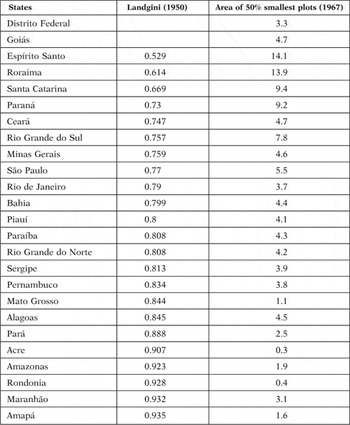
Even the abolition of slavery did not alter the land tenure system and Brazil entered the 20th century with a highly unequal land distribution, characterized by the coexistence of latifundios and the so-called minifundios (very small plots of land incapable of ensuring an adequate living). Table 1 shows the land concentration measured by the Gini index as of 1950 and the percentage of the total area corresponding to the 50 per cent smallest plots up to the median in the year 1967Footnote 10. The northern states with very low population densities such as Pará, Acre, Amazonas, Rondonia, Maranhão or Amapá exhibit the highest land inequalities. Except for Maranhão, these are all frontier states in which the geography is dominated by the Amazon Forest. With Gini indices ranging from 0.76 to 0.85, historically important states with a past of plantation-style, export-oriented agricultural production still exhibited a concentrated land ownership structure in 1950. The historical sugarcane plantations from Pernambuco, Paraíba and Alagoas, the cocoa and sugarcane cultivations in BahiaFootnote 11, the coffee production in São Paulo, Minas Gerais and Rio de JaneiroFootnote 12 or the cattle breeding and mineral extraction in Mato Grosso and Minas Gerais left footprints on the states’ land tenure conditions.
Land concentration across states

Four states are frequently referred to as having a different agrarian land structure: Santa Catarina, Espírito Santo, Paraná and — to a lesser extent — Rio Grande do Sul. Plots between 25 and 30 hectares were no exception within these states, guaranteeing families’ subsistence and small surpluses (see IBGE 1946, p. 58). Within these states, the latifundia system was never as widespread and powerful as in the coffee or sugar plantation zonesFootnote 13. In 1960, the percentage of plots smaller than 100 hectares corresponding to the states’ total area in Espírito Santo, Santa Catarina and Paraná were 54.7, 52.4 and 46.3 per cent, respectively. These numbers were significantly lower in federal units with a latifundia tradition such as Pernambuco (35.2 per cent), Bahia (33.6 per cent) or Alagoas (32.2 per cent; see Guimaraes Reference Guimaraes1968, p. 221).
In the state of Santa Catarina, the concession of the already mentioned sesmarias during the 17th and 18th centuries was granted to the destitute population rather than to nobles or wealthy individuals (Fiori Reference Fiori1991, p. 27). Because of this, according to Cabral (Reference Cabral1968, p. 192), Santa Catarina never experienced the «colonial society that prevailed in other areas, the wealthy and powerful sugar barons, the masters and slaves. The latifundia system never established itself, while the small property regime spread rapidly contributing to the emergence of free labor» (translated by the author). Furthermore, with the Land Law of 1850, the Portuguese Crown had given nearly a third of the province of Santa Catarina, and large areas of Rio Grande do Sul and Paraná to colonization companies. Secure land titles and reasonable properties were guaranteed to mainly German, Italian and Polish immigrants. As a consequence, the agrarian structure of these states was formed mostly around smaller family properties (see Hoffmann Reference Hoffmann1980). These European settlers were attracted in order to address the labor shortage and to stimulate the cultivation of crops such as maize or wheat, vital for the domestic market and neglected by the large plantations.
In Espírito Santo especially, the arrival of immigrants from other states — attracted by moderate land prices resulting from the state’s land-selling policy at the end of the 19th century — promoted the proliferation of smaller family farms. In the year 1920, the average size of rural properties in the state was 42 hectares in the Vale do Rio Doce and 77.1 in the Vale do Itapemirim, low figures compared to the rest of Brazil (see Almada Reference Almada1993, p. 31)Footnote 14. Although Espírito Santo received an important number of European colonizers, immigration did not play the same important role as in Brazil’s southern states (see Almada Reference Almada1993, p. 25).
As evident in Table 1, two other states figure among the most equal ones: Roraima and Ceará. Roraima’s low Gini index is a direct consequence of this state’s equally distributed and very large plots. Its median area of total properties in 1967 was 772 hectares (see Hoffmann Reference Hoffmann1998, p. 7). Thus, the state’s apparently equal land distribution is simply a shortcoming of the Gini index. When additional land concentration measures are taken into account, Ceará also fares worse than the southern states or Espírito Santo. An indication of this is the relatively modest total area of the 50 per cent smallest rural properties shown in Table 1. As will become evident in the next section, the interstate concentration patterns presented here have remained largely unaltered throughout the last decades.
Having briefly analyzed the colonial roots of Brazil’s land inequalities and outlined the regional differences within states’ agrarian structure, the next section addresses the consequences of this variation for states’ educational performance. Making use of historical data, it draws a picture of the different educational performances across Brazil’s federal units in the 19th and 20th centuries. Furthermore, it briefly describes the formulation of educational policies and the schooling indicators within the states of Santa Catarina and Espírito Santo.
6 AGRARIAN STRUCTURE AND SCHOOLING IN 19TH AND 20TH CENTURIES BRAZIL
Profiting from the Brazilian Government Document Digitization Project undertaken by the Center of Research Libraries Footnote 15, the question of whether the provinces mainly organized around family farming such as the southern states, Espírito Santo and, to a minor extent, Sergipe exhibit better educational indicators, as previously hypothesized, will be investigated.
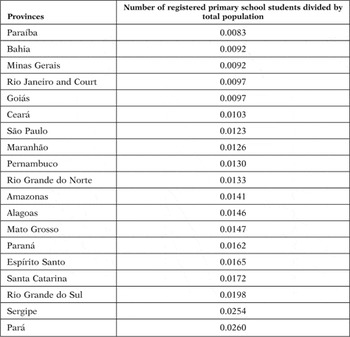
Table 2 lists the average primary school students’ registrations in the years 1865, 1869, 1875 and 1885 (divided by the total population in 1872 and 1890)Footnote 16. Clearly, the four provinces exhibiting the most equal land distribution are among the regions with the highest primary school matriculations. Sergipe has the second highest level of primary students, followed by Rio Grande do Sul, Santa Catarina, Espírito Santo and ParanáFootnote 17. Furthermore, it is striking how economically important provinces such as Bahia (a major producer of cocoa) or Minas Gerais (a major cattle breeder and coffee producer) or São Paulo (a major coffee producer and the motor of the Brazilian economy from the second half of the 19th century until 1920) neglected primary education compared to the other states. The high figures for frontier states with extremely low population densities such as Pará, Mato Grosso and Amazonas have to be interpreted with care. Given their geography, dominated by the rain forest, the population of Brazil’s three biggest states was concentrated in capital cities such as Belém, Cuiabá or Manaus. It is to be expected that the surveyed populations do not include residents outside these major urban areas, distorting the results. Schools outside these few major settlement areas were extremely rare.
Primary school registration, 1865–1885

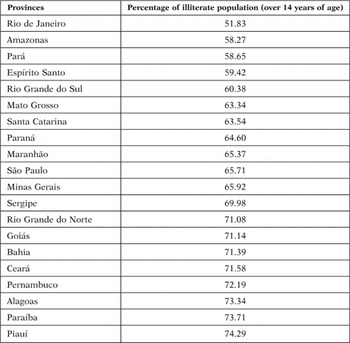
Data showing states’ expenditure on primary education and literacy rates confirm the cross-state variance in human capital formation depicted above. By the year 1870, for example, the province of Santa Catarina spent over three times more than Minas Gerais or Bahia on per capita primary educationFootnote 18. Table 3 confirms the leading position of the southern states and Espírito Santo as far as literacy figures are concerned. In 1900, all four states exhibited lower illiteracy rates than the two politically most influential provinces at that time: São Paulo and Minas Gerais. In Bahia and Pernambuco — prime examples of agrarian economies based on the latifundia system — less than 30 per cent of the population was literate. Again, the low-illiteracy numbers for frontier states such as Amazonas, Pará or Mato Grosso are rather a reflection of their extremely low population density than an effort to educate their citizens.
Literacy rates in 1900

Descriptive evidence of provinces’ effort to expand and ameliorate public schooling confirms the picture shown by the historical statistics. With the so-called Ato Adicional of 1824, provinces were allowed to make their own legislation governing public primary and secondary instruction. Compared to most of the other Brazilian states, Santa Catarina showed an early preoccupation with extending and consolidating the schooling system. As early as 1874, schooling was declared compulsory within the boundaries of the state. Rather than representing a mere legal determination, Ulhôa Cintra, the provincial president at that time, was concerned with truly enforcing compulsory education (see Fiori Reference Fiori1991, p. 53). Recognizing that public instruction was still characterized by deficient school inspection, unprepared teachers and poor-quality instruction, the provincial Assembly of Santa Catarina approved an educational reform in the year 1881. Among other measures, the reform introduced selection processes for the awarding of teaching chairs, lifelong tenure, secularization of schooling, mixed schools and redefined the inspection system.
In 1911, Governor Vidal Ramos introduced additional ambitious educational reforms that profoundly altered the state’s public instruction system. The efficient reorganization of public schooling promoted by Ramos was admired by other states (see Fiori Reference Fiori1991, p. 83). New teaching and learning concepts — rejecting servile memorization of learning matter — were propagated and there was a strong concern with the quality of schooling, which led to an increase in knowledge requirements for teachers and improved statistical coverage (Fiori Reference Fiori1991, p. 96). Writing on the state’s schooling system, the federal deputy Lebon Regis affirmed that teaching supervision in Santa Catarina is «a reality like in no other state» (Regis Reference Regis1917, p. 18, translated by the author).
Like Santa Catarina, the state of Espírito Santo also exhibits an agrarian structure in which smaller family farms always played a fundamental role. However, as previously highlighted, this state was primarily populated by internal immigrants rather than European settlers. By analyzing the state’s educational performance, it is possible to verify whether the positive schooling development in the south can be attributed exclusively to European immigration. Table 2 reveals that Espírito Santo exhibited similar primary school enrollment rates for the period 1865-1885 to the southern states. Furthermore, literacy rates for the years 1940 and 1950 reveal that municipalities organized around family farming showed a lower percentage of illiteracy among the population within this state. Thus, municipalities with greater numbers of smaller farms such as Santa Tereza, Santa Leopoldina or Cachoeiro had literacy rates of 43.63, 49.71 and 44.22 per cent, respectively. These figures were significantly lower in municipalities dominated by large rural properties such as Alegre (34.70 per cent), Mimoso do Sul (30.38 per cent) or Muqui (36.82 per cent). The state’s average literacy for the same year was 39.75 per cent (see IBGE 1953, p. 6). Thus, it seems unlikely that the superior educational performance of southern states is solely an expression of European immigrants’ push for more education.
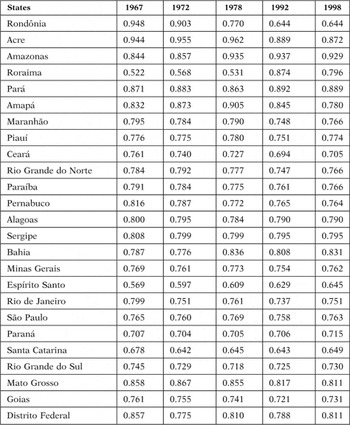
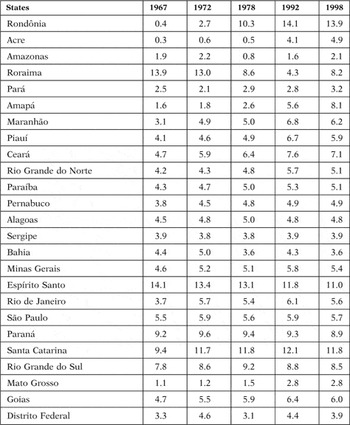
Looking into the 20th century, one can find a remarkable resilience of states’ agrarian structure and a path-dependent pattern for educational figures in most of the federal units. Tables 4 and 5 provide information on land Gini indices and the percentage of the states’ rural area corresponding to the 50 per cent smallest plotsFootnote 19. Considerable changes of both indicators are limited to the northern states. In Roraima, the Gini index increased drastically in the year 1992. However, as already outlined, the relatively low Gini indices for this state in the previous years merely reflected the small number of very large land propertiesFootnote 20.
GINI INDEX OF THE LAND DISTRIBUTION WITHIN BRAZIL’S FEDERAL UNITS

PERCENTAGE OF TOTAL AREA CORRESPONDING TO THE 50 PER CENT SMALLEST PLOTS

Rondônia experienced an extraordinary drop in the Gini index, with a simultaneous reduction in the rural property mean. In this state, government intervention in the rural property structure formation was the most pronounced one. In respect to the percentage area corresponding to the 50 per cent smallest plots, Amapá and Acre — along with the already mentioned states of Roraima and Rondônia — exhibit the biggest variance in land inequality. All these drastic changes can be attributed to the fact that the northern states have been colonized relatively recently. In general, this table reveals that the variance across and within Brazil’s federal units was very modest for the analyzed period.
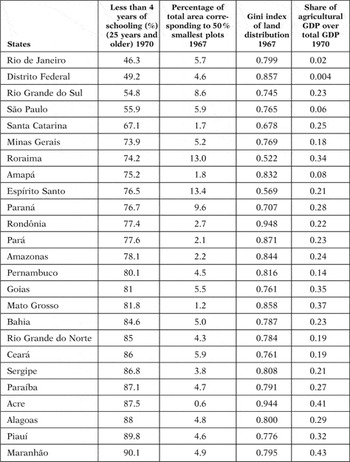
When changes in states’ economic structure and educational performance are analyzed in light of the reported resilience in land inequality, an interesting pattern can be observed. Table 6 shows that the ten Brazilian states exhibiting the lowest share of citizens with less than 4 years of schooling in the year 1970 are either predominantly urban (or do not rely much on rural economies) such as Rio de Janeiro, Distrito Federal, São Paulo or Amapá or maintain high incomes from agriculture while enjoying relatively low land inequality such as Rio Grande do Sul, Santa Catarina, Roraima, Espírito Santo or ParanáFootnote 21. It is striking, for example, that while 23 per cent of Rio Grande do Sul’s income is generated by the rural economy, it has a higher rate of citizens with at least 4 years of schooling than São Paulo, economically the most developed state in the country. In contrast, rural states, characterized by higher levels of land inequality, such as Maranhão, Acre, Mato Grosso, Pará or Amazonas, fare worse regarding the analyzed educational indicator. Thus, it seems fairly safe to conclude that the relationship between land inequality and education has survived within rural states well into modern times. Considering that, by the end of the 1960s, half of Brazil’s territory was still in the hands of plantation owners (see Hagopian Reference Hagopian1996); this conclusion does not appear particularly surprising.
LAND CONCENTRATION, SCHOOLING AND RURAL INCOME AROUND 1970

The descriptive statistics reported above, although corroborating the main argument of this paper, can only serve as preliminary evidence. Given the scarcity of historical data, more sophisticated statistical tools cannot be applied. The next section makes use of more recent data, asking whether the association between agrarian structure and educational outcomes holds for more recent years.
7 CROSS-SECTIONAL ANALYSIS
For the cross-sectional regression analyses presented in this part, a variety of educational indicators have been chosen. As a starting point, an output measure reflecting states’ secondary schooling coverage has been selected for the year 2000: the share of the population between 15 and 17 years of age attending secondary educationFootnote 22. This indicator may give us a particularly good idea of the scope of each state’s secondary school system. In contrast to the historical analysis, this part concentrates on public secondary schooling, given that cross-state differences are much larger for this educational level in present times.
To proxy for states’ agrarian structure, the land Gini index for the year 1995 was used. Data are from the 1995-1996 Censo Agropecuário from the IBGE, which unfortunately is the last agrarian census carried out in the countryFootnote 23. As already noted, the Gini index does not always reflect states’ agrarian structure in a valid manner (e.g. when states’ land ownership structure consists of very large, equally distributed plots). In fact, the measure does not necessarily reflect the size of landholdings. Therefore, the percentage of the total area corresponding to the rural plots smaller than the median (the 50 per cent smallest plots), taken from Hoffmann (Reference Hoffmann1998, p. 9), was also employed.
Several control variables frequently found in the literature have been included. Unless otherwise noted, all of them represent the year 2000. The percentage of children between 5 and 9 years of age was considered in order to account for possible demographic differences across states. Those federal units with a relatively high share of young people are expected to devote more resources to basic schooling and have more students enrolled at these educational levels. Since the performance of educational systems is found to be worse in rural areas, the total share of the rural population in each state was takenFootnote 24. To measure the impact of economic modernization on educational indicators, states’ per capita income in 2000 was included in all modelsFootnote 25. Richer units are expected to show a more highly developed secondary school system. In order to take account of recent findings showing a positive correlation between electoral competition and educational spending and coverage (e.g. Hecock Reference Hecock2006), the level of political competitiveness within each state was also considered. The variable was measured by the number of effective parties in states’ legislative assembly following the operationalization proposed by Laakso and Teegapera (Reference Laakso and Teegapera1979)Footnote 26. Finally, regional dummies for Brazil’s north and northeast were included to account for possible structural instability. Both regions clearly lag behind in most of the country’s economic and social indicators and, as previously shown, also exhibit the greatest land inequalities.
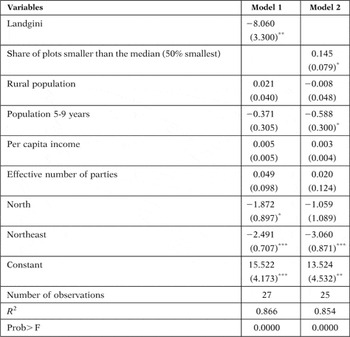
Table 7 shows the results of simple ordinary least squares (OLS) regressions using robust standard errors. In order to normalize the distribution of the dependent variable, the negative reciprocal was taken. After the transformation, a skewness–kurtosis test certified that the sample at hand came from a normally distributed population. In addition, Cook and Weisberg tests for heteroscedasticity indicate that the null hypothesis of constant error variance cannot be rejected — which applies for all the regression results reported in this paper.
DEPENDENT VARIABLE: SHARE OF POPULATION BETWEEN 15 AND 17 YEARS OF AGE ATTENDING SECONDARY EDUCATION

Note: Ordinary least square (OLS) regressions using robust standard errors. Standard errors are given in parentheses.
**Significant for P < 0.05; *P < 0.1; ***P < 0.01.
Clearly, land inequality measured by the Gini index significantly decreases the share of the population between 15 and 17 years of age attending secondary education (model 1 of Table 7). The effect magnitude is considerable, as secondary school attendance drops by 0.21 standard deviations with each one standard deviation increase in land Gini indices. Only the coefficients of the dummy variables accounting for the northeastern and northern states are larger. All remaining control variables are non-significant. The results are similar when the percentage of the total area corresponding to the 50 per cent smallest plots is used as an alternative operationalization of the agrarian structure (model 2)Footnote 27. The more the total rural area is constituted by smaller plots, the higher the rate of secondary school attendance. Under this model specification, the demographic variable measuring the share of the population between 5 and 9 years of age also turns out to be significant at the 10 per cent level, decreasing secondary school attendance. It can be expected that states showing a very young population tend to concentrate on primary schooling. Employing alternative educational indicators, such as the share of the population above the age of 9 years having completed 8 years of study as a dependent variable, yields very similar resultsFootnote 28.
An important caveat of educational indicators that measure attendance or attainment is their inability to account for schooling quality. A state, for example, may have nearly 100 per cent of its children attending elementary school. Effectively, however, only a small minority of them might in fact be able to read and write. Thus, it is necessary to assess the efforts made by the states to deliver high-quality educational policies. In 2005, Brazil’s Ministry of Education (MEC) together with the Instituto Nacional de Estudos e Pesquisas Educacionais Anísio Teixeira (INEP) developed an index of school quality for each state. The IDEB index combines information on students’ performance on standardized examinations (Prova Brasil or Seab) with information on students’ school performance (average pass rate)Footnote 29. The index ranges from 0 to 10, with higher values indicating better quality.
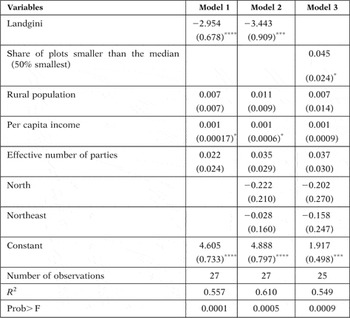
Table 8 reveals that the secondary schooling system of states exhibiting concentrated land ownership patterns suffers from an inferior teaching quality. Even after the introduction of the regional dummies (model 2), the main variable measuring states’ agrarian structure remains negative and highly significant. When standardized coefficients are calculatedFootnote 30, the variable landgini has the greatest effect magnitude of all. Each one standard deviation increase decreases the IDEB index score by 0.62 standard deviations. Furthermore, it seems that richer states also exhibit better-prepared secondary students. This assertion, however, does not hold for model 3. All other coefficients remain identical when the alternative operationalization of land concentration (share of the 50 per cent smallest plots) is employedFootnote 31. Note that the percentage of the population between 5 and 9 years of age was excluded from the analysis as there are no theoretical grounds to believe that states’ demography has an impact on schooling quality.
DEPENDENT VARIABLES: QUALITY OF SECONDARY EDUCATION

Note: Ordinary least square (OLS) regressions using robust standard errors. Standard errors are given in parentheses.
****Significant for P < 0.001; ***P < 0.01; *P < 0.1.
Up to this point, only output variables have been employed to describe each state’s educational system. Many authors argue in favor of the superiority of these indicators relative to incidence-based measures. Government-spending levels, for example, can be distorted by patterns of «hidden» rentsFootnote 32. Nevertheless, this paper will make use of educational spending figures in order to test the political economy mechanism formulated in section 3 explicitly. Assuming that the rural elite has no interest in the promotion of broadly targeted educational policies, it can be expected that governments under the influence of this elite will refrain from investing in the school system. The next analysis uses states’ overall educational expenditures divided by their total population between the years 2003 and 2005 as a dependent variable. The data are reported by IPEA and is expressed in Reais (thousand)Footnote 33. To transform the variable into a normally distributed one, the negative reciprocal root was taken.
Rather than proxy the influence of agrarian elites by drawing on the landownership patterns within each state, a more direct measure of landlords’ political articulation capacity will be employed. The so-called bancada ruralista is a good indicator of landowners’ current political power. This powerful rural interest group encompasses federal deputies and senators from different political parties that defend the interests of large landowners within the National Congress. During the legislature of 2003-2007, the bancada ruralista consisted of 111 federal deputies (from a total of 513 seats), as calculated by the Departamento Intersindical de Assessoria parlamentar (Diap). These deputies were extremely successful in maintaining the current land distribution patterns and agricultural work relations. In the Chamber of Deputies, for example, they repeatedly blocked the constitutional amendment PEC 438/2001, which foresees the confiscation of properties employing slave work.
For each new legislature, the Diap publishes the names of federal deputies and senators pertaining to the referred interest group, examining whether congressmen embraced the causes of this particular advocacy group in the plenary sessions, the commissions or in interviews. Most of the representatives openly state their membership in their curricula posted on the chamber of deputies’ website. The total number of federal deputies and senators belonging to the bancada ruralista in each state during the legislature 2003-2007 will be employed as a measure of landlords’ political influenceFootnote 34. In addition to the control variables included in the former modelsFootnote 35, two more were added: the federal educational transfers to the states in the period 2003-2005 (reported by IPEA) and a dummy variable reflecting the partisanship of the major state legislative party in the year 2004Footnote 36. According to conventional wisdom, left-wing parties are expected to spend more on social policies.
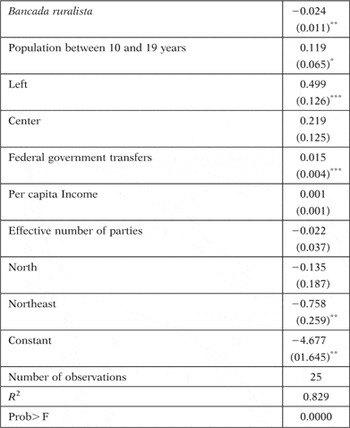
As can be seen in Table 9, the higher the number of members belonging to the described interest group within each state, the less is spent on education. The coefficient for the variable bancada is negative and significant at the 5 per cent level. Three control variables reached statistical significance. In accordance with the literature, left-wing parties seem to spend more on schooling. Also, the more educational transfers the federal government makes to the single states, the higher their total expenditure on education. Finally, demographically younger states (with a higher share of their population between 10 and 19 years of age) disburse more on the schooling system. Once more, northeastern states lag behind, spending less on education than the other states.
DEPENDENT VARIABLES: TOTAL EDUCATIONAL EXPENDITURE DIVIDED BY POPULATION

Note: Ordinary least square (OLS) regressions using robust standard errors. Standard errors are given in parentheses.
**Significant for P < 0.05; *P < 0.1; ***P < 0.01.
Concerning the robustness of the results, several checks were carried out. First, the robustness of including and excluding one or more control variables in the preferred specification was verified, applying a technique recently developed by Barslund (Reference Barslund2007). The author provides a STATA module to perform robustness checks of alternative specificationsFootnote 37. The command estimates a set of regressions in which the dependent variable is regressed on core variables — which are included in all regressions — and all possible combinations of other (non-core) variables. An analysis of predictors’ variance inflation factor (VIF) confirmed that the results are not driven by multicollinearity.Footnote 38 In addition, two varieties of robust regressions that resist the pull of outliers — giving them better-than-OLS efficiency in case of non-normal, outlier-prone error distributions — were appliedFootnote 39. In addition, dropping one state at a time did not alter the results substantially. The tests indicate that all models presented in this section are robust to alternative specifications and are not driven by single outliers.
8 Conclusions
Given the general academic consent regarding the importance of education for countries’ development, it is surprising how little attention the social sciences have paid to the effect of structural variables such as landownership patterns on the formation of human capital. Trying to address this shortcoming within the literature, this paper explored the impact of different agrarian structures on the schooling system of the Brazilian states.
The paper has concentrated on the political economy argument, suggesting that landlords had no interest in the expansion of schooling out of the fear of higher taxes as well as the loss of a cheap, coerced labor force and their monopoly over the decision-making process. By describing several episodes of Brazil’s history of education, the paper provided positive evidence for the proposed causal mechanism. In this manner, it tried to remediate a frequently found shortcoming of quantitative, macrocomparative studies, which limit themselves to showing significant correlations without truly addressing and testing particular channels. Brazil proved particularly useful for this purpose, given that it has a tradition of plantation-style agriculture and, simultaneously, exhibits federal units with a rural economy organized around smaller family farms. Moreover, the country’s primary and secondary education lies largely in the hands of each individual state.
The overview of Brazil’s history of education revealed the importance of politically influential groups such as landlords in the formulation of educational policies. It showed, especially, that traditional forces represented by the rural aristocracy tried to maintain the elitist character of the educational system, depriving the masses from citizenship-enhancing schooling while favoring the development of higher education. Long-winded and mostly unsuccessful attempts to reform the educational system illustrated this point. Through this course of action, the rural elite maintained their strong political power and the agrarian structure characterized by high land inequality and coercive working relations for a long time.
Descriptive analysis of historical data showed that economically important provinces whose agriculture was based on plantations employing slave or cheap hired labor lagged behind with respect to student registration rates. More recent data evidenced little variation of land distribution patterns across and within states as well as enduring educational backwardness in predominantly agrarian and unequal federal units. Inferential statistics corroborated the paper’s main claim. Cross-section regression analysis showed that states exhibiting higher land equality systematically outperform less egalitarian units concerning school coverage and educational quality. This is especially true for the secondary school system. Finally, states with a high number of congressmen belonging to the interest group bancada ruralista invest less in education. Thus, supportive evidence was provided to demonstrate large landlords’ aversion to governmental schooling expenditures.
Much room remains for future research. Upcoming studies should concentrate on disentangling and testing the single channels through which the agrarian structure impacts countries’ educational policies. This would surely improve our understanding of the formulation of public policies and, above all, would be particularly relevant for many developing countries which are still highly dependent on agricultural production. Another interesting line of research to be explored is the possible interconnectedness of the rural and industrial elites and its impact on human capital formation.