Ventricular septal defects are one of the most common CHDs, accounting for approximately 40% of all CHDs. Reference Penny and Vick1 The current treatments for VSD mainly include surgical repair, transcatheter device closure, and transthoracic device closure. Reference Liu, Lu and Zhou2–Reference Xu, Chen and Chen4 For some infants with low age, low weight, unrestricted VSD, and pulmonary hypertension, early surgical treatment in infancy remains the first choice. With the gradual improvement of surgical techniques and perioperative management, the surgical risk is relatively low. Reference Roos-Hesselink, Meijboom and Spitaels5,Reference Hazekamp, Gomez and Koolbergen6 However, these infantile patients still need to be followed up closely to identify and address related complications in a timely manner. However, due to the uneven distribution of medical resources in China, children with CHD are mostly from rural areas and remote mountainous areas, and their family economic conditions and education levels are low, leading to a high rate of loss to follow-up due to traffic and economic factors. For parents living in cities, it is difficult to follow-up regularly due to work. Economic burden, time cost, and inconvenient transportation are the main factors affecting regular follow-up. Reference Zhang, Geng and Shao7,Reference Zhang, Wang, Li and Xu8 Currently, the rapid development of information technology has promoted the convenience of medical consultation patterns. Reference Wiegand, Marggraf, Wilhelm, Eivazi and Werner9 In China, the WeChat platform is an electronic social media platform that is used as a telemedicine model for disease monitoring, prevention, and health management in a variety of cases such as infertility, chronic diseases, and infectious diseases. Reference Shao, He and Zhu10–Reference Xu, Huang and Qiu12 In this study, we explored the feasibility and superiority of the WeChat platform in the clinical follow-up of infants after cardiac surgery.
Methods and materials
Patients and their families were informed of the study content and signed informed consent forms.
Research object
According to the presurvey results, the alpha value was set to 0.05, and the power was set to 0.90. Considering an inevitable loss to follow-up rate, the resulting minimum sample size was 86 patients based on the calculation. This was a prospective randomised controlled study.
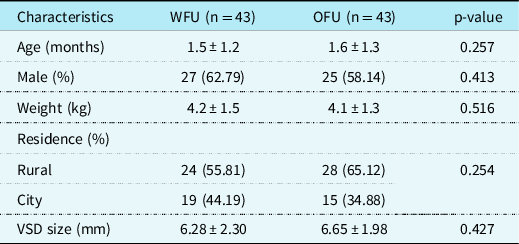
From February, 2019 to March, 2020, 86 infantile patients diagnosed with VSD who successfully underwent surgical repair were selected as the research patients. Inclusion criteria were as follows: infantile patient with VSD; combined with moderate-to-severe pulmonary hypertension; no other cardiovascular malformations were associated; no aortic regurgitation; no serious perioperative complications of other organs; and the parents had smartphones and could complete the WeChat operations. The exclusion criteria were as follows: parents were unwilling to complete this research or they had no smartphones. Parents with mental illness or other medical illnesses that might affect the willingness and ability to participate in the study were also excluded from this study. Our hospital ethics committee approved the study, and all the parents signed informed consent to participate. The clinical information of the patients is shown in Table 1.
Baseline characteristics between the two groups

According to the predesigned random distribution envelope, eligible patients were randomly divided into an outpatient follow-up group and a WeChat follow-up group. A distribution card with 0 or 1 written in the envelope: 0 represented the WFU group and 1 represented the OFU group. A technician who was not directly involved in the study performed the group process, so the researchers did not know how the patients were grouped. All patients were diagnosed with VSD and successfully received surgical repair. The parents of the patients in the WFU group were required to have a smartphone and be able to complete follow-up consultations through the WeChat platform.
All patients were given regular discharge and rehabilitation guidance when they were discharged. In the OFU group, electrocardiogram and echocardiography were performed at 3 months and 1 year of follow-up in the outpatient department. Then, the outpatient doctors guided the related medications and post-operative rehabilitation. If the patients experienced any sudden emergency, they could see the doctor at any time. In the WFU group, electrocardiogram and echocardiography were performed at the 3-month and 1-year follow-ups at the local hospital, and then the results were submitted to the WeChat platform. A doctor with a specific WeChat account was dedicated to the follow-up work and asked all the parents in the WFU group to add this WeChat account. Then, the doctor instructed the parents to join the WeChat exchange group and taught them how to receive and send WeChat messages. Knowledge of post-operative rehabilitation, family health care, and diet were regularly released through the official WeChat platform, mainly in the form of text, video, and pictures. The parents in the WFU group could communicate with the doctor when their patient experienced any sudden emergency.
Post-operative complications were recorded, including heart block, valve insufficiency, residual leakage, low cardiac output syndrome, and pulmonary infection. Post-operative echocardiography was performed routinely before discharge to confirm surgical outcomes and detect post-operative complications. Patients with pericardial effusion were to be cured during hospitalisation. In this study, the calculated value of the economic cost and time spent was derived from the patients. The time spent in the OFU group was calculated from the start at home to the return home during the follow-up period. The cost included the fee of transportation from the local city to our clinic, accommodation, and examination expenses. For the WFU group, the time spent included examination, sending the results, and consulting with the doctor on the WeChat platform. The cost included transportation in the local city and examination expenses, as well as Internet tariffs. Internet tariffs in China are relatively cheap and could even be ignored. Reference Lyu, Zhao and Wang13 A unified researcher who did not know the specific grouping situation analysed and managed these data.
In this study, parents were notified if they were not followed up in time in the OFU group. They were considered lost to follow-up if they had not been followed up in an outpatient clinic one week later. For the WFU group, parents who did not reply to the WeChat platform were reminded by the WeChat message within 3 days. If they still did not reply within 1 week, they were considered lost to follow-up. Reference Murray, Britton and Bulstrode14
The patient satisfaction questionnaire (PSQ-18 questionnaire) was used to assess parent satisfaction and was completed during 1 year of follow-up. The questionnaire was validated for use in different settings, developed through rigorous research, abbreviated from many other questionnaires, and maintained internal consistency and reliability. Seven dimensions of satisfaction were used by the Likert scale, including general satisfaction, technical quality, interpersonal manner, communication, financial aspects, time spent with the doctor, and accessibility and convenience. Reference Qiao, Geater, Chongsuvivatwong, Fan and Guo15,Reference Thayaparan and Mahdi16
All statistical analyses were conducted with SPSS software version 23.0 (SPSS Inc., Chicago, IL, United States of America). Continuous data are expressed as the mean ± standard deviation. A routine distribution test was performed for all continuous data, and the data were confirmed to be normally distributed. Clinical parameters between the two groups were compared with the independent samples t-test. The χ 2 or Fisher’s exact test was used for categorical variables. A p-value of <0.05 was defined as statistically significant.
Results
A total of 81 patients (41 in the WFU group and 40 in the OFU group) completed the study. There was no significant difference in the demographic and clinical characteristics of all patients between the two groups (Table 1).
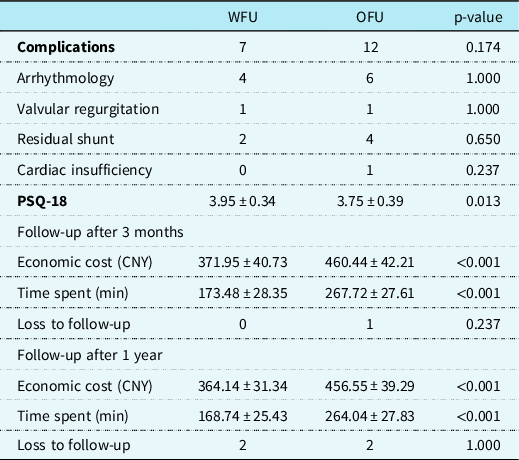
No postdischarge deaths were found during the follow-up period. There were no cases that required readmission to drain pericardial effusions during the 3-month follow-up. The total number of post-operative complications was 7 in the WFU group and 12 in the OFU group. Arrhythmia occurred in four cases in the WFU group and six cases in the OFU group. No severe atrioventricular block occurred in either group. Valvular regurgitation occurred in one case in the WFU group and one case in the OFU group. Post-operative residual shunts occurred in two cases in the WFU group and four cases in the OFU group. There was no significant difference in the incidence of complications between the two groups (p > 0.05, Table 2).
Comparison of post-operative complications, PSQ-18, loss to follow-up, time spent, and related cost between the two groups

CNY = China Yuan
There was a statistically significant difference in the time spent between the two groups during the 3 months and 1 year of follow-up (173.48 ± 28.35 versus 267.72 ± 27.61 min, p < 0.05, and 168.74 ± 25.43 versus 264.04 ± 27.83 min, p < 0.05, respectively; Table 2). There was a statistically significant difference in economic cost between the two groups during the 3-month and 1-year follow-ups (371.95 ± 40.73 versus 460.44 ± 42.21 China Yuan, p < 0.05, and 364.14 ± 31.34 versus 456.55 ± 39.29 China Yuan, p < 0.05, respectively; Table 2).
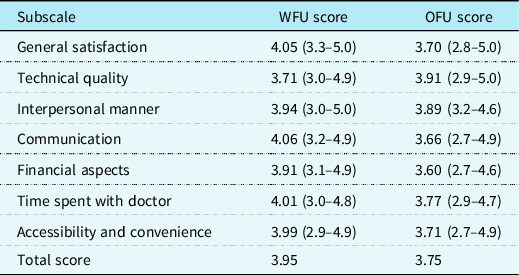
During the 3-month follow-up, no patient in the WFU group was lost to follow-up, while one patient in the OFU group was lost to follow-up. During the 1-year follow-up, two patients in the WFU group and two patients in the OFU group were lost to follow-up. There was no statistically significant difference in loss to follow-up between the two groups (p > 0.05, Table 2). During the 1-year follow-up, the overall parents’ satisfaction in the WFU group was significantly higher than that in the OFU group (p < 0.05, Table 3).
PSQ-18 scale scores (n = 81)

Discussion
There are many patients with VSD who need to be treated each year. Reference Penny and Vick1–Reference Yi, You and Ding3 For most infantile patients with unrestrictive VSD, early surgical repair is still the best option. Reference Zhang, Geng and Shao7,Reference Zhang, Wang, Li and Xu8 Although these patients have received detailed health education and medication guidance during their hospitalisation, they will still encounter many factors that affect their recovery after discharge. To strengthen these infantile patients’ follow-up after discharge, timely targeted guidance on medication, diet, rest, and exercise could prevent complications and improve their quality of life. Reference Videbæk, Laursen, Olsen, Høfsten and Johnsen17 At present, outpatient follow-up is one of the most commonly used traditional methods and can obtain reliable and comprehensive clinical data. However, this method is time-consuming and costly, and it is difficult for most patients from other provinces, cities, or remote areas. In our centre, outpatient follow-up usually lasts only a few minutes and often cannot meet most patients’ and their families’ needs. Reference Dixon, Beaver, Williamson, Sutton, Martin-Hirsch and Hollingworth18 It is therefore necessary to add a new follow-up method. In recent years, mobile medical technology has been widely used as an educational tool for medical guidance. Reference Wiegand, Marggraf, Wilhelm, Eivazi and Werner9–Reference Xu, Huang and Qiu12 Hospital-based telemedicine systems have proven to be effective in carrying out continuity of care after primary treatment is over and used in both developed and developing regions of the world. Reference McLean, Protti and Sheikh19,Reference Montgomery, Krupa, Wilson and Cooke20 Many studies have shown that the WeChat platform, as a health education tool for disease management, is more effective than other traditional methods in reducing time and economic costs, improving treatment compliance, reducing patient complications, increasing follow-up rates, and improving patient conditions. Reference Liu, Luo and Zhang21,Reference Feng, Liang and Zhang22
In this study, the results showed no significant difference in the incidence of post-operative complications between the two groups, which indicated that both follow-up modes were safe. With socialisation in China, the rhythm of people’s lives has generally accelerated, and the time spent is increasing. This study found that follow-up through the WeChat platform could significantly save time, which was the right choice for family members pressed for time, and had excellent life pressure. In addition, it was found that the economic cost of the WFU group was significantly lower than that of the OFU group, which was of great significance for reducing medical expenditures and improving residents’ living standards. This study showed that the overall parents’ satisfaction with the WFU group was higher than that of the OFU group. The parents in the WFU group could fully communicate with each other in the WeChat group. Through the WeChat platform, parents could learn professional knowledge about post-operative care, feeding, and complication handling anytime and anywhere. When they encountered problems, they could consult with professional medical staff and obtain professional support more quickly and continuously. Simultaneously, it was more beneficial for both doctors and patients to complete the follow-up process. In addition, the parents of patients could send texts, pictures, and videos through the WeChat platform. During the communication process, doctors would have more time to answer the parents’ questions and give more humane care, leading to a better experience for parents. This provides the right impetus for the improvement of the doctorpatient relationship.
Although the study found that there was no significant difference in the loss to follow-up rate between the two groups, it was found that the parents of the WFU group were more willing to keep in close contact with the doctor during the follow-up period. Through the WeChat platform, parents could have timely and easy access to professional medical support. Doctors could send relevant health knowledge according to parents’ different needs, which made the information transmission more targeted and practical. After receiving oral health education from the nursing staff at discharge, parents could strengthen the related knowledge through the WeChat platform. Such strengthening did not occupy much workforce and material resources, avoid the repetitive labour of medical staff, save doctors’ and parents’ time, and improve follow-up work efficiency. In the case of limited medical resources, the WeChat platform could improve the medical compliance of patients’ family members and increase their understanding of the condition and confidence in treatment, thereby increasing the satisfaction of the medical process.
Limitations
In addition, this research had some limitations. First, due to the instability of network support and WeChat access, especially in rural areas of China, some qualified parents had not been recruited. Second, this study did not involve complex CHDs, and these patients usually require long-term follow-up. In future studies, this group of patients should be included to verify the effect of WeChat follow-up on patients with complex CHDs. Third, the sample size of the study was limited, and the follow-up time was short. Future research needs to confirm these conclusions in larger cohorts, offer a more extended follow-up period, and further investigate whether the WeChat follow-up model will bring intentional clinical results and reduce the burden of follow-up to outpatient doctors.
Conclusion
Midterm clinical follow-up of infants undergoing surgical repair of VSD through the WeChat platform can effectively save time and economic costs, improve parents’ satisfaction, increase the convenience of follow-up, and promote communication between doctors and patients.
Acknowledgements
We highly acknowledge the contribution of the participating doctors: Qi-Liang Zhang, Ze-Wei Lin, Wang-Sheng Dai, Li-Wen Wang, Jing Wang, and Ling-Shan Yu. We hope humans eventually defeat COVID-19.
Author contributions
Wen-Peng Xie and Qiang Chen designed the study, performed the statistical analysis, participated in the operation, and drafted the manuscript. Jian-Feng Liu and Yu-Qing Lei collected the clinical data. Hua Cao provided financial support. All authors read and approved the final manuscript.
Financial support
This study was supported by the National Key Research and Development Program of China (grant no. 2016YFC1301900).
Conflicts of interest
None.
Ethical standards
This study was approved by the ethics committee of our hospital (2020KY039) and conformed to the Declaration of Helsinki.