Challenging “dogmas” in cognitive neuroscience is important for the advancement of our professional development. Therefore, we highly appreciate Cohen Kadosh & Walsh's (CK&W's) target article, which attempts to challenge the widely held belief that the neural representation of numerosity may be abstract rather than non-abstract. According to “neural constructivism,” the representational features of the human neo-cortex are strongly modulated by a dynamic interaction between neural growth mechanisms and environmentally derived neural activity (Quartz & Sejnowski Reference Quartz and Sejnowski1997; see also Fisher [Reference Fisher2006] for discussion of the gene–environment interdependency). Hence, a closer look at the development of the brain, and in particular, at the development of neural representations of numerosity, will shed further light on the question of whether numbers are represented in an abstract or non-abstract manner.
The primary aim of this commentary is to provide more recent developmental data revealing that number representations in children are not stable, but rather, undergo a developmental shift from distinct (non-abstract) to shared (abstract) representations. Beyond behavioral data, we attempt to apply a functional geneticist view as an explanatory framework for the complex data reported thus far. As outlined rather briefly by CK&W, the findings of the few developmental studies that were dedicated to examining notation-dependent effects on number processing in children largely support the authors' notion that children's number representations are likely to be non-abstract (Holloway & Ansari Reference Holloway and Ansari2009). Maybe even more interesting is the finding that 3-year-olds' abilities to compare non-symbolic number sets seem to rely on perceptual cues if the ambiguity between (discrete) numerical and (continuous) non-numerical stimulus properties is overwhelming (Rousselle et al. Reference Rousselle, Palmers and Noël2004). The latter results clearly speak against the notion of an abstract number representation. A similar conclusion has been drawn by Butterworth (2005), who argues that “if put into conflict … continuous quantity seems a more powerful cue” (p. 5; see also Mix et al. Reference Mix, Huttenlocher and Levine2002). Five-year-old children are able to compare and add large sets of elements presented in different non-symbolic modalities (dot arrays, tone sequences) (Barth et al. Reference Barth, La Mont, Lipton and Spelke2005). Importantly, the authors' report a significant interaction between the presentation format and the ratio of the two sets to be compared, being characterized by a steeper ratio-dependent decline in cross-modal performance. If one assumes an abstract representation of numbers, no performance differences within and across modalities should have been observed. Likewise, children's mapping between non-symbolic and symbolic number representations becomes more refined with age, which is contrary to expectation if one assumes abstract number representations (Mundy & Gilmore Reference Mundy and Gilmore2009). Findings of dissociations between different notations are not restricted to typically developing children; dyscalculic children also are reported to exhibit impaired performance when comparing symbolic Arabic digits, but not when comparing non-symbolic object sets (Rousselle & Noël Reference Rousselle and Noël2007).
With respect to developmental dyscalculia (DD) the distinction between automatic and intentional performance is an important one. Empirical evidence, supporting the authors' claim that automatic number processing might be a more powerful tool to assess differential number processing skills, comes from a single-case study of DD (Kaufmann et al. Reference Kaufmann, Lochy, Drexler and Semenza2004). Results are incompatible with the notion of abstract number representation, as they revealed that number-processing deficiencies predominantly emerged upon automatic, but much less upon intentional number processing. A further interesting issue in this case study was the finding of operation-specific effects in fact retrieval (addition and subtraction facts being relatively preserved, while multiplication facts were severely impaired; Kaufmann Reference Kaufmann2002). In our view, operation-specific effects (which have been frequently reported in the patient literature, e.g., Pesenti & van der Linden Reference Pesenti and van der Linden1994) – like effects of notation – are not in line with an abstract view, but rather, are strongly suggestive of the existence of distinct number representations.
Finally, we suggest that the “generalist genes” theory may provide a plausible – though thus far, speculative – explanatory framework for the view that number representations undergo a gradual developmental change (Kovas & Plomin Reference Kovas and Plomin2006). In particular, concepts of polygenicity (many genes affect one trait/one cognitive domain) and pleiotropy (one gene affects many traits/cognitive domains) are not only apt to explain the frequently observed comorbidity between DD and other learning disabilities such as dyslexia or attention disorders, but may also provide a useful theoretical framework for the assumption that number representations become shared (abstract) with more experience/practice, which is inevitably accompanied by a more fine-tuned gene–environment interdependency (Fisher Reference Fisher2006; Kovas & Plomin Reference Kovas and Plomin2006).
In sum, developmental findings challenge the existence of an abstract number representation. However, in our view, notation-specific effects are not necessarily indicative for the existence of non-abstract number representations, especially when it comes to developmental studies. The observed interactions between different input modalities could also be a result of deficient mapping between symbolic and non-symbolic representations in children with and without DD. We assume that developmental progress goes along with higher overlap of brain activation between, as well as across, different numerical input modalities. Previously, we found no activation differences between approximate and exact calculation in school children (Kucian et al. Reference Kucian, von Aster, Loenneker, Dietrich and Martin2008). These results, rather, point to a mutual neuronal network for both tasks. However, one has to keep in mind that both tasks have been presented symbolically, differing solely in demands.
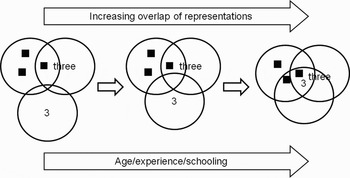
Taken together, we suggest that brain activation patterns for different numerical tasks are partly overlapping and that some brain regions are dependent on notation/input modality. Moreover, activation patterns get influenced by task demands such as automatic or intentional number processing. If a core region for number processing exists, it is plausible that this region consists of highly interconnected neurons for different numerical inputs and that activation of one neuronal population quickly spreads to other populations, leading to cross-notational activation, as proposed by CK&W. With development and higher numerical proficiency, these cross-notational activations might increase, reflecting automatization processes. There is probably a gradual difference in definition between non-abstract and abstract representation of numerosity with respect to both the strength of connections and to coactivations of different neuronal populations. If, for instance, the connection is extremely tight and both neuronal populations get activated simultaneously independent of inputs, one could label it as an abstract numerical representation, although this representation is built up by distinct neuronal populations. Upon summarizing the above-mentioned findings, we propose the following developmental model (Fig. 1) of how number representations might be formed:
Our developmental model of number representation proposes an increased overlap of representations across different number notations with advanced expertise, and, furthermore, implies a gradual shifting from non-abstract to abstract representations of numerosity.