Introduction
Marco Polo, with his father and uncle, supposedly arrived in Shangdu about 1275, the same year that the only Easterner to visit the West in medieval times, Rabban Sawma, supposedly departed for the Holy Land from Khanbaligh (Beijing). This article examines the perspective of Polo, through his direct observation of Kublai Khan and Yuan China, as revealed in the book that tells the story of Marco Polo’s journey, The Travels of Marco Polo. As is well known, Marco Polo did not write the work himself, but related his experiences to his fellow prisoner in Genoa, Rustichello, a popular romance writer, who wrote them down, and transformed them into the stories presented in The Travels. Although Rustichello is the author of The Travels, the sections on Yuan China’s political, social and economic affairs come clearly from Polo’s memories of the East without much intervention of Rustichello, since there is a remarkable agreement between Polo’s descriptions and those of a contemporary Chinese scholar, which I will be discuss later. The edition of The Travels to be considered here is the English translation by H. Yule and H. Cordier, because of its substantial annotations. In addition to The Travels itself, other sources to be considered are the Official Chinese Yuan History (the Yuan shi), other first-hand accounts, the vast secondary literature on the subject, and an archaeological discovery.
The paper analyses the sources of Polo’s perspective on the people he encountered on his travels in foreign lands. It argues that Polo’s ideas were shaped by his cultural background, personal experiences and his own interests. Then it examines how the work presents Kublai Khan himself, as well as the Yuan empire’s monetary system, its waterway trade and its ethnic policy. It aims to show that Polo praised some aspects of Kublai’s rule while also criticizing others; thus, in my view, Polo gave an on-the-spot report on the autocratic rule of the Yuan empire. Polo neither ‘exhausts his powers of admiration and delineation’ of the Great Khan, as Charles Beazley comments,Reference Beazley 1 nor ‘gives his reader a panorama of transgressive topoi with rude chaos and abomination, which deterritorialises other habitudes’ as Syed Manzurul Islam claims.Reference Islam 2 Insofar as the past East–West encounter is concerned, The Travels contributed much to both Western and Eastern mutual understanding of the world and fulfilled Polo’s aim in writing it, ‘… so that men might know the things that are in the world’.Reference Polo 3 The Travels provides a detailed description of the lands through which the Polos travelled. According to Charles Beazley, the description of the East in The Travels unfolded ‘a Far Eastern panorama which long held the attention of Christian Europe, which to a great extent prompted the explorations of succeeding centuries’ (Ref. Reference Beazley1, pp. 102–103). John Larner comments that The Travels ‘bestowed on Europe an amazing gift, a geographical treatise of a vast extent and complexity, an unparalleled opening of horizons’.Reference Larner 4 Coming after the works of the early Franciscans Carpini (1245–1247) and Rubruck (1253–1255), The Travels reflects a somewhat different historical moment, especially an eye to East–West relations. When Marco Polo, with his father and uncle, set out to the East in about 1271, their destination was Yuan China, not the Mongol empire of Carpini and Rubruck. The pattern of world politics had shifted in the intervening years. Mongol rulers of Yuan China were not as scornful of Westerners as their predecessors were when the two Franciscans had visited the ‘Mongol Orient’, nor did they consider launching another invasion in the distant West. Instead, as recorded in The Travels, Kublai Khan sent the two elder Polos to the Pope to request that a hundred learned Christians be sent to his court. Not only were the attitudes of the Mongol rulers toward Western Europe different from the time of the early Western travellers to Mongolia, but Western attitudes had changed as well. The Venetian traveller’s attitude towards the Mongols differed from that of the early missionaries, again largely because of the changes in the world situation, and especially because the Mongol threat to Europe had diminished. Moreover, Carpini, as the Pope’s representative, and Rubruck, as a preaching friar, had religious and political motives. The persona in The Travels, representing Marco Polo, is a Venetian merchant. This probably explains why he pays more attention to secular society than to matters of religion.
The Portrayal of Yuan China and its Ruler
The study of The Travels of Marco Polo has attracted attention from academia both in the East and the West. A recent academic work, by Hans Vogel, offers a thorough discussion of the pros and cons of Marco Polo’s authenticity, providing new evidence for the latter, and thus forms a convincing defence. In my paper the main questions to be discussed are: how did Polo view what he encountered in distant foreign lands, what shaped his perspective, and what did The Travels contribute to East–West communication and to the study of Yuan history. An examination of The Travels shows that Polo’s judgements concerning Kublai Khan and Yuan China were affected by his personality, cultural background and personal experience. I shall argue that his work shows a substantial amount of objectivity towards his subject matter. Although he had great respect for the monarch and enormous admiration for the wealth of China, and was grateful to the Khan for offering him excellent opportunities to carry out profitable business deals, at the same time he pointed out a number of deficiencies in the Khan’s rule. For the most part, the aspects of Kublai’s reign that the traveller admired were standard features of the settled civilization of China, such as its large population, extensive territories, inexhaustible natural resources, ambitious constructions and skilled shipbuilding. On the other hand, those aspects that he criticized tended to be characteristic of Mongol rule.
Polo’s relationship with the Great Khan seems so close that he almost worships him. He grew very attached to the Yuan court. The situation of China under Mongol rule was unusual, and more will be said about it later. In the view of Polo, one of the reasons Kublai wielded power successfully was that he was wise, prudent, and gifted at waging war (Ref. Reference Polo3, vol. 1, pp. 331–332). Polo sings the praises of the Khan’s military power, which he finds formidable, noting that the Christian kings and Muslim rulers could not have resisted him even if they had pooled their resources. Polo speaks well of the Khan’s great achievements and heroic exploits (and as if there were no match for the Khan in all of world history – Ref. Reference Polo3, vol. 1, pp. 246, 331). He extols the Yuan dynasty’s impressive achievements under the Khan’s rule, mentioning its flourishing industry and commerce, and its great accomplishments in urban and rural construction, shipbuilding, roads and bridges, and astronomy. (Ref. Reference Polo3, vol. 2, pp. 13, 22, 24, 31, 33, 36–37, 49, 66, 76, 85, 106, 132, 135, 138, 140–142, 152–153, 157, 170–171, 174, 176, 178, 181–182, 186, 201, 215, 218–219, 231, 235, 433, 440). He also praises the Khan’s centralized and benevolent rule. Polo reports that the Khan appointed 12 lords under whom he formed a system of highly concentrated political power, controlling the state and military affairs (Ref. Reference Polo3, vol. 1, pp. 430–431), and that he also sent his court officials to make regular investigative tours of the whole country. When crops failed due to bad weather, or when people suffered because their livestock froze to death or died of an epidemic, the government reduced their taxation and granted them new animals (Ref. Reference Polo3, vol. 1, p. 439). It also purchased and stockpiled grain in years of bumper harvests when the price was low, selling the grain stocks to those in need at the original low price when there were crop shortfalls and grain was expensive. Polo notes that Kublai Khan supported the poor people in Khanbaligh, with the Yuan court giving food to the poor every day (Ref. Reference Polo3, vol. 1, pp. 443–446). The Khan’s capital was a densely populated area, with throngs of people coming and going. According to the description in the work, the streets were truly an impressive sight (Ref. Reference Polo3, vol. 1, pp. 412, 415). Buildings with rich decorations and ornaments looked both exquisite and imposing, and gold and silver grills in front of the windows displayed the city’s magnificence (Ref. Reference Polo3, vol. 1, pp. 363–364). In many respects, The Travels is a paean to Yuan culture.
The Travels also gives a flattering account of Marco Polo himself. It portrays the Venetian as quick-witted and good at grasping the meaning of what others said. The narrator claims that, as a result, the Great Khan thought highly of him. Once he had learned the Mongol language and customs, Polo claims to have served as an envoy, by order of the Khan, to various places, once even to a remote area that was a six-month journey away. He says that he knew the Khan enjoyed hearing about local conditions and customs, so each time he was sent away to deliver an official message, he paid special attention to, and brought back information about, the local people and society. According to Polo, the Khan and the people around him were all very interested in what he saw and heard outside Khanbaligh. He soon won even greater favour from the Khan, who, according to The Travels, entrusted him with the task of administering Yanguy City for three years. According to Polo, the Great Khan was so fond of him that he persuaded him to stay and work for him. Polo claims that he remained in China until the 27th year of the Zhiyuan period of Kublai Khan’s reign (1290), when he was sent, together with his father and uncle, to escort the Mongol princess (Cocachin) to marry Il-khan Arghon at the request of the latter’s wife in her will (Ref. Reference Polo3, vol. 1, pp. 27–31).
Because of the near simultaneity of the composition of The Travels of Marco Polo and Rabban Sawma’s account, 5 the two works can be fruitfully compared and contrasted. In both cases, rather than the distant and fearful attitude that characterized Carpini and Rubruck’s view of the Mongols, Polo and Sawma’s attitudes can be described as a relatively familiar intimacy. This shift may perhaps be seen as a sign of the increasing links between the comparatively advanced civilizations of both Europe and the Far East in the late thirteenth century.
Unlike the Nestorian Christian monk, Sawma, whose religious zeal comes through strongly in his representation of Europe, Polo barely mentions religion, stressing instead the wonders and wealth of the East. Sawma’s self-characterization is also considerably humbler. Yet although Rustichello or Polo may have exaggerated Kublai’s esteem for him, this boasting did not entail belittling the foreign land encountered in the text. As noted above, the traveller found many things to admire in Yuan China.
Based on the comparison between The Travels and Rustichello’s Meliadus, John Larner asserts that The Travels was the result of a literary cooperation between Polo and Rustichello. He argues that since the former was a merchant traveller who had set off for the Far East at 17 years of age and returned home 24 years later, he possessed rich personal experiences but lacked the literary skill necessary to produce a book. Rustichello, by contrast, was a practised writer. According to Larner, Polo probably ‘welcome[d] an opportunity to acquire help in giving literary form to his notes’ (Ref. Reference Larner4, p. 54). In all likelihood Rustichello embellished some tales and anecdotes in The Travels to satisfy young Western readers’ curiosity about the Far East and rouse their sense of adventure. Yet, when he was recording Polo’s memories of practical political, social and economic issues of the Yuan government, he, without personal experience of the East, probably did not embroider the story. Therefore, The Travels’ views of the Khan and the customs of Yuan society still offer a helpful counterpoint to the earlier reports of the pastoral nomadic Mongols by Carpini and Rubruck, reflecting the different time, setting, and experiences of the traveller.
Yuan China from a Merchant’s Perspective
The main character of The Travels is the Venetian merchant Marco Polo and we can see a number of almost evident correlations between his profession and the descriptions in this work. It is easy to understand that a merchant would be captivated by both Yuan paper currency (Figure 1) and waterway trade, and his accounts of these two aspects resonate with the contemporary Latin mercantile enterprise in the Black Sea. His descriptions also advanced the frontiers of Western knowledge of the Far East.
Paper money in the Yuan dynasty. 6

The Use of Paper Money
Not surprisingly, the contrast between Marco Polo’s perspective and that of his Franciscan predecessors is rendered most obviously through the adjustments that the Dominican monk Pipino felt he had to make to Rustichello’s text. Pipino’s Latin translation made in the 1320s was widely accepted. When he translated The Travels, Pipino abridged and rearranged it, making it more suitable for evangelist enterprises. Like Carpini and Rubruck, Pipino’s primary concern was the spread of Christianity through the harvesting of souls, which was rather different from Marco Polo’s mercantile perspective.
The Travels grasps the basic concept of the Yuan monetary system and offers an understanding of the economic importance of paper money. It repeatedly emphasizes the use of paper money, pointing out that this standardized system of money guaranteed the vitality of government finances and provided a solid foundation for economic development. The accounts of Carpini, Rubruck and Rabban Sawma do not pay as much attention to economic, financial and commercial conditions as The Travels does, although this is partly explained by the different contexts of Mongol Quaraqorum and Yuan China.
Marco Polo was a merchant traveller, so naturally he had a special interest in the means of exchange. The Travels comments that the Yuan monetary system was convenient for traveling merchants in conducting their business (Ref. Reference Polo3, vol. 1, p. 424). Paper money was particularly convenient for merchants who had contracts with the Mongol government, as they did not need to carry large quantities of gold and silver to carry out financial transactions. In the eyes of Polo, this monetary system not only worked well; it played a major role in the Yuan empire’s economic growth and accumulation of wealth. Kublai Khan was able to obtain treasures from all the various regions of his empire through the use of paper money.
Pipino’s version of The Travels eliminated most of Polo’s descriptions of Kublai’s financial wizardry, instead including only an emotionless mention of paper currency.Reference Polo 7 I would argue that this was because Pipino’s main focus was on spreading Christianity. In his copy of Pipino’s text, Columbus made marginal notes on this chapter, remarking on the gold, silver and precious stones that were fleetingly mentioned. The issue, circulation, solemnity and authority of Yuan paper notes recorded in The Travels are corroborated in the official Yuan history (the Yuan shi). In China, paper money was not new. It had been in use all through the Tang, Song and Jin dynasties. Kublai established a Mint Bureau in Khanbaligh, to foster commerce and promote economic growth, and he had huge sums of money made without any cost. According to the Yuan shi, ‘[The Khan] issued an imperial edict to make paper money which he called Zhongtong yuanbao’, in July of the first year of the Zhongtong period (1260).Reference Song 8 These notes, made from the bark of the white mulberry trees that grew everywhere in the country, bore the Great Khan’s seal. It was a legal currency, recognized by all the state treasuries of the Mongol khans. Everywhere throughout the Great Khan’s domain, it was used both in ordinary transactions and by the court to pay officials and other employees. According to The Travels, no one dared refuse it on pain of death. Counterfeiting this money was punishable by death (Ref. Reference Polo3, vol. 1, p. 424; Ref. Reference Song8, fascs 5, vol. 93, pp. 2357–2375).
Not only was paper money used in domestic buying and selling, but also in foreign trade. A special government institution (department) was in charge of this matter. Kublai appointed 12 appraisers to decide the price of gold, silver and the precious stones imported from India and other foreign lands. When foreign merchants arrived with these precious things, the Khan would only trade paper money for them. According to Yule’s edition of The Travels, the Khan offered them a high price and they were allowed to use the money throughout the Khan’s territory. Such details are absent from Pipino’s version of the text, which does not mention how the Mongols decided the price of gold, silver and leather, or that an old piece of paper money could be exchanged for a new one (Ref. Reference Polo7, p. 37).
Some scholars doubt the existence of paper money in the Yuan. At the time when Yule published his edition of The Travels, no Yuan paper money had been found, although some collectors possessed samples of the Ming equivalent. In 1986, however, six pieces of Yuan paper money were found in the Ningxia Hui Autonomous Region.Reference Lei, Yu and He 9 According to Vogel, the various manuscripts of The Travels do not differ from each other in their accounts of the types and functions of paper money in Yuan China. He also compares these with the accounts of eight other non-Chinese medieval writers. He concludes that The Travels provides the most detailed descriptions of all the 23 accounts he examined. None of the other authors displays such a solid understanding of the economic meaning of paper money. Vogel also examines Persia’s experiments with paper money and rules out the possibility that Polo borrowed the descriptions from Persian records. Moreover, he compares Polo’s descriptions with Chinese sources, finding that Polo’s accounts are, in almost all cases, consistent with the extant historical records and archaeological discoveries.Reference Vogel 10
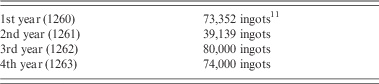
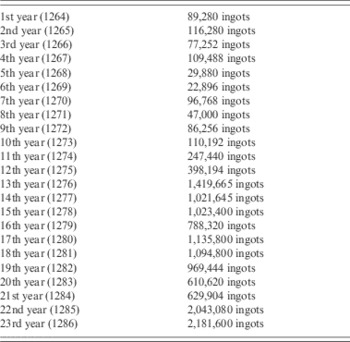
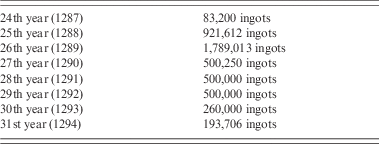
From a commercial angle, Polo viewed the Yuan monetary system as an easy way to accumulate wealth. In his eyes, trading paper money for goods brought the Khan many valuable items and guaranteed that the court would never run out of treasures. The Khan also urged his subjects to sell their gold, silver, precious stones, pearls and leather to the Mint Bureau, for which he paid them a high price in paper money. Reciprocally, people could buy treasures at the Bureau with paper money if they chose to do so. Under the currency system, precious items from all over the world flowed into the treasury of the Yuan court (Ref. Reference Polo3, vol. 1, p. 423). The Travels conveys the impression that Kublai Khan was a powerful ruler and an astute businessman. The amount of paper money made during Kublai Khan’s 35-year reign through these measures confirms Polo’s view. Tables 1–3 show a year-by-year list of the quantities of paper money produced during this period (Ref. Reference Song8, fascs 5, vol. 93, pp. 2351–2375).
Year-by-year list of paper money produced during the Zhongtong period.

Year-by-year list of Zhongtong paper money produced during the Zhiyuan period.

Year-by-year list of Zhiyuan paper money produced during the Zhiyuan period.

The descriptions of paper money in The Travels reflect well on the Yuan monetary system, and show the economic conditions of Kublai’s government in a positive light. The reason why Yuan China’s financial system made such a favourable impression on Polo was probably because it resembled ‘new techniques of credit and investment’ developed by Italian merchants ‘to support commercial adventures’ going to unusual places.Reference Jackson 12
Trade along the Jinghang Canal
As noted above, both Rabban Sawma’s and Marco Polo’s texts laud the achievements of the foreign civilization they experienced, rather than condemning it for being different. It was also mentioned previously that The Travels differs from Rabban Sawma’s description of Europe in its emphasis on commercial rather than religious conditions. This contrast is clear not only in its focus on paper money, but also in its discussion of trade.
The account of the trade along Jinghang Grand Canal in The Travels has so much in common with Venetian commercial culture that one wonders if Marco Polo’s interest in the subject is attributable to its resemblance to the trading activities of his homeland. As Beazley says, the Grand Canal ‘possessed an incredible amount of traffic – more than could be found (in Polo’s judgment) on all the seas and rivers of Christendom’ (Ref. Reference Beazley1, p. 106).
The Travels shows that Kublai Khan attached great importance to transportation by water. The Khan’s administration used canal transport as a means to foster commerce, stimulate manufacturing, and receive annual revenues, thereby strengthening the Yuan empire’s economy. Of the 44 important places mentioned in volume two of The Travels, 16 are cities where trade along the canal was booming. Traders plied the waters, buying and selling all kinds of foreign and domestic goods, and turning a profit. The rivers in these places were very busy, with many boats coming and going. The text says that only those who had seen it for themselves would believe the number of boats sailing on the Min River in Sichuan Province, or imagine the number of merchants dealing in various merchandise. On the Caramoran (Yellow River), according to The Travels, Kublai Khan had more than 15,000 boats and ships (Ref. Reference Polo3, vol. 2, p. 22).
Trade along the canal is portrayed as booming during Kublai Khan’s reign, which had a positive effect on the Yuan empire’s economy, being not only highly profitable for merchants, but also greatly stimulating manufacturing and increasing tax revenues to the government.
The Travels conveys the impression that there were good opportunities for trading ventures under Kublai Khan and that Yuan China constituted an attractive market for commodity exchanges, perhaps even more attractive than Western trading posts in the Black Sea. The work also suggests that business deals with Mongol khans made considerable profit. The Travels remains silent about the Great Sea, claiming that ‘Since they are so many who explore it and sail it every day, as is well known, such as Venetians, Genoese and Pisans and many other people who make that journey so often that everyone knows what it is there ...’. (Ref. Reference Polo3, vol. 2, p. 500). Perhaps Polo saw no need to mention it because he was only interested in contributing new knowledge to Western understanding of the Far East or because he assumed his readers would be familiar with it.
Discussing the trade along the canal in Sinjuymatu (Jining 济宁), The Travels remarks on the huge number of merchant ships that carried vast amounts of goods to Cathay and Manzi, and brought back commensurate amounts of merchandise in return, enabling traders to make immense profits (Ref. Reference Polo3, vol. 2, pp. 138–139). Trade along the canal also increased the volume of exports, especially silk, which in turn advanced the production of silk. As well as the profits accruing to individual merchants such as himself, Polo also notes that the Great Khan received an enormous amount of tax revenue from the trade along the canal every year. Several chapters in the second volume provide specific details. On all imported valuables, for example, including precious stones, pearls and other luxury goods, the Khan levied a tax of 10%, with 44% on pepper and 40% on aloe wood, sandalwood and coarse things. The Great Khan every year enjoyed ‘a vast revenue’ (Ref. Reference Polo3, vol. 2, p. 235).
One wonders if the motivation behind Polo’s enthusiasm for the way in which grain was ferried from the South to the capital city of Khanbaligh (Beijing) was the similarity between Yuan China and the Italian city-states. The transportation of grain by water (caoyun) to supply the capital or meet military demands was an important step that Kublai Khan took to strengthen economic and commercial cooperation between the South and the North. According to the Travels, the Mongols stored up huge amounts of rice and wheat in Caigui (Guazhou) and then had it transported to Khanbaligh via the inland water course. The Khan connected all the rivers from Caigui to Khanbaligh by deep channels, so ships loaded with grain could sail all the way to the capital (Ref. Reference Polo3, vol. 2, p. 174). This practice resembles the grain traffic in Venice that David Abulafia mentions in The Great Sea.Reference Abulafia 13 The Venetians used sea trade routes to solve the problem of supplying their 100,000 citizens with the grain they needed. In the last two decades of the thirteenth century, ‘the commercial revolution’ in the Latin world stimulated urban development, as craftsmen and traders poured in and settled in towns. An increase in population and rising prices forced the towns around the Mediterranean to find enough grain from far away places to feed their inhabitants. The Venetians exploited the Adriatic Sea shipping lanes for food supplies, and ‘sought to transform the Adriatic Sea into what came to be called the “Venetian Gulf”’. When imports of grain reached the ‘Upper Adriatic’, they tried to send all the grain to their inhabitants to satisfy their needs. They also endeavoured to guarantee supplies of ‘Apulian wheat’ to their growing population.Reference Abulafia 13 In this respect, the Jinghang Grand Canal functioned in the same way as the Adriatic. The grain trade not only guaranteed vital food supplies to the growing city of Venice, but also served as a source of profit for Venetian merchants.
It seems likely that the waterway trade and the practice of caoyun interested Polo because such features of Yuan life facilitated merchant trade. He may have noticed the similarity between the commercial environment in Yuan China and in the Black Sea. It was in this location that ‘Marco’s uncle and namesake owned a house, and from here too the two brothers set out on their first journey in c.1260’ (Ref. Reference Jackson12, p. 292). Polo may have mentioned the waterway trade and other such elements of commercial life in China so frequently to encourage fellow Latin merchants to emulate his adventure and penetrate new markets in the Far East. The Travels provides important information on China’s inland waterway trade, urban civilization, industry, commerce and seaports, which could prove useful to those choosing to journey to China. The Travels may also have been intended to serve as a model for future development in Europe. The experience of life in Yuan China, as related in The Travels, ‘told of a more excellent path of happiness than the endless wars of feudal princes or the internecine mercantile rivalries of little city-states’ (Ref. Reference Beazley1, p. 17).
Two Cases of Acute Observation
The Great Khan’s Award System
The difference between ‘the spirit of Venetian republicanism’ characterized by ‘the aristocratic Senate’s execution of power in ‘politics, trade and society’, and ‘the magnificence of Kublai’s autocratic rule’ characterized by the great Khan’s absolute power over his vast territories and subjects, filled Polo with amazement (Ref. Reference Larner4, p. 86; Ref. Reference Abulafia13, pp. 360-361). One of the measures of Kublai’s government that Polo observed was the award system. This consistent award system for his officials was one method by which the Mongol emperor retained hegemony. This system stood in sharp contrast to the countless political divisions that plagued Europe. The Travels includes a detailed description of this system peculiar to Mongol culture, and expresses surprise that the Khan should award his officials with costly items. Having made the source of the Khan’s wealth clear, The Travels turns to discuss what flowed outward as expenditure. Polo tells his readers that the greater part of the revenue collected by the court from all parts of the country was put into storage (Ref. Reference Polo3, vol. 2, pp. 215–218) but that the Khan’s award system was a major expenditure. The Travels shows that the Yuan dynasty’s award system, at least in Kublai’s time, harkened back to the Mongols’ nomadic past. The Khan granted each of his 12,000 keshig men 13 official gowns decorated with jade beads, pearls, and other valuables in different colours, along with beautiful gold belts of great value and exquisite leather boots embroidered with silver threads. According to The Travels, the award of 156,000 gowns, plus the same number of expensive belts and boots was a considerable government outlay, ‘all this costs an amount which it is scarcely possible to calculate’ (Ref. Reference Polo3, vol. 1, p. 394). The implication is that such an exhaustive expense was part of what drove Kublai Khan to encourage his ministers to accumulate government revenues.
This award system had originated in Genghis Khan’s times. Generations of Mongol khans had followed the rules and regulations set down by their founding ancestor, and Kublai Khan continued them as well. After ascending the throne, he distributed generous awards of gold, silver, cloth and silk to his Mongol brethren. He also showered an enormous annual award on his court. He was always prepared to grant substantial awards to visitors, such as a visiting Mongol prince from a remote garrison town, as well. These customs, which were meant to showcase the Khan’s power through his generosity and secure the loyalty of his followers, caused the award system to become a massive financial outlay for the government. According to the official records, in the first year of the Zhongtong period (1260) the total amount of annual awards was 60,850 liang of silver, 3050 bolts of cotton and silk, 141 ingots of paper money, 5098 bolts of thin tough silk and 5148 jin of silk floss. When it came to the 26th year of the Zhiyuan period (1289), the total amount reached 2000 liang of gold, 252,630 liang of silver, 110,290 ingots of paper money, and 122,800 bolts of cotton and silk.Reference Zhang, Qizhi, Chengkang, Tianyou and Chongde 14
The voracious appetite of the state for more revenue to fund such lavish awards gave rise to social ills that would be difficult to cure.Reference Zhang, Qizhi, Chengkang, Tianyou and Chongde 14 Presumably one of the purposes of the detailed description The Travels gave of the award system was to explain to Western readers that the Yuan court’s outlay on these expenses resulted in a heavy tax burden on its subjects. Thus, whoever was able to manage finance and taxation effectively could win the Khan’s favour, regardless of any other failings, because he so urgently required money. The traveller’s account of one such finance minister reveals the tensions and resentments at court and in wider society created by the Yuan dynasty’s systems of revenue and expenditure. That The Travels notices such dynamics lends veracity to the account and testifies to Polo’s keen interest in Mongol financial life.
Ahmad and the Four Classes of Yuan Society
Despite its adoration of Kublai Khan, The Travels also points out occasions of misrule. Yuan China’s special social, political and cultural environment provided a context for Polo to show his insight into the social sciences. An examination of the case of Ahmad and the classification of ethnic groups in The Travels shows that Polo was not only a shrewd businessman, but was also clever at understanding and making judgements about political affairs. He did not think that ‘all the measures of Kubilai are miracles of wisdom’ as Beazley comments (Ref. Reference Beazley1, p. 30), nor were judgements ‘all seen from a Mongol point of view’ as Larner argues (Ref. Reference Larner4, p. 85), because the Mongols would by no means have realized and acknowledged that their discrimination of certain ethnic groups would harm their government. Otherwise they would have treated the Chinese equally and their government would have lasted longer. This judgement must have come from Polo’s own observation.
Thus, in my view, The Travels displays an even-handed perspective. Although Polo frequently lauds Kublai Khan for China’s highly developed economy, and rigorously centralized government, he also points out negative aspects of his rule. An example of this is his criticism of the treacherous finance minister Ahmad, who held power for 20 years, controlled the economic life of the empire, and was given free rein to terrorize the population. The Travels notices that Ahmad, both greedy for money and fond of women, abused his official power, defamed the loyal and the righteous and had them persecuted, murdered innocent people at will, favoured his own cohort of supporters, extorted excessive taxes and levies, and invested his followers with governorships and offices wherever he liked. The Travels depicts him as an immoral and depraved character who wielded nearly unlimited power on account of the boundless favour the Khan bestowed on him (Ref. Reference Polo3, vol. 1, pp. 415–420).
What is recorded about Ahmad in The Travels is also documented in Chinese written sources. While condemning Ahmad for deceiving the Khan and abusing his trust to do injury and commit crimes, The Travels also faults Kublai Khan for granting too much power to this evil man and thereby misgoverning his realm (Ref. Reference Polo3, vol. 1, pp. 415–420). This account of Ahmad and Kublai’s misrule accords closely with the Yuan shi on these points (Ref. Reference Song8, fascs. 8, vol. 205, pp. 4557–4589). It can also be found in some first-hand accounts. Ahmad and his associates gained personal wealth by means of goukao (audit and liquidation of the accounts), a system they employed to extort money through repeated auditing. Zheng Sixiao (?–1357), a Yuan-era Chinese writer, drew an analogy between goukao and ‘cormorant fishing’, to indicate the way in which local officials took sustenance out of the mouths of the common people and used it themselves. The heavy burden of the Khan’s taxes and levies left the people starving despite their productivity.Reference Zheng 15 Zhao Yi (1727–1814), a Qing historian, commented that the Khan was ‘fond of gains and addicted to wars’ and argued that it was his maladministration that embedded political crisis deep within the Yuan society at an early stage (Ref. Reference Zhang, Qizhi, Chengkang, Tianyou and Chongde14, p. 68).Reference Zhao 16
Polo’s searing criticism of Ahmad shows the sharp clash between two distinct conceptions of state wealth accumulation. Ahmad’s techniques for acquiring wealth consisted primarily of seizure, exacting taxes at home and waging warfare abroad. Latin merchants such as Marco Polo instead favoured trade as a means to economic success. The discussion of Ahmad in The Travels adds to the credibility of the work because his misdeeds are corroborated elsewhere.
It was not solely the Khan’s revenue-raising tactics that provoked criticism in The Travels. Polo also criticized Kublai’s division of Yuan society into ethnic groups. Scholars now classify Yuan society into ‘four categories’: (1) the Mongols; (2) the semuren, who include Persians, Arabs and Europeans; (3) the Northern Chinese; and (4) the Southern Chinese. The situation was perhaps not so clear at the time when The Travels was written, and Polo saw them only from a limited perspective. However, his detailed description of the different groups, and his attempt to make sense of them shows his awareness of the complex political situation in Yuan China with its mixture of ethnic groups in conflict with each other. In Polo’s experience, the division was between ‘the bearded people’ (those from Central Asia, Western Asia and Europe) and those without beards (the Cathayans and Manzi/Chinese).
The Cathayans hated the Khan’s government because the senior officers, who were Mongols and Muslim semuren, treated them like slaves (Ref. Reference Polo3, vol. 1, pp. 415–420). The expression ‘they [Cathayans] were treated by them [Mongols and semuren] just like slaves’ that he used to describe the Mongols’ treatment of the Chinese coincides exactly with the Chinese scholar Kong Qi’s (1274–1344) words.Reference Kong 17 The Travels attributes this discriminatory treatment to Kublai Khan’s well-founded suspicion that the subjugated native Cathayans did not wholeheartedly love or esteem him, nor did they fully support his government. Retaining the perspective of a conqueror, the Khan sought to repress them by employing Mongols, Muslims and Christians (the bearded ones) as commanding officers and top officials in positions of authority over the Chinese (Ref. Reference Polo3, vol. 1, pp. 415–420).
This is a well-known fact of Yuan history and is supported by the Yuan shi. During his reign, Kublai Khan implemented an official legal system to retain control of government administrative posts (Ref. Reference Song8, fascs 4, vol. 81, pp. 2015–2036; fascs 5, vol. 85, pp. 2119–2151). People called it zuqun dengji zhi (the four-class ethnic group system) which divided his subjects into Mongols, people of foreign extraction (semuren, or ‘the bearded people’ to Marco Polo), northern Chinese (hanren), and southern Chinese (nanren). The Travels is thus correct about the discrimination that the Mongol regime practised on the grounds of ethnic identity.
There is also an account in a work called Caomuzi, written in 1379, shortly after the fall of the Yuan. Its author, Ye Ziqi, a Chinese Confucian scholar, described the Mongols’ official appointment system and its discriminatory treatment of the hanren and nanren. He argued that if the Yuan monarchs had treated the South (hanren and nanren) and the North (the Mongols and semuren) equally, employing whomever was capable, their rule could have lasted longer.Reference Ye 18 Thus, the judgement in The Travels that the Khan’s discriminatory policies exacerbated ethnic conflict was in line with the view of contemporary Chinese scholars.
This issue is also discussed by modern scholars such as Thomas Allsen, who in addition to analysing the ‘four categories’ of Yuan society also describes the ‘quotas’ established for official recruitment and promotion.Reference Allsen 19 David Morgan calls them ‘four classes’, pointing out that the Mongols, semuren, hanren and nanren were listed in ‘descending order of position and privilege’.Reference Morgan 20 Most Chinese scholars describe Kublai’s division of the Yuan population, the si deng ren zhi (four-classed personnel system) as a class system of nationalities (minzu dengji zhi). For example, Xiao Qiqing, in his 2007 monograph Favoring Northland and Discriminating against the Middle Kingdom, emphasizes that the four-class ethnic group system was thoroughly discriminatory, despite the lack of restrictions on migration, and communication among nationalities.Reference Xiao 21 He notes that Marco Polo thought that Ahmad was killed by hanren (Chinese) who resisted the Huihui (semuren), because they had helped ‘the evil-doer’, i.e. (the Mongols who tyrannized the Chinese) (Ref. Reference Xiao21, p. 473).
What Polo may not have realized is that the Yuan’s rigid ethnic classification system had developed in response to an earlier rebellion. This ‘four-class ethnic group system’ seems to have had a profound effect on the traveller’s experiences in China. Perhaps most significantly, it placed him in a privileged class as a foreigner. From this position, it seems that he developed informal connections with the Mongol court. It is understandable that a Venetian merchant in these circumstances would have felt closer to the Mongols than to the Chinese. The Travels suggests that Polo not only did not know the Chinese language but also did not have any personal acquaintances who were Han Chinese. This may be surmised since he did not express any political sympathies for them. Himself a ‘bearded one’, Polo accused the Chinese of being treacherous and disloyal to the Khan.
Conclusion
Genghis Khan’s campaigns of conquest led to a new degree of communication between the East and the West, and that while both Western and Eastern travellers’ perceptions of ‘the other’ were coloured by their cultural backgrounds, their personal experiences and observations as individuals also profoundly shaped their judgements about what confronted them in the distant East or West.
The Travels of Marco Polo was far more positive and even enthusiastic about the ‘other’ than the accounts of the two Franciscans, Carpini and Rubruck. In this respect, The Travels was similar to Rabban Sawma’s account of Europe. Both men could identify with the strange land through their vocation. Whereas Sawma found in Europe the ideal place to be a Christian priest, Polo found in Yuan China the ideal place to be a merchant.
The Travels made a substantial contribution to the history of communication between the East and the West because of its attitude toward the East and the rich detail it recorded. As a source, it not only contributes source material to the study of Yuan history but also reveals much about medieval Western culture. Its example also spawned a new genre of travel literature. The boasting and exaggerations it contains do not invalidate The Travels as a compendium of information on Yuan China. What is striking about Polo’s perspective is that his perceptions of Kublai Khan, his state and his subjects, Yuan China’s economy and commerce, and its natural resources such as gold, silver, salt and many other such matters, are not tainted by any disdain of the ‘other’. The Travels is full of admiration for Yuan China. It portrays China as a highly developed society, painting a panoramic view of the whole rich cultural landscape. Although not always accurate, it contains many details that are in accord with the evidence provided in Chinese historical works and archaeological discoveries. For contemporary scholars of China, the study of Marco Polo provides an important source through which to explore Yuan society.
To its Western readers, The Travels offered crucial cartographical information that was eventually incorporated into the Catalan Atlas. It charted a travel route from west to east and back again for both missionaries and commercial adventurers to follow. Indeed, while Marco Polo was traveling back to the West, Montecorvino (sent by the Pope in response to Rabban Sawma’s testimony) was advancing into the Far East. He would soon be followed by a group of new travellers, Catholic missionaries. The Travels of Marco Polo, along with the accounts of the journeys of the other fourteenth-century missionaries Montecorvino, Odoric, Jordanus and Marignolli, served as the principal stimulus to subsequent Western exploration.
The fast-riding Mongols had made this communication between the East and the West possible with the sprawling imperial network that resulted from their military success. When they were expelled from China at the fall of the Yuan dynasty, direct interactions between the East and the West temporarily declined. Yet in China, The Travels of Marco Polo had an enduring cultural influence due to Polo’s keen observation of Yuan China’s society. In the West, accounts of the Eastern ‘other’ would provide the main impetus for the European ‘discovery’ of the New World in the fifteenth century just as Beazley argues, ‘… and among the objects of Columbus’s westward enterprise there was none more treasured than the discovery of that Far Eastern island, the realization of that glittering vision which he had caught from the Book of the old Venetian’ (Ref. Reference Beazley1, p. 130).
Dr Na Chang was educated at Gonville and Caius College, University of Cambridge, UK. She worked on maritime history and the encounter between the East and the West in the late middle ages during her PhD studies. Na is currently working on two major projects: European perspective on South China Sea disputes; and European experiences on how to resolve maritime disputes. In the meantime, she is working as the Deputy Editor of the Cambridge Journal of China Studies.