Nonventilator, hospital-acquired pneumonia (NV-HAP) is an important infection associated with length of stay, morbidity, and higher rates of mortality. Reference Giuliano, Baker and Quinn1 Common risk factors for NV-HAP include advanced age, the presence and severity of underlying diseases, malnutrition, and depression of consciousness. Reference Mitchell, Russo and Cheng2 Oropharyngeal dysphagia and enteral feeding play important roles in the development of pneumonia because they increase the risk of aspiration. Reference Chang, Huang, Lin and Tsai3 We assessed the impact of an NV-HAP bundle in a cohort of patients on enteral tube feeding (ETF).
Methods
We conducted a quasi-experimental study at Hospital de Clínicas de Porto Alegre, a 833-bed public university hospital in southern Brazil. Adults on ETF but not on mechanical ventilation who had been hospitalized >72 hours were included. The inpatient units included 5 clinical wards (190 beds) and 7 surgical wards (395 beds). The bundle’s effects were evaluated in 4 stages: stage 1 began in September 2016 in 2 clinical units; stage 3 began in September 2017 in another 3 clinical units; stage 3 began in January 2018 in 2 surgical units; and stage 4 began in April 2018 in another 5 surgical units.
Data were collected from the patient charts, and each patient was observed at the bedside to check the bundle items. Each unit was monitored for 2 months before and after the intervention. The intervention also consisted of weekly meeting for training a multidisciplinary team. The training related to the bundle items: radiographic control and confirming the ETF site prior to diet administration, maintaining the head of the bed above 30° during feeding, oral hygiene 3 times daily, daily nasal hygiene, and daily review of ETF fixation.
The χ2 test was used to compare patient adherence to the bundle, and the Student t test was used to compare the mean adherence. A segmented regression model adjusted for potential confounders was used to verify the intervention’s influence on monthly rates of pneumonia. Reference Wagner, Soumerai, Zhang and Ross-Degnan4 Linear models were adjusted to assess monthly variations in preintervention period rates (β1), changes in level (β2), and trends (β3) after intervention. The residues were evaluated with the Shapiro-Wilk test and the Durbin-Watson test. The βs ± standard error (SE) estimates of the univariate models are presented. Descriptive data are presented as mean ± standard deviation (SD) or frequency. The analyses were performed in SPSS version 18 software (IBM, Armonk, NY) and R Studio version 3.5.1 software (R Foundation for Statistical Computing, Vienna, Austria). We chose a 95% significance level for our analyses.
Results
During the study period (January 2016 to July 2019), the burden of NV-HAP in our institution comprised 10.8% (816 of 7,547) of all infections. Overall, 927 patients with ETF were followed (53.3% before and 46.7% after the intervention). In total, 2,095 observations, 816 (38.9%) were performed before the intervention and 1,279 (61.1%) were performed after the intervention. Mean compliance prior to the intervention was 55.9% (95% CI, 51.0–60.7) compared to 70.5% (95% CI, 69.1–72.0) after the intervention (P < .01). We observed significant increases in adherence to the bundle: in stage 1, from 72.4% to 79.7% (P = .04); in stage 2 from 60.7% to 79.1% (P < .01); in stage 3 from 63.1% to 75.2% (P < .01); in stage 4 from 74.7% to 74.9% (P = .45).
Before and after the intervention, x-ray control was performed for all patients. The ETF site was verified in 37.9% (N = 187) of the patients prior to the intervention, compared to 78.5% (N = 340; P < .01) after the intervention. Head of the bed above 30° occurred in 54.0% (N = 267) of the patients prior to the intervention and increased to 74.8% (N = 324; P < .01) after the intervention. Complete oral hygiene increased from 42.9% (N = 212) to 62.8% (N = 272; P < .01). No significant difference was observed in nasal hygiene (93.1 vs 93.8%; P = .91). ETF fixation increased from 88.1% (N = 435) prior to the intervention to 93.1% after the intervention (P < .01). Finally, 194 patients (39.3%) received a minimum of 70% of the prescribed enteral nutrition prior to intervention, whereas 266 (61.4%; P < .01) did so after the intervention.
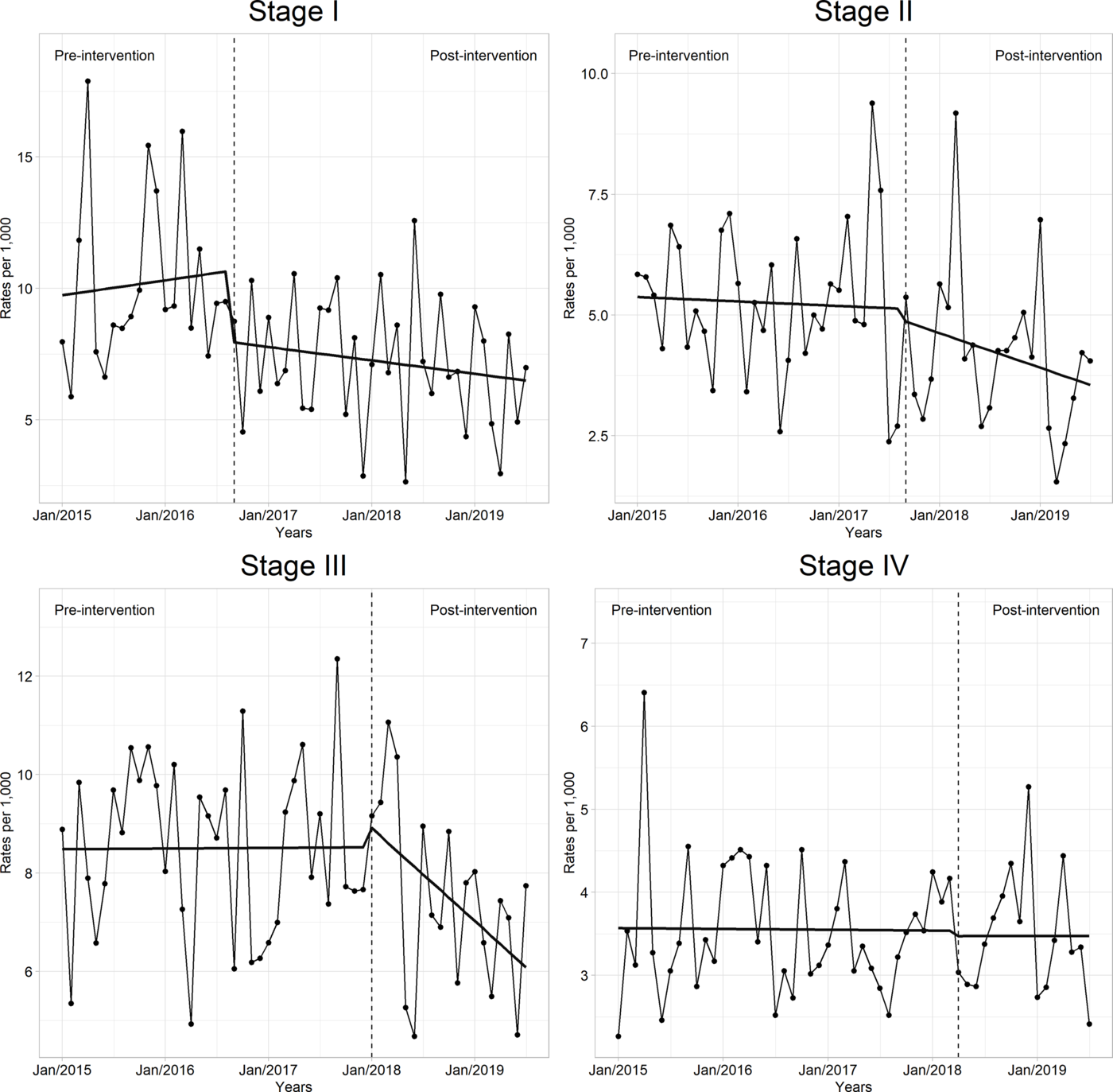
We found that the NV-HAP rate decreased from 5.71 per 1,000 admissions prior to the intervention to 3.77 per 1,000 admissions after the intervention. Other risk factors for NH-HAP were not different between the pre and postintervention periods: age 68 years (range, 63–75) versus 70 years (range, 63–78) (P = .59); surgery (N = 313 [63.4%] versus N = 248 [57.3%]; P = .06); altered mental status (190 [38.5%] vs 173 [40%]; P = .69); lung disease (341 [69%] vs 316 [73%]; P = .21) and restriction to bedrest (190 [38.5%] vs 169 [39%]; P = .91). Segmented regression analysis showed a significant reduction in the monthly mean preintervention rate in the first 3 stages. We observed a significant reduction in the monthly rate of pneumonia after the stage 2 intervention (β2 = −2.97 ± 0.77; P < .001), as well as a change in the trend (β3 = −0.11 ± 0.03; P = .001). In stage 2, we observed changes in level (β2 = −1.05 ± 0.43; P = .018) and trend (β3 = −0.08 ± 0.03; P = .009). In stage 3, the change in level was not significant (β 2 = −1.01 ± 0.50; P = .051); there was only a change in trend (β 3 = −0.12 ± 0.04; P = .005). Finally, in stage 4, we detected no changes in level (β2 = −0.08 ± 0.23; P = .732) or trend (β3 = −0.01 ± 0.02; P = .774) (Fig. 1).
Rate of nonventilator hospital-acquired pneumonia per 1,000 discharges or deaths before and after the intervention during stages 1, 2, 3 and 4, according to a segmented regression analysis.

Discussion
In our study, the overall rate of NV-HAP was 0.8 per 1,000 patient days, compared with 0.12–2.28 and 3.63 per 1,000 patient days in 2 different US hospitals. Reference Giuliano, Baker and Quinn1,Reference Baker and Quinn5 Our intervention yielded an overall reduction from 0.8 to 0.5 NV-HAP per 1,000 patient days (we presented data per 1,000 admissions). Previous studies corroborate that the impact of NV-HAP goes beyond specific patient risk groups and occurs in every hospital unit. Reference Baker and Quinn5
Risk factors for NV-HAP have been reported, and the CDC recommends focusing on modifiable risk factors for prevention. Reference Tablan, Anderson, Besser, Bridges and Hajjeh6 In a recent systematic review, the most common preventive strategies for reducing NV-HAP were oral care, increased mobility, and dysphagia management. Reference Mitchell, Russo and Cheng2
During stage 4, the rates of bundle adherence were above the mean found in other units and did not change after intervention. Furthermore, the NV-HAP rates were also lower in the experimental units, which might explain (reinforcing the importance of the bundle) why pneumonia rates did not change during the intervention.
Efforts to prevent NV-HAP must be undertaken when the number of events is higher than that of ventilator-associated pneumonia. There is evidence that the rates of NV-HAP are not decreasing. Reference Magill, O’Leary and Janelle7 Bundles to prevent healthcare infections are commonly associated with invasive procedures. Reference Yokoe, Anderson and Berenholtz8 The challenge to identifying patients at risk for NV-HAP is an important issue because these infections are not related to a specific invasive procedure. Reference Giuliano, Baker and Quinn1,Reference Klompas9 The use of ETF could be considered a ‘red flag’ among risks in a clinical ward. One study automatically flagged patients if they were postoperative or if they had aspiration precautions, altered mental status, low albumin levels, or ETF. After the intervention, NV-HAP rates decreased significantly between 2012 and 2018, falling from 5.92 to 1.79 per 1,000 admissions. Reference Lacerna, Patey and Block10
Our study has some limitations. Because the intervention was focused on the risk of dysphagia and malnutrition, we did not study the specific pneumonia rate for patients on ETF. Nevertheless, we improved care and decreased the overall NV-HAP rate.
In conclusion, this bundle implemented for patients on enteral nutrition contributed to a reduction in global NV-HAP and optimized patient care.
Acknowledgments
This study was sponsored by Hospital de Clínicas de Porto Alegre Research Incentive Fund.
Financial support
No financial support was provided relevant to this article.
Conflicts of interest
All authors report no conflicts of interest relevant to this article.