


Introduction
An important objective of the Nahrein Network’s Forgotten City of Kish project (2021–25) was to recover and recentre Iraqis in the story of the site’s rediscovery and interpretation. While Dr Nadia Aït Saïd-Ghanem studied the role of antiquities traders in supporting excavations and furnishing major western museums with artefacts for their cuneiform tablet collections, I asked, what was the experience of excavation like for Iraqi archaeological workers in the first decades of the twentieth century?
Although those workers rarely—but, as we shall see, not never—left records themselves, the accounts of European and American fieldworkers are often unintentionally revealing, and we can contextualise them within broader studies of colonial attitudes and infrastructures of control in Ottoman and Mandate Iraq. As historian Zeynep Çelik showed in her sensitive study of archaeological labour in the late nineteenth-century Ottoman empire, through “reading against the grain” it is indeed possible to “dismantle the lopsided assumptions and disrupt the position of the Western archaeologists deemed in charge” (Çelik Reference Çelik2016: 155, 169). Building on Stephen Quirke’s foundational study of Flinders Petrie’s Egyptian workforce (Quirke Reference Quirke2010), there is now a rich literature on the history of local archaeological labour in the Middle East. Studies of foreign-led projects in late Ottoman and early 20th-century Egypt, Palestine, Syria and Türkiye have investigated working conditions, labour relations and gender roles on site in the tacitly and often explicitly violent context of colonial occupation and control (e.g., Çelik Reference Çelik2016; Irving Reference Irving2017; Reference Irving2021; Reference Irving2024; Mickel Reference Mickel2019; Reference Mickel2021; Carruthers Reference Carruthers2021; Baird 2022; 2023; Reference Baird2024; Tamari Reference Tamari2022; Abu Alsaud Reference Abu Alsaud2023; Baird et al. Reference Baird, Kamash and Raja2023; Cline Reference Cline2023; Heffron and Çağlar Reference Heffron and Çağlar2024; Holley-Kline and Mickel Reference Holley-Kline and Mickel2024; Griswold Reference Griswold2025) while Mairs and Muratov (Reference Mairs and Muratov2015; Reference Mairs, Muratov and Gorshenina2019) explore the complex social mediations and fluid career trajectories inherent in the role of dragoman.
However, with some exceptions, the history of archaeological labour on Iraqi soil has tended to be on the margins of that historiography. This contribution therefore brings late Ottoman and Mandate Iraq into the conversation, using Kish as a case study. A key aim is simply to identify and acknowledge the central contribution of Iraqi labour to Assyriology and archaeology. But I also hope to contribute methodologically to the history of these disciplines in four interrelated ways. I foreground the structural violence embedded in labour relations between Western expedition leaders and Iraqi workers in colonial contexts, and their long-term repercussions. In particular, I reveal how archaeological labourers became the subjects of racialised anthropometric study over many decades. I also highlight the blurry boundaries between licit and illicit archaeological activities perpetrated historically by both local and international actors. Finally, I reconstruct the vast local support network on which large-scale foreign led excavations depended: site guards, facilitators and administrators as well as excavators, including many hundreds of child labourers.
I plan to discuss the aims, motivations and methods of the Oxford-Field Museum Expedition (OFME) and its spin-off endeavours, and the intellectual knots that its leaders tied themselves into when their fuzzy thinking, outdated methods and messy data failed to support their starting hypotheses, as part of a bigger project on the history of that expedition. Laith Shakir (Reference Shakir, Crouzet and Miller2025), meanwhile, has analysed contemporary responses to the work at Kish in the Iraqi and regional press. Although I draw on many previously unpublished photographs for this article, I leave it to others more expert than me to analyse them in detail (e.g., Riggs Reference Riggs2019). Likewise, while comparisons with the archaeological regimes in other historical contexts are beyond the scope of this study, I hope the material uncovered will prove a useful starting point for such work. Here, rather, I stick closely to the site of Kish itself in order to bring its labour force into historical focus as much as I can.
At first, it is tempting to categorise Iraqi archaeological workers as “doubly invisible” technicians, in the terminology of sociologist of science Steven Shapin: largely invisible to those who employed them, and therefore also to posterity, as if there were “no persons involved in the production of science but the stipulated authors” of formal publications (Shapin Reference Shapin1989: 556).Footnote 1 However, as I shall argue here, in the case of Kish, while Western archaeologists were increasingly reticent about their large teams and their expertise in official reports, their colleagues in anthropology rendered many of those same men all too visible in academic publication. And, as we shall also see, some workers made themselves visible, and heard, to those in charge, and their agency and expertise is still salvageable in the historical record. It will also become clear that another category of expertise has been overlooked, even by post-colonial historians, despite being essential to the functioning of the discipline: namely the civil servants and officials who licensed and supported the work in the field. In short, as I hope to demonstrate below, Iraqis engaged in archaeological work were not really “invisible” to those in power, but rather have been deliberately or neglectfully “forgotten”. As such, my approach has much in common with historian of science Gabriela Soto Laveaga (Reference Laveaga2023: 835), who invites us to re-evaluate the work of those “once known” but “whose labor has been demoted in the historical narrative because of their gender, class, or ethnicity”.
I start by considering French Assyriologist Henri de Genouillac’s account of his abruptly terminated excavations at Kish in 1912, and then compare it with three sets of documents from the Oxford-Field Museum Expedition (OFME) from 1923–1935: the official field reports written by Stephen Langdon, Ernest Mackay and Charles Louis Watelin; the publications of anthropologist Henry Field; and archival documents held by the State Board of Antiquities and Heritage in Baghdad and the Field Museum of Natural History in Chicago.Footnote 2
Some of the subject matter this article covers is quite distressingly racist, but I think it needs to be aired. We cannot pretend that Assyriology and archaeology have treated all participants with equal humanity. How should we balance our duty as a discipline to recover the often brutalising experience of the adults and children whose effort and skills generated the material evidence on which we still depend, while treating them with dignity and respect? It is a hard question to answer and I apologise if I do not get everything right in this paper. Indeed, I welcome constructive criticism for how to do it better, both personally and as a profession.
Henri de Genouillac’s expedition workers, 1912
In late 1911, the Ottoman Government granted a two-year permit to excavate at Kish to Henri de Genouillac, a museum-based Assyriologist and ordained Catholic priest with no fieldwork experience but with official French funding and diplomatic backing (Chevalier Reference Chevalier2002: 97–99, 422–423, 510). By his own account, Genouillac wanted to unearth written evidence for Sumerian history, as tablets reaching European museums from Kish via the illicit antiquities market over the previous decade suggested he might (Genouillac Reference Genouillac1924–25: I, 10).
The many ruin mounds that comprise the archaeological site of Kish were (and are) situated about 15 km northeast of the Iraqi town of Hillah, which at that time was struggling both economically and environmentally (Fig. 1). Ottoman land reforms of 1869, although not universally successful across Iraq, had encouraged small-scale land-ownership and agricultural production around Hillah, briefly leading to increased prosperity for newly settled tribal members (Çetinsaya Reference Çetinsaya2006: 73; Ceylan Reference Ceylan2011: 172). Unfortunately, from 1875 the Hillah branch of the Euphrates became increasingly silted up after the closure of the Saklawiyya canal, many miles upstream near Fallujah, had forced the river’s main flow into the Hindiyyah branch (Ceylan Reference Ceylan2011: 195). By 1903 the Hillah branch had dried up completely, almost destroying the local economy (Herzog Reference Herzog2012: 490). In early February 1908, a German archaeological expedition, led by Friedrich Sarre and Ernst Herzfeld, walked for 8 km along the dry bed of the Shatt an-Nil canal next to Kish (Sarre and Herzfeld Reference Sarre and Herzfeld1911: I, 246). According to the testimonies of American and European visitors to the Hillah district in the decade after 1900, collected by Gibson (Reference Gibson1972: 29), there was “widespread disease, hunger, etc., [with] no employment in Hilla[h] and men clamor[ing] for work… Whole sections of the country were deserted, and the former occupants were forced to locate. … Except for a few palm trees along the banks, all vegetation had withered”. This desperate local context was exacerbated by political instability caused by the rapid turnover of Baghdad’s Istanbul-appointed governors in the tumultuous aftermath of the 1908 Young Turk revolution, ongoing tribal rebellion in the far south of Iraq, and a cost-of-living crisis in the province of Baghdad that had increased prices for basic foodstuffs, clothing and rent by an eye-watering 50 percent since 1905 (Herzog Reference Herzog2012: 177, 581–582; Fattah and Badem Reference Fattah and Badem2013). In this light, it is no wonder that people had turned to excavating antiquities to support themselves, both to supply local dealers and to service the German excavations at Babylon, which had been running since 1899. Genouillac’s new project must have been welcomed in Hillah, at least by some, as an important new source of income.
Map of the Hillah area in 1908, showing Babylon to the north, the Hindiyya branch of the Euphrates to the southeast, and Kish to the northeast, comprising Al-Uhaimir and an unnamed mound (“Hügel”) which can only be Tell Ingharra. The village of (Shakhat an-)Nil is on a canal between Hillah and Kish and those of Kuwairish (Quwairish) and Jumjuma (Djumdjumah) on the fringes of Babylon. Abu Sudaira is to the east. (Sarre and Herzfeld Reference Sarre and Herzfeld1911: I, map 2, inset 5, detail).

Fig. 1 Long description
A historical map of the Hillah area in 1908. The map shows Babylon to the north, the Hindiyya branch of the Euphrates River to the southeast, and Kish to the northeast. Key locations include Al-Uhaimir and an unnamed mound identified as Tell Ingharra. The village of Shakhat an-Nil is situated on a canal between Hillah and Kish. The villages of Kuwairish and Jumjuma are located on the fringes of Babylon. Abu Sudaira is marked to the east. The map also includes the Euphrates River and various canals, illustrating the region’s waterways and settlements.
Genouillac’s report of his expedition is light on archaeological detail and primarily consists of pen-and-ink copies of cuneiform tablets (Genouillac Reference Genouillac1924–25). However, a brief narrative introduction provides interesting glimpses into the set-up of the project. With the support of the qa’imaqam (district governor) of Hillah, Namouk Bey, Genouillac recruited his workers from townspeople and Sheikh Khabil’s semi-nomadic Amar tribe (Genouillac Reference Genouillac1924–25: I, 16). No doubt some of these men had worked for the German excavations at Babylon, which by now had been running for over a decade, and which Genouillac and Drouin had just visited. But it is equally likely that their number also included many who had already been digging at Kish for many years, supplying Baghdadi antiquities dealers with cuneiform tablets.Footnote 3 Their numbers soon grew from 80 to a stable 180, including women and children as well as adult men, divided into 17 teams of around 11 each (Fig. 2). As at Babylon and elsewhere, each team (jokha) was led by one or two pickmen, with a few shovellers, who filled baskets with spoil, and several basket-boys who carried it away (Genouillac Reference Genouillac1924–25: I, 16; Çelik Reference Çelik2016: 146–147).
Photographic plate from Genouillac’s excavation report, showing (1) the assembled workforce; (2) excavations in progress; (3), a pickman (team leader), shoveller, and basket-boy; (4) two of the Amar tribe’s tents pitched at Kish for workers (Genouillac Reference Genouillac1924–25: I, pl. I).

Accordingly, in late January 1912 Genouillac set his workmen to dig where he expected the highest yields of written finds, impatiently moving teams from place to place across the huge mounds if they had not found sufficient quantities after a few days (Genouillac Reference Genouillac1924–25: I, 16; II, 30–33). And by these lights this strategy was successful. Over the course of three months, before the excavations were cut short by an escalating row with the Ottoman officials monitoring his work, Genouillac’s team unearthed some 1400 cuneiform tablets and over 600 other portable objects from four different tells (Genouillac Reference Genouillac1924–25: I, 16; II, 30–33), while architect Raoul Drouin mapped the contours of the ziggurat, part of a temple and a huge fort.
As the immediate environs of Kish were virtually uninhabitable, for agriculturalists and pastoralists alike (Genouillac Reference Genouillac1924–25: I, 15; Gibson Reference Gibson1972: 26–30), the entire workforce had to pitch camp or build temporary reed huts to live onsite, as Genouillac expected them to work 8 1/2 hours a day (which was at least better than the 10 hours that Koldewey demanded at Babylon). He instituted a weekly day off only at the Iraqis’ demand. Whatever the weather, except during a three-day dust storm, Iraqis performed heavy physical labour for Genouillac with picks, shovels and baskets that they provided themselves, all in their everyday clothes. Despite appointing a team to dig a well ten metres deep—dangerous work for those involved—it was impossible to find clean water onsite, so that Genouillac had to hire porters to carry daily supplies of drinking water on donkeys from over 15 km away. But at least Genouillac did not begrudge paying his workers at the same daily rates as on nearby construction projects, on a scale based on role and age, and he prided himself in paying them directly rather than to Sheikh Khabil (Genouillac Reference Genouillac1924–25: I, 16–17).
Although in the main narrative of his excavation report, such as it is, Genouillac does not name any workers, nor even his Baghdadi dragoman and foreman, in a fragmentary diary reproduced in the second volume he mentions several team leaders by name (Table 1; Genouillac Reference Genouillac1924–25: II, 30–33). Interspersed with photos of archaeological finds, two plates feature a posed group photo of the whole workforce, plus various shots of individuals and their temporary homes (Fig. 2; Genouillac Reference Genouillac1924–25: I, pls. I, XII, XXII).
Names of Iraqi workers from Genouillac’s published excavation diary (Genouillac Reference Genouillac1924–25: II, 30–33)

Table 1: Long description
A table listing names, roles, and activities of Iraqi workers from an excavation diary. The table has three columns: Name, Role, and Activities noted. It contains nine rows of data. Row 1: Saleh, Foreman, Mentioned once, as leaving the site at midday on one occasion. Row 2: Ali Schammeri, Team leader, Mentioned seven times, finding artefacts, especially tablets, in various locations. Row 3: Fessal, Team leader, Mentioned six times, initially working with Komet, then as independent team leader on Tell Bandar, discovering walls and metal artefacts. Row 4: Hamzé, Team leader, Mentioned once as leader of a half-team. Row 5: Hassoun, Team leader, Mentioned once, working at the foot of the (Tell Uhaimir) ziggurat. Row 6: Komet, Team leader, Mentioned four times, initially working with Fessal, and then as independent team leader, working “in front of the palace” and discovering large numbers of tablets. Row 7: Scheihan, Team leader, Mentioned once, finding a figurine. Row 8: Poutros, Team leader, Mentioned once, finding artefacts.
1 In a letter of 15 March 1912, Messayeh writes to Genouillac that he has paid Salah and his two workers (“Saleh et ses deux ouvriers”) 2 Turkish lira on credit (Musée de Louvre archives, courtesy of Nadia Aït Saïd-Ghanem).
2 In the same letter of 15 March 1912, Messayeh writes to Genouillac that he has also paid Petros Salman’s family (“la famille de Petros Salman”) 2 Turkish lira.
Genouillac’s report is in many ways disarmingly candid about the organisation and progress of the project, but there are also strategic gaps and silences, some of which can be filled by archival records. As Aït Saïd-Ghanem (this volume) shows, Genouillac depended heavily on a Baghdadi antiquities dealer, Alexander Messayeh, to help run the expedition; perhaps Messayeh was the unnamed dragoman whom Genouillac hired in Baghdad, along with a foreman, Saleh, in early January 1912 (Genouillac Reference Genouillac1924–25: I, 15). The Ottoman government also furnished the expedition with a superintendent, Abdul-Settar Effendi, who was “completely ignorant of the French language”, to Genouillac’s disgruntlement—his own competency, or lack of it, in Abdul-Settar’s languages, apparently being irrelevant.Footnote 4 Thus Bedry Bey, attached to the excavations at nearby Babylon, was also drafted in, as well as three Ottoman policemen (Genouillac Reference Genouillac1924–25: I, 17).Footnote 5 As Çelik (Reference Çelik2016: 90–91, 150–155) notes, this much-resented official oversight, which could also cause tensions with the local workforce, was in implementation of the 1884 Ottoman antiquities law, designed to monitor and impose compliance with the conditions of foreigners’ excavation permits. Nevertheless, like others before and after them, Genouillac and Messayeh did as much as they could to circumvent the permit’s explicit ban on export of antiquities, conspiring to purchase nearly 150 of the best tablets and 200 other artefacts for the Louvre and Genouillac’s own personal collection instead of shipping them to the Imperial Ottoman Museum in Istanbul (Genouillac Reference Genouillac1924–25: I, 20 n1; II, 16–29, 34–41; Lecompte and Pariselle Reference Lecompte and Pariselle2017: 106–107; Çelik Reference Çelik2016: 154).
The expedition erupted into controversy after just a few weeks, in February 1912, when Bedry objected to Genouillac flying the French flag over his on-site tent (Genouillac Reference Genouillac1924–25: I, 16). The dispute escalated into to a full-blown scandal when Genouillac, convinced that the Germans and Ottomans were conspiring against him, physically assaulted another government representative with his whip. Unsurprisingly, the Ottoman governor of Baghdad province, Cemal Bey, immediately withdrew the permit, and the French authorities did not support Genouillac’s pleas to be re-instated (Chevalier Reference Chevalier2002: 97–99). Even in January 1919, an official French review of likely archaeological sites in former Ottoman territories did not consider returning to Kish (Chevalier Reference Chevalier2002: 234–235, 272 n162).
The workers of the Oxford-Field Museum Expedition, 1923–33
In 1923, a decade after Genouillac’s project at Kish ended, and while he was still preparing the publication of his work, the Joint Oxford-Field Museum Expedition (OFME) started to dig at Kish (Langdon Reference Langdon1924; Mackay Reference Mackay1925; Reference Mackay1929; Langdon and Watelin Reference Langdon and Watelin1930; Reference Langdon and Watelin1934; Gibson Reference Gibson1972; Moorey Reference Moorey1978). Despite precarious, philanthropically-sourced funding, the OFME ended up running for over a decade, with field seasons typically lasting several winter months.Footnote 6 The whole was overseen from the University of Oxford by Assyriologist Stephen Langdon, who worked onsite only twice, in 1923 and 1925–26. His primary aim, like Genouillac’s before him, was to find cuneiform tablets that would further his research on Sumerian literature, language, and identity, while the Field Museum of Natural History in Chicago sought human remains and material culture for its anthropology department (Field Reference Field1929: 31; Gibson Reference Gibson1972: 70; Collins Reference Collins and Stevenson2022: 442).
When the OFME’s first field season started, in March 1923, it was just six years since Britain’s Indian Army had occupied the nearby town of Hillah, on 9 March 1917, two days before the capture of Baghdad. This Shi’a Middle Euphrates region, having revolted against Ottoman rule in 1915, was initially enthusiastic about British occupation but soon found its rich agricultural resources depleted to feed the occupiers (Heern Reference Heern2024). The British built roads, telegraphs and railways, and set up small schools and hospitals, in an attempt to modernise and domesticate their newly conquered territory (Ulrichsen Reference Ulrichsen2007; Atia Reference Atia2015). In April 1920, the San Remo Conference of Allied Powers assigned Britain a mandate to govern the newly created Iraqi state, reneging on earlier promises of independent rule. Within a few months, protests had erupted into a nationwide revolution, led by the agriculturally exploited Shi’a tribes (Ulrichsen Reference Ulrichsen2007: 352). British troops eventually repressed it with serial air bombardment and a large ground force, based at an army encampment in Hillah, killing an estimated 6000 Iraqis (Kadhim Reference Kadhim2012).
Then, at the Cairo Conference in March 1921, the British acceded to a more acceptable—and cheaper—model of indirect rule, allowing for the creation of an Iraqi army (largely led by former Ottoman officers of Sunni Arab background) and installing the Hashemite amir Faisal—then a complete stranger to Iraq—as king in August 1921 (Tripp Reference Tripp2014: 44–47). However, the Anglo-Iraqi treaty underpinning this new constitution, although signed by the British in October 1922, would not be ratified by the Iraqi government for another eighteen months, in March 1924 (Tripp Reference Tripp2014: 56). Meanwhile, Iraq was still being run by just 1270 members of the British Indian Civil Service and about 180 military officers (Dodge and Nexon Reference Dodge and Nexon2010: 33). Under that same treaty Gertrude Bell was appointed Director General of Antiquities and tasked with legislation that would become the Antiquities Law of 1924 after much hard negotiation with the new Iraqi parliament. Crucially, the law relaxed the existing Ottoman legislation in three crucial respects: it allowed for “division of finds” between licensed international archaeological expeditions and the state of Iraq; gave the Director of Antiquities (i.e., Bell herself in the first instance) carte blanche in deciding how the division should be made (Bernhardsson Reference Bernhardsson, Collins and Tripp2017); and it introduced a licensing system for the country’s well established but hitherto illicit network of antiquities dealers.Footnote 7
The OFME’s first field director was the Flinders Petrie-trained archaeologist Ernest Mackay (1923–26), who was replaced on his departure by Louis Charles Watelin (1926–33), who had last excavated with Jacques de Morgan at Susa twenty years earlier. There was usually a small, but ever-changing team of British, American and/or European epigraphers and anthropologists onsite too, including, in 1925–26 and 1927–28, the young anthropologist Henry Field (Gibson Reference Gibson1972: 174–176). Both Mackay and Watelin employed hundreds of local men and boys, who worked at a break-neck pace to move vast amounts of earth.Footnote 8 Especially under Watelin, they removed soil to depths of fifteen or more metres in trenches that were tens of metres wide. In anticipation of Bell’s antiquities law, and later in accordance with it, finds were divided at the end of each season, between the brand-new Iraq Museum in Baghdad, the Field Museum, and the Ashmolean Museum in Oxford. Formal documentation was not one of the Expedition’s strong points, while the sudden deaths of both Langdon and Watelin in the mid-1930s scuppered any summative publication plans they may have had.Footnote 9
The best pickmen and unruly children: official OFME representations of the Iraqi workforce
By contrast to Genouillac’s occasional candour, the OFME’s official reports of the 1920s and 1930s almost entirely erase Iraqi fieldworkers from their narratives. Nevertheless, I have so far been able to identify by name nearly forty individual Iraqis who worked for the OFME at Kish, many of whom are also named in surviving photographs (Table 2).
Names of Iraqi workers attested in official OFME reports and archival materials

Table 2: Long description
A table listing names of Iraqi workers in OFME reports. The table has 10 columns and 30 rows. The columns are labeled Name, Role, and Activities Noted. The table lists names of Iraqi workers attested in official OFME reports and archival materials, their roles, and activities noted. Each row provides specific details about individuals, their roles, and the activities they were involved in. The table includes various roles such as dig-house servant, pickman, site guard, and village sheikh, with activities ranging from anthropometric studies to involvement in archaeological excavations and theft crises.
In the first of three excavation reports, Langdon notes only that “about two thirds of our labourers” come from “the largest Arabic tribe between Babylon and Kish, whose present sheikh is named Mugheir” (Langdon Reference Langdon1924: 44). He tells us that the tribe is based near the shrine of Imam Ali Ibn Hassan, which is now in the modern town of Nil (Fig. 1).Footnote 10 Mugheir is the only named Iraqi in the photographic plates at the end of that volume, or indeed any other of the OFME’s official reports (Fig. 3). Likewise, the acknowledgements in each report recognise only Western team members and funders, and British administrators in Iraq (Langdon Reference Langdon1924: III; Mackay Reference Mackay1925: 8; Reference Mackay1929: 74–75, 77; Field Reference Field1929: 34; Langdon and Watelin Reference Langdon and Watelin1930: I–IIl). We shall come back to Sheikh Mugheir in the final section.
Sheikh Mugheir el-Salman, the only Iraqi whom OFME Director Stephen Langdon chose to name and represent in the project’s first excavation report (Langdon Reference Langdon1924: pl. I fig. 3).

Mackay (Reference Mackay1929: 77–78) gives a little more detail, noting that he worked with teams comprising “three men (a pick-man and two shovellers) and six boys. Nearly all the pick-men were from Kuwairish, a village close to ancient Babylon (Fig. 1), and most of them had had a certain amount of experience with the Germans digging at Babylon before the war”. He credits “experienced” pick-men with accurate identification of mudbrick walls and floors, while he tasked “one man, who seemed to have quite a flair for that particular work”, with identifying the doorways in those walls. For the most part Mackay reverts to a general “we” or even the passive voice to describe the process of excavation, and tends to describe “diggers” only in terms of their deficiencies, such as removing artefacts from the ground before their exact positions could be recorded (Mackay Reference Mackay1925: 35, 45). However, he was willing to provide training and attribute expertise to named individuals:
As none of the workmen could tell when they were coming to a grave, the rule was made that when pottery was met, they were to clear to the same level some distance around. Col. Lane or myself then completed the excavation of the burial with a small knife. After a little training, we were able to allow one tribesman, Omran Mazuk, to clear graves as far down as the bones, leaving us the task of removing the objects and recording them. (Mackay Reference Mackay1925: 12)
Watelin, Mackay’s successor as Field Director, gave even less credit in print to his vast on-site labour force. He consistently reported on the excavations in the first person singular, even though phrases such as “after I had excavated the whole building” clearly cannot be taken literally (Langdon and Watelin Reference Langdon and Watelin1930: 5).
It is anthropologist Henry Field’s publications that yield most data on Iraqi colleagues, even though he was in the field just twice: first, for three short weeks, as an undergraduate student, 20 December 1925 – 9 January 1926, and then, as a junior staff member of the Field Museum, for the full four months of the OFME’s sixth season (1 December 1927 – 22 March 1928). A brief pamphlet for the Field Museum’s visitors, written shortly afterwards, names Hassan Jedur (Fig. 4) as site foreman, “for eighteen years in charge of part of the excavations at Babylon with the German expeditions, and … expert at recognising a wall merely by the feel of the blade of the pick-axe as it sinks into the earth” (Field Reference Field1929: 17, 27). Likewise, he credits “Ali Daud, one of the most experienced pickmen,” with finding the copper rein ring that led the excavators to the first set of chariot wheels in the Early Dynastic cemetery in Ingharra’s Trench Y and—in an echo of Mackay’s earlier practice—describes teaching “one of the most intelligent workmen, Khalef el-Jebbar,” how to excavate human remains (Field Reference Field1929: 18, 28). Field (Reference Field1929: 23) also reveals the presence on site of “Mr Showket of the ‘Mesopotamia Studio’ in Baghdad”, “the professional [camera] operator employed from time to time”, who shot some or all of the “several thousand feet of good motion pictures … illustrating the work of the expedition”.Footnote 11
The OFME’s long-serving project foreman, Hassan Jedur, photographed onsite in 1925–26, perhaps by Henry Field. This image also shows the caption in the Field Museum’s photograph album, apparently assembled and typed up by a beneficiary of a New Deal Public Works Administration programme in the 1930s. (Field Museum Anthropology Department, ANT140/A, page 48, detail, neg. no. 58557. Reproduced with kind permission of the Field Museum.)

Even so, comparison of the text and fourteen plates in Field’s pamphlet with his unpublished photographs preserved in the Field Museum’s Department of Anthropology shows that he chose not to share images of his Iraqi colleagues with Chicago museum-goers. In one archival photo Khalef el-Jebbar is shown working alongside Langdon “cleaning objects” on Mound W in 1925–26 and in another he is melting wax to consolidate fragmentary skeletal material in 1927–28 (Fig. 5).Footnote 12 In further photos from the same season, one tomb group is consistently described as “Ali Adoud’s” (= Ali Daud’s) though Ali Daud is never in frame.Footnote 13 Two workers whose names never made it to print also feature in the captions of these albums. Jasim el-Abid is pictured cleaning a grave, while Dimna is posed beside excavated objects that he has presumably worked on (Fig. 6).Footnote 14 One of these photos also appears as Plate V of Field’s pamphlet, where Dimna is not only unnamed but entirely ignored: the caption reads, “Two chariot wheels just exposed after excavation. Note the animal skeletons above” (Field Reference Field1929: 9).
OFME pickman Khalef el-Jebbar (left) and an unnamed colleague, melting wax over a small fire in order to consolidate excavated human remains. Photograph probably by Henry Field, Eric Schroeder, or Mr S.Y. Showket, 1927–28. This image also shows the caption in the Field Museum’s photograph album, apparently assembled and typed up by a beneficiary of a New Deal Public Works Administration programme in the 1930s. (Field Museum Anthropology Department, ANT140/B, page 133, detail, neg. no. 59717. Reproduced with kind permission of the Field Museum.)

A page from one of the Field Museum’s unpublished photographic albums, showing three prints of an OFME excavator named Dimna next to freshly excavated chariot wheels from an Early Dynastic cemetery at Kish. The image at top right, neg. no. 66751, was reproduced as Field Reference Field1929: pl. V with a caption that completely ignores his presence in the photograph. Photographs probably by Eric Schroeder or Mr S.Y. Showket, 1927–28. The album was apparently assembled and typed up by a beneficiary of a New Deal Public Works Administration programme in the 1930s. (Field Museum Anthropology Department, ANT140/B, page 108, neg. nos. 59632, 60127, and 66751. Reproduced with kind permission of the Field Museum.)

While, as we have seen, OFME’s leaders named and praised the “best pickmen”, they had little to say about the rest of their workforce: “The shovelmen were local Arabs, as were also the basket-boys” is all Mackay (Reference Mackay1929: 78) writes, for instance. It is worth dwelling for a moment on the use of child labour at Kish, as on many other Middle Eastern archaeological sites of the era. In the early seasons, as noted above, Mackay employed twice as many children as adults, up to two hundred at any one time. By 1927 at the latest, some jokhas were adult-only, using RAF-owned light rail trucks instead of children carrying baskets to remove the spoil. Yet at least twelve jokhas retained six to eight basket-boys each, totalling almost a hundred children (Fig. 7; Field Reference Field1929: 25). Field (Reference Field1929: 26) blithely describes children as young as six carrying baskets of excavated soil for 8 1/2-hour days, begging to stop for lunch, and under constant supervision to prevent group play. By 4 pm, Field notes in an unpublished report, “most of the very small children are extremely tired as the baskets are quite heavy and they expend much of their energy in singing and racing each other to the dump heaps”.Footnote 15
A detail of a page from one of the Field Museum’s unpublished photographic albums, showing two photos of basket boys who worked at Kish in 1927–28. Taken in quick succession, they show the children’s natural curiosity and energy as they move between shots and are distracted by an event off-camera. Photographs probably by Eric Schroeder, Henry Field or Mr S.Y. Showket, 1927–28. The album was apparently assembled and typed up by a beneficiary of a New Deal Public Works Administration programme in the 1930s (Field Museum Anthropology Department, ANT140/B, page 134, detail, neg. nos. 59647 and 59674. Reproduced with kind permission of the Field Museum.)

Adult labourers also worked under a tight disciplinary and blacklisting regime, in which finds were rewarded daily with small cash payments (baksheesh) and even attempted theft was punished with instant dismissal and arrest (Field Reference Field1929: 27–29), as we shall see more of below. The rationale was not to protect the integrity of the archaeological site or ensure full data recording, but rather to maximise the acquisition of excavated artefacts for the sponsoring institutions. For the OFME’s leaders and patrons saw no moral taboo in profiting, financially or intellectually, from Iraq’s antiquities market themselves, regularly purchasing cuneiform tablets from other sites to resell or donate to both the Ashmolean and the Field Museum.Footnote 16
We know least about the expedition’s domestic staff. Field’s self-published autobiography unkindly portrays the dig-house cook Shemu, servant Ali, and guards Mahdi and Juad as figures of fun (Field Reference Field1953: 51–52). His mean-minded statement that “the Arabs did not know what they were supposed to be doing [in the field], or the great purpose behind it” is belied by his own testimonies in other publications, while the claim that “the work was a [merely] a source of revenue which could be used to buy wives or other luxuries” says more about Field’s own prejudices than the realities and hardships of rural Iraq in the 1920s (Field Reference Field1953: 59). He is also oblivious to the financial and emotional distress caused by the sudden closure of the dig in 1933 and the expectations raised when he returned alone to clear out the excavation camp the following year, despite having earlier acknowledged that it was “their only source of revenue” (Field Reference Field1953: 162, 275; Field in Gibson: Reference Gibson1972: ix).
In his foreword to Gibson’s The City and Area of Kish in 1972, Field finally manages to formally acknowledge Iraqi expertise at Kish. He names the six “best pickmen” (Table 2), and credits the “inestimable value” of senior foreman Hassan Jedur, “trained by Koldewey in Babylon”, for “his skilled handling of up to 500 workers, cool arbit[ration] of disputes and his expert knowledge in recognising mudbricks” (Field in Gibson Reference Gibson1972: vii–viii).
The OFME in Mandate context: violence, resistance and control
The OFME directors’ attitudes and discourses in relation to their workforce are much to be expected, and are consistent with those of their colleagues and contemporaries, as others have shown. But what of the Iraqi workers’ own feelings and values? Even if we cannot know of many Iraqi workers’ experiences directly—and we will come back to those we can—by putting the OFME excavation into geographical and historical context we may come closer to appreciating their general situation.
In the decade since the new Hindiyyah Barrage had opened in 1913, redirecting flow into the Hillah branch of the Euphrates, the town and its hinterland had become much more liveable (Fig. 8). In 1917, British occupying forces made Hillah the capital of a new governorate and then funded significant improvements to its irrigation regime in support of wheat, barley and rice farming, as well as fruit-tree cultivation, and which also benefited the herding economy. A new railway line from Hillah to Baghdad, and a growing road network, gave access to new markets for local produce and brought in new a range of goods for sale (Ulrichsen Reference Ulrichsen2007). By the mid-1920s, the mounds of Tell Uhaimir and Tell Ingharra were surrounded by cultivation, fed by the new Shatt an-Nil or Shakhah Canal running directly to the south and southeast of the site (Fig. 9; Gibson Reference Gibson1972: 55). Small farming villages co-existed with Bedouin encampments a few kilometres to the east and west (Fig. 10). The land to the south of the canal, however, remained as uncultivated scrubland, featuring two large but shallow lakes that were a source of both game birds and endemic, debilitating malaria (Field Reference Field1935: 85; Reference Field1940: 110). In short, the site was not nearly as isolated as it had been in Genouillac’s time a dozen years before, and the surrounding population, though still relatively impoverished, were not nearly as destitute as they had been.Footnote 17
Military aerial photograph of Hillah, sent to Gertrude Bell by General Aylmer Haldane, commander-in-chief of British forces in Iraq, in 1920. It must have been taken during the British repression of the 1920 uprising, from military barracks in Hillah. The high river level and surrounding date palm plantations are testimony to the success of the Hindiyyah Barrage, built further upstream on the Euphrates a decade earlier (Gertrude Bell Archive, Newcastle University, GB/PERS/G/007, Creative Commons Attribution Share-Alike 4.0 International licence).

Map of the archaeological site of Kish in the mid-1920s, showing the labels given to the mounds by the OFME: Tell Uhaimir comprises Mounds K, T, X, Y and Z and Tell Ingharra is Mounds A-H. It also shows the surrounding fields and date orchards under cultivation; the dry bed of the ancient river channel running north-south; and the light railway running east-west between Mounds A and Z. Drawn by Dorothy Mackay (Mackay Reference Mackay1929: frontispiece).

Sketch map of the area around Kish in the late 1920s, showing the location of the fieldworkers’ villages and encampments and other local landmarks. The distances and directions to nearby towns are mostly inaccurate, however (Field Reference Field1935: 84).

Fig. 10 Long description
A sketch map of the Kish area in the late 1920s, displaying villages, encampments, and local landmarks. The map shows land under cultivation, shifting sand dunes, and a canal. Key locations include Sheikh Mugheir, Sheikh Khadem, Sheikh Abied, Hadji Miniehil, Sheikh Eliowle, Tell Imamir, PCB, Inghara, Sheikh Aziz, Sayyid Ruda, Sheikh Swadi, Abu Sudaira, and a ruined tower. The map also indicates a spring, a government irrigation house, and motor tracks. The distances and directions to nearby towns are mostly inaccurate.
Yet in early March 1923, when the OFME began to recruit local workers, close to the epicentre of the 1920 uprising and its brutal repression, the legal and political relationship between Britain and Iraq was still up the air, and these tensions must have been very fresh in everyone’s minds. As neither Langdon nor Mackay had ever set foot in Iraq, and “a one man party can’t possibly conduct the excavation of so important a site with success”, Bell stipulated they appoint “locally an English foreman” to ensure good order as well as satisfactory archaeological results.Footnote 18 Accordingly Cavalryman Lt.-Col. Walter Hesketh (1872–1958?) served as Assistant Field Director for the first excavation season that spring (13 March–28 May 1923) (Gibson Reference Gibson1972: 174). As seems to have been usual for excavations at the time, Mackay and Hesketh worked their teams right through the fasting month of Ramadan, which that year began on 17 April, and stopped digging only when “the intense heat compelled the cessation of the work” at the end of May (Field Museum 1924: 197). Sadly this disregard for Iraqi needs and values was to prove endemic: nine of the OFME’s eleven long fieldwork seasons ran through some or all of Ramadan and Eid without a break, even though the many men who fasted “found the continual work with a pick-ax almost too hard to endure” (Fig. 11; Field Reference Field1935: 95).
Archaeological labourers filling light rail wagons, rented from the RAF, with spoil from the vast Trench B1 on Tell Ingharra in 1927–28. Note the outer layers of clothing that have been shed in the heat at top right. Photograph probably by Eric Schroeder, Henry Field or Mr S.Y. Showket. The album was apparently assembled and typed up by a beneficiary of a New Deal Public Works Administration programme in the 1930s (Field Museum Anthropology Department, ANT140/B, page 69, detail, neg. no. 58449. Reproduced with kind permission of the Field Museum).

For much of the longer second season (1 October 1923–20 March 1924), Hesketh was replaced by the more archaeologically engaged Lt.-Col. William Horsburgh Lane (1874–1946). Lane was a military topographer who had made Langdon’s acquaintance while writing a book on Babylonian geography, based on his observations on campaign in Mesopotamia in 1917 (Lane Reference Lane1923). Both Hesketh and Lane had served in the Mesopotamian Expeditionary Force, while Lane’s regiment had also helped to put down the revolution of 1920.Footnote 19 Nadia Atia has astutely analysed how “the [British] war-time vision of Mesopotamia… in which its people are violent and untrustworthy, and whose allegiance can never be trusted for very long” persisted into the early Mandate era (Atia Reference Atia2015: 204). Indeed Lane himself recollects with repulsion, “gain[ing] his (i.e., “the Arab’s”) acquaintance, sometimes of too intimate a nature to be pleasant, during the earlier stages of the Mesopotamian Campaign, and in the recent rebellion” (Lane Reference Lane1923: 128). He charges “the Arab” with “crass stupidity” in the “nefarious practices” of “robbing bricks [from archaeological sites] for the construction of his domicile”, thereby preventing “many priceless relics” from “pass[ing] within the portals of our museums”, and imagines tourists to Babylon “pay[ing] an exorbitant sum to an avaricious Arab, who would have no scruple whatsoever in knocking down an ancient piece of wall” in search of a stamped brick “in the interests of his pocket” (Lane Reference Lane1923: x–xi). It is hard to imagine Lane not bringing those dehumanising attitudes with him to Kish in the very same year he wrote those words.
In 1924, under the terms of the Anglo-Iraqi Treaty, an Iraqi army was created, while the Royal Air Force (RAF) took over responsibility for keeping civil order for the newly created monarchy. Over the next decade British military planes made regular flights from Baghdad across the country to produce aerial photographs for mapping, to conduct devastating bombing campaigns against resistant communities, and to maintain high levels of visibility, surveillance, and intimidation (Dodge Reference Dodge2003: 131–156; Satia Reference Satia2008: 239–262; Kaplan Reference Kaplan2018: 138–179). It was in this context of continued intimidation and violence from above that Langdon secured the services of the RAF photographic department to overfly the site of Kish at least three times: on 29 June 1923, 5 February 1924, and 17 January 1929, in order to produce mosaic maps of the whole site (Fig. 12; APAAME 2011: AP376–AP380, AP381–AP431). This technique had been pioneered on the sprawling ninth-century city of Samarra, 100 km north of Baghdad, by Lt.-Col. George Adam Beazeley (1870–1961) of the Survey of India while in charge of mapping Iraq for the invading British forces in 1916–18, and quickly hailed, by no less an authority than the Ashmolean Museum’s Director, D.G. Hogarth, as “enormously valuable to archaeology” (Beazeley Reference Beazeley1919; Reference Beazeley1920; Hogarth et al. Reference Hogarth1920: 123). What must the workforce have experienced as an RAF plane flew repeatedly over the site as they worked?Footnote 20
Detail of a composite aerial photograph of Kish, taken by the Royal Air Force in January 1929, while the site was under excavation (Gibson Reference Gibson1972: 264 fig. 24).

Archaeological labourers as coerced anthropometric subjects
While most aspects of the OFME’s engagement with its Iraqi workers discussed so far could be replicated more or less, with evidence from contemporary excavations in Mandate Iraq and other colonial contexts, there was one element of the project that was, to my knowledge, unique. The OFME was not solely an archaeological enterprise, as we would now understand it: for its co-sponsor, the Field Museum of Natural History, the key objective was to obtain “anthropological material” from Mesopotamia to complement its already extensive collections from the Americas, east Asia and other parts of the world. Initially, this just meant collection of ancient artefacts, but from 1925, once ancient human remains had been discovered, the Museum’s goal became “to secure data and photographs of the present inhabitants living around Kish for correlation with the skeletal material dug up during the last year” (Field Museum 1926: 425).
Towards the end of the OFME’s third season (8 October 1924 – 20 March 1925), in spring 1925, assistant field director David Talbot Rice, a 21-year-old Oxford undergraduate student in anthropology, made an attempt “to measure some of the living”, but any data he may have collected does not seem to have been kept or used in subsequent publications (Buxton and Rice Reference Buxton and Rice1931: 59). It was the following winter, during the fourth excavation season (21 December 1925 – 26 March 1926), that such work began in earnest.
In December 1925, Henry Field, then a 23-year-old undergraduate student at the University of Oxford and—no coincidence—the great nephew of the Field Museum’s founder and cousin of its current president, began a three-week paying visit to the Kish expedition, along with his anthropology tutor, L.H. Dudley Buxton. On 6 January 1926, Field assisted Buxton to record the cranial measurements and personal details of one hundred Iraqi men working at Kish (Buxton and Rice Reference Buxton and Rice1931: 59).Footnote 21 A quarter of a century later, Field recalled the process in a passage that is worth quoting at length:Footnote 22
During the noon rest period, with Mackay’s enthusiastic co-operation, we made arrangements through Hassan Jedur to measure a series of our workmen. He explained that we would pay a small coin to each person who submitted to measurement and observation. We had brought with us from Oxford the special instruments required for anthropometric measurements.
At the end of the working day Buxton and I waited before one of the mud huts in the camp with our equipment set up, and a table and two chairs in readiness. As each man came Buxton measured first his stature in the anthropometer, then, in rapid sequence, the height from acromion to sole (shoulder to ground), sitting height, head length, head breadth, breadth of the forehead, breadth of the face, total length of the face, length of the upper part of the face, length of the nose, breadth of the nose, and length and width of the right ear. He called out each measurement number and I repeated it as I wrote it down, very much like a tailor measuring for a suit of clothes.
Each subject was then seated at the table opposite Buxton, who made notes on the form regarding eye color, hair form, color and texture, and other observations, including an examination of the teeth, occlusion, and any other particular features. We regretted being unable to photograph them from front and profile because of poor light; however, forty measurements and observations were recorded on each person.
Our good-natured Arabs were completely mystified but, since they suffered no ill effects and were paid for their patience, they submitted willingly. (Field Reference Field1953: 85–86)
Considering that it would be at least two decades before the formal development of informed consent for participants in medical practice, and another half-century before its codification in anthropological research, we might at first wish to give Field the benefit of the doubt and agree with his judgement that the experience of being subjected to anthropometric study was both harmless and financially rewarding for the Iraqi participants. However, this is not the case: they had already been working a long and arduous day and must have been tired, hot and hungry, while the long-term detrimental effects on other Iraqis, individually and collectively, were significant, as we shall see.
Two years later, Henry Field returned to work the full four months of the OFME’s sixth season at Kish (1 December 1927 – 22 March 1928), now as an employee of the Field Museum and funded by his second cousin, Marshall Field III. In the week 12–18 March 1928, aided by Eric Schroeder—the latest Oxford student to serve as assistant field director—and pick-man Khalef el-Jebbar (Fig. 5), he examined 277 adult men who were working on the OFME’s spin-off excavations at the isolated desert site of Jemdat Nasr, 25 km northeast of Kish (Field Reference Field1935: 9, 11). By Field’s own account, the particularly tough conditions included “excessive heat, the water barely drinkable, sandstorms, and a plague of locusts”, which brought the expedition to a close after just ten days (Field Reference Field1929: 23). Even so, during this time Field required an average of forty men an evening to extend their working day in order to be measured, photographed—by Mr Showket and his assistant—and to allow Khalef el-Jebbar to collect hair samples from them, “no easy task” (Field Reference Field1935: 9, 11). A few months after the excavation field season had wrapped up, in June 1928, Field returned to the villages around Kish with Mr Showket and Khalef Al-Jabbar. With daytime temperatures of 95°–121°F (35°–49.5°C) in the shade, they recorded anthropometric data on a further 121 individuals from the village of Sheikh Aziz (Fig. 10), as well as members of a Bedouin encampment near Jemdat Nasr and a further 230 Iraqi soldiers at Hillah, “with a view to comparing at some future date the people now living in the Kish area with the ancient Sumerians and Semites” (Field Museum 1929: 429).
Showket’s photographs from 1928, published by Field (Reference Field1935), show that the men, with a few exceptions amongst the elders (Fig. 13), were required to remove their keffiyahs so that their skulls and hair could be subjected to examination. Many glared at the camera, obviously filthy and exhausted from a hard day’s labour on the dig. The sense of exposure and discomfort is palpable, and while it is possible to name some of the individuals, who are otherwise referred to only by number, by matching them with brief de-anonymised descriptions in Field (Reference Field1940) (see Table 2), I have chosen to respect their dignity and not to reproduce those images here.Footnote 23
Frontal and profile portrait of Sheikh Hajji Miniehil el-Bayan, probably taken by Mr S.Y. Showket as part of a series of anthropometric studies for Henry Field in spring 1928. Unlike the subjects of most surviving photographs in that series, Hajji Miniehil’s head is fully covered and his name remains attached to the images in the album. (Field Museum Anthropology Department, ANT140/B, pages 131–132, detail, neg. nos. 60152 and 60143. Reproduced with kind permission of the Field Museum.)

Field’s sojourns at Kish not only kick-started a career based on the coerced collection of anthropometric data, of highly dubious scientific value, from exploitable men and women from across Iraq, southwest Asia and north Africa, reproduced in multiple publications over the following decades (e.g., Field Reference Field1935; Reference Field1939; Reference Field1940; Reference Field1949; Reference Field1951; Reference Field1952; Reference Field1956a; Reference Field1956b; Reference Field1958).Footnote 24 It also spawned his infamous Hall of the Races of Mankind at the Field Museum (1933–69), which did so much to shape American thinking about the supposed immutability of racial hierarchy (Teslow Reference Teslow2014: 74–114; Redman Reference Redman2016: 233–249).Footnote 25 More than 320 anthropometric photographs of Iraqi members of the OFME are still held by the Field Museum in Chicago, along with the skulls of at least three Iraqi men from Najaf and Baghdad, donated by Henry Field in 1936–37 after his 1934 expedition to Iraq and neighbouring countries (Coleman Reference Coleman2003: 311; Field Museum 1937: 98; 1938: 254). However, the tissue samples—hair, blood, “tooth smears”—collected from Iraqis in 1928 and 1934 seem to have been dispersed to various specialists for study in the 1930s and may no longer survive (Field Reference Field1935: 459–460; 1956: 200 n43).
Archival case studies: illuminating the agency of Iraqi archaeologists
In spring 2025, the Nahrein Network was fortunate to be given scans of the documents in the site management archives of Kish, held by the Iraqi State Board of Antiquities and Heritage in Baghdad, and quoted here with their permission.Footnote 26 A few months later, we were kindly given access to the Field Museum’s archive of OFME documentation, including many candid letters between the project’s leaders and sponsors. Between them, these archives allow the voices, actions, experiences and opinions of Kish’s Iraqi workers—especially the site guards—to be brought back into the historical record, while laying bare the disregard in which they were held by the OFME’s leadership and the efforts expended by both Iraqi and European officials in the Directorate of Antiquities in Baghdad and Hillah to mediate and advocate for them. Another layer of under-recognised Iraqi archaeological labour thereby comes to light, namely the civil servants who maintained the legal and governmental infrastructure of excavation.
The earliest document in SBAH’s Kish archive is a carbon copy of a letter from one Jamal(?) Adnan, Administrative Inspector of the Hillah governorate, to Gertrude Bell as Honorary Director of Antiquities, in Baghdad on 16 January 1924. He notes that Langdon has written requesting that the OFME’s costs of the three armed guards protecting Kish be shared with the Iraqi state, given that “a proportion of the result of the excavations is the property of the ‘Iraq Government”, and asks her to “please favour me with a ruling on this point”.Footnote 27 Bell responded the next week, on official letterhead, that “there is no alternative but to charge the excavators with the payment of the guards” and reassured the inspector that she had “privately informed Professor Langdon that I have replied to your memorandum in this sense”.Footnote 28 Thus the pattern was set: perennially cash-strapped Langdon was to resent the expense of guarding Kish for the rest of the OFME’s long run, and local government officials did their best to push back and mitigate against the consequences of this neglect.Footnote 29
Assertiveness in action: Sheikh Mugheir el-Salman, 1924–27
I noted above that Sheikh Mugheir el-Selman (Fig. 3) was the only Iraqi named in Langdon’s first published report, in 1924, as a supplier of fieldworkers. Mackay’s unpublished letters and reports to Langdon in spring 1923 give much more detail about how this worked in practice. On the first planned day of excavation, Mugheir arrived with just ten other men, demanding better pay than the 1 rupee a day that they had been offered. Mackay responded by threatening to replace them with excavators from Hillah, leading Mugheir to back down and return with fifty labourers the next day.Footnote 30 Nevertheless, Mackay decided also to employ excavators from Hillah, given their long experience at Babylon, and to have them work alongside the followers of both Sheikh Mugheir and Sheikh Attiyah (Fig. 14) from the nearby villages (Fig. 10).Footnote 31 The aim was both to enable the experienced Hillah archaeologists to train the local men and to mitigate against theft, as “they watch one another like cats. The Mughir men hate the Attiyeh men and both dislike immensely the Hillah men. Even the basket boys are mixed”.Footnote 32 This decision, to create social tensions amongst the workforce by forcing them to work alongside strangers, was to have long-term repercussions that did not, in the end, serve the purpose Mackay had hoped. It was to create particular problems for Watelin, who could not communicate directly to his staff in their own language.
Portrait of Sheikh Attiyah el-Bahath and one of his sons, Hassan, with a reed mat construction and the OFME’s light rail tracks in the background. Note the dagger at Sheikh Attiyah’s waist. Photograph probably taken by Henry Field, Eric Schroeder or Mr S.Y. Showket in 1927–28. (Field Museum Anthropology Department, ANT140/B, pages 131–132, detail, neg. nos. 60152 and 60143. Reproduced with kind permission of the Field Museum.)

In early 1927, during OFME’s fifth season and Watelin’s first as Field Director (19 December 1926 – 20 March 1927), Sheikh Mugheir wrote to Bell’s successor as Director of Antiquities, Richard Cooke, apparently with the assistance of a translator (Fig. 15):Footnote 33
Sir,
I most humbly beg to state that I have served with my followers in the Uhaimir excavations for a long period of time. [No] complaint was done against us.
But lately some of our rivals named Atiyah al-Bahath, Haji Menaihil Al-Bayan Abood [Fig. 13] who have spite against us had reported that my followers had sold some antiquities to a Jewish man.
But enquiries were made, it was discovered that the said men had accused us by false accusation. I regret to say that it was dispensed with my [illegible] with my followers while we as poor guiltless men being victims of a plot directed against us.
Will you be kind enough to protect us in ordering our re-employment<?>
I was unable to inform our English master of that as I don’t understand the English and there was no interpreter with us for which act of kindness we shall ever pray for your long life and prosperity.
I have the honour to be your most obedient servant,
Mugheir al Salman, Chief of Amran tribe (signed with stamp seal)
NB Those men had complained for many times against us in the time of Mr Mackay. Nothing was accused as he was understanding the Arabic.
Scan of Sheikh Mugheir el-Salman’s letter to Richard Cooke as Director of Antiquities in early 1927, written by a translator and signed with his stamp seal. (Iraqi State Board of Antiquities and Heritage, Directorate of Excavations and Investigations, SBAH-KSMA-006. Reproduced with the kind permission of SBAH.)

To his credit, Cooke—ironically, soon to lose his post for smuggling antiquities out of Iraq (Bernhardsson Reference Bernhardsson2005: 156–163)—sent an Iraqi official named Ahmed Hameed to interview Mugheir, who reported back, in Arabic (Fig. 16):Footnote 34
As per your order, I spoke with Sheikh Mugheir, who swore faithfully, that he had no knowledge of anything. He also said that his tribe members were innocent but if anything were to suggest otherwise he would be prepared for any retributions. He pledged that, were he to return to his former job, he would protect to the utmost the digs and be prepared to accept any punishment the government sees fit, if more robberies or betrayals come to light.
Scan of Ahmed Hameed’s handwritten report to Richard Cooke, relaying Sheikh Mugheir’s testimony of innocence in March 1927. (Iraqi State Board of Antiquities and Heritage, Directorate of Excavations and Investigations, SBAH-KSMA-007. Reproduced with the kind permission of SBAH.)

From this we can infer that Mugheir and his tribe had been tasked with protecting the archaeological site as well as providing archaeological labour. The heads of neighbouring villages, who also supplied workmen to the expedition, had taken advantage of the newcomer Watelin’s inexperience in navigating the complex social relationships within the workforce, to try and oust Mugheir from the dig, and thereby gain more employment for their own followers. With only Mugheir’s moving protestations of innocence to rely on, we cannot adjudicate, a century later on, his innocence or guilt. It is notable, however, that Watelin’s lack of Arabic compared to Mackay, and his failure to provide an onsite interpreter to enable Mugheir to communicate with him directly, pushed the labour of resolving this dispute onto an Iraqi member of the Directorate of Antiquities.
It seems to have done Mugheir no good, though, as he disappears from the OFME archives from this point on. Nevertheless, about a dozen men from his village were still working for the expedition a year later, when subjected to Henry Field’s anthropometric study at Jemdat Nasr in March 1928 (Field Reference Field1935: 104–140, passim). Six months later, Langdon finally accepted that managing the Iraqi team-members was not one of Watelin’s strong points, writing to the Director of the Field Museum that he had “hired a dragoman from Mosul under a three year contract to manage the Arab workmen and so give Watelin all his time for scientific work”.Footnote 35 I have not yet been able to identify who this Moslawi dragoman might have been.
Petition and protection: Sheikh Attiyah el-Bahath and Salim Lawi, 1927–34
Mugheir’s “rival” Sheikh Attiyah and his family replaced Mugheir’s men as year-round site guards at Kish almost immediately, but were treated little better than their predecessors. Already in July 1927, Attiyah wrote in Arabic to the Department of Antiquities in Baghdad to point out that he had not yet been paid for this work (Fig. 17):Footnote 36
Your excellency knows that I’ve been protecting, for the last four months, the Al-Uhaimir excavations, in the Hillah district desert. Until this day I have not received the wages allocated by your department. I am therefore asking humbly for your kindness in sorting out my wages. I remain grateful for your benevolence, may you remain protected.
The guard of Al-Uhaimir excavations, head of Al-Dawaghel tribe
Attiyah Al-Bahath (signed by stamp seal)
20 July 1927
Note in English: Register and see if any orders were left by the excavators. [initials] 24/7/27
Scan of Sheikh Attiyah el-Bahath’s handwritten letter to Richard Cooke as Director of Antiquities in July 1927, petitioning to be paid for his work as site guard at Kish. (Iraqi State Board of Antiquities and Heritage, Directorate of Excavations and Investigations, SBAH-KSMA-009. Reproduced with the kind permission of SBAH.)

Cooke promptly acknowledged Attiyah’s petition, and wrote repeatedly to Watelin that summer asking for a resolution.Footnote 37 Finally, on 18 September, Watelin replied:Footnote 38
Shaikh Atiyyah al Bahath was paid for the summer 1926 guard by me in December 1926. I plan on paying for the summer 1927 guard on my return and I do not understand why he has asked you for money. I believe he has many debts and his creditors are demanding repayment, but it is not my business. He will be paid on my arrival, unless you suggest otherwise.
From this letter, it appears that Watelin had no memory of the dispute, just a few months earlier, that had led to him appointing Attiyah as guardian of Kish in Mugheir’s stead. In his mind, because he had paid the guard in arrears for the previous year, that guard should have enough money to see him through until the new excavation season. The fact that the man he had paid was not the man who was now working for him does not seem to have registered, and he was entirely unsympathetic to his financial plight.
Attiyah and Watelin must have come to a mutually agreeable arrangement on the latter’s return to Kish in December 1927, for the archive is then quiet for a couple of years. But from 1929 onwards, as the OFME’s finances and future became increasingly precarious, Attiyah had to petition the Department of Antiquities every single year to intercede on his behalf for payment of wages and/or provision of suitable arms and ammunition (Table 3). Successive Directors of Antiquities—Cooke, Sidney Smith, and Julius Jordan—repeatedly reminded Langdon and Watelin of their legal obligation to protect the archaeological site by paying and equipping their guards adequately. Meanwhile, their Iraqi assistant Salim Lawi engaged a network of local government officials and police services to ward off tax collection, advance unpaid wages, and source compatible bullets and rifles.
Official interventions in support of Sheikh Attiyah, from documents in SBAH-KSMA

Table 3: Long description
A table with 3 columns and 38 rows. The table lists 13 occasions between May 1927 and September 1934 when the Kish site-guard Attiyah requests support from the Department of Antiquities in Baghdad, for issues such as overdue salary payments and ammunition supplies. Each row lists the officials in Baghdad and elsewhere needed to resolve each problem, and the archival evidence for each incident.
As Lamia Al-Gailani Werr has noted, Salim Lawi (or Selim Levy, 1903–1984) was the unsung stalwart of Iraq’s Department of Antiquities as liaison for foreign excavations (Al-Gailani Werr Reference Al-Gailani Werr, Collins and Trip2017: 283). He had been appointed by Gertrude Bell in late 1923 to serve as the nascent Iraq Museum’s clerk under its first curator Abdul Qadir Pachachi, a former employee of the Ottoman Imperial Museum in Istanbul (Table 4).Footnote 39 Bell’s letters speak of Lawi as “a very good boy” (he was just 20 at the time) and “very intelligent”.Footnote 40 His duties ranged from writing museum labels and photographing artefacts to servicing the division of finds at Ur and Kish; he is almost certainly the young man observing Bell, Mackay and Lionel Smith poring over artefacts at the Kish dig house in two photos taken in March 1926 (Fig. 18).Footnote 41
Iraqi employees of the Department of Antiquities at the time of the OFME

Table 4: Long description
A table listing names, roles, and sources of Iraqi employees of the Department of Antiquities during the OFME period. The table has three columns: Name, Role, and Sources. It contains five rows with the following data: Row 1: Name: Abd al-Qadir/Abdul Qadir Pachachi, Role: Curator of the Iraq Museum, 1922-28, Sources: Gertrude Bell Archive, Newcastle University, GB/1/1/2/1/19/5, GB/1/1/2/1/20/4, 8, and 9; Al-Karmili 1928; Al-Gailani Werr 2017: 281-283. Row 2: Name: Abd al-Razzaq/Abdul Razzaq Lotfi/Lutfi, Role: Curator of the Iraq Museum, 1928-41, Sources: Goode 2007: 206-208, 210, 214-215, 220. Row 3: Name: Salim/Selim Youssef Lawi/Levy/Lewi/Lowi, Role: Clerk of the Iraq Museum, 1922-28, Assistant Curator of the Iraq Museum, 1928-, Sources: GB/1/1/2/22/13 and 14; Artzi 1985; Goode 2007: 210; Al-Gailani Werr 2017: 281-283; and references in Table 3. See Fig. 17. Row 4: Name: Ahmed Hameed, Role: Unclear from archival evidence, Sources: SBAH-KSMA-007, Ahmed Hameed to Cooke, 16/03/1927. Row 5: Name: Jamal(?) Adnan, Role: Unclear from archival evidence, Sources: See references in notes 27-29.
Raymond Dougherty’s photograph of Ernest Mackay, Gertrude Bell, and Lionel Smith undertaking the division of finds at Kish in 1926, observed by Salim Lawi on the right. (Gertrude Bell Archive, Newcastle University, GB/PERS/B/086, Creative Commons Attribution Share-Alike 4.0 International licence.)

Lawi’s talents were also recognised by Bell’s successors. The archival correspondence between Lawi and Jordan, for instance, shows how much the latter relied on his good judgement, multilingualism, and organisational skills (Fig. 19).Footnote 42 The increasing proportion of Arabic-language documents in the SBAH archive over the course of the 1920 and 30s, including those sent in the various (non-Iraqi) directors’ names, also points to the increasing power and autonomy of locally educated officials such as Lawi, even before Sati’ al-Husri’s appointment as the first Iraqi Director of Antiquities in October 1934 (Bernhardsson Reference Bernhardsson2005: 186). In the late 1920s Sidney Smith taught Lawi Assyriology, and his abilities as a cuneiformist led him to co-publish with greats of the field such as Taha Baqir, Albrecht Goetze, and Samuel Noah Kramer, and also as a sole author (e.g., Levy Reference Levy1935; Reference Levy1936; Reference Levy1947a; Reference Levy1947b; Baqir et al. Reference Baqir, Kramer and Levy1948). Like many Iraqi Jews, he fled the country in the late 1940s and as such his quarter-century of service for the Department of Antiquities, and status as the first Iraqi Assyriologist, have been largely forgotten (Artzi Reference Artzi1985).
Scan of an internal Department of Antiquities memo from Salim Lawi to Julius Jordan in September 1932, with his reply and several annotations in coloured pencil. (Iraqi State Board of Antiquities and Heritage, Directorate of Excavations and Investigations, SBAH-KSMA-068. Reproduced with the kind permission of SBAH.)

Back in Oxford and Paris, the OFME’s leaders seem to have remained oblivious of the work involved in compensating for their lack of humanity. For instance, in late 1930 when Watelin wrote to Jordan concerning Attiyah’s need for ammunition, he distanced himself from the request, claiming that “the question has not been presented to me in five years. Although he (i.e., Attiyah) has asked me to write to you, I leave the decision entirely in your hands”.Footnote 43 I shall return to this episode below.
Likewise, when Langdon finally accepted that the OFME had run out of funding, in the winter of 1933–34, he and Jordan entered into a long, tense exchange over the necessity to keep the site of Kish guarded and the guards paid. The following letter, written by Langdon to Jordan on 25 April 1934, is typical:
I am much obliged to you for arranging payment with Atiya. I did not know that Watelin was paying so much for guarding the camp. It seems to work out at £54–12 a year. I hope this Arab has not charged you much more than our agreement with him. I knew nothing about a second man in charge. Who is he? Of course if we go back to Kish we want to keep on good terms with the sheiks. Atiyah like all the others has been well treated for 12 years. We often paid his taxes for him. Be sure that he has not done us in on this.Footnote 44
Here Langdon convinces himself of his benevolence to the man whom his expedition has systematically under-paid and under-equipped for seven years, while suspecting him of financial impropriety. And the “second man” whose existence Langdon questions is simply Attiyah’s son Mohsen, who had worked alongside his father for at least two years by then, according to the archival records.Footnote 45 To some extent we can attribute Langdon’s ignorance of personnel to the fact he had not been back to Iraq since falling very ill at Jemdat Nasr in the spring of 1926, but the overall tone of suspicion towards supposedly untrustworthy Arabs is undeniable.
The Department of Antiquities must have taken over responsibility for paying the wages of Sheikh Attiyah and his family, for Kish continued to be guarded after the OFME shut down. When in February 1941 the collapsing dig house was partially demolished in order to salvage building materials for excavation stores at Babylon and Samarra, the official in charge noted, “I kept three rooms to be used as living quarters for the site guards and their families” (Fig. 20).Footnote 46 Decades of service to the OFME had clearly not made Attiyah wealthy.
Scan of an internal Department of Antiquities report on the demolition of the dig house at Kish in February 1941. (Iraqi State Board of Antiquities and Heritage, Directorate of Excavations and Investigations, SBAH-KSMA, unnumbered. Reproduced with the kind permission of SBAH.)

Frustrations, temptations, and accusations: the OFME in crisis, 1931
By the OFME’s ninth season of excavation (15 November 1930 – 17 March 1931), the inability to properly fund site guards led to a spate of encroachments and thefts, which ultimately led to the dismissal of several key team members.
Langdon was managing a meagre budget, his philanthropic donors having lost much of their income in the fallout of the Wall Street Crash of October 1929, and even the Field Museum was unable or unwilling to increase its own contribution.Footnote 47 The finances supported only Watelin, his son and step-daughter, on salaries much reduced in real terms by inflation, while fieldwork costs were escalating due to drought conditions and failing equipment that needed expensive repairs.Footnote 48
Much to Watelin’s disgruntlement, Langdon had thus allowed the independently wealthy Oxford graduate Gerald Reitlinger (1900–1978) to accompany the expedition, to dig for Islamic-era remains on nearby mounds, presumably in exchange for a sizeable cheque. But within a week of Reitlinger’s work starting at Abu Sudaira (“Father of buckthorn”), four miles east of Kish (Figs. 1, 10), Watelin was writing to the mutasarrif (provincial governor) of Hillah, complaining that local men had encroached on the mound and deliberately destroyed freshly excavated walls (while on the same day writing to Langdon that “this week has been quiet, with little to report”).Footnote 49 The mutasarrif, who signed his name Jamil, set up a reparative meeting with the accused ringleader’s nephew, and the affair was settled within a fortnight.Footnote 50 Meanwhile, however, “a stream of glazed pottery fragments kept coming in via the children of the Kish workmen” from “clandestine excavations” at Tell Khazna, just to the west of Tell Uhaimir (Reitlinger Reference Reitlinger1935: 200). Although Watelin was dismissive of Reitlinger’s interests as a distraction from the main goals of the expedition, it is perhaps no coincidence that it was at this point that Attiyah persuaded a reluctant Watelin to request fresh ammunition from the Department of Antiquities (Table 3). Meanwhile Reitlinger treated the children’s gifts of sherds as a signal to move his operations to the looted mound in early January 1931.Footnote 51
Before the end of the month, though, more excitement was afoot, for both better and worse. On 20 January, Watelin wrote to Langdon that his workmen had uncovered stucco decorations, including “an angel’s head” that could only come from a Sassanian palace: “You will grimace, but all little-known art is interesting”, and “it would make excellent publicity” for the flagging project.Footnote 52 Just two days later, however, he was appealing to the Hillah police to come and arrest three of his workers who had been spotted by a guard removing artefacts from the trenches but who had evaded capture (Fig. 21). Piecing together events from allusive and sometimes contradictory documents in the Baghdad and Chicago archives, it seems that this is what happened:Footnote 53
Portrait of five policemen from Hillah, visiting Kish in 1925–26. (Field Museum Anthropology Department, ANT140/A, page 55, detail, neg. no. 58585. Reproduced with kind permission of the Field Museum.)

Very soon after the Sassanian stuccos started coming to light, the site guard Mahdi ibn Alawi—whom Henry Field repeatedly characterised as “lazy” in both public and private writings (Table 2)—spotted Feruz el-Mahdi of Sheikh Hajji Miniehil’s tribe, Abbas el-Nur and either Dubais el-Onaiz or another man named Abbas, both from Sheikh Mugheir’s tribe, digging for antiquities in broad daylight by a road on the edge of Tell Uhaimir, near a place called Qalaat Zaidan al-Khalaf. Unable to apprehend them himself, Mahdi reported the incident to Sheikh Attiyah as head guard, who in turn told Watelin. The accused were arrested by the Hillah police, at Watelin’s insistence, and tried by the District Magistrate. As the mutasarrif later explained, with no evidence but each side’s testimony to go on, the magistrate could not rule out the possibility that the guards had invented the incident, motivated either by malice or by the hope of a reward. He therefore dismissed the case, releasing the accused. Frustrated by what he saw as local inaction, Watelin immediately lodged a formal complaint with the Department of Antiquities and the Ministry of Education, and even wrote letters to The Baghdad Times decrying the weakness of Iraq’s antiquities legislation and the police’s inability to enforce it.Footnote 54 Some time later that year two stucco heads of females, which could only have come from Kish, were seized in Baghdad and taken to the Iraq Museum, and one man—whose name does not survive in the archives—was sentenced to a month in prison.Footnote 55
In early March, perhaps emboldened by the outcome of this case, a few Iraqi members of the OFME staged another theft, targetting two stucco heads of Sassanian kings, which had already been excavated and were in the process of conservation. This time it was Mitteb el-Anad and Abbas el-Fedar of Hajji Miniehil’s camp who claimed to have found the heads in the house of Khalef el-Jebbar, Henry Field’s erstwhile assistant. They reported their find to the guard Rissin, and once more Watelin escalated the incident to the mutasarrif of Hillah, the Department of Antiquities and the Ministry of the Interior.Footnote 56 No record survives in either archive of any official action. Khalef el-Jebbar was not sentenced.Footnote 57
Meanwhile, Watelin’s immediate response was to sack all the workmen who had been excavating the Sassanian stuccos, whether they had been directly implicated in the thefts or not, and to end the excavation season a few weeks earlier than planned, on 8 March. He confided to Langdon that he had also asked a friendly antiquities dealer in Hillah to inform him of the names of any of the Kish workers who approached him with artefacts for sale and planned to tackle the Baghdadi dealer Géjou about a cylinder seal from Kish which the latter had supposedly bought.Footnote 58
Sheikh Attiyah, as we have seen, kept his post, and on 26 March finally received the rifle cartridges that he had first asked Watelin to petition for, back in December (Table 3). A couple of months later, someone from the Department of Antiquities, presumably Salim Lawi, wrote to the mutasarrif of Hillah, asking him to replace the rifle that Attiyah had borrowed from the Department and to make sure the local police were supporting him with regular site visits. Within three weeks, the commander of the Hillah police confirmed that all was in hand.
As the previous section showed, Jordan and Lawi continued to advocate for Attiyah, and provide him with practical interventions, until the OFME’s closure, and possibly beyond (Figs. 18 and 19). However, this all remained invisible, irrelevant or even irritating to Watelin, who preferred to dwell on the supposed failures of Iraq’s policing and judicial system and the perfidiousness of his workers. In the course of the following excavation season (25 November 1931 – 18 March 1932), he advised Henry Field not to think of Khalef el-Jebbar, “the greatest thief”, and announced to the Director of the Field Museum that, “all Arabs are liars and thieves by definition”.Footnote 59
Even if written testimony had survived from any of the Iraqi accusers or accused, it is likely that we will never know what actually happened at Kish in early months of 1931. With a little empathy, we can, however, imagine what it might have felt like to at the centre of such a storm and to live through its aftermath. Even those fortunate enough to be rehired the following season must have had to repair or endure the social ruptures that the previous spring’s scandals had caused, and tolerate Watelin’s increasing, racialised disdain.Footnote 60
Conclusions
Reflecting on the challenges of writing the history of archaeology in the Ottoman empire, Zeynep Çelik (Reference Çelik2016: 9, 11) despaired that “it is impossible to give voice to the army of workers on the sites” given the evidence available to her from “unequal archives”. Likewise, there is much we will never know about the adults and children of early twentieth-century Kish, given the expedition leaders’ lax approach to record-keeping and the accidents of archival preservation. There are no surviving excavation notebooks, for instance, wage books or attendance registers. Yet, as we have seen, five men—Genouillac, Field, Watelin, Mugheir, and Attiyah—wrote candidly, if not always reliably, about their experiences at Kish. Their publications and private correspondence furnish us with uniquely personal views from the field and unexpected insights into labour relations that are completely absent from the formal archaeological reports. Situating that primary evidence within a new wave of historical research on late Ottoman and Mandate Iraq enables us to re-humanise and start to remember the many individuals, both onsite and off, who were absolutely essential to the archaeological endeavour and to reconstruct parts of the vast network of knowledge and cultural exchange in which it operated (Fig. 22).
Men, women and children on the banks of the Euphrates in Hillah, in autumn 1932. (G. Eric and Edith Matson Photograph Collection call number LC-M33-14503, Library of Congress Prints and Photographs Division, Washington DC, public domain.)

As well as the immediate, and now well documented, hardships of the excavation site, early twentieth-century Iraqi and other Middle Eastern archaeological labourers were dealing with the challenges of colonial occupation. They belonged to financially precarious families and communities who had to work out how to resist or accommodate fast-changing Ottoman and British regimes of governance and control over their lands and livelihoods, often with brutal consequences. They had to make sense of the strangers who came to Hillah and Kish, entangled with the colonial enterprise, who offered regular, paid employment for hard archaeological labour, yet who made few attempts to learn Arabic, struggled to make sense of the culture, and generally treated Iraqis with contempt. In this light, we can better understand Sheikh Mugheir’s initial attempt at pay negotiations with Mackay, the accusations of theft directed at favoured team leaders, and even the temptation to sell excavated artefacts to the antiquities dealers with whom they and their archaeological employers regularly traded. If the expedition’s leaders and patrons could purchase cuneiform tablets, and even human remains, from Iraqi merchants, and routinely pay baksheesh for finds made onsite, then it must have been baffling to learn the hard way that similar activities were forbidden to their employees.
We should also seek to understand the actions and reactions of those often hapless expedition leaders, far from home in environments they perceived to be hostile. Genouillac clearly felt isolated, outnumbered and threatened by the Germanophile Ottoman officials whose job was to ensure he obeyed the law. A decade later, although the OFME was funded through private philanthropy, and not nearly as embedded in the British establishment as the British Museum’s contemporaneous excavations at Ur, it relied in more ways than one on the militarised infrastructure of British control over Iraq, especially in its early days. Indeed, I would argue, its relative outsider status made it particularly dependent on the hegemonic power structures under which it operated: neither Langdon nor his field directors had any of the political or cultural capital, or the local knowledge, that would have given them the capacity to forge more egalitarian relationships with their Iraqi co-workers, even if that had been a socially acceptable, or even conceivable, option at the time.
For in the early 20th century the concept of “race” was embedded in Western intellectual thought, and operationalised every day, in ways that, a century later, we as its inheritors find hard to comprehend and almost impossible to look at.Footnote 61 The colonial-era archaeological finds and records we still work with are not simply neutral outputs of an objective scientific process but the discoveries and creations of historically contextualised individuals, teams and social groups, both in the moment and through a perpetual process of revision, selection, and forgetting. Excavation leaders such as Genouillac, Langdon, Mackay, Field and Watelin made conscious and unconscious choices about what to document and what to ignore, how to present their work and its importance, to funders, peers, and publics. Those choices were fundamentally shaped by the historical conditions they were operating in: as historians of the topic have so ably shown, for many, “race” remained a legitimate way to conceptualise and categorise the peoples of the past and present even as the vanguard of research increasingly showed it to be at best meaningless and at worst eugenic and genocidal.
Meanwhile, later generations of archaeologists and Assyriologists have, on the one hand, critiqued early twentieth-century expeditions such as the OFME for their methodological failures of excavation and documentation and, on the other, excised those failures of historical context and ignored the increasingly unpalatable aspects of their motivations, theorising and practice. While, as Charles Tripp (Reference Tripp2020: 1) puts it, “violence is a near ever-present reality for much of humanity, manifested in a variety of practices, physical and verbal, as well as institutional”, our own discipline has conducted very little interrogation or self-reflection on the many layers of interpersonal and structural violence it has visited on its own labour force. In sanitising our history through failure to fully historicise our Western disciplinary ancestors, we also erase their Iraqi co-workers almost completely from the record.
As such, this article can barely start to make amends to the many thousands of Iraqis who have been exploited in the name of archaeology and Assyriology: the countless basket-carrying children who should have been at primary school; the hundreds of men whose photographic images and tissue samples were taken under duress; the excavators who were made fun of, humiliated, and accused of theft; the bilingual and bicultural intermediaries burdened with minimising and mitigating for the incompetence, arrogance and insensitivity of expedition leaders. There is scope for much more research on all of these topics.
Yet, as this case study from Kish demonstrates, Iraqis were involved in the production of archaeological and Assyriological knowledge in many ways, even if they were not allowed to lead projects of their own before Iraqi independence in the mid-1930s. Expert fieldworkers such as Petros Salman and Khalef el-Jebbar identified artefacts and removed them intact; the bravery and patience of guards like Sheikh Attiyah protected sites from looters, 24 hours a day, all year round; inspectors such as Bedry Bey, foremen such as Hassan Jedur, and administrators such as Salim Lawi mediated between the high-handedness of monoglot European project leaders and the very real needs and challenges of the Iraqis in the field. And we should never forget the many hundreds of now nameless men who hand-dug the vast excavation pits in often horrendous working conditions, not to mention the tiny children who toiled up the looming spoil heaps, day after day, to deposit the detritus of their brothers’ and fathers’ labour. Every single cuneiform tablet from Kish and many sites like it, every potsherd and cylinder seal, every bone and brick, has been spotted by Iraqi eyes and held in Iraqi hands on its transformational journey from found object to scientific specimen. We have a duty never to forget that.
Acknowledgements
As well as the colleagues thanked for specific references, sources or information, noted above, and the two anonymous referees, I am enormously grateful to Zainab Bahrani, Jen Baird, Mirjam Brusius, Paul Collins, Nadia Aït-Saïd Ghanem, Lawrence Grasty, Hélène Maloigne, Amanda Podany, and Laith Shakir for their unfailing enthusiasm and lively discussion, constructive critiques and careful readings of this paper as it progressed from idea to execution. All errors are infelicities are, of course, mine alone. Caitlin Chien Clerkin’s excellent unpublished PhD thesis on the history of excavations at Seleucia-on-the-Tigris (Clerkin Reference Clerkin2022) sadly came to my attention too late to take into account here.
This paper was researched and written entirely without AI.


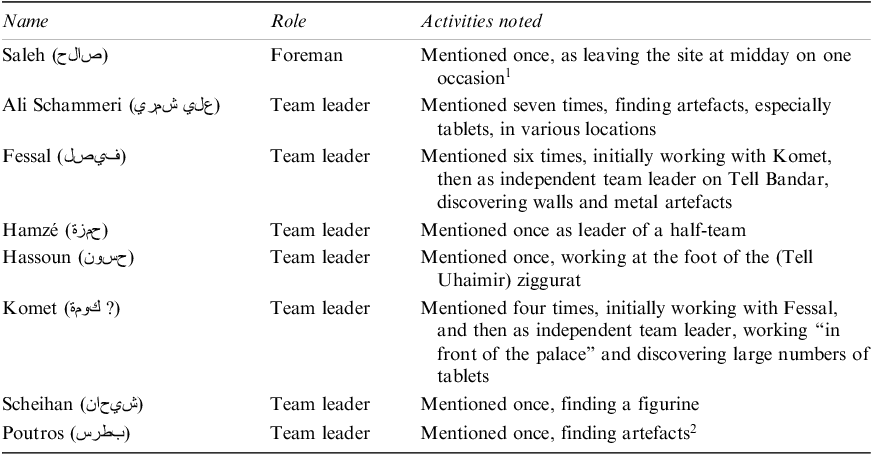


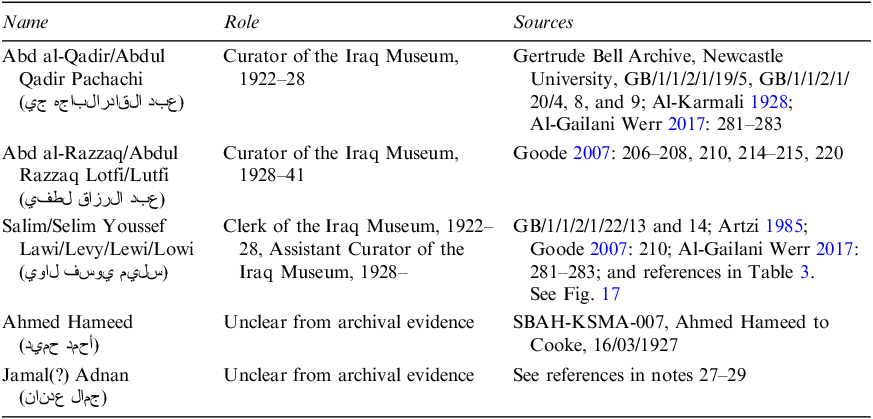


 Open access

