As the literature on endogenous growth has struggled to deepen its analysis of the forces underlying technological change, economists have begun to explore interactions between properties of new technologies and processes of international diffusion and adaptation.Footnote 1 There are few cases, however, for which specific technologies may be tracked empirically across many countries over an extended period of time. One such opportunity is provided by cotton spinning prior to World War I, the world's first global manufacturing industry, using a comparative data set that we have compiled from the records of the British textile machinery industry. Because Lancashire firms supplied nearly 90 percent of world trade in cotton spinning machinery during this period, we are able to observe the evolution of these technologies at global, national, and firm levels, and to track adoption decisions in a large number of countries over a span of more than 50 years. The result is a case study in global competition between technological alternatives, similar to other historical examples such as steam versus water power, or steamships versus sailing ships. In our case, however, the choices were not simply techniques but “paradigms” for workplace organization, skill development, and learning.Footnote 2
Modern diffusion studies typically depict a “trickle-down” process in which new technologies originate in advanced countries and gradually flow (with lags attributable to policies, institutions, or factor endowments) to the laggards.Footnote 3 By the mid-nineteenth century, however, the identity of the technology leader in cotton textiles was not always clear. Modernizing countries faced a choice between a “British” craft-like technology (the mule), in which the machinery drew upon the personal skills of the operators, and an “American” approach in which improvements in the machine reduced skill requirements and extended its capability along other dimensions. As we show, both paradigms were capable of supporting ongoing productivity growth through complementary improvements in machinery, organization, and workforce skills. The diversity of experience among national industries makes it clear that the transition was a two-sided affair, a mutual adaptation between machines and local conditions.
The transition to ring spinning has been extensively discussed by economic historians; along with other cases of alleged “entrepreneurial failure” in Victorian Britain, this topic represents one of the central achievements of the first generation of cliometrics.Footnote 4 In contrast to earlier indictments of the British for technological inertia, cliometricians were able to rationalize Lancashire's preference for the mule in terms of such factors as labor skills, product demand, the quality of local cottons, and proximity to major cotton markets. Looking back over these debates, however, we may observe that they shed little light on the evolution of the underlying technologies. The mule may have been the cost-minimizing choice under British conditions at a point in time. But could they not see (so goes the critique) that clinging to an outmoded and stagnant technology would ensure the demise of Lancashire's historic industry?
Our new evidence allows us to escape both the bilateral context and the narrowly defined issues that absorbed the attention of first-generation cliometricians. When we do, we find that although the British stood at one end of the spectrum, they were by no means alone in their preference for the mule. Such disparate nations as Brazil, Mexico, and Japan followed the U.S. lead and developed almost exclusively with the ring; but mules continued to be purchased in significant quantities by such unlikely bedfellows as Germany, Russia, France, India, Italy, Austria, and Canada. Further, a review of technical performance indicators shows that mule technology was not stagnant during this era. Productivity proxies derived from machine specifications suggest no significant difference in the rate of improvement of rings and mules between 1878 and 1914.
Seen in this light, criticism of Lancashire's failure to switch more rapidly to the ring seems misplaced. The mule was a skill-based technology, and in this competition, British mule spinners were the best in the world. Under machine-based ring technology, British performance was not much better than the world average. Thus, it was only with the mule that the pioneer country could hope to retain its place in world markets. Once the mule ceased to be viable, no feasible choices could have staved off the collapse of the Lancashire cotton industry. Although in most countries the mule became uncompetitive by the 1920s, this outcome was not obvious to industry participants even as late as 1914, based on extrapolation of their own experience and observation of global trends.
This article also contributes to the literature on the international diffusion of technology, shedding light on the perennial question whether technology is best thought of as a local or a global public good. Consistent with many modern studies, our results suggest that both local and global knowledge mattered. Adoption decisions were influenced by firm and national experience, but also by the evolution of best-practice technologies elsewhere in the world. It was possible, however, for follower countries to rearrange the terms of the paradigm choice in fundamental ways. The most striking example is the Japanese industry, which abandoned the mule almost overnight in the 1890s, adapting the ring to a labor-abundant setting by combining it with a package of complementary changes in the preparation of raw cottons.
THE FIRST GLOBAL INDUSTRY
Both mule and ring spinning descended from processes that date from the earliest days of the Industrial Revolution. Invented (but not patented) by Samuel Crompton in 1779, the mule embodied the same principle of intermittent spinning that underlay both the spinning wheel and the Hargreaves jenny. Mule spindles rest on a carriage that travels on a track a distance of five feet, while drawing out and spinning the yarn. On the return trip, as the carriage moves back to its original position, the newly spun yarn is wound onto the spindle, in the form of a cone-shaped cop. As the mule spindle travels on its carriage, the sliver which it spins is fed to it through rollers geared to revolve at different speeds to draw out the yarn. The rise of the mule ended a period of complementarity between cottage-produced weft yarn and factory-produced warp; by 1790 large mules with metal rollers and wheels, fitted with hundreds of spindles and powered by waterwheels, were being used in factories to spin both warp and weft yarn.Footnote 5
The late-nineteenth-century ring machine also rested on better than 100 years of development based on the principle of continuous spinning. The ring is a direct descendant of Arkwright's water frame; in contrast to the intermittent spinning action of the mule, the ring spins all the time, the frame being fixed in place. On each ring spindle is a little wire called a traveler, and around each spindle is also a steel ring. After the thread is drawn through rollers similar to those on the mule, it passes through the traveler onto a wooden bobbin placed on the spindle. As the spindle revolves, this traveler is drawn around the ring, receiving its impetus from the yarn. By revolving a little more slowly than the bobbin, the yarn receives twist at the same time that it is wound on the bobbin. To secure uniformity in winding, the frame of rings moves up and down slowly.
While both ring and mule were recognizable descendants of eighteenth-century machines, the pace of their development in the intervening 100 years was uneven. Mule spinning meant the demise of Hargreaves’ jenny, but not the end of continuous spinning. The water frames, and later the throstle, by twisting and drawing the yarn simultaneously, could produce a coarse yarn faster and cheaper than the mule, so continuous spinning retained a niche in this segment of the yarn market. This coexistence was threatened by the rise of the self-acting or automatic mule, invented by Richard Roberts of Manchester in 1825 and gradually diffused across the next several decades. The self-actor reduced the brute strength required for pushing the mule back and forth on its carriage, allowing a significant increase in the size of individual frames. The innovation also simplified the hand-eye coordination required for guiding the yarn into a precisely shaped conical package. Despite these reductions in skill requirements, the ascendancy of the self-actor coincided with the crystallization of Lancashire mule spinning as a skilled, all-male quasi-craft occupation.Footnote 6 Under this system, the mule became the primary basis for British domination of the world cotton goods market in the nineteenth century.
Across the Atlantic, technological evolution shifted to a different trajectory by the 1820s if not earlier. New England cotton yarn manufacturers tended to use throstles rather than mules, because of their higher productivity per spindle for coarse and medium yarns. When American machinists began to explore possibilities for improvements, their attention focused on continuous spinning. American patents on ring and cap spinning were issued in 1828, to John Thorp and Charles Danforth respectively. The key step was dispensing with the U-shaped “flyer” fixed at the top of the spindle. Cap spinning substituted a conical cap mounted over the spindle, to guide the yarn to the bobbin below. Ring spinning replaced the flyer with a “c”-ring traveling at a high speed around a grooved circular raceway mounted on a plate, which in turn traveled up and down the spinning bobbin. These improvements meant dramatic increases in output per spindle, with less labor and no increase in energy required. By the 1850s average ring speeds reached 5,500 rpm, and there were already reports at this time of coarse yarn spinning on rings at 9,000 rpm.Footnote 7 Because of these developments, continuous spinning was never eclipsed by the self-acting mule in the United States; by the 1860s the American industry had almost as many ring as mule spindles.
Reasons for this national differentiation are not difficult to identify; they have been the subject of an extensive literature in the wake of H. J. Habakkuk's classic work on the impact of labor scarcity on American technology. At the time of its early industrial surge in the 1820s and 1830s, the United States had no stock of skilled mule spinners to draw upon, and preferred machines that could be operated by inexperienced female and child labor.Footnote 8 Further, ring spinning was well suited for longer-staple American cottons that were used in the relatively power-intensive production runs of standardized yarn and cloth for the protected domestic market.Footnote 9 By contrast, the mule was better adapted to variations in cottons and yarn counts, and thus allowed Lancashire to produce for diverse buyers all over the world, and to take advantage of its proximity to the world's largest cotton market in Liverpool. These bases for divergence between the two technological leaders widened over time, as Lancashire perfected its institutions for transmission of mule spinning skills across generations. Mule spinning required an extended period of informal apprenticeship and observation, during which an aspiring spinner learned how to adjust the quadrant nut in order to form the cop; to monitor the product for quality flaws; and to maintain and repair the mule itself, over which he maintained personal responsibility.Footnote 10 Meanwhile, the United States adapted both technology and management systems to repeated generations of immigrants, whose high effort levels were essentially dictated by their assignments of machinery and speed of operation.Footnote 11
Thus it was that American ring spinning technology continued to progress, reaching new performance levels in the “spindle revolution” of the 1870s. The new Sawyer spindle was reduced in weight, and its point of support was changed to an elevated holster. Lightweight, self-centering spindles cut wobble and top-heaviness, thereby reducing power costs and allowing faster machine speeds. The average speed of rings in operation reached 7,500 rpm by the mid-1870s. The late 1870s saw the introduction of the Rabbeth spindle, and within a few years average spindle speeds were as high as 10,000 rpm. In this advanced form, continuous spinning recrossed the Atlantic in the 1870s, as British textile machine makers began to produce ring spinning machines under license from American companies—not because of a shift in domestic demand, but because the industry itself had become international, and the chief suppliers of capital equipment (outside of the United States) were the British.Footnote 12
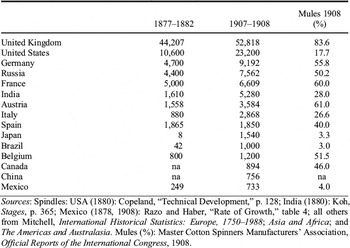
Subsequent advances in ring technology therefore owe as much to their British re-borrowers as to their origins in the American environment. Following the suggestion of Daron Acemoglu that scale economies in technology generation create a market-size bias favoring abundant factors, American progress in ring spinning may be interpreted as an adaptation to relative abundance of unskilled (primarily immigrant) labor in the U.S. economy.Footnote 13 Continuation of ring development by British firms may seem paradoxical, since their domestic textile industry overwhelmingly favored the mule. As of the 1870s, however, the relevant potential market for British-made textile machinery comprised virtually the entire industrializing world outside of the United States. Hence, these specialized machinery firms had strong incentives to advance a technology adapted to emerging industrial centers. Table 1 illustrates the globalization of the industry in the late nineteenth century, as well as the diversity of national choices between ring and mule.
RING AND MULE SPINDLES IN PLACE BY COUNTRY, 1878–1908 (in thousands)

Sources:
Spindles: USA (1880): Copeland, “Technical Development,” p. 128; India (1880): Koh, Stages, p. 365; Mexico (1878, 1908): Razo and Haber, “Rate of Growth,” table 4; all others from Mitchell, International Historical Statistics: Europe, 1750–1988; Asia and Africa; and The Americas and Australasia. Mules (%): Master Cotton Spinners Manufacturers’ Association, Official Reports of the International Congress, 1908.
THE TEXTILE MACHINERY RECORDS
In Britain, machinery producers sprang up with the rise of Lancashire in the first half of the nineteenth century. Their early orientation was strictly towards the domestic industry. Impulses towards markets overseas were discouraged both by close ties to British textile producers and by mercantilist laws prohibiting exports of machinery. The importance of these regulations is often discounted on the grounds that the laws were unenforceable. It is true that many skilled artisans found ways to leave Britain despite the prohibition of emigration, which was abandoned in 1824. A system of licenses allowed some machinery exports between 1824 and 1843, when this system also was abandoned. However imperfect enforcement may have been, the major machinery manufacturers could not have launched their highly visible export promotion and technical assistance programs in defiance of such laws. Repeal was bitterly contested, machinery firms leading the campaign for it—an indication that laws did make a difference.Footnote 14 They took full advantage of their new opportunities when repeal finally came: exports of British machinery and millwork doubled between 1842 and 1846.Footnote 15 The year 1843 thus stands as a watershed in the history of international technology diffusion.
The emergence of specialized machinery producers differentiated the United States and Great Britain from other nineteenth-century textile centers. Such specialization fostered the extreme adaptation of technology to national conditions in these two cases. Other countries, beginning later and relying on imported machinery, typically had to choose between the two dominant national models. As Kristine Bruland has emphasized, late industrializing countries did not just buy spinning machinery on the world market, but an entire “package” of ancillary services, including technological information and supplementary machines, often accompanied by expert advisors and even skilled laborers. In his book on Russian cotton workers, Chris Ward writes: “English Machinery did not come to Russia as neutral technology…self-actors [mules] exported to Russia before the revolution thus embodied assumptions about how they should be worked.”Footnote 16 As British machinery suppliers developed expertise in ring spinning, however, countries were increasingly able to compromise, dividing their investments between rings and mules. But they still relied heavily on British advice in doing so.
The industry leader, Platt Brothers of Oldham, was the largest engineering firm in the world as of the 1850s, and foreign sales accounted for nearly two-thirds of its receipts over 1873–1913.Footnote 17 The pioneering British ring producers were Samuel Brooks (1872) and Howard & Bullough (1878); but by the 1880s Platt Brothers and other firms were producing a full range of rings, mules, and ancillary machinery. The chairman's annual report to the stockholders of Platt Brothers for 1888 noted that the company was by far the largest producer of ring frames in the world, that its machines were unsurpassed for excellence and speed, and that they were scarcely able to keep up with demand.Footnote 18 But all the major firms drew upon expertise accumulated over most of the nineteenth century; the only significant new entrant after the 1870s was Tweedales and Smalley in 1891. By 1913 British firms supplied 87 percent of world trade in spinning and preparatory machines.Footnote 19
The business records of the major British textile machinery firms are now in the Lancashire Public Records office in Preston. Over many years time, we have assembled what we believe to be the most complete data set available on production and sales of spinning machines by these firms, covering the years 1879 to 1933.Footnote 20 These documents are unusually complete in recording technical properties such as machine size and speed, as well as the count of yarn and cotton varieties for which they were designed. The records thus offer a rare opportunity to trace the evolution of spinning technology across time, not only as it was embedded in machines, but as it was implemented in culturally and geographically diverse parts of the world.
PROGRESS UNDER COMPETING PARADIGMS
Because our data originate in sales transactions for spinning machines, we lack the information on labor inputs and production performance that would allow us to estimate production functions over time. What we have are detailed records of changing technical specifications, some of which are plausible proxies for productivity. One example is machine size, the number of spindles per ring or mule frame. If staffing ratios per frame were fixed, the rise in spindles per frame was an increase in labor productivity. Similarly, faster machine speeds raised output per worker, ceteris paribus. Earlier in the diffusion of the self-actor, the application of steam power raised both machine speed and labor productivity at roughly comparable rates.Footnote 21 Later in the century, codification of U.K. piece-rate payments in regional lists encouraged both firms and spinners to increase the size and speed of mules, augmenting both productivity and earnings.Footnote 22
To be sure, extensions of machine size and speed reflected a combination of effects, including both technical advances in machine capability and improvements in the endurance and dexterity of the labor force. Studies of early industrialization find wide variations in worker performance even in an ostensibly “unskilled” occupation such as ring spinner, differences that are correlated with variables such as age, experience and education.Footnote 23 Thus it is possible that staffing ratios were more flexible with rings than with mules, and to this extent differences in machine performance may be less than differences in labor productivity growth. Changes in machine characteristics should in any case not be understood as measures of “pure” technical progress. They are, however, indicators of overall productivity growth within ring and mule systems.
Prior to World War I, the data do not show a clear performance difference between the two types of machinery. Both ring and mule frames increased in size over the period, the global average for mules actually outpacing that for rings slightly, 192 added spindles versus 73. (The increases were almost identical in percentage terms, because mules were two to three times larger at the beginning of the period.) The pattern was similar for machine speed. Average speeds in ring spinning were somewhat below the U.S. norm, as reported by M. T. Copeland. But ring speeds increased over time, from an average of 8,100 rpm in 1884–1890 (the first period in which ring speeds were recorded) to 8,900 in 1907–1914. However, the same was true for mules. In the majority of cases for which comparisons are possible, mules were faster than rings.
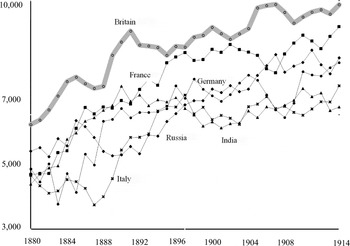
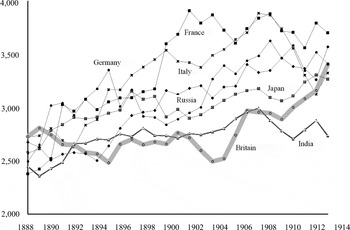
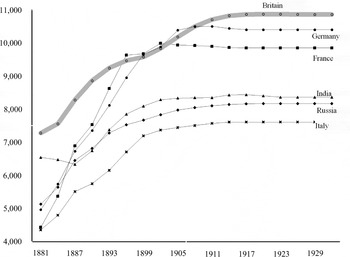
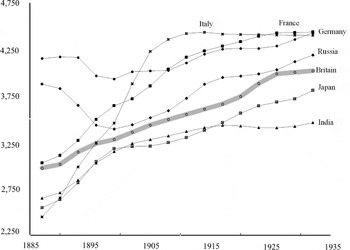
An efficient way to summarize this information is to multiply size (spindles per frame) by speed (rpm) to generate a measure of rpm per frame. Figures 1 and 2 display the data for rings and mules, adjusted for yarn count, for a selected handful of countries.Footnote 24 The robust progress of mules is evident in Figure 1, easily matching the performance of rings in Figure 2. Equally notable is the pattern of national differences. In the skill-based mule technology, Great Britain was the clear world leader throughout the period. But in the more egalitarian world of the ring, the British were no better than average. More generally, international dispersion in machine size and speed was considerably lower for rings than for mules. During the 1880s and 1890s the cross-country coefficient of variation for rpm per frame was 60 to 150 percent higher for mules than for rings.
RPM PER MULE FRAME, 1880–1914

RPM PER RING FRAME, 1888–1914

In light of this evidence, the idea that Lancashire's competitiveness would have been improved by an earlier and more decisive switch to the ring appears misplaced. It was only with the mule that the pioneer country could take advantage of its highly skilled labor force to maintain its leadership in world markets.
We caution, however, that the indices in Figures 1 and 2 should not be interpreted as direct measures of national productivity levels, because they do not account for differences in staffing ratios. In his celebrated study of work intensity in cotton mills, Gregory Clark, showed that the ratio of ring spindles to workers in 1910 was 20–30 percent higher in England than in France, Russia, or Italy, and three times as high as in India and Japan.Footnote 25 Thus labor productivity differences in rings were larger than the gaps displayed in Figure 2, though they were generally narrower than differences in wage rates between comparable pairs of countries. But if as we argue the graphs in Figure 2 are reasonable proxies for changes in labor productivity within countries, we may conclude that many countries were progressing at least as rapidly as the British in ring spinning.
For mules, differences in staffing ratios between countries were if anything even greater than for rings. In England, each pair of mules employed one spinner (the minder) and two piecers, while in Germany, France, Switzerland and Italy, the minder typically had three or even four assistants.Footnote 26 Thus the British productivity advantage in mules was as much as 30 to 60 percent greater than is indicated by Figure 1.
Comparative productivity analysis by Timothy Leunig confirms that pre-World War I labor productivity in British cotton spinning compared favorably to that of New England, with mule spinning at the top of the ladder. Significantly, Leunig finds that the relative productivity positions of the two technologies were reversed in the two countries: In Lancashire, productivity was higher in mule spinning at all yarn counts, while in New England, ring spinning had higher productivity at all counts below the mid-50s.Footnote 27 There is no basis here for the claim that Britain would have gained by switching to rings.
EXTENDING MACHINE CAPABILITIES: TRENDS IN YARN COUNT
Unfortunately for Lancashire and other mule-using national industries, physical productivity was not the only margin for progress. “Count” or “yarn number” is a measure of the fineness of yarn, the number of “hanks” of 840 yards each required to make one pound. To produce a given weight at a higher count, the yarn must spend more time on the spindle being stretched and twisted, increasing the frequency of breaks. Because continuous spinning made greater demands on cotton fibers, especially at higher counts, the mule had a relative advantage at the high-count end of the spectrum. Indeed, one of the standard rationalizations for the divergent technological choices between the United States and the United Kingdom is that British yarn production was concentrated at counts higher than forty.Footnote 28
The evidence shows an increase in average ring count specifications over time. For the world as a whole, the increase was modest prior to the 1920s: from 25.2 in 1878–1883 to 30.5 by 1907–1914. In individual countries, however, the rise could be dramatic. Between 1878–1883 and 1907–1914 the average count for which new rings were designed increased by 30 percent or more in Britain, Italy, Spain, and Alsace, as well as Japan and Mexico. Average counts for new mules increased as well, but this probably reflected a decline in market share rather than an extension of the mule's productive range.
The mule's advantage over the ring was not, however, monotonically related to yarn count. Because its strong suit was fiber control, the mule was often recommended for countries in which domestic cottons were extremely short-staple, even though the yarn spun was low in count. Thus, in the earliest period in our data (1878–1883), rings in India, Austria, and Germany were designed for counts higher than the average for mules. In India, average yarn counts on mules were below those on rings throughout the period. For the same reason, Japan in the 1880s committed to the mule. As a measure of ring capability, therefore, yarn count should be considered relative to cotton fiber length.
Nonetheless, increasing the ring's range of commercially viable yarn counts was a major frontier of ring-mule competition. The mule might match the ring in productivity growth for a given yarn count, but the mule's primary protection was its “preserve,” the range of counts that a skilled mule spinner could achieve, beyond the reach of the ring at a point in time. Once the ring moved into new territory, matching productivity growth was not enough to save the mule, because ring labor (less skilled, younger, and often female) was cheaper. Competitive efforts in the machinery industry to expand markets in low-wage countries propelled advances precisely along these lines. For example, an 1899 Platt Brothers memo headed “Rings for Fine Spinning” stated: “Please note that in the future all Ring Frames for fine spinning (say over 40 counts) should have rings specially finished and accurately gauged as recently supplied to Bolton Mills.”Footnote 29
Support for such implicit “bias” in the direction of technological change may be found in the records of British patenting. Between 1861 and 1877—during the era when the self-acting mule was still on its ascendancy, and prior to the advent of mass global ring marketing—more than two-thirds of British spinning patents were directed towards rings rather than mules.Footnote 30 Very likely ring innovations lent themselves more readily to patenting than mule innovations, because ring progress was more fully lodged in the machinery and less in the skills of the operatives. But quite apart from intrinsic patentability, this improving energy was clearly driven by prospects in the world market for spinning machinery, because the British domestic textiles industry remained overwhelmingly committed to the mule. The largest numbers of ring patents were in such categories as “driving and stopping apparatus,” “guards and protectors for threads,” “roving and thread guides,” “tension arrangements,” and “stop-motions”—just the types of improvements that increased fiber control and therefore extended the ring's range of viable production. This evidence thus supports Acemoglu's thesis that technology is directed by market size, if “market size” is understood as the number of potential buyers as opposed to the number of current ring users at a point in time.
Because Acemoglu's analysis is framed in terms of a “directed” technological bias in skill requirements, its application to machine spinning calls for clarification. The evidence from studies of national textile industries indicates that labor quality increased over time, by such criteria as endurance, dexterity, speed, and work effort, and that technology and job specifications evolved so as to complement these improvements in worker capability.Footnote 31 Thus, within ring spinning, technological progress was not necessarily deskilling, and may well have been skill-enhancing. Nonetheless, advances in the ring's yarn count-fiber length frontier were implicitly deskilling from a global perspective, because they expanded the world market share of a technology whose skill requirements were much lower than those of the primary alternative. Thus, technological progress need not be directed explicitly at skill requirements in order to have global labor market implications.
BREAKING THE MOLD: ALTERNATIVE PATHS TO FIBER CONTROL
The extension of the ring's range was thus not purely a matter of technical progress in machine making; it also reflected the success of user countries in improving their systems of management and labor force performance. Generally this progress was gradual, but not always. In Japan and Russia during the 1890s, a sharp swing towards rings coincided with a significant expansion of longer-staple cotton imports from abroad.
Whereas the more flexible mule was the logical choice if the country were restricted to short-staple domestic cottons, the balance tipped towards the ring if longer-staple American cotton could be substituted. In the Russian case, the move towards the ring was circumscribed by a change in Tsarist policy towards protecting domestic cotton production. Japanese adoption of the ring was accompanied by a series of complementary changes, the most notable of which were a dramatic increase in the share of imported raw cotton (facilitated by removal of a 5 percent import duty), and shifting to a labor force primarily composed of young women. An important feature of the new package was allocating more labor to preparing the raw cotton for spinning, by judiciously blending small amounts of longer-staple cotton to reduce breakage frequency at high speeds. An American observer reported in 1907: “The Japanese show skill in the mixing…of American, Indian, and Chinese cotton. They have plenty of help, however, and have the bales opened up and thoroughly mixed by hand and left in bins to open out and regain normal condition.”Footnote 32 By the 1920s a British visitor commented: “Mixing of cotton is an art of which the Japanese mill managers are justly proud…Each mill has its own private mixings, and they differ according to the price at which the yarn is to be sold and for what purpose it is wanted.”Footnote 33 But the system originated in the early 1890s.
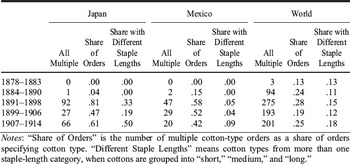
This account is confirmed in Table 2, showing that Japan's adoption of the ring in the 1890s was associated with a sharp increase in orders specifying multiple cotton types. A number of national ring industries moved in this direction at the time, but Japan's shift was the largest, and the country stood virtually alone in three- and four-cotton-type orders.Footnote 34 Thus the Japanese were able to use labor-intensive methods to match with the ring the fiber control and flexibility that the British had long accomplished with the mule.
RING ORDERS SPECIFYING MULTIPLE COTTON TYPES, 1878–1914

Notes:
“Share of Orders” is the number of multiple cotton-type orders as a share of orders specifying cotton type. “Different Staple Lengths” means cotton types from more than one staple-length category, when cottons are grouped into “short,” “medium,” and “long.”
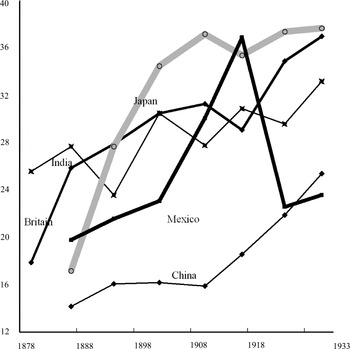
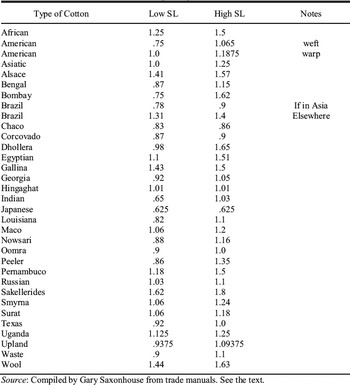
Because raw cotton constituted a large proportion of total yarn cost, the ability to squeeze ever-higher counts from lower-cost cottons was intimately related to a mill's success. In an effort to show the effects of this innovation more precisely, we have converted the heterogeneous entries for cotton type and cotton grade from the company records into a standard measure of “fiber length,” using trade manuals and instruction books.Footnote 35 The ratio between yarn count and fiber length serves as an index of technical performance using the ring.Footnote 36Figure 3 shows that the Japanese ratio doubled during the decades bracketing 1900, well ahead of other countries.
RATIO OF YARN COUNT TO FIBER LENGTH (RINGS), 1878–1933

Perhaps surprisingly, the closest parallel to the Japanese performance prior to 1914 was Mexico. Despite its proximity to the United States, and despite a lively debate over the comparative merits of American versus British technology, the Mexican textile industry was supplied almost exclusively by Lancashire ring spinning machines prior to 1918. Most large Mexican mills were electrified by 1905, running their machines at speeds that matched those of the leading countries of the world. Mexico was second only to Japan in its use of mixed cotton types on the ring (Table 2), though the cottons involved (American and Mexican) were mainly similar in length. Mexican yarn counts increased rapidly, from 12 in 1878–1883 to 30.9 in 1907–1914. This record is confirmed by econometric studies showing high rates of productivity growth in Mexican textiles through 1912.Footnote 37 Thus Mexico provides another illustration of the democratizing potential of ring spinning, for countries with appropriate social and political characteristics, and access to growing markets. Unfortunately, realization of that potential was interrupted by the Mexican Revolution and the retreat to protectionism on both sides of the Rio Grande in the 1920s.Footnote 38
A MODEL OF ADOPTION: THE INTERACTIVE NATURE OF TECHNOLOGICAL LEARNING
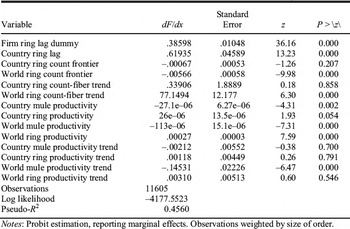
In this section, we estimate an equation characterizing the determinants of machinery choice by individual firms. The dependent variable is binary, that is, a firm either adopts ring or mule machinery. This decision is related to the firm's and the nation's previous experience with each technology, which we measure by a binary variable indicating whether the firm had chosen this technology in the immediately preceding order (Firm Ring Lag Dummy = 1 if previous ring order), and by the percentage of past spindles ordered in the country that were rings (Country Ring Lag). We posit that the decision was also related to the current ring capability frontier as seen from the firm's perspective, measured by the yarn count specified in the order minus the count spun by the top decile of ring firms in the country (Country Ring Count Frontier); and by a similar variable defined for the world (World Ring Count Frontier). Because this variable is positive if the firm is pressing against the ring frontier, we expect the sign of the coefficient to be negative. Expectations regarding the extension of ring capability are measured by the coefficient on time in a quantile regression of the ratio of yarn count spun to fiber length on all previous ring orders respectively (Country Ring Count-Fiber Trend) and for all world orders (World Ring Count-Fiber Trend), where the quantile is the top decile. We also include a set of variables representing the firm's expectations about the movement of the productivity frontier for mules as well as rings, measured by the coefficient on time in a quantile regression of spindle speed times spindles per frame, for rings and for mules, and for the nation and for the world, where again the quantile is the top decile. For each quantile estimation, previous orders are updated to the day of the order. Thus, we allow each firm to have its own view of the technological frontier, and its own expectations about the frontier's movement at the moment it makes its choice.
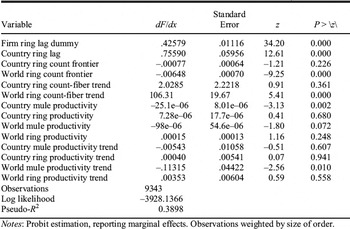
Table 3 reports these probit regressions for 1878–1914. Not surprisingly, prior experience using a technology was a powerful determinant of machine choice, both for the firm and for the country. But the progress of the technological frontier was also important. Advancing ring capability was particularly influential, specifically best practice suggesting that rings could spin the yarn count demanded at home and abroad (Country and World Ring Count Frontier). The variable representing the advance of the ring's world fiber frontier had a particularly powerful effect.
PROBABILITY THAT A NEWLY ORDERED SPINDLE WILL BE RING, 1878–1914

Notes:
Probit estimation, reporting marginal effects. Observations weighted by size of order.
Perhaps the most essential result in Table 3 is that progress in mule productivity also made a difference for adoption decisions. This effect was statistically significant for a country's mule productivity level, and for both the level and trend of mule productivity for the world. The results suggest that in their adoption decisions, firms set rising trends in ring capability against evidence of continuing improvements in mule productivity. While both local and global trends are statistically significant, global trends appear to have been more important to firms in projections of which technology was likely to be more dynamic in the future.
Simulations with these results show that in every country, the strong performance of world mule productivity exerted a drag on the adoption of rings. The effect was strongest in the 1880s and 1890s, but it was clearly visible throughout the prewar period. Added to this was the advantage of the mule in spinning higher count yarns relative to staple length. Ultimately, however, the rise in ring yarn counts relative to fiber length—the result at least in part of machinery company improvements—induced firms to try ring spinning, a decision that was ultimately ratified and consolidated by the accumulation of ring experience in these countries.
HIGH-DRAFT SPINNING AND THE DEMISE OF THE MULE
The era of competitive coexistence between ring and mule did not survive World War I. New installations of mules declined to a trickle in the 1920s, in all countries except Great Britain. Undoubtedly, it is the coincidence between the calamitous decline of the British textiles industry during this decade and Britain's status as the last predominantly mule nation that accounts for the widespread diagnosis that the root of Lancashire's problem was technological conservatism. To assess the role of technological change in this outcome, it is helpful to examine the trends in “best-practice” performance under the two alternatives. Figures 4 and 5 display three-year averages of our index of machine productivity (rpm per frame), for the top decile of firms within each country. It is evident in Figure 4 that the pace of progress in mules came to an end during and after World War I, even in Britain. With the aid of hindsight, one may see that the slowdown began several years earlier in most countries. Thus it is tempting to attribute the mule's demise to the idea that by the early decades of the twentieth century, it was reaching the limits of its technological potential.
MULE TOP DECILE RPM, 1880–1932

RING TOP DECILE RPM, 1887–1932

There are at least two reasons to resist the temptation of this simple technological determinist narrative. One is that technological stagnation in new mules was also observed in countries operating well below the British frontier, such as Italy, India, and Russia. Obviously, these countries could have had higher performance levels with the mule, and their failure to do so represented a human-capital investment decision rather than an outright technological imperative. As in the prewar period, international differences in mule productivity were large, and we associate them primarily with differences in labor skills.
The second reason is that the growth of best-practice productivity also declined for rings at about the same time, as shown in Figure 5. This too should not necessarily be seen as a technological imperative. In some countries, ring productivity continued to grow robustly through the 1920s, but all of these (Japan, Russia, and the United Kingdom) were well below the world frontier.Footnote 39 The frontier itself did not grow, and consistent with our previous argument, international dispersion diminished at this time. It is possible that labor productivity growth was rechanneled into higher assignments of spindles per worker (the “stretch-out” as it was known in the United States), but such changes cannot be tracked with our data. Perhaps the best summary statement is that the era of ring-mule competition through larger and faster machines came to an end around World War I.
In order to assess the ability of our adoption model to interpret this phase of the history, we have extended the probit estimation through 1933 (Table 4). The statistical fit is substantially tighter for the longer period, but the changes in the coefficients do not generate an obvious explanation for the swing towards rings. Persistence effects were if anything smaller, as was the trend coefficient on the world yarn count/fiber length ratio. Favoring rings were the coefficients on the country and world ring count frontier, both of which fell in absolute value (i.e., reducing the ring's disadvantage in higher-count yarns). The increased responsiveness to ring productivity in adoption decisions may in turn have been endogenously affected by continuing advances in ring capability.
PROBABILITY THAT A NEWLY ORDERED SPINDLE WILL BE RING, 1878–1933

Notes:
Probit estimation, reporting marginal effects. Observations weighted by size of order.
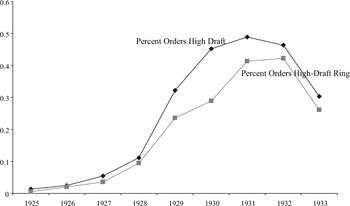
The most notable of these was the Casablancas method of drawing out the fibers in pre-spinning operations, also known as “high drafting” or “long drafting.” Developed in Spain in 1913, the system deployed elastic bands or soft leather “aprons” to achieve much higher levels of fiber control than was previously possible with machine methods. In addition diffusion to labor-saving features, high drafting relaxed restrictions on variation in staple length, increasing the range of counts that could be efficiently produced from a given hank roving.Footnote 40 Although the impact of the innovation was still in doubt in the early 1920s,Footnote 41 by mid-decade it was part of the standard package offered by textile machinery companies. Within a few years industry authorities recognized long-draft spinning diffusion as “a basic change in those supposedly unalterable principles established by inventors in eighteenth-century England.”Footnote 42Figure 6 displays the diffusion of high-draft spinning in our data set, indicating that nearly half of new ring orders were high draft by the 1930s.
DIFFUSION OF HIGH-DRAFT SPINNING, 1925–1933

Although high drafting was later adapted for use with the mule as well as the ring, the system largely nullified one of the mule's primary advantages, its flexibility in the use of raw cotton. Because it embodied a labor-saving, machine-based alternative to the Japanese method of “mixing” cotton fibers, the new technology quickly spread to the United States and was readily adopted in continental countries such as Belgium, France, and Italy. Interestingly, the largest number of high-draft orders during 1929–1933 were from India. The popularity of a labor-saving innovation in a low-wage country presumably relates to the predominantly male labor force in Indian textiles, and the prevalence of British-style labor relations in that country.Footnote 43
High-draft spinning thus extended the long-term trend towards rising yarn count relative to fiber length, allowing many countries to converge on Japan's leading position on this ring frontier (see Figure 3). Consistent with this analysis, the high draft was associated with an increase in ring orders specifying the use of multiple cotton types. Of high-draft orders after 1926 in which cotton type was identified, 40.4 percent specified multiple cotton types, compared to 23.2 percent during the pre-Casablancas era. In India, the number of such orders jumped from 16 during 1921–1928 to 58 in 1929–1933.
The Casablancas system did not immediately eliminate the competitive position of the mule. Indeed, despite the discontinuity in favor of rings, two-thirds of British orders were mules between 1921 and 1928, a far larger share than France in second place at 28.5 percent. The greatest impact was on medium-count mule-spun yarn, followed by its impact on low-count yarn, with little impact at all on fine yarn.Footnote 44 At the very highest yarn counts, where Britain retained comparative advantage in cotton textiles, the mule continued to be internationally viable. As late as the 1950s British company officials as well as labor representatives expressed strong belief in the superiority of the mule for fine yarn counts and specialty goods.Footnote 45
A plausible dynamic interpretation draws again on Acemoglu's hypothesis that scale economies in technology generation create a market-size bias. By the 1920s mules were only 6 percent of spinning machine sales by the British machinery companies, down from 28 percent during 1907–1914. In the wake of the Casablancas revolution, the potential for future expansion of this already limited market was bleak. There was thus little incentive for machinery firms to expend resources searching for improvements in the mule. And because, as we have argued, progress derived from interactions between machine producers and workers, there was also little incentive for new employees to invest in mule spinner skills. Accounts from the 1950s attribute the mule's ultimate demise to the scarcity of new recruits into the occupation of mule spinner, reflecting a lack of confidence in the industry's future. As the Bolton spinners’ union put it in 1953: “… what parent is prepared to place his son in a trade which is continually contracting?”—a good illustration of the effects of expectations on the viability of a technology.Footnote 46
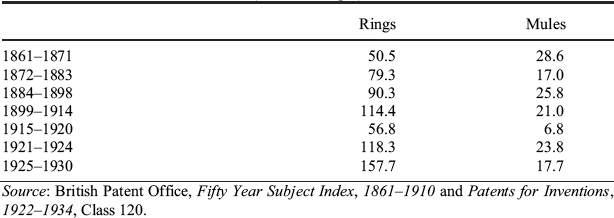
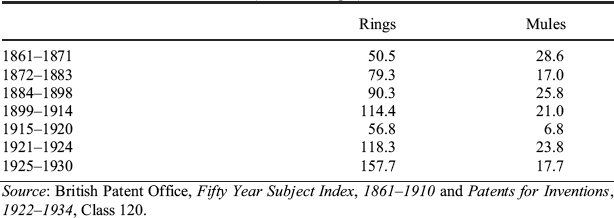
This interpretation is supported by data on patents (Table 5).Footnote 47 When the technological issue was still in doubt (1921–1924), patenting rates for mule innovations matched the highest rates of earlier periods, nearly 25 per year. But after high-draft spinning went on the market as a standard option in 1924, mule patenting rates fell off sharply. Thus it does not appear that the mule had reached a technological limit by the 1920s; instead, its limited future in the wake of high-draft ring spinning meant that further investments in mule improvements had low expected payoffs.
U.K. PATENTS ON RINGS AND ON MULES, 1861–1930 (annual averages)
Source:
British Patent Office, Fifty Year Subject Index, 1861–1910 and Patents for Inventions, 1922–1934, Class 120.
Thus there is no basis for the belief that an earlier or more decisive shift to the ring would have significantly extended the life span of this historic industry. As the loss of Lancashire's competitive position became clearer during the 1920s, the stock of British spindles began to decline. By the 1930s rings as well as mules were shut down. Between 1929 and 1937 the British ring stock declined by 2.3 million, many of these shipped to Japan via the secondhand dealer, Samuel Dodds & Co. British mule spinners were the best in the world; but using the ring, the British were no better, yet more expensive, than their chief rivals on world markets.
CONCLUSION
The historical diffusion of cotton spinning technology contains many lessons for the study of endogenous technological change and international technology transfer. The most basic is the relevance of the historical and institutional context. The ring and the mule represented different paradigms for organizing production and learning, reflecting core features of their countries of origin. Each one had its own internal logic and evolutionary tendencies. Most follower countries had to choose between these two systems, and their choices varied widely. A coherent long-term account should allow for such regime changes in underlying technological processes.
The case shows that the evolution of best-practice performance was a two-sided affair, a mutual adaptation between machines and local conditions. Most countries chose points within the already established global frontier. But even while importing virtually all of its spinning machinery from Britain, the Japanese industry extended the frontier by recombining elements of the production package in novel ways. By simultaneously moving to import a broad range of cotton varieties and deploying labor into cotton mixing prior to spinning, Japan was able to adapt ring spinning from its high-wage American origin to a much more labor-intensive setting.
Elsewhere, spinning firms were influenced in their adoption decisions by prior firm and national experience, but also by advances in best-practice performance elsewhere in the world. Diffusion of ring spinning was constrained both by limitations on the ring's capability for spinning higher count yarns and by evidence of continuing gains in mule productivity. The skill-saving bias of technological change was thus largely implicit. By improving the ring's fiber control and extending its capability into higher-count yarns, British machinery firms were effectively making the technology accessible to a less experienced and more demographically diverse global labor force.
APPENDIX
CONVERSION FROM COTTON TYPE AND GRADE TO STAPLE LENGTH (inches)

Source:
Compiled by Gary Saxonhouse from trade manuals. See the text.