The introduction of the central venous catheter (CVC) has revolutionized cancer patient care by facilitating the administration of chemotherapy, blood products, and supportive fluids. However, this decades-old advance has been somewhat offset by the life-threatening complications that accompany the insertion and maintenance of these devices, including infection and thrombosis.
The pathogenesis of central-line–associated bloodstream infection (CLABSI) commonly involves contamination of the catheter access port or “hub,” the part of the needleless connector that connects to the infusion tubing. Frequent manipulation and handling of the hub during catheter use makes it particularly vulnerable to entry by microorganisms, which can eventually lead to endoluminal colonization and bloodstream infection.Reference Segura, Alvarez-Lerma and Tellado 1 It is now well recognized that the majority of CLABSIs occur >5 days postinsertion and that implementing standardized catheter handling and maintenance practices benefit CLABSI prevention.Reference O’Grady, Alexander, Burns and Dellinger 2 , Reference O’Grady, Alexander and Burns 3 Thus, prevention efforts have expanded with a focus on optimum catheter maintenance practices.
A number of elements of catheter maintenance have been proposed and have been shown to reduce CLABSI rates.Reference Guerin, Wagner, Rains and Bessesen 4 – Reference Shapey, Foster, Whitehouse, Jumaa and Bion 6 The majority of these interventions include maintenance practices recommended by the Centers for Disease Control and Prevention (CDC) in conjunction with well-conducted education programs. Optimization of maintenance bundles with the inclusion of newer products could further improve post-insertion catheter care and lead to a reduction in CLABSI rates among high-risk populations.
One such recent invention is the antiseptic barrier cap, which has been reported to provide passive and continuous disinfection of the catheter hub without the need for manual scrubbing. Proponents claim that its use is time saving, practical, and effective, and some studies have demonstrated a reduction in bacterial contamination of the catheter hub.Reference Wright, Tropp and Schora 7 – 9 More recent reports have demonstrated that the introduction of these devices into routine catheter care practices in acute care hospitals and non–high-risk oncology patients may be associated with a decrease in CLABSI rates.Reference Wright, Tropp and Schora 7
To determine the efficacy of the disinfection cap among patients at a large tertiary care cancer center, we examined the rate of hospital-acquired (HA)-CLABSI and blood culture contamination (BCC) with coagulase negative staphylococcus (CONS) before and after the introduction of disinfection caps. We hypothesized that this intervention led to a decrease in the rates of these outcomes.
METHODS
Study Population
Memorial Sloan Kettering Cancer Center is a 470-bed tertiary care medical center in New York City with approximately 23,000 admissions and 150,000 patient days annually. The hospital includes a 25-bed transplant ward (HSCT), a 43-bed leukemia–lymphoma ward, and a 20-bed mixed medical–surgical intensive care unit (ICU). During the study period (2010–2012), the average numbers of autologous and allogeneic HSCTs performed at the center were 228 and 152, respectively. Approximately 53% of all MSKCC inpatients have indwelling CVCs at any given time.Reference Son, Daniels and Eagan 8 In our report, the 3 hospital units with the highest device utilization (ICU, HSCT unit, and leukemia-lymphoma ward) are referred to as high-risk units (HRUs). Other units are referred to as general oncology units.
Study Design
In this multiphase prospective study, we used sequential introduction of disinfection caps on CVCs used on HRUs followed by hospital-wide implementation that included general oncology units. The disinfection caps were introduced following education and training of nursing staff on the correct use of the device. The analysis was conducted in 4 phases as described below. No other CLABSI initiatives were introduced during any of the study phases.
Phases 1 and 2. The pre-intervention surveillance phase was divided into an early phase (P1, May 2010–December 2010) and a late phase (P2, January 2011–August 2011)
The CDC recommended practices for catheter maintenance were followed during P1 and P2. These practices included (1) hand hygiene; (2) disinfection with alcohol by scrubbing the hub with alcohol pad prior to access; (3) catheter access with sterile device only; (4) replacement of dressings that were visibly wet, soiled, or dislodged (chlorhexidine impregnated dressings are routinely used at MSKCC); and (5) dressing changes using an aseptic technique.Reference O’Grady, Alexander, Burns and Dellinger 2
CLABSI surveillance at MSKCC began in the ICU in 2003. Hospital-wide CLABSI surveillance was implemented in May 2010. The insertion bundle (including chlorhexidine impregnated dressings) was implemented in 2008, and CDC-recommended catheter maintenance practices have been followed since 2009.
Phase 3. Disinfection cap intervention on HRUs (P3, September 2011–March 2012)
During this phase, the standard of care for CVC hub disinfection was changed from manual scrubbing to routine use of SwabCap disinfection caps (Exelsior Medical Corporation, Neptune, NJ) with each CVC access. SwabCaps contain 70% isopropyl alcohol; the cap is changed after each access or at 7 days if not accessed. For the purposes of this report, this intervention is referred to as the disinfection cap.
Phase 4: Hospital-wide (HW) disinfection cap intervention on general oncology units (P4, April 2012–December 2012)
During this phase the use of disinfection caps on CVCs was extended to include the general oncology units.
Variables and Outcome Measures
The primary outcomes of the study were hospital-wide and unit-specific rates of hospital-acquired CLABSI (HA-CLABSI). Primary CLABSI was defined according to the CDC/National Healthcare Safety Network (NHSN) criteria. Onset of bacteremia >48 hours after inpatient admission was used to classify infections as hospital-acquired (HA). 9
Our secondary outcome was contamination of blood culture specimens. Inadequate CVC hub disinfection can result in contamination of blood culture specimens yielding growth of common skin commensals. CONS isolated in blood culture that did not meet the NHSN primary CLABSI criteria were considered BCC. Any single CONS-positive blood culture or ≥2 positive cultures drawn on separate occasions >2 days apart were considered BCC. CONS blood isolates attributed to infection at another site were not considered BCC.
Statistical Analysis
The HA-CLABSI rates were compared during the 4 phases of the study. Data from units that did not use CVC disinfection caps were used to determine possible changes in rates unrelated to the product. A secondary analysis was performed to measure the impact of the introduction of the disinfection cap on BCC by CONS. Summary data for both outcomes were also examined in bimonthly intervals to monitor trends over the study period.
The pre-intervention phase was divided into an early phase (P1) and a late phase (P2). To detect any statistically significant changes in CLABSI rates or BCC introduced by implementation of surveillance (beginning May 2010), we compared HA-CLABSI rates with BCC using data from both P1 and P2 as baseline measures.
We calculated the device utilization ratio (DUR) by dividing the number of catheter days by the number of patient days. We also calculated the standardized incidence ratio (SIR), which reflects the ratio of observed infections to the expected number of infections in the study population under the assumption that the incidence rates for the study period are the same as those for the reference period.
All comparisons were performed using χ2 test for 2 population proportions with 95% confidence intervals; a 2-tailed α<0.01 was considered statistically significant. The Memorial Sloan Kettering Cancer Center Institutional Review Board granted a Health Insurance Portability and Accountability Act (HIPAA) waiver of authorization to conduct this study.
RESULTS
During the study period, 806 CLABSI episodes occurred in 691 patients, including 393 (48.8%) episodes in 353 patients that were HA. Of the HA-CLABSI episodes, 264 (67.2%) occurred in patients with underlying hematologic malignancy. When examined by unit, 204 of 393 (52%) HA-CLABSIs were attributed to HRUs, accounting for ~21% of inpatient hospital days. The device utilization ratio (DUR) of HRUs was 0.69; the DUR of general oncology units was 0.37. The total number of patients and the proportion with different cancer types remained stable over the study period.
Impact of Disinfection Caps on HA-CLABSI Rate
HRUs
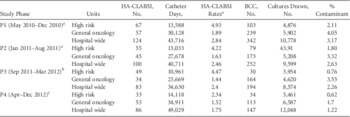
In the pre-intervention period, the hospital-wide HA-CLABSI rate, which included both the HRUs and the general oncology units, did not vary significantly: 2.84 for P1 and 2.46 for P2 per 1,000 catheter days (P=.20). The specific HRU rates also did not vary between the baseline phases: 4.93 for P1 and 4.22 for P2 per 1,000 catheter days (P=.30). Table 1 shows the absolute number of HA-CLABSI episodes and rates by unit.
HA-CLABSI Rates per 1,000 Catheter Days and Blood Culture Contaminants (absolute and %) During the 4 Study Phases in HRUs, General Oncology Units, and Hospital-wide

NOTE. HA-CLABSI, hospital-acquired catheter-line–associated bloodstream infection; BCC, blood culture contamination; HRUs, high-risk units.*Rate per 1000 catheter days.
a Phase 1 (P1) and Phase 2 (P2): pre-intervention period (8 months each).
b Phase 3 (P3): implementation of disinfection cap on HRUs only (7 months).
c Phase 4 (P4): hospital-wide implementation of disinfection cap to include general oncology units (9 months).
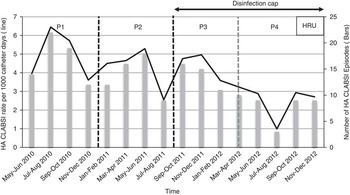
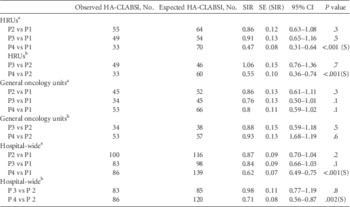
After the introduction of CVC disinfection caps in HRUs (P1 vs P3 and P4), the HA-CLABSI rates in the units did not significantly decrease during P3 (4.47 per 1,000 catheter days) compared with the baseline (Tables 1 and 2). However, the rates declined significantly compared to baseline during P4 to 2.34 per 1,000 catheter days (P4 vs P1: SIR=0.47, 95% confidence interval [CI]=0.31–0.64, P<.001; P4 vs P2: SIR=0.55, 95% CI=0.36–0.74, P<.001). Table 2 shows the HA-CLABSI comparison between the various study phases with P1 and P2 as reference. Figure 1 displays the bimonthly trend in HA-CLABSI episodes and rates on the HRUs only.
Bimonthly hospital-acquired central-line–associated bloodstream infection (HA-CLABSI) episodes (bars, secondary Y axis) and HA-CLABSI rates in high-risk units (HRUs) (line, primary Y axis) during the 4 study phases: before (P1 and P2) and after (P3 and P4) the introduction of disinfection cap.

Comparison of HA-CLABSI Rates in HRUs, General Oncology Units, and Hospital-wide before and after the Introduction of Disinfection Caps

NOTES. HA-CLABSI, hospital-acquired central-line–associated bloodstream infections; SIR, standardized incidence ratio; SE, standard error; 95%CI, 95% confidence interval; S, significant.
a Using P1 as a reference.
b Using P2 as a reference.
General oncology units
The HA-CLABSI rate in general oncology units did not change significantly between the baseline surveillance phases (P2 vs P1: 1.89 vs 1.63 per 1,000 catheter days; P=.30). There was also no change when CVC disinfection caps were introduced on the HRUs only (P3 vs P1: P=.10; P3 vs P2: P=.50) (Tables 1 and 2).
After the CVC disinfection cap was introduced on the general oncology units (P4), the HA-CLABSI rate was 1.52 per 1,000 catheter days. This rate did not significantly differ from P1 (P4 vs P1: P=.10) or P2 (P4 vs P2: P=.60).
Microbiology
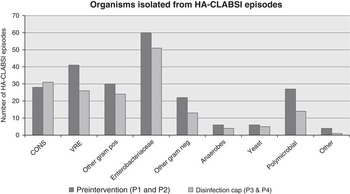
A total of 352 of 393 (90%) HA-CLABSI episodes were monomicrobial; the organisms isolated from these episodes are depicted in Figure 2. Gram-positive organisms were the most common etiologic agents for HA-CLABSI. Among these organisms, vancomycin-resistant enterococcus (VRE) and CONS were most frequently isolated, representing 19% and 16.7% of HA-CLABSI episodes, respectively.
Organisms isolated from hospital-acquired central-line–associated bloodstream infection (HA-CLABSI) episodes during the pre-intervention period (P1 and P2) and after stepwise introduction of CVC disinfection caps on high-risk units (HRUs) (P3) and general oncology units (P4).

Impact of Disinfection Caps on BCC by CONS
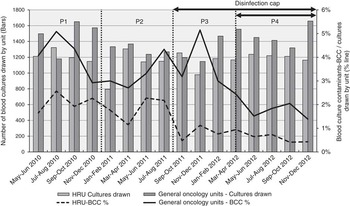
To examine the impact of the disinfection cap on BCC, we examined the proportion of CONS to BCC among blood cultures drawn from catheters. No significant changes in testing trend were detected during the study phases (Figure 3). However, the proportion of CONS to BCC declined significantly during P3 after introduction of the disinfection cap on HRUs, from 2.11% (103 of 4,876) and1.8% (79 of 4,391) in P1 and P2, respectively, to 0.76% (30 of 3,954) and 0.62% (34 of 5,461) in P3 and P4, respectively. Both P values were <.01 using P1 and P2 as the reference values (Table 1). The bimonthly trend for BCC in HRUs and general oncology units is depicted in Figure 3.
Bimonthly blood culture contamination (BCC) by coagulase negative staphylococci (CONS; as defined by NHSN criteria for contaminant blood culture) during the 4 study phases. Data on primary Y axis (bars) show the number of blood cultures drawn on high-risk units (HRUs) and general oncology units. Data on secondary Y axis (lines) represent unit-specific CONS positive contaminant blood cultures/blood cultures drawn as percentage in HRUs (red line) and general oncology units (black line).

No change in the proportion of CONS was observed on the general oncology units during P3, as the CVC disinfection caps had not yet been introduced to this hospital area (Table 1). A statistically significant decline in BCC was observed in general oncology units between the early (P1=4.05%) and late (P2=3.32%) pre-intervention surveillance periods (P2 vs P1: SIR=0.82, 95% CI 0.70–0.94, P=.01). The rates remained stable for P3 (3.55%) when compared with P2, then significantly dropped during P4 compared with baseline (1.72%) (P1 reference: SIR=0.42, 95% CI=0.35–0.50, P<.001; P2 reference: SIR=0.52, 95% CI=0.42–0.61, P<.001) (Table 1 and Figure 3).
Cost Savings Analysis
Given the declines in outcomes observed, we conducted a cost analysis to determine the financial impact of introducing the disinfection caps from the hospital perspective. Annualized numbers of HA-CLABSIs and BCCs prevented were calculated based on expected vs observed infections or contaminations. These estimates were translated into cost savings using averages derived from published upper and lower estimates of direct attributable medical cost of HA-CLABSI and BCC. All costs reflect actual hospital expenditure on patient care or direct medical costs. Costs and projected savings are summarized in 2014 dollar amounts (Table 3).
Annual Estimated Reduction in HA-CLABSI, BCC, and Gross and Net Cost Savings Associated with the Implementation of Disinfection Caps

The upper and lower estimates for direct medical costs attributed to BCC were $7,802.39 and $10,581. We estimated an annual reduction in CONS cultures of 249 (84 in HRU and 165 in general oncology). The upper and lower estimates of annual gross cost savings from these reductions in BCC were $1,942,795 and $2,634,659.
The direct medical costs of HA-CLABSI were derived from the most recent CDC estimates (ie, 2007). The annual savings associated with these were calculated to be in the range of $473,136–1,892,802 (Table 3). 10 The net cost savings were calculated by subtracting the annual cost of hospital-wide implementation of disinfection caps ($202,706.56) from the gross savings associated with reduction in BCC and HA-CLABSI. The average annual net cost savings associated with use of disinfection cap in this study was estimated to be $3,268,990.Reference Alahmadi, Aldeyab and McElnay 11 – Reference Hall and Lyman 14
DISCUSSION
Long-term catheters are a necessity for patients receiving chemotherapy and supportive treatment. However, their use also increases the risk for CLABSI. The rates of CLABSI among oncology patients, especially those with hematologic malignancy, are higher than the rates for other hospitalized patients.Reference Son, Daniels and Eagan 8 , Reference Walshe, Malak, Eagan and Sepkowitz 15 – Reference Dettenkofer, Wenzler-Rottele and Babikir 17
Despite adherence to CDC-recommended maintenance practices with extensive education programs and routine use of chlorhexidine impregnated dressing, we observed high HA-CLABSI rates, especially in our HRUs.Reference Ruschulte, Franke and Gastmeier 18 , Reference Timsit, Schwebel and Bouadma 19 This finding led us to implement and study the impact of additional CLABSI preventive strategies. We incorporated use of disinfection caps into routine catheter care to further reduce CLABSI rates.
Disinfection of the needleless connector with an approved antiseptic such as chlorhexidine, povidone iodine, an iodophor, or 70% alcohol is currently recommended by the CDC to reduce the risk of infection.Reference O’Grady, Alexander and Burns 3 , Reference Soothill, Bravery, Ho, Macqueen, Collins and Lock 20 The optimal contact time for which the manual swiping technique should be performed has been recommended to be at least 5 seconds prior to each access.Reference Lockman, Heitmiller, Ascenzi and Berkowitz 21 – Reference Rupp, Yu and Huerta 23 Adherence to this practice prior to each and every access requires substantial nursing time and effort.
Our study shows an overall 34% decrease in hospital-wide CLABSI rates attributed to a statistically significant decrease in rates among our HRUs. This population contributed a fifth of annual patient days but hada DUR almost twice that of general oncology units; these accounted for the majority (>50%) of all HA-CLABSIs.
In the literature, 2 recent studies on use of CVC disinfection caps have demonstrated a reduction in CLABSIs, including 1 study among general oncology patients.Reference Wright, Tropp and Schora 7 , Reference Sweet, Cumpston, Briggs, Craig and Hamadani 24 Unlike our study, in which no significant decrease in the HA-CLABSI rate among general oncology patients was observed, Sweet et al.Reference Sweet, Cumpston, Briggs, Craig and Hamadani 24 found a decrease in the CLABSI rate from 2.3 to 0.3 infections per 1,000 catheter days after introduction of CVC disinfection caps. They reported a simultaneous intervention during the study period to replace the connector previously in use with a neutral-pressure device to accommodate the size of the disinfection cap. Therefore, it is not possible to determine how much of the reduction in rates was directly attributable to the cap itself.
Another possibility is that effect of disinfection caps on HA-CLABSI rates among general oncology patients in our study did not become apparent due to the short follow-up period. This possibility is supported by the finding that a reduction in HA-CLABSI rates among HRUs was only noted mostly during P4 after disinfection caps had been in use for almost 16 months and with a DUR that was much higher than that of general oncology units.
A more immediate and significant reduction of CONS-BCC was observed after the introduction of disinfection caps in HRUs (63% decrease) than in general oncology units (51% decrease). The magnitude of reduction in contamination without any significant change in the rate of blood cultures drawn during this time and the temporal association with the stepwise introduction of disinfection caps strongly suggest that these findings are the result of implementing disinfection caps.
The decrease in the proportion of CONS–BCC without a concomitant reduction in CLABSI due to this organism is an intriguing. This finding may represent episodes with established intraluminal colonization that were not amenable to surface disinfection. Unlike CONS, reduction in the number of HA-CLABSIs due to VRE was noted with the use of CVC disinfection caps. This is especially important among cancer patients, a population in which VRE is now among the leading causes of HA-CLABSI.Reference See, Iwamoto, Allen-Bridson, Horan, Magill and Thompson 25
We estimate a cost savings of approximately $3.2 million associated with the use of CVC disinfection caps during our study. The clinical impact of BCC is substantial: treatment may extend hospital stays and may result in readmission, excessive antibiotic use, and delay in oncologic care. Our costs are based on BCC with CONS; we did not specifically examine other skin commensals commonly considered as contaminants. Therefore, we believe additional savings may be achieved with the use of this device. In addition, the savings from the reduction in professional time spent managing patients who are treated for contaminants were not included.
We are aware of several limitations to our study. First, this is not a randomized controlled study; such a study design would be extremely challenging to conduct. For accurate comparisons, for example, compliance with manual scrubbing of the hub with alcohol pad (control arm) prior to each access would have to be monitored and recorded. Second, variable follow-up periods for HRUs and general oncology units could have contributed to different HA CLABSI outcomes observed on these units. The subsequent introduction of other CLABSI prevention interventions after December 2012 precluded an extension of current study follow-up period. Lastly, we did not quantitatively determine the burden of hub or endoluminal contamination.
In summary, the use of CVC disinfection caps is a practical and low-cost intervention for catheter care. Our study provides evidence on the efficacy of disinfection caps in reducing HA-CLABSI rates among high-risk cancer patients and promotes a hospital-wide reduction in contamination among blood cultures. Because of the improved clinical outcomes and substantial cost savings associated with use of CVC disinfection caps, we recommend routine use of this device in hematology–oncology practices.
ACKNOWLEDGMENTS
The authors acknowledge and thank Diane L. Lerandi, RN, Christina Kiss, RN, and Kathy Choo, RN, from the CLABSI Prevention Group at Memorial Sloan Kettering Cancer Center for their assistance with data collection. We thank Preston Blair for his assistance with the cost savings analysis.
MK and KS had full access to all of the data in the study, and they take responsibility for the integrity of the data and the accuracy of the data analysis.
Financial support: SwabCaps were provided free of cost during phase 2 of the study (7 months). None of the authors declare any financial interest or having received consulting or advisory fee from the manufacturer (Exelsior Medical Corporation, Neptune, NJ). This work was supported by National Institute of Health/ National Institute of Allergy and Infectious Diseases career development award to MK (grant no. K23 AI083880).