Introduction
The legume pod borer, Maruca vitrata Fabricius (Lepidoptera: Crambidae), is one of the major pest of grain legumes in the tropics and subtropics. Its emergence as a serious pest is attributed to an extensive host plant range, distribution and persistence. The geographic range of M. vitrata extends from northern Australia and East Asia through sub-Saharan Africa (Taylor, Reference Taylor1967; Raheja, Reference Raheja1974; Katayama & Suzuki, Reference Katayama and Suzuki1984; Ke et al., Reference Ke, Fang and Li1985; Sharma, Reference Sharma1998) to the Americas (Wolcott, Reference Wolcott1933; Taylor, Reference Taylor1967; Munroe, Reference Munroe and Heppner1995). The larval stages of M. vitrata are destructive within agricultural and forest eco-systems as they feed on the tender parts of the plant stems, peduncles, flower buds, flowers and pods (Singh & Jackai, Reference Singh and Jackai1988) of more than 39 host plants belonging mostly to the family Fabaceae (Singh & van Emden, Reference Singh and van Emden1979; Sharma et al., Reference Sharma, Saxena and Bhagwat1999; Arodokoun et al., Reference Arodokoun, Tamo, Cloutier and Brodeur2006).
In West Africa, M. vitrata is one of the major pests of cowpea, especially in the countries of Nigeria, Niger and Burkina Faso, which are the major cowpea producing areas. Cowpea production in West Africa accounts for more than 80% of the world's production (Ortiz, Reference Ortiz1998; FAOSTAT, 2000; Sawadogo, Reference Sawadogo, Ouedraogo, Balma, Ouedraogo, Gowda, Botanga and Timko2009), but typical infestations by M. vitrata can cause yield reductions of 20 to 80% (Taylor, Reference Taylor1967; Raheja, Reference Raheja1974; Katayama & Suzuki, Reference Katayama and Suzuki1984; Ke et al., Reference Ke, Fang and Li1985; Singh et al., Reference Singh, Jackai, Dos Santos, Adalla and Singh1990; Sharma, Reference Sharma1998). The year-to-year crop losses and challenges faced in the effective field control have led to the identification of this pest as a major threat to economic and humanitarian well-being in developing and under-developed nations. Efforts to enhance the effectiveness of biological control agents that attack M. vitrata were partially successful following the importation of the parasitoid wasp, Apanteles taragamae, into Benin from Taiwan by the International Institute of Tropical Agriculture (IITA) (Dannon et al., Reference Dannon, Tamò, Van Huis and Dicke2010). However, this has been hindered by the lack of population genetic data and information regarding the structure of M. vitrata populations in West Africa. Although significant advances have been made to understand the life-history and distribution patterns of M. vitrata using light trap and field studies (Ba et al., Reference Ba, Margam, Dabire-Binso, Sanon, McNeil, Murdock and Pittendrigh2009; Baoua et al., Reference Baoua, Ba, Agunbiade, Margam, Binso-Dabire, Sanon and Pittendrigh2011), extensive population-level data are still needed for deployment of biocontrol agents to be effective (Margam et al., Reference Margam, Coates, Hellmich, Agunbiade, Seufferheld, Sun, Ba, Sanon, Binso-Dabire, Baoua, Ishiyaku, Covas, Srinivasan, Armstrong, Murdock and Pittendrigh2011). The application of population genetic data to biological control of M. vitrata will provide better information on how many distinct genotypes exist and the effect this can have on the parasitoid population over time. If different distinct genotypes exist, then this could result in the formation of specialized parasitoid populations on the different host genotypes in a process termed sequential speciation. So, over time, parasitoids on a particular genotype or host population may be isolated from other parasitoids on other populations. As herbivorous insects and their parasitoids interact with their environment on a fine spatial and temporal scale, sequential radiation may be quite common (Feder & Forbes, Reference Feder and Forbes2010). More importantly, detailed population genetics data can be used to better target biological control interventions. First, the origin of a given pest can be traced by comparing the population genetics of the same organisms across continents where it occurs, thus allowing to focus the search for efficient natural enemies in areas where both the pest and its antagonistic organisms have co-evolved (Roderick, Reference Roderick1996). Once the most efficient natural enemies have been identified, their deployment in the field can be guided by the genetic structure of the target pest population in the likely area of introduction (Roderick & Navajas, Reference Roderick and Navajas2003).
Prior studies in sub-Saharan Africa, including Burkina Faso, have suggested that seasonal flowering patterns of the different host plants on a south-north gradient may influence the migration of M. vitrata (Ba et al., Reference Ba, Margam, Dabire-Binso, Sanon, McNeil, Murdock and Pittendrigh2009). This seasonal movement occurs from temperate conditions along the coast into the Savannas of West Africa as the rainy season progresses (Bottenberg et al., Reference Bottenberg, Tamò, Arodokoun, Jackai, Singh, Youm, Singh, Mohan Raj, Dashiell and Jackai1997). Migrating M. vitrata find favorable feeding and reproductive conditions on a succession of different host plants and, thereby, increase the population size and density with each successive generation. Despite the results of previous studies, many questions remain regarding the timing and spatial scale of M. vitrata migration patterns. A preliminary survey that genotyped M. vitrata from West Africa using 11 single nucleotide polymorphism (SNP) markers indicated that the population may show genetic subdivision (Margam et al., Reference Margam, Coates, Hellmich, Agunbiade, Seufferheld, Sun, Ba, Sanon, Binso-Dabire, Baoua, Ishiyaku, Covas, Srinivasan, Armstrong, Murdock and Pittendrigh2011). Corroborating evidence is still necessary in order to validate the conclusions drawn from prior SNP analyses, and it is yet to be seen whether alternate molecular genetic markers, such as highly polymorphic microsatellites, have a similar potential to differentiate populations.
We developed and applied a set of microsatellite markers to estimate the genetic variability, population structure and gene flow among M. vitrata in the West African countries of Niger, Nigeria and Burkina Faso. The main objective of this study was to assess the genetic variability in the M. vitrata populations across West Africa, where these data will be useful for (i) determining effective areas for the release of biocontrol agents and (ii) the recommendation of insect resistance management (IRM) protocols aimed at minimizing the threat of selection for insecticide resistance alleles in the major cowpea producing areas in West Africa.
Material and methods
DNA sequence libraries
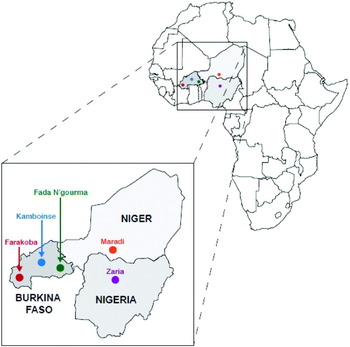
A combined assembly from Roche 454 reads of a premolt 4th to 5th instar M. vitrata larval EST library and Sanger-based EST reads from whole M. vitrata adults (referred to as the ‘reference assembly’) was generated from M. vitrata collected from Maradi in Niger; Zaria in Nigeria; and Fada, Farakoba and Kamboinse in Burkina Faso between 2005 and 2007 (see Margam et al., Reference Margam, Coates, Hellmich, Agunbiade, Seufferheld, Sun, Ba, Sanon, Binso-Dabire, Baoua, Ishiyaku, Covas, Srinivasan, Armstrong, Murdock and Pittendrigh2011: fig. 1 provides a map of the locations). Specifically, adult and larval samples from Nigeria were collected from a cowpea field around Zaria. The adults were collected using light traps. Samples from Niger were also collected from a light trap at Maradi field station while samples from Burkina Faso were collected in cowpea plots at the Institut de l'Environnement et de Recherches Agricoles (INERA) Fada, Farakoba and Kamboinse stations. This microsatellite study was conducted using DNA samples from 72 individuals from Niger, 53 individuals from Nigeria and 175 individuals from Burkina Faso (Fada: 40, Farakoba: 86 and Kamboinse: 49). Additionally, a microsatellite repeat-enriched partial genomic library was constructed using biotinylated (CA)15 and (GA)15 probes. Biotin probe-selected fragments were ligated into the pBluescript SK+ vector, which was used to transform the Escherichia coli strain XL1 Blue (Stratagene) by electroporation. Transformants were plated on LB agar containing 20μgml−1 ampicillin and clones were picked, cultured and plasmid DNA purified at the Purdue University Genomics Core Facility (PUGCF), West Lafayette, Indiana, USA. Additionally, PUGCF performed sequencing of plasmid inserts on an ABI 3730XL sequencer, as well as vector sequence trimming, and PHRED quality parameter assessment and trimming at q<30 (99% base call accuracy). Sanger sequence reads from the microsatellite-enriched library were assembled with CAP3 (Huang & Madan, Reference Huang and Madan1999) using default parameters, and contig and singleton sequences pooled into a single FASTA-formatted file.
Map showing locations in West Africa (Niger, Nigeria and Burkina Faso) where the M. vitrata samples were collected.

Microsatellite prediction, repeat filtering and marker development
The EST ‘reference assembly’ and DNA sequence files were merged and used as input for the program SciRoKo (Kofler et al., Reference Kolfer, Scholtterer and Lelley2007), where a search for arrays ≥10 units at di-, tri- and tetranucleotide repeat loci was specified. The M. vitrata sequence from +250 to −250 of predicted microsatellite repeats was parsed from FASTA files using ‘SciRoKo's Little Helper’ application (Chunk size 50,000,000; overhead 0) and corresponding positional information exported in tab-delimited format. Repetitive DNA has been described in proximity to microsatellite loci in Lepidopteran genomes and proven problematic for the development of locus-specific molecular genetic markers (please see Discussion). In order to identify repetitive DNA adjacent to M. vitrata microsatellites, we employed a bioinformatic pipeline to predict loci with homologies to known Lepidopteran transposable elements and showing sequence similarity to other unrelated M. vitrata microsatellites. To do this, the Bombyx mori transposon database was downloaded (file silkworm_glean_transposons.fa.tar.gz at http://sgp.dna.affrc.go.jp/pubdata/index.html) and was queried with M. vitrata microsatellite sequences using the blastn algorithm and results filtered for E-values ⩽1×10⁻¹⁵ (low-complexity filter was not used). NCBI nr database accessions identified as microsatellite loci from Lepidoptera were downloaded and queried with M. vitrata microsatellite sequences as described previously. Maruca vitrata sequences that produced a ‘hit’ with an E-value ⩽1×10⁻¹⁵ to a B. mori transposon or Lepidopteran microsatellite sequence were removed from the merged M. vitrata dataset.
The remaining M. vitrata sequences were used as input for BatchPrimer3 (http://probes.pw.usda.gov/batchprimer3/index.html: You et al., Reference You, Hou, Gu, Lou, Ma, Hane, Lazo, Dvorak and Anderson2008), and primer pairs were picked with the SSR screening and primers module [pattern type=di-, tri- or tetranucleotide; product size=90 to 300 (150 opt); primer size=18min. 21 opt. 26 max.; primer Tm=58min. 60 opt. 65 max). Primer and predicted PCR amplified genome sequence information was used as input for the program MultiPLX 2.0 (http://bioinfo.ut.ee/multiplx/: Kaplinski et al., Reference Kaplinski, Andreson, Puurand and Remm2005), where potential primer-primer interactions were predicted using a monovalent salt concentration of 50mM and a Mg concentration of 1.5mM. Alignment energies for all primer pairs and products, and locus groupings used the normal stringency conditions according to author instructions. Oligonucleotides were synthesized and 5□-dye labels were added to forward primers by Integrated DNA technologies (Coralville, Iowa, USA).
Maruca vitrata sampling and genotyping
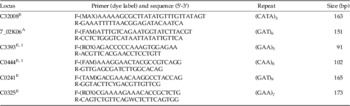
Maruca vitrata samples were collected from West African sites and genomic DNA extracted as described by Margam et al. (Reference Margam, Coates, Hellmich, Agunbiade, Seufferheld, Sun, Ba, Sanon, Binso-Dabire, Baoua, Ishiyaku, Covas, Srinivasan, Armstrong, Murdock and Pittendrigh2011), and DNA concentrations were adjusted to ~10ngμl−1 with nuclease free water. PCR reactions of 25μl were set up with 2.0mM MgCl2, 150μM dNTPs, ~15ng DNA, 1.75pmol each primer (multiplex reactions indicated in table 1), 2μl 5X PCR buffer and 0.3125U GoTaq DNA polymerase (Promega, Madison, Wisconsin, USA), then amplified using the touchdown thermocycler program TD2 (Coates et al., Reference Coates, Sumerford, Miller, Kim, Sappington, Siegfried and Lewis2009). A total of 2μl of each of the five PCR products for individual samples was pooled, diluted to a total volume of 128μl, and a 5μl aliquot submitted to the Roy J. Carver Biotechnology Center at the University of Illinois at Urbana-Champaign for separation on an ABI Prism 3730×l Analyzer with the LIZ500 internal standard. Fragment analysis was performed using Peak Scanner software 1.0 (Applied Biosystems, Foster City, CA, USA) for data scoring and GeneMapper software for the identification and classification of alleles present per locus and per individual.
Maruca vitrata primer sequences used for microsatellite amplification reactions.

E EST-derived primer pair; A, anonymous genomic sequence-derived primer pair; 1, PCR multiplexed primers.
Genetic structure of M. vitrata
The mean number of alleles per locus, observed heterozygosity and expected heterozygosity were used to estimate within population genetic variability using Arlequin version 3.5.1.2. (Excoffier & Lischer, Reference Excoffier and Lischer2010). Analysis of molecular variance (AMOVA) was also performed using Arlequin 3.5.1.2. Variance components were used to compute fixation indices, and their significance was tested at 1000 permutations as described by Weir & Cockerham (Reference Weir and Cockerham1984) in Arlequin. The program Micro-Checker 2.2.3 (Van Oosterhout et al., Reference Van Oosterhout, Hutchinson, Wills and Shirley2004) was used to estimate the frequency of null alleles and other genotyping errors such as stuttering and allele drop out. Null alleles are suspected for a given locus when the Micro-Checker 2.2.3 program rejects Hardy-Weinberg Equilibrium (HWE) among genotypes and if the excess homozygote genotypes are evenly distributed among allele size classes. Because some of the alleles harbored potential null alleles, corrected pairwise F ST estimates were calculated for all populations by applying the ENA correction in the FREENA package (Chapuis & Estoup, Reference Chapuis and Estoup2007; Chapuis et al., Reference Chapuis, Lecoq, Michalakis, Loiseau, Sword, Piry and Estoup2008). F ST values were estimated following Weir (Reference Weir1996) while the null allele frequencies for each locus and population was analyzed following the expectation maximization (EM) algorithm (Dempster et al., Reference Dempster, Laird and Rubin1977). Exact tests using a Markov chain were used to test the deviation from HWE at each locus and population (Guo & Thompson, Reference Guo and Thompson1992) as implemented in Arlequin 3.5.1.2. Locus-by-locus F-statistics and pairwise F ST estimates were also calculated using Arlequin 3.5.1.2. Due to the fact that pairwise F ST estimates among sample sites represent multiple comparisons that are considered simultaneously, application of a significance threshold that treats these comparisons as a single comparison (that is α=0.05) fails to recognize that as the number of comparisons increases the probability that any comparison will differ by random chance also increases (Miller, Reference Miller1981). Specifically, when multiple hypothesis tests are performed, the experiment-wise (EW) Type I error is quickly increased at the rate of 1−(1−α)k, where k is the number of hypothesis tests performed. To account for the presence of multiple dependent tests within our pairwise F ST estimates, we implicated a correction to the significance thresholds used and determined the critical value according to B-Y method by Benjamini & Yekutieli (Reference Benjamini and Yekutieli2001). Isolation by distance (Slaktin, Reference Slatkin1993) was tested by analyzing the independence between geographical and genetic distances (Bohonak, Reference Bohonak2002). The relationship was assessed by the Mantel test after 1000 permutations using a program IBD version 1.52 (http://www.bio.sdsu.edu/pub/andy/IBD.html).
The program STRUCTURE 2.3.3. uses a model-based clustering to predict population structure using genotypic marker data from individual samples, where the model assigns proportions of individual genotypes to one of K populations (Pritchard et al., Reference Pritchard, Stephens and Donnelly2000). To accomplish this, we used an admixture model to define individual ancestry and included data of sampling location as a priori informative descriptors of potential shared co-ancestry among the genotypes (LOCPRIOR command) according to the STRUCTURE 2.3.3 modification described by Hubisz et al. (Reference Hubisz, Falush, Stephens and Pritchard2009). STRUCTURE 2.3.3 was run using an initial burn-in of 100,000 iterations followed by 100,000 iterations. We ran ten replicates with each value of K ranging from 1 to 10. The ‘real’ value of K (number of potential unique populations represented by the M. vitrata genotypes within our sample) was estimated from the ln Pr(X|K) values output for each replicate of K=1 to K=10 using the m|L“(K)/sL(K) statistic described by Evanno et al. (Reference Evanno, Regnaut and Goudet2005). In brief, the ‘real’ value of K within our dataset was determined by where the ln Pr(X|K) maximized the value of m|L“(K)|sL(K). A graphical display of individual coancestry (Q-matrix) data generated within STRUCTURE 2.3.3 output was performed using the program Distruct (Rosenberg, Reference Rosenberg2004).
Results
DNA sequence libraries
The combined assembly of M. vitrata EST read data produced a total of 3499 contigs of 452.9±279.9bp (see Margam et al., Reference Margam, Coates, Hellmich, Agunbiade, Seufferheld, Sun, Ba, Sanon, Binso-Dabire, Baoua, Ishiyaku, Covas, Srinivasan, Armstrong, Murdock and Pittendrigh2011, for details). Sequencing of 480 clones from the (CT)n and (GT)n microsatellite repeat resulted in a total of 461 high quality sequences of 285.8±200.8bp (131.8kb total; GenBank accessionnNumbers JN685509–JN685580). Assembly of the (CT)n and (GT)n microsatellite repeat sequences using CAP3 resulted in 46 contigs (5.9±7.2 sequences per contig) and 69 singletons that were merged into a single dataset with a mean length of 442.1±300.3bp.
Microsatellite prediction, repeat filtering and marker development
A search for microsatellite-like repeats within 115 sequences in file ‘MvMsatCAGA.fasta’ predicted a total of 118, 26 and 11 di-, tri- and tetranucleotide repeat motifs, respectively. All of the 118 putative dinucleotides were predicted from the (AC) and (AG) repeat enriched libraries, and respectively showed a mean length of 57.1 nt (28.5 repeats) and 56.6 nt (28.3 repeats; table 2). In contrast, all putative tri- and tetranucleotide repeats were characterized from EST library sequences. The mean mismatch of nucleotides within the predicted array was ≥3.7-fold higher among dinucleotides compared to either the tri- or tetranucleotide repeat groups. Filtering of sequences±250bp of putative M. vitrata microsatellite repeats against B. mori transposon-like sequences resulted in identification of 12 putative repetitive elements (E-values ⩽2.0×10⁻¹⁶; similarity ≥81.5%; L=164.7±111.0bp; remaining data not shown). An analogous blastn search of the NCBI nr nucleotide database accessions from Lepidoptera that contained microsatellite sequences indicated that sequence similarities existed with 28 M. vitrata microsatellite flanking sequences (E-values ⩽2.0×10⁻¹⁶; similarity ≥86.7%; L=245.5±77.8bp; remaining data not shown). In total, 40 sequences were identified within M. vitrata microsatellite flanking sequences (34.8%) and were removed from the file prior to PCR primer design. All of the filtered sequences were derived from the anonymous (AC) and (AG) microsatellite-enriched library.
Microsatellite motifs predicted from M. vitrata DNA sequence sources (combined library), that was partitioned into (CA) and (GA) repeat enriched library (microsatellite library), and expressed sequence tag (EST) library (EST library) sources. The mean length of repeat arrays (L) and frequency of nucleotide mismatch within repeat arrays (MisMch).

The design of oligonucleotide primers from the remaining 75 sequences using Batch Primer3 resulted in 24 pairs (11 from anonymous microsatellite enriched library and 13 from EST sequence). Preliminary analysis by PCR resulted in the successful amplification for one of 11 anonymous microsatellite markers (9.1%) and five of 13 EST-derived microsatellite markers (38.5%; results not shown). PCR primer multiplex pair design using MultiPLX resulted in the prediction of two loci being suitable for co-amplification (markers C3393 and C0444), where primer alignment energies were at a maximum of −5.1kcal mol−1 compared to −6.0±0.9kcalmol−1 for all remaining possible primer pairs (remaining data not shown).
Genetic structure of M. vitrata
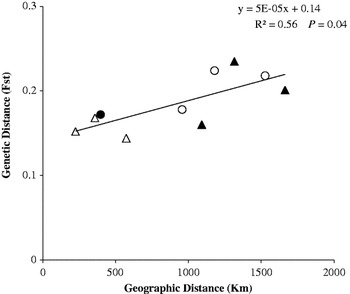
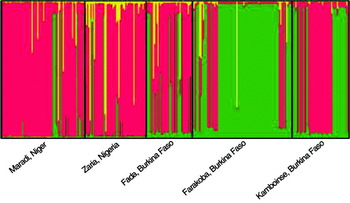
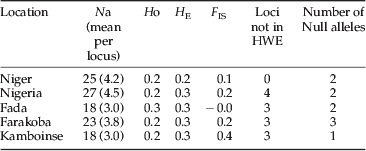
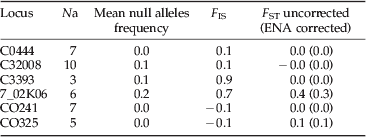
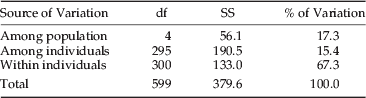
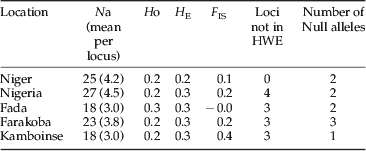
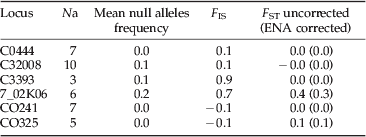
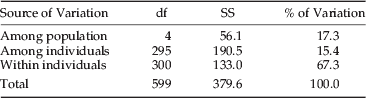
The six microsatellite loci used to screen M. vitrata samples collected at five African sites showed significant deviation from HWE at 13 instances following 30 locus-by-site calculations (supplementary data), thus subsequent estimations of population subdivision used ENA corrected values to account for potential influence of null alleles. The mean number of alleles per locus was similar across all sample sites, and the overall observed heterozygosity was less than expected (F IS≥0.1) for all populations except at Fada, Burkina Faso (F IS=−0.0; table 3). Also the F IS estimates were negative for only two loci (CO241 and CO325) across all populations (table 4). The locus-by-locus F ST estimates derived from the five populations ranged from −0.0 (ENA corrected F ST=0.0; marker 32008) to 0.3 (ENA corrected F ST=0.0; marker 7_02K06; remaining data not shown). The subsequent global estimates of F ST across all loci and all populations were moderate (uncorrected F ST=0.1, ENA corrected F ST=0.1) and significant (95% CI=0.0–0.3, 95% CI with ENA correction=0.0–0.2, with the lower bounds rounded to zero in one decimal place). The partitioning of population genetic variance from AMOVA results indicated that ≥67.3% resides within individuals, and correspondingly 17.3% and 15.4% of the total genetic variation, was among populations and among individuals (table 5). Pairwise comparison of F ST estimations showed that a significant level of differentiation exists for all the possible comparisons after the sequential B-Y adjustment for the ENA corrected F ST estimates across all loci (table 6). Specifically, a critical significance level was achieved at 0.05/2.929=0.017. Results indicated that the P-values obtained from pairwise F ST estimates (⩽0.005) were all statistically significant at the B-Y adjusted thresholds (table 6). Regression of uncorrected F ST estimates and geographic distance (km) among West African sample sites showed a significant dependence of genetic variation on geographic distance (R2=0.6, Mantel P=0.04), and showed the relative genetic similarity (F ST estimates) of genotypes at Niger and Nigeria, and among Burkina Faso samples (fig. 2). The ‘real’ number of populations (K) estimated from the microsatellite-defined M. vitrata genotypes from the m|L″(K)|sL(K) statistic calculated from STRUCTURE 2.3.3 output achieved a maximum value of 14.5 at K=3 and suggested that three genetically-distinct M. vitrata ancestries exist in West Africa. The three genetically distinct ancestries across collection sites were represented in fig. 3 as vertical bars with Niger, Nigeria and Fada, Burkina Faso primarily red; Farakoba, Burkina Faso primarily green; Kamboinse, Burkina Faso primarily green and red and a minor cluster represented by yellow across all sites.
Geographic distance versus genetic distance among populations of M. vitrata using F ST. Correlations and probabilities were estimated from a Mantel test with 10,000 repeats of bootstrapping. ▵, Comparisons among Burkina Faso (Fada, Farkoba and Kamboinse; ●, Niger and Nigeria; ▲, Niger and locations in Burkina Faso; ○, Nigeria and locations in Burkina Faso are indicated.

Partitioning of the co-ancestry among microsatellite-defined M. vitrata genotypes generated from STURUTURE using the LOCPRIOR command for Maradi, Niger, Zaria, Nigeria and Fada, Farakoba and Kamboinse locations in Burkina Faso. For each, the estimated co-ancestry was derived from the Q-matrix for each individual and represented as vertical lines showing the proportion of the K=3 segments that made up the individual genotype.

Characteristics of the M. vitrata individuals across West Africa showing the number of alleles (Na), observed heterozygosity (H O), expected heterozygosity (H E) and fixation index (F IS) per sample site (values rounded up to 1 decimal place).
Estimates of total number of alleles (Na), mean estimated frequency of null alleles, fixation index (F IS) and F ST across microsatellite loci (values rounded up to 1 decimal place).
Analysis of Molecular Variance (AMOVA) for Maradi, Niger, Zaria, Nigeria and Fada, Farakoba, and Kamboinse locations in Burkina Faso.
Pairwise comparisons of M. vitrata samples showing the corrected F ST estimates (below diagonal) and significance of corresponding comparisons (P-values) as indicated above the diagonal. Significance thresholds were evaluated using a Benjamini and Yekutieli (B-Y) adusted α=0.017.

Discussion
Microsatellite markers in Lepidoptera
The isolation and subsequent application of microsatellite loci as molecular genetic markers in Lepidopteran insects has often been difficult (Nève & Meglécz, Reference Munroe and Heppner2000; Ji & Zhang, Reference Ji and Zhang2004; Reference ZhangZhang, 2004), where studies have developed five or fewer loci for most species studied so far (reviewed in Ji et al., Reference Ji and Zhang2004). These difficulties have been attributed to the high degrees of nucleotide sequence similarity between regions that flank different microsatellite loci (Meglécz et al., Reference Meglécz, Pétenian, Danchin, D'Acier, Rasplus and Faure2004) or the low frequency of microsatellites in Lepidopteran genomes (Ji et al., 2003; Prasad et al., Reference Prasad, Muthulakshmi, Madhu, Archak, Mita and Nagaraju2005). Additionally, evidence suggests that Lepidopteran microsatellites may be derived from and mobilized by transposable elements (TEs) (Coates et al., Reference Coates, Sumerford, Miller, Kim, Sappington, Siegfried and Lewis2009, Reference Coates, Sumerford, Hellmich and Lewis2010, Reference Coates, Kroemer, Sumerford and Hellmich2011, Reference Coates, Hellmich, Grant and Abel2012; Tay et al., Reference Tay, Behere, Batterham and Heckel2010). Despite these associations with repetitive DNA, microsatellite markers have been developed for more than 40 Lepidopteran species in 35 genera (GenBank, 15 August 2006) and have proven to be useful for population genetic analyses. Within this study, we initially identified 155 unique M. vitrata microsatellite loci from which six were eventually considered informative genetic markers. Forty of 155 loci (25.8%) contained known repetitive element-like sequences previously identified within the B. mori genome assembly, which suggests that M. vitrata microsatellites may be associated with repetitive DNA as observed in other Lepidopteran species (Meglécz et al., Reference Meglécz, Pétenian, Danchin, D'Acier, Rasplus and Faure2004). High failure rates observed during microsatellite marker development are rarely reported, and the extent to which repetitive DNA can cause these failures has not been thoroughly investigated (Tay et al., Reference Tay, Behere, Batterham and Heckel2010). In the current study, we aimed to identify M. vitrata microsatellite loci which may contain repetitive sequences and remove them from consideration for molecular marker development. Despite these measures, an approximate 25% success rate for M. vitrata microsatellite markers suggest that screening for repetitive DNA from distantly related species may not be sufficient to identify all affected loci.
Microsatellite loci that deviate significantly from HWE show evidence of null alleles according to the distribution of homozygote-size classes. Microsatellite null alleles are commonly found among a wide range of taxa but have a particularly high incidence among species of Lepidoptera (Meglecz et al., Reference Meglécz, Pétenian, Danchin, D'Acier, Rasplus and Faure2004), Diptera (Lehmann et al., Reference Lehmann, Besanky, Hawley, Fahey, Kamau and Collins1997) and Orthoptera (Chapius et al., Reference Chapuis, Loiseau, Michalakis, Lecoq and Estoup2005). The extent to which null alleles tend to overestimate the true population differentiation has not been investigated (Chapuis & Estoup, Reference Chapuis and Estoup2007) but can lead to overestimates of population differentiation due to effects on subsequent calculations of F ST and genetic distances (Slatkin, Reference Slatkin1995; Paetkau et al., Reference Paetkau, Waits, Clarkson, Craighead and Strobeck1997). Although null alleles were present at all microsatellite loci, correction with the ENA algorithm nonetheless allowed effective population genetic analysis. Specifically, analysis of these microsatellite markers resulted in conclusions analogous to those obtained from M. vitrata single nucleotide polymorphism (SNP) markers applied to the same populations (see next section).
Genetic structure of M. vitrata in West Africa
At the population level, our ENA corrected microsatellite genotype data suggested that a moderate level of genetic differentiation may be present among M. vitrata sample sites in West Africa. Consistent with previous studies in other insects, a majority of the total genetic variation is within individuals compared to between sample sites (Coates & Hellmich, Reference Coates and Hellmich2003; Juan et al., Reference Juan, Crespo, Cowan, Lexer and Fay2004; Timmermans et al., Reference Timmermans, Ellers, Marien, Verhoef, Ferwerda and Van Straalen2005). Furthermore, our microsatellite results agree with an analogous study using M. vitrata SNP markers in West Africa (Margam et al., Reference Margam, Coates, Hellmich, Agunbiade, Seufferheld, Sun, Ba, Sanon, Binso-Dabire, Baoua, Ishiyaku, Covas, Srinivasan, Armstrong, Murdock and Pittendrigh2011), where genetic structure was detected between Niger and Nigeria, and Burkina Faso sample sites and an overall K=3 obtained from STRUCTURE results. The current study also indicated three distinct populations of M. vitrata in West Africa and suggests that analysis of microsatellite and SNP markers can provide equivalent results and conclusions. The findings from that study, however, showed significant pairwise F ST estimates between eastern (Niger and Nigeria) and western sample sites from Burkina Faso, and all other comparisons indicated a lack of genetic divergence while findings from our study indicated a significant divergence in all pairwise populations using a critical P-value determined using B-Y adjustment method (Benjamini & Yekutieli, Reference Benjamini and Yekutieli2001). Our population differentiation results derived from microsatellite data may be expected since SNPs typically have two alleles per locus due to their low mutational rate (Hancock, Reference Hancock, Goldstein and Schlötterer1999; Zhang & Hewitt, Reference Zhang and Hewitt2003) compared to multi-allelic microsatellites that have higher power per locus for estimating genetic divergence or gene flow when using F-statistics or assignment tests (Vignal et al., Reference Vignal, Milan, SanCristobal and Eggen2002; Brumfield et al., Reference Brumfield, Beerli, Nickerson and Edwards2003; Morin et al., Reference Morin, Luikart, Wayne and Grp2004). Studies further suggest that measures of pairwise genetic relationships using SNPs would require analysis of more than five times more loci as compared to microsatellites (Blouin et al., Reference Blouin, Parsons, Lacaille and Lotz1996; Glaubitz et al., Reference Glaubitz, Rhodes and Dewoody2003) and suggest that the current set of microsatellite markers will be more efficient at detecting population subdivision compared to SNP markers within future population genetic analyses.
Effect of migration on the population structure in M. vitrata
Migration is a fundamental population process and is crucial to understanding the dynamics and persistence of populations of insects (Dingle, Reference Dingle1996). Despite the field observations that M. vitrata has high rates of migration, significant differences in F ST estimates and partitioning of 17.3% of population variance between sample sites within AMOVA analysis suggested that M. vitrata showed reduced gene flow and genetic structuring in West Africa. This is evidenced in the F IS estimates obtained for almost all the study sites except Fada, Burkina Faso where there was some evidence of outbreeding suggesting high gene flow in this population. Specifically, an isolation by distance (IBD) model suggested that subpopulation differentiation (F ST) or structured gene flow is a function of the geographical distance between them (Slaktin, Reference Slatkin1993). Our analyses indicate that although M. vitrata has a seasonal south-north migration, there appears to be evidence of reduced gene flow. In agreement with this, Peterson & Denno (Reference Peterson, Denno, Mopper and Strauss1998) reported that insect species with high- and low-dispersal rates tend to show less IBD compared to species with moderate dispersal capabilities. High levels of gene flow tend to homogenize the observed genetic variation across a geographic range, whereas low gene flow can result in the effective genetic isolation of subpopulations and genetic drift. We observed a positive correlation between geographic and genetic distances among the M. vitrata sample sites within this study (R2=0.56), suggesting that M. vitrata may have a structured migratory pattern. Although isolation by distance is not typical for species with high mobility (Arguedas & Parker, Reference Arguedas and Parker2000), it has been reported for other Lepidoptera, such as Chazara briseis Linnaeus (Lepidoptera: Satyridae) (Johannesen et al., Reference Johannesen, Schwing, Seufert, Seitz and Veith1997) and Hesperia dacotae Skinner (Lepidoptera: Hesperiidae) (Britten & Glasford, Reference Britten and Glasford2002). Light trap data and sampling of M. vitrata in West Africa showed that M. vitrata does not infest cowpea during the dry season in the northern extremes of its geographic range, even if cowpea is present (Bottenberg et al., Reference Bottenberg, Tamò, Arodokoun, Jackai, Singh, Youm, Singh, Mohan Raj, Dashiell and Jackai1997; Ba et al., Reference Ba, Margam, Dabire-Binso, Sanon, McNeil, Murdock and Pittendrigh2009). Climatic factors such as lack of rain, and temperature or relative humidity may influence this observed spatial restriction. Research has also shown that M. vitrata survive on alternate host plants within the more humid southern regions and migrate to the northern regions over a period of several months (Bottenberg et al., Reference Bottenberg, Tamò, Arodokoun, Jackai, Singh, Youm, Singh, Mohan Raj, Dashiell and Jackai1997). During the seasonal migration, the population of M. vitrata finds favorable conditions for multiplying on a succession of different host plants, which may result in temporal mating barriers due to differential larval maturation rates on the alternate host plants. This serves to emphasize the importance of ecological migration (movement of individuals) on population genetic migration (transfer of alleles). Gene flow cannot occur without ecological migration, but the effects of ecological migration on the population genetic structure can be tempered by factors such as temporal mating barriers between dispersing and resident individuals.
Implications for pest control
The implementation of effective cultural, chemical and biological control strategies to limit M. vitrata feeding damage to cowpea crops in West Africa is dependent upon a basic understanding of population structure and migration. Our results and previous ecological studies have implications for IRM strategies involving Bt-cowpea in West Africa. The implication is that in the north, resistance may spread only slowly among M. vitrata populations because the populations eventually die out during the dry season; in other words, the southern populations in endemic zones act as a source population. Also, the long-distance migration from the south to the north might be a source of susceptible populations into the northern part, which can slow down the evolution of resistance (if there are pockets of M. vitrata populations that survive in the north throughout the year). In the more humid south, M. vitrata can be found on different host plants throughout the year. Further studies should be conducted on population characterization on the different host plants, especially in the more humid south, to determine if there are differences in populations on the different host plants or if geographic barriers restrict gene flow between them. Migration results in changes in allele frequency that are greater in the short term and smaller in the long term, leading to under- and overestimation of effective population size, respectively, if it is ignored (Wang & Whitlock, Reference Wang and Whitlock2003). Using these polymorphic markers, studies should also be conducted to test how migration rate affects the effective population size of the M. vitrata populations. The results of this study also have implications for the implementation of control strategies involving the release of biocontrol agents against M. vitrata. In keeping with an endemic zone to migratory zone hypothesis, the conclusions of this study agree with the conclusions by Margam et al. (Reference Margam, Coates, Hellmich, Agunbiade, Seufferheld, Sun, Ba, Sanon, Binso-Dabire, Baoua, Ishiyaku, Covas, Srinivasan, Armstrong, Murdock and Pittendrigh2011), which suggested that the deployment of biocontrol agents (for classical biological control) would be most logical in the endemic zone directly south of migratory regions where M. vitrata is a significant pest during the cowpea growing season.
Funding
The project was supported through the Bean/Cowpea Collaborative Research Support Program (CRSP) program with funding from the United States Agency for International Development (USAID). This study was also made possible through support provided to the Dry Grains Pulses CRSP by the Office of Agriculture Research and Technology, Bureau of Food Security, in the United States Agency for International Development, under the terms of grant no. EDH-A-00-07-00 005. Support for USDA-ARS personnel who contributed to this study was provided by the Agricultural Research Service (CRIS Project 3625-22000-017-00D) and the Iowa State University Agriculture and Home Economics Experiment Station (Project 3543).
Acknowledgements
We thank Susan Balfe for her technical assistance on the manuscript.