Introduction
Diphyllobothriasis is widely prevalent in countries where raw or undercooked freshwater fish such as salmon, perch and pike are commonly consumed. Over ten species of diphyllobothriid cestoda, including Diphyllobothrium latum, D. dendriticum, D. pacificum, D. nihonkaiense, D. yonagoense and D. klebanovskii, have been isolated and characterized from human sources in South America and countries of the northern hemisphere. Diphyllobothrium latum and D. dendriticum infections have mainly been reported in north-western Europe and the North American Pacific coast (Andersen, Reference Andersen1977; Andersen et al., Reference Andersen, Ching and Vik1987). In Japan, since the first case of diphyllobothriid cestoda infection reported by Ijima in Reference Ijima1889, the most common species causing human infections has been D. nihonkaiense, which was only identified as a separate species from D. latum in 1986 (Yamane et al., Reference Yamane, Kamo, Bylund and Wilkgren1986). After sequencing of the complete mitochondrial genome of D. nihonkaiense and D. latum, molecular analysis of diphyllobothriid cestodes was conducted, which enabled the diagnosis of diphyllobothriasis (Miyadera et al., Reference Miyadera, Kokaze, Kuramochi, Kita, Machinami, Noya, Alarcón de Noya, Okamoto and Kojima2001; Nakao et al., Reference Nakao, Abmed, Yamasaki and Ito2007). Moreover, the identification of D. klebanovskii as a new Diphyllobothrium species was reported in north-eastern Russia (Muratov & Posokhov, Reference Muratov and Posokhov1988); however, it has recently been reported that D. klebanovskii is synonymous with D. nihonkaiense (Arizono et al., Reference Arizono, Shedko, Yamada, Uchikawa, Tegoshi, Takeda and Hashimoto2009a). Diphyllobothrium nihonkaiense infections are mainly caused by the ingestion of Oncorhynchus spp., such as Oncorhynchus masou (cherry salmon), O. gorbuscha (pink salmon) and O. keta (chum salmon). Among these Oncorhynchus spp., O. masou has long been thought to be the most important source of D. nihonkaiense infections (Nishiyama, Reference Nishiyama1994). However, in recent years, several cases of D. nihonkaiense infections via ingestion of O. keta have been reported in Japan and European countries (Yoshida et al., Reference Yoshida, Hasegawa, Takano and Miyata1999; Suzuki et al., Reference Suzuki, Murata, Miyake, Yanagawa and Araki2004; Yera et al., Reference Yera, Estran, Delaunay, Gari-Toussaint, Dupouy-Camet and Marty2006; Wicht et al., Reference Wicht, de Marval and Peduzzi2007). However, in Japan, where salmon is habitually eaten, the differences between Oncorhynchus spp. are unclear to the Japanese people; salmon and trout are identified by the same name in certain areas. This is why the Oncorhynchus species that caused the infection has not been identified in many cases.
In the present study, plerocercoids of diphyllobothriid cestodes from several wild Pacific salmon were examined and analysed for the mtDNA cytochrome oxidase subunit 1 (cox1) gene, mtDNA NADH dehydrogenase subunit 3 (nad3) gene, and ribosomal DNA internal transcribed spacer 1 (ITS1). Golden hamsters were also infected with plerocercoids, and clinical D. nihonkaiense isolates and tapeworms obtained by experimental infection with the D. nihonkaiense reference strain were compared using morphological and molecular techniques.
Materials and methods
Clinical samples
Four clinical D. nihonkaiense samples (Dnh1–4) were obtained from hospitals and health centres in Tokyo, Japan. In one of the clinical samples (Dnh1), the infection was caused by ingestion of chum salmon (O. keta, called Tokishirazu in Japan) from Hokkaido, Japan, but in the other three clinical samples (Dnh2–4), the source of infection was only identified as ingested salmon; the route of infection was unknown. The Dnh1 sample had separated into individual proglottids and started to decompose. Dnh2–4 were composed of the tapeworm and included mature proglottids that ranged in length from 300 to 1000 mm.
Fish material and collection of plerocercoids
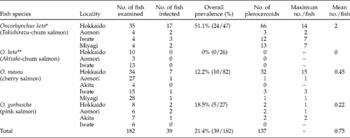
Between 2000 and 2002, 182 wild salmon samples were collected from Tsukiji central market in Tokyo, Japan. Of these 182 wild Pacific salmon, 47 were identified as O. keta (chum salmon called Tokishirazu in Japan); 26 as O. keta (called Akizake in Japan); 82 as O. masou (cherry salmon); and 27 as O. gorbuscha (pink salmon). The landing places of these salmon are shown in table 1. Tokishirazu is an immature chum salmon that does not swim up Japanese rivers but swims up the Amur River located at the Sino-Russian border; this salmon is available in Japanese fish markets from early April to June. Akizake is mainly a type of mature chum salmon that returns to Japanese rivers and is available from September to December in Japan.
Prevalence of Diphyllobothrium nihonkaiense plerocercoids in wild Pacific salmon from five locations in Japan.

* Distribution of Tokishirazu-chum salmon in Japan from early April to June.
** Distribution of Akizake-chum salmon in Japan from September to November.
Plerocercoids were collected by cutting up fillets of the fish samples into pieces. The plerocercoids collected from wild Pacific salmon were orally administered to golden hamsters (one or two plerocercoids per hamster) to obtain mature tapeworms. The plerocercoids and fish muscle that were used for DNA extraction were stored in liquid nitrogen until the present genetic studies were conducted.
Morphological characteristics
Mature tapeworms were obtained by orally infecting golden hamsters (an experimental definitive host) with plerocercoids isolated from chum salmon and cherry salmon (Andersen, Reference Andersen1972). Live tapeworms obtained from golden hamsters were relaxed in physiological saline at 4°C and fixed with hot 10% neutral buffered formalin (Wako Junyaku Co. Ltd., Osaka, Japan). The mature proglottids of tapeworms from salmon were examined by whole mounting them with carmine stain and by sagittal sectioning with haematoxylin and eosin staining (Andersen, Reference Andersen1971). The morphological features of the strobila and proglottids of D. nihonkaiense were compared to those of the strobila and proglottids of D. latum (Rausch & Hilliard, Reference Rausch and Hilliard1970; Yamane et al., Reference Yamane, Kamo, Bylund and Wilkgren1986).
DNA preparation and polymerase chain reaction amplification
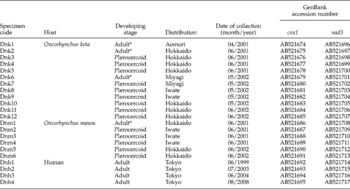
We analysed a total of 22 samples comprising 4 clinical tapeworm samples, 4 tapeworm samples from infected golden hamsters, 9 plerocercoid samples from Tokishirazu-chum salmon (O. keta) and 5 plerocercoid samples from cherry salmon (O. masou) (table 2). All DNA templates were prepared using the QIAamp DNA mini kit (Qiagen GmbH, Hilden, Germany).
Adult and plerocercoid stages of Diphyllobothrium nihonkaiense obtained from five locations in Japan between 1999 and 2008.

* Adult tapeworms were obtained by infecting a golden hamster with plerocercoids.
Polymerase chain reaction (PCR) amplification of the tapeworm and plerocercoid samples was performed using a previously reported primer set targeting the mtDNA cox1 and nad3 genes and rDNA ITS1 (Yera et al., Reference Yera, Estran, Delaunay, Gari-Toussaint, Dupouy-Camet and Marty2006; Arizono et al., Reference Arizono, Shedko, Yamada, Uchikawa, Tegoshi, Takeda and Hashimoto2009a). Moreover, PCR amplification of the salmon samples was performed using the primer set Sn16SF (5′-TTTGCATCATGATTTAGCCA-3′) and Sn16SR (5′-ACTTACACATGTGCTGGGAG-3′), which was designed from the 16S ribosomal RNA gene sequence of two species of salmon, O. keta and O. masou masou (GenBank accession numbers EF105341 and DQ864465, respectively).
PCR was performed in a reaction mixture (50 μl) containing 5 μl of DNA template, 1.0 U LATaqDNA polymerase (Takara Bio Inc., Shiga, Japan), 0.4 μm of each primer and 0.25 mm of deoxynucleoside triphosphates (dNTPs). The following cycling parameters were used for all the PCR amplifications: (1) Taq activation at 94°C for 3 min; (2) 35 cycles of denaturation at 94°C for 40 s, annealing at 52°C (cox1 and nad3 of D. nihonkaiense) or 60°C (ITS1 of D. nihonkaiense and 16S rRNA of salmon) for 40 s, and extension at 72°C for 1 min; and (3) final extension at 72°C for 5 min.
Sequence analysis of PCR products was conducted using the ABI Prism BigDye Terminator v3.1 Cycle Sequencing Ready Reaction Kit (Applied Biosystems, Foster City, California, USA) and an ABI PRISM 3130 Genetic Analyzer.
Phylogenetic analysis
Analysis and multiple alignments of the sequences obtained for mtDNA cox1 and nad3 from Diphyllobothrium species were performed using the YEBIS for DNA Alignment software with a tree-based round-robin iterative algorithm (Hirosawa et al., Reference Hirosawa, Totoki, Hoshida and Ishikawa1995). The phylogenetic tree was constructed using the PHYML version 2.4.5 software (Guindon & Gascuel, Reference Guindon and Gascuel2003), and the maximum likelihood (ML) method and a general time-reversible (GTR) model were used to calculate genetic distances. The reliability of the branches was tested in the GTR model with bootstrap values obtained from 1000 replications. The ML tree data files were visualized using the MEGA software (Tamura et al., Reference Tamura, Dudley, Nei and Kumar2007). The GenBank accession numbers of the reference strains of Diphyllobothrium species used in the phylogenetic analysis of cox1 and nad3 were as follows: D. nihonkaiense Dn1 strain (AB288371 and AB288374), D. nihonkaiense Dn8 strain (AB375003 and AB375009), Diphyllobothrium sp. (AY972072 and AY973608), D. klebanovskii RB1 strain (AB375660 and AB375663), D. klebanovskii RB3 strain (AB375662 and AB375665), D. latum (AB269325 and AY973606), and D. dendriticum (AB374223 and AB374224).
Results
Detection of plerocercoids of Diphyllobothrium
Plerocercoids of Diphyllobothrium were not detected in 26 Akizake-chum salmon caught between September and November. However, the detection rate for Tokishirazu-chum salmon caught between early April and June was 51.1% (24/47), with an average of two plerocercoid larvae per fish (table 1). The detection rates for cherry salmon (O. masou) and pink salmon (O. gorbuscha) were 12.2% (10/82) and 18.5% (5/27), respectively, and the average numbers of plerocercoid larvae per fish were 0.45 (37 larvae/82 fish) and 0.22 (6 larvae/27 fish), respectively. All the plerocercoids were found in the muscle of salmon; 84.0% (79/94) of plerocercoids found in Tokishirazu-chum salmon were encysted in the host tissue, but the encystation rates in cherry salmon and pink salmon were 29.0% (11/37) and 0% (0/7), respectively.
Morphological identification
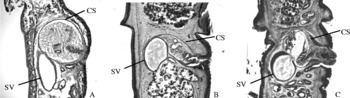
The uteri of Dnh2–4 isolated from humans (Dnh1 could not be identified morphologically because it was severely damaged) were brown or light brown in colour and situated approximately in the centre of each segment. The structures of the uterus were convoluted and reached the side of the cirrus sac (CS). The genital pore in each proglottid was in the form of an opening on the body surface. In sagittal sections of Dnh2–4, the angles between the long axis of the CS and the long axis of the seminal vesicle (SV) were sharp or almost 90° (fig. 1). In D. latum, which shows a high level of similarity with D. nihonkaiense with regard to morphological features, the angles between the CS and SV are obtuse. These morphological features of the clinical samples were similar to those observed in the D. nihonkaiense reference strain.
Sagittal sections of mature proglottids of Dnh2–4 isolated from humans. Sagittal sections (A–C) of mature proglottids stained with haematoxylin and eosin showing the cirrus sac (CS) and seminal vesicle (SV) from Dnh2, Dnh3 and Dnh4 isolates.

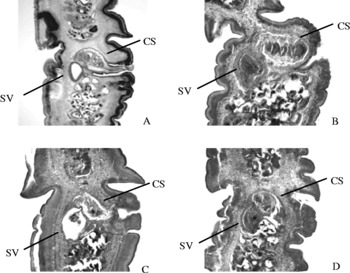
The total lengths of the four adult tapeworms (Dnk1, Dnk2, Dnk6 and Dnm1), which were developed in golden hamsters, were 0.57, 1.23, 1.11 and 0.73 m, respectively, but adult tapeworms could not be obtained from the plerocercoids isolated from pink salmon. The scolices of four adult tapeworms, measuring 0.8–1.5 mm in length and 0.6–0.9 mm in width, showed ventral and dorsal bothria. In sagittal sections of Dnk1, Dnk2, Dnk6 and Dnm1, the angles between the long axes of the CS and SV were sharp and were similar to those observed in D. nihonkaiense (fig. 2). The morphological features of their strobila and proglottids were similar to those of the strobila and proglottids of D. nihonkaiense observed in whole mounts of mature proglottids from Dnk1 obtained from O. keta and of Dnm1 from O. masou: the genital pore was located ventrally in the middle of the anterior quarter of the proglottids; the uterine pore opened slightly posterior to the genital pore; and the uterus consisted of 4–6 loops on each side in all four tapeworms.
Sagittal sections of mature proglottids from Dnk1, Dnk2, Dnk6 and Dnm1. Sagittal sections (A–D) of mature proglottids stained with haematoxylin and eosin showing the cirrus sac (CS) and seminal vesicle (SV) from Dnk1, Dnk2, Dnk6 and Dnm1. Dnk1, Dnk2 and Dnk6 from Oncorhynchus keta and Dnm1 from O. masou were prepared by infecting a golden hamster with plerocercoids.

Molecular identification
PCR and sequence analysis of the cox1 and nad3 sequences were performed in 22 samples, comprising 4 clinical tapeworm samples, 4 tapeworm samples obtained from golden hamsters, and 14 plerocercoid samples from salmon. The DNA sequences showed a high level of similarity with those of D. nihonkaiense deposited in GenBank, but they were different from those of D. latum and D. dendriticum. The cox1 and nad3 sequences of 22 samples showed 28 and 16 variable sites, respectively. The GenBank accession numbers of each sample are listed in table 2. Analysis of ITS1 in D. nihonkaiense indicated that it could be divided into two groups on the basis of a polymorphism (A or G) at position 19. In the ITS1 sequences of Dnk3 and Dnk4 isolated from Tokishirazu-chum salmon, and the clinical isolate Dnh4, adenine (A) was present at position 19 from the 5′ end of ITS; the sequence showed 100% identity with that of the D. klebanovskii RB1 reference strain (GenBank accession no. AB375657) and D. nihonkaiense Dn8 reference strain (GenBank accession no. AB375174). The sequences of other samples that had guanine (G) at position 19 were 100% identical with that of the D. nihonkaiense Dn1 reference strain (GenBank accession no. AB288368).
On the basis of the nucleotide sequence of the 16S rRNA gene from Tokishirazu, in which the plerocercoids were detected, this species was identified as O. keta. On the other hand, the cherry salmon was identified as O. masou masou or O. masou ishikawae.
Phylogenetic analysis
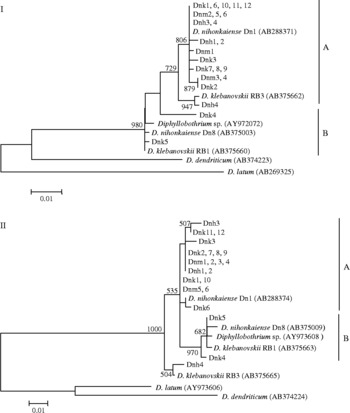
Phylogenetic trees generated by the ML method and GTR model revealed two major lineages, which were designated as A and B. The 22 samples were well separated from D. latum and D. dendriticum in the phylogenetic analysis of the cox1 and nad3 sequences, and Dnk4 and Dnk5 were found to belong to lineage B, similar to the D. klebanovskii RB1 and D. nihonkaiense Dn8 reference strains (fig. 3). The ITS1 sequence of Dnh4 showed 100% identity with that of D. klebanovskii RB1 and D. nihonkaiense Dn8; on the basis of the mtDNA cox1 and nad3 sequences, Dnh4 was determined to belong to the same lineage as the D. klebanovskii RB3 strain.
Unrooted phylogenetic reconstruction based on mtDNA cox1 (I) and nad3 (II) sequences for exploring the relationships among Diphyllobothrium species. A maximum likelihood (ML) tree was derived with a general time-reversible (GTR) model by using estimates of the proportion of invariable site parameters of 0.266 (cox1) and 0.216 (nad3) and gamma distribution parameters of 0.194 (cox1) and 0.563 (nad3). Significant bootstrap support (>500) from 1000 replicates is indicated to the left of the supported node. The scale bar represents the distance in substitutions per nucleotide. Specimen codes and the names within parentheses represent the GenBank accession numbers.

Discussion
In a previous survey of D. nihonkaiense plerocercoid infection caused by wild Pacific salmon, 20–30% of cherry salmon were parasitized, and the number of patients with D. nihonkaiense infections peaked between May and August and decreased in winter (Arizono et al., Reference Arizono, Yamada, Nakamura-Uchiyama and Ohnishi2009b). In this survey, D. nihonkaiense plerocercoids were not detected in Akizake-chum salmon caught between September and November, but the rate of detection of plerocercoids in Tokishirazu-chum salmon was high. It has been reported that the Okhotsk Sea contains two salmon populations – mature chum salmon that have their migratory routes in Japanese rivers and immature chum salmon that migrate to the Amur River (Okazaki, Reference Okazaki1986). We think that D. nihonkaiense plerocercoids were not detected in Akizake-chum salmon because the eggs of D. nihonkaiense present in the stools of final hosts such as humans and bears are eliminated by treatment in sewers and disposal plants before they enter the rivers in Japan.
Tokishirazu-chum salmon is an expensive fish that is caught off the coast of Hokkaido between April and June; it is rich in fat as compared to Akizake-chum salmon, which is found in the market after autumn and is often eaten raw. Because the distribution of Tokishirazu-chum salmon overlaps that of cherry salmon, Tokishirazu salmon has not received much attention as a cause of diphyllobothriasis; however, the mean number of parasitizing plerocercoids per Tokishirazu was two larvae, while that per cherry salmon was 0.45 larvae (i.e. the number of larvae was 4.4 times higher in Tokishirazu). Moreover, when we examined 42 eviscerated wild salmon that were imported from the USA and Canada between 1996 and 1998, they comprised 4 samples of chum salmon, 18 samples of Oncorhynchus tshawytscha (king salmon), 4 samples of Oncorhynchus kisutch (silver salmon) and 17 samples of Oncorhynchus nerka (sockeye salmon) (unpublished observations). Diphyllobothrium plerocercoids (0/42) were not detected in these salmon.
Consumption of fresh salmon is popular in Japan because the natural salmon resources have been kept intact and the population of farmed salmon in the market has increased (Shimizu, Reference Shimizu2001). Therefore, ingestion of Tokishirazu, which is available during the same period as cherry salmon, is more likely to be the cause of D. nihonkaiense infection than ingestion of cherry salmon.
The morphological features of clinically isolated tapeworms and adult tapeworms (by infection of golden hamsters with diphyllobothriid plerocercoids) were similar to those of D. nihonkaiense. However, there are some difficulties in the morphological identification of these species. (1) Sensitivity to plerocercoids varies among hamsters, and the infection is not always established; only four adult worms were obtained after the hamsters were infected 35 times with plerocercoids. (2) Although all the four tapeworms were collected by conducting an autopsy 1 month after infection, the length of the worms varied from 0.57 to 1.23 m; thus, they showed variation in their growth. (3) The differentiation between D. nihonkaiense and D. latum, based on morphological characteristics in histological preparations, such as the relative positions of, and angles of, the SV and CS, was difficult. This is because the morphological characteristics of the two tapeworms were greatly influenced by relaxation of the adult worm with cold physiological saline and their fixation in hot 10% neutral buffered formalin. The method of molecular identification of plerocercoid species is superior in terms of both speed and accuracy.
Arizono et al. (Reference Arizono, Shedko, Yamada, Uchikawa, Tegoshi, Takeda and Hashimoto2009a) conducted phylogenetic analyses and reported that D. klebanovskii is synonymous to D. nihonkaiense and that the mtDNA cox1 and nad3 of D. nihonkaiense and D. klebanovskii are roughly divided into two groups, A and B. However, analysis of the mtDNA nad3 sequence showed that the RB3 reference strain of D. klebanovskii did not fit into either group. In gene analysis using 22 samples, Dnk4 and Dnk5 were found to belong to Group B. Phylogenetic analysis of the cox1 and nad3 sequences showed that the Dnh4 clinical sample, identified as D. nihonkaiense on the basis of its morphological features, was very similar to the RB3 strain. However, in the ITS1 analysis, the sequences of Dnk3, Dnk4 and Dnh4 were identical to those of the RB1 reference strain of D. klebanovskii and the Dn8 reference strain of D. nihonkaiense belonging to lineage B, whereas on the basis of the cox1 or nad3 sequences, Dnk3 and Dnh4 were determined to belong to lineage A, like the Dn1 reference strain of D. nihonkaiense. The ITS1 sequences were thought to differ with regard to only one base. No strain belonging to Group B was detected in the plerocercoids from cherry salmon, whereas phylogenetic analysis of mtDNA cox1 and nad3 showed that plerocercoids belonging to Groups A and B were isolated from Tokishirazu-chum salmon. In order to determine the significance of the results of phylogenetic analysis of D. nihonkaiense, it will be necessary to increase the number of plerocercoids isolated from cherry salmon and pink salmon for molecular analysis.
Acknowledgement
We are very grateful to and sincerely thank Dr Hirofumi Miyake, Tokyo Metropolitan Institute of Public Health, for providing constructive comments on this manuscript.