Introduction
Voice hearing experiences, or auditory verbal hallucinations, are typically defined in relation to their perceptual characteristics (David, Reference David2004). However, such definitions belie the fact that voice hearers are typically not passive bystanders of these experiences (Beavan, Reference Beavan2011; Nayani & David, Reference Nayani and David1996). Voice hearers commonly report being drawn in to reacting or responding to their voices (Thomas, Morris, Shawyer, & Farhall, Reference Thomas, Morris, Shawyer, Farhall, Morris, Johns and Oliver2013), either via direct and reciprocal acts of communication (Hayward et al., Reference Hayward, Berry and Ashton2011), or via the use of actions to mitigate their activation or negative impact (Farhall, Greenwood, & Jackson, Reference Farhall, Greenwood and Jackson2007).
The cognitive model proposes that these behavioural responses are driven primarily by the beliefs a person holds about their voices (Chadwick & Birchwood, Reference Chadwick and Birchwood1994). Voices are typically perceived as powerful, intrusive beings with malevolent intent towards the hearer or others, over whom the hearer has little control or ability to escape. They are suggested to evoke innate evolved defences of fight, flight or submission, similar to those observed in real-world social interactions (Gilbert et al., Reference Gilbert, Birchwood, Gilbert, Trower, Hay, Murray and Miles2001), as a means of mitigating perceived threat (Morrison, Reference Morrison1998). A number of studies have demonstrated that efforts to resist voices (by arguing back, avoiding cues that trigger voices, or employing distraction tactics), and attempts to appease the perceived agent of the voices by complying with voice commands, are common responses to voices (Chaix et al., Reference Chaix, Ma, Nguyen, Ortiz Collado, Rexhaj and Favrod2014; Hacker, Birchwood, Tudway, Meaden, & Amphlett, Reference Hacker, Birchwood, Tudway, Meaden and Amphlett2008; Howard, Forsyth, Spencer, Young, & Turkington, Reference Howard, Forsyth, Spencer, Young and Turkington2013). Furthermore, both resistance and compliance are predicted by perceptions of voice dominance (Birchwood et al., Reference Birchwood, Gilbert, Gilbert, Trower, Meaden, Hay and Miles2004; Gilbert et al., Reference Gilbert, Birchwood, Gilbert, Trower, Hay, Murray and Miles2001; Hayward et al., Reference Hayward, Denney, Vaughan and Fowler2008; Reynold & Scragg, Reference Reynold and Scragg2010) and intrusiveness (Hayward et al., Reference Hayward, Denney, Vaughan and Fowler2008; Mackinnon, Copolov, & Trauer, Reference Mackinnon, Copolov and Trauer2004), whilst resistance (to command hallucinations, and voices more generally) is additionally associated with perceived voice malevolence (Birchwood et al., Reference Birchwood, Gilbert, Gilbert, Trower, Meaden, Hay and Miles2004; Hayward, Reference Hayward2003; Peters, Williams, Cooke, & Kuipers, Reference Peters, Williams, Cooke and Kuipers2012b; van der Gaag, Hageman, & Birchwood, Reference van der Gaag, Hageman and Birchwood2003; Vaughan & Fowler, Reference Vaughan and Fowler2004).
Behavioural responses to voices are a central target of cognitive behaviour therapy for psychosis (CBTp) (Morrison & Barratt, Reference Morrison and Barratt2010), due to their potentially immediate distressing or harmful effects. These harmful effects are most evident in the case of compliance with voice commands, which can pose significant risks of danger to self and others, with an estimated 30% of hearers reporting at least partial compliance with harmful voice commands (Shawyer, Mackinnon, Farhall, Trauer, & Copolov, Reference Shawyer, Mackinnon, Farhall, Trauer and Copolov2003). Cognitive models further suggest that, rather than simply representing a consequence of voice beliefs, behavioural responses in turn play a role in maintaining voices and associated distress and disability (Chadwick & Birchwood, Reference Chadwick and Birchwood1994; Morrison, Reference Morrison1998). In the case of resistance, Morrison (Reference Morrison1998) suggested that efforts to resist voices may be counterproductive, serving to increase voice frequency in a manner similar to the demonstrated effects of thought-suppression on the frequency of intrusive thoughts (Abramowitz, Tolin, & Street, Reference Abramowitz, Tolin and Street2001). Morrison also proposed that resistance and compliance should be conceptualized as ‘safety behaviours’ (Salkovskis, Reference Salkovskis1991); compensatory actions that afford short-term relief, but contribute to the longer-term maintenance of voice distress, by preventing opportunities for disconfirmation of negative voice beliefs (Michail & Birchwood, Reference Michail, Birchwood, Hagen, Turkington and Berge2010).
It has indeed been demonstrated that whilst voice hearers typically perceive their responses as being effective in reducing the sense of immediate threat from voices (Hacker et al., Reference Hacker, Birchwood, Tudway, Meaden and Amphlett2008), there is a positive association between levels of voice-related distress and resistance, avoidance (Farhall & Gehrke, Reference Farhall and Gehrke1997; Hayward et al., 2008; Vaughan & Fowler, Reference Vaughan and Fowler2004) and compliance (Hacker et al., Reference Hacker, Birchwood, Tudway, Meaden and Amphlett2008). Hacker et al. (Reference Hacker, Birchwood, Tudway, Meaden and Amphlett2008) demonstrated that the positive association between safety behaviour use and distress is mediated by perceived voice omnipotence, consistent with the notion that safety-seeking behaviours exert their effect on distress by preventing disconfirmation of threat. Furthermore, randomized controlled trials (RCTs) of cognitive therapy for command hallucinations (COMMAND), which aim to change omnipotence beliefs through the use of behavioural experiments to test the consequences of resisting commands (Meaden, Keen, Aston, Barton, & Bucci, Reference Meaden, Keen, Aston, Barton and Bucci2013), have demonstrated reductions in both compliance behaviours, and beliefs about the perceived power of voices (Birchwood et al., Reference Birchwood, Michail, Meaden, Tarrier, Lewis, Wykes and Peters2014; Trower et al., Reference Trower, Birchwood, Meaden, Byrne, Nelson and Ross2004).
However, whilst the initial COMMAND pilot RCT reported reductions in voice-related distress (Trower et al., Reference Trower, Birchwood, Meaden, Byrne, Nelson and Ross2004), this finding was not replicated in the full-scale trial (Birchwood et al., Reference Birchwood, Michail, Meaden, Tarrier, Lewis, Wykes and Peters2014), suggesting that other factors are involved in maintaining distress, in addition to behaviours and appraisals. Furthermore, to date, the majority of research exploring this issue has been cross-sectional in nature. Whilst findings are consistent with the interpretation that resistance and compliance responses may contribute to or maintain voice-related distress, the opposite inference cannot be ruled out; distressing voices may lead to the hearer persisting with ineffective responses (Farhall et al., Reference Farhall, Greenwood and Jackson2007; Hacker et al., Reference Hacker, Birchwood, Tudway, Meaden and Amphlett2008). Furthermore, these studies have relied on ‘retrospective’ accounts of voice hearers, and so it remains unknown how different response styles might impact on voice-related distress during the course of daily life.
Experience Sampling Method (ESM) may shed further light on the role of behavioural responses in maintaining voice distress and associated appraisals. ESM involves assessing constructs of interest using questions delivered by paper or electronic means at semi-random intervals during participants' daily life. This provides a rich, ecologically valid dataset within which to examine the relationships between variables as they fluctuate over time. ESM has previously been used to assess relevant aspects of the cognitive behavioural model of voice hearing. Peters et al. (Reference Peters, Williams, Cooke and Kuipers2012b) demonstrated significant associations between momentary levels of voice distress, voice intensity and concurrent appraisals of voice power and uncontrollability, whilst Hartley, Haddock, Vasconcelos e Sa, Emsley, and Barrowclough (Reference Hartley, Haddock, Vasconcelos e Sa, Emsley and Barrowclough2015) used a ‘micro-longitudinal’ approach to demonstrate that momentary increases in voice intensity and distress are predicted by antecedent attempts to control or suppress thoughts. Most recently, So et al. (Reference So, Chung, Tse, Chan, Chong, Hung and Sommer2020) demonstrated how negative affect and voice hearing experiences formed a feedback loop that maintained voices, with these associations being exacerbated by appraisals of voices. The authors found no associations between ‘resistance’ and ‘engagement’ responses (on the BAVQ-R; Chadwick, Lees, & Birchwood, Reference Chadwick, Lees and Birchwood2000); however, the measurement of appraisals and responses was conducted in a cross-sectional manner. To date, no study has used ESM to assess the dynamic relationships between voice appraisals, responses and distress.
The present study aimed to test the predictions of the cognitive model that: (a) behavioural and emotional responses to voices during daily life are driven primarily by beliefs about voices (e.g. omnipotence and malevolence), rather than voice characteristics (e.g. negative content or intensity) and (b) behavioural responses serve to maintain or exacerbate negative voice appraisals and distress from moment-to-moment. These predictions were tested by assessing both momentary and micro-longitudinal relationships between variables.
Four predictions were made. First, we predicted that momentary resistance and compliance responses to voices would be more closely associated with concurrent voice appraisals, rather than voice characteristics. Specifically, in line with past cross-sectional research, it was expected that resistance and compliance responses would be most closely related to appraisals of voice dominance and intrusiveness, with uncontrollability uniquely predicting compliance.
Second, we predicted that momentary voice distress would be related to concurrent resistance and compliance responses (indicating greater use of these behaviours at times of distress), but that these associations would not persist after controlling for concurrent voice appraisals (i.e. suggesting, in line with the cognitive model, that responses are driven by voice appraisals, rather than by distress).
Third, in line with their hypothesized role as safety behaviours, we predicted that resistance and compliance behaviours would be associated with increases in voice distress from moment-to-moment.
Finally, based on the suggestion that responses serve to maintain distress by reinforcing negative voice appraisals, we predicted that resistance and compliance behaviours would be associated with moment-to-moment increases in appraisals of voice dominance, intrusiveness and uncontrollability.
Method
Sample
Thirty-five participants were recruited from mental health services across Sussex, UK. Inclusion criteria were: aged 18 or over; currently treated as an outpatient of mental health services; currently experiencing frequent auditory verbal hallucinations [score of 2 (‘at least once a day’) or above on the frequency item of the Psychotic Symptoms Rating Scale – Auditory Hallucinations (PSYRATS-AH; Haddock, McCarron, Tarrier, & Faragher, Reference Haddock, McCarron, Tarrier and Faragher1999)]; adequate command of the English language. Exclusion criteria were: unable to provide fully informed written consent; symptoms precipitated by an organic cause; evidence of primary substance dependence; previously received 16 sessions or more of NICE-adherent CBTp. Ethical approval was obtained from the Camberwell St Giles National Research Ethics Committee (REC reference: 14/LO/0475).
Data collection
Basic sample characteristics
Data on age, gender, ethnicity, level of education and employment status were collected using a modified version of the Medical Research Council socio-demographic schedule (Mallet, Reference Mallet1997). DSM-IV diagnoses were determined based on a structured examination of case records using the OPerational CRITeria+ (OPCRIT+) system (Rucker et al., Reference Rucker, Newman, Gray, Gunasinghe, Broadbent, Brittain and McGuffin2011). Data on psychotropic medication use were collected using a medication checklist, which was completed based on a close examination of clinical documentation.
ESM measures
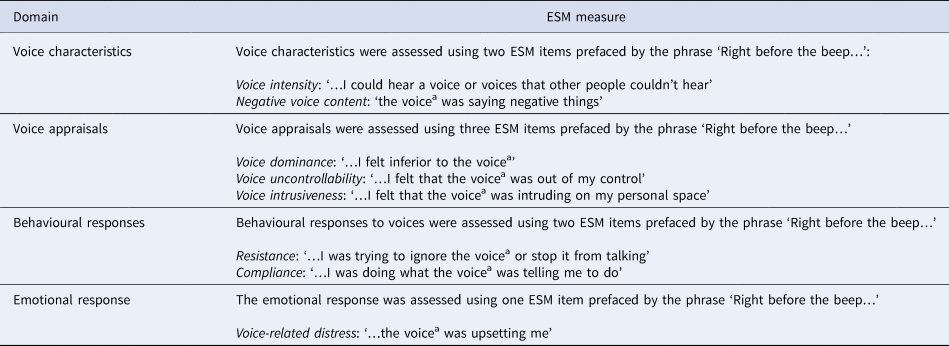
Items assessing voice characteristics, voice appraisals, behavioural responses and emotional response were included in the ESM questionnaire and were rated on 1–7 Likert scales (1: not at all; 7: very much). A detailed description of the ESM items is shown in Table 1. Extensive work was undertaken on the item development, including literature and scale reviews for constructs of interest, patient consultation and piloting. Psychometric evaluation of the ESM items indicated a sufficient degree of reliability (split week reliabilities ranging from 0.67 to 0.94; see Table 3) and convergent and divergent validity.
ESM measures

a On occasions when more than one voice was reported, all voice-relevant items referred to the ‘voices’ rather than the 'voice’, with appropriate associated grammar (e.g. the voices were as opposed to was; them as opposed to it, etc.).
ESM procedure
All participants were provided with a smartphone pre-loaded with the movisensXS ESM app (https://xs.movisens.com/), via which the ESM measure was administered 10 times per day. We used a time-based design with stratified random sampling (i.e. with ESM assessments scheduled at random within set blocks of time) (Myin-Germeys et al., Reference Myin-Germeys, Oorschot, Collip, Lataster, Delespaul and van Os2009; Palmier-Claus et al., Reference Palmier-Claus, Myin-Germeys, Barkus, Bentley, Udachina, Delespaul and Dunn2011; Stone, Shiffman, Atienza, & Nebeling, Reference Stone, Shiffman, Atienza and Nebeling2007). On each day over nine consecutive days, the smartphone emitted 10 ‘beep’ signals at semi-random moments within set blocks of time. During an initial briefing session, participants were trained in the use of the smartphone and practising its usage by going through a practice questionnaire. In this session, participants were given instructions about the forthcoming ESM assessment; they were informed that each time the device emitted the beep signal, they should stop their activity and respond to a comprehensive diary questionnaire assessing voice phenomenology and social interactions in daily life. During the assessment period, which was selected to start at any day of the week at the discretion of the participants (to optimize compliance and achieve sufficient spread of week and weekend days in our sample), the ESM questionnaire was available to participants for the duration of 15 min after emission of the beep signal. Participants were contacted twice during the assessment period to assess their adherence to instructions, identify any problems and help participants overcome any potential barriers. At the end of the assessment period, participants' reactivity to, and compliance with, the method was examined in a debriefing session. Participants were required to provide valid responses to at least one-third of the emitted beeps (i.e. 30 data points) to be included in the analysis, in line with previous ESM research.
Statistical analysis
ESM data have a multilevel structure, such that multiple observations (level-1) are nested within participants (level-2). Linear mixed models were therefore used to control for within-participant clustering of multiple observations using the MIXED module in STATA 14.0 (StataCorp, 2015). Restricted maximum likelihood estimation of these models allows for the use of all available data under the relatively unrestrictive assumption that data are missing at random (Mallinckrodt, Clark, & David, Reference Mallinckrodt, Clark and David2001). Where model assumptions were violated, standard errors of the final models were estimated using robust maximum likelihood methods. Effect sizes from predictors in the multilevel model were expressed as β, representing the unstandardized fixed regression coefficient. This can be interpreted in the same way as unstandardized B estimates in unilevel regression analysis.
The improved fit of complex models above baseline models was evaluated using Akaike's and Schwarz's Bayesian information criteria (Burnham, Anderson, & Anderson, Reference Burnham, Anderson and Anderson2004). In all models, dependent variables were entered un-centred, and all predictor variables were entered group (i.e. person) mean centred, in order to control for between-person differences in experience intensity (Nezlek, Reference Nezlek2012). Intercepts and slopes were modelled as random effects, wherever this resulted in an improved model fit (i.e. indicating a significant random effect). Fixed and random linear effects of time (i.e. measurement occasion) on the dependent variables were explored and controlled for when necessary (Bolger & Laurenceau, Reference Bolger and Laurenceau2013). In all models, an independent random-effects covariance matrix was specified to allow for distinct variances of all random effects. Given the possibility of serial autocorrelation between residual errors in ESM data (Bolger & Laurenceau, Reference Bolger and Laurenceau2013), in all analyses described, we explored whether model fit was improved by modelling the residual error structure using an autoregressive process of order 1 (Walls, Höppner, & Goodwin, Reference Walls, Höppner, Goodwin, Stone, Shiffman, Atienza and Nebeling2007). For these analyses, Bonferroni-adjusted Wald χ2 tests, based on the multilevel regression models, were used to test the equality of fixed effects in order to assess the relative contribution of each significant predictor on the outcome variable.
Results
Basic sample characteristics and ESM item descriptives
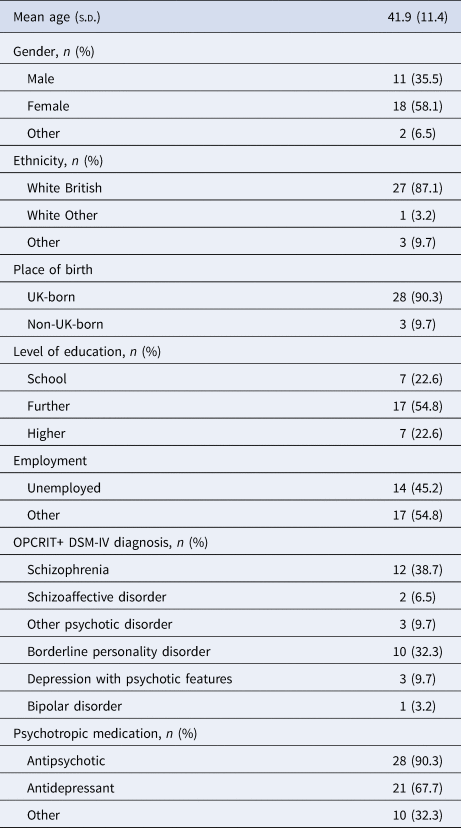
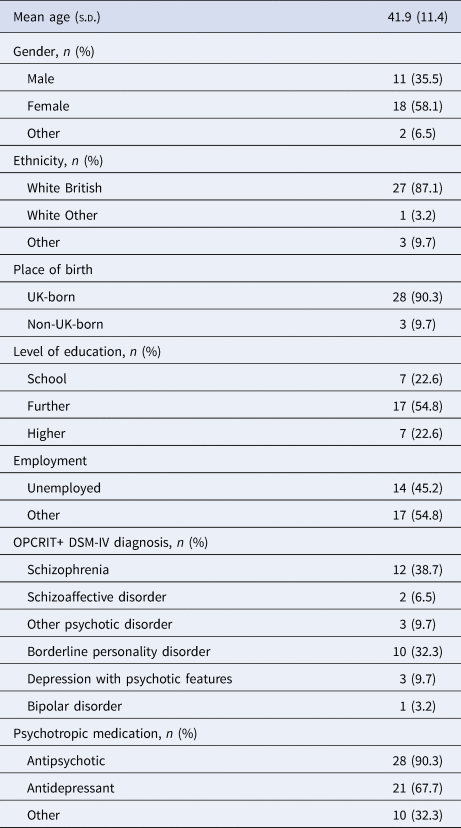
A total of 35 participants were assessed with the ESM during the study period. Of these, 31 participants (88.5%) provided ⩾30 valid responses and were included in the analyses. Demographic and clinical information for included participants is summarized in Table 2.
Demographic and clinical characteristics (N = 31)
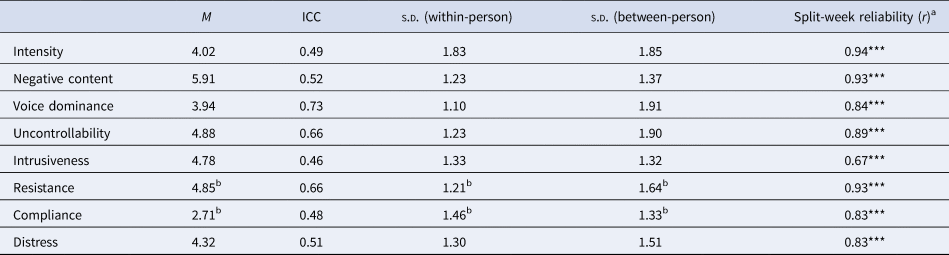
ESM data were provided on 1682 occasions, of which voices were reported at 1094 moments (65% of measurement occasions). Descriptive statistics for all ESM constructs are displayed in Table 3. All participants reported voice-hearing episodes, with a mean of 35.3 voice reports (range 2–69) per participant. Thirty participants (96.8%) reported attempting to resist their voices at least once over the course of the 9-day assessment period. Across these individuals, some degree of resistance (i.e. score >1) was reported on 88.4% of measurement occasions during which voices were experienced. Twenty-four participants (77.4%) reported complying with voice demands at least once. On average, these individuals reported complying with their voices to some degree (score >1) on 58.5% of occasions when voices were reported. There were no significant changes in compliance (B = 0.06, z = 1.61, p = 0.11, 95% CI −0.01 to 0.01) or resistance (B = −0.01, z = −1.35, p = 0.18, 95% CI −0.01 to 0.01) behaviours over the course of the 9 days.
Variability was assessed using intraclass correlation (ICC), which provides an index of the percentage of between-person variability relative to the total variability and can thus be used to assess the degree to which items vary between persons, or from moment-to-moment within persons. Standard deviations (s.d.) were also calculated at both the within- and between-person levels, providing a further indication of the variation residing at each level of analysis. A summary of item means, ICCs and within- and between-person s.d. are displayed in Table 3.
Descriptive statistics for ESM items assessing voice characteristics, appraisals and responses
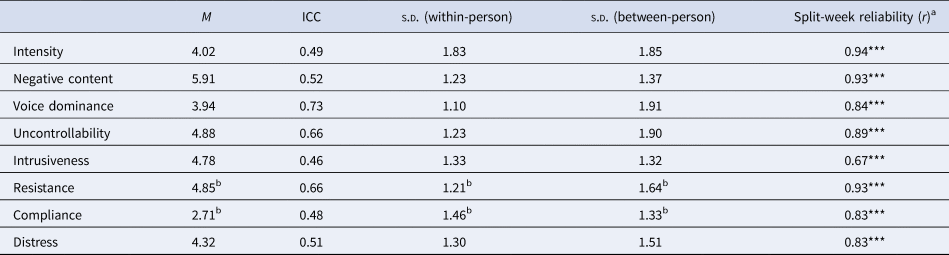
a The split-week reliability (the ESM equivalent of test-retest reliability) was calculated as the correlation between mean within-person item scores from the first half (days 1–4) and the second half (days 5–9) of the sampling period.
b Calculated across participants who reported this response (score >1) on at least one occasion.
ICC values indicate a significant level of clustering for each of the items, indicating substantial between-person variation (i.e. individual differences) in these mean levels. In particular, these analyses indicate high between-person variation in voice intensity and distress, perceived voice dominance and uncontrollability and degree of resistance to voices, indicating heterogeneity in both the experience of voice hearing, and in the psychological mechanisms underlying these experiences.
The values of within-person s.d. also reveal substantial within-person (i.e. temporal) variation in various constructs related to the experience of distressing voices, including voice characteristics (voice intensity and negative content), voice appraisals (perceived voice dominance, uncontrollability and intrusiveness), behavioural responses (resistance and compliance) and emotional response (voice-related distress). Of these constructs, perceived voice dominance demonstrated the least within-person variation, suggesting that this experience might be somewhat more ‘trait-like’ in nature, demonstrating greater variation between individuals than within individuals. Variables demonstrating particularly high within-person variability included voice intensity, distress, perceived voice intrusiveness and compliance with voices.
Are behavioural responses to voices best predicted by concurrent voice characteristics or voice appraisals?
Predictors of momentary responses to voices were explored using two multilevel models, with resistance and compliance responses as the outcome variables, and voice characteristics (intensity; negative content) and appraisals (voice dominance, uncontrollability and intrusiveness) as predictors. Table 4 reports the results of these analyses.
Momentary associations between behavioural responses, voice characteristics and appraisals

a Includes only participants who reported response with score >1 on at least one occasion; see text for details.
b The B is the unstandardized fixed regression coefficient of the predictor in the multi-level model. Robust standard errors are reported for all coefficients.
*p < 0.05, **p < 0.01, ***p < 0.001 (significant findings are shown in bold).
In line with predictions, momentary reports of voice resistance and compliance responses were significantly associated with concurrent voice appraisals, but not voice characteristics (although note that the momentary association between negative voice content and resistance responses approached significance; p = 0.05). Also supporting predictions, momentary compliance behaviours were associated with appraisals of voice dominance and uncontrollability, with the results indicating that, on average, a unit increase in perceived voice dominance was accompanied by a 0.16-unit increase in voice compliance. A Wald χ2 test indicated that there was no significant difference in the magnitude of the effects of perceived voice dominance and uncontrollability on compliance behaviours [χ2 (1) = 0.27, p = 0.60]. Unexpectedly, perceived voice uncontrollability was the only significant predictor of momentary resistance to voices, whilst voice intrusiveness was not significantly associated with either compliance or resistance behaviours.
Are behavioural responses related to momentary levels of voice distress?
A multilevel model with voice distress as the outcome variable, and resistance and compliance responses as predictors, indicated that momentary distress was significantly associated with both resistance (B = 0.23, z = 3.55, p < 0.001, 95% CI 0.10–0.35) and compliance (B = 0.18, z = 3.48, p < 0.001, 95% CI 0.09–0.29) responses. However, in line with predictions, these effects did not persist once voice characteristics and appraisals were added to the model (Table 5), indicating that there is no direct relationship between distress and resistance/compliance responses.
Momentary associations between voice-related distress and behavioural responses, voice characteristics and appraisals

a Analysis excluded participants who did not report compliance or resistance responses. Thus, this analysis is based on 922 observations from 24 participants.
b The B is the unstandardized fixed regression coefficient of the predictor in the multi-level model. Robust standard errors are reported for all coefficients.
*p < 0.05, **p < 0.01, ***p < 0.001 (significant findings are shown in bold).
As predicted by the cognitive model, voice distress was significantly associated with appraisals of voice dominance, uncontrollability and intrusiveness. However, unexpectedly, both voice intensity and negative voice content made significant independent contributions to the prediction of momentary voice distress.
Are behavioural responses related to subsequent increases in voice distress?
Next, reports of behavioural responses at the previous ESM measurement occasion (time t–1) were entered as predictor variables in a multilevel regression analysis assessing current voice distress (time t) as the dependent variable. This analysis controlled for the effects of voice appraisals, characteristics and distress at t–1. Table 6 reports the results of this analysis, including all model covariates.
Time-lagged associations between voice-related distress at time t and behavioural responses at time t–1

a Analysis excluded participants who did not report compliance or resistance responses. Thus, this analysis is based on 519 time-lagged observations from 24 participants.
b The B is the unstandardized fixed regression coefficient of the predictor in the multi-level model. Robust standard errors are reported for all coefficients.
*p < 0.05, **p < 0.01, ***p < 0.001 (significant findings are shown in bold).
As predicted, the results indicate that both resistance and compliance behaviours are associated with increases in voice-related distress at subsequent measurement occasions, even after controlling for antecedent effects of voice characteristics, appraisals and voice-related distress. A unit increase in voice compliance or resistance at time t–1 were associated with a 0.1-unit increase in voice-related distress at time t, indicating that these responses might serve to maintain or exacerbate voice-related distress. A Wald χ2 test indicated that there was no significant difference in the magnitude of the effects of resistance and compliance on subsequent distress [χ2 (1) = 0.04, p = 0.85].
Running the reverse models indicated that levels of voice distress reported at t–1 did not significantly predict compliance (B = 0.07, z = 1.15, p = 0.25, 95% CI −0.05 to 0.18) or resistance (B = −0.03, z = −0.66, p = 0.51, 95% CI −0.12 to 0.06) at time t, indicating directional effects of these behavioural responses on subsequent distress.
Are behavioural responses related to subsequent increases in negative voice appraisals?
Finally, a series of multilevel analyses were performed to determine whether behavioural responses at time t–1 predict subsequent increases in voice appraisals. Here, voice dominance, uncontrollability and intrusiveness at time t were the outcome variables, whilst behavioural responses at the previous time point (t–1) were the predictor variables. Voice characteristics, appraisals and associated distress at time t–1 were controlled for in these analyses. Table 7 reports the results of these analyses including all model covariates.
Time-lagged associations between voice appraisals at time t and behavioural responses at time t–1

a Analyses excluded participants who did not report compliance or resistance responses. Thus, these analyses are based on 517–639 time-lagged observations from 24 participants.
b The B is the unstandardized fixed regression coefficient of the predictor in the multi-level models. Robust standard errors are reported for all coefficients.
*p < 0.05, **p < 0.01, ***p < 0.001 (significant findings are shown in bold).
Resisting voices at time t–1 did not independently predict changes in voice appraisals at time t, although the associations between resistance and subsequent increases in perceived intrusiveness approached significance (B = 0.10, z = 1.80, p = 0.07, 95% CI −0.01 to 0.21).
On the other hand, compliance with voices at time t–1 was significantly associated with increases in perceived uncontrollability of voices, at time t. Running the reverse model indicated that compliance at time t was not significantly predicted by voice uncontrollability (B = 0.06, z = 0.91, p = 0.36, 95% CI −0.07 to 0.20) at time t–1, suggesting directional effects of compliance on this outcome.
Discussion
In support of the cognitive model, findings suggest that both momentary behavioural and emotional responses to voices are associated with concurrent negative voice appraisals. Whilst voice distress was associated with both resistance and compliance responses, these effects did not persist after controlling for concurrent voice appraisals, suggesting that these behaviours are not direct responses to (or causes of) momentary voice distress, but to beliefs about voices. Furthermore, in line with the hypothesized role of behavioural responses in the maintenance of voice distress, the ‘micro-longitudinal’ analyses indicated that both resistance and compliance behaviours were associated with increases in voice-related distress at subsequent measurement occasions, even after controlling for antecedent effects of voice characteristics, appraisals and voice-related distress. Compliance was additionally associated with increases in appraisals of voice uncontrollability over time, suggesting a mechanism via which responses may serve to maintain voice distress.
Considering first the results of the momentary analyses, the demonstrated associations between negative voice appraisals and both voice distress and behavioural responses are consistent with the possibility of a mediating role of voice appraisals in both behavioural and emotional responses to voices (Chadwick & Birchwood, Reference Chadwick and Birchwood1994). In line with past cross-sectional and ESM research, voice distress was associated with concurrent appraisals of voice dominance, uncontrollability and intrusiveness (Beavan & Read, Reference Beavan and Read2010; Birchwood, Meaden, Trower, Gilbert, & Plaistow, Reference Birchwood, Meaden, Trower, Gilbert and Plaistow2000; Hayward et al., 2008; Peters et al., Reference Peters, Lataster, Greenwood, Kuipers, Scott, Williams and Myin-Germeys2012a; So et al., Reference So, Chung, Tse, Chan, Chong, Hung and Sommer2020), whilst both compliance and resistance were associated with appraisals of voice uncontrollability, with compliance additionally being associated with appraisals of voice dominance. The finding that associations between voice distress and behavioural responses did not persist after controlling for concurrent voice appraisals parallel those of Hacker et al. (Reference Hacker, Birchwood, Tudway, Meaden and Amphlett2008), who demonstrated that the observed cross-sectional association between safety behaviour use and voice distress was mediated by appraisals of voice omnipotence, suggesting that safety behaviours reflect attempts to mitigate perceived threat, rather than to reduce distress per se. Findings from the current study suggest that similar mechanisms may be at play during daily life.
The demonstrated association between compliance and perceived voice dominance is consistent with a wealth of cross-sectional findings implicating perceived voice rank (Reynold & Scragg, Reference Reynold and Scragg2010) and omnipotence (Bucci et al., Reference Bucci, Birchwood, Twist, Tarrier, Emsley and Haddock2013; Fox, Gray, & Lewis, Reference Fox, Gray and Lewis2004; Reynold & Scragg, Reference Reynold and Scragg2010) as predictors of compliance with voice commands. However, whilst it was predicted, based on past cross-sectional research (Birchwood et al., Reference Birchwood, Gilbert, Gilbert, Trower, Meaden, Hay and Miles2004; Gilbert et al., Reference Gilbert, Birchwood, Gilbert, Trower, Hay, Murray and Miles2001; Hayward et al., 2008), that voice dominance would also be associated with resistance, this was not born out in the findings.
Interestingly, some studies have failed to demonstrate an association between voice omnipotence (a construct closely related to voice dominance) and resistance, after controlling for the perceived malevolent intent of voices (Peters et al., Reference Peters, Williams, Cooke and Kuipers2012b; van der Gaag et al., Reference van der Gaag, Hageman and Birchwood2003). Indeed, social relating theories (Benjamin, Reference Benjamin1989; Hayward et al., 2011; Thomas, McLeod, & Brewin, Reference Thomas, McLeod and Brewin2009) propose that voices perceived as dominant will elicit complementary submissive responses, such as compliance, whilst resistance is more likely to be elicited by voices that are perceived as intrusive or hostile. Whilst no evidence was found of an association between voice intrusiveness and resistance responses, the finding that dominance uniquely predicted compliance, and not resistance, is in line with this suggestion. Based on their findings, Peters et al. (Reference Peters, Williams, Cooke and Kuipers2012b) suggested that voice malevolence might be more critical in eliciting resistance than voice power/dominance. This notion is supported by findings from the command hallucination literature, where resistance to commands is best predicted by perceived voice malevolence, and with compliance being more likely when voices are perceived as powerful (Barrowcliff & Haddock, Reference Barrowcliff and Haddock2006; Bucci et al., Reference Bucci, Birchwood, Twist, Tarrier, Emsley and Haddock2013). However, since there was no attempt to assess perceived voice malevolence, this possibility could not be tested.
Findings from the current study additionally highlight the importance of appraisals of voice uncontrollability in both resistance and compliance responses. To our knowledge, this construct has not previously been assessed as a predictor of voice compliance or resistance, but research has demonstrated cross-sectional associations between voice-related distress and both perceived voice uncontrollability (Beavan & Read, Reference Beavan and Read2010; Peters et al., Reference Peters, Lataster, Greenwood, Kuipers, Scott, Williams and Myin-Germeys2012a), and metacognitive beliefs about the uncontrollability of voices and their associated danger (Morrison, Nothard, Bowe, & Wells, Reference Morrison, Nothard, Bowe and Wells2004; Varese et al., Reference Varese, Morrison, Beck, Heffernan, Law and Bentall2016). It has been suggested that perceived loss of control may elicit maladaptive attempts to control or suppress voices (Varese et al., Reference Varese, Morrison, Beck, Heffernan, Law and Bentall2016), or alternatively, reinforce appraisals of voice power, eliciting submissive responses such as compliance (Benjamin, Reference Benjamin1989; Thomas et al., Reference Thomas, McLeod and Brewin2009). Whilst the findings from the current study are consistent with these suggestions, it is of course equally possible that appraisals of uncontrollability may stem from failed attempts to resist voices or their commands.
Using a micro-longitudinal approach, we found evidence that resistance and compliance responses played a role in maintaining or exacerbating voice distress and negative appraisals over time in daily life. Furthermore, these associations appear to be directional; antecedent distress did not predict increases in resistance or compliance responses. Similar findings have previously been demonstrated with regard to the role of attempts to control or suppress thoughts on subsequent voice distress (Hartley et al., Reference Hartley, Haddock, Vasconcelos e Sa, Emsley and Barrowclough2015); results from the current study suggest that this effect applies to attempts to control or resist voices.
Some support was also found for the notion that behavioural responses might maintain distress via their effect on reinforcing and/or preventing disconfirmation of negative voice appraisals (Michail & Birchwood, Reference Michail, Birchwood, Hagen, Turkington and Berge2010; Morrison, Reference Morrison1998). Compliance with voices was associated with subsequent increases in appraisals of voice uncontrollability, whilst the time-lagged association between resistance and perceived voice intrusiveness approached significance. This dynamic association between compliance and voice uncontrollability is particularly interesting in light of the findings of momentary associations between uncontrollability appraisals and both voice distress and compliance, suggesting a mechanism via which compliance may serve to exacerbate voice distress, and prompt further compliance, over time, by reinforcing appraisals of voice uncontrollability.
An unexpected finding concerned the associations between momentary voice distress and both voice intensity and negative content, even after controlling for voice appraisals. Whilst this lies in contrast to previous cross-sectional research (van der Gaag et al., Reference van der Gaag, Hageman and Birchwood2003), similar findings were obtained in previous ESM studies (Peters et al., Reference Peters, Lataster, Greenwood, Kuipers, Scott, Williams and Myin-Germeys2012a; So et al., Reference So, Chung, Tse, Chan, Chong, Hung and Sommer2020), suggesting that the influence of voice characteristics on voice-related distress as experienced during daily life may have been underestimated. This finding echoes suggestions that exploration of voice content may be a crucial component of both understanding and reducing the distress experienced by some in relation to their voices (Beavan & Read, Reference Beavan and Read2010; Laroi et al., Reference Larøi, Thomas, Aleman, Fernyhough, Wilkinson, Deamer and McCarthy-Jones2018; Longden, Corstens, Escher, & Romme, Reference Longden, Corstens, Escher and Romme2012; Romme & Escher, Reference Romme and Escher2000).
The findings of this study should be interpreted in light of several limitations. First, the findings are consistent with a mediating role of voice appraisals in the relationship between behavioural responses and voice distress, both in the moment and over time, but it was not possible to perform formal tests of mediation whilst controlling for necessary covariates due to model non-convergence. Future research should use a multilevel mediation approach (Bauer, Preacher, & Gil, Reference Bauer, Preacher and Gil2006; Bolger & Laurenceau, Reference Bolger and Laurenceau2013) within the context of a larger ESM study to test whether: (i) the observed momentary association between behavioural responses and voice distress is mediated by appraisals of voice dominance and uncontrollability; and (ii) the observed micro-longitudinal relationship between compliance and subsequent increase in voice distress is mediated by appraisals of voice uncontrollability.
Second, there was no assessment of appraisals of voice malevolence. Whilst an item assessing voice benevolence was included, it was rarely endorsed and demonstrated unacceptably low within-person variability for use (in reverse-coded form) within the present analyses.
Third, the magnitude of the effects was generally small, although not negligible. Small effect sizes are common in ESM studies, but it is the cumulative impact of these effects that can be substantial given the frequency with which they are observed during daily life (Myin-Germeys et al., Reference Myin-Germeys, Peeters, Havermans, Nicolson, DeVries, Delespaul and van Os2003).
Finally, despite conducting extensive work on item development, the psychometric evaluation of the ESM items did not include an assessment of their construct validity. This should be a focus of future research.
The findings from the current study provide ecological validation for a role of compliance and resistance responses in the maintenance of voice distress and negative voice appraisals during daily life. In addition to providing support for cognitive models, these findings have implications for psychological interventions for distressing voices, supporting the notion that behaviour change should remain a central goal of therapy. However, the results have particular implications for therapies incorporating behavioural experiments encouraging attempts to resist command hallucinations; the findings highlight the importance of differentiating between resistance to voice commands and resisting voice experiences more generally. In this respect, interventions incorporating acceptance and mindfulness approaches (e.g. Chadwick et al., Reference Chadwick, Strauss, Jones, Kingdon, Ellet, Dannahy and Hayward2016), targeting coping behaviours (Bell et al., Reference Bell, Fielding-Smith, Hayward, Rossell, Lim, Farhall and Thomas2019; Hayward, Edgecumbe, Jones, Berry, & Strauss, Reference Hayward, Edgecumbe, Jones, Berry and Strauss2018) or interpersonal relationships with voices (Craig et al., Reference Craig, Rus-Calafell, Ward, Leff, Huckvale, Howarth and Garety2018; Hayward, Jones, Bogen-Johnston, Thomas, & Strauss, Reference Hayward, Jones, Bogen-Johnston, Thomas and Strauss2017), may offer hearers an alternative way of responding to their voices. Furthermore, whilst the results support the focus of cognitive interventions on re-evaluating appraisals of voice power/dominance and uncontrollability, they highlight the importance of a parallel therapeutic focus on exploring and responding to negative voice content (Larøi et al., Reference Larøi, Thomas, Aleman, Fernyhough, Wilkinson, Deamer and McCarthy-Jones2019).