INTRODUCTION
Elasmobranch predation plays an important role in marine community structure (Heithaus et al., 2010). Large sharks are top predators in many marine ecosystems affecting the abundance of species at lower trophic levels (Heithaus et al., Reference Heithaus, Frid, Wirsing and Worm2008). Some mesopredatory batoids affect the species turnover of benthic communities by disrupting the structure of the bottom while feeding on benthic invertebrates (Thrush et al., Reference Thrush, Pridmore, Hewitt and Cummings1994). Therefore, declines in the abundance of elasmobranchs have broader ecological consequences on community structure (Heithaus et al., Reference Heithaus, Frid, Vaudo, Worm, Wirsing, Carrier, Musick and Heithaus2010). Further study of the feeding habits of the elasmobranch populations should help to elucidate the ecological role of these fishes in the marine ecosystem.
The apron ray, Discopyge tschudii (Narcinidae) is an elasmobranch endemic to South America that occurs in two broadly separated geographical areas (Atlantic and Pacific coasts of the continent) (Cousseau et al., Reference Cousseau, Figueroa, Díaz de Astarloa, Mabragaña and Lucifora2007). In the south-west Atlantic it inhabits waters from Rio Grande do Sul, Brazil, to Patagonia, Argentina (Menni & Stehmann, Reference Menni and Stehmann2000; Cousseau et al., Reference Cousseau, Figueroa, Díaz de Astarloa, Mabragaña and Lucifora2007). In northern Argentina, the area with the highest catch of elasmobranchs (Lucifora et al., Reference Lucifora, García, Menni and Worm2012), D. tschudii has been subjected to heavy fishing pressure as by-catch of bottom trawl fisheries (Massa et al., Reference Massa, Lucifora, Hozbor, Sanchez and Veis2004a). Therefore, this species has declined heavily in its population abundance and the International Union for Conservation of Nature (IUCN) categorized D. tschudii as near threatened (Massa et al., Reference Massa, Hozbor and Lamilla2004b). Studies about the feeding habits of this species are scarce and limited to the description of diet composition: D. tschudii feeds mainly on polychaetes, amphipods and siphons of clams (García, Reference García1984; Arrighetti et al., Reference Arrighetti, Livore and Penchaszadeh2005).
For understanding how elasmobranch predation impacts on prey populations and the whole community, studies on how the diet composition might vary with ontogeny, space and time are essential for the implementation of ecosystem-level management and a conservation programme. The aim of this study was to investigate the feeding habits of D. tschudii, from off Uruguay and north Argentina. The specific objectives were to: (1) quantify the diet composition; and (2) assess the effects of sex, maturity stage, body size and season on the diet.
MATERIALS AND METHODS
Study area and sampling
The study area, between 34°S and 38°S, consists of a stratified coastal system influenced by the discharge of continental waters of the Río de la Plata (Guerrero & Piola, Reference Guerrero, Piola and Boschi1997; Lucas et al., Reference Lucas, Guerrero, Mianzán, Acha and Lasta2005). This system is characterized by strong vertical stratification: freshwater flows seaward on the surface while denser shelf water intrudes along the bottom, taking the shape of a salt wedge (Acha et al., Reference Acha, Mianzan, Guerrero, Favero and Bava2004). Wind fields force seasonal patterns of surface salinity, while bottom salinity is controlled by the bathymetry (Guerrero et al., Reference Guerrero, Acha, Framiñan and Lasta1997).
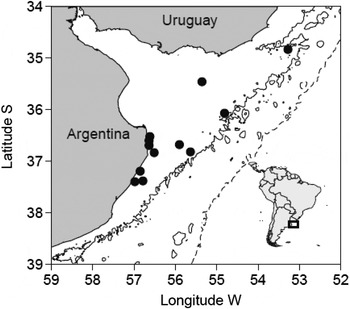
Individuals of Discopyge tschudii were collected from scientific trawl surveys (N = 176) conducted by the Instituto Nacional de Investigación y Desarrollo Pesquero (INIDEP, Argentina: Figure 1). Research cruises were conducted in November (2005 and 2008) and September (2010). For each individual captured, total length (TL, mm), sex and maturity stage were recorded. Maturity stage (juvenile or adult) was determined according to the degree of calcification of the claspers and the development of testes and reproductive ducts in males, and observation of the uteri, oviductal glands and ovarian follicles in females (Colonello, Reference Colonello2009). The stomachs were excised and frozen at −20°C for subsequent analyses in the laboratory.
Map of study area showing positions of trawl station where individuals of Discopyge tschudii were collected off North Argentina and Uruguay. The 50 m and 200 m isobaths are shown as solid and dashed lines, respectively. The rectangle in the inset shows the location of the study area in South America.

Diet composition and analysis
Stomach contents were sorted and identified to the lowest possible taxonomic level, using reference collections preserved at the Laboratorio de Ictiología, Universidad Nacional de Mar del Plata (Argentina). Preys were counted and their wet weights recorded (± 0.01 g). To evaluate the importance of each prey and allow for comparisons with other studies the composition of diet was presented as percentage by number (%N), percentage by mass (%M), percentage frequency of occurrence (%FO) and index of relative importance (IRI) (Pinkas et al., Reference Pinkas, Oliphant and Iverson1971). IRI was expressed in percentage (%IRI: Cortés, Reference Cortés1997).
To determine whether a sufficient number of D. tschudii was sampled, the stomachs sampled were randomized 100 times and the sample size was plotted against the mean cumulative Shannon–Wiener diversity index (Magurran, Reference Magurran2004). Sample size was considered sufficient to describe diet and to conduct statistical analyses if the curve reached an asymptote.
For identifying changes in the diet with sex, ontogeny and season, preys were grouped into four categories: errant polychaetes; buried polychaetes; siphons of clams; and amphipods. The majority of polychaetes live in close association with the substrate. The errant polychaetes are active worms that live on the substrate (Hesselberg, Reference Hesselberg2006). On the other hand, buried polychaetes are sedentary and live in tubes buried in the substrate (Hesselberg, Reference Hesselberg2006). Siphons of clams are an anatomical structure which is part of the body of molluscs bivalves and are used for feeding, respiration and reproduction (Hadley et al., Reference Hadley, Manzi, Eversole, Dillon, Battey and Peacock2005; Grabarkiewicz & Davis, Reference Grabarkiewicz and Davis2008).
Dietary variability of D. tschudii with sex, maturity stage (juvenile and adult), TL and season (warm = October–March; cold = April–September) were evaluated using generalized linear models (GLM: Venables & Ripley, Reference Venables and Ripley2002). For each prey category, models were built where the response variable was the number of prey consumed and the independent variables were sex, maturity stage, TL and season. Models with combinations between sex + season, maturity stage + season and TL + season as independent variables, were also fitted. We also fitted a model without any of the independent variables (i.e. null model) to test the hypothesis that none of the variables tested had an effect on the consumption of a prey category (Lucifora et al., Reference Lucifora, García, Menni, Escalante and Hozbor2009). Models have a negative binomial error distribution because there were too many zeros and the variance was often much greater than the mean, and a log link (Crawley, Reference Crawley2005).
We used a multiple-hypothesis model approach to identify the best model explaining the consumption of a given prey (Anderson et al., Reference Anderson, Burnham and Thompson2000; Franklin et al., Reference Franklin, Shenk, Anderson, Burnham, Shenk and Franklin2001; Johnson & Omland, Reference Johnson and Omland2004). For each competing model, we calculated the Akaike information criterion (AIC) and the model with the lowest AIC was selected as the best model (Crawley, Reference Crawley2005). To obtain the likelihood of each competing model given the data, Akaike's weight (w) was calculated (Franklin et al., Reference Franklin, Shenk, Anderson, Burnham, Shenk and Franklin2001; Johnson & Omland, Reference Johnson and Omland2004). If w did not provide strong support for any model fitted, we used model averaging to measure the effects of the variable explaining most of the variation (Johnson & Omland, Reference Johnson and Omland2004; Symonds & Moussalli, Reference Symonds and Moussalli2011).
RESULTS
Overall diet
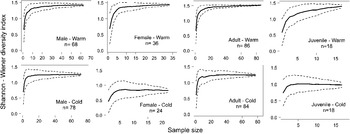
A total of 176 stomachs of D. tschudii were examined (100% contained food). Of all specimens sampled, 59 were female (144–378 mm TL) and 117 were male (210–459 mm TL). Overall, 1777 preys with a total weight of 254.26 g were found in the stomachs. The cumulative curves of prey diversity reached an asymptote for all groups, indicating that sample size were sufficient to describe their diet (Figure 2).
Cumulative mean Shannon–Wiener diversity index (continuous lines) and standard deviation (dashed lines) as a function of sample size for Discopyge tschudii.

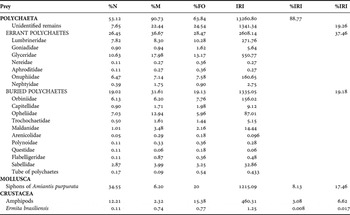
Polychaetes were the most important prey in terms of %N, %M, %FO and %IRI in the diet composition of D. tschudii. Less important were siphons of the purple clam, Amiantis purpurata, and amphipods (Table 1). The consumption of the crab Ermita brasiliensis was considered occasional (%IRI <0.01). Species belonging to 17 families of polychaetes were identified: seven families of errant polychaetes and 10 families of buried polychaetes. Among the errant polychaetes, Glyceridae was the main family consumed followed by Lumbrineridae and Onuphiidae. Among the buried polychaetes, Orbiniidae was the most important followed by Opheliidae.
Diet composition of Discopyge tschudii. %N, percentage by number; %M, percentage by mass; %FO, percentage of frequency of occurrence; IRI, the index of relative importance; %IRI, percentage of IRI. Bold indicates major taxonomic group.

Relationship between diet and sex, body size and season
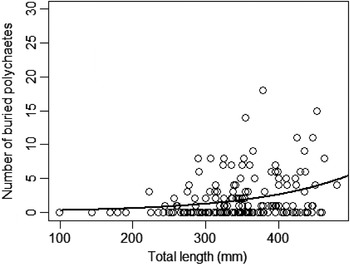
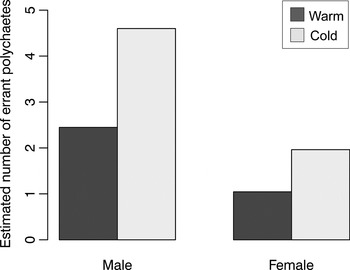
Several patterns were found in the relationships between number of prey consumed with sex, TL and season (Table 2). As the D. tschudii size increased, the consumption of buried polychaetes increased in number (Figure 3). The consumption of errant polychaetes was higher in males than females, and that consumption was higher in the cold season than in the warm season (Figure 4). On the other hand, more amphipods were preyed by females than by males (estimated number of amphipods by GLM: females = 2.08 and males = 0.80). The number of siphons of A. purpurata consumed was higher in the cold season than in the warm season (estimated number of siphons by GLM: cold = 7.85 and warm = 0.47). The consumption of all prey categories was independent of the maturity stage.
Changes in consumption of buried polychaetes (in number) with body size of Discopyge tschudii estimated by generalized linear models. The models had a log link and a negative binomial error distribution.

Changes in consumption of errant polychaetes (in number) with sex and season of Discopyge tschudii estimated by generalized linear models. The models had a log link and a negative binomial error distribution.

Best models explaining the consumption of prey category in number of Discopyge tschudii. The intercept and coefficient for the variables are given. TL, total length (mm); AIC, Akaike information criterion; w, Akaike's weights; standard errors in parentheses.

The models for siphons of clams and amphipods had a low w, therefore model averaging was computed. For siphons, the model averaging slope for the cold season was 0.462 (standard error (SE) = 0.54) with a combined w of 0.6348. The estimated averaged coefficient for amphipods was −0.714 (SE = 0.42) for males with a combined w of 0.999.
DISCUSSION
The feeding habits of D. tschudii are exclusively benthic because they feed mainly on polychaetes, followed by siphons of A. purpurata and amphipods. Discopyge tschudii showed changes in the diet composition between sexes, with increasing body size and also between seasons.
García (Reference García1984) described the diet of D. tschudii from individuals captured in Argentine waters and observed that the most important prey were polychaetes, followed by amphipods and cephalochordates. In agreement with García (Reference García1984), our results showed that the most important prey were polychaetes. In contrast with our results and García's (1984), Arrighetti et al. (Reference Arrighetti, Livore and Penchaszadeh2005) found that the diet of D. tschudii from Mar del Plata (38°S) was dominated by siphons of A. purpurata. These differences in the most important prey may be due to two reasons: the very restricted extent of the study area and a low sample size (N = 67) in Arrighetti et al. (Reference Arrighetti, Livore and Penchaszadeh2005).
Along its distribution range, D. tschudii coexist with other electric ray species such, as Narcine brasiliensis, Torpedo puelcha (Cousseau et al., Reference Cousseau, Figueroa, Díaz de Astarloa, Mabragaña and Lucifora2007) and D. castelloi (Menni et al., Reference Menni, Rincón and García2008), but the ecology of these species is poorly known, including its feeding habits. Bornatowski et al. (2006) off São Francisco do Sul (Brazil), with a sample size of 15 individuals, found that N. brasiliensis feeds mainly on decapod crustaceans and polychaetes. In Argentinean waters, the stomach contents of T. puelcha contained fish species as prey (Cousseau & Bastida, Reference Cousseau and Bastida1982; Belleggia et al., Reference Belleggia, Barbini, Scenna, Figueroa and Díaz de Astarloa2008). The diets of other species of Narcinidae are similar to that of D. tschudii. For example, off Colima (Mexico), N. entemedor consumed primarily polychaetes (Valadez et al., Reference Valadez, Aguilar and Hernández2000; Valadez-Gonzalez, Reference Valadez-Gonzalez2007) and N. vermiculatus has a high incidence of polychaetes and presence of stomatopods, decapods and fishes in its diet (Valadez-Gonzalez, Reference Valadez-Gonzalez2007). This and other studies confirm that Narcinidae are a group of electric rays highly specialized in their feeding habits. On the other hand, the species of the genus Torpedo feeds mainly on active preys such teleost fishes (Bigelow & Schroeder, Reference Bigelow and Schroeder1948; Abdel-Aziz, Reference Abdel-Aziz1994; Capapé et al., Reference Capapé, Crouzet, Clément, Vergne and Guélorget2007; Belleggia et al., Reference Belleggia, Barbini, Scenna, Figueroa and Díaz de Astarloa2008). These differences between Narcinidae and Torpedinidae may be related to the difference sizes that reach both families.
Electric rays are benthic suction feeders with a highly protrusible and versatile jaw apparatus, capable of adjustment of the mandibular apparatus in position to capture benthic invertebrates (Rudloe, Reference Rudloe1989; Rudloe & Rudloe, Reference Rudloe and Rudloe1993), obtaining their food by projecting their jaws and generating a negative pressure in the oral cavity to suck the food (Dean & Motta, Reference Dean and Motta2004). Excavation of benthic prey by jaw protrusion can be performed only by an extremely protractile jaw and that is most likely unique to the Narcinoidea and Batoidea (Dean & Motta, Reference Dean and Motta2004). As the numbers of D. tschudii increase their body size could increase the pressure in the oral cavity (i.e. increase the suction power), which allows them to hunt prey buried in the bottom. This could explain the increase in the consumption of buried polychaetes with increasing body size. Furthermore, the feeding behaviour of digging in the bottom (e.g. bioturbation) in search of prey could cause disturbances on the surface of the substratum. This physical disturbance to soft-bottom can play an important role in determining benthic community structure by removing prey species, providing secondary predators with access to normally unavailable prey and creating new opportunities for colonization (VanBlaricom, 1982; Thrush et al., Reference Thrush, Pridmore, Hewitt and Cummings1991; O'Shea et al., Reference O'Shea, Thums, van Keulen and Meekan2012). From this way, some elasmobranchs of low trophic level, mainly mesopredatory batoids like D. tschudii, could be considered a key influence on marine ecosystems.
Diet of predators may differ between sexes due to sexual size dimorphism (Begg et al., Reference Begg, Begg, Du Toit and Mills2003), differences on predatory capability of males and females (Floeter & Temming, Reference Floeter and Temming2003) and/or due to differences in the spatio-temporal foraging activity of males and females (Braccini et al., 2005). In D. tschudii amphipods were most consumed by females than males and errant polychaetes were most consumed by males than females. The reasons for diet shifts between females and males could be the result, in part, of possible shift in habitat use between sexes. There are previous reports of sexual segregation in elasmobranchs (e.g. Sphyrna lewini, Klimley, Reference Klimley1987; Scyliorhinus canicula, Sims et al., Reference Sims, Nash and Morrit2001; Dasyatis longa, Bohórquez-Herrera, Reference Bohórquez-Herrera2006) and this pattern was previously proposed for D. tschudii (Menni et al., Reference Menni, López and García1981; Cousseau et al., Reference Cousseau, Figueroa, Díaz de Astarloa, Mabragaña and Lucifora2007). However, this hypothesis needs to be corroborated with dedicated studies at shifts in habitat use between sexes of D. tschudii. Also, females reach smaller sizes than males (Cousseau et al., Reference Cousseau, Figueroa, Díaz de Astarloa, Mabragaña and Lucifora2007). The fact that females consume greater amounts of amphipods than males may be related to the different sizes shown between them. This sexual dimorphism in body size may have an effect on the feeding habits of D. tschudii.
The diet composition of D. tschudii showed seasonal variation. This seasonal pattern is characterized by a higher consumption of siphons of A. purpurata and errant polychaetes in the cold season than in the warm season. These seasonal differences in the use of some trophic resources may be related to migration patterns of the predator and/or to a seasonal peak in abundance of different prey (Muto et al., Reference Muto, Soares and Goiten2001). Amiantis purpurata inhabits shallow waters and the relative abundance of this species is constant throughout the year (Morsán E., personal communication). However, the consumption of this prey species changed between seasons. In the south-west Atlantic, Cortés et al. (Reference Cortés, Jaureguizar, Guerrero and Dogliotti2011) found onshore–offshore movements of D. tschudii with water temperature and salinity being the environmental factors with the highest effect on spatial distribution. In the winter, cool and high salinity waters cover a greater area of this region allowing the intrusion of D. tschudii into shallower waters (Cortés et al., Reference Cortés, Jaureguizar, Guerrero and Dogliotti2011). These onshore–offshore movements could explain the seasonal pattern observed in the diet composition.
The sublethal predation on siphons of bivalves might be interpreted as an important role in increasing secondary production, since that predation pressure stimulated the continuous regeneration of the lost siphons by clams (Tomiyama et al., Reference Tomiyama, Sasaki and Omori2004; Cledón & Nuñez, Reference Cledón and Nuñez2010). Thus, this prey constitutes a renewable source of food for predators (Penchaszadeh et al., Reference Penchaszadeh, Pastorino, Brögger and Boltovstoy2008).
Fishing affects marine populations both directly though removal of the individuals and indirectly through loss of habitat and modification of the trophic structure. Coastal areas off Uruguay and north Argentina are exposed to a high intensity of bottom trawling (Cousseau & Perrota, Reference Cousseau and Perrota2000). This activity alters the physical structure of the habitat, affecting the diversity of the benthic community (Kaiser, 1998), and generating potential indirect effects on the fish community (Brazeiro et al., Reference Brazeiro, Acha, Mianzán, Gómez and Fernández2003). Our results show that the diet of D. tschudii was composed exclusively of benthic prey (i.e. polychaetes, amphipods and siphons of bivalves). Thereby, the loss of habitat caused by bottom trawling may alter the abundance and availability of prey for D. tschudii and of other benthic predators, with ecological consequences in the marine community.
ACKNOWLEDGEMENTS
We thank the Instituto Nacional de Investigación y Desarrollo Pesquero (INIDEP, Argentina) for specimens collected, J. Colonello for his assistance in sample processing, J. Nuñez and C. Bremec for help in identification of prey, and L.O. Lucifora and two referees for their valuable comments. M.C. Spath and S.A. Barbini were supported by CONICET.