


Introduction
Established cognitive models (Brewin, Reference Brewin2001; Ehlers and Clark, Reference Ehlers and Clark2000) of posttraumatic stress disorder (PTSD) suggest that the decontextualized processing of a traumatic event leads to the subsequent experience of trauma-related intrusive memories. This “core” symptom of PTSD fuels a state of hypervigilance and avoidance. More recent research has highlighted how trauma-related intrusive images may also play a role in the development and maintenance of a number of other psychological disorders, including social phobia (Wild and Clark, Reference Wild and Clark2011), depression (Patel et al., Reference Patel, Brewin, Wheatley, Wells, Fisher and Myers2007) and psychotic disorders (Steel, Fowler and Holmes, Reference Steel, Fowler and Holmes2005).
Influential theoretical accounts of bipolar disorder have highlighted the roles of reward seeking behaviour (Johnson, Edge, Holmes and Carver, Reference Johnson, Edge, Holmes and Carver2012), mania as a potential defence against low self-esteem (Lyon, Startup and Bentall, Reference Lyon, Startup and Bentall1999) and appraisal of changes in internal state (Mansell, Morrison, Reid, Lowens and Tai, Reference Mansell, Morrison, Reid, Lowens and Tai2007). Recent work has also highlighted the role of vivid intrusive images of future events on the amplification of emotion in bipolar disorder (Holmes et al., Reference Holmes, Deeprose, Fairburn, Wallace-Hadrill, Bonsall and Geddes2011). However, to date there has been limited research aimed at exploring the role of intrusive memories of traumatic life events within symptoms associated with a diagnosis of bipolar disorder.
There is, however, growing evidence that traumatic life events are associated with an increased prevalence and severity of bipolar disorder (Daruy-Filho, Brietzke, Lafer and Grassi-Oliveira, Reference Daruy-Filho, Brietzke, Lafer and Grassi-Oliveira2011; Grubaugh, Zinzow, Paul, Egede and Freuh, Reference Grubaugh, Zinzow, Paul, Egede and Freuh2011; Garno, Goldberg, Ramirez and Ritzler, Reference Garno, Goldberg, Ramirez and Ritzler2005). Emotional abuse has been identified as a predictor of predisposition to mania (Reid, Reference Reid2005) and associated with early onset bipolar disorder (Larsson et al., Reference Larsson, Aas, Klungsøyr, Agartz, Mork and Steen2013). Childhood sexual and physical abuse have been associated with increased symptom severity and poorer clinical outcomes (Larsson et al., Reference Larsson, Aas, Klungsøyr, Agartz, Mork and Steen2013; Leverich et al., Reference Leverich, McElroy, Suppes, Keck, Denicoff and Nolen2002). Further, there are reports of a high rate of intrusive negative images of past events within bipolar disorder (Gregory, Mansell and Donaldson, Reference Gregory, Mansell and Donaldson2010; Mansell and Lam, Reference Mansell and Lam2004; Tzemou and Birchwood, Reference Tzemou and Birchwood2007). Specifically, Mansell and Lam (Reference Mansell and Lam2004) highlight the presence of intrusive images of a past depressive episode within individuals with remitted bipolar disorder.
Given the limited research investigating the relationship between trauma-related intrusive images and the symptoms of bipolar disorder, it is currently unclear as to whether this relationship is direct, indirect or both. That is, it may be that the emotion and content of the intrusive images directly contribute to the emotion, beliefs and experiences that subsequently develop within a presentation of bipolar disorder. However, another possibility is that distressing intrusive images drive an increased use of emotion regulation strategies, which subsequently exacerbate the mood instability and other symptoms associated with bipolar disorder. As would be expected, there is evidence that cognitive emotion regulation difficulties do occur within bipolar disorder (e.g. Rowland et al., Reference Rowland, Hamilton, Lino, Ly, Denny and Hwang2013), although it remains unclear which, if any, specific emotion regulation strategies may mediate a potential relationship between a posttraumatic reaction and the symptoms of bipolar disorder.
As with schizophrenia, the symptoms associated with a diagnosis of bipolar disorder have been argued to occur within the non-clinical population (Claridge, Reference Claridge1997; Eckblad and Chapman, Reference Eckblad and Chapman1986). The symptoms of bipolar disorder can be considered to occur within a continuum, with high level of “hypomanic personality traits” being associated with an increased risk of developing a diagnosis of bipolar disorder (Klein, Lewinsohn and Seeley, Reference Klein, Lewinsohn and Seeley1996; Kwapil et al., Reference Kwapil, Miller, Zinser, Chapman, Chapman and Eckblad2000). These traits have been measured using scales such as the Hypomanic Personality Scale (HPS; Eckblad and Chapman, Reference Eckblad and Chapman1986).
A similar continuum between non-clinical phenomena and the symptoms of clinical disorder has been argued to occur between “schizotypal” personality traits and schizophrenia (Claridge, Reference Claridge1997). Negative and traumatic developmental experiences may impact on the formation of schizotypal personality traits. The magnitude of schizotypal personality subsequently acts as a vulnerability factor for a future psychotic episode, dependent on further environmental events (Mason and Beaven-Pearson, Reference Mason and Beaven-Pearson2005). A potential relationship between hypomanic personality traits and negative developmental experiences remains to be explored.
The current study employs a cross-sectional design with non-clinical participants in order to assess potential relationships between posttraumatic stress, cognitive emotion regulation and hypomanic personality traits. Whilst the study design limits the inference of causal relationships, the results may contribute to questions being asked within future studies adopting a longitudinal design. The first aim is to test whether the previously reported relationship between posttraumatic symptoms and bipolar disorder also exists within hypomanic personality traits as measured by the Hypomanic Personality Scale (Eckblad and Chapman, Reference Eckblad and Chapman1986). The second aim, should this relationship exist, is to assess whether intrusive trauma-related memories make an independent contribution. Intrusive memories are singled out for this analysis as they are considered the core symptom of PTSD, and have been argued to contribute directly to the psychopathology of a range of other disorders (Holmes and Mathews, Reference Holmes and Mathews2010). The third aim is to explore a potential indirect relationship between intrusive images and hypomanic personality traits as mediated by cognitive emotion regulation strategies.
Method
Participants
Participants were recruited via a student research panel at the University of Reading, UK (within which psychology undergraduates receive course credits for their participation) and via an internationally available psychology research website to which volunteers contribute their time for no financial reward. In order to be eligible to take part in the study, students had to be at least 18 years old and to not have suffered from a diagnosed mental health problem. The study was approved by the University of Reading Research Ethics Committee.
Measures
Depression Anxiety and Stress Scale (DASS-21; Lovibond and Lovibond, Reference Lovibond and Lovibond1995)
The DASS-21 is a 21-item scale comprising three 7-item subscales that assess anxiety, depression and stress over the previous week.
Hypomanic Personality Scale (Eckblad and Chapman, Reference Eckblad and Chapman1986) measures dispositional hypomanic characteristics, consisting of 48 true–false items. An example of an item is, “There have often been times when I had such an excess of energy that I felt little need to sleep at night.”
Impact of Events Scale – Revised (Weiss and Marmar, Reference Weiss, Marmar, Wilson and Keane1997) measures reactions to a specific traumatic event, consisting of 22 items. The subscales of intrusions, avoidance and hypervigilance are included.
Cognitive Emotion Regulation Questionnaire (CERQ) short version (Garnefski and Kraaij, Reference Garnefski and Kraaij2006)
The 18-item CERQ assesses individual differences in coping across nine 2-item subscales: self-blame, blaming others, acceptance, refocusing on planning, positive refocusing, rumination, positive reappraisal, putting into perspective, and catastrophizing.
Procedure
After accessing the study via the relevant web link, participants were directed to an information sheet that advised them to only complete the study if they were certain to be able to do so whilst not being disturbed. They then completed demographic information, the Hypomanic Personality Scale, the Depression Anxiety Stress Scale, the Impact of Event Scale revised and, finally, the Cognitive Emotion Regulation Questionnaire. Upon completion of the study the participants were presented with a Sources of Support Information Sheet in case they had been affected by completing any of the questionnaires.
Statistical analysis
Data were only extracted from participants who had completed all the measures included in the study. On the basis of variables exhibiting a normal distribution (as determined by histograms, and checks for skewness and kurtosis) parametric correlations and partial correlations were adopted where relevant. Bonferroni corrections were applied to the significance threshold when multiple analyses were conducted. When assessing the relationships between intrusive memories, cognitive emotion regulation strategies and hypomanic personality traits, the effects of age, low mood and anxiety were controlled for. Low mood was partialled out of these relationships given that previous reports have highlighted that depression may account for some of the associations found between bipolar disorder and emotion regulation strategies (Johnson, McKenzie and McMurrich, Reference Johnson, McKenzie and McMurrich2008). We also controlled for the role of anxiety, given the high rate of comorbid anxiety disorders within those diagnosed for bipolar disorder (McIntyre et al., Reference McIntyre, Soczynska, Bottas, Bordbar, Konarski and Kennedy2006). Potential mediators between the Intrusion subscale and hypomanic personality were investigated using multiple regression analyses, followed up with bootstrapping with bias-corrected confidence estimates.
Results
Participant characteristics
One hundred and eighty-seven complete data sets were obtained from the 225 participants who accessed the study, of whom 41 were male (21.9%) and 146 (78.9%) were female. The mean age was 24.3 years (SD = 9.1; range = 18 to 64). The mean score on the HPS was 18.3 (SD = 8.4; range = 1 to 41). Age was positively associated with HPS (r = -0.20, p < .01), whereas there were no significant differences within gender (t = 0.35, p = .75). Depression (r = 0.17, p = .02) and anxiety (r = 0.31, p <.001) were significantly associated with HPS.
Step 1: the relationship between posttraumatic stress symptoms and hypomanic personality
There was a significant positive relationship between the severity of posttraumatic stress (i.e. IESr total score) and the level of hypomanic personality characteristics (rp = 0.18, p = .01), whilst controlling for anxiety, depression and age.
In order to understand the relationship between intrusive memories and hypomanic personality, a simple multiple regression was conducted entering the Intrusion subscale of the IESr, DASS anxiety, DASS depression and age. The Intrusion subscale (B = 0.18, p = .03), anxiety (B = 0.52, p <.01) and age (B = − 0.20, p <0.01) all made a significant contribution to the variance in hypomanic personality within this model, whereas depression did not (B = − 0.16, p = .33). The model as a whole explained 16% (adjusted r square) of the variance (F = 9.74, df = 4, 182).
Step 2: the relationship between intrusive trauma-related images, emotion regulation and hypomanic personality
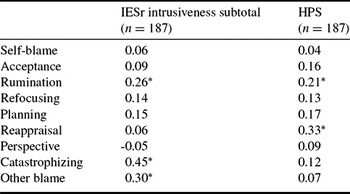
The relationship between the Intrusion subscale of the IESr, the subscales of the cognitive emotion regulation scale and the hypomanic personality scale are shown in Table 1. The significance level was adjusted to p <.006 (0.05/9) for these multiple analyses conducted with the nine subscales of the CERQ.
Partial Pearson correlations between trauma-related intrusive-memories, cognitive emotion regulation and hypomania whilst controlling for age, anxiety and depression

Notes: IESr = Impact of Events Scale revised; HPS = Hypomanic Personality Scale
* p < .006
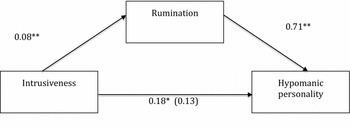
As shown in Table 1, rumination was the only cognitive emotion regulation strategy that was significantly associated with both the Intrusion subscale of the IESr and characteristics of hypomanic personality. Based on these data multiple regression analyses were conducted to assess each component of a proposed mediation model. First, it was found that the Intrusion subscale was positively associated with hypomanic personality (B = 0.18, t = 2.21, p <.05). It was also found that this subscale was positively related to rumination (B = 0.08, t = 3.67, p <.001). Finally, results indicated that the proposed mediator, rumination, was positively associated with hypomanic personality (B = 0.71, t = 2.46, p <.05). Because both a-path and b-path were significant, mediation analyses were tested using the bootstrapping method with bias-corrected confidence estimates. In the present study, the 95% confidence interval of the indirect effects was obtained with 5000 bootstrap resamples (Preacher and Hayes, Reference Preacher and Hayes2008). Results of the mediation analysis confirmed the mediating role of rumination within the relationship between the Intrusion subscale and hypomanic personality (B = 0.05, CI = 0.02 to 0.13). In addition, results indicated that the direct effect of the Intrusion subscale on hypomanic personality became non-significant (B = 0.13, t = 1.52, p = .13) when controlling for rumination, thus suggesting full mediation. Figure 1 displays the results.
Indirect effect of intrusiveness on hypomanic personality through rumination. *p < .05 **p < .01

Discussion
Our study suggests that the association between the symptoms of posttraumatic stress disorder and bipolar disorder is also observed within sub-clinical levels of these phenomena. Whilst intrusive memories of traumatic events were independently related to hypomanic personality, this variable only made a small contribution to the overall variance. Interestingly, hypomanic personality was strongly related to anxiety but not depression, supporting the rationale for interventions specifically targeting anxiety within the treatment of bipolar disorder (Jones et al., Reference Jones, McGrath, Hampshire, Owen, Riste and Roberts2013).
In line with previous results, posttraumatic stress was associated with a number of emotion regulation difficulties (Tull, Barrett, McMillan and Roemer, 2008). It is of interest to note the significant relationship between hypomanic personality traits and reappraisal within the current study. Mansell et al. (Reference Mansell, Morrison, Reid, Lowens and Tai2007) also highlight the role of appraisals of internal states within their model of bipolar disorder. However, we did not observe the widely reported relationship between self-blame and posttraumatic stress (e.g. Ullman, Filipas, Townsend and Starzynski, Reference Ullman, Filipas, Townsend and Starzynski2007), which suggests that this relationship may only develop when individuals present with a diagnostic level of symptomatology.
Rumination was the only cognitive emotion regulation strategy that mediated the relationship between posttraumatic stress and hypomanic personality. Further analyses suggested that the relationship was fully mediated by the role of rumination. Given the nature of the scale used in the current study, rumination was measured in relation to negative emotion only. Whilst previous results have highlighted the role of rumination of positive emotion in bipolar disorder (Johnson et al., Reference Johnson, McKenzie and McMurrich2008; Gruber, Eidelman, Johnson, Smith and Harvey, Reference Gruber, Eidelman, Johnson, Smith and Harvey2011), the current results suggest a link between negative rumination and hypomanic personality that is not dependant on the role of low mood. Also, given that bipolar disorder is associated with intrusive images of both past episodes of low mood (Mansell and Lam, Reference Mansell and Lam2004) and positive images of future events (Holmes et al., Reference Holmes, Deeprose, Fairburn, Wallace-Hadrill, Bonsall and Geddes2011), it may be that rumination exacerbates this process in both directions.
The use of a cross-sectional design has clear limits within the understanding of the direction of the proposed relationships. It should also be acknowledged that the HPS is not a measure of high mood or mania per se, and that this variable was therefore not measured or controlled for in the current study. As the participants did not state the age at which they experienced the traumatic event that is assessed within the IESr, it is possible that hypomanic personality traits predated any posttraumatic symptoms reported in the current study. Also, the current study focused on the exploration of cognitive emotion regulation strategies and further research is required to assess the role of behavioural and other strategies. Further, the use of a non-clinical sample limits the extent to which conclusions can be drawn in relation to diagnostic levels of PTSD and bipolar disorder. However, the current results highlight specific questions to be asked within future longitudinal clinical studies. Specifically, the role of rumination as a potential target in the treatment of co-morbid bipolar and posttraumatic disorder would seem to warrant further investigation.
Acknowledgements
Conflict of interest: The author has no conflicts of interest with respect to this publication.



Comments
No Comments have been published for this article.