Introduction: the concepts of hegemony, imperial overstretch, and hegemonic overreach
The concept of hegemony has come to have several different shades of meaning in several different disciplines. The notion used in this article is Gramscian, conceiving hegemonic power as being based on a subtle fusion of coercion and consent.Footnote 1 Sustained leadership of any political system, particularly a global system of states, requires not only the hard military and economic power to enforce dominance when necessary, but also the ideological, political, and institutional power to persuade others to accept the rules and norms of a system largely designed and operated by the hegemon and its allies. This soft power is what allows a hegemonic system to function across decades without continuous resort to massive violence. The global hegemon is able to represent the world system, which works primarily to the advantage of itself and its allies, as a system of universal norms and practices that benefit all.
Of course, many participants in the system may regard the ideological justifications of the hegemon as mystifications. The absence of open opposition should not be confused with complete consent. Compliance may be obtained by subtle coercion, by aligning the political, economic, and institutional incentives of the system to reward states and leaders who submit and punish those who do not. Consent may be ‘manufactured’ by massive lies, disinformation, and propaganda, consent that might well be revoked if the truth were known.Footnote 2 The appearance of consent may be created by the behaviour of elite regimes that are completely out of touch with the vast majority of their populations. And of course, the hegemon and/or its allies often resort to pure force when persuasion does not produce the required outcome. However, it should not be missed that at least to some degree not only compliance but actual consent is produced, that many of the beliefs and ideas of the system are internalised and sincerely held by many key participants in the global system.
Virtually all theories of hegemony agree that a necessary condition for a state gaining hegemony in the global system is to become the leading economic power. Certain ‘long cycle’ theories focus not only on periods of hegemonic predominance but also on a cycle of breakdown caused by the hegemon's unavoidable tendency toward growing military and political commitments and its slipping economic capability relative to rising challenger states.Footnote 3 Paul Kennedy gave this phenomenon the succinct label of imperial overstretch.Footnote 4
However, this article suggests that because most of the failures of the policies of the current hegemon come from poor choices rather than an inexorable mechanical process, a better metaphor would be hegemonic overreach. It also argues that exactly because the Gramscian notion of hegemony puts such emphasis on the ideological dimension as well as the economic and military aspects of hegemony, theories of hegemonic breakdown should take more seriously ideological factors.
Hegemons have histories. The US in particular is a nation not founded on blood or ancestral ties but on ideas – especially liberal democracy, individualism, and market economics. To become citizens waves of immigrants not only had to learn English but also had to internalise the ideas of America. The experience of the US before it was a world power in founding a new nation on new principles in a new world and then conquering a continent have continued to shape US foreign policy even after the US stepped up to its current global position. One of the central contradictions of US foreign policy for the past century has been between the imperatives of hegemony and the sense of messianic mission developed in America's formative years and enlarged in scope as US power expanded. These two basic elements do not always conflict, yet in certain key crises the American belief in its special mission in the world leads it to make foreign policy choices that ultimately undermine its hegemonic position.
Hegemons have great power – not only economic or military, but also political, institutional, and even ideological. Hegemons are particularly powerful because they can not only exercise force but they can also construct global systems that constrain others to act in ways that benefit the hegemon and those like it. Yet hegemons are not imperial rulers. Their power is based on some degree of consent, however grudging it may be at times.
Still, hegemons do not succeed at all their projects. Hegemons can even fall from their privileged position, as the British did in the early 20th century. This article will present several cases of major policy failure during US hegemony, discuss the contradiction in US foreign policy between hegemonic imperatives and messianic mission, and consider potential trajectories of decline of US hegemony.
I. Hegemonic overreach and US foreign policy: failures and ‘successes’ overreach vs. overstretch as explanation of US foreign policy failures
In the past half century the contradiction between a desire of American policymakers to transform the world in the US image and the limited will and ability to commit resources to carry out this grandiose project have led to several major US policy failures. Scholars have hardly been unaware of the mismatch between the American impulse to reshape the world and US will and capacity.Footnote 5 Perhaps the most influential concept that emerged from the academic literature on hegemonic cycles into policy and popular political discourse was the phrase ‘imperial overstretch’ coined by Paul Kennedy. Imperial overstretch was introduced in the late 1980s in the wake of the US retrenchment after Vietnam, the global recessions of the 1970s and 1980s, the relative decline of the US economy compared to the Japanese and East Asian and even the leading European economies, and the conversion of the US from the leading global creditor into the leading global debtor.Footnote 6 It captured in a simple phrase the perception that the US was a power in decline and offered a concise theory to explain that decline. It fell out of fashion in the 1990s with the collapse of the Soviet Union, the revival of the US economy, the easy victory in the first Iraq War, and overall impression of US hyperpower. However, in the wake of 9/11, the snafu in Iraq and the resistance around the world to Bush administration policies, overstretch or some similar concept seems destined to return to international political discourse to seek to explain the deeper roots of US foreign policy dilemmas.
I suggest that hegemonic overreach is a more apt metaphor. What is the difference which term is applied? Over-stretch, over-reach, they both describe over-action. But overstretch implies an unavoidable, inevitable, mechanical process devoid of human will or choice. Overreach identifies willful human action, like reaching for an apple on a tree in a garden. Overstretch connotes a defective product; overreach invokes bad choices.
Kennedy's theory of overstretch is an expression of the standard view of the cycle of hegemonic breakdown which emphasises the temporal contradiction of the hegemonic state – the rising cost of politico-military commitments vs. the declining economic capabilities relative to rising challenger states. The metaphor of hegemonic overreach supplements this perspective by pointing to an inherent contradiction that is not so much rooted in time, although it works out over time – the mismatch between the finite capabilities of the hegemonic state and the virtually infinite mission of transforming the world into one liberal, democratic paradise. Over time, this broad messianic mandate to ‘save the world’ translates into a series of unmanageable particular interventions that prove beyond the ability of the hegemonic state to sustain.
In the context of the global system and US foreign policy both overstretch and overreach signify a mismatch between capabilities and missions, but they suggest different ways of thinking about why this mismatch occurs, how to avoid future policy failures, what causes the breakdown of hegemonic systems, and the future direction of the current system.
The theory of hegemonic overreach contributes to better understanding of several cases of US foreign policy failure, particularly: 1) the Vietnam War, 2) the current war in Iraq, and 3) the attempt of Woodrow Wilson to impose his vision of reform at the Paris peace conference after the First World War. Two apparent policy triumphs that later bore bitter fruit are also examples of hegemonic overreach – the restoration of the Shah of Iran and the support for the anti-Soviet Islamic militant rebels in Afghanistan – who later evolved into the Taliban. Each of these cases lends credence to the theory of hegemonic overreach as a way of understanding recurrent crises in the global system and endemic flaws in US foreign policy.
Wars and key coup d'etat are especially instructive not only because they show the hegemonic system in crisis mode, but also because they mark a shift from reliance on ideological hegemony to the brute enforcement of dominance – the abandonment of hope for persuasion and consent in favour of pure coercion.Footnote 7 They also reveal the purpose of the relentless Manichean distinction between the absolute goodness of the hegemon and its allies vs. the absolute evil of those who oppose the hegemon – to mobilise citizens to kill or be killed in war. Asking citizens to kill or be killed to maintain US hegemony does not evoke the same passion as asking them to sacrifice to protect freedom, democracy, and Christianity against godless, communist dictatorship or crazed Islamic terrorists who want to destroy your way of life.
Vietnam
One of the most significant policy failures of US hegemony, and one that first gave credence to the possibility that US hegemony was headed toward breakdown was the Vietnam War. Many different reasons have been given for the miscalculation of the US in Vietnam and it is beyond the scope of this article to delve into them all. The more limited purpose here is to compare overreach vs. overstretch as explanations and in particular to consider the importance of ideological-cultural factors as compared to more purely economic or military-strategic factors in the decision to intervene.
Certainly one of the principle reasons for the US invasion of Vietnam was the misinterpretation of the nature of the Vietnamese revolution as primarily part of the world communist conspiracy rather than a national revolution. This is how President Lyndon Johnson characterised the war:
North Viet Nam has attacked the independent nation of South Viet Nam. Its object is total conquest […] Over this war – and all Asia – is […] the deepening shadow of Communist China […] The contest in Viet Nam is part of a wider pattern of aggressive purposes […] Around the globe, from Berlin to Thailand, are people whose well being rests in part on the belief that they can count on us if they are attacked. To leave Viet Nam to its fate would shake the confidence of all these people in the value of an American commitment and in the value of America's word.Footnote 8
Because of its crusade against communism the US saw not only the Vietnamese conflict, but virtually every local anti-colonial rebellion and regional conflict as part of its global struggle with communism. Local and regional forces were either good supporters of the ‘free’ world or agents of the communist dark side. That the forces the US was fighting against could be more nationalist than communist was beyond US policymakers ability to conceive.
US forces may have been stretched thin around the world by this global crusade as was recognised by the Nixon Doctrine which was proclaimed upon retreat from Vietnam. But the reason why the US had so many missions must also be examined carefully. The interests of the West and its corporations stretch far and wide around the world. But few major corporate interests were at stake in Vietnam. The ‘domino theory’ suggested that if Vietnam fell more obvious assets like Indonesia, the Philippines, or even eventually Japan might be at risk. Yet in fact when Vietnam went, the rest of Indochina fell, but no further dominos toppled. So perhaps we should also take seriously the messianic mindset that sought to save the entire world from godless communism as a real ideological and cultural force in driving the US commitment in remote Vietnam. Maybe the real geostrategic lesson of Vietnam is that reach exceeded grasp.
Iraq
The Vietnam War or the current Iraq War were not strictly speaking caused by imperial overstretch. Rather, they were conscious choices of the hegemonic power which could very easily have chosen not to fight in these countries. In both cases the vast majority of US allies cautioned against going to war; in both cases that counsel was not heeded.
No one knows the long-term outcome of the current conflict in Iraq, but the ability of the US to establish a pro-Western government is still in doubt. What is certain is that the invasion triggered a bitter Sunni-Shia civil war with hundreds of thousands of casualties and millions of refugees. Instead of spurring a wave of liberalisation in the Muslim world, the war has also created enemies and lost supporters for the US throughout Muslim and non-Muslim worlds alike.
The US invasion of Iraq is more easily explained by traditional economic and geostrategic factors than the US invasion of Vietnam (or Wilson's master plan for postwar peace). Iraq has huge oil reserves and is strategically located in the region that produces most of the world's oil exports. It is clear that the US and its allies have massive material interests at stake in the Middle East.
Yet the very fact that the US and several of its key allies have differed so sharply on strategy toward Iraq since 9/11 shows that something more than raw material interest drove the US invasion of Iraq. In the first Gulf War under the first President Bush, the US had virtually unanimous support of its major allies and either troops or major financial and logistical support from France, Germany, and Canada as well as Britain, Italy, and Japan. In the current war in Iraq, while the governments of Britain, Italy, and Japan supported the US, France, Germany, and Canada pointedly refused to do so. Popular support in Europe and major allies in Asia has always been low. Several early supporters of the war, such as Italy and Spain, have withdrawn their troops and others are preparing to do so.
When nations that all are heavily reliant on imported oil have such sharply different policies toward the world's leading oil exporting region, one must look at other factors beyond simple dependence on foreign oil. Other material interests could be invoked. France's long standing oil contracts with the Saddam regime have often been used to explain French reluctance to take a hard line, as has the high number of Arabs residing in France compared to the low number of Jews. Yet neither of these factors deterred France from sending troops in the first Gulf War. And neither of these factors was at play in Canada's or Germany's decision not to back the US in the Second War after they did in the First War.
Perhaps we need to look more carefully at the official motivations proffered by the Bush administration. President Bush's 2003 State of the Union address to the American people, before the invasion, played on post-9/11 fears and stressed the issue of WMD. Bush accused Saddam Hussein of potentially having
25,000 liters of anthrax – enough doses to kill several million people
38,000 liters of botulinum toxin – enough to subject millions of people to death
500 tons of sarin, mustard, and VX nerve agent (which) could also kill untold thousands
advanced nuclear weapons development program (and) a design for a nuclear weaponFootnote 9
Bush also claimed
Evidence from intelligence sources, secret communications, and statements by people now in custody reveals that Saddam Hussein aids and protects terrorists, including members of Al-Qaeda. Secretly, and without fingerprints, he could provide one of his hidden weapons to terrorists, or help them develop their own.Footnote 10
One year later, in his 2004 State of the Union speech, after no WMD had been found, Bush's justifications had shifted, and the war was now part of a grander strategy of freedom and democratic peace for the entire Middle East.
[C]ombat forces of the US and other countries enforced the demands of the UN, ended the rule of Saddam Hussein, and the people of Iraq are free.
As long as the Middle East remains a place of tyranny, despair, and anger, it will continue to produce men and movements that threaten the safety of America and our friends. So America is pursuing a forward strategy of freedom in the greater Middle East.
Our aim is a democratic peace, a peace founded upon the dignity and rights of every man and woman. America acts in this cause with friends and allies at our side, yet we understand our special calling: This great republic will lead the cause of freedom.Footnote 11
The very fact that the ideological validations for the war could shift so dramatically in one year shows they cannot be taken at face value, that more base economic and geostrategic interests also lie behind the more noble rationalisations. Yet just because something is not entirely true does not mean it is not believed. Although Washington (and London) may have grossly exaggerated reports of WMD in Iraq, many may still have sincerely believed that Saddam was attempting to regain weapons he in fact once did have, even if they clearly exaggerated the meager empirical evidence that backed their assumptions.
Similarly, just because the US has historically acted more often to crush democratic movements in the Middle East than to promote them, it does not follow that the rhetoric about democratising Iraq was not serious. Neoconservatives, emboldened by the breakdown and assimilation of the former Soviet empire, had articulated this aggressive transformational agenda toward the Middle East before Bush came to office and specifically targeted Saddam Hussein's Iraq.Footnote 12 Neoconservatives might well have simply wished away the real dilemma between establishing a post-Saddam regime that would be pro-American versus a post-Saddam regime that would reflect the true will of the Iraqi people by the typical American exceptionalist assumption that Arab people want to emulate Americans but are simply held back by reactionary governments and religious leaders. In a historically messianic US traumatised by 9/11 but still comforted by post-Cold War triumphalism, the neoconservative project of combating rising terrorism and Islamic fundamentalism by transforming Iraq into an oasis of liberal democracy in the desert of Middle Eastern autocracy sounded a sweet siren's song. Surely the US has neoimperial ambitions in Iraq, but its original ambitions were actually much greater than merely economic or geostrategic. In fact, they were truly revolutionary. They reached far beyond what could reasonably have reasonably been expected to have been achieved.
Wilson's postwar vision
Of the three policy failures cited in this section, the one that most clearly demonstrates the superiority of hegemonic overreach against overstretch is Wilson's failure to achieve his visionary goals in the post-World War I settlement. The theory of overstretch hypothesises that hegemonic power degrades over time, like a physical substance being subjected to repeated stress. If characteristic miscalculations and failures are significant factors early in the hegemonic cycle that weighs heavily against life-cycle theories of decline and overstretch as principle explanations of hegemonic failure.
Policy goals that reach far beyond capabilities available and missionary ideology that drives global transformational goals that cannot be realised can be seen from the very dawning of US hegemony, after the US had played a decisive role in the outcome of the first world war. Woodrow Wilson, the US president and the son of the preacher, struck such a dramatic pose at the Paris Peace Conference as a man on a mission to reform world politics. The story is so well known it does not need retelling here.
Yet Wilson's bold declarations about self-determination of peoples and peaceful settlement of international disputes went essentially unheeded as the leading imperial powers carved up the Ottoman Empire's territories, applied the concept of disarmament only to Germany, and, while creating a League of Nations, did not give it sufficient power to influence the outcome of international conflicts. Wilson's reach so exceeded his grasp that even his own country's Senate rejected the treaty that only marginally reflected his transformational agenda.
It could be argued that Wilson's failure is not quite the same as the failure in Vietnam and the unfolding potential failure in Iraq because the US had not yet the established itself as global hegemon. However, Wilson's postwar plan was clearly designed to create US hegemony. The US had most of the capabilities to step up as the hegemon in the post-World War I world. American hegemonists simply misplayed their hand, first by Wilson's overreaching at the peace conference, then back home by not managing the subsequent Republican opposition to the Treaty of Versailles and mastering the diplomacy necessary to carry out hegemonic strategy. Why did the US succeed in establishing its hegemony after the World War II when it failed after World War I? The standard answer that US power was more overwhelming because the old European powers were so much more thoroughly destroyed and needed help facing the threat of the Soviet Union and international communism has great merit, but it leaves out some nuances that are important for understanding the later development of US hegemony. As the Cold War unfolded, because of its anti-communist, anti-Soviet mission, the US reined in its reformist zeal and took a more realist approach to the European powers and Japan. And because they were under such grave threat, the other major powers were willing to tolerate American messianic enthusiasm, because a savior was precisely what they were seeking.
The early Cold War masked the conflict between the missionary proclivities of US foreign policy and the interests of other capitalist powers that were more apparent when Wilson came to Paris, during the Vietnam War, and after the end of the Cold War.
What price success?
Even prominent US policy ‘successes’ during the Cold War have later proven to be cases of hegemonic overreach because of ‘blowback’, or counterproductive long-term consequences.Footnote 13 In the 1950s a popular revolution in Iran ousted the British-created and US-supported Shah of Iran. The CIA quickly engineered a counterrevolution to bring the Shah back to power.
In 1979 the Shah was ousted again, this time by the Islamic revolution led by the Ayatollah Khomeini, which established the theocracy which was ideological inspiration for rising fundamentalism throughout the Islamic world. The additional quarter of a century of repression by the Shah that US intervention had produced had enraged the Iranian people, liquidated democratic and popular forces that might have channeled that anger in a progressive direction, and thus paved the way for a reactionary fundamentalist revolution. The US had the power to help impose a regime on the Iranian people and help keep it in government for a generation, but it could not control the long-term consequences of its actions. Now the US is facing down a militant Islamic state apparently pursuing nuclear weapons. Once again, US reach exceeded its grasp.
US support for mujahadin in Afghanistan is another example of the US cold warriors helping empower forces that would come back to haunt them. During the Cold War, when the religious fundamentalists were pointing their guns at the pro-Soviet government in Afghanistan, the US counted them as the good guys and was actually providing them with weapons. The fall of the pro-Soviet regime in Afghanistan was a major triumph in US policy, one of the first in the series of shocks that led to the fall of the Soviet empire. However, the swiftness and totality of the collapse of the Soviet system indicates that fall was heavily overdetermined, that it was bound to happen regardless of any particular historical sequence. The fall of the pro-Soviet government in Afghanistan probably sped up the coming of the collapse and the US support for the mujahadin probably helped their cause. But the depth of Muslim hostility to the Soviet system was revealed in the absolute and total flight of all the Muslim republics out of the Soviet Union once Gorbachev lifted political repression. US aid to the mujahadin was almost certainly superfluous to the end of the pro-Soviet regime in Afghanistan and even more so to the overall fall of the Soviet empire.
However, the US aid was perhaps not incidental to the more local issue of who won out in post-Soviet Afghanistan. Certainly the money, weapons, and training provided to fundamentalist militants were substantial to small, irregular groups trying to establish themselves as independent fighting units and make a name for themselves among anti-Soviet forces. The US cannot claim full credit for the collapse of the pro-Soviet government in Afghanistan, yet it cannot escape some of the responsibility for the kind of government that succeeded it. Of course, the Taliban government that was to some degree a creature of US intervention in the 1980s became the symbol of state support for terrorism in 2001. Unlike the war in Iraq, there was a clear link between the Taliban and the militants who attacked the US, and therefore, there was broad international support for the original US-led invasion that overthrew the Taliban. However, just as in Iraq, long-term presence of Western militaries in an Islamic country has come to be perceived more as a foreign occupation than liberation. The implications of US ‘successes’ in Iran in the 1950s and Afghanistan in the 1980s are profound for the situations in Iraq and Afghanistan today. Several years after the invasion of Afghanistan the Taliban still operates in the countryside, US intelligence confirms that Al-Qaeda is stronger than at any time since the invasion, and the neighbouring Pakistani central government is in a weaker position versus Islamic militants. In Iraq, in the long run, US ‘success’ in establishing a partially functioning pro-American regime in Baghdad would probably do more to stimulate the forces of Islamic fundamentalism across the Arab and Muslim world than an early US retreat. Today, a permanent US military presence in Iraq hardly seems likely to herald a rising tide of liberal democratisation in the Muslim world, but US forces certainly have already become a symbol of infidel oppression, and a spur to a new surge of Islamic fundamentalist resistance to Western domination.
II. Messianic mission: a major cause of overreach during US hegemony
Here, this article looks at sources of overreach in the character of hegemony. A case for the importance of overreach during US hegemony has been made. A detailed examination of the causes of hegemonic overreach or the degree to which the concept generalises across hegemonies is beyond the scope of this limited article. However, one crucial factor in the origins of the overreach of US hegemony will be examined further in this section and the potential for breakdown of US hegemony will be addressed in the next.
One place to start looking for the causes of hegemonic overreach is in the dynamics of hegemony itself. A simple tendency toward overreach may be found in a modification of an old phrase: power tempts and great power tempts greatly. Predominant power means great capability to achieve goals. With the capacity to achieve great goals comes the possibility of making big mistakes. Hegemons may simply find it hard to separate what grand goals are feasible and what are illusory. The long cycle theory of hegemonic decline gives a more complex explanation of overreach. Although the hegemon attempts to structure the world system to maximise and even multiply its initial advantages, the world does not stand still. Even hegemons cannot command the tides of history to cease to move. New technologies appear, old technologies diffuse, other economies grow more quickly than the hegemon's, other powers emerge, alliance systems shift, etc. Moreover, new ideologies appear, old ideologies revive, new networks of resistance develop. The favourable constellation of forces that led to the emergence of the hegemon is not likely to be maintained indefinitely into the future. Yet the hegemon, sheltered from full understanding of shifting sands by its own self-confirming systems, may not be fully aware of how much the world has changed. It will have a tendency to intervene to try to hold the world to previously established patterns of relations and behaviour, characteristically overestimating its power relative to rising new forces and powers based on new ideas, technologies, and forms of social organisation.
Furthermore, as the leader of a system that represents itself as the universal global standard, the hegemon is generally inclined to apply its normative matrix to other states and peoples even in situations where it is likely to be resisted. Convinced its ideas are the guide to right reason and its practices ensure the smooth operation of the global system, the hegemon is disposed to bring its will to bear even in cases where its understanding of local conditions is limited and its way of thinking and methods of conflict resolution are alien. The hegemon is often taken as a highly conservative power, bent on preserving the system that puts it at the apex. However, the hegemonic state has always been in somewhat of a conflicted position. It must be conservative in the sense of preserving the system yet it must also be aggressive in extending the scope and depth of the overall system into the non-Western world.
Thus hegemons are likely to become involved to one degree or another in a wide range of issues and conflicts. However, despite pressures toward interventionism, hegemons are capable of exercising judgment. Hegemons must recognise that some domains will always lie outside the hegemonic system. Some conflicts are not worth the squandering of the hegemon's resources. Some issues are too nettlesome and/or just not important enough to the hegemonic system. When intervention is chosen it needs to be measured and proportional.
US messianic mission as a cause of overreach
Yet a hegemon infused with a sense of messianic mission to transform the world has skewed judgment. It is consistently going to make wrong choices – choices on the side of intervention. To understand the causes of overreach during the era of US hegemony it is crucial to look at the contradiction between the demands of hegemony and the ideologies and practices of US foreign policy developed long before the US grasped hegemony. From the founding of the US there has been a kind of messianic mission driving US foreign policy, a sense of almost religious calling, an almost revolutionary zeal to transform a backward world, an assumption that the world should be reshaped in America's image.Footnote 14
Due to its pre-hegemonic formative experiences, the US has always been qualitatively different than the British or any hegemonic predecessor.Footnote 15 It is not American liberalism that is unique. Britain and the Netherlands were liberal hegemons. It is not US expansionism that is unique. Britain and the Netherlands sought to expand the scope of their power. What is qualitatively different about US hegemony is its sense of messianic mission.
From the first attempts of the US to step up as a leading world power at the post-World War I peace conference, the US has sought more aggressively to transform international political and economic systems in its liberal image. The missionary impulse certainly was not unknown in European colonial experience, from the Church's desire to Christianise the natives to France's mission civilisatrice to the British empire's sense of its political and economic institutions as an ideal for colonial emulation. However, few doubt the unique breadth and depth of the US mission to transform the global system.Footnote 16
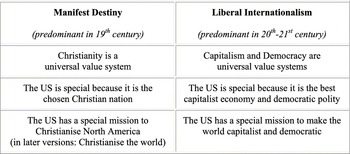
A key source of this difference lies in US historical experience. The origin of the American sense of messianic mission lies in the belief of many of the religious sects that came to the New World for freedom of worship that North America was the promised land of the Bible and that they were God's new chosen people, literally replacing the apostate Jews. The new covenant of God's new chosen people was to spread the salvation of the New Testament throughout the New World. As the new American nation was forged on a ‘new’ continent uncorrupted by the conflicts and oppressions of Europe, the US was portrayed as the new home of liberty and the best hope of mankind. From the very founding of the nation the sacred and secular justifications of America's special role in the world were married. The frame of missionary zeal to save souls and spread the realm of the Savior became fused with a missionary zeal to save the world from oppression and spread the domain of liberal democracy. Conveniently for emerging capitalists and state builders, the ‘empire of liberty’ Jefferson proclaimed soon discovered a ‘manifest destiny’ to conquer the North American continent, with little concern for the liberties of the native peoples or Mexicans who stood in the way or the slaves who suffered in building the new nation.Footnote 17
America's history as a nation built on immigration also played a key role in both creating the American sense of global mission and in socialising new waves of citizens into the ideology of Americanism. People from around the world came to the US and were made over into Americans, leaving the more nationalistic of the American elite with the impression that most of the world wants to become Americans. It is only a slight parody to say that from this point of view, those who have not yet made the passage to America are simply weaker and lack the will compared to their stronger brethren who have already made it.
These immigrants from diverse nations, religions, and cultures were poured into the ‘melting pot’ of American culture and ‘Americanized’ through a systematic process of indoctrination into a civic culture of liberal capitalism, rugged individualism, democracy of white males, nationalist expansionism, and ‘Manifest Destiny’ through public schools and political propaganda in the mass media. It was no accident that the random cacophony of peoples that desperately fled to the North American continent in the 18th and 19th centuries was molded into the unified, purposeful global hegemon of the 20th century. And while it was not part of a master plan, neither is it a random event that the US attitude toward the entire planet in the 20th and 21st centuries is not that different than the American attitude toward North America in the 19th century.
By the time the conquest of the North American continent was completed, the US was the leading industrial power, and the US was ready to step up on the world stage. Visions of an empire of liberty and manifest destiny had been transmuted into a world historical mission to liberalise and democratise, as well as sometimes to Christianise, the whole world. In the 20th century the secular liberal democratic version of mission grew stronger, particularly during the Cold War when the US subordinated somewhat its own ideological tendencies to the requisites of leading a global alliance system. Woodrow Wilson unabashedly expressed his belief in the US as a Savior nation in religious terms rarely seen during the Cold War. However there has been a religious revival going on in the US for a generation and a re-sacralisation of politics beginning in the 1980s and intensifying in the first decade of the 21st century. The openly religious version of the Savior nation has returned to public prominence along with the more secular liberal democratic mission it spawned.
The sacred and secular versions of American messianic mission.

Those who question the power of these beliefs tend to also be those who are baffled by US behaviour in the world or the willingness of the wider population to follow elites into overseas adventures. These are the deep mindsets that drive American overreach in its era of hegemony. And these are the organic ideologies that have been formulated and updated over centuries to induce obedience of citizens and soldiers.
The American transformational mission cannot be fully grasped without understanding US economic and geostrategic interests as the hegemonic state.Footnote 18 But neither can it be truly understood without grasping the messianic impulses that lie deep in American history and culture. The twin pillars of religious doctrine and secular liberalism that lie at the heart of US hegemony, the ‘fusion of Puritan piety and Lockian liberalism’, can be seen in the son of a Christian minister Woodrow Wilson, the first US president to clearly articulate the concepts of US hegemony and whose name is still synonymous with them.Footnote 19 Speaking of the US forces in World War I, Wilson's sense of religious mission shines through:
[The troops] brought with them a great ardor for a supreme cause […] They saw a city not built with hands. They saw a citadel […] where dwelt the oracles of God himself […] There were never crusaders that went to the Holy Land in the old ages […] that were more truly devoted to a holy cause.Footnote 20
And Wilson also clearly saw the US as expression of God's will on earth:
The men who […] frame[d] this government […] set up a standard to which they intended that the nations of the world should rally. They said to the people of the world, ‘Come to us, this is the home of liberty; this is the place where mankind can learn how to govern their own affairs’ […] and the world did come to us.Footnote 21
While over the years it has often been judged wise not to express directly overt religious sentiments in international fora and the ideology itself has become more secularised, the same sense of global mission to transform the world has been consistent for almost a century. And the openly religious version of this missionary idealism is once again in vogue, reflecting changing US political, social, and religious dynamics.Footnote 22 In his second Inaugural Address, often taken as the defining speech of his presidency, George W. Bush, openly expressing long held views, sounds much like Wilson nearly a hundred years ago. Although at one point he explicitly denies seeing the US as the ‘chosen nation’ of God, the rest of the text shows a profound sense of divine mission. President Bush clearly believes that ‘God moves and chooses’ in human history and the direction ‘He’ chooses for ‘all the world’ is American style liberty.
We go forward with complete confidence in the eventual triumph of freedom […] Not because we consider ourselves a chosen nation; God moves and chooses as He wills. We have confidence because freedom is the permanent hope of mankind, the hunger in dark places, the longing of the soul. When our Founders declared a new order of the ages; when soldiers died in wave upon wave for a union based on liberty; when citizens marched in peaceful outrage under the banner ‘Freedom Now’ – they were acting on an ancient hope that is meant to be fulfilled. History has an ebb and flow of justice, but history also has a visible direction, set by liberty and the Author of Liberty.
America, in this young century, proclaims liberty throughout all the world, and to all the inhabitants thereof.Footnote 23
The American impulse to rework the world in its image comes not only from its corporate and political imperatives but also at a deeper level from fundamental cultural, ideological, and even religious beliefs, not only from its calculations of power, but from its sense of its manifest destiny, once taken as a charge to rule over North America, now conceived on even a grander scale to be a mission to literally save the world.
III. Potential sources of hegemonic breakdown and future challenges to hegemony
Despite the belief of some in the US in the divine sanction of US hegemony, hegemons do not stand forever any more than the houses of absolute monarchs of earlier ages who claimed celestial legitimation. Theory of hegemonic cycles focuses on the macro-historical process of the rise and decline of hegemonic powers. However, within any one of the long cycles, there are lesser periods of hegemonic weakening and regeneration. The loss of the Vietnam War followed by the oil shock induced recessions of the 1970s and the early 1980s led some to predict the imminent breakdown of US hegemony. The decisive victory in the first Iraq war and the revival of the US economy in the 1990s led others to talk of a second American century. Both were premature.
Similarly, the short term outcome of the war in Iraq, whether it is the stabilisation of a pro-American regime, the coming to power of a government unfriendly to the US or on-going civil war will almost certainly lead either to new euphoric pronouncements about the 21st century belonging to the US or claims that the end of US hegemony are nigh. Again, either conclusion will most likely be premature. However, the outcome on the main battlefield so far in the Terrorism Wars will indicate much about the future direction of the global system. Hegemonic states and even hegemonic systems do have life spans, however hard it is to gauge them. On the home front, the Iraq War, like the Vietnam War before it, has laid bare one of the key problems of US missionary hegemony – the fervor of elites is not always matched by the willingness of the population to sacrifice. The expansive, messianic conception of the US role in the world predominates in American thinking, but it is not without challenge. The image of the US as a ‘shining city on a hill’ is rarely disputed, but the need for the US to engage in military conflict abroad to spread its principles does come into question when the costs become too high and the benefits are not apparent.Footnote 24 After World War I, the ideology of American mission was not strong enough to overcome the resistance of ordinary citizens at being conscripted to fight in distant conflicts overseas andpolitical elites not yet accommodated to the multilateralism hegemony entails. Thus there was a period of renunciation of hegemonic ambitions.
Certainly since World War II the missionary ideology has held sway among policymaking elites. However, the political unpopularity of the long Vietnam War and the second Iraq War show that the average American citizen does not share the elite's taste for battle overseas if the sacrifice in blood and treasure becomes steep. There is a cycle of hegemonic overreach, political reaction to the costs of failed policies, and then rebuilding of the ideology of messianic intervention. American sense of exceptionalism does not disappear at any time during this process. However, in the reactive part of the cycle the ‘city on the hill’ tends to try to turn inward, wanting more to avoid contamination from the impure world outside than to take on new challenges. But since that conception of America is not adequate to sustain US hegemony, the sense of America's world historic mission must be painstaking rebuilt through political rhetoric, spoon feeding the mass media the right pictures of the world, and infusing civil society with political messianism. Someday either the overreach may be too costly and/or the public resistance may be too great to effectively rebuild the American missionary ideology. But that day does not seem just around the corner.
There is an even larger question than whether the US will remain the hegemonic state within a Western dominated system. How long will the West remain hegemonic in the global system?Footnote 25 Since Spengler the issue of the decline of the West has been debated. It would be hard to question current Western dominance of virtually every global economic, political, military, or ideological system today. In some ways the domination of the West seems even more firm than it was in the past because the West is no longer a group of fiercely competing states but a much more cohesive force. In the era of Western domination, breakdown of the rule of each hegemonic state has come because of competition from powerful rival Western states at the core of the system leading to system-wide war. The unique characteristic of the Cold War and particularly the post-Cold War system is that the core capitalist states are now to a large degree politically united and increasingly economically integrated.
In the 21st century, two factors taking place outside the West seem more of a threat to the reproduction of the hegemony of the American state and the Western system than conflict between Western states: 1) resistance to Western hegemony in the Muslim world and other parts of the subordinated South, and 2) the rise of newly powerful or reformed super states.
Relations between the core and periphery have already undergone one massive transformation in the 20th century – decolonisation. The historical significance of decolonisation was overshadowed somewhat by the emergence of the Cold War and the nuclear age. Recognition of its impact was dampened somewhat by the subsequent relative lack of change of fundamental economic relations between core and periphery.
But one of the historical legacies of decolonisation is that ideological legitimation has become more crucial in operating the global system. The manufacture of some level of consent, particularly among the elite in the periphery, has to some degree replaced brute domination. Less raw force is necessary but in return a greater burden of ideological and cultural legitimation is required. Now it is no longer enough for colonials to obey; willing participants must believe. Therefore, cultural and ideological challenges to the foundations of the liberal capitalist world view assume much greater significance. Thus the resurgence of Islamic fundamentalism, ethnic nationalism, and even social democracy in Latin America as ideologies of opposition have increasing significance in a system dependent on greater levels of willing consent. As Ayoob suggests, the sustained resistance within the Islamic world to Western hegemony may have a ‘demonstration effect’ on other southern states with similar grievances against the West.Footnote 26 The other new dynamic is the re-emergence of great states that at one time or another have been brought low by the Western hegemonic system. China, in recent centuries low on the international division of labour, was in some ways a classic case of a peripheral state, or today a semi-peripheral state. But its sheer size, its rapid growth, its currency reserves, its actual and potential markets, etc. make it a major power and a potential future counter-hegemon. India lags behind China, but has similar aspirations. Russia has fallen from great power to semi-peripheral status since the collapse of the Soviet empire, but its energy resources and the technological skills of its people make recovery of its former greatness possible. No one knows exactly what the resurgence of Asia portends for the future. However, just as half a century ago global decolonisation was a blow to Western domination, so the shift in economic production to Asia will redefine global power relations throughout the 21st century.
Conclusion
Classical theory of hegemonic cycle is useful if not articulated in too rigid a form. Hegemonic systems do not last forever; they do have a life span. The hegemonic state cannot maintain itself as the fastest growing major economy forever and thus eventually will face relative decline against some major power or powers. The hegemon faces recurrent challenges both on the periphery and from other major powers that feel constrained by the hegemon's power or are ambitious to usurp its place. Techniques of the application of military force and ideological control may become more sophisticated over time, but so too do techniques of guerilla warfare and ideological forms of resistance such as religious fundamentalism, nationalism, and politicisation of ethnic identity. World war may not be imminent, but wars on the periphery have become quite deadly, and the threat of the use of nuclear weapons or other WMD by the rising number of powers who possess them looms.
The hegemonic state tends to become overstretched, but more importantly the US, because of its messianic sense of mission, tends to overreach. Some of the burden the hegemon has to assume is inevitable, but the US is particularly prone to massive miscalculation. However, long cycle hegemonic theory may no longer be accurate, at least in the short to mid term, in the prediction of the formation of a relatively coherent counter-hegemonic coalition led by a counter-hegemonic state which will eventually go to war with the hegemon and its bloc. Perhaps in the mid to long term future the Terrorism Wars will be overshadowed by a counter-hegemonic challenge by a coalition of Asian states led by China or some other power. Yet while signs of US and Western decline can be found, along with much resistance to US hegemony, no powerful state has taken a position of consistent opposition to the current global system, much less begun assembling a counter-hegemonic coalition. At this point, the decline of US hegemony, if it occurs in this century, looks more likely to take the form of a death of many cuts rather than the bang of a world war. If so, US hegemony seems more likely to be replaced by multipolarity and regionalisation rather than a new global hegemon.