




No CrossRef data available.
Article contents
Eleven years of malaria surveillance in a Sudanese village highlights unexpected variation in individual disease susceptibility and outbreak severity
Published online by Cambridge University Press: 23 August 2004
Abstract
An analysis is presented of continuous data collected over 11 years based on 1902600 person/days of observation on the malaria experience of the people of Daraweesh, a village in eastern Sudan. Malaria transmission is hypo-endemic: the acquisition of clinical immunity with age is not as obvious as in more holo-endemic areas and malaria remained a problem in all age groups throughout the study. However, this population, who are of Fulani origin, showed a distinctly variable level of disease susceptibility. Thirty-two percent of the village never reported malaria symptoms or required malaria treatment while others experienced up to 8 clinical episodes over the 11 years of observation. Malaria incidence was clearly influenced by drought but much less obviously by rainfall. To what extent outbreak patterns are explicable in terms of anopheline factors, and to human immune factors, remains an interesting question for malaria modelling in this, and in other low transmission zones, such as the burgeoning urban areas of modern Africa.
Information
- Type
- Research Article
- Information
- Copyright
- © 2004 Cambridge University Press
INTRODUCTION
The epidemiology of clinical malaria incidence is classically described as ranging from epidemic in non-immune populations, through hypo- and meso-endemic in populations receiving seasonal or low exposure risk, to hyper- and holo-endemic where the population is under continuously high transmission conditions. These generalizations were originally derived from observations made in the first half of the 20th century in rural populations with little or no access to anti-malarial drugs. In such circumstances maximum prevalence of malaria-positive blood films was reached before the age of 2 years in holo-endemic areas, between 2 and 4 years in hyper-endemic areas and between 5 and 9 years in meso- and hypo-endemic areas (Christophers, 1924; Schwetz, 1949). The decline in malaria prevalence with age was taken to indicate the acquisition of immunity after a delay proportional to the intensity of transmission (Wilson, 1939).
The distribution of both human and vector populations in Africa, is now changing at an unprecedented rate as migration from more endemic rural areas to less endemic urban centres accelerates (El Sayed et al. 2000). Urbanization reduces human--vector contact although vector adaptation to new environments may occur (Trape & Zoulani, 1987a,b). Although low-intensity and variable malaria transmission is an increasing aspect of the malaria problem in Africa, relatively few data on prevalence and susceptibility have been collected from areas with these characteristics. To understand the risks posed by malaria in such areas, long-term, longitudinal observation and reliable information on anti-malarial drug consumption in the population are required.
We have collected data on the prevalence of clinical malaria in Daraweesh village in eastern Sudan, where it has been possible to detect and treat all cases of malaria in the years between 1990 and 2000. The short, wet summer season of the farming villages in the Gedaref plain supports low-level malaria transmission. In Daraweesh an entomological inoculation rate (EIR) of 2 infective bites/year has been estimated based on surveys in drought-free years (Hamad et al. 2002). The extended study presented here confirms the importance of established factors affecting malaria, but also reveals unexpectedly striking patterns of individual variation in malaria susceptibility in this largely Fulani population. The analysis also highlights continuing uncertainty concerning the relative contribution of human and anopheline factors, in determining malaria incidence over the medium-to-long term in areas of low transmission.
MATERIALS AND METHODS
The longitudinal study in Daraweesh
The malaria experience of the residents of Daraweesh was monitored between 1 January 1990 and 31 December 2000, by a village health team composed of doctors, malaria researchers and microscopists visiting from a permanent field station in the nearby town of Gedaref. The health team included a health worker from Daraweesh who lived within his own family compound in the village. All individuals who became ill in Daraweesh received treatment from the health team that visited the village daily during the malaria transmission season (September–November), and 2–3 times per week outside that period. The project protocol and objectives were carefully explained in Arabic to regular village assemblies. Individual informed consent was obtained from all study participants. Participation in activities such as finger-pricking for blood sampling was entirely voluntary for all ages, except babies, where consent was sought from the mother. Ethical permission for the study was granted by the Sudanese Ministry of Health.
The tightly-knit nature of the Islamic society of the people of Daraweesh aided the study considerably. The majority of people in Daraweesh are the descendants of Fulani migrants who reached Sudan from the Volta River region of present-day Burkina Faso around 120 years ago. Although now less commonly used than Sudanese Arabic, Fulani is still widely spoken in Daraweesh. The current village elders, several of them grandsons of the village founder, maintain some contacts with Burkina Faso, and three of them made an extended visit there as young men in the mid-1960s (M. A. Osman, personal communication). Rain-fed sorghum and sesame farming on land cleared of Acacia forest from the 1940's onward is the foundation of the agricultural economy of the village and the surrounding Gedaref plain.
Malaria monitoring and treatment
Parasitological, immunological and entomological aspects of the Daraweesh study have been described in detail in prior publications (El Hassan et al. 1995; Roper et al. 1996; Cavanagh et al. 1998; Giha et al. 1998; Hamad et al. 2000, 2002). During each malaria season, villagers reported any symptoms of malaria to the health team. Patients with signs or symptoms of malaria had thick blood films taken for microscopy. Patients were defined as having clinical malaria if they were either febrile (temperature >37·5 °C), or reported fever, and had slide detectable malaria parasites, evaluated by examining 200 fields under oil immersion on each slide (Roper et al. 1996, 1998; Giha et al. 1998, 2000).
Malaria cases were treated with chloroquine or with pyrimethamine/suphadoxine in the case of chloroquine treatment failures. Chemoprophylaxis was reportedly not used in Daraweesh prior to this study, through custom and on grounds of cost. Given the easy and rapid access to free and reliable diagnosis and treatment, there has been no reason to change this behaviour. Occasional urine surveys showed no evidence of antimalarial consumption in those who had no recorded malaria episodes. Apart from monitoring of clinical malaria each season, several large-scale point prevalence surveys (Cavanagh et al. 1998) and dry season surveys (Hamad et al. 2000), using both microscopical and PCR malaria detection systems, have added to the understanding of the malaria dynamics in the village. As described previously (Hamad et al. 2002), 95% of all slides showing malaria parasites in this area showed only Plasmodium falciparum infection, 3% of slides showed P. vivax, 1% P. malariae and 1% showed mixed infections of P. vivax and P. falciparum.
Data analysis
Data analysis was based on records of all malaria cases from the first quarter of 1990 until the fourth quarter of 2000 – 3653 days of observation of the malaria experience of Daraweesh village. Data were stored in both Microsoft Access and Microsoft Excel formats and processed using Microsoft Excel software and the EpiInfo StatCalc programme. Chi2 test P-values are expressed with the Mantel-Haentzel correction.
Satellite-derived climatic data were downloaded in the form of the Normalised Difference Vegetation Index (NDVI), via the NASA African Dissemination Service using the ARCVIEW software environment. NDVI is calculated from the ratio of visible and infra-red reflectances measured daily by the National Oceanographic and Atmospheric Administration series of polar orbiting weather satellites using the formula NDVI=(near IR−visible)/(near IR+visible).
RESULTS
Demography and epidemiology
The population of Daraweesh in the first quarter of 1990 was 396 and by the last quarter of 2000 had risen to 559, an average annual increase of around 3·8% per annum. Daraweesh has grown largely by virtue of the number of births (164), greatly exceeding the number of deaths (17), in the 11 years of the study. Several families and a few individuals emigrated from the village during this time and 2 families and a few individuals moved back to the village after a period of emigration. The study is thus based on 1902600 person/days of observation on the malaria experience of the people of Daraweesh during the period between 1 January 1990 and 31 December 2000.
A total of 880 episodes of symptomatic malaria were recorded. Seventy-eight of these episodes occurred in individuals who had already had one malaria attack, 3 or more weeks earlier, in that particular season. Chloroquine resistance clearly increased throughout the study, and it is likely that the majority of these second malaria episodes in previously diagnosed and treated individuals were a recrudescence of a chloroquine-resistant infection. This conclusion is supported by a study of bi-monthly PCR genotyping of the P. falciparum parasites present in such chronic infections (Hamad et al. 2000). Recurrent episodes within a season were consequently treated as on-going single infections in the data analysis. A total of 802 individual cases of clinical malaria were therefore recorded in the 11 years. Mortality from malaria was low with only 2 directly malaria-attributable deaths during the study.
The 802 individual clinical infections were diagnosed and treated over 63420 person/months giving an overall 11-year average malaria case rate of 12·6 episodes/1000 person/months. This average, however, conceals large year-by-year variation in clinical disease incidence. Malaria in Daraweesh is seasonal, and more than 95% of cases in each year occurred in the months September to November, following the rains which start in June, peak in August and end by mid-late September (Hamad et al. 2000). October always had the majority of clinical malaria in any year in Daraweesh, as is the case throughout northern and eastern Sudan. In the drought year of 1990 there were 0·2 malaria cases/1000 person months and in 1998 when rain was abundant there were 27·5 malaria cases/1000 person months and more than 30% of the village suffered clinical episodes that year.
Climate and rainfall
Rainfall is recorded at a weather station in Gedaref, 18 km from Daraweesh. However, accurate records were not available for the entire 11-year period of the study. Therefore satellite-derived Normalised Difference Vegetation Index (NDVI), a direct surrogate for rainfall, was downloaded for the site of the village. The Daraweesh NDVI correlated very significantly (P=<0·0001), with the 3 years of accurate rainfall records obtained from the Gedaref station (data not shown), indicating that this surrogate was a reasonable substitution for the true rainfall measurement.
Malaria case incidence in relation to precipitation in Daraweesh between 1990 and 2000 is shown in Fig. 1. Malaria cases typically start to occur in low numbers approximately 10 weeks after the rise in NDVI (which occurs with the arrival of the first rain of the year), and approximately 3–4 weeks after the start of the short but heavy ‘main rains’, when precipitation occurs on most days. Precipitation on the Gedaref plain between January and late May-early June is very rare and usually does not occur at all between January and April. The capacity of drought to break malaria transmission in Daraweesh was particularly obvious in the drought years of 1990 and 1991 when the normal autumnal outbreaks of malaria failed to occur (Fig. 1).

Fig. 1. Malaria cases in relation to the Normalised Difference Vegetative Index (NDVI) in Daraweesh village between January 1990 and December 2000. Cases are expressed per 1000 inhabitants. The NDVI represents a measure of vegetative growth and is a reliable surrogate for rainfall. Both the NDVI and the number of cases per 1000 are expressed per dekad or 10-day period.
Age/sex prevalence
Malaria case prevalence by sex for each age group between 1990 and 2000 is shown in Fig. 2. The data illustrate the year-by-year variation and the fact that the dramatic concentration of malaria in young children observed in areas of higher transmission is not seen in Daraweesh. Relative differences in malaria risk between adults and children under 11 are not marked, although risk is clearly higher in older children and teenagers up until the age of around twenty (Fig. 2). After this age, incidence and risk decline but do not disappear and villagers over 40 years still remained susceptible to clinical infections. There were several years after the drought e.g., 1993 and 1994, when malaria affected the younger age groups more heavily but this pattern did not persist in the following years when the rainfall remained at a similar level.

Fig. 2. The proportion of each age group, differentiated by sex, that suffered clinical malaria in Daraweesh in each season over the 11 years of observation illustrating the wide variation between years. Data are not presented for the drought year 1990 because only one 16-year-old boy had clinical malaria in Daraweesh that year.
Figure 3 aggregates the age and prevalence data over 11 years and compares clinical malaria experience of males and females. Very low infection rates are observed in the under 1 year age group. In the toddler and young child groups, boys appeared to be slightly more at risk than girls and this trend continued into the teenage and adult groups, with the exception of the ages between 20 and 40, where risk to women from malaria equalled or was slightly higher than that of males (Fig. 3).

Fig. 3. Malaria incidence in Daraweesh by age and sex, from the beginning of 1990 till the end of 2000. This average annual figure demonstrates the major year to year variation in incidence, ranging from 1 case in 1990 to 180 cases in 1998.
Longitudinal infection patterns
Figure 4 illustrates the clinical data from that subset of the population (378 individuals), who were present and monitored throughout the entire 11-year study. The data for this cohort are categorized as those who experienced 0, 1–2, and 3 or more malaria episodes during this period. Those with the most frequent infections were within the 6–30 year age group at the start of the study. However, 6% of males in the over 40 age group (i.e. aged 41–50 at the start of the project), still suffered 4 or more infections during the subsequent 11 years, illustrating a marked continuing susceptibility of some mature adults.

Fig. 4. Frequency of clinical malaria episodes among a cohort of 378 individuals living continuously in Daraweesh from 1990 to 2000. The age groups refer to the age of an individual at the start of the study in 1990. Given the low E.I.R., short transmission season and presence of chloroquine resistance, the number of years in which a clinical infection was experienced is taken as a surrogate for the actual number of clinical infections due to genetically distinct inoculations.
A third of the individuals (32%) in the village never experienced a clinical malaria episode over the 11 years studied. Within this category there were representatives from every age group (Fig. 4). Approximately 25% of those who were under 1 year of age in 1990 were clinically malaria-free for the next 11 years. There was a steady rise in this ‘clinically disease-free’ proportion through the age groups with around 70% of the oldest members of the community not experiencing any recorded clinical malaria. By contrast some individuals in the village were much more prone to malaria and experienced up to 8 episodes each over the 11 years.
Further analysis of this subset of 378 individuals present throughout the entire 11 years of study showed that they suffered 641 malaria infections giving a mean overall infection rate of 1·7 per person. If it is assumed that these infections occur randomly in the population (a situation broadly true in Daraweesh where there is little age-dependent immunity – see Figs 2 and 3), the number of individuals expected to be free of infection for this period (using the formula E−mean×total population) would be 69. The actual number of individuals who never experienced clinical malaria was 120. The difference between the observed and expected numbers of individuals with no infections for the 11 years was found to be significant to P=<0·001. This is a conservative estimate of likelihood, since the mean infection rate is calculated including the 120 malaria-free individuals.
To test how much the older individuals (50 and over), who are least likely to experience malaria, might have contributed to this significance, the analysis was then repeated excluding this age group. In this case the mean number of infections rose to 1·8, the number expected to be malaria-free for 11 years was 58 and the actual number was 103, a difference still highly significant (P=>0·001).
Malaria and pregnancy in Daraweesh village
Over the 11-year period 60 women became pregnant, experiencing between 1 and 5 pregnancies each, resulting in a total of 162 successful pregnancies. Thirty-three of these women (55%) had episodes of clinical malaria during the 11 years. These 33 women accounted for 91 pregnancies but only 16 (27%) women had malaria while pregnant. Four of the women had malaria in more than one pregnancy so that a total of 20 cases of pregnancy-associated malaria (PAM) were recorded during the study.
Thirty-four of the 60 child-bearing women in the village experienced their first pregnancy during the study period. Only one of these 34 women experienced the classic pregnancy-associated malaria syndrome during her first pregnancy, illustrating that, in Daraweesh, primigravidae were not at greater risk from malaria than secundigravidae or multigravidae. The other 19 PAM cases occurred in a second or later pregnancy, 2 cases occurring in fourth pregnancies. Overall, women during pregnancy were no more at risk of clinical malaria during their pregnancy than when they were not pregnant. Neither were those women experiencing one or more pregnancies during the 11 years at greater risk than age-matched controls who had not been pregnant.
Genetic resistance to malaria: sickle cell trait
Sixty-four individuals (30 male, 34 female) in the village carried the sickle cell trait in the homozygous form (HbAs), and 44 (16 male, 28 female) were monitored for the entire 11 years. The total number of infections in this group was therefore small. Nevertheless, bearing in mind this small sample size, in any one year individuals with HbAS phenotype experienced significantly less malaria than their peers without the trait (P=<0·01), confirming the results described previously (Giha et al. 2000) (see also Fig. 5). Most of the episodes experienced by those with the HbAS allele occurred when they were teenagers and young adults, and there was some indication that the young (10 years and under), were particularly protected relative to their peers lacking the trait. Ten of the HbAS females experienced 1 or more pregnancies over the 11 years. Four of these women experienced malaria episodes and 1 experienced malaria during pregnancy.

Fig. 5. Percentage of individuals carrying the sickle cell trait (HbAS) experiencing malaria by sex and age group relative to individuals without the trait. This graph relates to the group of individuals who were present for the entire 11-year study period between 1990 and 2000.
DISCUSSION
The Daraweesh study is the most extensive study of malaria immuno-epidemiology under conditions of variable and low-level transmission undertaken in Sudan and possibly in Africa. In Daraweesh, the well-known risk factors affecting the dynamics of malaria – age and sickle cell trait – are evident but not dramatic. With close clinical monitoring and rapid diagnosis and treatment, mortality from the disease was kept to a very low level.
Over the 11 years, malaria affected over two-thirds of the village. More surprisingly, it did not occur at all in one third of the village and these markedly different levels of individual susceptibility to malaria did not appear to correlate with any of the parameters measured in the study. As we have previously noted (Giha et al. 2000), such age-specific immunity to malaria as exists in Daraweesh manifests itself as only a slight reduction of malaria risk starting in young adulthood. It is therefore unlikely that age-acquired immunity alone could explain why 32% of Daraweesh showed long-term insusceptibility to malaria, nor does this trait simply coincide with known genetic resistance factors such as the sickling allele of the α haemoglobin gene. In considering alternative explanations we note a remarkably coincidental set of observations.
Malariological studies among the sympatric ethnic groups of Mossi, Rimaibe and Fulani peoples in parts of the West African state of Burkina Faso, have found that the Fulani had lower susceptibility and higher immune responses to P. falciparum than the other groups. Slides consistently negative for P. falciparum in 5 surveys over 14 months were found in 36% of the Fulani older than 10 years, but in only 1% of those from the Mossi and Rimaibe groups (Modiano et al. 1996, 1999, 2001). Daraweesh is a village founded by the Fulani grandfather of many of the current village elders who migrated to Sudan from the Volta River region of present-day Burkina Faso in the 1880's. This raises the possibility that a similar relative resistance to malaria observed among the Fulani of Burkina Faso, may be occurring in Daraweesh. In Daraweesh, variation in malaria susceptibility is observed between individuals within one largely Fulani village (who are usually related), rather than between members of sympatric, but separate ethnic groups. Whether the Burkinabe Fulani exhibit any intra-group variation in susceptibility is not clear from published accounts. The West African studies indicate that the trait is not related to any known protective allele and Fulani-type malaria resistance is the result of unknown factors, possibly involved in regulation of humoral immune responses (Modiano et al. 2001). The frequency of HbAS genotypes in Daraweesh is around half that found in the Burkina Faso Fulani group studied, suggesting that genetic contributions from non-Fulani groups have occurred in Daraweesh. Local out-marriage is known to occur, although there is also inter-marriage with Sudanese Fulani groups living in other areas of Sudan. Our findings nevertheless may constitute an independent corroboration of the reports of significant levels of malaria resistance in the Fulani ethnic group (Modiano et al. 1996). Segregation of a Burkina Faso-derived ‘Fulani’ protective gene(s) in Daraweesh may account for a proportion of the variation in malaria susceptibility we observe. Until this long-term study revealed the interesting variation in susceptibility, genealogies of the 54 Daraweesh families, particularly among households with more than one wife, had not been studied in great detail. These data are now being collected and it is hoped that genetic segregation analysis may be able to test this hypothesis.
A second feature of the longitudinal data is of specific interest to the malariology of the Sudan. Although transmission in Daraweesh was broken by drought, the number of malaria cases in any given non-drought year varied widely and rose and fell around peaks in 1994 and 1998. Periodicity in the incidence of malaria epidemics and peaks and troughs in incidence have been reported from several regions of the world, particularly where malaria is seasonal and unstable. In the Punjab for example, an approximately 10-year cycle of major epidemics of P. falciparum malaria was noted by Christophers (Christophers, 1911), and a 20 to 25-year cycle was noted by Swellengrebel in the incidence of P. vivax malaria epidemics in North Holland (Swellengrebel, 1950). These malariologists interpreted possible cycles in epidemic severity as resulting from the interplay between snopheline density, influenced by rainfall, and a ‘human factor’ proposed to be a form of long-term immunity. Each epidemic peak left survivors partially immune, but this protection gradually wore off, leaving the population susceptible to a greater or lesser degree to recurring epidemics, depending on when vectors again found favourable conditions and plentiful infected hosts.
The Daraweesh data are not extensive enough to demonstrate the existence of any long-term cyclic pattern to Sudanese malaria outbreaks or epidemics. This would require longitudinal surveillance at many more sites over many more years. Nonetheless, Sudanese malaria epidemiology is puzzling. Why does the severity of seasonal malaria outbreaks vary between years in which there is no drought and little difference in rainfall? Can it be explained by local anopheline factors or does the long-term waxing and waning of total population immunity, as proposed by Christophers (1924) and Swellengrebel (1950), play a significant part? Seeking to resolve these questions may provide useful predictive models for the seasonal malaria outbreaks in this huge area of Sudan and in similar low transmission situations that, in turn, may allow increasingly effective targeting of malaria control.
The Daraweesh study provides 11 years of experience of the application of an early malaria treatment programme to an area of variable low transmission. The small size of the village and the close co-operation of its inhabitants meant that every case of clinical malaria diagnosed was treated promptly and appropriately during this time. However this type of intervention did not appear to show any strong suppressive effect on malaria incidence over this period. There was clearly development of some resistance to chloroquine over the 11 years, and many patients were not completely cleared of their parasites, despite a negative blood smear (Hamad et al. 2000). Rapid and clinically effective, but not transmission-breaking treatment of cases thus failed to reduce malaria incidence in this area of low transmission. Treatment of asymptomatic gametocyte carriers before the rainy season, as a pre-emptive outbreak-suppressing control measure, has been considered but not yet attempted in Sudan (Hamad et al. 2002). Mass treatment and good patient compliance with drugs that are both schizonticides and gametocytocides, could be an effective control measure in this epidemiological setting. Vaccination, even with imperfect vaccines that induced only short-term immunity to challenge, might also be capable of closing the very short window of opportunity for transmission that exists in northern and eastern Sudan.
In the past it has been observed that malaria field research projects tend to dissolve into a ‘thousand local epidemiological puzzles’ (Hackett, 1937). However, solving local epidemiological puzzles using detailed analytical methods and closely monitored interventions remains a primary source of new insights into improved strategies for malaria control.
The sustained and generous co-operation of the people of Daraweesh, the Malaria Administration of the Sudanese Ministry of Health and the Gedaref Malaria Team are all gratefully acknowledged. During the course of the 11 years a large number of individuals, too numerous to mention individually, have been involved in various research aspects of the Daraweesh study. Many, but not all, are mentioned in the previous papers arising from the work in this village. All of these people are again acknowledged here. We would also like to thank Dr David Baird for downloading satellite-derived climate data, and Drs Margaret McKinnon and Andrea Graham for statistical advice. The work received funding from the INCO-DC Programme of the European Union (IC18 CT97-0238 and from the UNDP/World Bank/WHO TDR Project 960448. D.E.A. was supported by a Senior Fellowship of the Wellcome Trust, who also provided funding for the project. T.G.T. and the Copenhagen University team were supported by the Danish International Development Agency (DANIDA).
References
REFERENCES
CAVANAGH, D. R.,
ELHASSAN, I. M.,
ROPER, C.,
ROBINSON, V. J.,
GIHA, H.,
HOLDER, A. A.,
HVIID, L.,
THEANDER, T. G.,
ARNOT, D. E. &
McBRIDE, J. S.
(
1998).
A longitudinal study of type-specific antibody responses to Plasmodium falciparum merozoite surface protein-1 in an area of unstable malaria in Sudan.
Journal of Immunology
161, 347–359.Google Scholar
CHRISTOPHERS, S. R.
(
1911).
Malaria in the Pujnab.
Scientific Memoirs of Officers of the Medical and Sanitary Department, Government of India, No. 46, 1–122.
Government of India Printers,
Calcutta.
CHRISTOPHERS, S. R.
(
1924).
The mechanisms of immunity against malaria in communities living under hyper-endemic conditions.
Indian Journal of Medical Research
12, 273–294.Google Scholar
ELHASSAN, I. M.,
HVIID, L.,
JAKOBSEN, P. H.,
GIHA, H.,
SATTI, G. M.,
ARNOT, D. E.,
JENSEN, J. B. &
THEANDER, T. G.
(
1995).
High proportion of subclinical Plasmodium falciparum infections in an area of seasonal and unstable malaria in Sudan.
American Journal of Tropical Medicine and Hygiene
53, 78–83.CrossRefGoogle Scholar
EL SAYED, B. B.,
ARNOT, D. E.,
MUKHTAR, M. M.,
BARAKA, O. Z.,
DAFALLA, A. A.,
ELNAIEM, D. E. &
NUGUD, A. H.
(
2000).
A study of the urban malaria transmission problem in Khartoum.
Acta Tropica
75, 163–171.CrossRefGoogle Scholar
GIHA, H.,
ROSTHOJ, S.,
DODOO, D.,
HVIID, L.,
SATTI, G. M.,
SCHEIKE, T.,
ARNOT, D. E. &
THEANDER, T. G.
(
2000).
The epidemiology of febrile malaria episodes in an area of unstable and seasonal transmission.
Transactions of the Royal Society of Tropical Medicine and Hygiene
94, 645–651.CrossRefGoogle Scholar
GIHA, H. A.,
THEANDER, T. G.,
STAALSOE, T.,
ROPER, C.,
ELHASSAN, I. M.,
BABIKER, H. A.,
SATTI, G. M.,
ARNOT, D. E. &
HVIID, L.
(
1998).
Seasonal variation in agglutination of Plasmodium falciparum-infected erythrocytes.
American Journal of Tropical Medicine and Hygiene
58, 399–405.CrossRefGoogle Scholar
HACKETT, L. W.
(
1937).
Malaria in Europe.
Oxford Press,
London.
HAMAD, A. A.,
ELHASSAN, I. M.,
EL KHALIFA, A. A.,
AHMED, G. I.,
ABDELRAHMIN, S. A.,
THEANDER, T. G. &
ARNOT, D. E.
(
2000).
Chronic Plasmodium falciparum infections in an area of low intensity malaria transmission in the Sudan.
Parasitology
120, 447–456.CrossRefGoogle Scholar
HAMAD, A. A.,
NUGUD, A. H.,
ARNOT, D. E.,
GIHA, H. A.,
ABDEL-MUHSIN, A. M.,
SATTI, G. M.,
THEANDER, T. G.,
CREASEY, A. M.,
BABIKER, H. A. &
ELNAIEM, D. E.
(
2002).
A marked seasonality of malaria transmission in two rural sites in eastern Sudan.
Acta Tropica
83, 71–82.CrossRefGoogle Scholar
MODIANO, D.,
PETRARCA, V.,
SIRIMA, B. S.,
NEBIE, I.,
DIALLO, D.,
ESPOSITO, F. &
COLUZZI, M.
(
1996).
Different response to Plasmodium falciparum malaria in west African sympatric ethnic groups.
Proceedings of the National Academy of Sciences, USA
93, 13206–13211.CrossRefGoogle Scholar
MODIANO, D.,
PETRARCA, V.,
SIRIMA, B. S.,
LUONI, G.,
NEBIE, I.,
DIALLO, D.,
ESPOSITO, F. &
COLUZZI, M.
(
1999).
Different response to Plasmodium falciparum in West African sympatric ethnic groups: possible implications for malaria control strategies.
Parassitologia
41, 193–197.Google Scholar
MODIANO, D.,
LUONI, G.,
SIRIMA, B. S.,
LANFRANCOTTI, A.,
PETRACA, V.,
CRUCIANI, F.,
SIMPORE, J.,
CIMINELLI, B. M.,
FOGLIETTA, E.,
GRSANTI, P.,
BIANCO, I.,
MODIANO, G. &
COLUZZI, M.
(
2001).
The lower susceptibility to Plasmodium falciparum malaria of Fulani of Burkina Faso (West Africa) is associated with low frequencies of classic malaria-resistance genes.
Transactions of the Royal Society of Tropical Medicine and Hygiene
95, 149–152.CrossRefGoogle Scholar
ROPER, C.,
ELHASSAN, I. M.,
HVIID, L.,
GIHA, H.,
RICHARDSON, W.,
BABIKER, H.,
SATTI, G. M.,
THEANDER, T. G. &
ARNOT, D. E.
(
1996).
Detection of very low level Plasmodium falciparum infections using the nested polymerase chain reaction and a reassessment of the epidemiology of unstable malaria in Sudan.
American Journal of Tropical Medicine and Hygiene
54, 325–331.CrossRefGoogle Scholar
ROPER, C.,
RICHARDSON, W.,
ELHASSAN, I. M.,
GIHA, H.,
HVIID, L.,
SATTI, G. M.,
THEANDER, T. G. &
ARNOT, D. E.
(
1998).
Seasonal changes in the Plasmodium falciparum population in individuals and their relationship to clinical malaria: a longitudinal study in a Sudanese village.
Parasitology
116, 501–510.CrossRefGoogle Scholar
SCHWETZ, J.
(
1949).
Notes on endemic and acute malaria in Central African natives.
Transactions of the Royal Society of Tropical Medicine and Hygiene
42, 403–410.CrossRefGoogle Scholar
SWELLENGREBEL, N. H.
(
1950).
The malaria epidemic of 1943–1946 in the province of North-Holland.
Transactions of the Royal Society of Tropical Medicine and Hygiene
43, 445–476.CrossRefGoogle Scholar
TRAPE, J-F. &
ZOULANI, A.
(
1987 a).
Malaria and urbanization in central Africa: the example of Brazzaville. Part II: results of entomological surveys and epidemiological analysis.
Transactions of the Royal Society of Tropical Medicine and Hygiene
81 (Suppl. 2), 10–18.Google Scholar
TRAPE, J-F. &
ZOULANI, A.
(
1987 b).
Malaria and urbanization in central Africa: the example of Brazzaville. Part III: relationships between urbanization and the intensity of malaria transmission.
Transactions of the Royal Society of Tropical Medicine and Hygiene
81 (Suppl. 2), 19–25.Google Scholar
WILSON, D. B.
(
1939).
Implications of malarial endemicity in East Africa.
Transactions of the Royal Society of Tropical Medicine and Hygiene
32, 435–446.CrossRefGoogle Scholar

Fig. 1. Malaria cases in relation to the Normalised Difference Vegetative Index (NDVI) in Daraweesh village between January 1990 and December 2000. Cases are expressed per 1000 inhabitants. The NDVI represents a measure of vegetative growth and is a reliable surrogate for rainfall. Both the NDVI and the number of cases per 1000 are expressed per dekad or 10-day period.
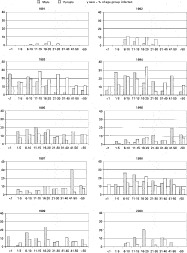
Fig. 2. The proportion of each age group, differentiated by sex, that suffered clinical malaria in Daraweesh in each season over the 11 years of observation illustrating the wide variation between years. Data are not presented for the drought year 1990 because only one 16-year-old boy had clinical malaria in Daraweesh that year.
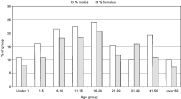
Fig. 3. Malaria incidence in Daraweesh by age and sex, from the beginning of 1990 till the end of 2000. This average annual figure demonstrates the major year to year variation in incidence, ranging from 1 case in 1990 to 180 cases in 1998.
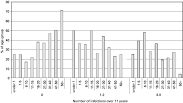
Fig. 4. Frequency of clinical malaria episodes among a cohort of 378 individuals living continuously in Daraweesh from 1990 to 2000. The age groups refer to the age of an individual at the start of the study in 1990. Given the low E.I.R., short transmission season and presence of chloroquine resistance, the number of years in which a clinical infection was experienced is taken as a surrogate for the actual number of clinical infections due to genetically distinct inoculations.
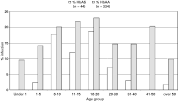
Fig. 5. Percentage of individuals carrying the sickle cell trait (HbAS) experiencing malaria by sex and age group relative to individuals without the trait. This graph relates to the group of individuals who were present for the entire 11-year study period between 1990 and 2000.
 You have
Access
- 38
- Cited by