Introduction
The number of people surviving until old age has been increasing in Malaysia, resulting in an increase in the susceptibility to diseases that commonly afflict the elderly including dementia (Arokiasamy, Reference Arokiasamy1999). According to the report on dementia occurrence in Malaysia, the prevalence of cases reported in the year 2005 was 63.0 cases per 100,000 of population and projected to increase to 126.8 cases per 100,000 of population per year in 2020 (Access Economics, 2006). Factors such as older age, being female, having no formal education, being single, being bumiputera (indigenous ethnic group of Sabah and Sarawak) and living in rural areas has been associated with a higher prevalence of dementia (Hamid et al., Reference Hamid, Krishnaswamy, Abdullah and Momtaz2011).
Acknowledging that there is no cure for people with dementia at the moment, focus has been given to the care management of PWCI especially in relation to QoL. The concept of QoL varies among individuals, especially those from different age group, illness, countries or cultures. In view of the meaning of QoL among PWCI, it is proposed that affect, attachment, social contact, enjoyment of activities, sense of aesthetics in living environment, physical and mental health, and satisfaction with financial situation are important factors in assessing QoL in patient with dementia (Brod et al., Reference Brod, Stewart, Sands and Walton1999; Logsdon and Albert, Reference Logsdon and Albert1999).
Regarding these factors, studies reported that health status/satisfaction was found to be the strongest predictor of QoL in older adults, along with other factors such as number of chronic illnesses, meaning in life, having enough money and exercise (Paskulin and Molzahn, Reference Paskulin and Molzahn2007). In another study, Arlt and colleagues reported there was a significant correlation between QoL and depression as reported by dementia patients, their caregivers and clinicians (Arlt et al., Reference Arlt, Hornung, Eichenlaub, Jahn, Bullinger and Petersen2008). As for social factor, a replication QoL study using a random sample of 202 older adults found that emotional support and a healthy environment enhanced the meaning and purpose in life (Low and Molzahn, Reference Low and Molzahn2007).
With regards to living arrangement, previous studies suggested that PWCI who lived in nursing homes experienced poor QoL. This evidence appears to be based on a mix of cross-sectional and longitudinal observation studies, with a few intervention trials, mainly conducted in Western societies (Missotten et al., Reference Missotten2009; te Boekhorst et al., Reference te Boekhorst, Depla, De Lange, Pot and Eefsting2009; Crespo et al., Reference Crespo, Bernaldo De Quiros, Gomez and Hornillos2012). However, it is not known if the QoL of PWCI in the nursing homes is poorer compared to those living in the community. Studies which directly compare the QoL of PWCI in these two settings are very limited and provide inconclusive evidence (Selwood et al., Reference Selwood, Thorgrimsen and Orrell2005; Missotten et al., Reference Missotten2009; Leon-Salas, Reference Leon-Salas2013).
Furthermore, individuals’ studies from other countries suggest that the experience of QoL in PWCI varies among nations and cultures, thus leading to the justification for having a new study in Malaysia (Huang et al., Reference Huang, Chang, Tang, Chiu and Weng2009; Wolak et al., Reference Wolak2009). The rationale for this study may be to provide the best available knowledge to date in this field and to inform public policy, service administration, and care delivery.
Methods
Study design and procedures
This is a cross-sectional comparative observational study of PWCI receiving informal care (cared by family members) and formal care (nursing home). Participants were sampled from two different settings: nursing homes (PWCI residing in government nursing homes) and home care (PWCI who live with a carer and visit memory clinics in government hospitals as outpatients).
Government nursing homes in Malaysia were built based on a mixture of a home-like environment and hospital model. It is a secured facility and fully funded by the government. Application for admission to government nursing homes should meet the pre-requisite criteria such as aged 60 years and older, cannot be cared for in the community, homeless, has been identified as needing nursing home level care, having poor financial support and consent from the patients. Approval to conduct the study for participants from nursing home was obtained from the Social Welfare Department of Malaysia, the Economic Plan Unit of Malaysia and the Ministry of Women, Family and Community Development of Malaysia (three agencies).
As for participants from memory clinics, referral to memory clinics was made by the primary care physicians or specialists following the recommendation by the Australia Practice Guideline 2003 and the Royal College of Psychiatrist 2005. Approval to conduct the study for participants in memory clinics was obtained from the Directors of hospitals and the Ministry of Health (four agencies). As for ethics, approval was sought and granted from the Human Research Ethics Committee of The University of Melbourne, Victoria, Australia, the Malaysia Research Ethics Committee and the National Institute of Health, Malaysia (three lots of ethics approval).
Potential participants were identified from the list provided by the managers of the nursing homes and the nurses from the memory clinics, which started at the top with the patient who had been seen most recently in the memory clinic or moved most recently into the nursing home. Participants (aged between 60–89 years old) were contacted following the sequence from the list until the requisite sample size was reached. The nature and purpose of the study were explained to both the relatives and the participants before getting their consent. Following consent, participants were then assessed using the SMMSE and those with a SMMSE score of less than 11 (Braekhus et al., Reference Braekhus, Laake and Engedal1992) were included in the study and proceeded with the interview. The interview covered a set of questionnaires consisting of the socio-demographic information, the BI (Mahoney and Barthel, Reference Mahoney and Barthel1965), the EUROHIS-QOL (WHO-8) (Power, Reference Power, Nosikov and Gudex2003), the FS (Hawthorne, Reference Hawthorne2006) and the GDS (Yesavage et al., Reference Yesavage1983).
These questionnaires were chosen following a thorough review conducted by the main author (A. Nikmat) prior to this study. Questionnaires were translated into Malay language using forward and backwards translation and reconciliation done by the National Translation Institute of Malaysia prior to administration. The duration of the interview was between 30 to 45 minutes. To minimize participant fatigue, participants were offered a break during the interviews. The administration of scales was terminated when a participant proved to be unwilling or unable to respond to the questions that were asked.
Respondents and sample size
Participants were recruited from government nursing homes and government memory clinics. Of nine nursing homes in West Malaysia, four were selected and agreed to participate in this study; Rumah Sri Kenangan Seremban, Rumah Sri Kenangan Melaka, Rumah Sri Kenangan Ulu Kinta and Rumah Sri Kenangan Kelantan. As for government hospitals, 3 out of 12 memory clinics were approached and agreed to participate in this study. The three memory clinics were; Hospital Sungai Buloh, Hospital Selayang and Hospital Kuala Lumpur. These facilities were chosen based on geographical factors and accessibility. Inclusion criteria for the study are for participants to:
-
1. Be aged between 60–89 years old.
-
2. Living in a government nursing home or in the community with a carer (any carer) and receiving treatment from a memory clinic (government hospitals).
-
3. Sufficient command of the Malay or English language (able to complete a questionnaire or interview).
-
4. Score of less than 11 on the SMMSE.
-
5. Be able to provide informed consent.
A total of 720 cases (nursing homes cases = 264, memory clinics cases = 456) were reviewed from patient’s/resident's lists. Out of 720 cases reviewed, 315 older adults (nursing homes cases, n = 149, memory clinics cases, n = 166) met the age criteria and were approached to participate in the study. In all, 295 older adults gave their verbal consent but only 271 provided a signed consent form. Out of 271 older adults, 266 were screened for presence of cognitive impairment. The remaining five were not screened due to the presence of psychotic symptoms during the interview (2), communication problem (1), being bed ridden (1) and defaulted appointment (1).
Measures
Demographic data
Socio-demographic questions included age, gender, ethnicity, relationship status, education attained, living arrangement, length of stay in nursing home, number of children, relationship satisfaction with children, financial situation, self-reported health conditions, and length of suffering from cognitive impairment.
Short Mini Mental State Examination (SMMSE)
The SMMSE (Braekhus et al., Reference Braekhus, Laake and Engedal1992) is a brief cognitive screening tool derived from the original Mini-Mental State Examination (Folstein et al., Reference Folstein, Folstein and Mchugh1975). It consists of 12 items namely year, month, date, day, country, postal code, spell backwards, recall, repeat sentence, three stage command, write a sentence and copy design. Each of these items was scored binomially which gave a total score of 12. Giving a sensitivity of 98% and specificity of 91%, a cut-off score of ten was used to differentiate those with cognitive impairment (Braekhus et al., Reference Braekhus, Laake and Engedal1992). Classification of cognitive impairment was defined based on the SMMSE score as; 1) mild to moderate cognitive impairment (a score between 5–10) and 2) moderate to severe cognitive impairment (a score ranging from 0 to 4). The Cronbach's α value for the SMMSE was 0.70.
EUROPE Health Interview Survey-QoL (WHO-8)
The WHO-8 is a short HRQoL measure that was derived from the original WHOQOL-100 and the WHOQOL-BREF (Power, Reference Power, Nosikov and Gudex2003; Schmidt et al., Reference Schmidt, Muhlan and Power2006). It consists of eight items, two from each of the psychological, physical, social and environmental domains of the WHOQOL-BREF (Power, Reference Power, Nosikov and Gudex2003). Each item is rated using a five-point response format, ranging from “0 = not at all/very poor” to “5 = completely/very good.” The overall HRQoL score is computed by summing all eight items, with higher scores indicating better HRQoL (Power, Reference Power, Nosikov and Gudex2003). The scale showed a good internal consistency with a Cronbach's α value of 0.81.
The Geriatric Depression Scale (GDS-15)
The GDS (Yesavage et al., Reference Yesavage1983) is a self-rating scale developed to screen depression in elderly population. The original version of GDS consists of 30 items (GDS-30), while a short version of the GDS contains 15 items (GDS-15). These items seek information representing lowered affect, decreased activity levels, irritability, withdrawal, distressing thoughts, and negative judgments about the past, present and future (Yesavage et al., Reference Yesavage1983). It is presented in a yes/no response format with one point is assigned to each answer. Items were summed and higher scores indicate higher depression level. The Cronbach's α value for the GDS-15 was 0.89.
Barthel Index (BI)
The BI (Mahoney and Barthel, Reference Mahoney and Barthel1965) consists of ten items; feeding, moving from wheelchair to bed and return, getting on and off toilet, bathing self, walking on level surface, ascending and descending stairs, dressing, and controlling bowels and bladder (Mahoney and Barthel, Reference Mahoney and Barthel1965). Each item is scored on a three-point scale, with 0 = totally dependent. 1 = some help needed and 2 = totally independent. Items are weighted and summed to give a score range from 0 to 100, with higher scores indicating total independence. The Cronbach's α value for the BI was 0.91.
Friendship Scale (FS)
The FS (Hawthorne, Reference Hawthorne2006) is an instrument which assesses aspects of both perceived social isolation and loneliness. It consists of six-items with three of the items covering the feelings of loneliness and the other three items probing the importance of actual social contacts. Responses are categorized into five levels of perceived social isolation (almost always/most of the time/about half the time/occasionally/not at all). A total score is derived from the summation of item responses (items one, three and six are reversed prior to scoring). A score of “0” indicates complete social isolation and a score of “24” indicates high social connectedness (Hawthorne, Reference Hawthorne2006). The Cronbach's α value for the FS was 0.91.
Data analysis
Prior to analysis, all variables were examined for accuracy of data entry, missing values, pattern of distributions and assumptions of multivariate analysis. Descriptive statistics and categorical variables were presented as percentages. Categorical data was analyzed using χ2 (Chi-square); where distributional assumptions were violated, the Fisher exact test was used. Scales were scored using the instrument developers recommended methods and algorithms. In the interests of readability and comparability with other studies, the original scale scores were presented as means and standard deviations (SDs). Inferential statistical analyses were carried out on the original score data where this is normally distributed; where it is non-normally distributed, medians and inter-quartile ranges will be reported and the non-parametric tests were used instead. Where there are multiple levels to be examined, analysis of variance (ANOVA) or the Kruskall–Wallis H test were used. All data will be entered and analyzed using SPSS version 16.0.
Results
Of the 266, a total of 224 met the inclusion criteria for the study and completed the questionnaires. However, during the final data cleaning process prior to analysis, five participants exceeded the age limit set for this study and therefore their data was excluded from the data analysis, which gave a total number of 219 participants.
Following the recommendation for calculating the response rate by Lynn and colleagues, the full response rate for the study was 69.5% (Lynn et al., Reference Lynn, Beerten, Laiho and Martin2001). Non-consenting participants were statistically younger (mean = 69.07, SD = 5.89) compared to those who consented (mean = 72.06, SD = 7.70) (t = −2.46, df = 313, p = 0.01). There was no significant difference with regard to gender (χ2 = 0.54, df = 1, p = 0.46) and place of residence (χ2 = 0.07, df = 1, p = 0.79). Based on the study cohorts, the participation rate for the nursing home was 73.8% and 65.7% for home care. There was no significant difference in participation rates between study cohorts (χ2 = 2.47, df = 1, p = 0.12).
Comparison of socio-demographic profile of people with cognitive impairment in nursing homes and home care
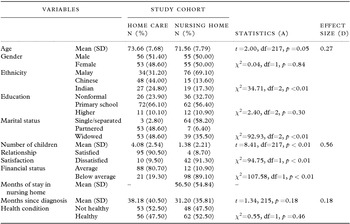
Table 1 shows the comparison of socio-demographic profile of PWCI in home care versus nursing home. Out of 219 participants, 109 participants were from the home care and 110 were from nursing homes. There were no significant differences in age, gender and level of education attained between the study cohorts (all p > 0.05).
Comparison of socio-demographic profiles of people with cognitive impairment in nursing home and home care

Notes: a = t: student t-test, χ2: Chi-square, Mann–W: Mann–Whitney test.
Among the three ethnicities, the proportion of the Malays in nursing homes was significantly higher (69.10%) compared to the Chinese (13.60%) and the Indians (17.30%) (χ2 = 34.71, df = 2, p < 0.01). There were significant differences in marital status, family support and relationship satisfaction between PWCI in home care and those in nursing homes. Participants in the nursing homes were more likely to be single/separated (58.20%) (χ2 = 92.93, df = 2, p < 0.01), have no partner/child (56.40%) (χ2 = 75.40, df = 1, p < 0.01) and reported unsatisfactory relationships with their children (91.30%) (χ2 = 94.75, df = 1, p < 0.01). In addition, those in nursing homes also reported significantly lower income (91.30%) (χ2 = 107.58, df = 1, p < 0.01) compared to those receiving care at home.
Comparison of outcome measures of people with cognitive impairment in nursing homes and home care
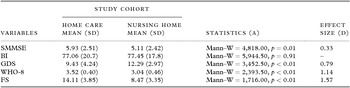
With regards to outcome measures, non-parametric analysis was used as the data was non-normally distributed. However, for the ease of interpretation, means and SDs are reported. There were significant differences in cognitive impairment, depressive symptoms, QoL and social connectedness between PWCI in home care and those in nursing homes (Table 2). PWCI in the nursing homes had significantly lower cognitive function (Mann–W = 4,818.00, p = 0.01) compared to those in home care, with more than 40% of PWCI living in nursing homes suffered from moderate/severe cognitive impairment.
Comparison of outcome measures of people with cognitive impairment in nursing homes and home care

Notes: SMMSE = Short Mini-Mental State Examination; BI = Barthel Index; GDS = Geriatric Depression Scale; WHO-8 = EUROHIS-QOL; FS = Friendship Scale; a = Mann–W: Mann–Whitney test; d = Cohen d.
Similarly, PWCI living in nursing homes were more likely to be depressed (Mann–W = 3,452.50, p < 0.01), with more than 85% of them suffered from major depression as opposed to those who were living at home (60%) (χ2 = 19.11, df = 2, p < 0.01). On further analysis, the higher prevalence of major depression among PWCI living in nursing homes could be explained by financial status, relationship satisfaction with children, loneliness and severity of cognitive impairment. It was revealed that among PWCI living in nursing homes who suffered from major depression, almost 90% (n = 87) reported to have below average income (χ2 = 14.16, df = 2, p <0.005), 95% (n = 40) reported poor relationship with children (χ2 = 13.61, df = 2, p < 0.005), 89% (n = 79) reported feeling very isolated (χ2 = 20.43, df = 4, p < 0.001) and 100% (n = 48) had moderate/severe cognitive impairment (χ2 = 14.49, df = 2, p < 0.005).
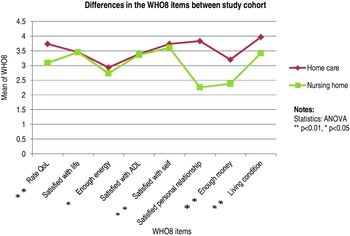
In regards to QoL, PWCI living in home care reported significantly better QoL (Mann–W = 2,393.50, p < 0.01) compared to those in the nursing homes with an effect size of 1.14. These large differences can be explained by the differences in item responses between the study cohorts. Figure 1 shows the differences in means for the WHO-8 items. Out of 8 items, significant differences in item response were observed for item 1, 3, 6, 7 and 8, suggesting that PWCI in nursing homes rated their overall QoL (ANOVA, F(1,217) = 47.99, p < 0.01), having enough energy (ANOVA, F(1,217) = 4.322, p = 0.04), satisfaction with personal relationship (ANOVA, F(1,127) = 239.877, p < 0.01), having enough money (ANOVA, F(1,217) = 89.87, p < 0.01) and living arrangement (ANOVA, F(1,217) = 68.93, p < 0.01) lower than those in home care. No significant differences were observed in other WHO-8 items.
Mean of the WHO-8 items according to study cohort.

Additionally, PWCI in home care also had significantly better social connectedness (Mann–W = 1,716.00, p <0.01) compared to those in the nursing homes with an effect size of 1.57. A significantly large difference in the number of participants reporting to feel very socially isolated was observed between study cohorts compared to other level of isolations (nursing home, n = 89 and home care, n = 30) (χ2 = 69.31, df = 3, p <0.01). Just as the majority of PWCI living at home reported to feel some isolation/connectedness, none of those living in nursing homes reported to feel socially connected.
Determinants of quality of life in people with cognitive impairment
On further analysis, the WHO-8 showed strong associations with depression (r = −0.80), social isolation/connectedness (r = 0.70), relationship satisfaction with children (r = −0.64), financial conditions (r = −0.54), and living arrangements (r = −0.52). Moderate associations were observed between QoL and physical function (r = 0.44), cognitive impairment (r = 0.44), health condition (r = 0.36) and number of children (0.27). No associations were observed for age, marital status, gender, ethnicity, and education attainment.
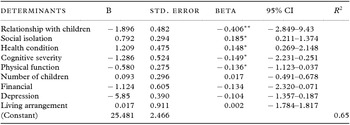
Given an adequate sample size in this study (n = 219), a maximum of 15 variables were allowed for the multivariate analysis. Therefore, all nine variables (living arrangement, relationship with children, financial status, social isolation, number of children, physical function, depression, cognitive severity, and health condition) were included in the regression analysis. Using the WHO-8 as the dependent variable, five out of nine independent variables gave significant results (Table 3). These variables explained 65% of the variance in QoL with relationship satisfaction with children being the strongest determinant of QoL. No significant association was observed between number of children, financial status, living arrangement and depression with QoL. Table 3 summarizes the determinants of QoL in PWCI.
Multiple linear regressions predicting QoL in people with cognitive impairment (WHO-8)

Notes: *p ≤0.05; **p ≤0.01.
Discussion
QoL is a complicated and abstract concept to explore. Recently, QoL has been increasingly recognized as an important study outcome in cases of dementia and in PWCI (Wetzels et al., Reference Wetzels, Zuidema, De Jonghe, Verhey and Koopmans2010; Crespo et al., Reference Crespo, Bernaldo De Quiros, Gomez and Hornillos2012). Subject to the caveats, in this study, PWCI living at home experienced better QoL with an effect size for the study outcomes measure of 1.14. However, it is difficult to determine the minimum important difference in scores as there is no agreement on what constitutes a clinically important change in the scores for the WHO-8. Nonetheless, the reported mean score in this study was lower compared to other studies (Schmidt et al., Reference Schmidt, Muhlan and Power2006; Arlt et al., Reference Arlt, Hornung, Eichenlaub, Jahn, Bullinger and Petersen2008).
These findings stand in marked contrast with those previously published. Although significant differences in QoL among older adults living in the community and those in nursing homes have been reported in other studies, previously published findings were based on data from normal adult populations (Hawthorne, Reference Hawthorne2006; Prieto-Flores et al., Reference Prieto-Flores, Forjaz, Fernandez-Mayoralas, Rojo-Perez and Martinez-Martin2011). As for Malaysia, in spite of a considerable amount of studies involving older adults, very few have focused on the area of QoL (Justine et al., Reference Justine, Hamid, Kamalden and Ahmad2010; Sazlina et al., Reference Sazlina, Zaiton, Nor Afiah and Hayati2012). Furthermore, most of the studies in older adults in Malaysia used the SF-36 to measure QoL (Justine et al., Reference Justine, Hamid, Kamalden and Ahmad2010; Sazlina et al., Reference Sazlina, Zaiton, Nor Afiah and Hayati2012), which makes it difficult to compare with the finding from the current study.
Among the limited studies that used the WHO definition in measuring QoL was that of Rashid and colleagues, which involved older adults in a non-governmental nursing home in Penang, Malaysia (Rashid et al., Reference Rashid, Ong and Yi Wong2012). In their study, a mean score of 69.5 (using WHOQOL-BREF instrument) was reported, which is slightly higher in comparison to other similar studies from other countries (Lucas-Carrasco, Reference Lucas-Carrasco2011; Colbourn, Reference Colbourn, Masache and Skordis-Worrall2012). The findings from studies which have directly compared QoL in PWCI or dementia by home versus institutional care were mixed with some studies reporting that place of residence predicts QoL (Missotten et al., Reference Missotten2009) whilst other studies have not (te Boekhorst et al., Reference te Boekhorst, Depla, De Lange, Pot and Eefsting2009). Precisely why such large differences in QoL were observed in this study whereas other studies did not is not entirely clear. But four reasons may be relevant as explained below.
QoL is related to social isolation; indeed social relationship is regarded as a core domain of QoL. As shown by QoL item analyses, significant differences between the two groups were observed for relationship with other people, relationship with family, personal relationship and having enough money to meet needs. In this sample, those living at home were supported by their families. They were more likely to be married and to have adequate financial support. There is some evidence in the literature that the absence of a partner created insecurity and isolation (Thomopoulou et al., Reference Thomopoulou, Thomopoulou and Koutsouki2010) and having enough money has been previously found as a predictor for a good QoL (Paskulin and Molzahn, Reference Paskulin and Molzahn2007).
The data reported in this study were self-reported in an interview with the researcher. Therefore the outcomes from this study directly reflected the views of participants – which is the recommended perspective in studies involving those with mild cognitive impairment (MMSE score >10 points) (Sansoni et al., Reference Sansoni2007). In contrast, other studies comparing home and institutional care have relied upon proxy assessments, where the proxies have included practice nurses or caregivers (Missotten et al., Reference Missotten2009; te Boekhorst et al., Reference te Boekhorst, Depla, De Lange, Pot and Eefsting2009). Since proxies tend to understate the QoL of participants (Herrman et al., Reference Herrman, Hawthorne and Thomas2002), it is likely this may explain some of discrepancies between the present findings and previous studies.
Additionally, there may be issues relating to study design. As mentioned above, the samples in this study were well matched in terms of their health. Importantly, there were no statistically significant differences between home and institutional participants for age, educational attainment, duration of cognitive impairment and ability to perform daily activities (ADL). Elsewhere, these variables have been shown to be determinants both of nursing home admission and QoL among older adults (Luppa et al., Reference Luppa, Luck, Weyerer, Konig, Brahler and Riedel-Heller2010; Wetzels et al., Reference Wetzels, Zuidema, De Jonghe, Verhey and Koopmans2010).
It is also worth noting that social and cultural aspects may play a pivotal role in research. This study was conducted in a different cultural and residential context when compared with previous research in the field. Differences in the cultural milieu may cause differences in attitudes toward nursing home placement, family involvement in residents’ care, health system, income equality, staff employment conditions, and so on. All these could affect perceptions and ratings of QoL among PWCI. Importantly, it is expected in Malaysian society that family members, especially children, will provide care to their elderly parents. Certainly the results from this study would be consistent with this.
In regards to factors determining the QoL in PWCI, five factors; relationship with children, social isolation, health condition, cognitive severity, and functional independence were key variables associated with QoL. This model explained about 65% of the variance in QoL. In agreement with other studies, this study showed that functional independence and cognitive impairment are among the determinants for QoL in PWCI (Missotten et al., Reference Missotten2008; Mougias et al., Reference Mougias, Politis, Lyketsos and Mavreas2011).
In this study, the SMMSE and the BI correlated with the WHO-8 0.44 which explained about 19% of the variance in QoL. These findings suggest that a patient's QoL decreases when cognitive severity and dependency increase. This is inconsistent with Hoe and colleagues who reported that QoL is independent of the level of cognitive functioning and physical functions in dementia patients (Hoe et al., Reference Hoe, Hancock, Livingston and Orrell2006). However, it is worth noting that the data reported in this study was self-reported with a 100% completion rate, whereas in the Hoe et al. study, 52% of their study participants had missing data. Furthermore, Hoe et al. recruited those with severe dementia (defined as <12 points on the Mini-Mental State Examination) whereas in this study a cut-off point for exclusion was 10 points on the SMMSE.
The link between social isolation and loneliness has been observed to be associated with health, well-being and QoL in adults (Hawthorne, Reference Hawthorne2006; Hawton et al., Reference Hawton2010). The key associate of social isolation in this study was personal relationships. As reported in this study, social isolation and relationship with children explained 19% and 40% of the variance in QoL respectively, suggesting that contacts with friends and relatives and the level of social engagement were significant in determining their QoL. As reported by Hawthorne, older adults who were single or separated were three times more likely to experience social isolation when compared with those with a partner (Hawthorne, Reference Hawthorne2005).
In this study, although number of children, financial status, depression and living arrangement demonstrate significant association with QoL, these variables did not predict the QoL of PWCI. This finding is in agreement with other studies which did not find evidence of living arrangement and depression affecting QoL (Missotten et al., Reference Missotten2008; Wetzels et al., Reference Wetzels, Zuidema, De Jonghe, Verhey and Koopmans2010). This result suggests that factors underlying the living arrangement, such as social isolation and relationship with children which has been discussed earlier are the determinants for QoL in PWCI. However, caregiver's financial status has been shown to be a potential determinant for QoL in dementia patients (Mougias et al., Reference Mougias, Politis, Lyketsos and Mavreas2011), although this was not assessed in this study.
There are a number of possible limitations to this study which must be acknowledged. Concerning design, the study was carried out in a naturalistic setting and therefore the findings are subject to the associated limitations. It is also acknowledged that this study was cross-sectional in nature and the results point to possible relationships between variables but cannot imply causation. Though this is the first study of QoL of PWCI in Malaysia, the findings of this study cannot be generalized to PWCI in Malaysia as the sample was not a nationally representative sample. In addition, the home care sample may not be representative of PWCI living in community, as the study was conducted drawing participants from memory clinics.
In relation to questionnaires used in the study, additional information such as having a primary family carer, home environment safety and having adequate support facilities may be useful in reducing the class biases between samples. Additionally, information on the diagnosis and type of dementia may be beneficial in providing a better understanding of the QoL of older adults with cognitive impairment. As reported in some studies, patients with Lewy-body dementia as opposed to those with Alzheimer's disease were reported to have lower QoL (Bostrom et al., Reference Bostrom, Jonsson, Minthon and Londos2007). Therefore, it is worthwhile to examine these differences in future studies. Also, questionnaire such as the SMMSE do not provide thorough information's about memory, attention and executive functions capacity of PWCI. As for other questionnaires, there is little or no evidence of clinical properties of the scales among PWCI.
In conclusion, this study suggests the possibility that PWCI have better QoL, if they are living in a community setting, compared to an institutional setting. Further research is required to investigate the effect of other living arrangements such as private nursing homes, retirement homes, day care centers and other assisted living facilities on the QoL of PWCI. By understanding how different types of living arrangements could affect the QoL of the patients, better options could be made by the caregivers in managing PWCI. Furthermore, studies on interventions that could delay the progression of cognitive decline and subsequently delaying institutionalization for PWCI would be beneficial.
Conflict of interest
None.
Description of authors’ roles
A. Nikmat developed the conceptual framework of the study, conducted a background literature search, carried out the study and wrote the paper. S. Hassan supervised data collection and assisted with writing the paper. A. Hashim assisted with writing the paper.
Acknowledgments
This study is funded by a grant from the Research Management Institute of Universiti Teknologi MARA, Malaysia, and is supported by The University of Melbourne. The sponsor of the study is the Ministry of Higher Education of Malaysia.