INTRODUCTION
Public discussion on euthanasia and physician-assisted suicide (PAS) indicates that these are complex challenges for healthcare in postmodern societies. Many anticipate suffering so severe and cannot imagine, for example, in the case of progressive disease, that they might want to go on living under such circumstances.
The “desire for hastened death” (DHD) is a phrase that has been employed for a variety of phenomena, including requests for PAS, euthanasia, and suicidal ideation (Rosenfeld, Reference Rosenfeld2000). DHD in patients at the end of life has been associated with diverse symptoms such as depression, hopelessness, and physical suffering (Akechi et al., Reference Akechi, Okamura and Kugaya2000; Rosenfeld & Breitbart, Reference Rosenfeld and Breitbart2000; Breitbart et al., Reference Breitbart, Rosenfeld and Pessin2000a ; Kelly & McLoughlin, Reference Kelly and McLoughlin2002; Morita et al., Reference Morita, Sakaguchi and Hirai2004). In order to evaluate the prevalence of requests for euthanasia or PAS, how often people desire a hastened death, and how well this can be changed by palliative care (PC), reliable and validated instruments are required. Such instruments should be sensitive to the fact that DHD in patients may vary in intensity and persistence, as clinical experience shows. Apart from the clinician-assessed Desire for Death Rating Scale (DDRS) (Chochinov et al., Reference Chochinov, Wilson and Enns1995), only one self-administering instrument exists to measure DHD—the Schedule of Attitudes Toward Hastened Death (SAHD) (Rosenfeld et al., Reference Rosenfeld, Breitbart and Galietta2000). This instrument has been validated for HIV/AIDS (Rosenfeld et al., Reference Rosenfeld, Breitbart and Stein1999) and terminally ill cancer patients (Rosenfeld et al., Reference Rosenfeld, Breitbart and Galietta2000). It is described as having good psychometric properties in terms of reliability and validity. For concurrent validity, it was tested against the DDRS. For discriminant validity, the factors depression, distress, and hopelessness have been assessed. Factor analysis showed a unidimensional construct (Rosenfeld et al., Reference Rosenfeld, Breitbart and Stein1999). The first validation for a European language and culture was performed for a Greek version and revealed psychometric properties comparable to those of the original (Mystakidou et al., Reference Mystakidou, Rosenfeld and Parpa2004).
The aim of our study was to validate the Schedule of Attitudes Toward Hastened Death in German (SAHD–D) with patients on palliative care units.
METHODS
Translation of SAHD
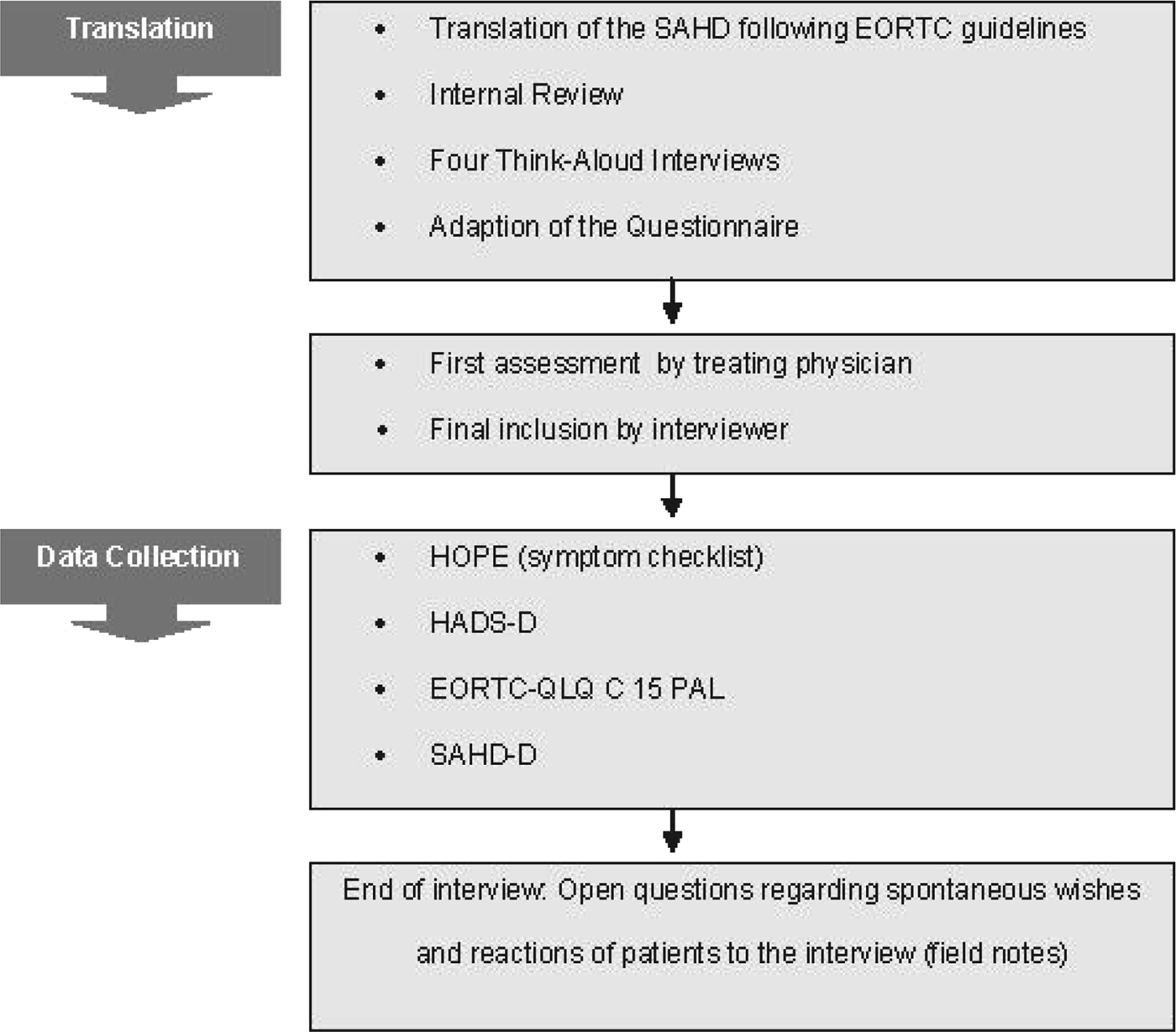
The SAHD was translated following guidelines for cultural adaptation (Guillemin et al., Reference Guillemin, Bombardier and Beaton1993). The original version was translated into German by four translators working in parallel. The German versions were then translated back into English by independent native speakers and compared with the original. Using these translations, the most suitable versions (criteria: close to the original and easy to understand in German) were chosen. After the German version was compiled, it went through internal review to identify misunderstandings and idiomatic mistakes. Then four think-aloud interviews were conducted with patients in specialized palliative care settings to test comprehensibility (Willis, Reference Willis2005). Amendments were made where necessary, and a final version was developed. The SAHD–D questionnaire was then applied in all interviews.
Data Collection
Patients in specialized palliative care units were screened for inclusion from November of 2007 until November of 2009. The formal inclusion criteria for our study were as follows: (a) inpatient treatment on one of the three ABC (Aachen, Bonn, Cologne) palliative care units; (b) fluency in the German language; (c) clinical situation adequate for the interview; (d) Mini-Mental Status Examination (MMSE) score equal to or greater than 21 to exclude cognitive impairment (Folstein et al., Reference Folstein, Folstein and McHugh1975); and (e) informed consent (oral or written).
The study protocol consisted of (a) the HADS–D (the Hospital Anxiety and Depression Scale–German Version; Herrmann et al., Reference Herrmann, Buss and Snaith1995); (b) the EORTC QLQ-C15 PAL (Groenvold et al., Reference Groenvold, Petersen and Aaronson2006); (c) the SAHD–D (Rosenfeld et al., Reference Rosenfeld, Breitbart and Galietta2000; Reference Rosenfeld, Breitbart and Stein1999) (to be validated); (d) an external estimation of DHD by the attending physician; and (e) a core dataset including a symptom checklist extracted from the Hospice and Palliative Care Evaluation (HOPE) (Ostgathe et al., Reference Ostgathe, Alt-Epping and Lindena2009; Stiel et al., Reference Stiel, Pollok and Elsner2012).
The SAHD–D is a 20-item instrument with dichotomous (yes/no) items that assess DHD. It has a self-report format, yet we administered this measure, as well as other research instruments, during a face-to-face interview so as to reduce the burden on patients and extract field notes. This instrument employs a true-or-false format, with a higher score indicating a greater desire for death. The cutoff score was the one used in previous validation studies (Mystakidou et al., Reference Mystakidou, Rosenfeld and Parpa2004; Rosenfeld et al., Reference Rosenfeld, Breitbart and Galietta2000), with more than one standard deviation above the mean suggesting a high level of DHD.
The interview was conducted within five days of admission. For criterion validity, the attending physician had to document his estimation of DHD for all included patients. A structured document was developed for this purpose. The SAHD–D score was not known to the clinical physician who estimated DHD for the patient. The score and rating by the physician were collected independently from one another. Ethics committee approval was obtained (No. 06/208 for Cologne, No. 168/07 for Bonn, and No. 095/07 for Aachen).
The German validation study presented here was part of the ABC research project on end-of-life issues (Radbruch et al., Reference Radbruch, Stiel and Nauck2008).
Procedures
Patients were screened by the treating physician, and final inclusion was determined by the interviewer (JWW), a psychologist working in palliative care. The reasons for exclusion were documented. All answers according to the instrument were documented in the questionnaire. Spontaneous reactions from the patients were additionally recorded as field notes (Voltz et al., Reference Voltz, Galushko and Walisko2011). The interview ended with open-ended questions regarding reactions and wishes (see Fig. 1). Issues arising during the interview were immediately fed back to the team. A follow-up was obtained from all patients, either by personal interview, telephone call, or feedback from the team. As only patients on palliative care units were interviewed, they all had access to 24-hour support if needed after an interview.
As there were concerns from the ethics committee regarding the safety of patients when confronted with an interview about a desire for hastened death, the interviewer was obliged to adapt the standardized interview procedure in order to minimize possible burden for patients. If they were unable to answer a question, it was repeated once, but patients were not pressured for a reply. This procedure led to missing values despite using the direct interview method.
All standardized answers were transferred to a database. The data were analyzed using SPSS® software (version 15.0). Field notes taken during interviews were checked for specific comments on interview burden and analyzed descriptively on a content level. The results have been published (Voltz et al., Reference Voltz, Galushko and Walisko2011). In addition, preliminary recruitment data on the feasibility of our study were also published (Voltz et al., Reference Voltz, Galushko and Walisko2010).
Summary of the validation study procedures, beginning with the translation process through to the data collection process.

Analysis
Both uni- and bivariate methods were utilized in analyzing participating and nonparticipating patients. To assess the reliability of the SAHD–D, we computed Cronbach's alpha, which is also applicable for dichotomous variables (Bortz & Döring, Reference Bortz and Döring1995). Item analysis included the frequency of endorsement, that is, the number of items endorsed, the discrimination index, and item–total score correlation (Spearman).
The factor structure was assessed by factor analysis based on the tetrachoric correlation coefficient for dichotomous items and using orthogonal Varimax rotation. The number of factors was determined on the basis of the eigenvalues and considering the scree plot. Moreover, an item was assigned to a factor when loading above 0.5 and with a difference of 0.2 when loading high on more than one factor. Each factor should have at least three items loading according to these criteria, as recommended by Tabachnick and Fidell (Reference Tabachnick and Fidell2005). SAHD scores were not normally distributed; nonparametric statistics (Spearman's rho) were employed to assess the criterion, convergent, and construct validity.
The HOPE Symptom and Problem Checklist (HOPE) contains 16 items for 8 physical symptoms (pain, nausea, vomiting, dyspnea, constipation, weakness, loss of appetite, and tiredness); two special nursing topics (wound care and assistance with activities of daily living); four psychological problems (feeling depressed, anxiety, tension, and disorientation/confusion); and two social problems (organization of care and overburdening of family). The HOPE uses a four-step verbal rating scale for evaluation of symptom intensity, differentiating no, mild, moderate, and severe (coded 0–3). Summed scores were calculated for each subscale (i.e., physical, nursing, psychological, and social) and then divided by items in order to calculate a mean, that is, the sum of the subscale physical problems was divided by eight since there were eight items measuring physical problems (Stiel et al., Reference Stiel, Pollok and Elsner2012).
RESULTS
Sample
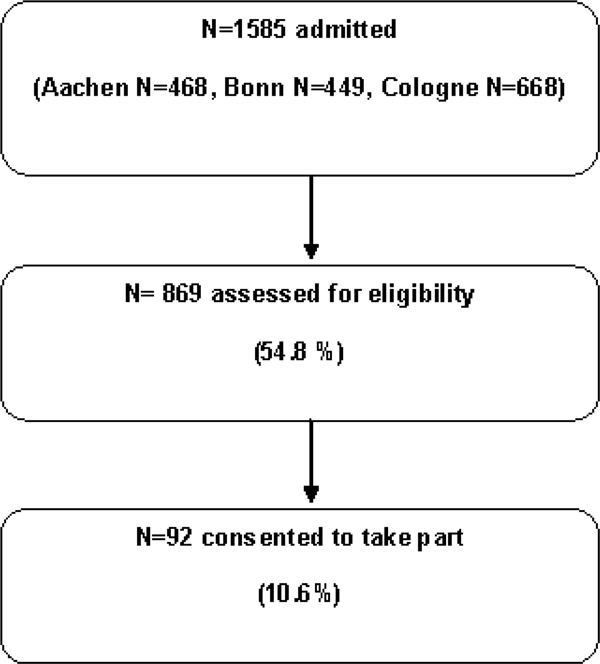
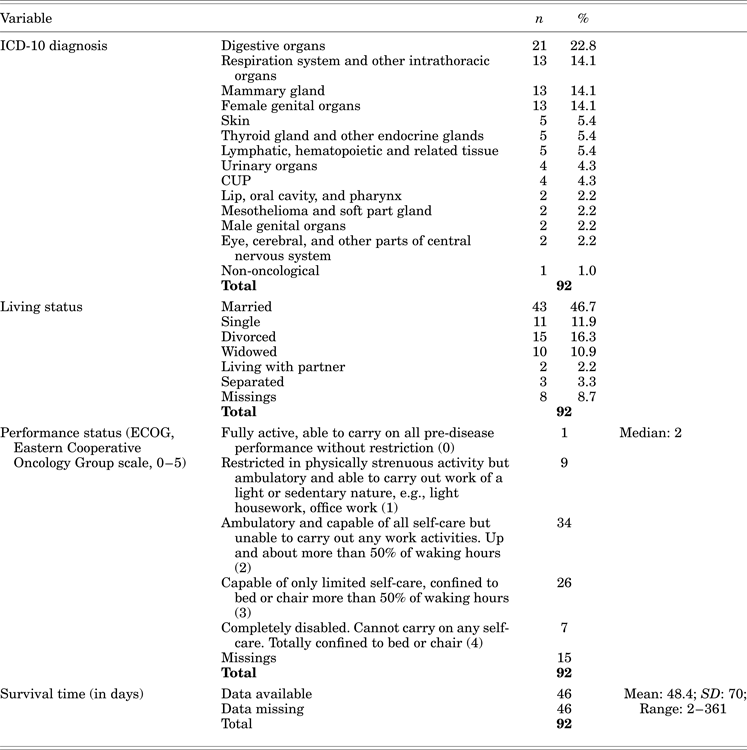
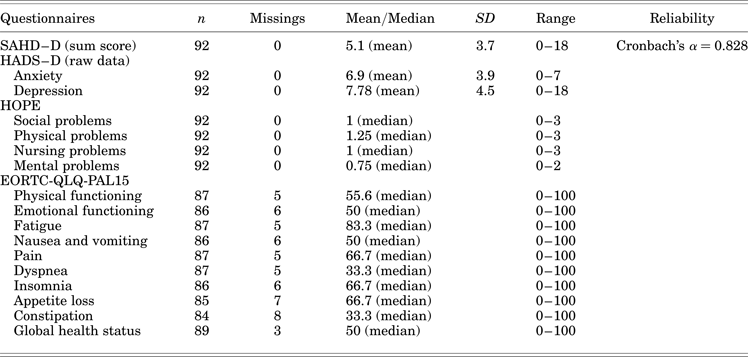
From November of 2007 until November of 2009, team members of the palliative care units at Aachen, Bonn, and Cologne assessed 869 patients for study eligibility. Of those, 92 consented to take part in the validation (Aachen 23, Bonn 15, and Cologne 54). All but one were oncological patients, and their mean age was 64.5 years (range 40–86, SD = 11.5) (see Fig. 2). Participants' diagnoses were grouped according to the International Classification of Diseases (ICD-10). The demographical and clinical data, as well as data from the applied questionnaires, are presented in Tables 1 and 2.
Patient flowchart, beginning with patient admission to hospital through to consenting to take part in our study.

Demographical and clinical data

Questionnaires applied

DHD
Patients had a mean score of 5.09 (SD = 3.717) on the SAHD–D, and a high level of DHD (1 SD above the mean) was found in 20.7% (n = 19). The HADS anxiety level scores had a mean of 6.9 (range 0–17, SD = 3.9), and HADS depression had a mean of 7.78 (range 0–18, SD = 4.5). HOPE data: social problems ranged from 0 to 3 (median = 1), physical problems 0–3 (median = 1.25), nursing problems 0–3 (median = 1), and mental problems 0–3 (median = 0.75).
Item Analysis of the SAHD
For item analysis, discrimination index and frequency of endorsement (percentage of positively answered questions, having a desire of death) were employed. Some 11 of 20 items were endorsed by between 20 to 80% of participants, with two items just missing this ideal span. Items with a frequency of endorsement under 10% (items 5, 7, 12, and 15) applied to positive aspects of the current situation for patients (except for item 5) and were not often answered.
The discrimination index is one of the most important criteria for evaluating the benefit of items, as it measures the correlation of items and total score. The lower the value of this index, the more useless the item is for analysis (items 2, 17, 18, and 19).
Factor Analysis
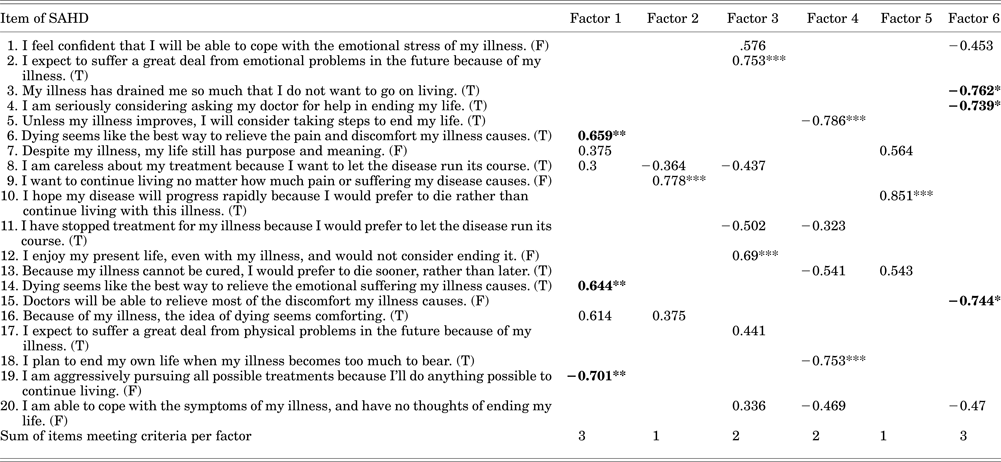
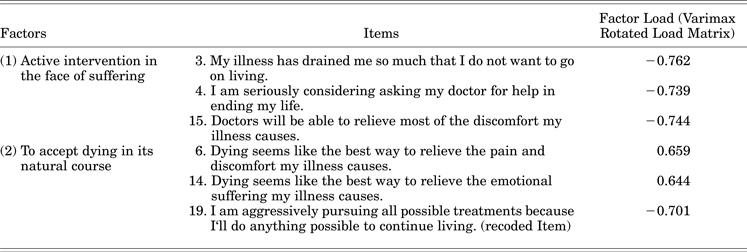
A factor analysis for dichotomous items based on a tetrachoric correlation coefficient was employed to explore whether the scale was unidimensional. Based on eigenvalues greater than one, six factors have been identified explaining 59% of the variance. Items had considerable overlap among these six factors. When applying the criteria for factor loading, only two factors with three items each were found (see Tables 3 and 4). We described the two identified factors as follows: (1) active intervention in the face of suffering, and (2) accepting the natural course of dying (see Table 4).
Correlations of SAHD–D total score with analyzed scales.

All items and their factor loadings

Note. Factor loadings of all SAHD items (Varimax rotations) with all items coded in one direction; items of two identified factors meeting the defined criteria are in bold type; *items of factor 1 “active intervention in the face of suffering”; **items of factor 2 “to accept dying in its natural course”; ***potentially relevant items, three items per factor not attained.
Factors identified by Factor Analysis

Reliability
For reliability of the SAHD–D, Cronbach's alpha was calculated including missings, and resulted in an alpha value of 0.711. Six items of two factors were identified by factor analysis. Using only these six items of the two factors resulted in an alpha of 0.646.
Criterion Validity
Measured correlation of the external criterion (estimation of DHD by the attending physician) and SAHD–D total score (all 20 items) was positive and significant, but nevertheless lower than expected (Spearman's rho = 0.290, p = 0.003, one-tailed).
Discriminant Validity
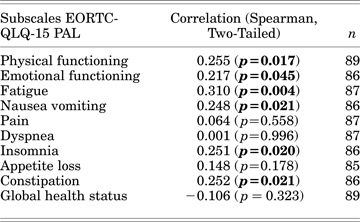
For discriminant validity, the correlations between the SAHD–D and depression (r rho = 0.472), anxiety (r rho = 0.224), and clinical state (r rho = 0.178) were low to moderate and significant. Correlations with the ten EORTC-QLQ-PAL15 subscales were low but significant for six subscales, indicating only a weak relationship (see Table 5). Figure 3 depicts the correlations of the SAHD–D with analyzed scales.
EORTC-QLQ-15-PAL

DISCUSSION
The current study validated the German version of the SAHD for palliative patients in Germany (SAHD–D). Clinicians and researchers have shown a growing interest in analyzing the desire for a hastened death (Hudson et al., Reference Hudson, Kristjanson and Ashby2006a ; Reference Hudson, Schofield and Kelly2006b ; Shim & Hahm, Reference Shim and Hahm2011; Nissim et al., Reference Nissim, Gagliese and Rodin2009; Rodin et al., Reference Rodin, Zimmermann and Rydall2007; Ransom et al., Reference Ransom, Sacco, Weitzner and Azzarello2006; Monforte-Royo et al., Reference Monforte-Royo, Villavicencio-Chavez and Tomas-Sabado2011; Reference Monforte-Royo, Villavicencio-Chavez and Tomas-Sabado2012; Kelly et al., Reference Kelly, Burnett and Pelusi2003). This wish is not uncommon among patients with serious or incurable illnesses when facing the end of life or the advanced stages of their disease. Defining the intensity and frequency of this wish is extremely difficult due to the fact that the phenomenon tends to vary over time, depending on the stage or circumstances in which patients find themselves (Monforte-Royo et al., Reference Monforte-Royo, Villavicencio-Chavez and Tomas-Sabado2011; Reference Monforte-Royo, Villavicencio-Chavez and Tomas-Sabado2012). To facilitate quantification and comparison of a desire for a hastened death, a few measurement instruments have been developed (Chochinov et al., Reference Chochinov, Wilson and Enns1995) and modified (e.g., the Schedule of Attitudes Toward Hastened Death, SAHD) (Rosenfeld et al., Reference Rosenfeld, Breitbart and Galietta2000).
Rosenfeld and colleagues (Reference Rosenfeld, Breitbart and Galietta2000) intended to include various aspects of the desire to hasten death in scale development, but they found a unidimensional construct. Despite their intention to “sample various domains of attitudes in the Schedule of Attitudes Toward Hastened Death that might result in multiple discreet factors, no such solution was evident.” The original SAHD was highly correlated with ratings on the Desire for Death Rating Scale, a clinician-rated measure of desire for death, and was significantly correlated, though to a lesser extent, with several measures of depression and overall psychological distress. The Greek version of the SAHD, as validated by Mystakidou et al. (Reference Mystakidou, Rosenfeld and Parpa2004), supported the unidimentionality of the measurement and found significant associations of SAHD scores with anxiety and depression, pain intensity (moderate correlation), pain interference in mood, and enjoyment of life. SAHD scores were significantly associated with both quality of life and health status (r = −0.36, p < 0.01). Poor performance status (ECOG) significantly correlated with high SAHD scores.
The cutoff for a high DHD as defined in our study differs only slightly from that in other studies using the SAHD. When a cutoff of 10 or more was employed, almost 12% of our sample had a high desire to hasten death. With this definition, 5% of patients in a Greek palliative care unit (Mystakidou et al., Reference Mystakidou, Rosenfeld and Parpa2004) had elevated DHD scores. If we define a high level of DHD as the mean plus one standard deviation (as proposed by Rosenfeld et al., Reference Rosenfeld, Breitbart and Galietta2000), we have 20.7% (n = 19), a value higher than the one presented by Rosenfeld and coworkers (16%). When regarding two studies in nonpalliative settings (Jones et al., Reference Jones, Huggins and Rydall2003; Ransom et al., Reference Ransom, Sacco, Weitzner and Azzarello2006) using a cutoff of 10 or more on the SAHD, elevated scores were found in 2% of a sample of cancer inpatients. This demonstrates that there is variability in the cutoff scores used and in the reported distribution of scores.
The unidimensionality of the scale as demonstrated in the original English and Greek versions could not be reproduced. Six identified factors with only two factors having at least three items with suitable factor loadings might question the unidimensionality in our sample. Nevertheless, the results of the factor analysis have to be interpreted cautiously, as a lot of items are loading on more than one factor. Moreover, for a factor analysis of 20 items, our study population of 92 is quite low. The differences from other validation studies might also be due to differences in sample and setting compared to the original SAHD version validated on samples of ambulatory and terminally ill patients with human immunodeficiency virus (HIV) and acquired immunodeficiency syndrome (AIDS). Despite these limitations, the two latent factors determining a wish to hasten death found in our sample might help facilitate future research by forming a basis for further refinement of an instrument to measure the desire for hastened death. Still, we do not believe that the current validation research supports clinical applications of the SAHD–D at this time in Germany.
Furthermore, after conducting item, factor, and reliability analysis, only 6 of 20 items retained reasonable psychometric properties. A possible reason for this might be the paucity of differentiation between acute and non-acute DHD or a lack in discrimination between DHD and the will to live, as was shown by Voltz and coworkers (Reference Voltz, Galushko and Walisko2011). So a further differentiation of SAHD items concerning these aspects might lead to other psychometric properties of the scale, although the abovementioned limitations still apply.
The fact that criterion validity is not as high as expected, though positive and significant, can be due to the fact that the external criterion was the physician's estimate, a nonstandardized and nonvalidated instrument. For subsequent studies, it might be necessary to refine it by using test theory. Nevertheless, the problems mentioned for the SAHD–D apply here as well.
Our hypotheses about the SAHD–D sum score being correlated with depression and anxiety were confirmed. We also found a number of physical and psychological variables associated with a desire for hastened death. The low correlations of the SAHD–D sum score with clinical situation, mental and physical burden, as well as the ECOG may be due to the fact that parameters were collected via assessment by others. External assessments can be biased compared to the subjectively perceived reality of patients. This could explain why the correlations with the EORTC-QLQ-PAL15—symptoms self-assessed by the patient at the time of the interview—were higher. Applying the EORTC-QLQ-PAL15 showed that physical symptoms as perceived by patients correlate with a desire for a hastened death, yet not as much as depression. Other studies (Rodin et al., Reference Rodin, Zimmermann and Rydall2007) confirm that depression and hopelessness are the strongest predictors of a desire for hastened death and provide independent and unique contributions. Future studies should therefore include validated instruments that measure hopelessness. Research on the impact of treatment for depression and/or hopelessness on DHD would be worthwhile to identify options for clinical responses to patients expressing a desire for hastened death. Those treatments, however, should take into account that a desire for hastened death can change over the course of the illness and is not a static emotion.
The desire for hastened death did not correlate strongly with any particular physical problem or clinical situation in our study, which could justify putting more emphasis on psychosocial aspects.
STUDY LIMITATIONS
From the 869 patients screened for eligibility during the trial period, only 92 consented to take part, and this was considerably less than the planned trial size of 200. This demonstrates the immense difficulty in acquiring patients from this select patient population. Patient participation in palliative care has been known to be extremely low due to family concerns and limited life expectancy (Addington-Hall, Reference Addington-Hall2002; Head & Ritchie, Reference Head and Ritchie2004; Henderson et al., Reference Henderson, Addington-Hall and Hotopf2005; O'Mara et al., Reference O'Mara, St. Germain and Ferrell2009), and the implications significantly affect the availability and quality of research in the palliative patient population. Trials are often ended prematurely due to the difficulty in reaching appropriate sample sizes. In our study, the reasons for exclusion were mainly related to the clinical status of patients. In the SAHD study (see Breitbart et al., Reference Breitbart, Rosenfeld and Pessin2000b ; Rosenfeld et al., Reference Rosenfeld, Breitbart and Galietta2000), only 22% of screened patients were included, a return rate similar to our low number. Specific considerations related to German history have been discussed as a reason for refusal to be part of such research, but this was not seen as a problem in the field notes (Voltz et al., Reference Voltz, Galushko and Walisko2010). The term “euthanasia” has been mainly employed in Germany to describe Nazi atrocities committed during the Third Reich, where the mentally impaired and mentally ill were murdered by the national regime. This may impact patients who had direct experience with the Nazis as well as younger patients without such experiences, as this kind of discussion is bound to affect their value system. Therefore, end-of-life research in Germany may add too great a burden on patients to be ethical. End-of-life research on patients' attitudes toward hastened death in Germany must prove feasible within this historical context. There are a few studies that have shown that the atrocities of the Third Reich play only a minor role in shaping attitudes toward euthanasia when considering self-estimation of German physicians, as shown by Mueller et al. (Reference Mueller-Busch, Klaschnik and Onuncu2003). These findings are consistent with other studies reporting only the very small influence of Nazi history on the current euthanasia debate (Maitra et al., Reference Maitra, Harfst and Bjerre2005). In our study, the specifics of German history also did not appear to be an issue (see also Voltz et al., Reference Voltz, Galushko and Walisko2010). Reasons for exclusion of patients were associated with the specific palliative care clinical situation of the patients, rendering them physically or psychologically unable to participate. Furthermore, the fact that the term “euthanasia” carries negative connotations was not regarded as a reason for nonparticipation. The advanced stage of the underlying disease and a poor performance status were much more often the reason for noninclusion.
The sample comprised terminally ill cancer patients, all of whom were hospitalized in palliative care units. Therefore, the extent to which the SAHD–D might be valid for use in other patient populations remains unclear. General recommendations for factor analysis suggest a minimum sample size of at least 100 datasets (Knapp & Sawilowsky, Reference Knapp and Sawilowsky2004). Since we did not reach this number, our findings have to be considered with caution.
CONCLUSION
Validation of the SAHD–D illustrates good discriminant validity, confirming that a desire for hastened death is a construct separate from depression, anxiety, and physical state. The unidimensionality of the SAHD could not be reproduced and requires further differentiation. Our findings support the multifactorial interdependencies involved in a desire to hasten death and suggest that the SAHD–D should be refined in order to consider actual wishes, general attitudes, and patient options.
ACKNOWLEDGMENTS
Our study was funded by the German Research Association (GZ: VO 497/4-1) as part of the ABC project “Das Lebensende Gestalten.” We would like to thank all participating patients for their openness, as well as all involved health professionals for their effort in supporting the recruitment. Our department is supported for clinical studies by the Federal Ministry of Education and Research (BMBF01KN0706). The clinical and academic activities of the Department of Palliative Medicine, University Clinic of Cologne, are substantially supported by German Cancer Aid (Deutsche Krebshilfe e.V.). The authors would also like to thank Sigrid Altmeyer and Sidonie Wacker for data management.