Introduction
Although mental disorders in old age are less common than in the younger population (Byers et al., Reference Byers, Yaffe, Covinsky, Friedman and Bruce2010; Serrano-Blanco et al., Reference Serrano-Blanco2010), mental disorders in the elderly are relatively common, with a 12-month prevalence among older adults in the community ranging from 8.54% to 26.4% (Ritchie et al., Reference Ritchie2004; Gum et al., Reference Gum, King-Kallimanis and Kohn2009). A number of theories attempt to explain this decline in prevalence, from methodological explanations to some psychological theories, such as the suggestion, that elderly people are more likely to use strategies of acceptation and adaptation rather than trying to change their circumstances (Diehl et al., Reference Diehl, Coyle and Labouvie-Vief1996) and disengage from stressful situations in ways that reduce adverse emotional effects (Charles and Carstensen, Reference Charles and Carstensen2008).
Unfortunately, many mental disorders in the elderly, are unrecognized, untreated, and associated with poor health outcomes (World Health Organization, 2008). Elderly persons with psychiatric disorders are even less likely to be seen in mental health settings than younger patients. However, they are more likely to see their PC physician regularly (Lyness et al., Reference Lyness, Caine, King, Conwell, Duberstein and Cox2002). In consequence, integrating mental health treatment into PC could be a viable way of closing the treatment gap and ensuring that people get the mental healthcare they need (World Health Organization, 2008). Beyond depression and anxiety, little is known about the prevalence of the full range of disorders among the elderly in PC settings. There are very few studies and their results shows high variability (from 5% to 46%) (Almeida et al., Reference Almeida1997; Olafsdóttir et al., Reference Olafsdóttir, Marcusson and Skoog2001; Klapow, Reference Klapow2002; Olivera et al., Reference Olivera2008) probably due to methodological issues (i.e. age of the sample selected; or how mental disorders were identified and measured).
Mental disorders have been related to various factors (age, gender, marital status, isolation, physical illness, disability, etc.) (Hybels and Blazer, Reference Hybels and Blazer2003). In spite of this, a deeper analysis is still needed of the prevalence and risk factors associated with mental disorders by age groups. As stated by Weyerer, (Weyerer et al., Reference Weyerer2008), the study of prevalence of mental disorders according to age is important since some crucial risk factors such as bereavement, social isolation, and functional impairment become more common with increasing age. Moreover, knowledge of risk factors is necessary to design interventions or define high-risk groups.
The Diagnostic and Assessment Study of Mental Disorders in Primary Care (DASMAP) was designed to estimate the lifetime and 12-month prevalence of mental disorders in PC in Catalonia (Spain) (Serrano-Blanco et al., Reference Serrano-Blanco2010). Taking the above into account with the current and expected aging of the population, knowledge about the prevalence and factors associated with mental disorders in the elderly in PC is still needed. The aims of this paper, with this secondary analysis conducted in the elderly sample of the DASMAP study, are: (1) to describe the prevalence of mental disorders in our elderly population in general and by age groups, and (2) to ascertain factors associated with the presence of mental disorders.
Methods
Participants and setting
Catalonia is an autonomous community in the northeast of Spain that covers an area of 32,114 km2 and had an official population of 7,134,697 inhabitants in 2006. The study was a face-to-face, cross-sectional survey of a representative sample of adult attendees (18 years or older) at PC health centers in Catalonia. As a consequence of a devolution process started in 1981, the 17 autonomous communities that comprise Spain have full governance in health and social care. Healthcare and social care for people with severe disabilities are publicly financed and near-universal coverage is provided. The features of this system have been explained elsewhere (Serrano-Blanco et al., Reference Serrano-Blanco2010).
Presently, the Catalan Health Service is divided into seven health regions based on geographic, socio-economic, and demographic factors.
For the purpose of the present study, a stratified multistage probability sample without replacement of adult consultees (18 years or older) in PC was drawn. Replacement was prohibited to ensure that every individual had a known probability of selection. The sampling frame was all health regions in Catalonia. The first stage consisted of selection of the PC centers within each health region. The number of PC centers selected in each region was proportional to the population of the region. However, to have a minimum set of interviews, even in the smaller regions, at least six PC centers were chosen per region. The probability of selection depended on the population of the catchments area covered by the center. Eighty centers were selected and two declined (97.5% acceptance rate). All family physicians at the health centers were invited to participate, and finally, 618 accepted (68%). The third stage consisted of the random selection of patients who had an appointment with each of the participating family physicians.
A total of 5,042 patients was randomly selected. Of these, 654 (12.1%) did not keep the appointment with the respective family physician, 764 (16.1%) declined to participate and 164 (3.5%) were excluded because they showed cognitive impairment severe enough to preclude an adequate interview. The weighted response rate was 80.5%, leaving a study sample of 3,820 participants from 78 PC centers. One of the PCs was excluded from the statistical analysis because of data loss. Therefore, the sample analyzed consisted of 3,815 patients (70.62% of the contacted sample).
We focus in this paper on the subsample of elderly people (over 65 years), a total of 1,192 patients (31.20% of the total sample).
Study measures
Socio demographic questionnaire
We collected information on the following variables: gender, age, marital status, employment status, educational level, place of birth, and main reason for consulting the physician on the last visit (physical, mental/emotional, other). For the purposes of this paper, age was categorized into three groups: (1) from 65 to 74 years old; (2) from 75 to 84 years old; and (3) ≥ 85 years old.
Mental disorders
Mental disorders were assessed with the Spanish versions of the SCID-I-RV (major depressive episode, dysthymic disorder, anxiety disorder modules and adjustment disorders excluding obsessive–compulsive disorder) and MINI (manic/hypomanic episodes, obsessive–compulsive disorder, substance and alcohol use disorders, anorexia nervosa, and bulimia nervosa) (Ferrando et al., Reference Ferrando1998; First et al., Reference First, Spitzer, Gibbon and Williams2002). Both instruments allow diagnoses according to DSM-IV criteria. The main aim of the DASMAP study was to assess the prevalence of mood and anxiety disorders in PC in Catalonia, since such disorders were expected to be the most prevalent. We chose the SCID-I-RV because it is one of the most frequently used and reliable instruments for assessment of these disorders. Since the complete SCID-I-RV would have taken over an hour to administer, we decided to evaluate other mental disorders with a shorter instrument (the MINI).
Chronic physical conditions
Chronic physical conditions were assessed using a checklist that included questions about a wide range of chronic physical conditions commonly managed by physicians such as allergies, arthritis or rheumatism, asthma, bronchitis, constipation, diabetes mellitus, heart disease, heart attack, high blood pressure, migraines or frequent headaches, neck or back pain, and digestive ulcer. Similar conditions, or conditions with similar risk factors, were grouped together (i.e. chronic pain includes arthritis or rheumatism, chronic back pain, chronic neck pain, and migraines or frequent headaches; cardiovascular disease includes heart attack and heart disease; respiratory conditions includes asthma and bronchitis; high blood pressure; and diabetes).
Disability
Disability was assessed through the SDS (Luciano et al., Reference Luciano2010). The SDS measures the severity of disability in three inter-related domains (items): work, family life/home responsibilities, and social/leisure activities. The patient has to rate the extent to which each domain has been impaired by his/her symptoms during the previous month, using a 10-point Likert scale (0 = “Not at all impaired,” 5 = “Moderately impaired,” 10 = “Very severely impaired”). It uses spatio-visual, numeric, and verbal descriptive anchors simultaneously. A total score ranging from 0 (unimpaired) to 30 (highly impaired) is obtained. The SDS includes two optional ratings of perceived stress (0–10) and perceived social support (0–100) that we also included in our analysis.
Procedure
Data were collected between October 2005 and March 2006 using a paper-and-pencil, face-to-face interview. Following a visit to a family physician, patients were evaluated at the PC centers after providing written informed consent. A group of 20 trained clinical psychologists evaluated participants. All interviewers were trained by one of the study investigators during a two-day course. Ethics approval was obtained from the Sant Joan de Déu Foundation Ethics Board. More details on the study have been previously reported (Serrano-Blanco et al., Reference Serrano-Blanco2010).
Statistical analysis
Prevalence estimates of mental disorders were expressed in weighted percentages with 95% confidence intervals. Results are presented overall and stratified by gender and group-age.
The results of the analysis were weighted to account for the varying probability of selection, given the stratified sampling.
To assess the factors associated with mental disorders, disability, stress, and perceived social support in the unadjusted analyses, we conducted logistic and lineal univariate regressions.
To assess factors associated with 12-month prevalence of mental disorders (any mental disorder, any mood disorder, and any anxiety disorders) we first performed univariate logistic regressions. In the final multivariate model, we included all those variables that were significant (p ≤0.200) in univariate analysis following the criteria established by Mickey et al. (Mickey and Greenland, Reference Mickey and Greenland1989). Age and gender were retained because of an a priori assumption. In the final multivariate models, only those variables with p < 0.05 were considered to be statistically significant. All analyses were carried out using STATA 12.
Results
Socio-demographic characteristics
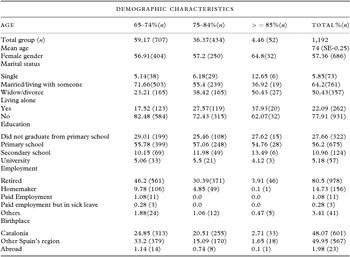
Table 1 shows the socio-demographic characteristics of the study sample. Mean age was 74 (SE = 0.25) and 57.36% were women. Only 22.17% of the sample lived alone.
Demographic characteristics by age (weighted proportions, absolute number)

Prevalence of mental disorders
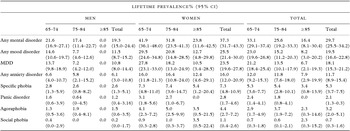
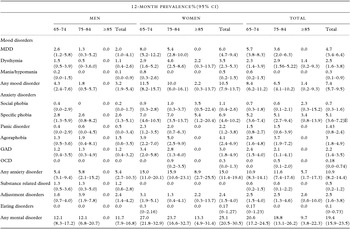
Tables 2 and 3 show the lifetime and 12-month prevalence of mental disorders by gender and age group.
Lifetime prevalence by age group and gender (weighted proportions and 95% CI)

MDD: major depressive disorder.
12-month prevalence by age group and gender. (weighted proportions, 95% CI)

MDD: Major depressive disorder; GAD: Generalized anxiety disorder; OCD: Obsessive compulsive disorder.
Lifetime prevalence
Nearly 30% of the sample had experienced at least one mental disorder in their lifetime and this was higher in women than in men (37.34% vs. 19.25%). Lifetime history of mood disorders was the most prevalent (19.52%), followed by anxiety disorders (11.73%). We did not find any mental disorder in men over 85 years. Prevalence of mental disorders decreased across the age groups in both men and women.
12-month prevalence
A total of 19.48% of the sample had a mental disorder in the previous 12 months, with a higher prevalence in women than in males. Anxiety disorders were the most frequent (10.9%), followed by mood disorders (7.37%). Eating-related (0.1%) and substance-related disorders (0.5%) were the least frequent ones.
The overall 12-month prevalence for any mood disorder is 7.37%, and this is higher in women (10.47%) than in men (3.21%). The prevalence of major depressive disorder was 4.67%, and again the figure for women was higher (6.04% vs. 2.03%). We also observed a downward trend in prevalence with increasing age.
As for anxiety disorder, the overall 12-month prevalence for any anxiety disorder is 10.9%. Specific phobia was the most prevalent disorder (5.06%), followed by generalized anxiety disorder (2.23%). In all conditions we found a higher prevalence in women than in men. Comorbidity between mood and anxiety disorders was 1.72%.
Factors associated with mental disorders, disability, stress and perceived social support. unadjusted analysis
Gender
Being female was associated with greater prevalence of mood disorder (OR = 3.52, 95% CI = 1.96–6.34 p < 0.001), anxiety disorder (OR = 3.11, 95% CI = 1.55–6.22, p < 0.002), and any mental disorder (OR = 2.55, 95% CI = 1.64–3.97, p < 0.001).
Comorbidity between 12-month mental disorders and chronic physical conditions
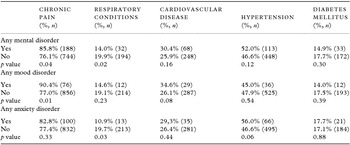
Having a mental disorder was associated with chronic pain and respiratory disease. Chronic pain was associated with affective disorders but not with anxiety disorders. On the other hand, respiratory disease was associated with anxiety disorders but not affective disorders. No statistically significant differences were found regarding the presence of cardiovascular disease, hypertension or diabetes mellitus among people with or without mental disorders. (Table 4)
Comorbidity somatic disorders and psychiatric disorders

Disability
The mean score in disability was 5.14 (SE = 0.28). Women were more disabled than men (Coef = 2.70, 95% CI = 1.76–3.64, p < 0.001). There were no differences across age groups. People who had a mental disorder also had greater disability (Coef = 3.94, 95% CI = 2.44–5.45, p < 0.001). Disability was also higher in people with any mood disorder (Coef = 7.32, 95% CI = 5.42–9.22, p < 0.001 and any anxiety disorder (Coef = 2.44, 95% CI = 0.52–4.35, p = 0.013).
Perceived social support
Mean perceived social support was 81.6 SE = 1.31. Women had lower perceived social support (Coef = −5.34, 95% CI = −7.88–2.80, p < 0.001. The older ones (>85 years old) had higher perceived social support compared with younger ones (Coef = 8.84, 95% CI = 3.71–13.96, p = 0.001).
Patients who had a mental disorder had lower perceived social support compared with those without. (Coef = −5.24, 95% CI = −10.45–0.03, p = 0.049). Patients with any mood disorders also had lower perceived social support (Coef = −12.7, 95% CI = −20.6–4.8, p = 0.002). There were no differences in patients with any anxiety disorders.
Perceived stress
Mean Perceived stress was 2.44 (SE = 0.15). There were no differences across age groups. Women had greater perceived stress (Coef = 1.07, 95% CI = 0.68–1.46, p < 0.001. Patients with any mental disorder had greater perceived stress (Coef = 2.40, 95% CI = 1.85–2.96, p < 0.001). Perceived stress was also higher in patients with any mood disorder (Coef = 3.29, 95% CI = 2.46–4.11, p < 0.001) and any anxiety disorder (Coef = 1.75, 95% CI = 1.06–2.44, p < 0.001).
Factors associated with mental disorders. adjusted analysis
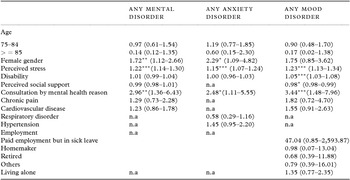
After performing multivariate model (Table 5), being female (OR = 1.72, 95% CI = 1.12–2.66, p < 0.01), greater perceived stress (OR = 1.22, 95% CI = 1.14–1.30, p < 0.001), and having a mental/emotional problem as the main reason for consultation (OR = 2.96, 95% CI = 1.36–6.43, p < 0.001) were the variables associated with a 12-month prevalence of any mental disorder.
Multivariate model. Association between demographic factors, comorbidity, disability, perceived stress, perceived social support and mental disease

n.a: not applicable. Significance levels: *p < 0.05; **p < 0.01; ***p < 0.001.
The same variables were associated with 12-month prevalence of anxiety disorders: being a woman (OR = 2.29, 95% CI = 1.09–4.82, p < 0.02), greater perceived stress (OR = 1.15, 95% CI = 1.07–1.24, p < 0.001), and having a mental/emotional problem as the main reason for consultation (OR = 2.48, 95% CI = 1.10–5.55, p < 0.02).
Regarding the 12-month prevalence of mood disorders, the variables that showed a significant association were: greater disability (OR = 1.05, 95% CI = 1.02–1.08, p < 0.001); greater perceived stress (OR = 1.22, 95% CI = 1.12–1.33, p < 0.001); lower perceived social support (OR = 0.98, 95% CI = 0.97–0.99, p < 0.04); and having a mental/emotional problem as the main reason for consultation (OR = 3.43, 95% CI = 1.48–7.96, p < 0.001).
Discussion
Summary of main results
We found that more than 19% of the PC population over 65 years old had suffered a mental disorder in the previous year. Rates were more frequent in women. We also observed an overall downward trend with increasing age. However, after adjusting for other factors, age was no longer associated with prevalence. A third of the older population had experienced a mental disorder in their lifetime.
Although the prevalence is high, it is noteworthy that it is lower than in younger adults (19% vs. 31%) (Serrano-Blanco et al., Reference Serrano-Blanco2010), as has already been stated in numerous studies (Byers et al., Reference Byers, Yaffe, Covinsky, Friedman and Bruce2010; Serrano-Blanco et al., Reference Serrano-Blanco2010). As we said above, several theories have been proposed to explain this phenomenon such as the suggestion by Charles and Carstensen (Reference Charles and Carstensen2008) that the elderly are more likely to disengage from stressful situations in ways that reduce adverse emotional effects.
There are four key findings in our study: (1) anxiety disorders were the most frequent disorders in our elderly population in the previous year; (2) people with mental disorder do not have more comorbidity after full adjustment for potential confounding variables; (3) age is not related to declining prevalence after full adjustment for potential confounding variables; (4) people with mental disorders have greater perceived stress.
Comparison with the literature
A little over 19% of the elderly PC population had suffered a mental disorder in the previous 12 months. These rates are similar to those reported in the PC population in the Linkoping (Olafsdóttir et al., Reference Olafsdóttir, Marcusson and Skoog2001) study in 2001 in Sweden (17%, excluding dementia patients) with a sample of 350 patients older than 70 years. However, our rates are lower than those reported by Almeida (Almeida et al., Reference Almeida1997) in 1997 or Olivera (Olivera et al., Reference Olivera2008) in 2008 in Huesca (Spain). Almeida assessed a sample of 351 patients over 60 years old in Brazil and found that more than one-third (33.1%) had a mental disorder. Olivera assessed 293 patients over 65 years old and found a prevalence of 46.1%. There is one other study in a PC setting with a very low prevalence in the USA, with a sample of 534 patients older than 65 years (5%) (Klapow, Reference Klapow2002). These differences could be explained by methodological issues, particularly case definition, instruments and disorders evaluated.
Anxiety disorders were the most prevalent disorders in our sample (10.9%). Specific phobia (5%) was the most prevalent, followed by agoraphobia (3%) and generalized anxiety disorder (2.2%). We found similar rates for any anxiety disorder as the Linkoping study (Olafsdóttir et al., Reference Olafsdóttir, Marcusson and Skoog2001) (11%), and, again, lower rates than those in the Olivera (Olivera et al., Reference Olivera2008) study (14.3%). We cannot find any other PC setting study which replicates our findings regarding the importance of anxiety disorders over the others, but we can find this pattern in some community studies such as the ECA study (Hybels and Blazer, Reference Hybels and Blazer2003) and the NCS-R study (Byers et al., Reference Byers, Yaffe, Covinsky, Friedman and Bruce2010).
Some 7.37% of our sample had had a mood disorder in the previous year, lower than that described in previous PC setting studies such as the Linkoping (Olafsdóttir et al., Reference Olafsdóttir, Marcusson and Skoog2001) (12%), or the AgeCoDe (Weyerer et al., Reference Weyerer2008) study in Germany in 2008 (9.7%), with a sample of 3,327 without dementia patients over 75 years old, using the geriatric depression scale 15 to measure depression. Major Depression was the most prevalent mood disorder (4.67%) in our sample, with a rate similar to that seen in previous studies (5%–10%) (Lyness et al., Reference Lyness, Caine, King, Conwell, Duberstein and Cox2002; Aragonès et al., Reference Aragonès2004).
These results highlight the public health relevance and the need for more research into those disorders among the elderly in PC.
Associated factors
Comorbidity between 12-month mental disorders and physical comorbidity
This subject has captured the interest of researchers, indicating an association between general psychiatric morbidity among patients with physical illness (Ormel et al., Reference Ormel2007; Scott et al., Reference Scott2007) and the presence of physical morbidity in psychiatric patients. This association was confirmed in the ZARADEMP Project in an elderly community sample in Spain (Lobo-Escolar et al., Reference Lobo-Escolar2008).
In our study, after adjusting for potential confounding variables, elderly people with mental disorders did not have more physical comorbidity than people without mental disorders. We think that the sample characteristics (i.e. clinic sample, with some possible “high users”) could explain why we have not found any association between chronic physical conditions and mental disorders. It is also possible that the self-report method we used to assess chronic physical conditions could explain these results. On the other hand, disability was associated with mood disorders. Thus, we can suggest that the impairment caused by the chronic conditions could be more important than the presence of the chronic condition itself. However, due to the cross-sectional design of our study, this suggestion should be treated with caution.
We would also like to stress that the fact that we adjusted with some variables that had not been used in other similar studies could determine these differences in results.
Age and gender
As far as we know, there are no studies conducted in PC studying the prevalence of a broad range of mental disorders in elder age groups. Some community studies suggest a pattern of declining prevalence with age (Klapow, Reference Klapow2002; Hybels and Blazer, Reference Hybels and Blazer2003; Gum et al., Reference Gum, King-Kallimanis and Kohn2009; Byers et al., Reference Byers, Yaffe, Covinsky, Friedman and Bruce2010), most of them grouping, within in the term elderly, the broad range of ages older than 65 years (sometimes 50, 55, or 60) and comparing them with younger adults (≤65). Our results show a general downward trend with increasing age although, after full adjustment for all potential confounding variables, age is not found to be related to declining prevalence across age groups.
In line with findings from previous studies (Olafsdóttir et al., Reference Olafsdóttir, Marcusson and Skoog2001; Hybels and Blazer, Reference Hybels and Blazer2003; Ritchie et al., Reference Ritchie2004; Olivera et al., Reference Olivera2008; Gum et al., Reference Gum, King-Kallimanis and Kohn2009; Byers et al., Reference Byers, Yaffe, Covinsky, Friedman and Bruce2010), in our sample women more frequently had a mental disorder. This is particularly true with anxiety disorders. It is important to emphasize that after full adjustment for potential confounding variables, we found that affective disorders are no longer related to being female. This phenomenon is also reported by previous studies (Olafsdóttir et al., Reference Olafsdóttir, Marcusson and Skoog2001; Olivera et al., Reference Olivera2008; Weyerer et al., Reference Weyerer2008). In addition to possible social factors, a further explanation could be related to hormonal changes, as some previous studies had observed a decrease in depression in postmenopausal women (Freeman et al., Reference Freeman, Sammel, Liu, Gracia, Nelson and Hollander2004).
Social support and perceived stress
It is generally agreed that social support plays a role in maintaining mental health and psychological well-being; and social isolation and loneliness has been implicated as being a risk for depression (Bruce, Reference Bruce2002; Golden et al., Reference Golden2009). Moreover, some studies found that higher levels of perceived stress at baseline and follow-up predict poor outcomes (Moak and Agrawal, Reference Moak and Agrawal2010; Kim et al., Reference Kim2011). In our study, we found that the higher the perceived social support, the lower the presence of affective disorders. We also noted that perceived stress is strongly related to having a mental disorder, an anxiety disorder or an affective disorder. Therefore, it is important to highlight the need for interventions in this area, identifying the population at risk and developing strategies to mitigate these potentially modifiable risk factors.
Finally, we also found that asking for help for mental health issues was related to having a mental disorder. This is important, since older adults are less likely to perceived a need for mental healthcare (Klap et al., Reference Klap, Unroe and Unützer2003) and, although depression is common in elderly, it is often under diagnosed, undertreated or untreated (Park and Unützer, Reference Park and Unützer2011). A recent meta-analysis showed that PC providers have more difficulties in detecting depression among elder patients than among younger ones (Mitchell et al., Reference Mitchell, Rao and Vaze2010). Therefore, it is very important improve physicians’ skills in terms of in recognizing and treating mental disorder, especially in those who are seeking help because, as our results show, this is frequently related to a mental disorder.
Strengths and limitations
The study has some strengths and limitations. Among the strengths, we have the use of a one-phase design, the randomized recruitment of a multisite, a geographically diverse and representative sample of PC outpatients, and the administration of structured psychiatric interviews for the diagnosis of mental disorders. However, some limitations should be mentioned. First, we considered a prevalence sample of PC patients, which tend to over represent people considered “frequent attendees” at ambulatory services. Various reviews have concluded that mental health problems are associated with frequent attendance (Menchetti et al., Reference Menchetti, Cevenini, De Ronchi, Quartesan and Berardi2006). As such, we may have overestimated the real prevalence of mental disorders in the PC setting. Second, we should note that, despite the large sample size, it does not have enough statistical power to analyze problems with low expected prevalence rates. We also found that the oldest individuals were underrepresented (≥85 years, 4.46%). The study does not include institutionalized elderly people in whom a number studies (McDougall et al., Reference McDougall, Matthews, Kvaal, Dewey and Brayne2007) have observed a higher prevalence of mental disorders. We also excluded patients with dementia, which may have led us to underestimate the prevalence of mood and anxiety disorders, often comorbid with cognitive disorders. In addition, since the DASMAP project is a cross-sectional study, we cannot conclude that factors associated with mental disorders are causally related. Further, chronic physical conditions were ascertained using a checklist rather than examination by a physician. However, methodology research has shown that self-reporting of chronic physical conditions shows moderate to high agreement with medical-record data (Evaluation of National Health Interview Survey diagnostic reporting, 1994). Finally, despite the wide use of the instruments used in epidemiological research, acceptable reliability of these instruments in the elderly population has not been satisfactorily demonstrated.
In spite of these limitations, we found that mental disorders in the elderly are highly prevalent in PC. Thus, we need to improve physicians’ skills in terms of recognizing and treating mental disorders in the elderly (giving greater importance to mental health during undergraduate training in medicine, stressing the relevance of mental health during the specialty training, through continuing education, etc.). Perceived stress and social support are two modifiable factors strongly associated with mental disorders. Therefore, it is important to develop strategies to identify the population at risk (e.g. assess perceived stress and social support regularly in PC), and take into account especially those who are seeking help since, as our results show, this is frequently related to a mental disorder. Due to population aging in Western Societies, special efforts are needed to reduce this prevalence, not just to decrease the societal cost and burden associated with mental disorders but, most importantly, to increase the well-being of our elderly adults.
Conflict of interest
None.
Description of author's roles
ASB and DJP conceived, designed and coordinated the development of the DASMAP study. With regard this paper, LB, AF, MRV, ASB conceived and designed the analysis. JCE and JAB collaborated in the design of the analysis. LB, AF, and MRV analyzed the data. LB, AF, and MRV drafted the paper and LB, AF, MRV, JCE, DJP, JAB, and ASB discussed and agreed the final version.
Acknowledgments
We are indebted to the family physicians and patients who participated in this study. Support: study funded by the “Direcció General de Planificació i Avaluació Sanitària Departament de Salut Generalitat de Catalunya” (Barcelona, Spain).
Supplementary material
To view supplementary material for this paper, please visit http://dx.doi.org/10.1017/S1041610214002841.