Introduction
Carotid–femoral pulse wave velocity (PWV) detects functional changes in the large arteries that precede the onset of clinical cardiovascular disease, with higher values indicative of increased vessel stiffness. In the adult population the metabolic syndrome (a cluster of risk factors for cardiovascular disease) is strongly associated with increased PWV.Reference Kim, Cho and Lee 1 Although components of the metabolic syndrome have been associated with increased PWV in pre-school children, these associations have not been analysed using twins. Nor has the association between subcutaneous adiposity and PWV been investigated in this age group.
Carotid–femoral PWV – the velocity of the arterial pulse between the carotid and femoral arteries – is the ‘gold standard’ measure of large vessel arterial stiffness. Increasing arterial stiffness is associated with increased cardiac stress, and associated with a higher incidence of cardiovascular events.Reference Willum-Hansen, Staessen and Torp-Pedersen 2 PWV has been shown to be reproducible both in large studies and clinical practice.Reference Wilkinson, Fuchs and Jansen 3 Thus, in adults, PWV is a standard component of cardiovascular risk assessment.Reference Urbina, Williams and Alpert 4 PWV measurement is well tolerated, reproducible and reliable, even in children as young as 2 years of age.Reference Currie, Proudfoot, Timmons and MacDonald 5 Previous studies in children and adults have established that higher PWV is associated with older age, increased height and elevated systolic blood pressure (SBP),Reference Reusz, Cseprekal and Temmar 6 – Reference Tikellis, Ponsonby and Wells 9 and further in adults with the cardiovascular risk factors of male gender, dyslipidemia, smoking and diabetes.Reference Mattace-Raso, Hofman and Verwoert 8 One study unexpectedly found a negative association between BMI and PWV.Reference Donald, Charakida and Falaschetti 10 No studies have included measures of adiposity (as quantified by skin-fold thickness),Reference Tikellis, Ponsonby and Wells 9 plasma lipid profile, or markers of insulin resistance.
Twin studies have illuminated the understanding of genetic and environmental determinants of cardiovascular disease,Reference Mangino and Spector 11 however none have used twin children to examine the determinants of childhood PWV. Evidence strongly suggests that cardiovascular risk is partly determined during childhood;Reference Urbina, Williams and Alpert 4 , Reference Aatola, Hutri-Kahonen and Juonala 7 , Reference Skilton 12 , Reference Chen, Srinivasan, Elkasabany and Berenson 13 and childhood twin studies allow partitioning of early life determinants;Reference Sun, Ponsonby and Wong 14 genetic (monozygotic 100%, dizygotic 50% shared genes), antenatal and post-natal environments.
Specific statistical methods allow us to compare twins overall, allowing for the lack of independence within twin pairs, as well as compare both twins as pairs (between-pair analysis) and also compare the individuals within a twin pair (within-pair analysis).Reference Carlin, Gurrin, Sterne, Morley and Dwyer 15 The method used here which involves examining within-twin associations between an exposure and an outcome allows ‘matching’ of each twin with their paired sibling for certain factors. Included among these factors are age and, in some pairs, sex – and for monozygotic pairs – genetic background. Examining twins overall identifies overarching associations between exposures and outcome. If there an association persists using the within-pair comparisons one can infer that something unique to each individual twin is contributing, rather than common to both twins. Thus, if an association reflects a shared maternal factor, a shared family factor (such as socioeconomic status) or shared uterine or childhood environment in the overall analysis, it will not be evident in the within-pair analysis. If it reflects a genetic contribution, it will be evident when studying within-pair analysis of dizygotic (50% shared genes) but not monozygotic (100% shared genes) twin pairs. If it is present even for a within-pair analysis for monozygotic twins it is more likely to reflect unshared environmental factors such as placental supply line factors or the non-shared childhood environment. These statistical methods have been used previously to explore the independent relationship between birth length and retinal arteriolar calibre, and the contribution on twin-specific in utero factors on this association.Reference Sun, Ponsonby and Wong 14 , Reference Carlin, Gurrin, Sterne, Morley and Dwyer 15
Here we report PWV measurements in school-aged twin children and the associations with components of the metabolic syndrome (including obesity, skin-fold thickness, hypertension and lipid profile). To our knowledge, this is the first study to examine these associations in twin children of this age.
Methods
The Tasmanian Infant Health Survey (TIHS) recruited live born infants between 1988 and 1995 as part of an investigation of sudden infant death syndrome. Of the 226 twin pairs in the original survey, 147 pairs (294 children) were recruited into a follow-up Child Blood Pressure Study that included PWV measurement. Twins were eligible if they still resided in Tasmania at the time of follow-up and were born between 1991 and 1993.Reference Morley, Dwyer and Hynes 16 Both the TIHS and Child Blood Pressure Study were approved by the University of Tasmania Human Research Ethics Committee.
Zygosity was confirmed for each twin pair by genetic testing of blood or buccal swabs. Anthropomorphic parameters were measured during a single study visit. Head circumference was measured three times and the maximum result recorded. Height was measured barefoot using a Leicester Height Measure. Weight was measured on Heine Portable Professional Adult Scales, with the children in light clothing. Body mass index (BMI) was calculated as weight in kilograms divided by the square of height in metres. Skin-fold thickness measurements were taken at multiple standardized anatomical locations (triceps, biceps, subscapular, suprailiac, calf and mid-abdominal) using Holtain calipers. Truncal skin-fold thickness was calculated by the sum of mid-abdominal, suprailiac and subscapular skin-fold measurements. All measurements were taken from the right side of the subject. In addition right mid upper arm circumference, waist and hip circumference were measured using protocols from the Australian Schools Health and Fitness Survey. 17
All children had blood taken following an overnight fast. Blood tests included lipid profile, insulin, glucose, C-peptide and cortisol levels. Resting blood pressure was recorded in from the left arm of seated children with their left elbow at heart level, using a Critikon Dinamap Pro 100 Monitor (Critikon, Tampa, FL, USA) with an appropriately sized cuff.
A total of three PWV measurements were attempted on all participants in a supine position with simultaneous ECG, using the SphygmoCor Pulse Wave Velocity (Vx) system (AtCor Medical Pty. Ltd, West Ryde, NSW, Australia), which has been validated in children.Reference Kis, Cseprekal and Kerti 18 Pulse pressure waves were detected using applantion tonometers (Millar microtip SPT301) held over two sites, the base of the right common carotid artery and the femoral artery. Integral software measured the time between the tip of the ECG R-wave and a specified point on the pulse wave, averaged for all acceptable waveforms over a period of 10 s for each site. The default algorithm measured the time between the tip of the R wave and 10% up from the foot of the flow wave. The difference between the times taken for the pulse wave to reach each of the two sites represented the time the pulse wave took to travel between the two sites. The distance between the femoral and carotid artery sites was measured using a non-stretchable tape measure in a straight line. PWV was calculated as distance (metres) between the femoral and carotid sites, divided by the time (seconds) the pulse wave took to travel between the two sites.
A measure of fitness was obtained using a 20-metre shuttle run test.Reference Morley, Dwyer and Hynes 16
Statistical analysis
Mixed linear regression analysis was performed as the main form of analysis to estimate associations between variables and PWV in the cases of twins as individuals (accounting for birth set clustering) (βc), between twin pairs (βB) and within-pair (βW).Reference Carlin, Gurrin, Sterne, Morley and Dwyer 15 These results were then stratified by zygosity. We used standard linear regression to determine the R 2 of the model and consider the contribution of each exposure. Analysis was performed using Stata11.2 (Stata Corp, College Station, TX, USA). P-values are two-sided, and statistical significance was assumed at P<0.05.
Results
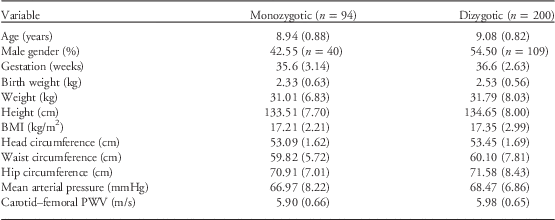
Of the 147 twin pairs, 47 were monozygotic and 100 dizygotic. There was no significant difference of age, gender, BMI or mean arterial blood pressure between the twin groups. Baseline characteristics between monozygotic and dizygotic twins are similar (Table 1). Between individuals within monozygotic twin pairs there was a strong correlation of BMI (r=0.91), weight (r=0.93), height (r=0.96) and head circumference (r=0.85), with moderate correlation between SBP (r=0.57) and PWV (r=0.53). Within dizygotic twin pairs, the correlations were smaller than in monozygotic twins; the correlations of SBP and PWV between twins were 0.44 and 0.36, respectively.
Characteristics of twin pairs by zygosity

BMI, body mass index; PWV, pulse wave velocity.
Unless percentage given, all results are mean (standard deviation).
PWV data were available on 289 children (mean 5.95 m/s, s.d. 0.66 m/s).
Standard linear regression analysis was conducted treating the twins as independent individuals and adjusting for age and sex. Height (β=0.01 m/spercm, 95% CI 0.00–0.03, P=0.048), weight (β=0.01 m/s per kilo, 95% CI 0.00–0.02, P=0.022), waist circumference (β=0.01 m/s per cm, 95% CI 0.00–0.02, P=0.010), hip circumference (β=0.01 m/s per cm, 95% CI 0.00–0.02, P=0.046), and truncal skin-fold thickness (β=0.01 m/spermm, 95% CI 0.00–0.01, P=0.009) were positively associated with PWV. BMI, birth weight and gestation were not significantly associated with PWV.
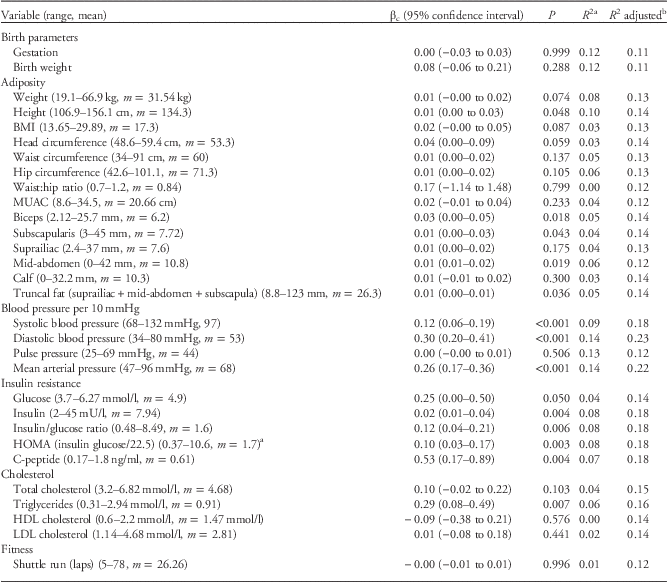
Mixed linear regression analysis was repeated treating the twins as individuals clustered by birth set and adjusting for age and sex (Table 2). Markers of adiposity such as biceps (βc=0.03 m/spermm, 95% CI 0.00–0.05, P=0.018), subscapularis (βc=0.01 m/spermm, 95% CI 0.00–0.03, P=0.043), and mid-abdominal (βc=0.01 m/s per mm, 95% CI 0.01–0.02, P=0.019) skin-fold thickness, as well as combined truncal skin-fold thickness (βc=0.01 m/s per mm, 95% CI 0.00–0.01, P=0.036) remained positively associated with PWV, while weight, waist circumference and hip circumference no longer showed a significant relationship. The association between truncal skin-fold thickness and PWV persisted after further adjusting for age, sex, BMI and maternal pre-pregnancy weight.
Associations of the elements of metabolic syndrome with carotid–femoral pulse wave velocity using linear regression analysis treating twins as independent individuals adjusting for birth-set clustering (
 $$ \beta $$
c), age and gender

MUAC, mid upper arm circumference; HOMA, homeostatic model assessment; HDL, high-density lipoprotein; LDL, low-density lipoprotein.
a Calculated from standard linear regression.
b Adjusted for age and sex.
Height directly impacts on carotid-femoral distance, which is a component of the PWV calculation. Height was positively associated with PWV, however current weight and BMI were not associated with PWV. Markers of insulin resistance [insulin, glucose, insulin/glucose ratio, homeostatic model assessment (HOMA) and C-peptide] were all strongly associated with PWV. Of the lipids measured, only triglycerides remained associated with PWV after adjusting for age and sex (Table 2). No association was seen between fitness (shuttle run) and PWV.
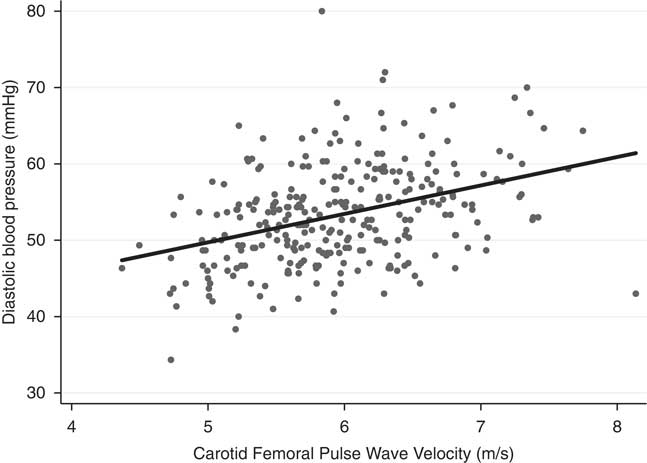
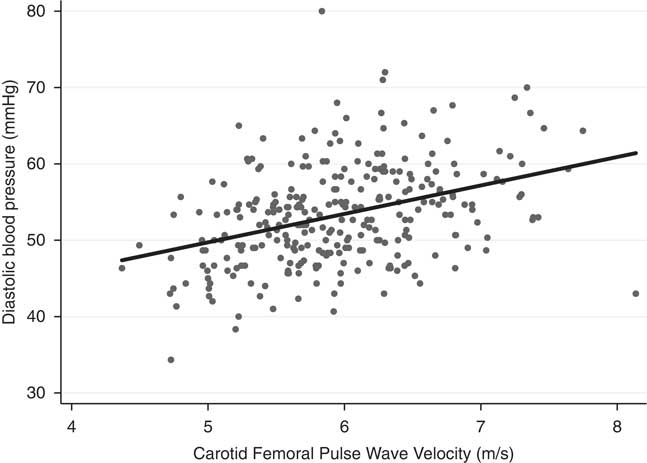
Central arterial blood pressure and arterial compliance are key determinants of PWV; the greater the force (blood pressure) and the stiffer the artery (compliance), the faster the pulse will travel. Thus it is expected that peripherally derived blood pressure will be strongly positively associated with PWV. Both simple linear regression analysis and mixed linear regression analysis of individual twins accounting for birth-set clustering found that systolic, diastolic and mean arterial blood pressure (average arterial pressure during a cardiac cycle) were all positively associated with PWV (SBP βc=0.12, 95% CI 0.06–0.019 per 10 mmHg, P<0.001; diastolic blood pressure βc=0.30, 95% CI 0.20–0.41, P<0.001; and mean arterial blood pressure βc=0.26, 95% CI 0.17–0.36, P<0.001) (Table 3). Diastolic blood pressure had the strongest association, accounting for 14% of the variance in PWV, and 23% of the variance in combination with age and gender (Fig. 1). The further inclusion of SBP in the model accounted for only a further 0.3% of the variance, reflecting the strong correlation between all blood pressure measures. When all markers of blood pressure, adiposity, lipids and glucose resistance were included in a multivariable model they accounted for 33% of the variability of PWV.
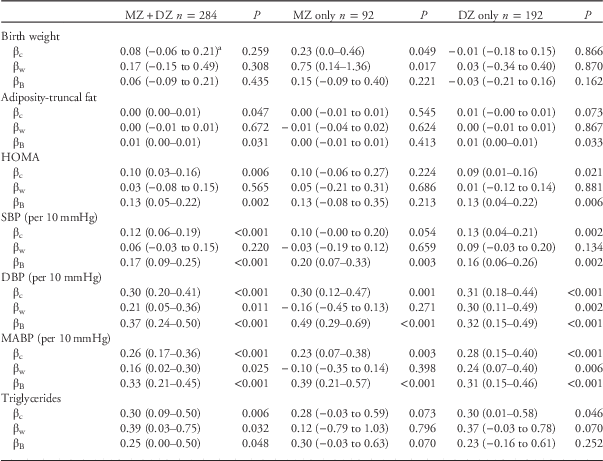
Associations of the elements of metabolic syndrome with carotid-femoral pulse wave velocity using mixed linear regression analysis

MZ, monozygotic; DZ, dizygotic; HOMA, homeostatic model assessment; SBP, systolic blood pressure; DBP, diastolic blood pressure, MABP, mean arterial blood pressure.
a βc – twins as individuals accounting for clustering; βw – within twin pair analysis; βB – between twin pair analysis.
Strong linear association between diastolic blood pressure and carotid–femoral pulse wave velocity, R 2=0.14.
In addition to analysing the twins as clustered individuals (βc), we examined estimates of between (βB) and within (βW) twin-pair associations (Table 3). The significant associations found between truncal skin-fold thickness, HOMA, blood pressure and triglycerides and PWV persisted in the between-pair analysis (βB), however, with the exception of triglycerides (βW=0.39 mmol/l, 95% CI 0.03–0.75), these were attenuated in the within-pair analysis (βW) (Table 3).
Repeating this analysis after stratifying by zygosity (Table 3), we found that birth weight was positively associated with PWV in monozygotic twins only, with the strongest association found in the within twin analysis (βW). In dizygotic twins the diastolic and mean arterial blood pressures were significantly associated with PWV both between twin pairs (βB) and within twin pairs (βW), with a positive trend in SBP and triglycerides. Further, in both monozygotic and dizygotic twins analysed as clustered individuals (βc) and twin pairs (βB), the positive association between higher triglyceride levels and PWV remained evident. This association remained significant in the within-twin pair analysis (βW) of dizygotic, but not monozygotic twins.
Discussion
Increased truncal adiposity, insulin resistance and elevated triglycerides are clearly associated with increased PWV, a marker of arterial stiffness, in twin school-aged children. The Avon Longitudinal Study of Parents and Children (ALSPAC) found an unexpected negative correlation between BMI and PWV,Reference Donald, Charakida and Falaschetti 10 whereas in our study the trend was positive but non-significant.
This is the first study to investigate known cardiovascular and metabolic risk factors and PWV in school-aged twins. ALSPAC studied a population of 7557 school-aged singleton children, but did not include skin-fold thickness, or metabolic markers such as lipid profile and insulin profile.Reference Donald, Charakida and Falaschetti 10 The Young Finns Study, a longitudinal population-based study of 1754 participants, found that participants with features of the metabolic syndrome in childhood (9–18 years) had increased arterial PWV in adulthood (aged 30–45 years), but childhood measures of PWV were not reported.Reference Koivistoinen, Virtanen and Hutri-Kahonen 19 Our study measured PWV in twin children, with the addition of multiple novel measures of adiposity and metabolic measures.
PWV is known to be a function of age, blood pressure, and distance between carotid and femoral vessels. The distance between carotid and femoral arteries is a function of the height of a subject. We found that PWV is associated with height and blood pressure, consistent with findings from previous studies, both in adultsReference Aatola, Hutri-Kahonen and Juonala 7 , Reference Mattace-Raso, Hofman and Verwoert 8 , Reference Kis, Cseprekal and Kerti 18 and children.Reference Reusz, Cseprekal and Temmar 6 , Reference Kis, Cseprekal and Kerti 18 Both height and blood pressure are major determinants of PWV, acting independently of other risk factors.Reference Aatola, Hutri-Kahonen and Juonala 7 , Reference Mattace-Raso, Hofman and Verwoert 8 , Reference Lilitkarntakul, Dhaun and Melville 20 The association between blood pressure and PWV persisted even in within-pair analysis (βW) in dizygotic but not monozygotic twins. This result suggests that there is a factor that could be considered a relevant confounder of the blood pressure relationship with PWV that is controlled for by stratification by pair. The most obvious such ‘confounder’ – one that is identical between members of monozygotic pairs – is their genetic background. Genetic differences remain in dizygotic pairs, and therefore the within-pair analysis fails to remove their effect.
Birth parameters such as gestation and birth weight did not show an association with PWV, except in stratified analysis. Monozygotic twins were born earlier, and at lower birth weights than dizygotic twins. It is also more frequent for one of a monozygotic twin pair to have growth restriction in pregnancy.Reference Dube, Dodds and Armson 21 Our results, however, show a positive correlation in monozygotic twins between birth weight and PWV, most evident in within-twin pair analysis. This is different to the expected association between intra-uterine growth restriction and cardiovascular events,Reference Barker, Winter, Osmond, Margetts and Simmonds 22 but may be explained post-natal growth.
Our study demonstrated strong positive associations between several markers of adiposity not previously reported, such as bicep and truncal skin-fold thickness, and PWV. The association between obesity and PWV has been found previously in a small specific exposure study comparing obese to lean children,Reference Celik, Ozcetin and Yerli 23 but not previously in a population-derived cohort of children. A population based study of 1306 participants which included school-aged children demonstrated an association between BMI and PWV, but it included subjects from 10 to 86 years of age and did not include measures of body composition.Reference Zebekakis, Nawrot and Thijs 24 In our study, truncal adiposity appeared to be important, remaining a significant predictor of PWV even after accounting for child BMI or maternal BMI pre-pregnancy. The within-twin pair analysis did not allow us to conclude this association was independent of shared maternal, family or antenatal factors.
Insulin Resistance was positively associated with increased PWV across all markers – HOMA, C-peptide, insulin/glucose ratio. This is consistent with adult data of a positive correlation between PWV and worsening glucose intolerance.Reference Webb, Khunti and Silverman 25 In adults, HOMA has been found to be the most powerful metabolic predictor of arterial stiffness.Reference Webb, Khunti and Silverman 25 Similarly a study of children and young adults aged between 10 and 24 years old, found an association between type 2 diabetes and higher PWV.Reference Urbina, Kimball, Khoury, Daniels and Dolan 26 Our study also indicates glucose intolerance is associated with increased PWV and thus arterial stiffness in twin children.
In adults, high triglycerides have been associated with increased PWV,Reference Koivistoinen, Hutri-Kahonen and Juonala 27 although data are inconsistent.Reference Wang, Ye and Luo 28 There are no published data reporting an association between triglyceride levels and PWV in school-aged children. Here, the association remained significant in combined between (βB) and within-twin pair (βW) analysis, and remained a strong positive trend within twin pair analysis (βW) for dizygotic, but not monozygotic, twin pairs. Similar to our findings with blood pressure and PWV, this result suggests that genetic differences (e.g. evident between dizygotic twins, not monozygotic twins) may influence this association more strongly than environmental influences. Unfortunately we were unable to determine the percentage contribution of genetic versus environmental factors in this data set.
Unlike other studies,Reference Sakuragi, Abhayaratna and Gravenmaker 29 we did not observe a clear negative correlation between PWV and cardiovascular fitness (20 m shuttle run), although this was our only measure of fitness.
Conclusion
In mixed linear regression analysis accounting for birth-set clustering, known cardiovascular risk factors are positively associated with higher PWV in twin children. Of particular importance were higher truncal adiposity, insulin resistance and elevated triglycerides. As expected, blood pressure was also an important determinant. In the detailed twin analysis, the contrasting results for dizygotic but not monozygotic twins indicate genetic factors may contribute to the associations of mean arterial, diastolic blood pressure and triglycerides with PWV. These results support both the genetic and environmental contribution to cardiovascular disease, and reiterate the importance of preventing metabolic syndrome from childhood.
Acknowledgement
The authors would like to thank the participants in the TIHS study.
Financial Support
The Tasmanian Infant Health Survey was supported by the US National Institutes of Health Grant 001 HD28979–01A1, Tasmanian State Government, Australian Rotary Health Research Fund, National Health and Medical Research Council of Australia, National Sudden Infant Death Syndrome Council of Australia, Sudden Infant Death Research Foundation of Victoria and other constituent organizations, Community Organizations’ Support Program of the Department of Human Services and Health, Zonta International, Wyeth Pharmaceuticals and Tasmanian Sanatoria After-Care Association. K.M. has a Sydney Myer research grant. A.-L.P holds a senior research fellowship with the National Health and Medical Research Council.
Conflicts of Interest
None.