


The ancient Greek philosopher Theophrastus was an early student of human personality. His character sketches, which depict people in their public and private dealings, underscore the essential insight of modern personality research: behaviors across what might at first seem like unrelated domains are correlated, and behavioral patterns can be explained by reference to underlying personality types (Gosling Reference Gosling2008). In recent years, personality psychologists have refined our understanding of personality and have reached a working consensus that personality traits can be comprehensively conceptualized and reliably measured in terms of five traits (the Big Five): Agreeableness, Openness (to Experience), Emotional Stability (sometimes referred to by its inverse, Neuroticism), Conscientiousness, and Extraversion.Footnote 1
Individual personality is shaped by experience—family dynamics, cultural forces, work experiences, and educational experiences. However, a great deal of evidence indicates that substantial variation in foundational personality dispositions such as the Big Five are stable from very early in life. There is evidence that these dispositional traits have some genetic basis (e.g., Bouchard Reference Bouchard, Blum and Noble1997; Plomin et al. Reference Plomin, DeFries, McClearn and McGuffin1990; Van Gestel and Van Broeckhoven Reference Van Gestel and Van Broeckhoven2003) and are quite stable through the life cycle (Caspi, Roberts, and Shiner Reference Caspi, Roberts and Shiner2005; Costa and McCrae Reference Costa and McCrae1992; Gosling, Rentfrow, and Swann Reference Gosling, Rentfrow and Swann2003).Footnote 2 These personality differences affect how individuals respond to the stimuli they encounter in their environment. As such, personality traits can likely be viewed as predating, rather than being caused by, social and political influences, offering an opportunity to examine how fundamental, enduring personality differences affect an array of social outcomes, including political attitudes and behaviors.
Research finds that Big Five traits can explain substantial amounts of variation in a variety of opinions, behaviors, and outcomes. For example, Borghans et al. (Reference Borghans, Duckworth, Heckman and ter Weel2008) report that the predictive power of dispositional traits “equals or exceeds the predictive power of cognitive traits for schooling, occupational choice, wages, health behaviors, teenage pregnancy, and crime” outcomes (1006). Others have found that these traits affect outcomes such as behavior in economic games (Ben-Ner, Kramera, and Levy Reference Ben-Ner, Kramera and Levy2008; Koole, Jager, and van den Berg Reference Koole, Jager and van den Berg2001), political tolerance (Marcus et al. Reference Marcus, Sullivan, Theiss-Morse and Wood1995, ch. 8), job satisfaction (Hogan and Holland Reference Hogan and Holland2003; Salgado Reference Salgado1997), alcohol and tobacco consumption (Paunonen and Ashton Reference Paunonen and Ashton2001), and physical and mental health (Goodwin and Friedman Reference Goodwin and Friedman2006). Although the Big Five personality traits have only recently begun to receive attention in political science, existing evidence suggests that they are significant predictors of political outcomes such as ideology and turnout (Gerber et al. Reference Gerber, Huber, Doherty, Dowling, Raso and Ha2010b; Mondak and Halperin Reference Mondak and Halperin2008). Indeed, the size of the effects of these traits rivals those of canonical predictors of political behavior that have been the subject of countless studies—such as education and income (Gerber et al. Reference Gerber, Huber, Doherty, Dowling, Raso and Ha2010b).
In this article, we use a large national survey of registered voters conducted around the 2008 presidential election to examine the relationships between dispositional personality traits (the Big Five) and political attitudes. We utilize a theoretical framework for studying how personality affects political attitudes and behavior. Building on recent work in psychology, we argue that political attitudes should be thought of as characteristic adaptations—“middle-level units”—that are the product of essential dispositional traits and environmental factors (McCrae and Costa Reference McCrae, Costa, Pervin and John1999, 145; also see McAdams and Pals Reference McAdams and Pals2006). McCrae and Costa (Reference McCrae1996) describe characteristic adaptations as “acquired skills, habits, attitudes, and relationships that result from the interaction of individual and environment” (69). In this framework, political issues and ideological labels are “stimuli” to which the Big Five traits shape responses. Notably, the meaning of these stimuli is shaped by environmental factors such as political context. One important implication is that the link between personality and political attitudes may be subtle; if political stimuli are understood differently by different people, then the observed relationship between personality traits and political attitudes, such as ideology and issue positions, should also vary. More generally, this approach provides a structure for developing hypotheses regarding aggregate-level relationships between Big Five traits and political outcomes, as well as expectations for how environmental factors moderate these relationships.
We apply the conceptual framework of characteristic adaptations to guide our empirical investigation of the links between personality and political attitudes. We make two empirical contributions to the understanding of how personality is related to political attitudes. First, because for many people the reasons for preferring liberal social policies may be different from the reasons for preferring liberal economic policies, we investigate the effects of personality on self-reported liberal-conservative ideology and both economic and social policy opinions separately. We find that certain personality traits explain liberal or conservative leanings in both policy domains, providing an individual-level explanation for “ideological constraint” (the empirical finding that seemingly unrelated attitudes “go together” in the political arena [Converse Reference Converse and Apter1964]; see also Jost Reference Jost2006). We also show that the aggregate effects of Big Five traits on overall self-reported ideology mask important differences in the separate effects of these personality traits on social and economic policy attitudes, a finding that helps explain the apparent lack of a relationship between, for example, the Big Five trait of Agreeableness and overall self-reported ideology. Our large national data set permits us to both resolve inconsistent findings from previous research and identify even modest relationships between personality traits and political attitudes.
Second, we use the characteristic adaptations framework to formulate and test hypotheses about how individual personality interacts with political and social context (environment) to produce political attitudes. Because racial groups provide relatively clear and identifiable differences in context in the United States, we examine black–white differences in the relationship between personality and political attitudes as a test case. (We use the label “black” rather than African American because the survey instrument we employ asked respondents to self-categorize using this label. On the difference between “black” and “African American,” see Sigelman, Tuch, and Martin Reference Sigelman, Tuch and Martin2005.) Our contribution is to both present hypotheses about how context moderates these relationships and empirically investigate these hypotheses. We find support for our expectations. For example, Conscientiousness and Emotional Stability are more strongly associated with conservative economic views among white Americans than among black Americans. Overall, our findings provide evidence that although dispositional traits shape how individuals respond to political stimuli, because the social meanings of political stimuli (e.g., policy proposals) vary across environments (political context), so too do the relationships between Big Five traits and characteristic adaptations (i.e., political attitudes).
The remainder of this article is organized as follows. We begin by describing the Big Five traits in more detail, addressing how these traits were identified and how they differ from other psychological characteristics—such as Right-Wing Authoritarianism (RWA)—that have received substantial attention in political research. Next we convey our expectations regarding the relationships between Big Five traits and political attitudes. We also discuss how interpretations of stimuli such as ideological labels likely vary across racial groups and describe our expectations regarding how these varying interpretations might lead individuals with similar dispositional traits to different characteristic adaptations (ideologies and issue attitudes). We then describe our data and present our analysis. We conclude by discussing the implications of our findings.
1 DISPOSITIONAL TRAITS—THE BIG FIVE
The Big Five personality dimensions were identified through lexical analysis. The lexical approach rests on the notion that “most of the socially-relevant and salient personality characteristics have become encoded in the natural language” (John and Srivastava Reference John, Srivastava, Pervin and John1999, 103). In essence, we are able to make meaningful judgments about the most fundamental aspects of what people (including ourselves) are like, and our language includes an array of words that allow us to effectively express those judgments. Lexical analysis involves gathering a set of descriptors that might be used to describe enduring personality characteristics. Individuals are then asked to rate how well each trait describes themselves or a peer. These ratings are then factor-analyzed to identify clusters of descriptors that tap the same underlying dimensions of personality. Early research was groundbreaking in applying and refining the method, but was constrained by limitations in computing resources (e.g., Allport and Odbert Reference Allport and Odbert1936; Cattell Reference Cattell1943). Despite these early limitations, however, evidence that core personality traits are organized along five underlying factors emerged over time (John and Srivastava Reference John, Srivastava, Pervin and John1999, 105). These five traits are described by John and Srivastava (Reference John, Srivastava, Pervin and John1999, 121) as follows:
Extraversion implies an energetic approach to the social and material world and includes traits such as sociability, activity, assertiveness, and positive emotionality. Agreeableness contrasts a prosocial and communal orientation toward others with antagonism and includes traits such as altruism, tender-mindedness, trust, and modesty. Conscientiousness describes socially prescribed impulse control that facilitates task- and goal-directed behavior, such as thinking before acting, delaying gratification, following norms and rules, and planning, organizing, and prioritizing tasks. [Emotional Stability describes even-temperedness and] contrasts . . . with negative emotionality, such as feeling anxious, nervous, sad, and tense. . . . Openness to Experience (versus closed-mindedness) describes the breadth, depth, originality, and complexity of an individual's mental and experiential life. (bold added for emphasis; italics in original)
The Big Five are core dispositional personality traits—“stable individual level differences in people's motivational reactions to circumscribed classes of environmental stimuli” (Denissen and Penke Reference Denissen and Penke2008, 1286). Over the past several decades, researchers have found that the Five-Factor Model (Big Five) appears robust to variation in samples, types of raters, and methodological variations (John and Srivastava Reference John, Srivastava, Pervin and John1999, 106). Although researchers still contest exactly how to label the Big Five dimensions (e.g., Saucier Reference Saucier1994; Trapnell Reference Trapnell1994), the strength and robustness of findings from research using the Big Five has led to a great deal of enthusiasm. Costa and McCrae describe the Big Five as “the Christmas tree on which findings of stability, heritability, consensual validation, cross-cultural invariance, and predictive utility are hung like ornaments” (Costa and McCrae Reference Costa and McCrae1993, as cited in McCrae and Costa Reference McCrae, Costa, Pervin and John1999, 139).
It is important to be clear about the distinctions between these Big Five traits and characteristic adaptations. As should be plain from the traits’ descriptions, the Big Five are basic and general orientations. They are commonly thought of as “core” personality traits (Asendorpf and van Aken Reference Asendorpf and van Aken2003)Footnote 3 because they “are based on genetic differences and/or early childhood experiences, with limited susceptibility to social and contextual influences later in life” (Ekehammar and Akrami Reference Ekehammar and Akrami2007, 900; see also, Bouchard and Loehlin Reference Bouchard and Loehlin2001; Plomin and Caspi Reference Plomin, Caspi, Pervin and John1999). They are therefore theorized to be causally prior to traits that are influenced by both core personality traits and contextual factors, which are instead often referred to as “characteristic adaptations” (McAdams and Pals Reference McAdams and Pals2006; McCrae and Costa Reference McCrae, Costa and Wiggins1996; Olver and Mooradian Reference Olver and Mooradian2003). These characteristic adaptations, that is, individual-level differences “contextualized in time, situations and social roles” (McAdams and Pals Reference McAdams and Pals2006, 208; also see McCrae and Costa Reference McCrae and Costa1994, Reference McCrae, Costa and Wiggins1996) encompass an array of aspects of human individuality such as values, attitudes (including political attitudes such as ideology), expectations about one's role in society, and personal goals (McAdams and Pals Reference McAdams and Pals2006; McCrae and Costa Reference McCrae and Costa2003). In the McAdams and Pals model, these characteristic adaptations, such as RWA and Social Dominance Orientation (SDO; a measure of group-based discrimination), are a product of dispositional traits, such as the Big Five (see Akrami and Ekehammar Reference Akrami and Ekehammar2006; Ekehammar et al. Reference Ekehammar, Akrami, Gylje and Zakrisson2004), and the environment (see Sibley and Duckitt Reference Sibley and Duckitt2008). As such, although some of the adaptations are also quite stable, they are shaped in part by context and may also change in response to contextual changes. To our knowledge, however, the only study to consider such contextual differences in the relationships between Big Five traits and political attitudes is Sibley and Duckitt's (Reference Sibley and Duckitt2008) meta-analysis of the effects of Big Five traits on SDO, RWA, and prejudice in European and North American samples.Footnote 4
There is an extensive and important body of work examining the relationship between a variety of political attitudes and other characteristic adaptations. These adaptations include, among others, RWA (e.g., Adorno et al. Reference Adorno, Frenkel-Brunswick, Levinson and Sanford1950; Altemeyer Reference Altemeyer1996; Ekehammar et al. Reference Ekehammar, Akrami, Gylje and Zakrisson2004; Feldman Reference Feldman2003; Feldman and Stenner Reference Feldman and Stenner1997; Hetherington and Weiler Reference Hetherington and Weiler2009; Stenner Reference Stenner2005), SDO (e.g., Ekehammar et al. Reference Ekehammar, Akrami, Gylje and Zakrisson2004; Sidanius and Pratto Reference Sidanius and Pratto1999; Sidanius, Pratto, and Bobo Reference Sidanius, Pratto and Bobo1996), Racial Resentment (e.g., Feldman and Huddy Reference Feldman and Huddy2005; Henry and Sears Reference Henry and Sears2002; Kinder and Mendelberg Reference Kinder, Mendelberg, Sears, Sidanius and Bobo2000; Kinder and Sanders Reference Kinder and Sanders1996; Kinder and Sears Reference Kinder and Sears1981; Sniderman and Carmines Reference Sniderman and Carmines1997), and core values (e.g., Goren Reference Goren2001, Reference Goren2005; Jacoby Reference Jacoby2006). Our work contributes to this research by examining (1) how basic dispositional traits—arguably formed prior to these characteristic adaptations—shape political attitudes (another characteristic adaptation) and (2) how the effects of Big Five traits vary across clearly identified contexts.
2 THE BIG FIVE AND POLITICAL ATTITUDES
A number of previous studies have documented relationships between Big Five traits and political attitudes in U.S. samples. A review of that research appears in Table 1, which summarizes findings about the relationship between the individual traits and (1) self-reported liberal/conservative ideology, as well as both (2) liberal/conservative economic policy attitudes (e.g., beliefs about size of government, redistribution, and risk sharing) and (3) liberal/conservative social policy attitudes (e.g., attitudes on issues such as abortion, gay marriage, and the role of religion in public life).Footnote 5 In addition, Table 1 reports whether the relationships between Big Five traits and these characteristic adaptations have been studied across contexts (i.e., for specific groups) and in national samples. We note two important gaps in this literature.
Summary of Relationships between the Big Five and Ideology and Policy Attitudes in U.S. Samples

Note: Table includes published work that examines the relationship between the Big Five and ideology and policy attitudes in U.S. samples. See text for complete list of citations.
None = Statistically insignificant relationships (p > .05). + = Positive and statistically significant relationship between trait and liberal attitudes (p < .05). – = Negative and statistically significant relationship between trait and liberal attitudes (p < .05).
† Indicates relationship observed in more than 3 studies. Exceptions noted are in these articles: [A] Carney et al. (Reference Carney, Jost, Gosling and Potter2008); [B] Gosling, Rentfrow, and Swann (Reference Gosling, Rentfrow and Swann2003); [C] Mondak and Halperin (Reference Mondak and Halperin2008).
First, although there are several studies of the overall relationship between the Big Five and self-reported ideology, there is only a single published study that examines the relationship between the Big Five and economic and social policy attitudes. That pioneering study by Carney et al. (Reference Carney, Jost, Gosling and Potter2008) employs a sample of undergraduates (N < 600) from a single university who participated in a survey for course credit and finds that Openness is associated with social liberalism and Extraversion is associated with social conservatism. They also find a weak relationship between Conscientiousness and social conservatism. The relative lack of attention to different policy domains is surprising, both because attitudes are not obviously related across issue domains and also because the sources of beliefs in these domains are themselves important. In addition, because overall ideology likely builds on one's beliefs about both economic and social policy (with a relative weighting of these dimensions that may vary across individuals), our understanding of overall ideological orientation must build on knowledge of what undergirds opinions in particular domains.
Second, no published studies have explored whether differences in the political or social environment/context alter the relationship between the Big Five (or other core dispositional traits) and these political attitudes.Footnote 6 The Big Five is seen in psychological theory as causally prior to attitudes and other characteristic adaptations. Therefore, showing that the mapping of Big Five traits to these political attitudes is context dependent demonstrates that core personality differences across individuals are not direct sources of political beliefs, but rather that these core dispositional traits shape the responses to stimuli that will have different meanings in different contexts. Thus, the relationship between the Big Five and political attitudes will not be context independent, but instead will vary with features of the political and social environment. To illustrate the logic of this argument, consider the trait of Openness, which is associated with willingness to challenge and question existing conventions and assumptions. Among individuals in homogenously conservative social groups, this tendency to question existing norms is likely to be associated with liberalism. In contrast, among those in homogenously liberal groups, this trait may incline people toward conservatism. We are unaware of any empirical effort to investigate whether the relationship between personality and political attitudes varies across population groups.
We build on the existing research to generate hypotheses about the aggregate (or average) effect of Big Five traits on both overall ideology and attitudes in these two policy domains. Given our theoretical framework, which points to the possibility that the relationship between personality and political attitudes varies across context, we note that, as in prior research, our hypotheses for the “typical” American necessarily assume a dominant common political context or environment that not all survey respondents may experience. Such a concern motivates our second exercise in this section: identifying contextual differences for citizens in different racial groups in the United States, and using that variation to hypothesize about how these contexts alter the meaning of political stimuli and, therefore, the mapping of Big Five traits to political attitudes.
2.1 Aggregate Predictions: Personality and Overall, Economic, and Social Ideology
Here, we present our specific hypotheses about the average effects of Big Five traits on overall ideology and in the economic and social policy domains. Building on the framework discussed previously, which argued that Big Five traits affect how individuals respond to political stimuli, our theorizing focuses on how personality traits likely affect responses to these different stimuli. To organize our presentation, we consider each Big Five trait separately. As a reminder, the results of previous research using U.S. samples are summarized in Table 1.
We begin with Conscientiousness, which previous research has found is related to overall conservative ideology (Carney et al. Reference Carney, Jost, Gosling and Potter2008; Gosling, Rentfrow, and Swann Reference Gosling, Rentfrow and Swann2003; Mondak and Halperin Reference Mondak and Halperin2008; Stenner Reference Stenner2005, ch. 6; but see Alford and Hibbing Reference Alford and Hibbing2007 and Mehrabian Reference Mehrabian1996) and voting for conservative/right-wing candidates (Barbaranelli et al. 2007; Caprara, Barbaranelli, and Zimbardo Reference Caprara, Barbaranelli and Zimbardo1999; Caprara et al. Reference Caprara, Schwartz, Capanna, Vecchione and Barbaranelli2006; Rentfrow et al. Reference Rentfrow, Jost, Gosling, Potter, Jost, Kay and Thorisdottir2009; Schoen and Schumann Reference Schoen and Schumann2007). Given that those who are more Conscientious exhibit socially prescribed impulse control and are more likely to adhere to norms and rules (John and Srivastava Reference John, Srivastava, Pervin and John1999; Jost Reference Jost2006; Jost et al. Reference Jost, Glaser, Kruglanski and Sulloway2003), this is not surprising: identifying as a conservative involves supporting traditional norms in both the economic (e.g., work hard and you will get ahead [Devine Reference Devine1972; Feldman Reference Feldman1988; Feldman and Zaller Reference Feldman and Zaller1992; Goren Reference Goren2005; Lipset Reference Lipset1979; McClosky and Zaller Reference McClosky and Zaller1984]) and social (e.g., defend traditional family values [Goren Reference Goren2005; McCann Reference McCann1997]) policy domains. For these reasons, we expect Conscientiousness to predict overall, economic, and social policy conservatism.
Next, consider the trait of Openness (to Experience), which has consistently been associated with identifying as liberal (Carney et al. Reference Carney, Jost, Gosling and Potter2008; Gosling, Rentfrow, and Swann Reference Gosling, Rentfrow and Swann2003; Jost et al. Reference Jost, Glaser, Kruglanski and Sulloway2003; McCrae Reference McCrae1996; Mehrabian Reference Mehrabian1996; Mondak and Halperin Reference Mondak and Halperin2008; Riemann et al. Reference Riemann, Grubich, Hempel, Mergl and Richter1993; Stenner Reference Stenner2005, ch. 6; Van Hiel, Kossowska, and Mervielde Reference Van Heil, Kossowska and Mervielde2000; Van Hiel and Mervielde Reference Van Hiel and Mervielde2004) and left-party voting (Barbaranelli et al. Reference Barbaranelli, Caprara, Vecchione and Fraley2007; Caprara, Barbaranelli, and Zimbardo Reference Caprara, Barbaranelli and Zimbardo1999; Caprara et al. Reference Caprara, Schwartz, Capanna, Vecchione and Barbaranelli2006; Rentfrow et al. Reference Rentfrow, Jost, Gosling, Potter, Jost, Kay and Thorisdottir2009; Schoen and Schumann Reference Schoen and Schumann2007) in earlier research.Footnote 7 As suggested in prior research demonstrating the link between Openness and liberalism, those who are more open respond positively to unconventional and complex stimuli (Neuberg and Newsom Reference Neuberg and Newsom1993). It follows that this attraction to novelty and tolerance for complexity encourage not only overall liberalism, but also support for liberal social and economic policies, which typically involve new programs or interventions that overturn existing practices.
Prior work has typically found no relationship between Agreeableness and overall ideology (e.g., Gosling, Rentfrow, and Swann Reference Gosling, Rentfrow and Swann2003; Mehrabian Reference Mehrabian1996; Mondak and Halperin Reference Mondak and Halperin2008; Riemann et al. Reference Riemann, Grubich, Hempel, Mergl and Richter1993). However, Carney et al. (Reference Carney, Jost, Gosling and Potter2008) do find Agreeableness to be weakly associated with conservatism in their two largest samples (N = 1,826 and N = 17,103). Agreeable individuals are “prosocial and communal in orientation,” and can be characterized by more specific facets such as “altruism, tender-mindedness, trust, and modesty” (John and Srivastava Reference John, Srivastava, Pervin and John1999, 121). This trait may incline individuals to respond positively to liberal economic policies because they see them as a means to help others (see Graziano et al. Reference Graziano, Bruce, Sheese and Tobin2007). Agreeable individuals may respond positively to liberal social policies for similar reasons. However, it could also be the case that a desire to maintain social harmony predisposes Agreeable individuals to respond negatively to liberal social policies (e.g., gay marriage, abortion) that may upset existing and functioning communal relationships. Given these potentially offsetting influences with regard to social policy, we remain agnostic regarding the associations between Agreeableness and both social policy opinions and overall ideology.
Emotional Stability, which is associated with even-temperedness and resilience (in contrast to being anxious and tense), is sometimes found to be correlated with conservative ideology (Carney et al. Reference Carney, Jost, Gosling and Potter2008; Gosling, Rentfrow, and Swann Reference Gosling, Rentfrow and Swann2003; Mondak and Halperin Reference Mondak and Halperin2008) and voting for right parties (Barbaranelli et al. Reference Barbaranelli, Caprara, Vecchione and Fraley2007). We therefore expect a similar association between Emotional Stability and self-identifying as a conservative. In terms of economic policy opinions, because they are more anxious and worry prone, we expect those low on Emotional Stability to be more likely to embrace liberal economic policies that create “safety nets” and reduce exposure to market risks. The likely relationship between Emotional Stability and social policy attitudes is less clear. On the one hand, those who are more Stable may be less threatened by proposed changes to the social status quo. On the other hand, greater emotionality may lead the less Stable to identify with those who seek redress through social interventions.
Finally, consider Extraversion, which prior research has found is not related to ideological self-placement. Extraverts exhibit positive emotionality and are sociable, and although these motivations encourage political participation (e.g., Gerber et al. Reference Gerber, Huber, Doherty, Dowling, Raso and Ha2010b; Mondak and Halperin Reference Mondak and Halperin2008; Vecchione and Caprara Reference Vecchione and Caprara2009) and strong partisan attachments (Gerber et al. Reference Gerber, Huber, Doherty and Dowling2010a), there seems little reason to believe that this trait itself encourages particular economic or social policy views, although Carney et al. (Reference Carney, Jost, Gosling and Potter2008) do find Extraversion to be related to social conservatism in one of their samples (detailed previously).
2.2 Context Effects
Although the previous section examined aggregate relationships between dispositional traits and political attitudes in the United States, here we focus on developing hypotheses about how these effects are likely to vary across contexts (within the U.S.). Doing so requires identifying some set of individuals for whom we can make reasonable assumptions about how contextual factors affect the meaning of political stimuli. Ideally, such assessments rest on a substantial body of research rather than conjecture, and this group should be defined based on characteristics that are not, themselves, caused by dispositional traits. In the United States, we argue, one promising case for such an analysis of contextual effects is differences between black and white Americans, an important subject in its own right that has received substantial previous attention.
Previous research (as well as the data we use here) consistently finds that, relative to whites, black Americans are, on average, more likely to identify as liberal and hold more liberal economic policy opinions (e.g., Jackman Reference Jackman1994; Kinder and Sanders Reference Kinder and Sanders1996; Kinder and Winter Reference Kinder and Winter2001; Tate Reference Tate1994). Consistent with a shared history of experienced racial discrimination (Dawson Reference Dawson1994, Reference Dawson and Walton1997; Gurin, Hatchett, and Jackson Reference Gurin, Hatchett and Jackson1989; Herring, Jankowski, and Brown Reference Herring, Jankowski and Brown1999; Sellers et al. Reference Sellers, Smith, Shelton, Rowley and Chavous1998), black Americans are more likely than white Americans to express feelings of “linked fate” across social classes (Dawson Reference Dawson1994, Reference Dawson2001; Gay and Tate Reference Gay and Tate1998; Jaynes and Williams Reference Jaynes and Williams1989; Simien Reference Simien2005; Tate Reference Tate1994) and to believe that economic differences are rooted in racial discrimination and imbalances in resource allocation (Jackman Reference Jackman1994; Kinder and Winter Reference Kinder and Winter2001). In short, these data suggest that among black Americans, liberal economic policy tends to be understood not as redistributing to those who have made poor choices, but instead as an obligation to those who are poor for systematic reasons. Likewise, calling oneself a liberal may have a different meaning among white Americans. At the same time, black and white opinions do not differ substantially on non-race-related social policy issues (e.g., Lewis Reference Lewis2003; Wilcox Reference Wilcox1990). The differences in how black and white Americans understand economic policies and ideological labels provide a way to specify expectations regarding how the relationships between dispositional traits and these political attitudes vary across these groups.Footnote 8
The personality trait Conscientiousness provides an excellent case for understanding the relationships among dispositional traits, contexts, and attitudes. Previous work has argued that the Conscientious are more likely to be conservative because of their inclination to be dutiful and follow prescribed social rules. Existing research on attitudinal differences across racial groups suggests, however, that what it means to be dutiful is likely to be quite different for black and white Americans. We therefore conjecture that Conscientiousness will be more strongly associated with overall and economic conservatism among whites than among blacks because Conscientious black Americans may see redistributive policies (and being a liberal) as dutiful (e.g., helping those who are in bad circumstances through no fault of their own) rather than as undermining social norms (e.g., work hard and you will get ahead). We do not have strong expectations about differences between black and white Americans with regard to social policy because of the apparently small difference in norms across racial groups.
Similarly, the effect of Openness to Experience, which is associated with positive response to novel ideas and experiences, may vary for overall ideology and economic policy opinions across these racial groups. To the extent that black Americans face more homogenously liberal environments than whites, we expect that Openness will be more strongly associated with liberalism among whites than among blacks, for whom questioning existing conventions may include questioning a commitment to liberalism and liberal economic policies. For the reasons outlined previously, we do not have clear expectations about differences with regard to social policy opinions.
The Big Five trait Agreeableness provides more limited predictions with regard to context differences. Agreeableness is associated with a communal orientation and broad feelings of warmth toward others, but it is less clear why the relationships predicted previously are likely to vary across groups. We do note that to the extent that black Americans support liberal economic policy for reasons other than empathy for the poor (i.e., support for such policies is due to “linked fate”), economically liberal policies will not be interpreted in these terms. Thus, the importance of Agreeableness in promoting economic liberalism will likely be diminished for this group. We do not expect differences in terms of the relationship between Agreeableness and overall ideology or social policy opinions.
Our predictions with regard to the effects of differences in the trait Emotional Stability are similarly targeted. If less stable individuals are economically liberal because they are concerned about risks to economic security, this effect will likely be mitigated for black Americans to the extent that liberal economic policies are not understood as a hedge against personal misfortune. Put another way, if black Americans support liberal economic policies to reduce racial inequality, then their dispositional responses to risk may be largely irrelevant. We have no clear expectations with regard to overall ideological self-placement or social policy opinions.
Finally, we have no strong expectations about how the effect of Extraversion, which is associated with social activity and positive emotions, will vary across racial groups. If Extraversion predicts that social interaction and social environments are racially stratified, then peer influence might induce different sets of attitudes across racial groups; however, this is causally distinct from the argument that political stimuli have different meanings in these groups that are relevant to levels of Extraversion.
3 DATA AND ANALYSIS
The data for our analysis are drawn from the 2007–2008 Cooperative Campaign Analysis Project (CCAP; Jackman and Vavreck Reference Jackman and Vavreck2009). The CCAP is an Internet-based survey of registered voters that uses a combination of sampling and matching techniques to account for the fact that opt-in Internet survey respondents may differ from the general population on factors such as political interest. This process is designed to approximate a random digit dialing sample.Footnote 9 Our data come from the baseline wave of the study conducted between December 17, 2007 and January 3, 2008. The full survey includes 20,000 respondents. We restrict our sample to respondents who participated in the baseline survey and provided responses to all questions used to measure the Big Five (N = 14,601). Of these, 2,129 (14.6%) did not provide responses to all five measures of political attitudes that serve as our dependent variables and are therefore excluded from the analysis that follows.
We examine three measures as dependent variables in our analysis. To ease interpretation, all are scored so that more liberal opinions are larger values. (Summary statistics for all model variables appear in Table 2, and full question wording and scoring rules appear in the Appendix.) The first is self-reported ideology based on a measure that asked respondents to place themselves on a 5-point scale ranging from “very liberal” to “very conservative.” The second is economic policy opinions, which is a standardized scale constructed from two items, one soliciting opinions regarding the role of the government in health care and the other asking about support for raising taxes on those earning more than $200,000 per year (r = 0.59). The third is social policy opinions, which is also a standardized scale constructed from two items, one asking about abortion attitudes and the other about support for civil unions (r = 0.60).
Summary Statistics for Model Variables

Note: Standard deviations in brackets. Weighted analysis. Sample restricted to cases with valid observations for all variables.
Our primary independent variables of interest are measures of Big Five personality dimensions. We use the Ten-Item Personality Inventory (TIPI) developed by Gosling, Rentfrow, and Swann (Reference Gosling, Rentfrow and Swann2003). The TIPI asks respondents to report whether “I see myself as” characterized by a series of 10 trait pairs using a 7-point scale ordered from Disagree Strongly to Agree Strongly. Each Big Five trait is captured by responses to two trait pairs, with one trait pair for each trait reverse scored to mitigate problems of acquiescence bias. Responses to these 10 questions (see the Appendix) are used to score a respondent's personality on each of the Big Five traits. These scores are highly correlated with those obtained from longer personality batteries (Gosling, Rentfrow, and Swann Reference Gosling, Rentfrow and Swann2003, Tables 6 & 9).Footnote 10, Footnote 11
In addition to the Big Five measures, we include in all specifications measures of gender (indicator for female), racial identification (indicators for white [excluded category], black, Hispanic, and all other identifications), and age (in years and squared to allow for nonlinearity in the effect of age). Evidence linking personality to educational attainment (Borghans et al. Reference Borghans, Duckworth, Heckman and ter Weel2008; Paunonen and Ashton Reference Paunonen and Ashton2001) and earnings (Borghans et al. Reference Borghans, Duckworth, Heckman and ter Weel2008) suggests that these variables are at least partially endogenous to personality. For this reason, we present specifications with and without these measures. For education, we include six categorical indicators to allow for nonlinearity (the excluded category is some college attendance), and for income, we employ a linear scale, with refusals coded as the high point of the scale, as well as a separate indicator variable for refusals.
We begin our analysis of the direct effect of personality traits on political attitudes with this model specification:

The inclusion of state fixed effects in Equation (1) allows us to account for any unmeasured characteristic of respondents, or their environment, that may arbitrarily vary across states. We also cluster standard errors at the state level to account for the fact that observations within a state are geographically correlated and may reflect a common (unobserved) environment. To account for variation in the characteristics of those who completed the survey, as well as the oversample of battleground states, we employ weights to obtain representative population estimates. Finally, because our dependent variable is censored for both high and low values, we employ two-limit Tobit models, with the upper and lower censoring values set at the observed sample minimums and maximums.Footnote 12
For our analysis of the differential effect of personality across groups, we extend the Equation (1) specification by interacting personality with racial category indicators. Thus, we estimate
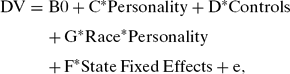
where Race is a vector of indicator variables (with white as the excluded category) that are interacted with each of the personality measures. This allows us to test whether the effect of personality is different for different races (although the hypotheses we offer in this article only pertain to black Americans).
One potential concern with the Equation (2) specification is that it assumes that the associations between personality and attitudes vary only across race (e.g., they do not also vary across gender groups) and that these are the only associations that vary across racial groups (e.g., the associations between gender and attitudes do not vary across races). To account for the possibility of such relationships, we also present results from specification (2′):

which includes all possible interactions between personality and the other controls as well as between race and all other controls.
3.1 Results, Aggregate Effects
We begin by presenting the results of our aggregate analysis of the effect of personality on opinions. Model estimates appear in Table 3. We implement Equation (1), and present results without (odd-numbered columns) and with (even-numbered columns) measures of education and income. Across dependent variables, we find that the results are similar for the specifications that do and do not include education and income, and so we focus our discussion on the results that include these measures. To simplify the presentation of results, Figure 1 plots the effect of a two standard deviation (SD) increase in each personality trait on the dependent variables shown in Table 3 (for the even column specifications, error bars are 95% confidence intervals).Footnote 13 The figure also presents comparable estimates of the relationships between education (the change from a high school diploma to a 4-year college degree) and income (a two SD increase) and the outcomes. As a reminder, the overall ideology measure has a SD of about 1.2, whereas both the economic and social policy attitude measures have SDs of 1.
Aggregate Effect of Personality on Ideological Self-placement and Economic and Social Policy Attitudes

Note: Tobit coefficients with robust standard errors (clustered by state) in brackets. Weighted analysis. Sample restricted to cases with valid observations for all variables. State fixed effects not reported to save space.
*Significant at 5%. ** Significant at 1%, two-tailed tests.
Aggregate Effect of Changes in Model Variables on Ideology and Policy Attitudes

Consistent with previous work, we find that Conscientiousness is associated with holding conservative opinions. Importantly, as predicted, this relationship extends to both economic and social policy opinions. As Figure 1 demonstrates, a two SD increase in Conscientiousness is associated with a 0.34 increase in overall conservatism (about 0.29 SD) and a 0.22 and 0.26 increase, respectively, in economic and social policy conservatism. Comparing the magnitudes of these effects to similar changes in income and education, we see that these effects are relatively large. Although increases in income have a larger effect on holding conservative economic policy attitudes and increases in education have a larger effect on holding liberal social policy views, the remainder of the effects of Conscientiousness on these outcomes are larger in absolute magnitude.
Our findings regarding Openness also comport with prior research that finds an association between this trait and liberal attitudes. Again, as predicted, we show that this trait is associated with support for liberal economic and social policies. These associations are quite strong: a two SD increase in Openness is associated with a 0.66 unit change in ideological self-placement (0.56 SD), a 0.48 SD increase in economic liberalism, and a 0.53 SD increase in social liberalism. The magnitudes of these effects are larger than the effects of either income or education.
We also find support for our hypotheses regarding the associations between the remaining Big Five traits and political attitudes. Consistent with some prior research (e.g., Gosling, Rentfrow, and Swann Reference Gosling, Rentfrow and Swann2003; Mehrabian Reference Mehrabian1996; Mondak and Halperin Reference Mondak and Halperin2008; Riemann et al. Reference Riemann, Grubich, Hempel, Mergl and Richter1993), we do not find a relationship between Agreeableness and overall self-reported political ideology. However, our findings show that this null finding masks countervailing effects of Agreeableness on more specific attitudes. Specifically, we find that Agreeableness is associated with liberal economic attitudes but is associated with conservative social attitudes (we did not expect this later relationship). Although these associations are modest in size, they are both clearly different from zero (p < .01). This countervailing pattern suggests that the inconsistent findings in previous research may originate in context differences or measurement issues (e.g., survey ordering effects) that may make either social or economic concerns more salient in particular surveys.
Next, we turn to Emotional Stability, which we predicted would be associated with overall and economic conservatism. These expectations are confirmed, and the magnitudes of the relationships between Emotional Stability and both ideological self-placement and economic policy opinions are comparable to the effects of education and income. We also observe that Stability is associated with holding conservative social policy attitudes, but this effect is relatively modest. (As we noted previously, our expectations regarding this relationship were mixed.)
Finally, we did not propose any directional hypotheses about the relationships between Extraversion and political attitudes. However, we find that those who are more Extraverted are somewhat more conservative on each of the outcomes we examine.
Table 4A summarizes our hypotheses and the observed relationships across the Big Five traits and the measures of ideology and opinions. We presented nine directional predictions about the relationship between Big Five traits and opinions, and we find support for each of them. In addition, in the six cases where we did not offer predictions, we found consistent statistically significant relationships in four of them. Agreeableness and Stability are associated with social conservatism, whereas Extraversion is associated with overall and economic conservatism, and sometimes with social conservatism.
Predicted and Observed Aggregate Relationship between Big Five Traits and Ideology and Economic and Social Policy Attitudes

Note: Rows are Big Five personality traits, and columns are measures of political attitudes, all scaled so that positive values are associated with more liberal opinions. Cells are the predicted relationship between the personality trait and the attitude, with + indicating more liberal, − indicating more conservative, and none indicating no prediction. In finding columns, confirmed indicates prediction is confirmed and + or − indicates statistically significant observed relationship when no prediction was offered.
The importance of these findings is twofold. First, we confirm the association found in previous work between Conscientiousness, Openness, and Emotional Stability and overall ideological self-placement. We also show that for each of these traits, the same directional relationship holds for both economic and social policy opinions (albeit with a much larger effect of Stability on economic than social policy opinions). A similar, if attenuated, pattern holds for Extraversion (depending on specification), which has not been associated with ideology or policy opinions in prior research. Together, this pattern suggests that ideological constraint, the tendency for an individual's attitudes on loosely related dimensions to be correlated, may originate in underlying personality differences that condition stimuli response. The second finding is the counterbalancing effects of Agreeableness on economic and social policy attitudes. As predicted, we find that Agreeable individuals are more economically liberal. We also find that they are somewhat more socially conservative. Thus, our findings suggest that Agreeableness has not been found to correlate with overall ideological self-placement because Agreeable individuals are pulled in opposite directions by their economic and social policy attitudes.
In the previous analysis, we used education and income to benchmark the size of the effects of Big Five traits on ideology. It is also useful to evaluate these magnitudes using attitudinal benchmarks. One of the most important individual-level characteristics in political behavior research is Authoritarianism. Recent scholarship often uses a set of five forced-choice items about child-rearing values to measure this concept (e.g., Hetherington and Weiler Reference Hetherington and Weiler2009; Stenner Reference Stenner2005). Respondents are asked whether it is more important for children, for example, to be obedient or self-reliant. These items appear to capture largely nonpolitical dispositions. However, they are indicators of social attitudes rather than personality traits. As such, they should be expected to have larger effects than personality traits on other social attitudes such as ideology. The five child-rearing items in the CCAP data form an Authoritarianism scale whose alpha reliability is 0.68.
Another widely studied attitude is Racial Resentment (Kinder and Sanders Reference Kinder and Sanders1996), which measures negative feelings of whites toward blacks. For example, one item asks respondents to agree or disagree that “Over the past few years, African Americans have gotten less than they deserve.” Like the child-rearing items, these items measure social attitudes, and in this case, attitudes that are quite political. Indeed, some of the items appear to be concise versions of arguments heard in contemporary political debates. The four-item Racial Resentment scale has an alpha reliability of 0.86.
We use three separate models to isolate the extent to which Authoritarianism, Racial Resentment, and the Big Five measures each explain ideology. The first is presented in Table 3, column (2). In the second, we substituted the standardized Authoritarianism scale for the Big Five items. In the third, we substituted the standardized Racial Resentment scale for the Big Five items. We found that Racial Resentment and Authoritarianism are strong predictors of ideology. The effect of a two SD shift in the Authoritarianism scale on self-reported ideology is 1.13 units on an ideology scale that runs from −2 to +2. The effect of a two SD shift in the Resentment scale is 1.51 units. For Openness, which affects ideology more than any other Big Five trait, the comparable two SD effect is 0.66. For the next most important trait, Conscientiousness, the effect is 0.34.
Another way to compare predictive power is to examine R squared for the separate models. The R squares from separate OLS regression of ideology on the Big Five traits, the Authoritarianism scale, and the Racial Resentment scale (including the control variables indicated in Table 3) are 0.15, 0.22, and 0.31, respectively. All of these models are, however, affected by the presence of measurement error in the independent variables. Using Gosling, Rentfrow, and Swann (Reference Gosling, Rentfrow and Swann2003) reported trait-by-trait correlations between the TIPI and the NEO PI-R measures of the Big Five, we implemented errors-in-variables regressions to account for this measurement error. The R square in the error-corrected model of Big Five effects is 0.22. In the error-corrected models for Authoritarianism and Racial Resentment, the R squares are 0.29 and 0.35.Footnote 14 Taken together, these results indicate that the Big Five personality traits are important determinants of ideology, but have less predictive power than the social dispositions measured by the Authoritarianism and Racial Resentment scales.
3.2 Results, Context Effects
We next turn to our analysis of how context differences, operationalized in this case by using race, affect the relationship between personality and political attitudes. As a first step, note that Table 2 displays both the population summary statistics and those figures separately for different racial groups. Focusing our comparison between black and white Americans, we note that there are relatively small differences in personality across groups. Relative to the SD for whites, the largest difference in average personality is only 0.18 SDs, for the trait Emotional Stability. It is important to note the possibility that, in theory, personality batteries might measure different things across racial, gender, or socioeconomic groups. We are unaware of prior research specifically validating the measurement of the Big Five separately for black and white Americans. However, prior research has documented the reliability and consistency of the Big Five measures across a broad range of social contexts (see John and Srivastava Reference John, Srivastava, Pervin and John1999). Consistent with this research, the small average differences between these racial groups provides evidence that racial context differences do not themselves generate large differences in average personality. The measures of attitudes, however, are quite different. On average, blacks are 0.34 SDs more liberal in self-reported ideology and 0.33 SDs more liberal on economic policy. There are small differences on social policy issues, however, where black Americans are only 0.04 SDs more liberal than whites.
Table 5 presents our analysis of the relationship between personality and attitudes across racial groups. The column (1) and (2) specifications are results from models estimated using Equation (2), without (column [1]) and with education and income measures (column [2]). Column (3) implements equation (2′) by adding 80 additional interactions. These are 30 interactions of the other covariates in the model (other than personality) multiplied by the race indicators (black, Hispanic, and all others). This specification therefore allows the effect of race to vary not only by personality, but also by gender, income, education, and age. In addition, we add 50 interactions for each of the personality traits interacted with all other independent variables (other than race). This specification also allows the effect of personality to vary across categories other than race. We view this specification as extremely conservative given the ample reason to believe that personality is (primarily) causally prior to outcomes such as education and income. Despite this, the differences across racial groups that we discuss are largely unaffected by these specification choices.
Effect of Personality by Race on Ideological Self-placement and Economic and Social Policy Attitudes

Note: Tobit coefficients with robust standard errors (clustered by state) in brackets. Weighted analysis. Sample restricted to cases with valid observations for all variables. State fixed effects not reported to save space.
*Significant at 5%. ** Significant at 1%, two-tailed tests except for personality traits × black interactions for which directional hypotheses were offered (see Table 4B).
We focus our discussion on the interactions between each personality trait and the indicator for black Americans because we have clear expectations regarding how differences in social environments across these groups affect how, on average, people in each group understand political stimuli. These expected differences in the meaning of political stimuli across groups allowed us to state specific hypotheses regarding how the associations between dispositional traits and political attitudes will vary across these groups. Therefore, although there are also interesting differences between whites and Hispanics, we do not discuss them here.
In each model, the coefficients on each Big Five trait are the relationship between the trait and the outcome among white respondents. The coefficients on the interactions between the traits and the black indicator capture the difference in each relationship between black and white Americans. Finally, the linear combination (sum) of the coefficient on a trait and the associated interaction term can be interpreted as the relationship between a trait and outcome among black respondents. For example, in the column (2) specification, the coefficient for Conscientiousness × black is positive and statistically significant. This means that, relative to whites, Conscientiousness is less strongly associated with conservative ideological self-placement among blacks. For ease of interpretation, Figure 2 presents graphically first difference estimates for the effects of personality (a two SD increase in each trait) separately for black and white Americans based on the models in columns (2), (5), and (8).
Self-reported Ideology

Economic Policy Attitudes

Social Policy Attitudes

We hypothesized that the relationships between Conscientiousness and conservative ideology and economic policy opinions and between Openness to Experience and liberal ideology and economic policy opinions would be attenuated for blacks relative to whites. Table 5 and Figure 2 confirm these expectations. In each case, we can reject the null hypothesis that the effects of these traits on overall ideology and economic policy opinions are the same for blacks and whites (p < .05, one tailed for all six Conscientiousness × black coefficients; p < .05, one tailed for four of six Openness × black coefficients, p = .07 and .06 for coefficients in columns [4] and [5], respectively). As Figure 2 illustrates, in contrast to the strong relationship between Conscientiousness and conservatism among white Americans, the ideology and economic policy opinions of black Americans do not change much with levels of Conscientiousness (the linear combination of the effect of Conscientiousness and Conscientiousness × black is indistinguishable from zero), and the strong relationship between Openness to Experience and liberal opinions is also greatly diminished. Note, too, that these effects persist in the column (3) and (6) specifications that include an additional 80 interaction terms. These findings are consistent with our expectations that ideological labels and economic policy have different political meanings for blacks relative to whites.
Before continuing, we note that although we did not have strong expectations about the differences in the effects of Openness on social policy attitudes for blacks and whites, we also find a mitigation of the effect of this trait for blacks (relative to whites). In the interest of avoiding ex post speculation, we simply note that this reduction is relatively large and similar in pattern to what we observe for the relationship between Openness and overall ideology and economic policy opinions.
For Agreeableness, we hypothesized that this trait would be more strongly associated with holding liberal economic policy opinions among whites. The coefficient for the interaction of Agreeableness × black is consistently negative, but it is not statistically significant (p values range from .13 to .33, one tailed) Although the estimate is not as precise as we might desire, we note that the difference in estimated effect sizes is substantial: for white Americans, the estimated effect of a two SD increase in Agreeableness is .24 (p < .01), whereas for black Americans it is .07 (p = .62). We did not expect differences for either overall ideology or social policy opinions, and find that the differences between blacks and whites are substantively small and statistically insignificant.
As with Agreeableness, in the case of Emotional Stability, we hypothesized that there would be a weaker relationship between this trait and holding conservative economic policy opinions for blacks than whites. This expectation is confirmed: among whites, a two SD increase in Stability is associated with a 0.49 SD increase in economic conservatism (p < .01, per the column [5] specification), but among black respondents this effect is relatively small (p = .47). This difference is statistically significant (p < .05 in the column [4] and [5] specifications, although it rises to .08 in column [6]). We did not predict differences between black and white Americans in the effects of Emotional Stability on overall ideology and social policy opinions, and find that there are only substantively modest and statistically insignificant differences in these domains.
Finally, we turn to Extraversion, for which we did not predict differences between black and white Americans in the effect of this trait. For overall ideology and social policy opinions, we find small and insignificant differences. However, we find a significant difference in the relationship between Extraversion and economic policy opinions for blacks and whites. Blacks scoring higher on Extraversion are more economically liberal (although this effect is statistically indistinguishable from zero), whereas whites higher on this trait are significantly more economically conservative. This is consistent with the possibility, considered previously, that peer effects in relatively homogenous environments are larger for those higher on the trait of Extraversion.
Our findings are summarized in Table 4B. We offered six directional hypotheses and found support for five of them. We also found statistically significant differences between black and white Americans in two cases where we did not expect them (the effect of Openness on social policy opinions and the effect of Extraversion on economic policy opinions). Counting those two cases as failures, our overall success rate is five out of eight statistically significant results (directional hypotheses plus two unexpected effects), or about 63%. 4
Predicted and Observed Context-dependent Relationship between Big Five Traits and Ideology and Economic and Social Policy Attitudes

Note: Rows are Big Five personality traits, and columns are measures of political attitudes, all scaled so that positive values are associated with more liberal opinions. Cells are the predicted difference in the relative effect of an increase in the personality trait and the attitude for (B)lacks and (W)hites, with B > W indicating blacks will be more liberal, W > B indicating whites will be more liberal, and none indicating no prediction. In finding columns, confirmed indicates prediction is confirmed and B > W or W > B indicates statistically significant observed relationship when no prediction was offered.
More substantively, our findings support the theoretical argument made previously that the relationships between dispositional traits (e.g., the Big Five) and opinions are affected by contextual differences that change the meaning of political stimuli. Across a variety of model specifications, we find that contextual differences—here, between black and white Americans—alter the relationships between Big Five traits and political attitudes. Of importance, these differences are not haphazard or the result of particularly confining model specifications, rather they emerge mostly for opinion areas (political stimuli) that are likely to have contextually different meanings and appear even in very flexible statistical specifications that allow the effects of race and personality to vary with all other model variables.
4 DISCUSSION AND CONCLUSION
The analysis we present in this article provides evidence that the core dispositional personality traits measured by the Big Five affect not only overall self-reported ideology, but also underlying economic and social policy opinions. This is, to our knowledge, the first study to use a large national sample to examine how Big Five traits affect these issue attitudes. What is perhaps most striking about our findings is that items on the TIPI, on their face, appear to have nothing to do with politics. Moreover, the TIPI is an extremely brief and crude battery. Importantly, our large and national sample of registered voters allows us to detect relatively modest effect sizes and resolve differences present in prior research, as well as to increase our confidence in the robustness of previous results linking personality to overall ideology.
To review, we find that Openness and Conscientiousness, the two traits most consistently associated with political ideology in prior research, also have effects of similar magnitudes on social and economic attitudes. Conscientiousness explains overall conservatism and holding conservative economic and social policy attitudes, whereas Openness is associated with liberalism across these three measures. However, the effects of the other three traits vary in direction or magnitude across issue domain. Although Emotional Stability is associated with social conservatism, it is much more strongly associated with economic conservatism. Similarly, we find a modest relationship between Extraversion and both economic and social conservatism, but the effect on economic attitudes is relatively larger. Finally, Agreeableness, which prior research has found to be uncorrelated with self-reported ideology, is associated with economic liberalism but social conservatism. The countervailing effects of Agreeableness and weak associations between Stability and Extraversion and social policy attitudes may explain the relative lack of statistically significant relationships between these traits and ideology in prior research relying on smaller samples.
Among the motivations for this research was the possibility that ideological constraint—the tendency of liberals (conservatives) to hold similar views across a variety of policy domains—could be partially explained by the influence of personality traits. Our finding that for four traits, and particularly for Conscientiousness and Openness, responses to economic and social policy stimuli are congruent (move in the same ideological direction, although for Emotional Stability and Extraversion there are important differences in effect sizes across issues domains) provides some evidence that ideological coherence is in part a function of core individual-level differences in personality (combined with contexts that give meaning to political and social stimuli). It also provides a micro-level explanation for the observation that liberals and conservatives are different in both their public political and private lives (Carney et al. Reference Carney, Jost, Gosling and Potter2008) because such ideological differences emerge, in part, from an individual's general response to external stimuli in both the political and nonpolitical world.
Of course, there are other explanations for the sources of, and barriers to, ideological thinking. But, in this regard, our new finding that Agreeableness is associated with economic liberalism and social conservatism provides important evidence of the value of a trait-based explanation. For the one trait for which we identify reasons why individuals could be moved in opposite ideological directions by economic and social policy stimuli, we find such differences. This suggests that when forming opinions, individuals do not need to be uniformly liberal or conservative, but instead that at times they may be cross pressured. Thus, seemingly conflicting views across domains may be evidence not of confusion or inattention to elite cues, but genuine differences in personality-shaped preferences across domains that do not conform to elite or academic notions of ideological constraint.
Beyond demonstrating aggregate correlations between Big Five traits and political attitudes, we also document the way in which these effects vary across environments in which political stimuli are likely to have different meanings. We show that the relationships between core dispositional traits and characteristic adaptations such as ideology and policy attitudes vary systematically with context. The particular empirical analysis we conduct focuses on differences in the United States between blacks and whites. We posit that differences in how ideological labels and economic policies are socially defined will affect the relationships between Big Five traits and both ideological self-identification and economic policy attitudes for these groups. The differences we observe are consistent with our expectations about how the meaning of these political stimuli varies across these groups. Although the particular hypotheses we present and racial differences in the relationship between personality and attitudes we find are interesting, the more general contribution is to instantiate the claim that political stimuli have contextually dependent meanings and that the route between personality and opinions is moderated by such differences. There are also several other implications of this finding.
First, there are likely to be other contextual differences of interest to scholars (e.g., gender, religious groups, local political networks, cultures) that affect the meaning of these political stimuli and other characteristic adaptations (e.g., Partisanship, RWA, Racial Resentment, SDO, Nationalism, Group Pride).Footnote 15 More broadly, the notion of environment-specific effects suggests that the link between personality and attitudes is likely to be a function of features of political environments such as social networks that are of growing interest across the social sciences (see, e.g., Christakis and Fowler Reference Christakis and Fowler2009; Heaney and McClurg Reference Heaney and McClurg2009). Likewise, the role of individual-level genetic differences in explaining political opinions and behavior is an area of ongoing work (e.g., Alford, Funk, and Hibbing Reference Alford, Funk and Hibbing2005; Dawes and Fowler Reference Dawes and Fowler2009; Eaves and Hatemi Reference Eaves and Hatemi2008; Fowler, Baker, and Dawes Reference Fowler, Baker and Dawes2008; Fowler and Dawes Reference Fowler and Dawes2008; Hatemi et al. Reference Hatemi, Alford, Hibbing, Martin and Eaves2009; Hatemi et al. Reference Hatemi, Medland, Morley, Heath and Martin2007; Martin et al. Reference Martin, Eaves, Heath, Jardine, Feingold and Eysenck1986; Settle, Dawes, and Fowler Reference Settle, Dawes and Fowler2009). Although there may be more direct links between genetics and political outcomes, the notion that contexts provide meaning to political stimuli seems like a promising theoretical conduit for how individual-level genetic differences, which are correlated with dispositional traits, affect political attitudes and behavior. It also suggests the value of mid-level research on how expressed dispositional traits relate to attitudes and behavior because such traits and context-dependent differences may capture relevant genetic influences.
Second, this finding places the study of political socialization and elite discourse in a unified framework linking individual dispositions to mass behavior. The process of political socialization grounds individual- and group-level interpretation of political objects, whereas elite contestation seeks to challenge existing categorizations and give meaning to emergent issues (stimuli) (Lakoff Reference Lakoff2004; Levendusky Reference Levendusky2009). Thus, for example, differences in the relationship between personality traits and attitudes about gay marriage may reflect context or cohort-based differences in whether the issue is understood as endorsing “homosexual behavior” or supporting same-sex couples in adopting heterosexual marriage practices. In this view, elite framing and other attempts to shape how issues are understood can have important implications for how mass attitudes relate to individual-level differences.
We also want to be clear about the limitations of this research. Most obviously, we rely on self-reports of attitudes and manipulate neither personality nor individual-level contexts that affect the meaning of political stimuli. As with all survey responses, measurement is an important and difficult issue. Self-reports of personality may incorporate accurate assessments of personality tendencies and also reflect a respondent's values, perceptions of social norms, and current state of mind, as well as attitudes induced by the survey itself. A great deal of research indicates that Big Five traits are highly stable over time and that the individual-level contexts we focus on are arguably exogenous to individual-level choices. Still, there is clear room for subsequent research that seeks to manipulate personality differences (e.g., the salience of different traits) or the meaning of political stimuli (e.g., by introducing new political objects and framing them in different ways). There is also the question of how to interpret findings from the CCAP sample, which although larger and more representative than many convenience samples, nonetheless focuses on registered voters and necessarily includes only those who are willing to take Internet-based surveys. These caveats aside, our work suggests fruitful ground for how scholars can turn to other data and analytic approaches to understand the complex relationship between personality and political attitudes that our research has helped to map.
APPENDIX
Question Wording and Coding
TIPI (10 trait pairs)
Here are a number of personality traits that may or may not apply to you. Indicate the extent to which you agree or disagree with each statement. You should rate the extent to which the pair of traits applies to you, even if one characteristic applies more strongly than the other.
Extraversion: Extraverted, enthusiastic; Reserved, quiet (Reverse coded)
Agreeableness: Sympathetic, warm; Critical, quarrelsome (Reverse coded)
Conscientiousness: Dependable, self-disciplined; Disorganized, careless (Reverse coded)
Emotional Stability: Calm, emotionally stable; Anxious, easily upset (Reverse coded)
Openness: Open to new experiences, complex; Conventional, uncreative (Reverse coded)
(1 = Disagree strongly; 2 = Disagree moderately; 3 = Disagree a little; 4 = Neither agree nor disagree; 5 = Agree a little; 6 = Agree moderately; 7 = Agree strongly. Responses rescaled to range from 0 to 1.)
Correlation Matrix among Big Five Traits

Ideology
Ideology: Thinking about politics these days, how would you describe the political viewpoint of the following individuals . . . Yourself? (−2 = Very conservative; −1 = Conservative; 0 = Moderate/not sure; 1 = Liberal; 2 = Very liberal).
Policy Opinions
All items are scored with the more liberal position on the high end and then standardized (M = 0, SD = 1). The two items within each scale were then averaged, and the new mean scale was standardized (M = 0, SD = 1). Respondents providing “don't know”/“not sure” responses were not included in the analyses.
Social Policy
Abortion (support): Under what circumstances should abortion be legal? (0 = Abortion should be illegal. It should never be allowed; 1 = Abortion should only be legal in special circumstances, such as when the life of the mother is in danger; 2 = Abortion should be legal, but with some restrictions (e.g., for minors or late-term abortions); 3 = Abortion should always be legal. There should be no restrictions on abortion.)
Civil Unions (support): Do you favor allowing civil unions for gay and lesbian couples? These would give them many of the same rights as married couples. (0 = Strongly oppose; 1 = Somewhat oppose; 2 = Somewhat favor; 3 = Strongly favor).
Economic Policy
Government Health Care (support): Which comes closest to your view about providing health care in the United States? (0 = Health insurance should be voluntary. Individuals should either buy insurance or obtain it through their employers as they do currently. The elderly and the very poor should be covered by Medicare and Medicaid as they are currently; 1 = Companies should be required to provide health insurance for their employees, and the government should provide subsidies for those who are not working or retired; 2 = The government should provide everyone with health care and pay for it with tax dollars.)
Tax $200K+ (support): Do you favor raising federal taxes on families earning more than $200,000 per year? (0 = Strongly oppose; 1 = Somewhat oppose; 2 = Somewhat favor; 3 = Strongly favor).
Other
Female: 0 = Male; 1 = Female
White: 0 = Non-white; 1 = White
Black: 0 = Non-black; 1 = Black
Hispanic: 0 = Non-Hispanic; 1 = Hispanic
Other race (Native American, Asian, Mixed, Other): 0 = Not other race; 1 = Other race
Education: 1 = No high school diploma; 2 = High school graduate; 3 = Some college; 4 = Two-year degree; 5 = College graduate; 6 = Postgraduate
Family income: 1 = <$10,000; 2 = $10,000–$14,999; 3 = $15,000–$19,999; 4 = $20,000–$24,999; 5 = $25,000–$29,999; 6 = $30,000–$39,999; 7 = $40,000–$49,999; 8 = $50,000–$59,999; 9 = $60,000–$69,999; 10 = $70,000–$79,999; 11 = $80,000–$99,999; 12 = $100,000–$119,999; 13 = $120,000–$149,999; 14 = $150,000 or more; 15 = Prefer not to say or missing
Age: Years
Authoritarianism: Although there are a number of qualities that people believe that children should have, everyone believes that some are more important than others. Listed here are pairs of desirable qualities. For each pair, please mark which one you think is more important for a child to have. Which is more important for a child to have? (α = 0.68)
1. Independence (0) or Respect for elders (1)
2. Obedience (1) or Self-reliance (0)
3. Curiosity (0) or Good manners (1)
4. Being considerate (0) or Being well behaved (1)
5. Disciplined (1) or Creative (0)
Racial Resentment (1 = Agree strongly; 2 = Agree somewhat; 3 = Neither agree nor disagree; 4 = Disagree somewhat; 5 = Disagree strongly) (α = 0.86)
1. Generations of slavery and discrimination have created conditions that make it difficult for African Americans to work their way out of the lower class.
2. Many other minority groups have overcome prejudice and worked their way up. African Americans should do the same without any special favors. (Reverse coded)
3. Over the past few years, African Americans have gotten less than they deserve.
4. It's really a matter of some people not trying hard enough; if African Americans would only try harder, they could be just as well off as whites. (Reverse coded)
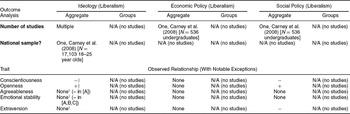
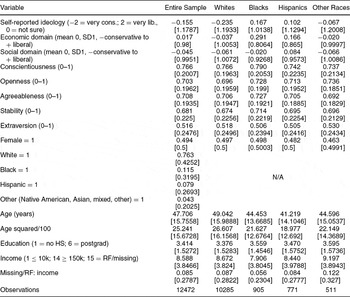
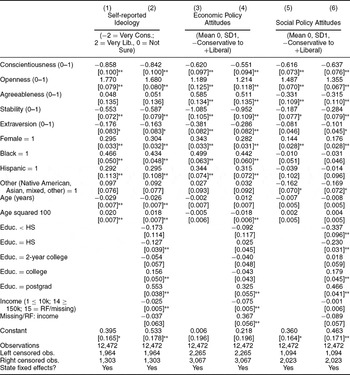
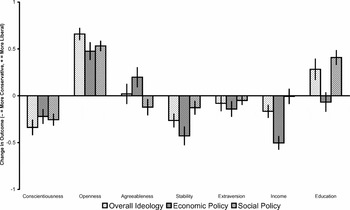
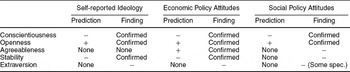
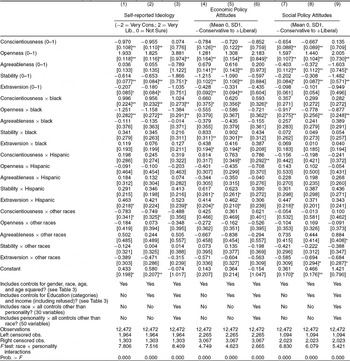
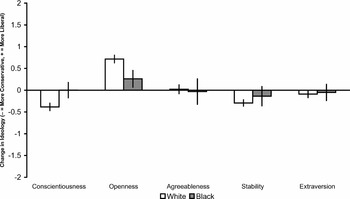
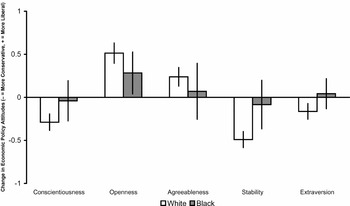
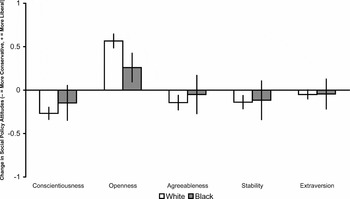
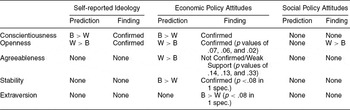




Comments
No Comments have been published for this article.