Introduction
In recent years, social cognition (SC) has emerged as a matter of concern in bipolar disorder (BD) research. SC is a multifaceted construct that encompasses a complex set of mental processes including: perceiving, interpreting, and generating responses to the intentions, dispositions, and behaviors of others that underlies social interactions and that enable successful and adaptive behavior in a social context (Harvey & Penn, Reference Harvey and Penn2010). It involves four core domains including the Emotional Intelligence (EI), Theory of Mind (ToM), Attributional Bias (AB), Social Perception and Knowledge. Specifically, ToM is the ability to comprehend and represent mental states of others, including the inference of intentions, dispositions, and/or beliefs. Next, the ability to share experiences and emotions of others, as well as the capacity to regulate one's emotional responses to others is known as EI. Attributional Bias refers to the way in which individuals explain or reason for the causes of social events or interactions. Finally, the ability to decode and interpret social cues in others is called Social Perception and Knowledge (Green et al., Reference Green, Penn, Bentall, Carpenter, Gaebel, Gur and Heinssen2008; Sergi et al., Reference SERGI, RASSOVSKY, WIDMARK, REIST, ERHART, BRAFF and MARDER2007).
Social cognitive deficits have been identified in patients with BD, particularly in ToM, EI and AB domains (Samamé, Reference Samamé2013). Moreover, these deficits appear even during remission periods (Samamé, Martino, & Strejilevich, Reference Samamé, Martino and Strejilevich2015) and could be present at early stages of the disorder and also among unaffected relatives of patients with BD (Bora & Özerdem, Reference Bora and Özerdem2017; Kjærstad et al., Reference Kjærstad, Mistarz, Coello, Stanislaus, Melbye, Harmer and Kessing2019). These data suggest that SC deficits might represent a trait marker of the illness (Meluken et al., Reference Meluken, Ottesen, Harmer, Scheike, Kessing, Vinberg and Miskowiak2019; Miskowiak et al., Reference Miskowiak, Kjærstad, Meluken, Petersen, Maciel, Köhler and Carvalho2017; Miskowiak et al., Reference Miskowiak, Burdick, Martinez-Aran, Bonnin, Bowie, Carvalho and Vieta2018) and not simply a result of medication side-effects or clinical episodes. However, evidence is still inconclusive as other studies indicate that patients with BD might actually present a quite preserved SC performance, or might have some impairment in only a few SC domains (Burdick et al., Reference Burdick, Russo, Frangou, Mahon, Braga, Shanahan and Malhotra2014; Lee et al., Reference Lee, Hermens, Naismith, Lagopoulos, Jones, Scott and Hickie2015; Sperry et al., Reference Sperry, O'Connor, Öngür, Cohen, Keshavan and Lewandowski2015; van Rheenen & Rossell, Reference Van Rheenen and Rossell2014; Varo et al., Reference Varo, Jimenez, Solé, Bonnín, Torrent, Valls and Reinares2017).
Recent cluster analysis studies indicate that neurocognitive performance in patients with BD is heterogeneous. Several studies have identified discrete neurocognitive subgroups in remitted patients with BD (Burdick et al., Reference Burdick, Russo, Frangou, Mahon, Braga, Shanahan and Malhotra2014; Jensen, Knorr, Vinberg, Kessing, & Miskowiak, Reference Jensen, Knorr, Vinberg, Kessing and Miskowiak2016; Jiménez et al., Reference Jiménez, Solé, Arias, Mitjans, Varo, Reinares and Benabarre2017; Lewandowski, Sperry, Cohen, & Öngür, Reference Lewandowski, Sperry, Cohen and Öngür2014; Lima et al., Reference Lima, Rabelo-da-Ponte, Bücker, Czepielewski, Hasse-Sousa, Telesca and Rosa2019; Russo et al., Reference Russo, van Rheenen, Shanahan, Mahon, Perez-Rodriguez, Cuesta-Diaz and Burdick2017; Solé et al., Reference Solé, Jiménez, Torrent, del Mar Bonnin, Torres, Reinares and Martínez-Arán2016; van Rheenen et al., Reference van Rheenen, Lewandowski, Tan, Ospina, Ongur, Neill and Burdick2017). These conclusions were assumed from studies mostly focused on neurocognitive domains and none of them has considered the performance using a comprehensive battery of tests covering different facets of SC. Even though, these data suggest that a gradation of severity in SC performance among patients with BD may exist.
As far as we know, there is only one study published by authors from our research team that aimed to examine the variability of the EI domain (Varo et al., Reference Varo, Jimenez, Solé, Bonnín, Torrent, Valls and Reinares2017). In this study, a large euthymic BD sample was divided into three subgroups according to normative data and resulting into three groups: average, above, or below normative means. Using this method, it was found out that 19% of the sample performed better than the normative population, 69% presented an adjusted EI performance. Only 12% of patients with BD were considered to present a low-range EI, showing poorer cognitive, clinical, and functional outcome scores. However, no previously published studies examining the variability of different SC domains in patients with BD have been published so far. To understand to what extent the specific domains of SC performance are impaired in patients with BD and evaluate whether subjects could be categorized into discrete profiles may aid to expand the knowledge regarding the neural underpinnings and etiology of SC deficits in BD (Russo et al., Reference Russo, van Rheenen, Shanahan, Mahon, Perez-Rodriguez, Cuesta-Diaz and Burdick2017).
The main aim of this study was to examine the existence of discrete SC profiles in a sample of euthymic patients with BD using a data-driven approach. We focused on three social cognitive subdomains – ToM, EI, and AB – that have received much attention in BD. Secondly, we evaluated whether participants with different profiles differed in terms of demographic, clinical, and neuropsychological variables and evaluated their contribution to SC performance. We hypothesized that heterogeneous SC profiles would exist among patients with BD, and that patients with a worse SC profile would be characterized by a poorer clinical course and exhibit a greater cognitive impairment.
Methods
Participants
Seventy-one euthymic outpatients with BD were recruited from the Bipolar and Depressive Disorders Unit of the Hospital Clinic of Barcelona under the umbrella of the Spanish Research Network on Mental Health (CIBERSAM) (Salagre et al., Reference Salagre, Arango, Artigas, Ayuso-Mateos, Bernardo, Castro-Fornieles and Vieta2019).
Participants were selected only if they fulfilled the following inclusion criteria: (i) DSM-IV-TR criteria for bipolar I or bipolar II disorder; (ii) age between 18 and 65 years; and (iii) euthymia defined as a score ⩽8 on the Hamilton Depression Rating Scale (HDRS) (Hamilton, Reference Hamilton1960; Ramos-Brieva & Cordero Villafáfila, Reference Ramos-Brieva and Cordero Villafáfila1988) and ⩽6 on the Young Mania Rating Scale (YMRS) (Colom et al., Reference Colom, Vieta, Martínez-Arán, Garcia-Garcia, Reinares, Torrent and Salamero2002; Young, Biggs, Ziegler, & Meyer, Reference Young, Biggs, Ziegler and Meyer1978) of at least the 3 months before the inclusion. Exclusion criteria were the presence of (i) intelligence quotient (IQ) lower than 70, (ii) presence of any medical condition affecting neuropsychological performance, and (iii) electroconvulsive therapy within the past year. Concerning pharmacological treatment, no restrictions were made, including the use of benzodiazepines, in order to capture a representative sample of bipolar population. Nevertheless, all the patients were instructed not to take benzodiazepines 12 h prior to the neuropsychological assessment.
A total of 60 healthy controls (HC) without evidence of psychiatric or neurological history were recruited via advertisement. None of the controls had first-degree relatives with psychiatric disorders. There were no differences between patients and healthy subjects in terms of age, gender, educational level, and estimated IQ.
This study was conducted in accordance with the ethical principles of the Declaration of Helsinki and Good Clinical Practice and approved by the Hospital Clinic Ethics and Research Board. All participants provided written informed consent prior to their inclusion in the study.
Assessment
Demographic, clinical, and psychosocial functioning measures
In order to gather the main sociodemographic and clinical data, all patients were assessed by means of a semistructured interview based on the Structured Clinical Interview for DSM Disorders (SCID) (First, Reference First1997), which also considered data from medical records. YMRS and HDRS-17 scores were also used to evaluate the severity of manic and depressive symptomatology, respectively.
Functional outcome was assessed by means of the Functioning Assessment Short Test (FAST) (Rosa et al., Reference Rosa, Sánchez-Moreno, Martínez-Aran, Salamero, Torrent, Reinares and Vieta2007). This brief interviewer-administered scale, which comprises 24 items, assesses six specific functioning domains: autonomy, occupational functioning, cognitive functioning, financial issues, interpersonal relationships, and leisure time. Higher scores indicate a greater degree of functional impairment.
Neuropsychological assessment
All participants completed a comprehensive neuropsychological battery in order to assess different cognitive domains including Processing Speed, Working Memory, Verbal Learning and Memory, Visual Memory, Executive Functions and Attention. This battery comprises the Digit-symbol Coding and the Symbol Search, Arithmetic, Digits, and Letter-Number sequencing subtests from Wechsler Adult Intelligence Scale (WAIS-III) (Wechsler, Reference Wechsler1997), Phonemic (F-A-S) and Categorical (Animal naming) components of the Controlled Oral Word Association Test (COWAT) (Benton, Reference Benton1976), Trail Making Test-A (TMT-A) and the Trail Making Test-B (TMT-B) (Reitan, Reference Reitan1958), the California Verbal Learning Test (CVLT) (Delis, Kramer, Kaplan, & Over, Reference Delis, Kramer, Kaplan and Over1987), the Rey Osterrieth Complex Figure (ROCF) (Rey, Reference Rey1997), the computerized version of the Wisconsin Card Sorting Test (WCST) (Heaton, Reference Heaton1981), the Stroop Colour-Word Interference Test (Golden, Reference Golden1978), the Continuous Performance Test-II (CPT-II), version 5 (Conners, Reference Conners2002). Finally, estimated IQ was assessed with the (WAIS-III) vocabulary subtest (Wechsler, Reference Wechsler1997).
Social cognition assessment
In order to assess different SC domains, all participants were evaluated with the following tests:
(1) Theory of Mind (ToM) was assessed with two tests: (a) the Reading the Mind in the Eyes test (RMET) (Baron-Cohen, Wheelwright, Hill, Raste, & Plumb, Reference Baron-Cohen, Wheelwright, Hill, Raste and Plumb2001) in which subjects are shown 36 photographs of a person's eyes and must select which of four words best describes what the person in the photograph is thinking or feeling. The RMET produces a single raw total score, with higher scores indicating better performance detecting mental states. (b) The Hinting Task (Corcoran, Mercer, & Frith, Reference Corcoran, Mercer and Frith1995) examines the ability of individuals to infer the true intent of indirect speech throughout 10 short passages reflecting an interaction between two characters. Higher scores indicate better performance. The present study used a reduced version with five stories of the Hinting Task, which has demonstrated good psychometric properties in the validated Spanish version (Gil, Fernández-Modamio, Bengochea, & Arrieta, Reference Gil, Fernández-Modamio, Bengochea and Arrieta2012).
(2) Emotional Intelligence (EI) was evaluated using the Mayer–Salovey–Caruso Emotional Intelligence Test (MSCEIT) (Mayer, Salovey, Caruso, & Sitarenios, Reference Mayer, Salovey, Caruso and Sitarenios2003). This instrument consists of 141 items and provides eight task scores that measure the four branches of EI: perceiving, using, understanding, and managing emotions. These branches can be assigned to the areas of emotional experience and emotional strategic. The test provides a total score and also scores in two areas, in the four branches and in each of the specific tasks that the test includes. Lower scores indicate poorer performance in EI.
(3) Attributional Bias (AB) was tested through the Ambiguous Intentions Hostility Questionnaire (AIHQ) (Combs, Penn, Wicher, & Waldheter, Reference Combs, Penn, Wicher and Waldheter2007). It is focused on assessing the individual's tendency to over-attribute hostile intentions to others and to respond to others in a hostile manner. It is comprised of 15 situations that are ambiguous, intentional and accidental in nature. The AIHQ produces bias scores in which higher scores reflect a more hostile, negative and personal attributional style and more aggressive attributions.
Statistical analysis
All analyses were performed with SPSS version 23 (IBM Corp, Armonk, NY, USA). Initial analyses were conducted to compare demographic and clinical characteristics between patients with BD and HC using t tests and χ2 tests (as appropriate).
Social cognition and neuropsychological tests raw scores were standardized to z-scores (with a mean = 0 and s.d. = 1) based on HCs' performance. Outlying z-scores exceeding 4 s.d.s below HC's mean were truncated at z = −4.0. The z-scores for TMT-A, TMT-B, CPT-II, and WCST perseverative errors were inverted so that lower scores were indicators of poorer performance. Six neurocognitive domains and ToM domain were calculated from mean z-scores compromising each domain: ToM (REMT total score and Hinting task, total score); (i) Processing Speed [WAIS-III Digit-symbol Coding subtest, Category fluency (Animal naming), and TMT-A]; (ii) Working Memory (WAIS-III Letter-number sequencing and Digit-span); (iii) Verbal Memory [CVLT (total trials 1–5 list A, short free recall, short cued recall, delayed free recall, and delayed cued recall scores)]; (iv) Visual Memory (ROCF delayed recall); (v) Executive Functions [WCST (number of categories and perseverative errors), Stroop Interference Test, and TMT-B]; and (vi) Attention (CPT-II (omission, reaction time and reaction time standard error)]. Neurocognitive and ToM composites were standardized against the composite scores obtained by the HC group. Finally, an overall composite cognition z-score was established for each participant by averaging the six domains and standardizing this output based on the HCs' composite cognition score.
A hierarchical cluster analysis (HCA) was carried out in order to identify homogeneous subgroups of patients with BD based on their SC performance in terms of the different SC domain scores. Similarity between cases was computed with the Euclidian distance and Ward linkage was selected as the agglomeration procedure. Next, the dendrogram was visually inspected to establish the appropriate number of clusters to be retained. In addition, a discriminant function analysis (DFA) was also conducted in order to test the validity of the clusters. The SC profiles of the patients in the different clusters and the HC group were compared using a one-way ANOVA, with group membership (the clusters and the HC group) as a fixed factor and the three SC domains as dependent variables. Tukey post-hoc comparisons were carried out to identify pair-wise differences between groups. Subsequently, comparisons (t tests and χ2, as appropriate) between the different clusters were carried out to examine possible differences in demographic, clinical, and neurocognitive variables. Finally, we conducted the logistic regression model with SC cluster groups as the dependent variable to estimate the effects of the risk factors associated with poor SC performance. The clinical, demographic, and neuropsychological variables introduced in the logistic regression were based on the statistically significant results found in the univariate analysis. All analyses were two-tailed and significance was set at p < 0.05.
Results
Sociodemographic and clinical characteristics of patients with BD and HC
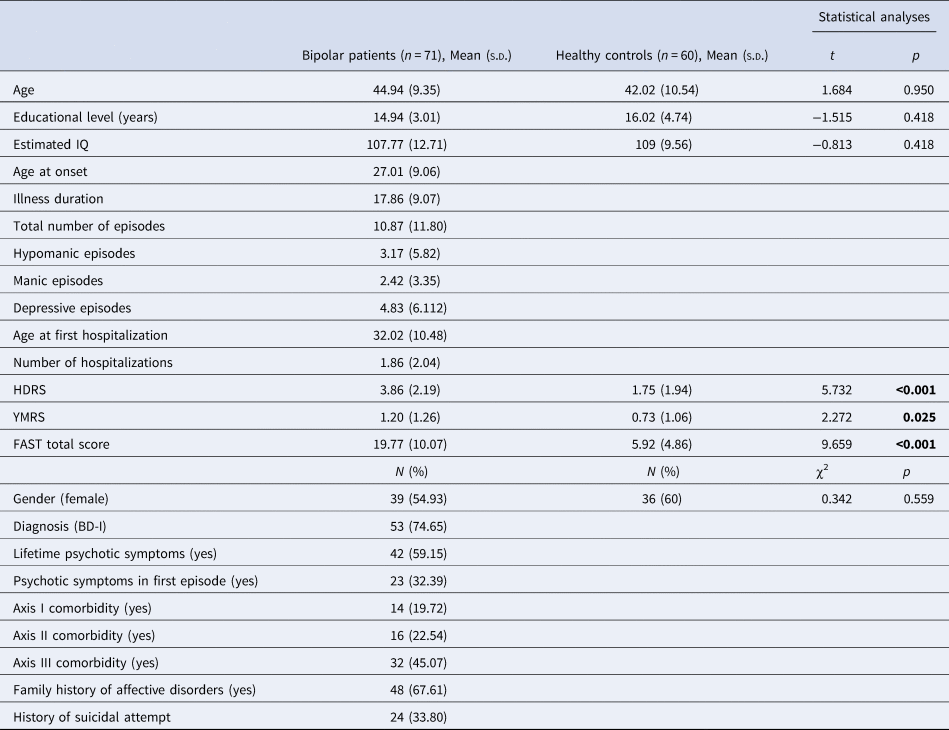
Table 1 shows the baseline characteristics of the study sample. Comparisons between both groups revealed statistically significant differences in psychosocial functioning, the clinical group being the most functionally impaired (t = 9.659; p ⩽ 0.001; BD > HC). Patients also showed higher subsyndromal depressive (t = 5.732; p ⩽ 0.025; BD > HC) and manic symptoms (t = 2.272; p ⩽ 0.001; BD > HC) (Table 1).
Sociodemographic and clinical variables comparing patients with bipolar disorder and healthy controls

Bold text in the table indicates significant values.
IQ, Intelligence Quotient; YMRS, Young Mania Rating Scale; HDRS, Hamilton Depression Scale; FAST, Functioning Assessment Short Test; BD-I, bipolar disorder type I.
Social cognition clusters in patients with BD
Results obtained from the HCA and data provided by visual inspection of the dendrogram indicated that 71 patients were optimally grouped, according to SC performance, into two different clusters: the first cluster representing the low-performance group (LP) included 23 subjects (32.4%), while the second one corresponding to the adjusted-performance group (AP) included 48 patients (67.6%).
The DFA revealed the presence of one discriminant function explaining 100% of the variance (Wilks' λ = 0.291; χ2 = 83.330; p < 0.001). The EI domain contributed most to classify bipolar patients into the different subgroups showing the highest standardized coefficient (0.929).
Comparison of SC between BD clusters and HC
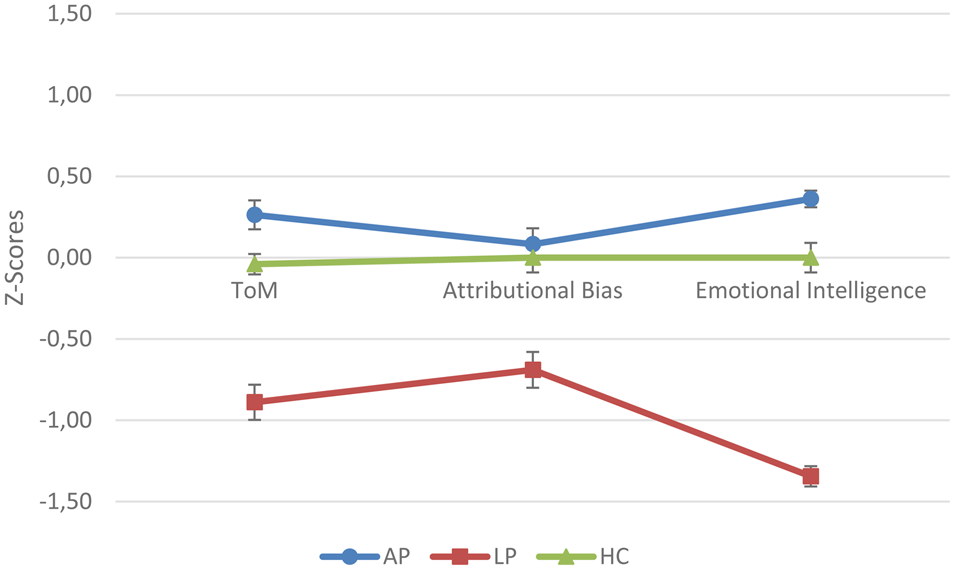
The ANOVA analysis revealed a statistically significant main effect of the group when comparing the two BD clusters and HCs (Table 2, Fig. 1).
Social cognition profiles across the two bipolar disorder clusters and healthy controls. ToM, Theory of Mind; LP, low performance; AP, adjusted performance; HC, healthy controls. Error bars depict standard error of the mean.

Comparison between the two social cognition bipolar disorder clusters and healthy controls across social cognitive domains (Z scores)

Bold text in the table indicates significant values.
LP, low performance; AP, adjusted performance; HC, healthy controls; EIQ, Emotional Intelligence quotient; AIHQ, Ambiguous Intentions Hostility Questionnaire.
The first cluster had a low SC profile (LP group) with a statistical significantly poorer performance in all SC domains when compared to the AP group and HC groups. Specifically, patients in the LP group showed mild difficulties in ToM [z = −0.89; F (2,114) = 11.90; p < 0.001] and AB [z = −0.69; F (2,110) = 4.24; p = 0.017] and moderate difficulties in EI [z = −1.43; F (2,129) = 35.50; p < 0.001]. Patients in the second cluster (AP group) performed comparably to HC on all SC domains (z-scores ranging from 0.08 to 0.36 above the HC's mean) with no significant differences between the two groups.
We also conducted comparisons between the two SC BD clusters and HC subjects across different SC tasks. The LP group performed significantly worse in most SC tasks than the AP group and HC. Patients in the AP group outperformed HC in understanding emotion branch [F (2,129) = 9.362; p = 0.011] (see online Supplementary Table S1).
Comparison between the two SC profiles on sociodemographic, clinical, and neuropsychological variables
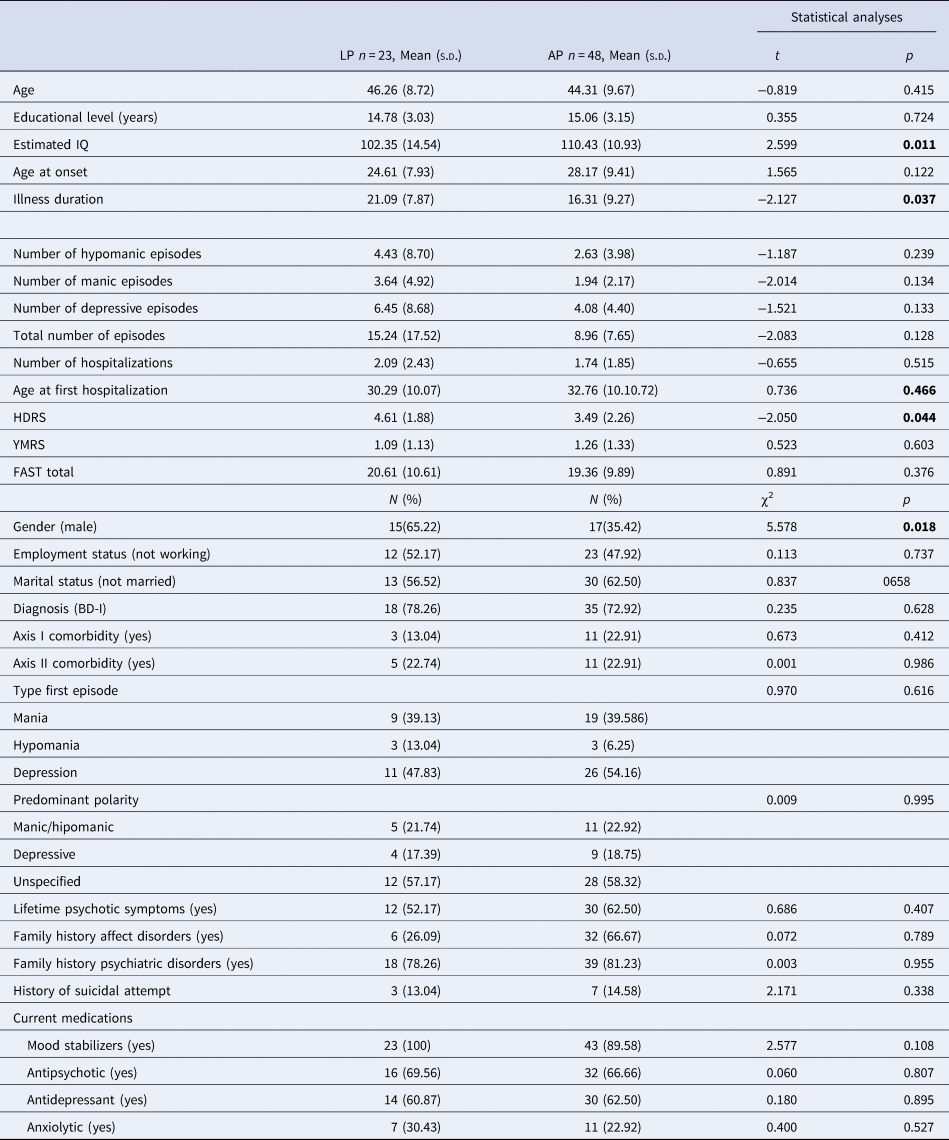
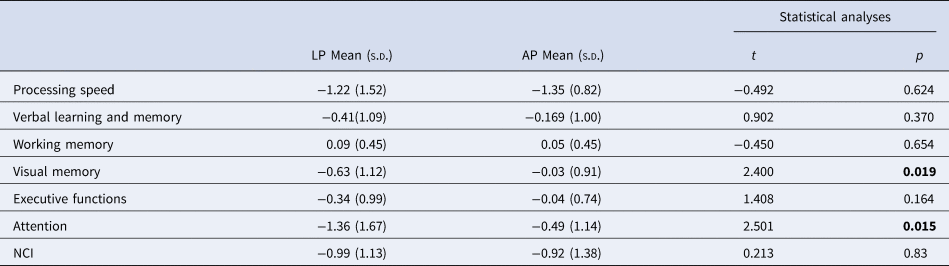
As reported in Table 3, concerning demographic variables, differences between the two clusters were found with regard to gender (χ2 = 5.578; p = 0.018) and estimated IQ (t = 2.599; p = 0.011). Specifically, patients from the LP group were characterized by a higher percentage of males and showed a lower estimated IQ. Considering clinical variables, significant differences were observed among groups in subthreshold depressive symptomatology at the time of the assessment (HDRS t = −2.050; p = 0.044) and illness duration (t = −2.127; p = 0.037). Patients belonging to the LP group exhibited increased subthreshold depressive symptoms and longer illness duration compared to the AP group. Regarding neurocognitive performance, both groups significantly differed in terms of visual memory (t = 2.400; p = 0.019) and attention (t = 2.501; p = 0.015) (see Table 4). In all cases, patients from the LP group performed worse than patients in the AP group. No significant differences between clusters were found for the rest of cognitive domains.
Comparison of sociodemographic and clinical characteristis among the two social cognition clusters

Bold text in the table indicates significant values.
LP, low performance; AP, adjusted performance; IQ, intelligence quotient; HDRS, Hamilton Depression Rating Scale; YMRS, Young Mania Rating Scale; BD, bipolar disorder; FAST, Functioning Assessment Short Test.
Comparison between the two social cognition clusters on neurocognitive domains

Bold text in the table indicates significant values.
LP, low performance; AP, adjusted performance; NCI, Neurocognitive Composite Index.
Identifying factors associated with SC performance
A logistic regression analysis was performed to assess the role of the variables on the likelihood of patients belonging to the LP group. The variables included in the model comprised of those that were found to be significant when comparing both groups: estimated IQ, gender, illness duration, HDRS score, attention and visual memory performance. After running the logistic regression, it was found that the final model included only three significant variables explaining up to 35.2% (Nagelkerke R 2) of the variance of poor SC performance. The model correctly classified 70.8% of the cases. The variables contributing to the model were: low estimated IQ (β = −0.083; OR 0.920; 95% CI 0.863–0.981; p = 0.011), male gender (β = 1.733; OR 5.661; 95% CI 1.473–21.762; p = 0.012), and illness duration (β = 0.082; OR 1.085; 95% CI 1.006–1.171; p = 0.035). In comparison with the AP members, patients belonging to the LP group were more likely to be male and to have a lower estimated IQ. In addition, the presence of longer illness duration increased the probability of low-performance membership.
Discussion
This is the first study aiming to identify profiles of patients based on their performance in different domains of SC by using a data-driven approach in a sample of euthymic patients with BD. Our results suggest the existence of two discrete patterns. First, our data reveal a cluster, labelled as the AP group, that constituted the 67.6% of the sample, characterized by patients with preserved social cognitive skills. Patients in the second cluster, the so-called LP group, was composed of 32.4% of the sample and showed mild difficulties in ToM and AB domains and moderate impairment in EI performance. The two distinct SC subgroups differed in terms of demographic, clinical, and neurocognitive variables. Particularly, patients in the more affected group were more prone to be males, to present a lower estimated IQ, longer illness duration, as well as more subsyndromal depressive symptoms. Concerning neurocognition, patients from this group showed lower performance outcomes in visual memory and attention domains when compared to patients with preserved SC. The logistic regression analysis showed that poorer SC was accounted for longer illness duration together with male gender and a lower estimated IQ.
Along with previous cognitive cluster analysis studies, our results demonstrated different SC severity performance among patients with BD. These differences ranged from intact SC performance to patients presenting mild/moderate impairment in SC domains (Burdick et al., Reference Burdick, Russo, Frangou, Mahon, Braga, Shanahan and Malhotra2014; Jensen et al., Reference Jensen, Knorr, Vinberg, Kessing and Miskowiak2016; Jiménez et al., Reference Jiménez, Solé, Arias, Mitjans, Varo, Reinares and Benabarre2017; Lewandowski et al., Reference Lewandowski, Sperry, Cohen and Öngür2014; Russo et al., Reference Russo, van Rheenen, Shanahan, Mahon, Perez-Rodriguez, Cuesta-Diaz and Burdick2017; Solé et al., Reference Solé, Jiménez, Torrent, del Mar Bonnin, Torres, Reinares and Martínez-Arán2016; van Rheenen et al., Reference van Rheenen, Lewandowski, Tan, Ospina, Ongur, Neill and Burdick2017). However, while some studies found that 32–48% of remitted patients are relatively cognitively intact (Burdick et al., Reference Burdick, Russo, Frangou, Mahon, Braga, Shanahan and Malhotra2014; Solé et al., Reference Solé, Jiménez, Torrent, del Mar Bonnin, Torres, Reinares and Martínez-Arán2016), our data revealed that around 68% of patients exhibited adjusted social cognitive abilities. This finding is consistent with several prior reports that indicate that SC would be relatively intact in a high proportion of patients with BD (Burdick et al., Reference Burdick, Russo, Frangou, Mahon, Braga, Shanahan and Malhotra2014; Lee et al., Reference Lee, Hermens, Naismith, Lagopoulos, Jones, Scott and Hickie2015; Sperry et al., Reference Sperry, O'Connor, Öngür, Cohen, Keshavan and Lewandowski2015; van Rheenen & Rossell, Reference Van Rheenen and Rossell2014; Varo et al., Reference Varo, Jimenez, Solé, Bonnín, Torrent, Valls and Reinares2017). It is worth highlighting that the current study focused exclusively on SC with different social cognitive domains by means of several tasks. In contrast, previous studies had included neurocognitive measures (Jensen et al., Reference Jensen, Knorr, Vinberg, Kessing and Miskowiak2016; Lewandowski et al., Reference Lewandowski, Sperry, Cohen and Öngür2014; Russo et al., Reference Russo, van Rheenen, Shanahan, Mahon, Perez-Rodriguez, Cuesta-Diaz and Burdick2017; Solé et al., Reference Solé, Jiménez, Torrent, del Mar Bonnin, Torres, Reinares and Martínez-Arán2016) and SC using solely one out of the four branches of the MSCEIT (Burdick et al., Reference Burdick, Russo, Frangou, Mahon, Braga, Shanahan and Malhotra2014; Jiménez et al., Reference Jiménez, Solé, Arias, Mitjans, Varo, Reinares and Bonnín2018; van Rheenen et al., Reference van Rheenen, Lewandowski, Tan, Ospina, Ongur, Neill and Burdick2017), hence they did not sufficiently assess the dimensions of SC. We did not identify a subtype with global severe impairment across SC domains. The lack of this subgroup in our results suggests that more severe SC deficits might be associated with other conditions such as schizophrenia instead of BD (Derntl, Seidel, Schneider, & Habel, Reference Derntl, Seidel, Schneider and Habel2012; Bora, Yucel, & Pantelis, Reference Bora, Yucel and Pantelis2009; Lee et al., Reference Lee, Altshuler, Glahn, Miklowitz, Ochsner and Green2013; Bora & Pantelis, Reference Bora and Pantelis2016). Our results would also be in line with previous studies, which support the presence of less severe impairment in SC compared to neurocognitive domains in patients with BD (Bilderbeck et al., Reference Bilderbeck, Reed, McMahon, Atkinson, Price, Geddes and Harmer2016; Martino et al., Reference Martino, Strejilevich, Fassi, Marengo and Igoa2011; Varo et al., Reference Varo, Jiménez, Solé, Bonnín, Torrent, Lahera and Reinares2019). This might suggest that improvement in SC might be not accompanied by changes in neurocognition (Green et al., Reference Green, Penn, Bentall, Carpenter, Gaebel, Gur and Heinssen2019. This should be taken into account when interventions are designed and addressed. However, the nature of the relationship between neurocognition and SC is not yet completely understood (Ventura et al., Reference Ventura, Wood, Jimenez and Hellemann2013).
Our results were similar to those obtained in our previous study (Varo et al., Reference Varo, Jimenez, Solé, Bonnín, Torrent, Valls and Reinares2017), in which euthymic patients were divided into three subgroups according to normative data and based on their performance in EI through the complete MSCEIT. These findings contrast with the two SC clusters found in the current study. It is plausible that discrepancies in the number of emergent subgroups may be due to methodological differences between both studies. In the previous study, the cluster analysis was not used, and results were limited due to the absence of a control group and the lack of assessment of different SC domains such as ToM and AB. In contrast, the use of cluster analysis approach with different SC domains in the current study provides a further understanding of the specificity of SC deficits in BD through a deep characterization of SC clusters. Nevertheless, while previous studies revealed that patients had impairments of moderate magnitude in ToM and of small effect size in the emotional SC domain (Samamé, Reference Samamé2013), the results of the current study reveal that the EI domain, unlike the other two SC domains, seems to play a key role in the differentiation between patients showing a preserved social cognitive performance and patients belonging to the lower social cognitive achievement group. It is also noteworthy that, as it has previously been suggested, EI is particularly relevant in patients with BD since impaired mood regulation may be related to maladaptive patterns of information processing, specifically with emotional processing biases (Aparicio et al., Reference Aparicio, Santos, Jiménez-López, Bagney, Rodríguez-Jiménez and Sánchez-Morla2017; Kjærstad et al., Reference Kjærstad, Mistarz, Coello, Stanislaus, Melbye, Harmer and Kessing2019; Varo et al., Reference Varo, Jiménez, Solé, Bonnín, Torrent, Lahera and Reinares2019). The literature on ToM and AB domains show mixed findings. While some studies indicate that patients with BD might actually have these domains considerably preserved (Donohoe et al., Reference Donohoe, Duignan, Hargreaves, Morris, Rose, Robertson and Cummings2012; Kerr et al., Reference Kerr2003), many others report deficits in patients with BD (Bora, Veznedaroğlu, & Vahip, Reference Bora, Veznedaroğlu and Vahip2016; Lahera et al., Reference Lahera, Herrera, Reinares, Benito, Rullas, González-Cases and Vieta2015; Samamé et al., Reference Samamé, Martino and Strejilevich2015). Our findings are partially in line with the latter, that is, patients of the LP group showed mild/moderate impairment in ToM and AB.
Further group comparisons provided information about the relationship between several demographic, clinical, and neurocognitive factors and the specificity of SC profiles in BD. Patients from the LP group were characterized by a higher percentage of males, lower estimated IQ, presented longer illness duration, and more subsyndromal depressive symptoms. These findings are in line with the results from other studies where several clinical and demographic variables such as male gender (Bücker et al., Reference Bücker, Popuri, Muralidharan, Kozicky, Baitz, Honer and Yatham2014; DeTore, Mueser, & McGurk, Reference DeTore, Mueser and McGurk2018; Donges, Kersting, & Suslow, Reference Donges, Kersting and Suslow2012; Varo et al., Reference Varo, Jiménez, Solé, Bonnín, Torrent, Lahera and Reinares2019), low estimated IQ (Bilderbeck et al., Reference Bilderbeck, Reed, McMahon, Atkinson, Price, Geddes and Harmer2016; Burdick et al., Reference Burdick, Russo, Frangou, Mahon, Braga, Shanahan and Malhotra2014; Varo et al., Reference Varo, Jimenez, Solé, Bonnín, Torrent, Valls and Reinares2017), subthreshold symptoms (Lahera et al., Reference Lahera, Herrera, Reinares, Benito, Rullas, González-Cases and Vieta2015; Varo et al., Reference Varo, Jimenez, Solé, Bonnín, Torrent, Valls and Reinares2017), and illness duration (Aparicio et al., Reference Aparicio, Santos, Jiménez-López, Bagney, Rodríguez-Jiménez and Sánchez-Morla2017; Samamé et al., Reference Samamé, Martino and Strejilevich2015) appear to increase the likelihood of significant SC impairment. However, other studies failed to find any association between SC and clinical variables (Bora et al., Reference Bora, Vahip, Gonul, Akdeniz, Alkan, Ogut and Eryavuz2005; Martino, Strejilevich, Fassi, Marengo, & Igoa, Reference Martino, Strejilevich, Fassi, Marengo and Igoa2011). Regarding neurocognitive variables, patients from the LP group showed more cognitive deficits in visual memory and attention. However, when neurocognitive domains were entered in the logistic regression model, these variables were no longer statistically significant. Therefore, as mentioned above and in agreement with previous studies (Bora et al., Reference Bora, Veznedaroğlu and Vahip2016; DeTore et al., Reference DeTore, Mueser and McGurk2018; Fanning, Bell, & Fiszdon, Reference Fanning, Bell and Fiszdon2012; Hoe, Nakagami, Green, & Brekke, Reference Hoe, Nakagami, Green and Brekke2012), we found that neurocognitive ability may represent a ‘necessary but not sufficient’ prerequisite for social cognitive abilities.
In light of the above mentioned findings, and bearing in mind that longer illness duration and lower estimated IQ have been suggested to be associated with neurocognitive dysfunction (Bora, Yucel, & Pantelis, Reference Bora, Yucel and Pantelis2009; Burdick et al., Reference Burdick, Russo, Frangou, Mahon, Braga, Shanahan and Malhotra2014; Martínez-Arán et al., Reference Martínez-Arán, Vieta, Reinares, Colom, Torrent, Sánchez-Moreno and Salamero2004; Vieta et al., Reference Vieta, Berk, Schulze, Carvalho, Suppes, Calabrese and Grande2018), one may argue that the aforementioned variables might also place a patient at increased risk for developing more generalized SC deficits. Although the temporal progression of SC dysfunction in BD is unclear, emerging evidences have found impairments in SC, in both patients with BD and their unaffected relatives, suggesting that deficits in SC may be considered a possible trait marker of genetic risk for BD (Bora & Özerdem, 2017; Kessing & Miskowiak, Reference Kessing and Miskowiak2018; Kjærstad et al., Reference Kjærstad, Mistarz, Coello, Stanislaus, Melbye, Harmer and Kessing2019; Russo et al., Reference Russo, van Rheenen, Shanahan, Mahon, Perez-Rodriguez, Cuesta-Diaz and Burdick2017). Future prospective longitudinal studies ideally starting with high-risk population are therefore needed to elucidate the nature and developmental trajectory of SC deficits in BD.
The results have several implications for clinical and research perspectives. The differences in profiles revealed by this study imply that SC should be measured by several tasks corresponding to different dimensions to better define and pinpoint specific difficulties. This may have important implications for the non-pharmacological treatment of BD patients. Our findings highlight the need to characterize the pattern of impairment more accurately, to enable designing of programs specifically to the tailored SC dysfunction, while taking into consideration the needs of the impaired cluster. Thus, patients in the LP subgroup might optimally benefit from a specific type of targeted intervention focusing mainly on EI, and then on tasks related to ToM and AB domains. Moreover, our findings shed more light on the hypothesis of specificity of social cognitive deficits in patients with BD, suggesting that difficulties in social cognitive abilities are characteristic of a subsample rather than being an overall deficit in BD. Taking into account that just one-third of the sample of patients presented low SC performance, an assessment screening for SC would be useful before introducing a comprehensive assessment. This would also be necessary before initiating a treatment trial targeting SC to ensure inclusion of an enriched sample of patients with scope for improvement (Miskowiak et al., Reference Miskowiak, Burdick, Martinez-Aran, Bonnin, Bowie, Carvalho and Vieta2018). It may be possible to hypothesize that SC might act as a protective factor in the course of BD, given its role in facilitating adaptive social interactions, maintaining social relationships and in achieving social support (González-Ortega et al., Reference González-Ortega, González-Pinto, Alberich, Echeburúa, Bernardo, Cabrera and Amoretti2019; Vlad et al., Reference Vlad, Raucher-Chéné, Henry and Kaladjian2018). However, our study failed to detect any statistically significant relationship between SC and psychosocial functioning outcomes in patients with BD. This was surprising given that one could assume that patients with BD who exhibit more persistent SC impairments would also experience greater functional difficulties in everyday life (Solé & Vieta, Reference Solé and Vieta2019). Nevertheless, it is important to mention that the association between both constructs is more complex since each of them encompasses multiple abilities and involves mediating variables (Green et al., Reference Green, Horan and Lee2019). Positive relationship between high IQ and better SC has been found (Bilderbeck et al., Reference Bilderbeck, Reed, McMahon, Atkinson, Price, Geddes and Harmer2016; van Rheenen et al., Reference van Rheenen, Lewandowski, Tan, Ospina, Ongur, Neill and Burdick2017; Varo et al., Reference Varo, Jimenez, Solé, Bonnín, Torrent, Valls and Reinares2017), suggesting that IQ could be a good indicator of premorbid functioning; therefore, IQ may play a protective role against SC dysfunction among this group of patients (Jiménez et al., Reference Jiménez, Solé, Arias, Mitjans, Varo, Reinares and Benabarre2017).
The main strength of this study includes the clustering analysis using a comprehensive assessment of SC covering EI, ToM, and AB. However, the study has some limitations that should be noted. First, our sample was recruited from a tertiary center, where some participants may represent a more severely affected subgroup of patients, which may affect the generalization of our results. Secondly, further studies with larger samples of patients with BD are needed in order to replicate our findings. Third, because of the cross-sectional design, we were not able to determine the natural stability of these SC subtypes over the course of illness. Finally, we were unable to account for the effects of psychopharmacological treatments given because medication regimes vary widely and dosages were not controlled. Nevertheless, there were no differences concerning the type of psychopharmacological treatment among the two groups. Since at present there is not a validated screening to assess SC nor a validated comprehensive battery that covers different SC domains, this issue should be addressed in future research in BD.
In conclusion, our results suggest the existence of two discrete SC profiles among euthymic patients with BD. Nearly two-thirds of patients exhibited social cognitive abilities comparable to HC, suggesting that SC deficits in BD are not generalized but rather selective. Particularly male gender, together with a lower estimated IQ and longer illness duration may act as risk factors for low performance in SC in patients with BD.
Supplementary material
The supplementary material for this article can be found at https://doi.org/10.1017/S0033291720001865.
Acknowledgements
The authors thank the support of the Spanish Ministry of Science, Innovation (PI15/00283, PI15/00330) integrated into the Plan Nacional de I + D + I y cofinanciado por el ISCIII-Subdirección General de Evaluación y el Fondo Europeo de Desarrollo Regional (FEDER); CIBERSAM; and the Comissionat per a Universitats i Recerca del DIUE de la Generalitat de Catalunya to the Bipolar Disorders Group (2017 SGR 1365) and the project SLT006/17/00357, from PERIS 2016–2020 (Departament de Salut). CERCA Programme/Generalitat de Catalunya
Conflict of interest
E.V. has received grants and served as a consultant, advisor, or CME speaker for the following entities: AB-Biotics, Abbott, Allergan, Angelini, Dainippon Sumitomo Pharma, Galenica, Janssen, Lundbeck, Novartis, Otsuka, Sage, Sanofi-Aventis, and Takeda. KWM reports having received consultancy fees from Lundbeck and Allergan. AMA has received funding for research projects and/or honoraria as a consultant or speaker for the following companies and institutions: Otsuka, Pfizer, AstraZeneca, Bristol-Myers Siquibb, Lundbeck, Brain and Behaviour Foundation (NARSAD Independent Investigator), the Spanish Ministry of Economy and Competitiveness and Instituto de Salud Carlos III.