Introduction
The quality of life (QoL) of people with dementia (PWD) and their caregivers is a priority in dementia care. Frequently, QoL is considered an indicator of the effectiveness of both psychosocial and pharmacological interventions (Karttunen et al., Reference Karttunen2011). Over the years, debates have ensued on what constitutes QoL. A more recent concept of QoL (Berwig et al., Reference Berwig, Leicht and Gertz2009) differentiated between objective circumstances and the subjective evaluations that impart meaning to these circumstances. This model conceptualizes QoL as it is experienced at any given moment as the result of a complex, multidimensional, and essentially subjective appraisal process. In addition to evaluating personal objective measures (including memory and functional abilities), environmental factors, such as social support and material conditions, personal value systems, and coping styles, also play a role (Berwig et al., Reference Berwig, Leicht and Gertz2009).
Measuring QoL in dementia is challenging because the validity of self-reporting is unclear. Many studies demonstrate that dementia severity, neuropsychiatric symptoms, cognitive impairments, and disease awareness may influence self-reported QoL ratings (Logsdon et al., Reference Logsdon, Gibbons, McCurry and Teri1999; Vogel et al., Reference Vogel, Mortensen, Hasselbalch, Andersen and Waldemar2006; Karttunen et al., Reference Karttunen2011). Logsdon et al. (Reference Logsdon, Gibbons, McCurry and Teri1999) determined the importance of depression in QoL evaluations, but other factors varied by disease severity.
Family caregivers might be in a better position to estimate how PWD may interpret their QoL. However, caregivers’ ratings of PWD QoL may be influenced by caregiver burden (Logsdon et al., Reference Logsdon, Gibbons, McCurry and Teri2002; Schiffczyk et al., Reference Schiffczyk, Romero, Jonas, Lahmeyer, Müller and Riepe2010), the personality characteristics of the caregiver, the nature of the relationship, the amount of time spent together, and the level of impairment (Schiffczyk et al., Reference Schiffczyk, Romero, Jonas, Lahmeyer, Müller and Riepe2010).
Recent studies have suggested that there are differences between self-reported ratings and caregivers’ ratings of PWD QoL (Ready et al., Reference Ready, Ott and Grace2004; Vogel et al., Reference Vogel, Mortensen, Hasselbalch, Andersen and Waldemar2006; Hurt et al., Reference Hurt2010; Bosboom et al., Reference Bosboom, Alfonso, Eaton and Almeida2012). Nevertheless, the evaluation of the differences has focused on a limited number of factors, such as cognitive impairment (Hurt et al., Reference Hurt2010; Schiffczyk et al., Reference Schiffczyk, Romero, Jonas, Lahmeyer, Müller and Riepe2010; Bosboom et al., Reference Bosboom, Alfonso, Eaton and Almeida2012; Buckley et al., Reference Buckley2012), insight (Ready et al., Reference Ready, Ott and Grace2004; Vogel et al., Reference Vogel, Mortensen, Hasselbalch, Andersen and Waldemar2006; Hurt et al., Reference Hurt2010; Bosboom et al., Reference Bosboom, Alfonso, Eaton and Almeida2012), and specific groups of PWD, such as those people living in residential care, a population that tends to be composed more of frail, elderly individuals (Bosboom et al., Reference Bosboom, Alfonso, Eaton and Almeida2012; Moyle and O'Dwyer, Reference Moyle and O'Dwyer2012).
An explanation for the differences between PWD and caregivers’ ratings is that QoL may change according to the level of cognitive impairment (Logsdon et al., Reference Logsdon, Gibbons, McCurry and Teri2002; Buckley et al., Reference Buckley2012). Early in the disease process, caregivers may be more focused on the difficulties caused by impairment in the instrumental activities of daily living (IADL). In the middle stages, neuropsychiatric symptoms are more significant, and these symptoms are related to caregiver burden. In the later stages of disease, activities of daily living (ADL) deficits are the predominant concern (Logsdon et al., Reference Logsdon, Gibbons, McCurry and Teri2002). On the other hand, Logsdon et al. (Reference Logsdon, Gibbons, McCurry and Teri2002) suggested that people with mild dementia may be unaware of their deficits or may deny impairments. However, as the disease progresses, and they require more assistance with basic ADLs, their awareness of their deficits may increase (Logsdon et al., Reference Logsdon, Gibbons, McCurry and Teri2002). Buckley et al. (Reference Buckley2012) found that dementia severity was the major predictor of the differences between caregiver and self-reported ratings of QOL, whereas neuropsychiatric symptoms did not contribute significantly. These differences highlight the fact that QoL will vary for PWD and their caregivers according to the existing context in each stage of the disease.
We can assume that PWD and caregivers provide valid, although differing, perspectives of QoL (Schiffczyk et al., Reference Schiffczyk, Romero, Jonas, Lahmeyer, Müller and Riepe2010). However, taking into account the differences in the disease process, the factors associated with PWD QoL ratings and family caregivers’ ratings of PWD QoL lead to some key questions: (1) Are there significant differences in the perceptions of QoL in mild dementia? (2) Are there significant differences in the factors associated with QoL ratings in mild dementia?
In the present study, we hypothesized that the differences in QoL ratings of people with mild AD and their family caregivers are not directly related to cognition. By focusing on one particular area (e.g. cognitive function), other equally important factors associated with QoL in mild dementia might be neglected (Banerjee et al., Reference Banerjee2006; Hurt et al., Reference Hurt2010; Bosboom et al., Reference Bosboom, Alfonso, Eaton and Almeida2012). We designed this study to determine the non-cognitive factors associated with both self-reported QoL and family caregivers’ ratings of PWD QoL.
Methods
Study design
The current cross-sectional study was part of a larger study designed to assess the awareness of disease in dementia.
Participants and setting
A consecutive series of 41 PWD (13 males, 28 females) and 41 family caregivers (5 males, 36 females) was recruited from an AD outpatient unit. A psychiatrist performed the clinical diagnosis of AD using clinical interviews with the PWD and caregivers, cognitive screening tests, laboratory tests, and imaging.
The participants were diagnosed with possible or probable AD according to Diagnostic and Statistical Manual of Mental Disorders, Fourth Edition (DSM-IV-TR; American Psychiatric Association, 2000) and National Institute of Neurological and Communicative Diseases and Stroke/Alzheimer's Disease and Related Disorders Association (NINCDS-ADRDA) criteria (McKhann et al., Reference McKhann, Drachman, Folstein, Katzman, Price and Stadlan1984). Only those individuals with mild AD according to the Clinical Dementia Rating (CDR; Morris et al., Reference Morris1993) and Mini-Mental State Examination (MMSE) scores of 13–26 (Folstein et al., Reference Folstein, Folstein and McHugh1975) were included in the study. The MMSE score range from 13 to 26 was chosen to adjust the cut-off points for education level. A score of 13 is correlated with illiteracy; a score of 18 corresponds with low educational attainment (seven or fewer years of school); a score of 24 corresponds with intermediate educational attainment (8–11 years); and a score of 26 corresponds with high educational attainment (12 or more years; Bertolucci et al., Reference Bertolucci, Brucki, Campacci and Juliano1994).
PWD with aphasia, head trauma, alcohol abuse, and epilepsy, as defined by the DSMIV-TR criteria (American Psychiatric Association, 2000), and uncontrolled medical problems such as hypertension and diabetes were excluded from the study.
The primary family caregiver was defined as the individual who was the most responsible for the care of the PWD. Each caregiver resided in the same house as the PWD and was able to provide detailed information on the life history, cognitive functioning, and ADL of the PWD. All of the caregivers had previously been informed of the diagnosis by the psychiatrist.
Each PWD-caregiver pair was interviewed together. PWD completed assessments of QoL, cognition, and their awareness of disease. Caregivers provided information about the PWD, including demographic measurements, ability to perform ADLs and assessments of QoL, depression, dementia severity, and burden of care. For the PWD interview, the research assistant read questions with accompanying large-type visual displays of the answer choices. In the event that a PWD expressed confusion over the question or its answer choices, the research assistant attempted to clarify the source of confusion. We presented the instruments in the same order for all participants.
All PWD were prescribed a cholinesterase inhibitor (galantamine, 8.0 mg, 16.0 mg, or 24.0 mg (one tablet a day); donepezil, 10 mg (one tablet a day), or rivastigmine, 1.5 mg, 3.0 mg, 4.5 mg, or 6.0 mg (two tablets a day)). PWD with depressive symptoms were treated with fluoxetine (20 mg), citalopram (20 mg), paroxetine (20 mg), or sertraline hydrochloride (50 mg).
Comorbidities including hypothyroidism, hypercholesterolemia, hypertension, smoking, mitral valve prolapse, and diabetes were monitored.
All assessments were conducted by trained research assistants. This study was approved by the Ethics Committee of the Institute of Psychiatry at the Federal University of Rio de Janeiro (UFRJ), and all PWD were capable of providing signed, informed consent. Family caregivers also gave informed consent prior to the first interview.
Measures
Quality of life
Quality of Life in Alzheimer's Disease (QoL-AD): The primary outcome measure of this study was QoL-AD, a 13-item measure of QoL that is completed by both the PWD and the caregiver. This questionnaire was developed specifically for the assessment of QoL in PWD. The QoL-AD includes 13 domains: physical health, energy, mood, living situation, memory, family, marriage, friends, chores, fun, money, self, and life as a whole. The 13 domains are rated as poor (1), fair (2), good (3), or excellent (4), and the total score ranges from 13 to 52. The ratings of PWD and caregivers’ ratings of PWD QoL were analyzed separately. We used both versions of the assessment (Logsdon et al., Reference Logsdon, Gibbons, McCurry and Teri1999; Novelli et al., Reference Novelli, Nitrini and Caramelli2010).
Cognition
Mini-Mental State Examination (MMSE): This instrument includes tests of orientation, registration, short-term memory, language use, comprehension, and basic motor skills. The total score ranges from 0 to 30. Lower scores indicate impaired cognition (Folstein et al., Reference Folstein, Folstein and McHugh1975; Bertolucci et al., Reference Bertolucci, Brucki, Campacci and Juliano1994).
Dementia severity
Clinical Dementia Rating (CDR): The CDR measures the severity of dementia. The stages range from 0 (no dementia) to 3 (severe dementia) according to the degree of cognitive, behavioral, and ADL impairment. We used the full protocol (Morris, Reference Morris1993).
Depressive symptoms
Cornell Scale for Depression in Dementia (CSDD): The Cornell Scale assesses mood symptoms, physical symptoms, circadian functions, and behavioral symptoms related to depression. Scores above 7 indicate the presence of depression (Alexopoulos et al., Reference Alexopoulos, Abrams, Young and Shamoian1988; Carthery-Goulart et al., Reference Carthery-Goulart2007).
Activities of daily living
Pfeffer Functional Activities Questionnaire (FAQ): The FAQ is a caregiver-reported inventory that evaluates the ADL. The ratings for each item range from normal (0) to dependent (3), with a total of 30 points. Higher scores indicate worse functional status (Pfeffer et al., Reference Pfeffer, Kurosaki, Harrah, Chance and Filos1982).
Burden
Zarit Burden Interview (ZBI): This assessment consists of 22 items. The caregiver assesses the impact of the illness on the caregiver's life by indicating how often the caregiver experiences a particular feeling: never (0), rarely (1), sometimes (2), quite frequently (3), or nearly always (4). The total score ranges from zero to 88. Higher scores indicate a higher level of burden (Zarit et al., Reference Zarit, Reever and Bach-Peterson1980; Scazufca, Reference Scazufca2002).
Awareness of disease
Assessment Scale of Psychosocial Impact of the Diagnosis of Dementia (ASPIDD): The ASPIDD is a 35-question scale based on PWD and caregiver reports. This scale was designed to evaluate awareness of disease in PWD through the scoring of discrepant responses across domains that include awareness of cognitive deficits, social relationships, family relationships, instrumental, and basic ADL, and affective relationships. The caregiver answers the same questions as the PWD. The caregiver is not allowed to discuss the questions with the PWD or to assist the PWD in any way. The ratings of awareness are preserved (1), impaired (2), and absent (3). The discordance rate is calculated as the number of discrepant responses on each domain divided by the number of questions. Higher scores indicate higher discrepancy (Dourado et al., Reference Dourado, Marinho, Soares, Engelhardt and Laks2007).
Statistical methods
All statistical analyses were performed with SPSS software for Windows release 17.0. The Shapiro–Wilk and Levine tests were used to verify the normal distribution and the variability between the variances, respectively. The parametric variables were described by their mean and standard deviations (SD), and the non-parametric variables were described by their median and interquartile ranges.
The paired Student's t-test was used to assess the differences between self-reported and caregiver ratings of PWD QoL and to identify the differences between reports in the various domains of the QoL-AD scale (physical health, energy, mood, living situation, memory, family, marriage, friends, chores, fun, money, self, and life as a whole). We corrected for multiple comparisons (Bonferroni correction). Only variables with p < 0.003 (p < 0.05/14, corrected for multiple comparisons) were included.
We used Spearman's correlation to investigate the relationships between self-reported and caregiver ratings of QoL and the general characteristics of the PWD and caregivers (age, gender, educational level, and duration of the disease), awareness of disease, cognitive function, functional activities, presence of depressive symptoms, and caregiver burden.
Two multivariate linear regression analyses were completed to identify the factors that influenced the self-reported and caregiver QoL ratings. Linear regression was conducted only with the variables that were significantly correlated (awareness of disease, presence of depressive symptoms, and educational level of the caregiver).
Cohen's d was used as a measure of effect size when the comparison of two means in the domains of the QoL-AD scale revealed significant differences.
All of the significance tests were performed at a two-tailed α-level of 0.05.
Results
Characteristics of the PWD and the caregivers
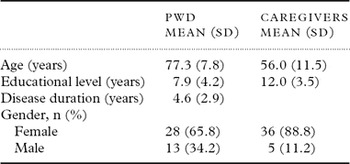
The mean PWD age was 77.3 years (SD = 7.82), and 65.8% of PWD (n = 28) were female. The PWD educational level was low (seven or fewer years of school) in 48.7% (n = 20), intermediate (8–11 years) in 36.5% (n = 15), and high (12 or more years) in 14.6% (n = 6) of the PWD.
The mean age of the caregivers was 56.0 years (SD = 11.51), and 88.8% of the caregivers (n = 36) were female. The educational level of the caregivers was low in 9.7% of cases (n = 4), intermediate in 36.5% (n = 15), and high in 53.6% (n = 22). The sociodemographic data of the PWD and the caregivers are summarized in Table 1.
Characteristics of PWD and caregivers

PWD = people with dementia; SD = standard deviation.
The PWD all showed mildly impaired cognitive function and functional ability, with a mean MMSE score of 21.0 (SD = 3.93, range 18–25), and a mean FAQ score of 12.0 (SD = 7.91, range 6–19). Overall, the PWD were not depressed, as indicated by a mean CSDD score of 4.0 (SD = 4.98, range 2–7). As a whole, the caregivers had a moderate caregiver burden, as indicated by a mean ZBI score of 29.0 (SD = 15.35, range 20–41). At baseline, 51% of the PWD (n = 21) showed preserved awareness of disease, 45% (n = 18) showed impaired awareness of disease, and 4% (n = 2) were unaware of their disease.
Factors associated with QoL ratings
Univariate analyses
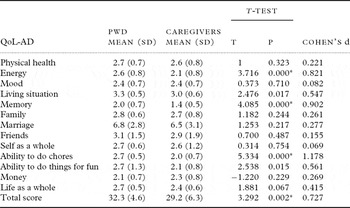
We observed a significant difference (t = 3.292, p < 0.05, d = 0.727) between self-reported QoL-AD (mean = 32.3, SD = 4.6) scores and caregivers’ ratings (mean = 29.2, SD = 6.3). The self-reported QoL-AD ratings were greater than the caregivers’ ratings. Upon analyzing the domains of QoL, we observed significant differences between PWD and caregiver ratings for chores (t = 5.334, p < 0.001, d = 1.178), memory (t = 4.085, p < 0.001, d = 0.902), and energy (t = 3.716, p < 0.001, d = 0.821), and these differences exhibited a large effect size. There were no significant differences between the self-reported and caregiver ratings of physical health, mood, living situation, family, marriage, money, fun, self, or life as a whole (Table 2).
QoL-AD scores of PWD and caregivers

PWD = people with dementia; SD = standard deviation; QoL-AD = Quality of Life in Alzheimer's disease.
Criterion for significance using the Bonferroni correction = *p < 0.003.
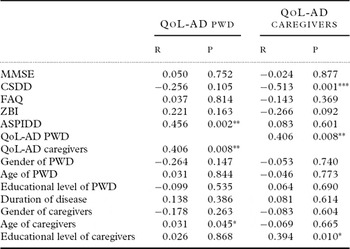
Self-reported QoL-AD was correlated with the level of awareness of disease (r = 0.456, p < 0.01) and the caregivers’ ratings of PWD QoL (r = 0.406, p < 0.01). There was no correlation between self-reported QoL-AD and cognitive function, functional activities, depressive symptoms, caregiver burden, or other sociodemographic characteristics (Table 3).
Spearman's correlation between QoL-AD and study variables

PWD = people with dementia; MMSE = Mini-Mental State Examination; CSDD = Cornell Scale for Depression in Dementia; FAQ = Pfeffer Functional Activities Questionnaire; ZBI = Zarit Burden Interview; ASPIDD = Assessment Scale of Psychosocial Impact of the Diagnosis of Dementia; QoL-AD = Quality of Life in Alzheimer's disease.
*p < 0.05; **p < 0.01; ***p < 0.001.
The caregivers’ ratings of PWD QoL were correlated with PWD depressive symptoms (r = −0.513, p < 0.001), the educational levels of the caregivers (r = 0.394, p < 0.05), and self-reported QoL-AD (r = 0.406, p < 0.01). No association was observed between the caregivers’ QoL ratings and disease awareness, cognitive function, functional activities, caregiver burden, gender of the PWD or caregiver, age of PWD or caregiver, educational level of PWD, or disease duration (Table 3).
Multivariate analyses
Self-reported QoL-AD: The linear regression indicated that awareness of disease (p < 0.01) was significantly related to self-reported QoL-AD. PWD with impaired or absent awareness of disease reported better QoL. The final model of the factor of self-reported QoL-AD explained 24% of the observed variance (p < 0.01). The adjusted R 2 and standardized regression weight is shown in Table 4.
Regression model of factors predicting self-reported QoL-AD ratings

ASPIDD = Assessment Scale of Psychosocial Impact of the Diagnosis of Dementia.
**p < 0.01.
Caregivers’ ratings of PWD QoL: The linear regression demonstrated that the depressive symptoms in PWD (p < 0.001) and the educational levels of the caregivers (p < 0.05) were significantly related to the caregivers’ QoL ratings. Caregivers reported low levels of QoL-AD when the PWD exhibited more depressive symptoms. The final model of the factors related to the caregivers’ ratings of PWD QoL explained 38% of the observed variance (p < 0.001). The adjusted R 2 and standardized regression weights are shown in Table 5.
Regression model of factors predicting caregivers’ ratings of PWD QoL

CSDD = Cornell Scale for Depression in Dementia.
*p < 0.05; ***p < 0.001.
Discussion
In this study, we investigated the factors associated with the self-reported QoL ratings of people with mild AD and the caregivers’ ratings of PWD QoL. We found that the factors that drive QoL ratings vary according to the rater. Caregiver QoL ratings are influenced by the caregivers’ educational level and depressive symptoms in the PWD. However, disease awareness plays a role in self-reported QoL. Additionally, PWD rated their QoL significantly higher than did their caregivers, a finding that has been observed in previous studies (Ready et al., Reference Ready, Ott and Grace2004; Vogel et al., Reference Vogel, Mortensen, Hasselbalch, Andersen and Waldemar2006). The difference between caregiver ratings of PWD QoL and self-reported QoL has important implications for interpreting QoL research findings in mild dementia because it suggests that cognitive impairment is not the main factor that results in poor agreement. There are several reasons why self-reported and caregivers’ ratings of PWD QoL might differ.
The first reason involves the awareness of disease. With mild disease, PWD maintain the capacity to acknowledge the deficiencies in their cognitive performance (Dourado et al., Reference Dourado, Marinho, Soares, Engelhardt and Laks2007); we found that PWD with impaired awareness of disease reported a better QoL than did those with preserved awareness. This finding is in line with other studies that have indicated that awareness was related to QoL ratings (Hurt et al., Reference Hurt2010; Bosboom et al., Reference Bosboom, Alfonso, Eaton and Almeida2012). Although decreased awareness was associated with self-reported QoL, it was not associated with caregiver ratings of QoL. Perhaps caregivers do not consider the degree of awareness to be a predictor of QoL because their judgments are based upon an appraisal of the individual's cognitive and functional performance.
The correlation between impaired awareness and positive QoL ratings illustrates the need to develop and apply rigorous domain-specific awareness measures (Clare, Reference Clare2004). Previous studies of QoL and disease awareness have approached awareness through dichotomous or categorical global ratings, primarily using clinician assessments to measure awareness (Ready et al., Reference Ready, Ott and Grace2004; Vogel et al., Reference Vogel, Mortensen, Hasselbalch, Andersen and Waldemar2006; Hurt et al., Reference Hurt2010). Individual variability in certain aspects of awareness has been documented in mild-to-moderate dementia, but most of these studies focused on the awareness of cognitive deficits (Dourado et al., Reference Dourado, Laks, Rocha, Soares, Leibing and Engelhardt2005). Because QoL is a multidimensional, complex concept that includes physical, psychological, and social functioning, it might be important for future studies to focus on the multidimensional characteristics of disease awareness.
Depression is common in mild AD (Starkstein et al., Reference Starkstein, Jorge, Mizrahi and Robinson2005). Most studies, including this one, have shown that depressive symptoms in PWD were associated with QoL ratings. When caregivers provide QoL ratings, they take into account a variety of factors, and their observations on mood are a critical component (Logsdon et al., Reference Logsdon, Gibbons, McCurry and Teri2002; Sousa et al., Reference Sousa, Santos, Arcoverde, Dourado and Laks2011). Caregivers reported lower QoL-AD ratings when PWD exhibited more depressive symptoms (Logsdon et al., Reference Logsdon, Gibbons, McCurry and Teri1999; Vogel et al., Reference Vogel, Mortensen, Hasselbalch, Andersen and Waldemar2006; Karttunen et al., Reference Karttunen2011). Therefore, from the caregivers’ viewpoint, the early identification and treatment of depressive symptoms in mild AD may help PWD maintain their QoL in the context of cognitive decline.
The self-reported and caregiver ratings of the QoL-AD domains of chores, energy, and memory exhibited significant differences (Conde-Sala et al., Reference Conde-Sala, Garre-Olmo, Turró-Garriga, López-Pousa and Vilalta-Franch2009). This finding may be related to differences between the standards for QoL of caregivers and PWD. Therefore, the term “quality of life” may not have the same mean for PWD as it does for healthy participants. The interpretation of “quality of life” is likely to be subjective and ambiguous even when PWD and caregivers are asked the same questions (Schiffczyk et al., Reference Schiffczyk, Romero, Jonas, Lahmeyer, Müller and Riepe2010). PWD who have experienced memory loss and decline in other cognitive skills may partially downgrade the importance of these abilities and place more importance on other abilities that are not impaired. Caregivers may witness the losses experienced by PWD and assume that they are a source of distress (Ready et al., Reference Ready, Ott and Grace2004). Nevertheless, it is important that future investigators carefully consider gathering QoL information from both caregivers and PWD.
Note that this study was performed in a Latin American country, which may explain the finding that the caregivers’ educational levels influenced the QoL evaluations (Vogel et al., Reference Vogel, Mortensen, Hasselbalch, Andersen and Waldemar2006; Hurt et al., Reference Hurt2010). The caregivers with more formal education provided higher QoL ratings than those with less formal education. Education is an important factor in Latin American countries because of the high levels of illiteracy. Educational background plays a key role in cognitive assessments in these contexts (Moreira et al., Reference Moreira, Lourenço, Soares, Engelhardt and Laks2009).
Some limitations of the present study must be acknowledged. First, the findings are specific to people with mild AD and may not be generalizable to other stages of AD. It is important that future studies compare the results of people with mild and more advanced stages of AD. Second, this study included a small sample size, and two regressions may have produced some chance associations. We would argue, however, that the consistency of our observations with those of other studies suggests that this explanation is unlikely for our findings (Conde-Sala et al., Reference Conde-Sala, Garre-Olmo, Turró-Garriga, López-Pousa and Vilalta-Franch2009; Schiffczyk et al., Reference Schiffczyk, Romero, Jonas, Lahmeyer, Müller and Riepe2010; Bosboom et al., Reference Bosboom, Alfonso, Eaton and Almeida2012). Third, cognitive impairment was evaluated by the MMSE. Further studies should use a more complete cognitive assessment. Finally, the QoL-AD should be administered to the PWD and the caregivers separately to ensure that the study participants are unaware of one another's answers. However, we found that caregivers’ ratings of PWD QoL corresponded to self-reported QoL ratings. Caregivers may have been influenced by the perceptions of the PWD. This fact highlights the importance of self-reported assessments of QoL and well-being.
Despite these limitations, our findings suggest that non-cognitive factors, such as disease awareness and depressive symptoms, play an important role in the differences between self-reported and caregivers’ ratings of PWD QoL in AD. A major implication is that discrete measures of cognition or function are likely to miss important factors. Awareness of disease and depressive symptoms may be particularly relevant in pharmacological and therapeutic intervention trials. In this case, improved function might otherwise be masked (and, therefore, incorrectly assumed to confer no increase in QoL) if the measurements are analyzed in isolation without considering these non-cognitive factors.
Conflict of interest
None.
Description of authors’ roles
M.F.B. Sousa was involved in designing the study, collecting the data, and writing the draft paper. R.L. Santos collected the data and assisted with the writing. P. Simões and C. Arcoverde performed the statistical analyses. T. Belfort assisted with the writing. I. Adler and C. Leal collected the data. M.C.N. Dourado designed the study, supervised the data collection, and wrote the paper.
Acknowledgments
This study was supported by Fundação de Apoio a Pesquisa do Estado do Rio de Janeiro (FAPERJ), grant E-26/102.256/2010.