Percutaneous transcatheter balloon angioplasty was first used as an alternative to surgical repair for children with aortic coarctation in the early 1980s.Reference Reynolds1–Reference Singer, Rowen and Dorsey4 There have only been two small prospective randomized controlled trials comparing surgical repair and balloon angioplasty for native aortic coarctation.Reference Shaddy, Boucek and Sturtevant5, Reference Hernandez-Gonzalez, Solorio and Conde-Carmona6 This type of direct comparison is difficult, as the characteristics, outcomes, and potential complications of both procedures differ considerably, as well as the probabilities and values, preferences, or weightings of these outcomes. Clinical trials cannot simultaneously take into account these differences. Comparisons of non-randomized case series are also problematic for many reasons, including that the literature for surgery is not contemporary compared to balloon angioplasty. While analysis using methods of cost-effectiveness have been applied, formal comparisons of cost may not reflect the preferences of physicians and patients for different outcomes.Reference Shim, Lloyd, Moorehead, Bove, Mosca and Beekman7, Reference George, Shim and Bucuvalas8 The incorporation of these preferences into clinical decision-making based on the best available research evidence is the cornerstone of the practice of evidence-based medicine. Decision analysis is a useful method to incorporate the broad spectrum of outcomes and preferences into a comparison, together with determination of threshold values for changes in preferred approach. We present a decision analysis designed to determine whether balloon angioplasty or surgery would be the preferred treatment in childhood for native aortic coarctation across various age groups.
Methods
Formulation of the decision tree: A MEDLINE search was performed to identify published reports that examined the outcomes of children treated for native aortic coarctation. Search criterions included the following terms: “coarctation of the aorta”, “balloon angioplasty”, “surgery” or “surgical repair”. Only articles published in English from 1984 through 2005 were used, restricting them to those examining primary repair or procedures for native aortic coarctation in children. Articles examining coarctation of the descending aorta, hypoplastic aortic arch, treatment of residual or recurrent coarctation, or the use of endovascular stents were excluded. The most recent article was used in situations where multiple articles were published using the same group of patients.
The results of the articles were stratified by age into 3 groups, neonates aged less than 3 months, children aged from 3 months to 12 years, and adolescents aged greater than 12 years. The probabilities of the following events were determined for each article
– perioperative death
– resolution of the gradient across the coarctation
– major and minor complication
– presence of residual or recurrent coarctation
– aneurysmal formation.
Individual decision trees were formulated for each article, and were combined to create a final decision tree for each age group. The contribution that each individual article made to the combined final decision tree was weighted based on the number of patients reported in that article, such that articles with a greater number of patients contributed more information to the baseline probabilities in the final decision tree. The probability of each of the events occurring was assumed to be independent of each other. The events occurred in either the periprocedural or follow-up periods.
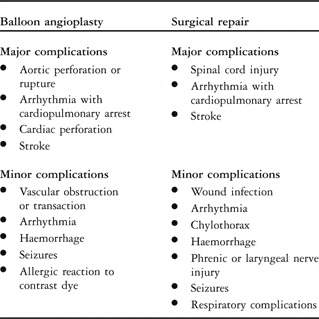
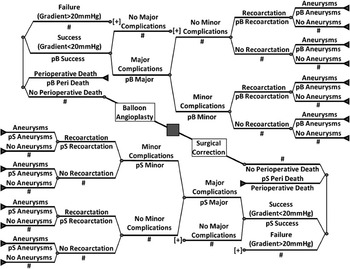
Decision trees were formulated by referring to the initial branch point as the decision node, and dividing the tree into the two different options for treatment options, namely balloon angioplasty versus surgical repair. Within each arm, the tree continues to branch out. Each branch is referred to as a “chance node,” and represent points where different events, such as complications, periprocedural death, aneurysms and recoarctation, may occur. Each chance node is also assigned a probability, which represents the probability of each event occurring. These probabilities are based on the weighted data from the articles. The first chance node represents the probability of periprocedural death, followed by the chance nodes for the probabilities of a successful procedure, leaving a residual gradient less than 20 millimeters of Mercury, major and minor complications, recurrent coarctation, and aneurysmal formation. Major and minor complications for balloon angioplasty and surgery are defined in Table 1, based on findings in the reviewed literature. Recurrent coarctation was defined as a recurrence of a gradient across the repair site of greater than 20 millimetres of mercury based on blood pressure or angiographic measurements in a successfully treated patient, or an increase in the residual gradient after an initially unsuccessful procedure. In the decision tree, branching stops at end nodes which represent different combinations of the various events. In other words, a patient with a successful repair, no major complications, no minor complications, no recoarctation and no aneurysmal formation, would represent one complete branch to the end node.
Major and minor complications for balloon angioplasty and surgical repair.

Determination of preferences: Preference scores are scores representing subjective preferences in a quantitative fashion. Preference scores were determined by a standard gamble interview. A perfect outcome is assigned a preference score of one, while certain death is assigned a preference score of zero. All other combinations of outcomes are assigned scores between these two values based on the standard gamble interview.
During the process of interviewing, hospital staff determined the preference scores due to their familiarity with management of aortic coarctation, potential complications, and outcomes. Fifteen individuals were interviewed, specifically 3 staff cardiologists, 5 cardiology fellows, 4 cardiovascular research assistants, and 3 experienced nurses working in our clinic for paediatric cardiology. Individuals were given the situation of a child of a particular age with isolated native aortic coarctation. At the start of the interview, individuals were asked to estimate what they believed to be the percentage mortality associated with each option for treatment for each of the age groups. They were then asked to state which option they favoured, either perfect surgery or perfect balloon angioplasty. An initial standard gamble interview was done to determine the amount of “disutility” associated with the alternative procedure. For example, if an individual stated that they would prefer a perfect balloon angioplasty over a perfect surgery, they were then asked whether they would prefer a perfect surgery with no residual gradient and no complications as opposed to a perfect balloon angioplasty but associated with 5% chance of periprocedural death. If they responded to this choice that they would prefer surgery, the choice was re-presented, but with a 1% chance of death. The chance of death was likewise adjusted up or down until the individual felt that the two choices were equivalent, with neither preferred. The chance of death associated with the point of equivalency was, in this situation, taken as the “disutility” associated with surgery. Respondents were then randomized to start with end nodes for either balloon angioplasty or surgical repair. They were asked to rank the end nodes, representing combinations of outcomes, for each procedure from the most to the least favourable, and standard gamble questions were given to determine the percentage chance of death associated with a perfect procedure which would be equivalent to the combination of outcomes represented by each end node.
Data analysis: To determine which option for treatment had the greatest final preference score, the preference scores of each end node were multiplied by the baselines probabilities of each event associated with that end node, and summed back to the initial decision node. The final cumulative preference scores for each treatment option were compared using paired t tests. To determine the effect of disutility associated with the initial biased preference, the disutility was subtracted from all final end nodes for that decision option and the adjusted preference scores were summed back to the decision node. This analysis was likewise performed with adjustment for perceived mortality, and both disutility and perceived mortality together. One-way sensitivity analysis was performed for mortality and disutility-adjusted final preference scores. Sensitivity analysis consists of varying the probabilities of each event for one procedure while holding the probabilities for the alternative procedure constant, until a threshold is reached at which the final cumulative preference score difference indicates a change in the preferred option. This type of analysis is important in exploring the robustness of the analysis, particularly if the baseline probabilities are felt to be inaccurate or not contemporary. If the threshold values are beyond what would be considered plausible, then the conclusions are supported with confidence.
Results
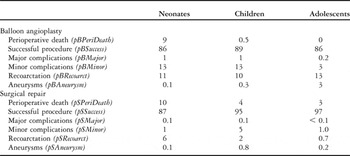
Decision tree: A total of 104 published articles were used in the formulation of the decision tree and the determination of the event probabilities. Of these, 7 articles from 3 different groups involved follow-up of the same groups of patient, and thus only the most recent article was used. Only 2 of the articles were based on prospective randomized control trials.Reference Shaddy, Boucek and Sturtevant5, Reference Hernandez-Gonzalez, Solorio and Conde-Carmona6 The remainder of the articles were case series. Overall, we used 97 articles, with a combined total of 4,963 patients. Duration of patient follow-up ranged from 1 month to 20 years, with a mean of 4.6 years. The citations for the articles are provided in the accompanying Appendix. Of the articles, 28 reported results of balloon angioplasty in 959 patients, and 68 reported on surgical repair in 4,004 patients. Of the 4,004 patients undergoing surgical repair, 1,601 underwent primary end-to-end anastamoses, 615 patch repair, 1,425 subclavian artery flap repair, and 363 used other types of repair, including extended end-to-end anastamosis. The baseline probabilities of periprocedural death, successful procedure, major and minor complications, recoarctation and aneurysms are shown in Table 2. Unavoidably, associated cardiac anomalies were found in 89% of the neonatal population. Ventricular septal defect, atrial septal defect, and patency of the arterial duct were the most common, making up 32%, 5%, and 20% of the associated lesions, respectively. Within the populations of children and adolescents, associated anomalies were found in 50% and 15% of patients, respectively. In addition, more complex lesions were found within the neonatal age group than the other two age groups. The final decision tree is shown in Figure 1.
Percent baseline probability of events stratified for each age group and procedure, as pooled from the medical literature reviewedFootnote *.
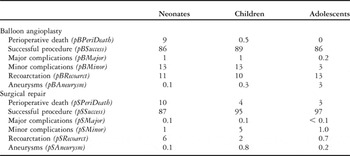
* The probabilities as they appear in the decision tree are shown in parentheses.
Diagram of decision tree – only selected branches are fully extended, collapsed branches (+) are similar in patterns to those that are fully extended. Circles represent chance nodes and triangles represent end nodes.

Preferences: At the time of the interview, the initial bias of all persons interviewed favoured a perfect balloon angioplasty over a perfect surgery. Individuals reported that they thought that estimated periprocedural motality within the neonatal age group was 2.0%, with a range from 0.5 to 10% for balloon angioplasty, and 3.0%, with a range from 0.5 to 9.0% for surgical repair. Similarly for children, the median perceived mortality was 1.0%, ranging from 0.1 to 5.0%, for balloon angioplasty and 1.0%, ranging from zero to 10.0%, for surgical repair. In adolescents the median perceived mortality was 1.0%, ranging from 0.1 to 15.0%, for balloon angioplasty and 1.5%, ranging from zero to 11.0%, for surgical repair. Perceived mortality was not statistically significantly different between the procedures for any age group.
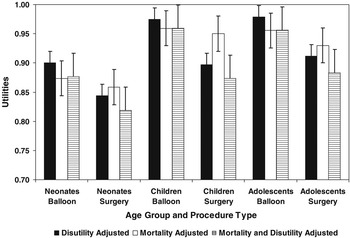
The decision analysis was performed for each individual interviewed to give the final cumulative preference scores for each procedure and, thus, the preferred option for treatment of that individual. Within the neonatal age group, balloon angioplasty was preferred to surgical repair, having a mean final preference score of 0.8999, and standard deviation of 0.0236 for balloon angioplasty versus 0.8873 and standard deviation of 0.0246 for surgery (p less than 0.001). For the children, a similar trend was seen, with balloon angioplasty significantly preferred over surgical repair, with a mean of 0.9746 and standard deviation of 0.0292 versus 0.9433 and standard deviation of 0.0285 (p less than 0.001). Within the adolescents, balloon angioplasty was also significantly preferred, at a mean of 0.9784 and standard deviation of 0.0300, over surgical repair, which scored a mean of 0.9588 and had a standard deviation of 0.0255 (p less than 0.001). When the cumulative preference scores were adjusted for disutility, perceived mortality, and both perceived mortality and disutility, similar statistically significant trends were also seen, with balloon angioplasty always being preferred (Fig. 2).
Median final preference scores adjusted for mortality, disutility and both mortality and disutility distributed among the various age groups and procedures.

One-way sensitivity analysis: One-way sensitivity analysis was performed on disutility and perceived mortality adjusted cumulative preference scores for all three age groups. As the probabilities of aneurysmal formation, a successful procedure, minor complications, or recurrent coarctation for either surgery or balloon angioplasty were varied between 0 to 100%, balloon angioplasty continued to be preferred throughout all age groups. Likewise, any reduction in the risk of periprocedural death or major complications associated with surgical repair did not alter the preference for balloon angioplasty, even when the risk of death or major complications with surgery within the child and adolescent age group reached zero. Within the neonatal age group only, when the periprocedural mortality for surgery fell below 4%, surgery became the preferred option. When the risk of periprocedural death with balloon angioplasty was greater than to 8%, 9%, and 15% within the groups of neonates, children, and adolescents, respectively, surgery was then preferred. When the risk of major complications with balloon angioplasty was greater than 52%, 76%, and 66% within these groups, respectively, surgical repair was then preferred. None of the published articles reviewed had a risk of periprocedural death with balloon angioplasty greater than 10%, or a risk of major complications greater than 50%. It would also be unlikely that even a contemporary series of surgical outcomes would report no mortality and no major complications.
Discussion
When reviewing the literature, there are only two randomized clinical trials comparing primary transcatheter balloon angioplasty and surgical repair for aortic coarctation. In a small randomized clinical trial of 36 patients, Shaddy et al.Reference Shaddy, Boucek and Sturtevant5 studied 36 patients between 3 and 10 years of age, and found that both procedures were equally successful in reducing the gradient across the site of coarctation, with no significant difference in the initial complication rates between the two procedures. Neurological complications, with 1 patient with paraparesis and another with paralysis of the vocal cords, occurred in the surgical group, and there was a statistically significant increase in aneurysmal formation, at 20% versus zero, and recurrent coarctation, at 25% versus 6%, with balloon angioplasty. A long-term follow-up study of the same population found that only half of the patients undergoing balloon angioplasty patients were free from aneurysm or reintervention, compared to 87% of surgical patients.Reference Cowley, Orsmond, Feola, McQuillan and Shaddy9
Hernandez-Gonzalez et al.Reference Hernandez-Gonzalez, Solorio and Conde-Carmona6 also conducted a small multi-centric randomized clinical trial involving 58 patients between the ages of 1 and 16 years who were randomized to either angioplasty or surgical repair. The success rates were comparable between the two groups. Recurrent coarctation was significantly more likely in those undergoing balloon angioplasty, at 50% versus 21%, while more serious post-operative complications were found to occur in those undergoing surgical repair.
Both clinical trials showed that balloon angioplasty was comparable to surgery, although the complications inherent to each treatment option differed considerably and varied in their frequency and severity. These differences may greatly impact on decisions concerning management and preferences. As a result, it is difficult directly to compare balloon angioplasty and surgical repair.
Decision analysis has been used successfully to evaluate complex and dissimilar options for treatment in a wide variety of clinical situations.Reference Detsky, Naglie, Krahn, Naimark and Redelmeier10 Decision analysis, through the use of utilities or preferences, places a quantitative value on very different outcomes, allowing them to be compared. It also allows one to account for the severity and frequency of the different complications inherent to each procedure. The methods for undertaking a decision analysis have been described in the literature.Reference Detsky, Naglie, Krahn, Redelmeier and Naimark11–Reference Naimark, Krahn, Naglie, Redelmeier and Detsky14
Our decision analysis indicates that balloon angioplasty was the preferred treatment of native aortic coarctation throughout the age range for childhood. Sensitivity analysis revealed that only increases in major complications and periprocedural death associated with balloon angioplasty outside the ranges currently cited within the literature affected the preference for angioplasty. Within the literature, the risk of major complications for balloon angioplasty ranges from zero to 10%, and it is doubtful that it will ever be greater than 50%. As a result, this threshold value is likely of little clinical significance. A periprocedural mortality of greater than 10% was found to be another threshold value. Our review of the literature found that the periprocedural mortality rate with balloon angioplasty in the neonatal population was approximately 9%. It was noted, however, that aortic coarctation in the neonatal age group was more frequently associated with other congenital cardiac abnormalities. As a result, the reported complication rates and periprocedural mortality rates in neonates may not be an accurate reflection of that associated with balloon angioplasty of isolated native aortic coarctation. It would also be unlikely that even a contemporary series of surgical outcomes would report no mortality and no major complications, which, even if achieved, would still not cause surgery to be the preferred option.
Our results must be viewed in light of some limitations. The estimates for the probabilities of outcomes were based on review of the literature, and hence are subject to publication bias. Over the recent past, there have not been as many articles published on surgical correction of aortic coarctation as compared to balloon angioplasty. As a result, the outcomes of surgical repair are not contemporaneous to those reported for balloon angioplasty, and may overestimate the probability of adverse outcomes, although this was explored through use of sensitivity analysis. Newer techniques with improved outcomes, such as extended end-to-end repair, were represented in only a minority of included reviews. Additionally, mortality and adverse outcomes may be underestimated in patients having balloon angioplasty because of the treatment bias for surgery in those with other associated complex defects, especially within the neonatal population. During our analysis, we varied these probabilities of the various complications and outcomes occurring from zero to 100%, accounting for all possibilities. As a result, even though estimates of probabilities may not be accurate reflections of present day results, they are accounted for within the sensitivity analysis. In addition, the number of articles relevant to each age group varied. Fewer articles examining the use of balloon angioplasty were found at the extremes of age, that is for neonates and adolescents.
The preference scores were obtained from medical professionals at a single institution. Although surgeons did not participate, the only difference they would be expected to have from other providers of health care might be a bias towards surgery, and lower estimates of periprocedural mortality associated with surgery. The remaining preferences are obtained in an unbiased manner as to procedure, and it would be unlikely that their results would be different. It would be interesting to see if these preference scores differed amongst various institutions or specialties, and how these values and the decision process vary when applied to parents and legal guardians of patients with this diagnosis. It was not currently feasible to educate a large number of parents with regards to the pathophysiology, complications, and outcomes for aortic coarctation. As a result, we interviewed only medical staff familiar with aortic coarctation and its management, complications, and outcomes.
More recently, endovascular stents are now being used as an adjunct to balloon angioplasty in older patients with aortic coarctation, and this may further improve the outcome of patients treated with interventional cardiac catheterization.Reference de Giovanni15–Reference Santoro, Carminati and Bigazzi18 George et al.Reference George, Shim and Bucuvalas8 compared balloon angioplasty with endovascular stenting versus surgical repair of aortic coarctation. Surgical repair was successful in all cases, and endovascular stenting was associated with a 10% initial rate of failure. No complications were seen with either procedure.
Our study is the first to use decision analysis systematically to evaluate the comparison of transcatheter balloon angioplasty and surgical repair of native aortic coarctation across all age groups of childhood. We show that balloon angioplasty appears to be the preferred initial treatment of non-neonatal aortic coarctation, though the findings concerning native coarctation treatment in neonates remain controversial.
Appendix
1. Grinda, JM, Mace, L, Dervanian, P, Folliguet, TA, Neveux, JY. Bypass graft for complex forms of isthmic aortic coarctation in adults. Ann Thorac Surg 1995; 60: 1299–1302.2. Westaby, S, Parnell, B, Pridie, RB. Coarctation of the aorta in adults. Clinical presentation and results of surgery. J Cardiovasc Surg (Torino) 1987; 28: 124–127.3. Heikkinen, L, Ala-Kulju, K. Long-term results of direct aortoplasty for repair of aortic coarctation in adults [See comments]. Ann Thorac Surg 1990; 49: 948–950.4. Wells, WJ, Prendergast, TW, Berdjis, F, et al. . Repair of coarctation of the aorta in adults: the fate of systolic hypertension. Ann Thorac Surg 1996; 61: 1168–1171.5. Bouchart, F, Dubar, A, Tabley, A, et al. . Coarctation of the aorta in adults: surgical results and long-term follow-up. Ann Thorac Surg 2000; 70: 1483–1488.6. Elkerdany, A, Hassouna, A, Elsayegh, T, Azab, S, Bassiouni, M. Left subclavian-aortic bypass grafting in primary isolated adult coarctation. Cardiovasc Surg 1999; 7: 351–354.7. Ray, DG, Subramanyan, R, Titus, T, et al. . Balloon angioplasty for native coarctation of the aorta in children and adults: factors determining the outcome. Int J Cardiol 1992; 36: 273–281.8. Attia, IM, Lababidi, ZA. Early results of balloon angioplasty of native aortic coarctation in young adults. Am J Cardiol 1988; 61: 930–931.9. Schrader, R, Bussmann, WD, Jacobi, V, Kadel, C. Long-term effects of balloon coarctation angioplasty on arterial blood pressure in adolescent and adult patients. Cathet Cardiovasc Diagn 1995; 36: 220–225.10. deGiovanni, JV, Lip, GY, Osman, K, et al. . Percutaneous balloon dilatation of aortic coarctation in adults. Am J Cardiol 1996; 77: 435–439.11. Tyagi, S, Arora, R, Kaul, UA, Sethi, KK, Gambhir, DS, Khalilullah, M. Balloon angioplasty of native coarctation of the aorta in adolescents and young adults. Am Heart J 1992; 123: 674–680.12. Phadke, K, Dyet, JF, Aber, CP, Hartley, W. Balloon angioplasty of adult aortic coarctation. Br Heart J 1993; 69: 36–40.13. Erbel, R, Bednarczyk, I, Pop, T, et al. . Detection of dissection of the aortic intima and media after angioplasty of coarctation of the aorta. An angiographic, computer tomographic, echocardiographic comparative study. Circulation 1990; 81: 805–814.14. Fawzy, ME, Sivanandam, V, Galal, O, et al. . One- to ten-year follow-up results of balloon angioplasty of native coarctation of the aorta in adolescents and adults. J Am Coll Cardiol 1997; 30: 1542–1546.15. Fawzy, ME, Dunn, B, Galal, O, et al. . Balloon Coarctation angioplasty in adolescents and adults: early and intermediate results. Am Heart J 1992; 124: 167–171.16. Fawzy, ME, Sivanandam, V, Pieters, F, et al. . Long-term effects of balloon angioplasty on systemic hypertension in adolescent and adult patients with coarctation of the aorta. Eur Heart J 1999; 20: 827–832.17. Paddon, AJ, Nicholson, AA, Ettles, DF, Travis, SJ, Dyet, JF. Long-term follow-up of percutaneous balloon angioplasty in adult aortic coarctation. Cardiovasc Intervent Radiol 2000; 23: 364–367.18. Koerselman, J, de Vries, H, Jaarsma, W, Muyldermans, L, Ernst, JM, Plokker, HW. Balloon angioplasty of coarctation of the aorta: a safe alternative for surgery in adults: immediate and mid-term results. Catheter Cardiovasc Interv 2000; 50: 28–33.19. Walhout, RJ, Lekkerkerker, JC, Ernst, SM, Hutter, PA, Plokker, TH, Meijboom, EJ. Angioplasty for coarctation in different aged patients. Am Heart J 2002; 144: 180–186.20. Biswas, PK, Mitra, K, De, S, et al. . Follow-up results of balloon angioplasty for native coarctation of aorta. Indian Heart J 1996; 48: 673–676.21. Kron, IL, Flanagan, TL, Rheuban, KS, et al. . Incidence and risk of reintervention after coarctation repair. Ann Thorac Surg 1990; 49: 920–925.22. Behl, PR, Sante, P, Blesovsky, A. Surgical treatment of isolated coarctation of the aorta: 18 years’ experience. Thorax 1987; 42: 309–314.23. Hamilton, DI, Medici, D, Oyonarte, M, Dickinson, DF. Aortoplasty with the left subclavian flap in older children. J Thorac Cardiovasc Surg 1981; 82: 103–106.24. Mullen, JC, Bentley, MJ, Talwar, MK. Coarctation of the aorta: tailoring the surgical approach. Can J Cardiol 1997; 13: 931–935.25. Backer, CL, Paape, K, Zales, VR, Weigel, TJ, Mavroudis, C. Coarctation of the aorta. Repair with polytetrafluoroethylene patch aortoplasty. Circulation 1995; 92: II132–II136.26. Wittig, JH, Mulder, DG. Repair of coarctation of the aorta in infants. Am J Surg 1980; 140: 158–163.27. Baudet, E, al Qudah, A. Late results of the subclavian flap repair of coarctation in infancy. J Cardiovasc Surg (Torino) 1989; 30: 445–449.28. Sade, RM, Crawford, FA, Hohn, AR, Riopel, DA, Taylor, AB. Growth of the aorta after prosthetic patch aortoplasty for coarctation in infants. Ann Thorac Surg 1984; 38: 21–25.29. Sarioglu, T, Kinoglu, B, Sarioglu, A, et al. . Early and moderate long-term results of a new surgical technique for repair of aortic coarctation. Eur J Cardiothorac Surg 1996; 10: 884–888.30. Sciolaro, C, Copeland, J, Cork, R, Barkenbush, M, Donnerstein, R, Goldberg, S. Long-term follow-up comparing subclavian flap angioplasty to resection with modified oblique end-to-end anastomosis. J Thorac Cardiovasc Surg 1991; 101: 1–13.31. Bertolini, A, Dalmonte, P, Toma, P, et al. . Goretex patch aortoplasty for coarctation in children: nuclear magnetic resonance assessment at 7 Years. J Cardiovasc Surg (Torino) 1992; 33: 223–228.32. Rostad, H, Abdelnoor, M, Sorland, S, Tjonneland, S. Coarctation of the aorta, early and late results of various surgical techniques. J Cardiovasc Surg (Torino) 1989; 30: 885–890.33. Arenas, JD, Myers, JL, Gleason, MM, Vennos, A, Baylen, BG, Waldhausen, JA. End-to-end repair of aortic coarctation using absorbable polydioxanone suture. Ann Thorac Surg 1991; 51: 413–417.34. Harlan, JL, Doty, DB, Brandt, B, Ehrenhaft, JL. Coarctation of the aorta in infants. J Thorac Cardiovasc Surg 1984; 88: 1012–1019.35. Venturini, A, Papalia, U, Chiarotti, F, Caretta, Q. Primary repair of coarctation of the thoracic aorta by patch graft aortoplasty. A three-decade experience and follow-up in 60 patients. Eur J Cardiothorac Surg 1996; 10: 890–896.36. Parikh, SR, Hurwitz, RA, Hubbard, JE, Brown, JW, King, H, Girod, D. A preoperative and postoperative “aneurysm” associated with coarctation of the aorta. J Am Coll Cardiol 1991; 17: 1367–1372.37. Johnson, MC, Canter, CE, Strauss, AW, Spray, TL. Repair of coarctation of the aorta in infancy: comparison of surgical and balloon angioplasty. Am Heart J 1993; 125: 464–468.38. Jahangiri, M, Shinebourne, EA, Zurakowski, D, Rigby, ML, Redington, AN, Lincoln, C. Subclavian flap angioplasty: does the arch look after itself? J Thorac Cardiovasc Surg 2000; 120: 224–229.39. Bromberg, BI, Beekman, RH, Rocchini, AP, et al. . Aortic aneurysm after patch aortoplasty repair of coarctation: a prospective analysis of prevalence, screening tests and risks. J Am Coll Cardiol 1989; 14: 734–741.40. van Son, JA, Falk, V, Schneider, P, Smedts, F, Mohr, FW. Repair of coarctation of the aorta in neonates and young infants. J Card Surg 1997; 12: 139–146.41. Corno, AF, Botta, U, Hurni, M, et al. . Surgery for aortic coarctation: a 30 years experience. Eur J Cardiothorac Surg 2001; 20: 1202–1206.42. Rao, PS, Galal, O, Smith, PA, Wilson, AD. Five- to nine-year follow-up results of balloon angioplasty of native aortic coarctation in infants and children [See comments]. J Am Coll Cardiol 1996; 27: 462–470.43. Rao, PS, Najjar, HN, Mardini, MK, Solymar, L, Thapar, MK. Balloon angioplasty for coarctation of the aorta: immediate and long-term results. Am Heart J 1988; 115: 657–665.44. Rao, PS, Waterman, B. Relation of biophysical response of coarcted aortic segment to balloon dilatation with development of recoarctation following balloon angioplasty of native coarctation. Heart 1998; 79: 407–411.45. Rao, PS, Thapar, MK, Kutayli, F, Carey, P. Causes of recoarctation after balloon angioplasty of unoperated aortic coarctation. J Am Coll Cardiol 1989; 13: 109–115.46. Rao, PS, Koscik, R. Validation of risk factors in predicting recoarctation after initially successful balloon angioplasty for native aortic coarctation. Am Heart J 1995; 130: 116–121.47. Rao, PS, Thapar, MK, Galal, O, Wilson, AD. Follow-up results of balloon angioplasty of native coarctation in neonates and infants. Am Heart J 1990; 120: 1310–1314.48. Rao, PS, Chopra, PS. Role of balloon angioplasty in the treatment of aortic coarctation. Ann Thorac Surg 1991; 52: 621–631.49. Rao, PS, Solymar, L. Transductal balloon angioplasty for coarctation of the aorta in the neonate: preliminary observations. Am Heart J 1988; 116: 1558–1562.50. Lababidi, ZA, Daskalopoulos, DA, Stoeckle, H Jr. Transluminal balloon coarctation angioplasty: experience with 27 patients. Am J Cardiol 1984; 54: 1288–1291.51. Fletcher, SE, Nihill, MR, Grifka, RG, O'Laughlin, MP, Mullins, CE. Balloon angioplasty of native coarctation of the aorta: midterm follow-up and prognostic factors. J Am Coll Cardiol 1995; 25: 730–734.52. Wren, C, Peart, I, Bain, H, Hunter, S. Balloon dilatation of unoperated aortic coarctation: immediate results and one year follow-up. Br Heart J 1987; 58: 369–373.53. Beekman, RH, Rocchini, AP, Dick, M, et al. . Percutaneous balloon angioplasty for native coarctation of the aorta. J Am Coll Cardiol 1987; 10: 1078–1084.54. Ovaert, C, McCrindle, BW, Nykanen, D, MacDonald, C, Freedom, RM, Benson, LN. Balloon angioplasty of native coarctation: clinical outcomes and predictors of success. J Am Coll Cardiol 2000; 35: 988–996.55. Fontes, VF, Esteves, CA, Braga, SL, et al. . It is valid to dilate native aortic coarctation with a balloon catheter. Int J Cardiol 1990; 27: 311–316.56. Morrow, WR, Vick GW, III, Nihill, MR, et al. . Balloon dilation of unoperated coarctation of the aorta: short- and intermediate-term results. J Am Coll Cardiol 1988; 11: 133–138.57. Cooper, RS, Ritter, SB, Rothe, WB, Chen, CK, Griepp, R, Golinko, RJ. Angioplasty for coarctation of the aorta: long-term results. Circulation 1987; 75: 600–604.58. De Lezo, JS, Sancho, M, Pan, M, Romero, M, Olivera, C, Luque, M. Angiographic follow-up after balloon angioplasty for coarctation of the aorta. J Am Coll Cardiol 1989; 13: 689–695.59. Saba, SE, Nimri, M, Shamaileh, Q, et al. . Balloon coarctation angioplasty: follow-up of 103 patients. J Invasive Cardiol 2000; 12: 402–406.60. Hijazi, ZM, Geggel, RL, Marx, GR, Rhodes, J, Fulton, DR. Balloon angioplasty for native coarctation of the aorta: acute and mid-term results. J Invasive Cardiol 1997; 9: 344–348.61. Redington, AN, Booth, P, Shore, DF, Rigby, ML. Primary balloon dilatation of coarctation of the aorta in neonates. Br Heart J 1990; 64: 277–281.62. Park, Y, Lucas, VW, Sklansky, MS, Kashani, IA, Rothman, A. Balloon angioplasty of native aortic coarctation in infants 3 months of age and younger. Am Heart J 1997; 134: 917–923.63. Finley, JP, Beaulieu, RG, Nanton, MA, Roy, DL. Balloon catheter dilatation of coarctation of the aorta in young infants. Br Heart J 1983; 50: 411–415.64. Ehrhardt, P, Walker, DR. Coarctation of the aorta corrected during the first month of life. Arch Dis Child 1989; 64: 330–332.65. Levinsky, L, Deviri, E, Schachner, A, Levy, MJ. Repair of coarctation of the aorta in the first three months of life. Scand J Thorac Cardiovasc Surg 1986; 20: 209–212.66. Han, MT, Hall, DG, Mache, A, Rittenhouse, EA. Repair of neonatal aortic coarctation. J Pediatr Surg 1995; 30: 709–712.67. Ziemer, G, Jonas, RA, Perry, SB, Freed, MD, Castaneda, AR. Surgery for coarctation of the aorta in the neonate. Circulation 1986; 74: I25–I31.68. Palatianos, GM, Thurer, RJ, Kaiser, GA. Comparison of operations for coarctation of the aorta in infants. J Cardiovasc Surg (Torino) 1987; 28: 128–131.69. Kopf, GS, Hellenbrand, W, Kleinman, C, Lister, G, Talner, N, Laks, H. Repair of aortic coarctation in the first three months of life: immediate and long-term results. Ann Thorac Surg 1986; 41: 425–430.70. Vitullo, DA, DeLeon, SY, Graham, LC, et al. . Extended end-to-end repair and enlargement of the entire arch in complex coarctation. Ann Thorac Surg 1999; 67: 528–531.71. Cobanoglu, A, Thyagarajan, GK, Dobbs, JL. Surgery for coarctation of the aorta in infants younger than 3 months: end-to-end repair versus subclavian flap angioplasty: is either operation better? Eur J Cardiothorac Surg 1998; 14: 19–25.72. Cobanoglu, A, Teply, JF, Grunkemeier, GL, Sunderland, CO, Starr, A. Coarctation of the aorta in patients younger than three months. A critique of the subclavian flap operation. J Thorac Cardiovasc Surg 1985; 89: 128–135.73. Knott-Craig, CJ, Elkins, RC, Ward, KE, et al. . Neonatal coarctation repair. Influence of technique on late results. Circulation 1993; 88: II198–II204.74. Penkoske, PA, Williams, WG, Olley, PM, et al. . Subclavian arterioplasty. Repair of coarctation of the aorta in the first year of life. J Thorac Cardiovasc Surg 1984; 87: 894–900.75. Korfer, R, Meyer, H, Kleikamp, G, Bircks, W. Early and late results after resection and end-to-end anastomosis of coarctation of the thoracic aorta in early infancy. J Thorac Cardiovasc Surg 1985; 89: 616–622.76. Pfammatter, JP, Ziemer, G, Kaulitz, R, Heinemann, MK, Luhmer, I, Kallfelz, HC. Isolated aortic coarctation in neonates and infants: results of resection and end-to-end anastomosis. Ann Thorac Surg 1996; 62: 778–782.77. Rajasinghe, HA, Reddy, VM, van Son, JA, et al. . Coarctation repair using end-to-side anastomosis of descending aorta to proximal aortic arch. Ann Thorac Surg 1996; 61: 840–844.78. Asano, M, Mishima, A, Yamamoto, S, Saito, T, Manabe, T. Modified subclavian flap aortoplasty for coarctation repair in patients less than three months of age. Ann Thorac Surg 1998; 66: 588–589.79. Rubay, JE, Sluysmans, T, Alexandrescu, V, et al. . Surgical repair of coarctation of the aorta in infants under one year of age. Long-term results in 146 patients comparing subclavian flap angioplasty and modified end-to-end anastomosis. J Cardiovasc Surg (Torino) 1992; 33: 216–222.80. Sanchez, GR, Balsara, RK, Dunn, JM, Mehta, AV, O'Riordan, AC. Recurrent obstruction after subclavian flap repair of coarctation of the aorta in infants. Can it be predicted or prevented? J Thorac Cardiovasc Surg 1986; 91: 738–746.81. Nair, UR, Jones, O, Walker, DR. Surgical management of severe coarctation of the aorta in the first month of life. J Thorac Cardiovasc Surg 1983; 86: 587–590.82. Yamaguchi, M, Tachibana, H, Hosokawa, Y, Ohashi, H, Oshima, Y. Early and late results of surgical treatment of coarctation of the aorta in the first three months of life. J Cardiovasc Surg (Torino) 1989; 30: 169–172.83. Zehr, KJ, Gillinov, AM, Redmond, JM, et al. . Repair of coarctation of the aorta in neonates and infants: a thirty-year experience. Ann Thorac Surg 1995; 59: 33–41.84. Abdulla, S, Malmgren, N, Bjorkhem, G, Lundstrom, NR. A postoperative follow-up study of infantile coarctation of the aorta. Acta Paediatr Suppl 1995; 410: 69–73.85. Metzdorff, MT, Cobanoglu, A, Grunkemeier, GL, Sunderland, CO, Starr, A. Influence of age at operation on late results with subclavian flap aortoplasty. J Thorac Cardiovasc Surg 1985; 89: 235–241.86. Sharma, BK, Calderon, M, Ott, DA. Coarctation repair in neonates with subclavian-sparing advancement flap. Ann Thorac Surg 1992; 54: 137–140.87. Brown, JW, Fiore, AC, King, H. Isthmus flap aortoplasty: an alternative to subclavian flap aortoplasty for long-segment coarctation of the aorta in infants. Ann Thorac Surg 1985; 40: 274–279.88. Hovaguimian, H, Senthilnathan, V, Iguidbashian, JP, McIrvin, DM, Starr, A. Coarctation repair: modification of end-to-end anastomosis with subclavian flap angioplasty. Ann Thorac Surg 1998; 65: 1751–1754.89. Lansman, S, Shapiro, AJ, Schiller, MS, et al. . Extended aortic arch anastomosis for repair of coarctation in infancy. Circulation 1986; 74: I37–I41.90. Moulton, AL, Brenner, JI, Roberts, G, et al. . Subclavian flap repair of coarctation of the aorta in neonates. Realization of growth potential? J Thorac Cardiovasc Surg 1984; 87: 220–235.91. Conte, S, Lacour-Gayet, F, Serraf, A, et al. . Surgical management of neonatal coarctation. J Thorac Cardiovasc Surg 1995; 109: 663–674.92. van Heurn, LW, Wong, CM, Spiegelhalter, DJ, et al. . Surgical treatment of aortic coarctation in infants younger than three months: 1985 to 1990. Success of extended end-to-end arch aortoplasty. J Thorac Cardiovasc Surg 1994; 107: 74–85.93. Allen, BS, Halldorsson, AO, Barth, MJ, Ilbawi, MN. Modification of the subclavian patch aortoplasty for repair of aortic coarctation in neonates and infants. Ann Thorac Surg 2000; 69: 877–880.94. Dietl, CA, Torres, AR, Favaloro, RG, Fessler, CL, Grunkemeier, GL. Risk of recoarctation in neonates and infants after repair with patch sortoplasty, subclavian flap, the combined resection-flap procedure. J Thorac Cardiovasc Surg 1992; 103: 724–731.95. Demircin, M, Arsan, S, Pasaoglu, I, et al. . Coarctation of the aorta in infants and neonates: results and assessment of prognostic variables. J Cardiovasc Surg (Torino) 1995; 36: 459–464.96. Goldman, S, Hernandez, J, Pappas, G. Results of surgical treatment of coarctation of the aorta in the critically ill neonate. Including the influence of pulmonary artery banding. J Thorac Cardiovasc Surg 1986; 91: 732–737.97. Messmer, BJ, Minale, C, Muhler, E, von Bernuth, G. Surgical correction of coarctation in early infancy: does surgical technique influence the result? Ann Thorac Surg 1991; 52: 594–600.98. Bacha, EA, Almodovar, M, Wessel, DL, et al. . Surgery for coarctation of the aorta in infants weighing less than 2 Kg. Ann Thorac Surg 2001; 71: 1260–1264.99. Isomatsu, Y, Imai, Y, Shin'oka, T, Aoki, M, Sato, K. Coarctation of the aorta and ventricular septal defect: should we perform a single-stage repair? J Thorac Cardiovasc Surg 2001; 122: 524–528.100. Backer, CL, Mavroudis, C, Zias, EA, Amin, Z, Weigel, TJ. Repair of coarctation with resection and extended end-to-end anastomosis. Ann Thorac Surg 1998; 66: 1365–1370.101. Gaynor, JW, Wernovsky, G, Rychik, J, Rome, JJ, DeCampli, WM, Spray, TL. Outcome following single-stage repair of coarctation with ventricular septald defect. Eur J Cardiothorac Surg 2000; 18: 62–67.102. Uddin, MJ, Haque, AE, Salama, AL, Uthman, BC, Abushaban, LA, Shuhaiber, HJ. Surgical management of coarctation of the aorta in infants younger than five months: a study of fifty-one patients. Ann Thorac Cardiovasc Surg 2000; 6: 252–257.103. Wu, JL, Leung, MP, Karlberg, J, Chiu, C, Lee, J, Mok, CK. Surgical repair of coarctation of the aorta in neonates: factors affecting early mortality and re-coarctation. Cardiovasc Surg 1995; 3: 573–578.104. Aeba, R, Katogi, T, Ueda, T, Takeuchi, S, Kawada, S. Complications following reparative surgery for aortic coarctation or interrupted aortic arch. Surg Today 1998; 28: 889–894.