Chest pain is a common symptom that results in visits to the emergency department or referral to paediatric cardiologists. Although most cases of chest pain in this age group are non-cardiac and do not require medical treatment, it may cause recurrent hospital admissions, school absences, restriction of activities, and anxiety in adolescents and their parents.Reference Selbst 1 – Reference Fyfe and Moodie 4 Chest pain without any obvious medical organic cause has been labelled with several names such as atypical chest pain, neurocirculatory asthenia, angina-like chest pain, unexplained chest pain, idiopathic chest pain, and non-cardiac chest pain.Reference Selbst 1 , Reference Taylor, Murphy and Berry 5 – Reference Roll, Rosenqvist and Sjöborg 7
Age is a major factor in the aetiology of paediatric chest pain. Young children are more likely to have a cardiorespiratory cause for their pain, such as cough, asthma, pneumonia, or heart disease, whereas adolescents are more likely to have pain associated with stress or a psychogenic disturbance.Reference Selbst 1 , Reference Selbst, Ruddy, Clark, Henretig and Santulli 8 Therefore, psychosocial evaluation following a comprehensive medical evaluation is of utmost importance for diagnosing non-cardiac chest pain in this age group.
As a general rule, chest pain was categorised as psychological when no organic cause could be identified. Psychogenic chest pain in older children can occasionally result from anxiety or a conversion disorder triggered by recent stressors in personal or family life.Reference Khairandish, Jamali and Haghbin 9 – Reference Lipsitz, Warner and Apfel 11 There have been no published studies, however, on the relationship between non-cardiac chest pain, suicidal ideation, and stressful life events in children or adolescents thus far. This study examined the relationship between state–trait anxiety, depression, suicidal thoughts, stressful events, and non-cardiac chest pain in a clinical sample and aimed to contribute to the management of adolescent chest pain.
Materials and methods
Participants and procedure
The study group comprised 100 adolescents with an age range of 13–18 years, recruited from outpatient paediatric cardiology clinics, and diagnosed with non-cardiac chest pain. After the initial evaluation, routine chest radiography was obtained in all cases, and, if necessary, an echocardiographic examination was performed. Trauma-associated cases as well as cases related to cardiac, musculoskeletal, respiratory, gastrointestinal, and any other organic factors were excluded. The control group consisted of 76 randomly chosen sex- and age-matched volunteer adolescents without chest pain who visited paediatric outpatient clinics for routine control. After a medical evaluation, they were asked to fill in the same questionnaires.
Patients with non-cardiac chest pain were referred to the adolescent medicine outpatient clinic after their initial cardiology visit. After receiving diagnostic feedback from their cardiologist, participants were invited to take part in the study. Participants provided their assent after being assured about confidentiality. Informed consent for study participation was requested from the parents and adolescents at the beginning of the study.
Data collection instruments
First, a checklist that contained questions about sex, age, monthly household income, stressful situations, and suicidal ideation in adolescents was filled in by the physician for all cases. Items about stressful events that were used in this study were inspired from the life event instrument of AggarwalReference Aggarwal, Prabhu, Anand and Kotwal 12 and the Adolescent Life Events Checklist of Wang.Reference Wang, Hao, Tao, Zhu and Zhang 13 These items were improved by conducting a pilot study on 10 adolescents. Participants were asked by the physician if any of these events had caused significant stress during the past 6-month period to determine the possible stress-causing life events. The 36 items included questions about inability to balance extracurricular activities, school-related problems – for example, failed an examination or had a heavy workload – trouble with bullies, romantic relationships, family-related problems – for example, poor economy, death of a parent, or parents’ divorce – commuting problems, etc.
After the interview, self-report scales were given to the participants, including depression and state–trait anxiety inventories. The Children’s Depression Inventory for children was developed by Kovacs on the basis of the Beck Depression Inventory.Reference Kovacs 14 The Children’s Depression Inventory is a commonly used measure of depression symptoms in children; 27 multiple-choice items assessed the severity of depressive symptoms during the last 2-week period. Higher scores represent more severe depression, and scores below 19 are considered to be normal. The scale is widely used and it has been demonstrated to have good concurrent validity and reliability (Cronbach’s α 0.80) in Turkish language.Reference Öy 15
The Spielberger’s State-Trait Anxiety Inventory for children is a self-reported tool used to measure trait–state anxiety.Reference Spielberger 16 The form has 20 items for measuring the general tendency to react to situations with anxiety (trait anxiety) and 20 items for assessing the degree of anxiety that the person may be experiencing from moment to moment (state anxiety). Translation to Turkish language and validation were performed by Ozusta et al,Reference Özusta 17 and the Cronbach’s α coefficients were 0.82 and 0.81, respectively.
Statistical analyses
Statistical Package for Social Sciences Software (SPSS 21, Chicago, Illinois, United States of America) was used for the analysis. The χ2 test was used to compare proportional data such as differences in gender, suicidal ideation, stressful life events, and the presence of depression. Independent sample Student’s t-test was used to compare the means of self-report test scores between the groups. A binary logistic regression analysis was performed to determine the independent effect of state–trait anxiety, depression, gender, trouble with bullies, grades lower than expected, and break-ups on non-cardiac chest pain.
Results
Socio-demographics
A total of 100 adolescents with non-cardiac chest pain participated in the present study, and 76 volunteer adolescents were enrolled into the control group. The members of both groups were predominantly from low-income families, without significant income differences. The average age of the non-cardiac chest pain and control groups was 14.5±1.7 and 14.9±2.1 years, respectively (p=0.114). There were 68 (68%) girls in the non-cardiac chest pain group, whereas there were 53 (69%) girls in the control group (p=0.806).
Recent stressful life events
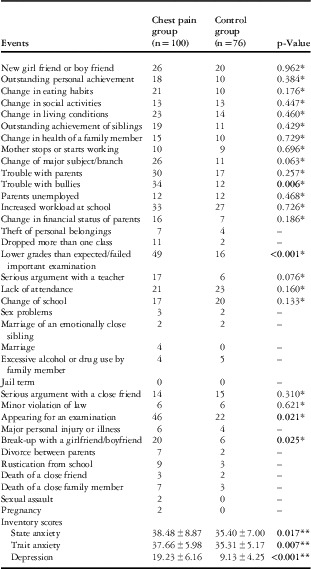
Among 36 items, trouble with bullies, lower grades than expected, an upcoming examination/interview, break-up with a girlfriend/boyfriend were significantly common in the non-cardiac chest pain group. Sexual assault was detected in two female cases in the non-cardiac chest pain group, and it was not statistically significant, although outstanding (Table 1).
Comparison of stressful life events, anxiety, and depression inventories between the groups.

* χ2 test
** Independent sample t-test; significant p-values are shown in bold
Suicidal ideation
It was observed that 22 (22%) subjects in the non-cardiac chest pain group had suicidal ideas, whereas this number was 4 (5.26%) in the control group (p<0.001).
Anxiety and depression scores
The number of cases with a depression score over the cut-off value was 54 (54%) in the non-cardiac chest pain group, whereas the number of cases was five (6.5%) in the control group (p<0.001). The state–trait anxiety and depression scores were significantly higher in the chest pain group (p=0.017, 0.007, and <0.001, respectively) (Table 1).
Binary logistic regression analysis
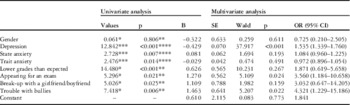
Binary logistic regression analysis applied to the entire sample also showed that adolescents with depression were 1.535 times, those with trouble with bullies were 4.321 times, and those having an upcoming examination were 3.560 times more likely to have non-cardiac chest pain when compared with those without such issues (p<0.001, 0.022, and 0.024, respectively) (Table 2).
Univariate and multivariate analysis: factors independently associated with non-cardiac chest pain.

When predictors are included in binary logistic regression. Nagelkerke R2: 0.710.
* χ2 value
** χ2 test
*** t-value
**** Independent sample t-test
Discussion
To our knowledge, there is no study that clearly articulates suicidal ideation and stressful situations among adolescents with non-cardiac chest pain. The findings of the present study provide evidence that stressful events combined with depression may have an interactive role on non-cardiac chest pain. Therefore, on the basis of the findings of the present study, we suggest that a specific structured psychosocial assessment method, including a negative life event checklist, would be beneficial in the evaluation of non-cardiac chest pain.
The volunteer adolescents in the study group, 68% of which consisted of girls, were selected consecutively. As a group, girls tend to report higher frequency of somatic complaints than boys do. It has been suggested that girls tend to react more with subjective symptoms, whereas boys more often react by behaviour, for example, delinquency or alcohol use.Reference Aro, Paronen and Aro 18 , Reference Kandel and Davies 19 Regarding gender differences in clinical studies, pain problems during adulthood have indicated specific gender distributions; women compared with men report greater pain with the same pathology;Reference Miaskowski 20 however, there is a need for future studies for detecting potential or actual differences in how boys and girls develop various pain complaints in adolescents, such as unexplained chest pain.
The results indicate that life events such as bullying and problems related to school were the most serious stressors among adolescents with non-cardiac chest pain. Exposure to bullying may result in an array of negative outcomes such as poor mental health and lower sense of well-being.Reference Juvonen, Nishina and Graham 21 – Reference Strøm, Thoresen, Wentzel-Larsen and Dyb 23 The stress of being bullied is strongly associated with a higher risk for psychosomatic complaints, suicidal thoughts, and depression during adolescence.Reference Gini 24 – Reference Fekkes, Pijpers and Verloove-Vanhorick 26 A study conducted in Northern Ireland revealed that being bullied at school was one of the most important stressors among adolescents who survived a suicide attempt.Reference Davies and Cunningham 27
School is the workplace of adolescents, where they spend a lot of time and may face severe social and academic challenges.Reference Murberg and Bru 28 This study identified significant associations between school-related stressors and non-cardiac chest pain. The results of the univariate analysis showed that lower grades than expected were associated with non-cardiac chest pain. In addition, the binary logistic regression analysis results showed that an upcoming examination was independently associated with non-cardiac chest pain as a somatic complaint. When adolescents feel that the workload of school is higher than their capacity, physiological activation and somatic complaints may occur.Reference Aro, Hänninen and Paronen 29 , Reference Garralda 30 Findings of this study suggest that pressure to get good grades as well as an upcoming examination may be of importance in predicting non-cardiac chest pain among adolescents. Moreover, sexual assault, which was detected in two cases of the study group, was found to be a devastating, distressful event that should be taken into consideration.
The direct relationship between chest pain and anxiety is a known issue in adults.Reference Mourad, Strömberg, Johansson and Jaarsma 31 , Reference Basara, Baydin, Yilmaz, Yucel, Erenler and Murat 32 In children and adolescents, chest pain is often associated with anxiety.Reference Khairandish, Jamali and Haghbin 9 – Reference Lipsitz, Warner and Apfel 11 , Reference Gilleland, Blount, Campbell, Johnson, Dooley and Simpson 33 In line with these studies, anxiety scores of the non-cardiac chest pain group were significantly higher in the univariate analysis; however, unlike certain stressful events and depression, anxiety was not found to be an independent predictor of adolescent non-cardiac chest pain according to the binary logistic regression analysis. These findings are in need of further validation to determine the complex relationship between anxiety, depression, and stressful events and non-cardiac chest pain.
Adolescence is a key period for the development of depressive symptoms.Reference Dekker, Ferdinand, van Lang, Bongers, van der Ende and Verhulst 34 It is well shown that first depressive episodes may develop following the occurrence of a major negative life event.Reference Maes, Mylle, Delmeire and Janca 35 Previous studies have reported that certain negative events increase the risk of suicidal ideation, suicidal attempts, and major depressive disorder.Reference Aktekin, Karaman, Senol, Erdem, Erengin and Akaydin 36 – Reference Low, Dugas and O’Loughlin 38 In addition, adolescents with somatic complaints are more likely to be depressed.Reference Karlidag, Unal, Evereklioglu, Sipahi, Er and Yologlu 37 , Reference Surís, Bélanger, Ambresin, Chabloz and Michaud 39 Common psychosomatic symptoms are shared risk factors of later suicidal behaviours.Reference Cao, Tao and Huang 40 In line with these studies, depression was found to be a predictive factor for the occurrence of non-cardiac chest pain as a psychosomatic complaint in the present study. Moreover, suicidal ideation was more frequent in the study group. The authors suggest that, according to the stress-diathesis model, stressful life events could act as a diathesis that could lead to depression symptoms, associated with non-cardiac chest pain and suicidal behaviours.Reference Mathew and Nanoo 41 , Reference Osvath, Vörös and Fekete 42
Limitations and strengths
The present study has a number of limitations. First, data to measure anxiety and depression were collected from self-report questionnaires, which could be biased and fall short of producing clinical diagnoses. Second, the cross-sectional nature of the study prevented the ability to detect a direct causal relationship between the variables. Third, the interviewers were not blinded during the structured interview, which was held to determine suicidal ideation and negative life events; however, the use of a face-to-face interview could be more appropriate for obtaining correct answers for the “taboo” questions.
Conclusions
Our results suggested that non-cardiac chest pain is a stress-related disorder. Non-cardiac chest pain can be a symptom of a negative life event experience, suicidal ideation, and depression among adolescents. Our findings suggest an important role for paediatricians, paediatric cardiologists, and other clinicians for obtaining additional information about stressful events and the need for psychosocial evaluation in adolescents with non-cardiac chest pain. Screening adolescents for stressful events, suicidal ideation, and a baseline level of other depression symptoms perhaps by using an event checklist may help avoid unnecessary investigations, repeated medical evaluations, and high cost of these procedures to the healthcare system.
The present study revealed that, non-cardiac chest pain can be the unestablished part of an important psychosocial health problem. Adolescents may develop skills to cope with stress caused by bullies or school-related problems. Comprehensive diagnostic assessments and development of new intervention methods are important avenues for future research.
Acknowledgements
None.
Authors’ Contributions: K.E., A.K., and N.B. carried out all the statistical analyses and drafted the article; B.G., U.K., B.D., and A.R.B. critically revised and approved the article; H.M. and K.E. collected the data.
Conflicts of Interest
None.
Ethical Standards
The authors assert that all the procedures contributing to this study complied with the ethical standards of the relevant national guidelines on human experimentation and with the Helsinki declaration, and have been approved by the local ethics committee (19.01.2016/17/26).