Cardiovascular diseases constitute a public health problem in both developed and developing nations around the world.Reference Juonala, Magnussen and Berenson 1 Therefore, great effort has been made to identify non-invasive and inexpensive tools to screen individuals at increased risk for cardiovascular diseases. With this in mind, heart rate variability has been used in different studies in order to analyse autonomic modulation patterns,Reference Vanderlei, Pastre, Hoshi, Carvalho and Godoy 2 principally because it is a simple and non-invasive marker for identifying disorders in autonomic patterns through oscillations between consecutive heartbeat intervals.Reference Vanderlei, Pastre, Hoshi, Carvalho and Godoy 2
In recent years, studies have linked heart rate variability in adults with increased risk of hospitalisation and early mortality;Reference Harris, Stein, Fung and Drew 3 , Reference Song, XF and Zhang 4 however, most of these studies involved adults with some previous cardiovascular complication – for example, acute myocardial infarction and acute coronary syndrome –Reference Harris, Stein, Fung and Drew 3 , Reference Song, XF and Zhang 4 and it is not clear whether these results can be applied to healthy populations.
In paediatric populations, although heart rate variability has been related to higher adiposity and blood pressure,Reference Altuncu, Baspinar and Keskin 5 – Reference Zhou, Xie, Wang and Yang 7 its use in children and adolescents seems greatly affected by maturational variables. Despite this, however, most studies investigating the issue do not take maturational variables into account, using chronological age instead.Reference Fernandes, Ronque and Venturini 8 , Reference Rabbia, Grosso and Genova 9
Moreover, outcomes directly related to autonomic modulation, such as resting heart rate, have been indicated as promising cardiovascular risk factors in paediatric populations;Reference Fernandes, Ronque and Venturini 8 however, it is not clear whether these different variables – resting heart rate and heart rate variability indices, such as high frequency and the root mean square of successive differences, both indicators of parasympathetic activity in the frequency and time domain, respectively – although biologically linked, are similarly related to cardiovascular outcomes. Thus, more scientific effort should be made to overcome the limitations observed in previous studies, instead of merely discussing these limitations without any significant advances in the issue.Reference de Moraes, Cassenote, Moreno and Carvalho 10
The aim of this study was to analyse the relationship of the parasympathetic index and resting heart rate with cardiovascular risk markers in adolescents.
Materials and methods
Sample
The present study constitutes the baseline measures of a cohort study, carried out in Presidente Prudente city (200,000 inhabitants; western São Paulo State, Brazil) from July to November, 2013. Initially, a minimum sample size was estimated (r=0.26, 80% of power and α of 5%),Reference Miot 11 which identified the need to recruit at least 86 adolescents. In the sampling process, seven large public and private schools in the metropolitan area of the city were invited to participate in the study, and of these three schools agreed to participate. In the participating schools, there were 495 school children with a chronological age between 11 and 14 years, who were invited to participate in the cohort. Among all, 120 adolescents agreed to participate and fulfilled all the following inclusion criteria: aged between 11 and 14 years; regularly enrolled in the school unit; absence of any known diseases; not consuming drugs; signature of parents or legal guardians. In the present study, 21 patients were excluded because they did not complete all the measurements, and thus the final sample size comprised 99 adolescents.
The study had been previously approved by the Human Research Ethics Committee (process: 322.650/2013) of the Universidade Estadual Paulista, Presidente Prudente, Brazil, and was in accordance with the National Health Council (Resolution no. 466/12).
Heart rate variability
Heart rate variability was analysed using a heart rate monitor (model RS800; Polar®, Kempele, Finland). Each heartbeat was monitored for 30 minutes at rest in a laboratory at the university (supine position, spontaneous breathing, on a stretcher). Electrodes were positioned at the xiphoid process of the sternum. The receptor device (clock) was placed on the wrist and the arms were extended alongside the body. All the adolescents were instructed to avoid caffeine consumption and physical activity for 24 hours before testing.Reference Song, XF and Zhang 4 Evaluations were performed in the morning in order to avoid possible influences of circadian rhythm in an acclimatised room with an ambient temperature of 25°C (±1°C).
Heart rate variability analysis was performed using the linear method in the time and frequency domains.Reference Vanderlei, Pastre, Hoshi, Carvalho and Godoy 2 In the time domain, the root mean square of successive differences was used, expressed in milliseconds. In the frequency domain, the spectral components of high frequency (0.15–0.40 Hz) were used, in normalised units. All data were downloaded using Polar Pro Trainer software, version 5.41.002. The method for filtering data was performed in two stages: automatic filter by the Polar Pro Trainer software, version 5.41.002 and manual filter to select extreme artefacts.Reference Vanderlei, Pastre, Hoshi, Carvalho and Godoy 2 A thousand heartbeat intervalsReference Vanderlei, Pastre, Hoshi, Carvalho and Godoy 2 were analysed and only series of >95% sinus beats were evaluated. The heart rate variability indices were calculated using the software Kubios, version 2.0.Reference Tarvainen, Niskanen, Lipponen, Rantaaho and Karjalainen 12
Biochemical variables
Blood samples were collected in the morning, after 12 hours of fasting, by a nurse in a private laboratory, which met all the quality-control standards adopted by the Brazilian Health Ministry. High-density lipoprotein cholesterol; low-density lipoprotein cholesterol; and triacylglycerol levels were measured using an enzymatic colorimetric kit processed in an Autohumalyzer (Dimension RxL Max model Siemens; Dade-Behring Deerfield, Illinois, USA). The high-sensitivity C-reactive protein was determined through the turbidimetric method (LABEST brand model LabMax 240 Chema Diagnostica, Monsano, Italy) using an enzyme kit (Millipore, St. Charles, MO, United States of America) – intra- and inter-assay coefficients ranging between 4.6 and 6.0 kit %, respectively.
Blood pressure and resting heart rate
Systolic and diastolic blood pressure, as well as resting heart rate were assessed using the oscillometric method in an automatic device (Intellisense model HEM 742 INT; Omron Healthcare Inc., Bannockburn, Illinois, United States of America), validated by Christofaro et alReference Christofaro, Fernandes, Gerage, Alves, Polito and Oliveira 13 and used in adolescents.Reference Fernandes, Ronque and Venturini 8 All measurements were performed after 10 minutes at rest in the seated position. A cuff of appropriate size for the arm circumference – aged under 13 years [child size] (6×12 cm) and aged 13 years or over [medium size] (9 ×18 cm) – was wrapped around the midpoint of the humerus of the right arm. Adjustments were made where necessary for obese adolescents with an arm circumference greater than that of their age group. In all, three measurements were taken, separated by an interval of 1 minute, and the average of the final two measurements was considered as the blood pressure.Reference Pickering, Hall, Appel, Falkner and Graves 14
Intima-media thickness and blood flow
The intima-media thickness and (maximum and minimum) blood flow of the carotid and femoral artery were assessed by a trained doctor using a Doppler ultrasound device (model Philips HD 11 XE; Philips, Brazil), equipped with a high-resolution, multi-frequency linear transducer, set to 12 MHz, in a private hospital in the city. All recommendations of the Brazilian Society of Cardiology 15 were adopted for this procedure. The common carotid artery and femoral artery (right side) were evaluated to estimate intima-media thickness; in other words, the distance between two echogenic lines that show the lumen/intima interface and media/adventitia of the arterial wall.Reference Jourdan, Wühl, Litwin, Fahr, Trelewicz and Jobs 16 When testing the common carotid artery, the neck was slightly hyper-extended and inclined at an angle of 45°. To assess the femoral artery, the adolescent’s leg was stretched out on the bed and the measurement was taken near the inguinal line.
The images were interpreted in real time by the doctor and stored in a digital file; the medical doctor did not know the results of the other tests performed for this study. The study of the vessels started with a B-mode ultrasound picture, evaluating the structure of the arterial wall, for wall thickening and any plaque, followed by studies with a pulsed and colour Doppler (spectral mode).
Measurements of the blood flow in centimetres per second were carried out, obtaining maximum values of systolic peaks (maximum blood flow) and minimum diastolic pressure (minimum blood flow) in the common carotid and common femoral arteries, both in the right side, using an automatic method with minimal adjustments when necessary. 15 Reproducibility of ultrasound measurements were performed in a sub-sample (n=16 adolescents) and scores ranged from ICC=0.57 to ICC=0.91.
Trunk fatness
Trunk fatness – that is, percentage of fat in the trunk region – was assessed using a dual-energy X-ray absorptiometry scanner (Lunar DPX-NT; General Electric Healthcare, Little Chalfont, Buckinghamshire, United Kingdom) with GE Medical System Lunar software, version 4.7; this variable being expressed as a percentage. The scanner quality was tested by a trained researcher before each measurement, in accordance with the manufacturer’s recommendations. Following this stage, an examination of the entire body was performed. Throughout the test, the patients wore light clothing, without shoes, and remained in the supine position on the machine, remaining immobile for ~15 minutes.
Biological maturation and other information
In the face-to-face interview, ethnicity – white, black, oriental, and other – sex, and chronological age were established. In addition, body weight was measured using an electronic scale (Filizzola PL 150 model; Filizzola Ltda, Sao Paulo, Brazil), and height was measured using a wall-mounted stadiometer (Sanny model; American Medical of the Brazil Ltda, Sao Paulo, Brazil). The cephalic trunk height and leg length – stature minus cephalic trunk height – were also measured. These measurements were used to calculate the somatic maturation using sex-specific equations proposed by Mirwald et al.Reference Mirwald, Baxter-Jones, Bailey and Beunen 17 The result of these equations denotes the time (in years) before (negative values) or after (positive values) the estimated peak height velocity (maturity offset). All anthropometric measurements were performed according to standardised techniques.
Statistical analyses
Descriptive statistics were composed of minimum and maximum values, means and a 95% confidence interval (95%CI), median, and interquartile range. The bivariate Pearson correlation and its 95%CI were used to analyse the relationship among the variables. Second, partial correlations and linear regression (expressed by β and 95%CI) were performed, controlled by sex, age, trunk fatness, and somatic maturation. Statistical significance was set at 5% (p-value<0.05), and all statistical analyses were performed using the software BioEstat (version 5.0, Tefé, Amazonas, Brazil).
Results
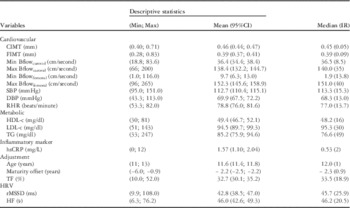
In the present study, the overall sample was composed of 99 adolescents of both sexes (49 boys), aged between 11 and 13 years (mean age 11.6±0.7 years). In general, the adolescents were >2 years before their peak height velocity (maturity offset: mean: −2.2 [95%CI: −2.5; −2.2]). All descriptive data are shown in Table 1.
Descriptive statistics of the study variables (Presidente Prudente, São Paulo, Brazil, 2013).

CIMT=carotid intima-media thickness; DPB=diastolic blood pressure; FIMT=femoral intima-media thickness; HDL-c=high-density lipoprotein cholesterol; HF=high frequency; HRV=heart rate variability; hsCRP=high-sensitivity C-reactive protein; IR=interquartile range; LDL-c=low-density lipoprotein cholesterol; Max=maximum; Max Bflowcarotid=maximum blood flow of carotid artery; Max Bflowfemoral=maximum blood flow of femoral artery; Min=minimum; Min Bflowcarotid=minimum blood flow of carotid artery; min Bflowfemoral=minimum blood flow of femoral artery; RHR=resting heart rate; rMSSD=root mean square of successive differences; SBP=systolic blood pressure; TF=trunk fatness; TG=triacylglycerol; 95%CI=confidence interval of 95%
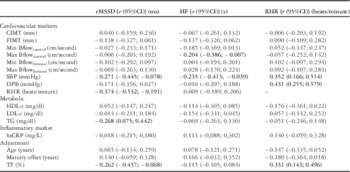
There were negative correlations between the root mean square of successive differences index and systolic blood pressure (r=−0.271 [95%CI=−0.445; −0.078]); the root mean square of successive differences index and triacylglycerol (r=−0.268 [95%CI=0.075; 0.442]); and the root mean square of successive differences index and trunk fat (r=−0.262 [95%CI=−0.437; −0.068]). Furthermore, there were positive relationships between resting heart rate and systolic blood pressure (r=0.352 [95%CI=0.166; 0.514]), diastolic blood pressure (r=0.431 [95%CI=0.255; 0.579]), and trunk fat (r=0.331 [95%CI=0.143; 0.496]). There was statistical significance between high frequency and maximum blood flow of the carotid artery (r=−0.204 [95%CI=−0.386; −0.007]); and between high frequency and systolic blood pressure (r=−0.235 [95%CI=−0.413; −0.039]) (Table 2).
Relationship between autonomic modulation and cardiovascular risk markers of health in adolescents (Presidente Prudente, São Paulo, Brazil, 2013).

CIMT=carotid intima-media thickness; DPB=diastolic blood pressure; FIMT=femoral intima-media thickness; HDL-c=high-density lipoprotein cholesterol; HF=high frequency; HRV=heart rate variability; hsCRP=high-sensitivity C-reactive protein; LDL-c=low-density lipoprotein cholesterol; Max Bflowcarotid=maximum blood flow of carotid artery; Max Bflowfemoral=maximum blood flow of femoral artery; Min Bflowcarotid=minimum blood flow of carotid artery; Min Bflowfemoral=minimum blood flow of femoral artery; r=correlation coefficient of Pearson; RHR=resting heart rate rMSSD=root mean square of successive differences; SBP=systolic blood pressure; TF=trunk fatness; TG=triacylglycerol; 95%CI=confidence interval of 95%
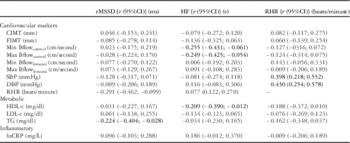
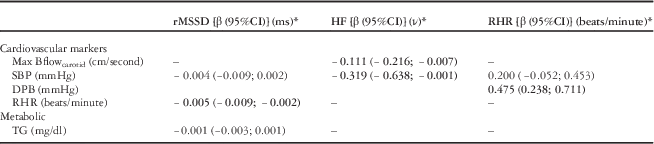
For the partial correlations controlled by sex, age, trunk fatness, and biological maturation, there was statistical significance between the root mean square of successive differences index and triacylglycerol (r=−0.224 [95%CI=−0.404; −0.028]); high frequency and minimum blood flow of the carotid artery (r=−0.255 [95%CI=−0.431; −0.061]); high frequency and maximum blood flow of the carotid artery (r=−0.249 [95%CI=−0.425; −0.054]); and high frequency and high-density lipoprotein cholesterol (r=−0.209 [95%CI=−0.390; −0.012]). There were positive correlations between resting heart rate and systolic blood pressure (r=0.398 [95% CI=0.218; 0.552]) and diastolic blood pressure (r=0.430 [95%CI=0.254; 0.578) (Table 3). In the linear regression analysis, the parasympathetic indices were significantly related to resting heart rate, maximum blood flow of the carotid artery, and systolic blood pressure. Resting heart rate and diastolic blood pressure were still significantly related in the multivariate model (Table 4).
Relationship adjusted for sex, age, TF, and maturity offset between autonomic modulation and cardiovascular risk markers of health in adolescents (Presidente Prudente, São Paulo, Brazil, 2013).

CIMT=carotid intima-media thickness; DPB=diastolic blood pressure; FIMT=femoral intima-media thickness; HDL-c=high-density lipoprotein cholesterol; HF=high frequency; HRV=heart rate variability; hsCRP=high-sensitivity C-reactive protein; LDL-c=low-density lipoprotein cholesterol; Max Bflowcarotid=maximum blood flow of carotid artery; Max Bflowfemoral=maximum blood flow of femoral artery; Min Bflowcarotid=minimum blood flow of carotid artery; Min Bflowfemoral=minimum blood flow of femoral artery; r=correlation coefficient of Pearson; RHR=resting heart rate; rMSSD=root mean square of successive differences; SBP=systolic blood pressure; TF=trunk fatness; TG=triacylglycerol; 95%CI=confidence interval of 95%
Adjusted linear regression between autonomic modulation and cardiovascular risk markers of health in adolescents (Presidente Prudente, São Paulo, Brazil, 2013).

DPB=diastolic blood pressure; HF=high frequency; Max Bflowcarotid=maximum blood flow of carotid artery; RHR=resting heart rate; rMSSD=root mean square of successive differences; SBP=systolic blood pressure; TG=triacylglycerol; β=linear regression; 95%CI=confidence interval of 95%
* Adjusted by sex, age, trunk fatness, and maturity offset
Discussion
Our results show that parasympathetic activity at rest in the domains analysed – time and frequency – is related to lower blood pressure, triacylglycerol, trunk fatness, and blood flow in pre-pubertal adolescents. In parallel, resting heart rate presented a positive relationship with blood pressure and trunk fatness. These outcomes could indicate that both heart rate variability and resting heart rate are notably linked to cardiovascular risk in paediatric populations.
In this study, trunk fatness was negatively related to the root mean square of successive differences index. The literature shows that increased adipose tissue has been related to worse autonomic modulation.Reference Altuncu, Baspinar and Keskin 5 This pathway can be explained, at least partially, by the function of the sympathetic nervous system on the adrenal gland, stimulating the secretion of catecholamines – adrenaline and noradrenaline – which are responsible for lipolysis in adipose tissue via adrenoceptors β 1 and β 2Reference Zouhal, Lemoine-Morel, Mathieu, Casazza and Jabbour 18 . In the same form, this pathway can be directly associated with triacylglycerol serum, as well as sympathetic hyperactivity stimulating the absorption of low-density lipoprotein cholesterol in endothelial cells, contributing to atherosclerotic formation.Reference Zouhal, Lemoine-Morel, Mathieu, Casazza and Jabbour 18 It is noteworthy that our sample was composed only of pre-pubertal adolescents who had not experienced the growth spurt, which dramatically increases the quantity of adipose tissue in a relatively short period of time (mainly in obese patients)Reference Knittle, Timmers, Ginsberg-Fellner, Brown and Katz 19 and which would boost the harmful effects of adiposity during later adolescence.
In parallel, the root mean square of successive differences index was inversely related to systolic blood pressure in both the domains analysed – that is, time and frequency. Our results are in concordance with previous literature, which shows that vagal response can be reduced by excess body fat and high blood pressure.Reference Zhou, Xie, Wang and Yang 7 Besides this, such autonomic behaviour could be related to blood flow in response to cardiac output and resting heart rate. In our study it was found that regardless of adjustments – that is, for sex, age, trunk fat, and maturity offset – the maximum blood flow of the carotid artery was related to parasympathetic activity, and this fact may be explained by the influence of resting heart rate on blood pressure, indirectly associated with blood flow velocity. Besides this, resting heart rate demonstrated a positive relationship with trunk fatness and blood pressure, regardless of adjustments for sex, age, trunk fat, and maturity offset. This fact seems to be affected by the interaction between body fat and blood flow, which is related to blood pressure.
On the other hand, carotid intima-media thickness, femoral intima-media thickness, and high-sensitivity C-reactive protein were not significantly related to autonomic modulation. Regarding intima-media thickness, the vessel’s architecture is modified throughout life and ageing acts on this morphological process, which can be exacerbated if behavioural risk factors are incorporated into lifestyle, such as smoking and physical inactivity.Reference Katano, Ohno and Yamada 20 , Reference Li, Yun and Fernandez 21 Similar effects on intima-media thickness have been observed from early life when the effects of cardiorespiratory fitnessReference Li, Yun and Fernandez 21 and physical exerciseReference Pahkala, Laitinen and Heinonen 22 , Reference Pahkala, Heinonen and Simell 23 are considered. A possible explanation for the absence of significant relationships could be based on the fact that these types of morphological outcomes have been observed in older adolescents, after the effects of the growth spurt on adipose tissue,Reference Christofaro, Fernandes, Oliveira, Freitas Júnior, Barros and Ritti-Dias 24 and young adults exposed over the years to behavioural risk factors.Reference Katano, Ohno and Yamada 20 , Reference Li, Yun and Fernandez 21 Moreover, in our study, the sample was not composed of obese adolescents, affecting high-sensitivity C-reactive protein concentrations, and half of the adolescents reported participating in organised sports practice outside school (data not shown).
In addition, high-density lipoprotein cholesterol presented negative correlations with the root mean square of successive differences index and high frequency, but this response was regardless of the adjustment only in the frequency domain. The direct relationship between high-density lipoprotein cholesterol and the parasympathetic indices demonstrates the protective importance of this lipoprotein in tackling illnesses associated with vasculature, for instance, atherosclerosis.Reference Yuhanna, Zhu and Cox 25 A significant review showed that the atherogenic process can begin in the first decade of lifeReference Herouvi, Karanasios, Karayianni and Karavanaki 26 and that high-density lipoprotein cholesterol has an essential function, principally to stimulate the enzyme expression of the endothelial nitric oxide synthase, and that physical exercise is associated with reverse cholesterol transport.Reference Leaf 27 Taken together, these facts could be related to vasodilatation of the smooth muscle of the blood vessel mediated by oxide nitric.Reference Yuhanna, Zhu and Cox 25 , Reference Zago and Zanesco 28 Furthermore, higher high-density lipoprotein cholesterol can also be related to a predominance of parasympathetic activity and lower lipolysis rate, and thus can promote amelioration in the lipid profile. This autonomic behaviour, however, still requires further research.
The adjustment by biological maturation is a strong point of this study. The role of maturational processes is noteworthy in the analysed outcomes.Reference Ciccone, Scicchitano and Zito 29 For example, prematurity is associated with some alterations in myocardial tissue Doppler velocity in preterm, and therefore it has the potential to influence the heart rate variability index in childhood.Reference Ciccone, Scicchitano and Zito 29 On the other hand, the burden of the interaction between prematurity and genetics/behavioural factors on heart rate variability is still unclear, and future studies are necessary to assess this issue.
Some limitations need to be clarified: the cross-sectional design of the baseline measures should be taken into account, because it does not offer support to causal relationships among outcomes; the adolescents breathed spontaneously, and thus there was no control of breathing rate, and this fact may have promoted alterations in the high frequency index; moreover, the absence of reproducibility measurements related to heart rate variability should be taken into account, as in this study parents were reluctant to bring adolescents to the laboratory twice to perform the same measurement. Finally, measurements of insulin resistance might be useful to understand the biological pathways behind our results and should be considered for future studies.
In conclusion, our data suggest that, independent of maturation and trunk fatness, parasympathetic activity and resting heart rate are related to different cardiovascular outcomes. Apparently, both variables could be used to screen different cardiovascular outcomes in paediatric populations.
Acknowledgement
None.
Financial Support
The authors thank the State of São Paulo Research Support Foundation (FAPESP [Process: 2013/06052–2]) and CNPq (Process: 476295/2013–0) for funding this research project.
Conflicts of Interest
None.
Ethical Standards
The study had been previously approved by the Human Research Ethics Committee (process: 322.650/2013) and was in accordance with National Health Council (Resolution no. 466/12).