


Key Messages
Pelvic bone marrow sparing radiotherapy can significantly reduce dose to the bone marrow. Haematological toxicity in patients receiving preoperative chemoradiation for locally advanced carcinoma rectum may be reduced with bone marrow sparing radiotherapy.
Introduction
Chemoradiotherapy (CRT) for rectal cancer causes haematological, gastrointestinal, genitourinary toxicity and skin reactions. Reference Sauer, Becker and Hohenberger1 Intensity-modulated radiotherapy (IMRT) has shown to reduce acute bowel toxicity, treatment breaks and hospitalisations. Reference Parekh, Truong and Pashtan2,Reference Samuelian, Callister, Ashman, Young-Fadok, Borad and Gunderson3 The destruction of radiosensitive marrow cells by pelvic radiation causes acute myelosuppression. Studies on pelvic malignancies including rectal cancer concluded that radiation dose to pelvic bone marrow is a predictor of haematological toxicity (HT). Reference Albuquerque, Giangreco and Morrison4–Reference Jianyang, Yuan and Yuan8 There were hardly any trials that assessed the benefit of bone marrow sparing (BMS) radiotherapy (RT) for rectal cancer. So, we aimed to determine the benefit of BMS RapidArc (RA) (volumetric-modulated arc treatment) on acute HT in patients with carcinoma rectum receiving CRT in neoadjuvant or adjuvant setting.
Materials and Methods
Forty-three patients who were undergoing pelvic CRT for locally advanced rectal cancer from August 2018 to December 2020, either preoperatively or postoperatively, were prospectively recruited in this single-centre randomised control trial.
Major inclusion criteria were as follows: (1) biopsy-proven, non-metastatic adenocarcinoma rectum of T stage 3–4 or N stage 1–2 with tumours located within 15 cm of the anal verge; (2) ECOG performance status ≤ 2; (3) age 18–80 years; and (4) adequate liver and renal function. Exclusion criteria were as follows: (1) recurrent disease; (2) history of previous pelvic irradiation; (3) synchronous malignancies; and (4) presence of any active collagen vascular diseases or gastrointestinal diseases like inflammatory bowel disease and coeliac disease. Eligible patients were stratified into two arms by block randomisation: (1) BMS arm: receiving BMS RA; (2) NBMS arm: receiving non-bone marrow sparing (NBMS) RA.
Radiation simulation, planning and delivery
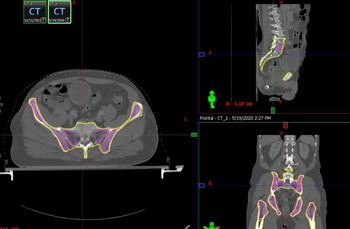
Patients were immobilised using a six-point thermoplastic mask in the supine position with arms above the head. CT simulation was done with the patient in the treatment position, of 3 mm slice thickness from L2 vertebrae to 3 cm below the pelvic floor, using oral and intravenous non-ionic contrast in full bladder. CT and diagnostic MRI images were then imported into the Eclipse treatment planning system (Varian Medical Systems), and both the datasets were fused. Targets were delineated as per radiation therapy oncology group (RTOG) consensus panel contouring atlas. Reference Myerson, Garofalo and Naga9 Bowel, bladder and femoral heads were defined as organs at risk for all patients. In patients allotted to BMS-RA arm, two sets of bone marrow were contoured, whole bone (WB) and freehand (FH) contours of low-density regions inside the bone. The WB volume started 3 cm above the upper border of PTV and ended 3 cm below the lower border of PTV. FH cavity volume was created in the LS spine from L5 to the entire sacrum, lower pelvis including pubes, ischia, acetabula and ilium (Fig. 1). RA plan was created on the Eclipse treatment planning system and calculated using an anisotropic analytical algorithm version 13.6.23. The optimisation priority was CTV> small bowel> bladder> femoral heads> WB marrow. Plan evaluation was done by assessing the D mean, D98% (near-minimum dose), D2% (near-maximum dose) received by CTV, conformity index, homogeneity index and organs at risk (OARs) constraints. All patients received RT dose of 45 Gy in 25 fractions to pelvis (tumour and pelvic lymph nodal regions) followed by 5·4 Gy in 3 fractions to tumour boost, by RA technique using 6-MV photons by Varian Unique performance Linear Accelerator with a dose rate of 600 MU/MIN.
Bone marrow contouring: CT sections showing whole bone (yellow line) and freehand cavity contours (purple line).

Chemotherapy delivery and toxicity assessment
Chemotherapy consisted of capecitabine (825 mg/m2) twice daily concurrently on the days of radiation. Capecitabine dose adjustment was done in case of grade 3 or more toxicity. Patients were assessed weekly during RT, and in the first week, sixth week and third month after RT for toxicities (haematological, gastrointestinal, genitourinary and skin), and they were graded using RTOG/EORTC acute radiation morbidity grading criteria.
Primary end point was acute HT. Grade 2 or higher anaemia, leucopenia, neutropenia or thrombocytopenia, any blood transfusions, colony-stimulating factor injection and platelet transfusions were considered as an event in acute HT.
Statistical analysis
Categorical and quantitative variables were expressed as frequency (percentage) and mean ± standard deviation, respectively. An independent t-test was used to compare quantitative parameters between categories. Mann–Whitney U-test was used to compare ordinal parameters between groups. Wilcoxon signed-rank test was carried out to compare ordinal parameters between two intervals of time. Chi-square test and Fisher’s exact test were used to find an association between categorical variables. For all statistical interpretations, p < 0·05 was considered the threshold for statistical significance. Statistical analyses were performed by using a statistical software package SPSS, version 20.0.
Results
Patient and treatment characteristics
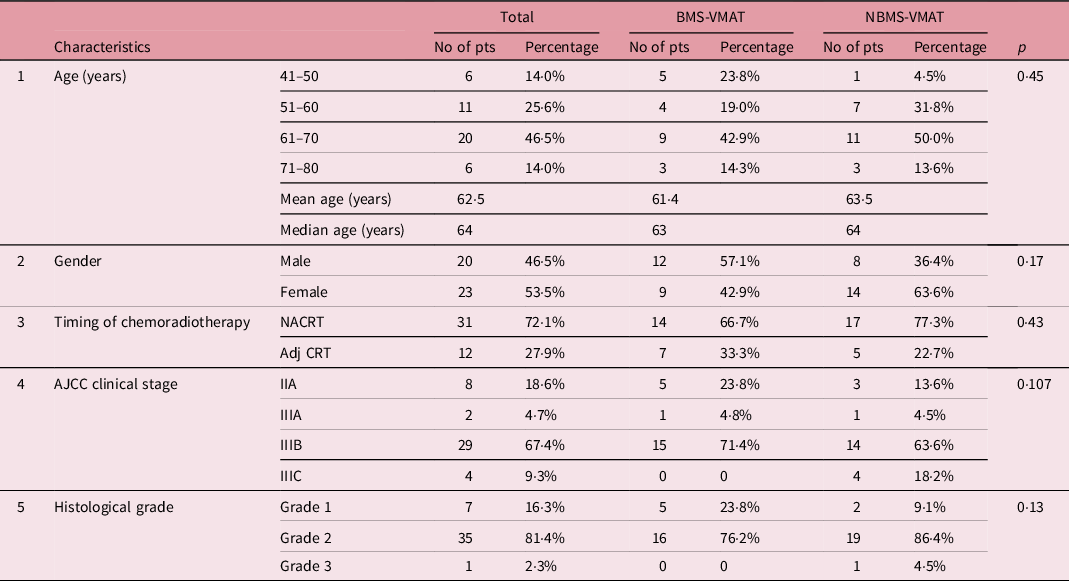
Between August 2018 and December 2020, 43 patients consented to the study, out of which 21 patients were in the BMS arm and 22 patients were in the NBMS arm. Most patients belong to the age group of 61–70 years. Gender distribution was equal in our study group. In the total 43 patients, 31 patients received neoadjuvant CRT and 12 patients received adjuvant CRT. This distribution was similar in both arms (Table 1).
Patient characteristics in BMS and NBMS arm

Dosimetric parameters
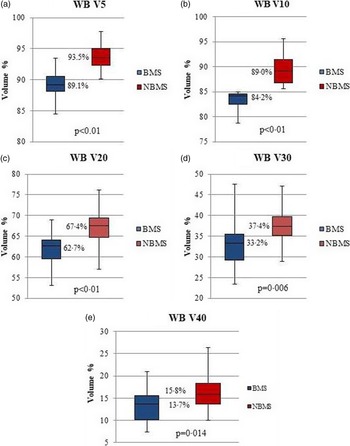
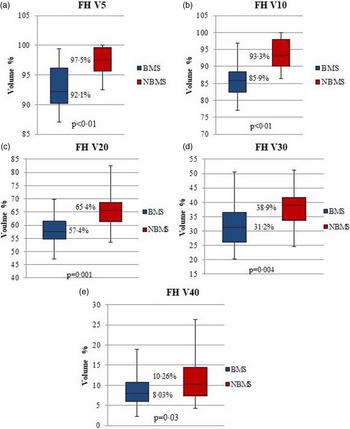
The bone marrow dosimetric parameters were significantly different between the BMS arm and NBMS arm (p < 0·01), favouring the BMS arm. The difference was seen in both WB marrow and FH bone marrow, presented as box plots (Figs. 2 and 3).
Dosimetric parameters of whole bone marrow (WB) in BMS and NBMS arms.

Dosimetric parameters of free hand bone marrow (FH) in BMS and NBMS arms.

Acute toxicity
In the whole study group, overall HT occurred in 41·9% of patients (Table 2). Acute HT was seen in 33% of patients in the BMS arm and 50% of patients in the NBMS arms; however, the difference was not statistically significant (p = 0·213).
Acute HT in whole study group

# Fisher’s exact test.
The incidence of grade 2 or more anaemia was 19% and 40% in BMS and NBMS arm, respectively (p = 0·109). Grade 2 or more leucopenia was seen in 23·8% and 18·1% in the BMS and NBMS arms, respectively, not statistically significant. Only one patient (2·3%) in the BMS arm developed grade 2 or more thrombocytopenia.
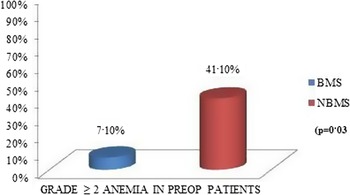
Out of the 31 patients who received preoperative CRT, 38·7% developed HT (Table 3). The incidence of HT was more in the NBMS arm than the BMS arm, 52·9% versus 21·4% (p = 0·063). Grade 2 or more anaemia was seen in 7·1% versus 41·1% in BMS and NBMS arms, respectively. This was statistically significant (p = 0·035), as shown in Fig. 4. Grade 2 or more leucopenia was seen in 23·5% and 14·2% in NBMS and BMS arms, respectively (p = 0·29).
Acute HT in patients who received preoperative CRT

# Fisher’s exact test.
Comparison in incidence of grade 2 or more anaemia in patients who received preoperative CRT, between BMS and NBMS arms.

Among patients who received postoperative CRT, 45% of the patients had HT, as described in Table 4. The incidence of grade 2 or more anaemia, leucopenia or neutropenia in both arms were similar in the postoperative setting. No patients had grade 2 or more thrombocytopenia.
Acute HT in patients who received postop CRT

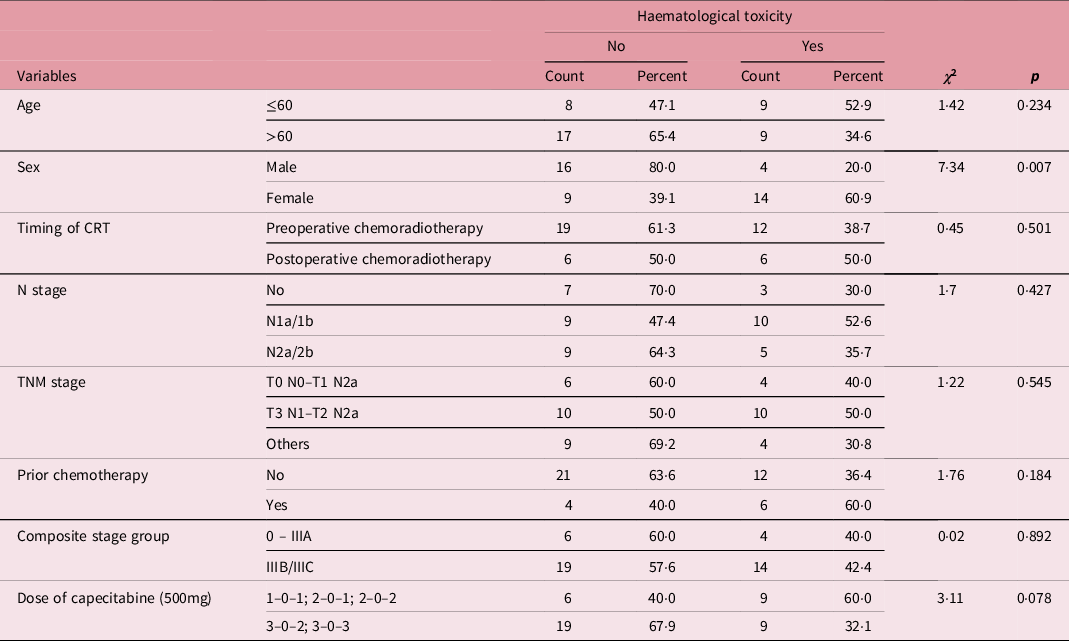
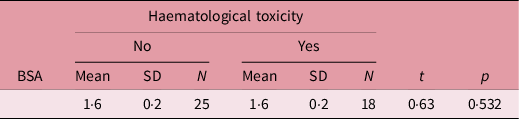
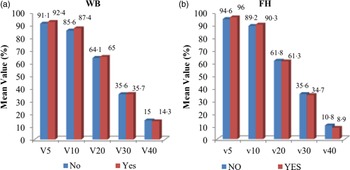
We analysed different variables like age, gender, preoperative or postoperative CRT, nodal status, TNM stage, AJCC composite stage group, prior chemotherapy received or not, the dose of capecitabine, and body surface area (BSA) as predictors of HT and found that only female gender was related to HT (Tables 5 and 6). Sixty-one percentage of women developed HT compared to 20% of men who received CRT (p = 0·007). We could find no association between the mean WB marrow dose and FH bone marrow dose with HT (Fig. 5)
Association of HT with selected variables in whole study group

χ2 – Chi-square test.
Association of BSA as a predictor for haematological toxicity in whole study group

t – Independent t-test.
Association of whole bone marrow (WB) and freehand bone marrow (FH) mean dose as predictors of haematological toxicity in patients who received preoperative CRT.

Disease response evaluation
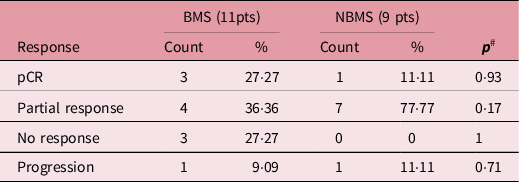
Thirty-one patients received preoperative CRT and 20 of them underwent surgery at our institution. These patients were taken for response evaluation. The post-neoadjuvant CRT surgical histopathology report revealed that 45% of patients were down-staged to T3N0 stage and only 15% of patients were above stage T3N0. Four patients have had pathological complete response, three in BMS and one in the NBMS arm. The partial response had occurred in four patients in BMS and seven patients in the NBMS arm. The disease was progressed in one patient in each arm even with neoadjuvant therapy. And hence as shown in Table 7, response to RT was statistically similar in both arms, with or without BMS RT.
Comparison of response to chemoradiotherapy between the BMS and NBMS arm

# Fisher’s exact test.
Discussion
The standard of care in locally advanced rectal cancer is CRT followed by radical resection and adjuvant chemotherapy as indicated. But the acute toxicities associated with CRT cause treatment interruptions frequently, thereby dampening treatment efficacy. Newer techniques like IMRT or RA can reduce the frequency of these acute toxicities, such as gastrointestinal toxicity than conventional treatments. Reference Parekh, Truong and Pashtan2,Reference Mok, Crane and Palmer10–Reference Klopp, Yeung and Deshmukh12 RA has the added benefit of faster treatment with lesser intrafraction error probability. Recently, the concept of BMS RT used in gynecological cancers resulted in reduction of acute HT. We know that it is possible to reduce the pelvic bone marrow dose without increasing the dose to other OARs or compromising dose to target with the help of BMS IMRT/RA.
Optimal dose or volume constraints are not well defined in the literature nor is there a clarity on the anatomical subsite of pelvic bone to be spared in treatment. Different techniques of delineation of bone marrow have been adopted in several studies. In RTOG 0418, the external surface of pelvic bones was contoured using autosegmentation through the whole length of PTV as bone marrow. Reference Klopp, Moughan and Portelance13 In some other studies, active bone marrow, that is, the low-density inner cavity of pelvic bone was spared. Reference Jianyang, Yuan and Yuan8,Reference Lujan, Mundt, Yamada, Rotmensch and Roeske14,Reference Mahantshetty, Krishnatry and Chaudhari15 Recently, functional imaging has been used to assess the extent of active bone marrow (FDG-PET or FLT-PET). Reference Rose, Liang and Lau16,Reference McGuire, Bhatia and Sun17 Various trials have also tried to find the relationship between HT and radiation dose to different anatomical subsites of the pelvis like the lumbosacral region, iliac crests, or lower pelvis. Reference Kumar, Schernberg and Busato18
In our study, we created two sets of bone marrow contouring, first one with bone autosegmentation and the second one as the low-intensity active inner cavity of pelvic bones. We defined constraints for WB marrow as V5 < 95%, V10 < 85%, V20 < 80%, V30 < 65% and V40 < 45%. Significant reduction in the irradiated volume of both whole pelvic bone marrow and FH inner cavity bone marrow (V5, V10, V20, V30, V40) were achieved with the BMS RA (p < 0·05) when compared to NBMS RA. Along with this the right proximal femur dose max, V10, V40 and left proximal femur V5, V10 and V20 were also reduced (p < 0·05).
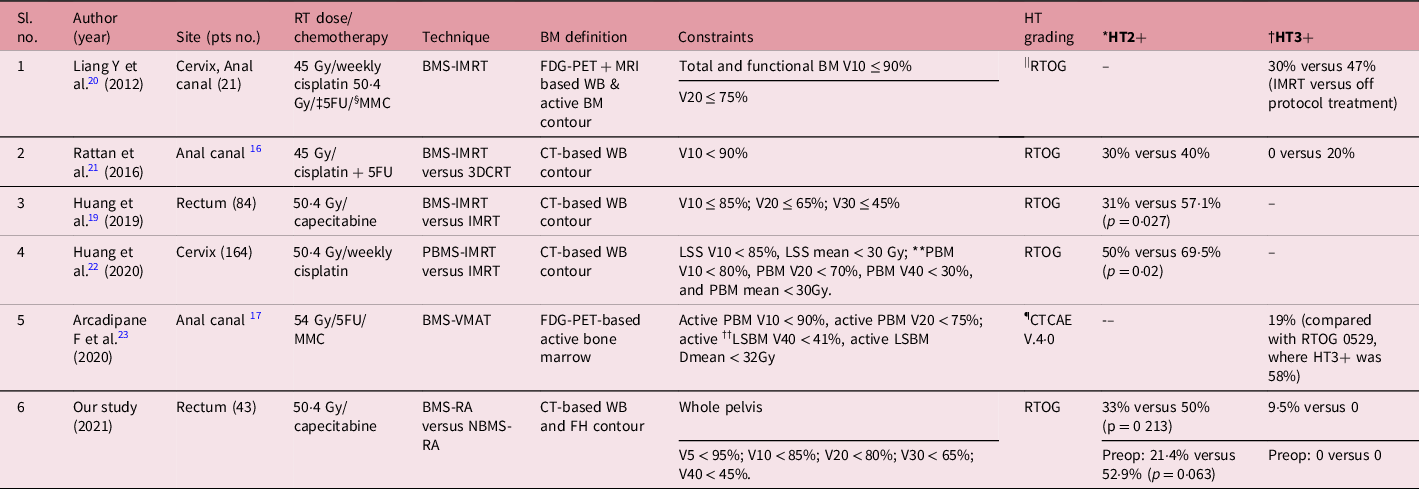
A recent study published in 2019 by Huang et al comparing pelvic BMS IMRT against NBMS IMRT in CRT with oral capecitabine for rectal cancer showed significant reduction in dose to bone marrow and bilateral femoral heads (p ≤ 0·05) with BMS IMRT, and these patients had lower incidence of grade 2 or more acute HT (31% versus 57·1%, p = 0·027). A 26·1% reduction in HT with BMS IMRT was achieved in this trial. Reference Klopp, Moughan and Portelance13
In our trial, we were able to achieve a 17% reduction in acute HT with BMS RA technique when compared to NBMS RA, though not statistically significant (p = 0·21). When we analysed, the HT in patients who received preoperative CRT alone, there was 31·5% reduction (p = 0·063) and 34% reduction in grade 2 or more anaemia which was statistically significant (p = 0·035), favouring BMS arm. This is similar to the aforementioned Huang et al trial.
Since most of the previous studies on HT and BMS pelvic radiation has been done using IMRT, it is possible that RA itself results in lower HT. However, evidence comparing volumetric-modulated arc therapy (VMAT) and IMRT in terms of HT showed no difference in the incidence of HT events, but the VMAT arm had lower bone marrow high-dose volumes. Reference Huang, Dang and Jiang19 We know from Albuquerque et al study on CRT in cervical cancer patient using 3DCRT, that volume of bone marrow receiving 20 Gy was a predictor of grade 2 or more HT. If V20 > 80%, the risk of grade 2 or more HT increases by a factor of 4·5 (p < 0·05). Reference Albuquerque, Giangreco and Morrison4 In our study, V20 was less than 80% in all patients (both BMS and NBMS arms) because of the utilisation of RA. This is may be the reason why there was no statistical difference in HT between both arms.
Reduction in HT with the use of BMS CRT for pelvic malignancies seen in the literature was compared to our trial results (RA technique), and we found that grade 2 HT was similar. Interestingly, grade 3 HT seems to be completely reduced (to near zero) with the use of BMS technique, except in anal canal cancers where mitomycin (known for its HT) is used, described in Table 8.
Clinical trials comparing acute HT in patients who received BMS versus NBMS CRT for pelvic malignancies

* HT2+ – Grade 2 or more haematological toxicity.
† HT3+ – Grade 3 or more haematological toxicity.
‡ 5FU – 5-fluorouracil.
§ MMC – mitomycin C.
|| RTOG – radiation therapy oncology group.
¶ CTCAE – common toxicity criteria for acute events.
** PBM – pelvic bone marrow.
†† LSSBM – lumbosacral spine bone marrow.
HT was correlated with various factors, and we found that female gender was a predictor (p = 0·007), as seen in literature. Reference Kaminski, Joseph and Elsaleh22 However, we could not identify the relation of bone marrow dosimetry to HT. In RTOG 0418, postoperative CRT of cervical cancer patients with IMRT found that V40 > 37% is related to grade 2 or more HT. Reference Klopp, Yeung and Deshmukh12 We were able to achieve V40 less than 37% in all our patients (both BMS and NBMS arms). Umesh Mahantshetty et al found that whole pelvis FH V40 ≥ 40% was associated with grade ≥ 2 HT in cervical cancer patients treated with chemoradiation using IMRT. Reference Jodda, Urbański, Piotrowski and Malicki24 In our study, none of the patients in either of the arms received more than this dose. These may be the reasons for not identifying the correlation between dosimetric values of bone marrow and HT.
Twenty percentage of patients had pCR, and 75% had downstaging in patients who received preoperative BMS RA, which is slightly higher than in other studies may be due to the small sample size. Reference Jalilian, Davis and Mohebbi23 This confirms that BMS RA is not detrimental to disease outcome.
Conclusion
Dose to the bone marrow, both WB and active bone marrow, can be significantly reduced by BMS RA. A 17% reduction in acute HT was attained by this technique. The non-significance of this difference may be due to an inadequate sample size or the superiority of RA technique itself. In the preoperative setting, 31·5% reduction in the occurrence of acute HT (p = 0·06) and 34% reduction in grade 2 or more anaemia (p = 0·035) were achieved. The disease response to RT was similar in both arms. Hence, we can conclude that BMS RA definitely reduces bone marrow dose and shows a trend towards lower HT. It may benefit patients receiving chemoradiation for carcinoma rectum, especially in the preoperative setting as multimodality treatment such as surgery and adjuvant chemotherapy which will further depress bone marrow reserve awaits them. Reference Huang, Gu, Ji, Zhao and Li25–Reference Rattan, Kapoor, Bahl, Gupta, Oinam and Kaur27 .
Acknowledgements
Dr Oommen P Mathew for his statistical help.
Source of support
None.
Presentation at a meeting
The data were presented at RADONC Conclave organised by Vivekanand Health Mission Trust on 30 July 2021 and won second position in best paper award.
Competing interests
None.