INTRODUCTION
White yam (Dioscorea rotundata) is a root crop grown throughout West Africa but especially in the more humid southern parts of the region. Nigeria and Ghana are major centres of production in West Africa, and indeed this region accounts for 95% of the global production of white yam (48 million tonnes) (Shehu et al., Reference Shehu, Iyortyer, Mshelia and Jongur2010). The crop has high nutritional and economic value as well as being of significant cultural importance in many parts of this region (Asiedu and Sartie, Reference Asiedu and Sartie2010; Muzac-Tucker et al., Reference Muzac-Tucker, Asemota and Ahmad1993). However, it is demanding of labour and good quality planting material is both scarce and expensive (McNamara et al., Reference McNamara, Morse, Ugbe, Coyne and Claudius-Cole2012; Morse et al., Reference Morse, McNamara and Acholo2009). The latter is influenced by the vulnerability of yam to attack by various pests and diseases, all of which can have a negative impact on yield as well as economic value (Korada et al., Reference Korada, Naskara and Edison2010). Given that yam is propagated vegetatively by farmers in West Africa there is potential for pest and disease issues to carry over from one season to the next.
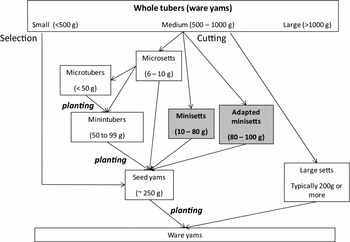
In terms of planting material the bulk of the options open to farmers are set out in Figure 1. The starting point at the top of the diagram is represented by large ‘whole’ tubers (‘mother’ yams) and the flow from the top to the bottom represents the various stages that can be followed to generate new ‘ware’ yams (i.e. large yam tubers consumed as food). For the most part farmers will either plant seed yams, their ideal option, or setts (yam tubers cut into segments) of 200g or larger.
The spectrum of approaches that have been taken for the vegetative reproduction of yams.

Ware yams are typically classified as those being 1 kg or more, while seed yams can be between 100g and 1 kg, although the ‘Grade 2’ (best) seed yams are between 100 and 250 g (Ezeh, Reference Ezeh, Ofori and Hahn1991, Reference Ezeh, Orkwuor, Asiedu and Ekanayake1998; Ikeorgu and Dabels, Reference Ikeorgu and Dabels2005; Ogbonna et al., Reference Ogbonna, Anyaegbunam and Asumugha2011a, Reference Ogbonna, Korieocha, Onyenobi and Njoku2011b).
A number of techniques have emerged from research designed to improve the production of seed yams, usually starting with healthy ware yam tubers of medium size (~1 kg). The goal has been to find ways in which seed yams can be produced cost effectively but also in ways that lower or even eliminate the chances of any pests and diseases finding their way from mother tuber to seed tubers. Hence the techniques often involve treatment with a pesticide mix (usually insecticide and fungicide) although there are trade-offs as such treatments are an additional cost to the farmer, either financially or in terms of additional labour. The two shaded boxes in Figure 1 - the use of minisetts (YMT) and adapted minsetts (AYMT) - represent two techniques that have been promoted to farmers in West Africa as a viable means for them to generate seed yams. In both cases the idea is for the farmer to use one year to produce seed yams that in turn can then be used to grow ware yams the following year. The YMT in particular has been promoted since the early 1980s in Nigeria. YMT uses minisetts of between 10 to 80g in size, although the recommended weight in Nigeria was initially set at 25g as a compromise between competing requirements of maximising setts from a single tuber and the need for a reasonable proportion of seed yams in the yield (Kalu et al., Reference Kalu, Norman, Pal and Adedzwa1989), although larger minisett sizes than 25g would be better in terms of sett survival (George, Reference George1990). Following cutting of mother tubers into minisetts the YMT recommendation was for farmers to allow the cut surface to ‘cure’ (dry and harden) in a warm but humid location (Onwueme and Charles, Reference Onwueme and Charles1994; Otoo, Reference Otoo, Akoroda and Arene1992). After this the setts are treated with a cocktail of insecticide and fungicide applied as a dust (Igwilo and Okoli, Reference Igwilo and Okoli1988; Kalu et al., Reference Kalu, Norman, Pal and Adedzwa1989; Okoli, Reference Okoli and Cock1986) and pre-sprouted in a pest and disease-free nursery before transplanting into the field (Okoli, Reference Okoli and Cock1986). Sprouting time and indeed sprouting rate (percentage of planted setts that sprout after a defined time period) can vary between varieties (Igwilo and Okoli, Reference Igwilo and Okoli1988), although varietal response to YMT has received very little attention from researchers. Sprouted minisetts are transplanted in the field after the rains have become established at a typical depth of 9 to 12 cm with a plant spacing of approximately 25 cm (4 stands per m2 if metre ridges are used = 40,000 stands/ha). In general, higher plant densities tend to give smaller seed yams (Okoli, Reference Okoli and Cock1986; Osiru et al., Reference Osiru, Hahan, Lal, Terry, Doku, Arene and Mahungu1987).
While the YMT has its benefits in terms of multiplication ratio (1:20 to 1:40) it does have some significant drawbacks. Studies have suggested that adoption of YMT is at most approximately 50%, although ‘adoption rate’ is usually defined in terms of those farmers adopting YMT once they were aware of it (Okoro, Reference Okoro2008). Various studies suggest that there has been no improvement in adoption rate in YMT over the 10 years period between 1991 and 2001, and if anything there has been a decline (Okoro, Reference Okoro2008). Various reasons have been given for the relatively poor adoption of YMT including its complexity, lack of extension support, additional labour demand, poor minisett sprouting and lack of finance (Okoli and Akoroda, Reference Okoli and Akoroda1995).
The AYMT is a far more recent initiative than the YMT. It was developed in a series of UK Department for International Development (DFID) funded research projects in Nigeria between 2005 and 2008 (Coyne et al., Reference Coyne, Claudius-Cole and Kikuno2010; Morse et al., Reference Morse, McNamara and Acholo2009) to help address some of the reasons for non-adoption of the YMT. The AYMT uses a larger sett size (80 to 120g) and planting can take place directly into the field rather than use an intermediate nursery stage as in YMT. This does mean, of course, that a single ‘mother’ tuber generates fewer setts and hence seeds with AYMT than YMT but the removal of the nursery stage more than compensates for this. Secondly the AYMT uses a pesticide ‘dip’ rather than the dust recommended for YMT. It would be possible, of course, to use a dip within YMT and so this can be regarded as an improvement in itself rather than being specifically tied to the AYMT. One widely used recommendation is for a dip of insecticide (e.g. chlorpyrifos) and fungicide (e.g. mancozeb). The treated setts are typically planted in a metre ridge at a spacing of 35 to 40 cm (skin side facing downwards), although some farmers have been known to use a spacing as high as 50 cm.
In theory the use of a pesticide ‘cocktail’ dip has the following benefits compared to the dust formulations employed in YMT:
-
a. Better penetration of the sett by the liquid.
-
b. Provide a more targeted application as there is less potential for loss of pesticide within the soil environment.
-
c. Safer as there is less manual handling of pesticide. Experience of the authors suggests that farmers typically use their bare hands to apply dusts to setts.
-
d. More choice for farmers as emulsifiable concentrate (EC) and wettable powder (WP) formulations of suitable pesticides are more readily available than dusts. EC and WP formulations are also less bulky to transport.
-
e. Less reliance on pesticides that have longer persistence in the soil. The YMT tended to rely on the use of products such as Aldrin and Lindane.
AYMT has received only limited promotion and this was within the context of testing its efficacy under more farmer-managed conditions. A Research-Into-Use (RIU) project (McNamara et al., Reference McNamara, Morse, Ugbe, Coyne and Claudius-Cole2012) was supported by DFID between 2010 and 2011, and involved a relatively small number of farmers in the middle belt of the country (10 farmers in Edeke village, Kogi State) as well as some farmer groups (including schools) in the Federal Capital Territory (FCT) of Nigeria. The aim of the project was primarily to test the agronomic and economic viability of AYMT under farmer-managed conditions, albeit with some scrutiny and significant input from researchers, but the plots also served as demonstrations for the wider community of farmers. The results from the RIU project were very positive, suggesting that AYMT does offer significant benefits for farmers. However, it has to be said that the results of the RIU project regarding wider applicability across yam growing areas can best be described as indicative rather than conclusive, and McNamara et al. (Reference McNamara, Morse, Ugbe, Coyne and Claudius-Cole2012) make the point that more work is required to test AYMT performance across a larger and more diverse sample of farmers.
Since 2012 the AYMT has been promoted by a Bill and Melinda Gates funded project called Yam Improvement for Income and Food Security in West Africa (YIIFSWA). The YIIFSWA project represents the first sustained and extensive promotion of the AYMT to farmers, and this paper presents some of the agronomic results from the demonstrations in two growing seasons - 2012 and 2013. It should be noted that the plots did not seek to compare YMT with AYMT or indeed with local methods of producing yam planting material. The demonstrations provide an opportunity to explore the agronomic performance of the AYMT under genuine farmer-managed conditions across a wide spectrum of farmers and locations. Also, unlike the RIU project the YIIFSWA farmers selected the variety that they wished to use in the AYMT (in the RIU project this was standardised) and thus the results can provide the first insights into whether there is a varietal effect with AYMT - does it perform equally well across different yam varieties? There were clues from the DFID funded work that variety could be an important factor. Hence as well as presenting some of the agronomic and economic results for AYMT the paper will also explore the issue of varietal differences.
METHODOLOGY
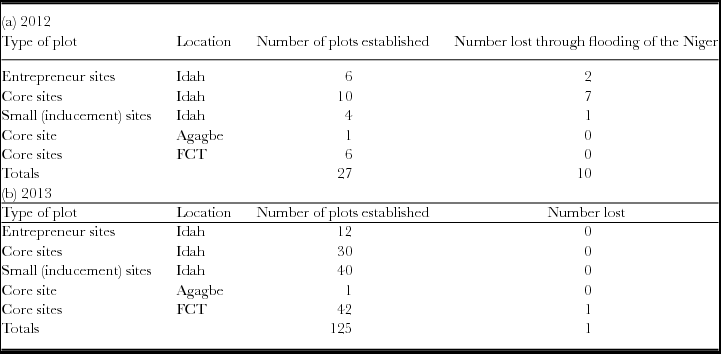
In 2012 and 2013 the YIIFSWA project involved a number of different types of demonstration plot, varying primarily in terms of plot size and complexity, and Table 1 provides a summary. At one end of the scale are the ‘entrepreneur plots’ that mirror the demonstrations employed in the RIU project funded by DFID. The number of farmers involved was relatively small and they were asked to keep extensive records regarding cost, expenditure, inputs used, activities etc. At the other end of the scale are smaller and simpler ‘inducement’ plots designed to give farmers a taste of what is involved in the AYMT. All plots were entirely farmer-managed, with no input from the YIIFSWA team in term of decision-making, and this control extended to the choice of site location, timing of all activities, yam variety and plant spacing. While the plots were not designed to be trials a number of untreated setts were included in many of the demonstrations so farmers could make comparisons with the treated setts and this provides scope for statistical analysis.
Number and types of demonstration plots established in 2012 and 2013.
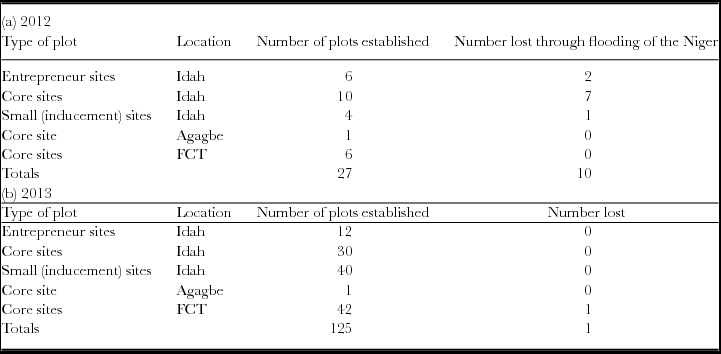
In 2012 the programme began with a total of 27 plots in three areas of Nigeria; Idah (Kogi State), Agagbe (Benue State) and FCT. Unfortunately 10 of these sites, all in the Idah area, were lost to a severe flood of the River Niger that year. The entrepreneur and core sites in 2012 (Idah and Agagbe) consisted of plots that were 10m by 15m in size, divided into two equally sized areas; one with treated setts and one with untreated setts. The major distinction between these type of plots was in the more extensive record keeping of the entrepreneur sites and a requirement that the same farmers continue to be involved in subsequent years of the YIIFSWA project. The inducement sites in Idah were 10m by 10m in size and all of the setts were treated. FCT had a total of 6 sites with areas planted to untreated and treated setts. The number of heaps planted to treated and untreated setts was left for the farmers to decide rather than being prescribed as in Idah and Agagbe.
The 2013 programme involved a total of 124 demonstrations established across Idah, Agagbe and FCT areas. The 2013 entrepreneur sites in Idah were 20m by 20m in size and only one row of planted setts was left untreated with the other 19 rows being planted to treated setts. Most of the entrepreneurs were the same as those of 2012. The Idah core sites in 2013 were 8 rows (ridges or rows of heaps) by 13m in length. One row was planted to untreated setts. A number of the 30 farmers involved in core sites in 2013 had also been involved in core and inducement sites in 2012. The Agagbe site in 2013 was also called a ‘core site’ but was 20m by 20m in size, of which 5m by 20m was planted to untreated setts. The Idah inducement sites were 8 rows by 10 m in size and as in 2012 all of the planted setts were treated.
Treatment was via the ‘pesticide dip’ method mentioned above. The pesticides employed were Act Force Gold (insecticide; 45% w/w chlorpyrifos) and Z Force (fungicide; 80% w/w/ mancozeb). For every 10 litres of water a total of 100 ml of Act Force Gold (the insecticide; contains 45% of chlorpyrifos) and 100 g of Z-Force (the fungicide; contains 80% of mancozeb) were added. Setts were cut to the recommended size (80 to 120 g) and dipped into the pesticide solution before drying in the shade and planting. Plant spacing was left to the farmer, as indeed were decisions over weeding, staking and harvesting.
For all plots in 2012 and 2013 a record was kept of plant population, germination, number and weight of seeds harvested per sett planted and germinated. Planting typically takes place between March and May of each year and the plots are harvested between October of the same year and February the following year. Unfortunately it was not possible to record levels of pest and disease attack for all the plots. As noted above, the more extensive records kept for the entrepreneur sites allowed for some economic analysis. The latter entailed a measure of the record of all inputs used in the production process, including labour, and their monetary value as well as an estimated financial value of the seed yams that were produced (number of tubers harvested multiplied by average market price/seed yam). None of the entrepreneurs in 2012 or 2013 sold their seed yams and instead opted to keep most of the material for planting to produce ware yams; larger tubers were consumed. The prices used for seed yams were those the farmers said they would have expected to get if the material had been sold in local markets. Revenue was estimated based upon the known number of seed yams harvested multiplied by two estimations of the price that may be obtained for each tuber - namely Naira (N) 50 ( = US$ 0.32) to 120 ( = US$ 0.76) - representing the minimum and maximum estimates made by the farmers. Prices tend to be lower towards the start of the storage season, soon after harvest of the seed yams, and increase significantly as the new planting season approaches.
Analysis of the data was primarily via analysis of variance (General Linear Model). In 2012 the analysis was based on 9 sites across both the FCT and the Idah areas; production from the Agagbe site was very poor and not well recorded. In 2013 the analysis was based on a total of 82 sites from the Idah area. The emphasis on the latter was chosen because it was apparent that farmers opted for two varieties - ‘Ekpe’ and ‘Opoko’. In FCT the farmers opted to grow just one variety called ‘Mechakusa’. The two varieties are seen by the Idah farmers as having quite different characteristics. Opoko is a relative ‘soft’ tuber that is easily pounded and described by them as ‘sweet’ (i.e. has a good taste). Ekpe on the other hand has a stronger (harder) tuber but is seen as being high yielding. Hence the results from the Idah demonstrations allow for the testing of a varietal effect with regard to AYMT, and for the sake of brevity only the Idah results from 2013 will be reported here.
RESULTS
(a) Germination, tuber number and tuber weight
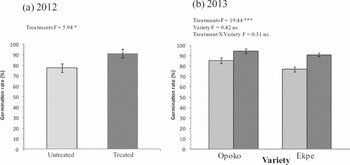
Figure 2 shows the average germination rate for the demonstrations in the 2012 and 2013 growing seasons. The bars are for untreated (light colour) and treated (darker colour) plots, and the error bars are the standard errors based upon the error mean square of an analysis of variance. The treated setts germinated better (~10% increase in both 2012 and 2013) than the untreated, but even the untreated setts had an average germination rate of approximately 80% in both years. In 2013 there was no apparent difference between the two varieties Opoko and Ekpe in terms of germination rate.
Average (± standard error) germination rate (%) for untreated and treated setts. Bars with the lighter shading are for untreated setts and the darker shading is for treated setts.

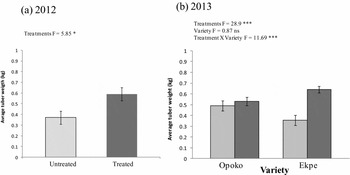
The average tuber weight harvested from the plots is shown as Figure 3. The difference between untreated and treated was again statistically significant, with tubers produced from treated setts having a higher average weight than untreated ones. In 2012 the average weight for tubers from treated setts was ~0.6 kg while for untreated setts the average was just under 0.4 kg. In 2013 there does appear to have been a different pattern of response to the pesticide dip treatment between the two varieties; the Ekpe variety responded better to the treatment than did Opoko. For Opoko the average tuber weight for untreated and treated setts was similar (~0.5 kg), while for Ekpe there was a marked increase in tuber weight from 0.36 kg to 0.64 kg. Farmers had commented in 2012 about the positive impact of pesticide treatment on tuber weight of Ekpe and the results from 2013 provide evidence for this. Interestingly in both 2012 and 2013 the untreated setts had an average tuber size (0.3 to 0.4 kg) that was closer to the ‘ideal’ for seed yam than the treated setts. However, the average tuber weights in Figure 3 do mask the distribution in tuber size; a variable not recorded.
Average (± standard error) tuber weights (kg/tuber) harvested from untreated and treated setts. Bars with the lighter shading are for untreated setts and the darker shading is for treated setts.

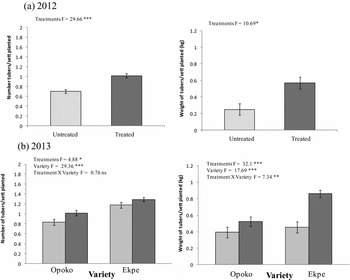
Given that the pesticide treatment influences germination rate as well as tuber size then it is necessary to look at performance relative to setts planted and germinated. Figure 4 provides the number of tubers harvested and the average tuber weight per sett planted. The results suggest that the treatment increases the number of tubers and the average weight of tuber for every sett planted. In 2012 the number of seeds per treated sett planted was approximately one, while for untreated setts the figure was around 0.7. The latter reflected in part a poorer germination for untreated setts. In 2013 the treatment increased the number of tubers/sett planted for both varieties, but there was also a significant variety effect (p < 0.001) as Ekpe had more tubers/sett than did Opoko. In terms of tuber weight/sett planted the variety effect was also significant in 2013 (p < 0.001), and indeed there was a significant (p < 0.01) variety X treatment interaction; suggesting that Ekpe responded better to the treatment than did Opoko.
Average (± standard error) number of tubers and average tuber weight (kg/tuber) per sett planted.

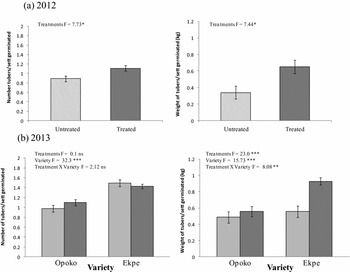
In relation to the number of tubers harvested/sett that had germinated the averages for untreated and treated plots are shown in Figure 5. There is a statistically significant difference between the average for untreated and treated plots in both years. In 2013 the effect of variety was significant (p < 0.001) with Ekpe having more tubers/sett planted than Opoko. In terms of tuber weight/sett germinated there was also a significant (p < 0.01) interaction between variety and treatment, with Ekpe having a higher average weight/sett germinated than Opoko.
Average (± standard error) number of tubers and average tuber weight (kg/tuber) per sett germinated.

Overall the results from the two years provide a consistent pattern in that the pesticide ‘mix’ increases germination rate, average tuber weight and yield (assessed on a per sett planted and per sett germinated basis). Unfortunately no assessment was made of pest/disease levels or tuber quality so it is not possible to say whether the increased yield also resulted in better quality tubers. For varieties it would appear that Ekpe responded better to the pesticide treatment than did Opoko; both in terms of the number of tubers and tuber weight per sett (planted and germinated). There are a number of possible explanations for the variety X treatment interaction, including:
-
a. Pest/disease levels may have been different for the two varieties.
-
b. Differences in tuber characteristics may have allowed different degrees of penetration of the pesticides.
-
c. Unknown effects of the pesticides on tuber growth.
Of these possibilities the first two would seem more probable but this clearly requires more research.
(b) Economics of AYMT
The business plans of the 12 entrepreneur plots in 2013 was used to derive some insights into the economics under AYMT. This had been explored in the RIU project funded by DFID but the YIIFSWA plots in 2013 had far less input from the project team. In the Idah area what matters to the farmers is the cash outlay they have to make when establishing an enterprise such as AYMT. The costs typically include planting material, staking material, herbicide and labour. Much of the labour is provided by the farmer him/herself, usually with some input from the household, and these are not usually regarded by them as a financial cost although socio-economic researchers typically usually try and ‘impute’ such data using labour rates for the area. An example of the latter is provided by Ibana et al. (Reference Ibana, Coyne, Claudius-Cole, McNamara and Morse2012) in their analysis of specialist seed yam producers in Edo State, Nigeria. It is important to differentiate between what the farmers perceive as a ‘cost’, and of course this is an important factor in driving their willingness to engage in AYMT, and what researchers would include. Hence the results reported here do not include any attempt to impute costs for household labour (although this was recorded), but do include money paid by farmers for hired labour.
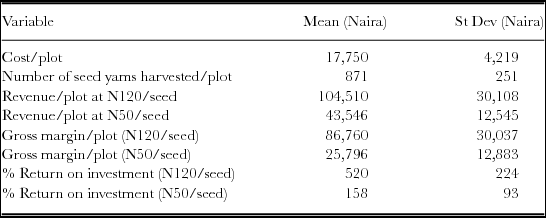
The means and standard deviations for a number of economic variables are shown as Table 2. These figures have not been extrapolated to the scale of a hectare precisely because it is the authors intention to show how they would appear to the farmers involved. Overall the results suggest a very healthy gross margin from AYMT and indeed an excellent return on investment (gross margin/cost) of between 158% and 520% (on average), although the standard deviations are admittedly large. Nonetheless an average outlay of N17,750 for a plot of 400 m2 is significant and can correspond to a monthly salary for many people in employment in Nigeria, and indeed the availability of cash has often been mentioned by farmers as a factor influencing the adoption of YMT (Okoli and Akoroda, Reference Okoli and Akoroda1995).
Economic results from the 2013 Entrepreneur sites established in the Idah area, Kogi State (Number of sites = 12 and plot size = 400 m2).
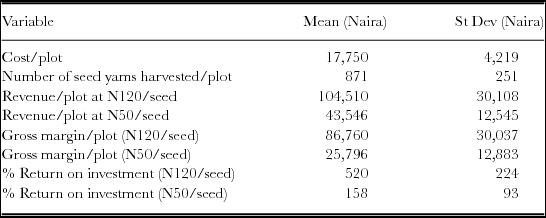
Note: US$ 1 = Naira 158.
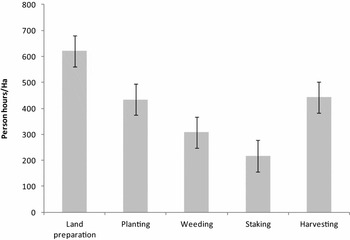
Labour is a major input into AYMT, along with planting material, and it is instructive to explore which activities demand the most labour. Figure 6 presents the average (± standard error) labour inputs (person hours/ha) across the 12 plots, and the ‘U’ shaped pattern is a typical one for yam production (Ibana et al., Reference Ibana, Coyne, Claudius-Cole, McNamara and Morse2012; McNamara et al., Reference McNamara, Morse, Ugbe, Coyne and Claudius-Cole2012). Land preparation (clearing, removing plants and ridging/heap making) was the activity with the largest labour requirement and after that there is a decline until harvesting. The latter activity can take much time given that the ground may have dried and become hard and there is understandably a desire not to damage the tubers when taking them from the soil. But the figures also include the labour involved in transporting the tubers from farm to a secure place, and this is often ignored in research on yam production.
Labour inputs for the 2013 AYMT entrepreneur plots in Kogi State. Note: Bars are the mean labour inputs per hectare (person hours). Error bars are ± Standard Error based on the error mean square from an analysis of variance.

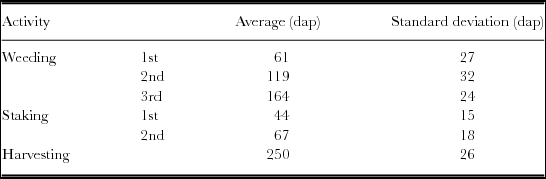
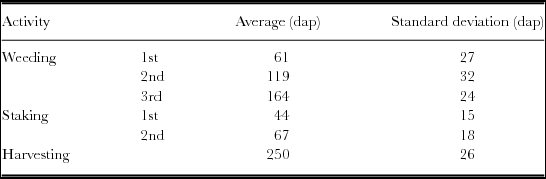
Of the 12 entrepreneurs’ plots in 2013, six were planted in April, five in May and one as late as June. In terms of harvesting, two were harvested in November 2013 and one in December 2013. Of the remaining nine plots, five were harvested in January 2014 and four in February 2014. Thus the favoured months for planting were April/May and for harvesting January/February. The timing of activities across the sites did vary and Table 3 provides the average timings and standard deviations. Three inputs of weeding were fairly typical, although some of the farmers did apply pre-emergent herbicide soon after planting which no doubt would have delayed the onset of the first weeding. Staking was often combined with weeding and for some farmers this activity needed to take place twice; the first time usually involves cutting and placing sticks next to the plants and the second may involve replacing/adding sticks plus adding some rope do the vines could spread laterally. It should be noted that the activities almost entirely take place in the first 5 to 6 months of crop growth. Harvesting took place between 8 and 9 months after planting. The farmers seem to have provided little in the way of labour input for the last 3 months of crop growth.
Timing of farmer activities in the 12 entrepreneur sites of 2013.
DISCUSSION
The results presented here provide strong confirmation that the AYMT can generate seed yams on a commercially viable scale for small-scale farmers in the middle belt of Nigeria. Previous research had shown this to be the case for a limited number of farmers applying AYMT under conditions that involved a degree of scrutiny from researchers (McNamara et al., Reference McNamara, Morse, Ugbe, Coyne and Claudius-Cole2012), but in the YIIFSWA project there was no such oversight and farmers were entirely free to make all decisions over crop management. Treatment of setts with the pesticide dip improved a number of important variables such as average tuber number and weight per sett planted and germinated, but it is of interest that even without treatment the setts were still able to produce a reasonable number of tubers at an average weight that was, if anything, closer to the ideal for seed yams than that obtained from treated setts. Clearly this is a technology that can ‘work’ under entirely farmer-managed conditions and across a wide range of farmers (even if only the Idah results are given here in detail) and it does help avoid some of the pitfalls of the YMT.
The production of larger seed yams with treated relative to untreated setts may at first be seen as a potential problem. Indeed while the distribution of weights was not recorded farmers did often say that some of the tubers were close to being ware yams in terms of size and thus too large to plant as seed yams. However, it is also the case that participating farmers did not regard the average higher weight of tubers from treated setts as being a problem; indeed far from it. From the farmers perspective the use of treated setts for seed production provides them with a spectrum of tuber sizes, some of which may be consumed as ware yams, and this flexibility is an important improvement over the YMT. This helps to address an issue that did emerge during the DFID projects, especially the RIU project (McNamara et al., Reference McNamara, Morse, Ugbe, Coyne and Claudius-Cole2012; Morse, Reference Morse, McNamara and Acholo2009), that farmers may be reluctant to engage in seed yam production as it provides no immediate return for the household in terms of sustenance. It has to be noted that in both YMT and AYMT one year has to be allocated for producing planting material, but the farmer needs to focus on ware yams for both food security and household income. The AYMT provides a compromise in the sense that while the recommended sett size of 80 to 120 g generates seed yams it also provides farmers with some ware yams.
The economics of AYMT, from the perspective of the farmer, does appear to be successful. It provides a good gross margin and return on investment, at least as perceived by the farmer. An interesting aspect of the analysis is the perception of ‘cost’ from the farmers point of view. The entrepreneurs tended to see this very much in terms of cash expenditure on inputs, including labour, and not so much in terms of their own or indeed family labour. Labour inputs, be they hired or household, were recorded for all of the entrepreneur plots and the pattern was broadly similar to that often seen for yam (McNamara et al., Reference McNamara, Morse, Ugbe, Coyne and Claudius-Cole2012), with relatively high inputs in terms of land preparation and harvesting. The demonstrations were not intended to compare AYMT with YMT or indeed with local methods of producing yam planting material, and hence no results can be presented here for such a comparison. It would nonetheless be interesting to do such research and this may be possible using information that already exists in the literature.
The significant variety and variety X treatment interaction effects observed in 2013 for a number of the variables provides the first empirical evidence for a difference often alluded to by farmers that the impact of AYMT is linked to variety. They had raised this during the DFID funded research, possibly based on observations of their own AYMT plots, and also in 2012 during the first year of the YIIFSWA demonstrations. Interestingly even though farmers knew that Ekpe responded better than Opoko to the pesticide treatment many of them still wanted to plant Opoko. The reason given for this was the claimed ‘softer’ nature of the Opoko tubers making them easier to process and eat relative to Ekpe. Nonetheless, the results raise the interesting question as to whether similar interactions may be observed with other yam varieties, and this seems to be highly likely. Varietal differences in germination rate noted by Igwilo and Okoli (Reference Igwilo and Okoli1988) have already been mentioned, and it may also suggest that some yam varieties are more susceptible to pest and disease than are others, a claim often made by farmer, but there could be other factors at play such as varietal differences in tuber structure that have an impact on ability of pesticides in dip form to penetrate into the cortex. Indeed it is interesting to note that varietal effect has not been systematically explored to any extent with YMT. Ijoyah et al. (Reference Ijoyah, Aba and Ugannyan2006) reported that a local variety in Benue State, Nigeria, called Dan-onicha is very well suited to the YMT, but beyond that paper and comments made by Igwilo and Okoli (Reference Igwilo and Okoli1988) little has been reported about the responses of local varieties within YMT.
Finally, it should also be noted that this research did not include an exploration of the benefits that accrue from planting seeds gained from treated setts versus those from untreated setts. Farmers are aware that planting better quality seeds for ware yam production does provide benefits, and this is the reason why such seeds fetch a higher price in markets. It can thus be assumed that the seed yams from treated setts should provide benefits compared to seeds from untreated setts but this needs testing. Also, are there benefits from using ware yams generated from the seeds of treated setts for AYMT? If so then this may negate the need to treat setts with pesticide every year. Clearly there is much scope for further research with AYMT.
CONCLUSIONS
The results of the YIIFSWA demonstration programme in 2012 and 2013 suggest that:
-
a. the AYMT can succeed in generating seed yams for small-scale farmers under their local conditions.
-
b. the use of the pesticide mixture results in larger tubers, but this is seen as a positive as it provides some tubers of ware yam size that can be consumed.
-
c. the economics of AYMT is positive from the farmers perspective; both in terms of gross margin and return on cash investment.
-
d. AYMT does require a cash outlay by the farmer and this can be a significant factor.
-
e. there is a varietal effect evident with the AYMT, including a significant interaction between variety and pesticide treatment. More research is required to look at this in greater depth, especially given the diversity of yam varieties grown in West Africa.
While the results are very positive with regard to AYMT, the cash constraint is an important consideration that needs to be addressed (McNamara et al., Reference McNamara, Morse, Ugbe, Coyne and Claudius-Cole2012).
Acknowledgements
We wish to acknowledge the support and encouragement of Dr Ademu Shaibu and the Director of the FCT-MDGs, Alhaji Ari Isa Muhammad; the Focal person at the FCT-MDGs Alhaji Abubakar Sani Pai; the Task Manager, Madam Nancy S. Nathan. A special word of thanks is due to the staff of the Diocesan Development Services (DDS), Idah and in particular Clement Agada, Gerard Obaje, Remigius Ikka, and Stephen Okanebu and all staff at DDS for providing the administrative support. The authors would also like to thank Dr. Lava Kumar, Dr. Robert Asiedu and Dr Norbert Maroya, all of the International Institute of Tropical Agriculture (IITA) as well as the two anonymous reviewers for their suggestions regarding the improvement of this paper.
The authors gratefully acknowledged the financial support for this work by the Bill and Melinda Gates Foundation (BMGF) under the Yam Improvement for Income and Food Security in West Africa (YIIFSWA) grant awarded to IITA.