In the first decade of his reign, Nicholas I set in motion an ambitious cultural agenda designed to elevate the arts in St Petersburg to the level found in major European centres and to extend Russia's cultural reach in Europe.Footnote 1 He assigned opera a major role in this project. Among his initiatives were the creation of two new opera troupes – Italian and Russian; the overhaul of the German opera troupe; the building of new theatres to accommodate an ever-growing array of dramatic spectacles in St Petersburg; the architectural expansion of the city's biggest public space – the Bol'shoy (Kamennïy) theatre – and its dedication to opera and ballet; the professionalisation of St Petersburg's musical establishment; and, most significantly for the present study, the modernisation of the repertoire. The last component included both support for homegrown opera and the importation of recent works from Italy and France. Nicholas's imperial ambitions for opera were hardly new: the reforms largely followed the pattern set in motion by his grandmother, Catherine the Great.Footnote 2 However, the magnitude of the vision and especially the swiftness of its implementation were uniquely his.
Nicholas wanted to stage the latest and finest of European operas. But he feared the volatile mix of disconcerting new ideas found in the librettos coming from the West, music's emotional appeal and socially heterogeneous mass audiences: this combination could easily ignite public unrest. To contain such a risk, the content and messages of dramatic works had to be censored, a process which became fully systematised during his period of rule. Nicholas selected the Third Section of his Imperial Majesty's Own Chancellery (secret or political police) to administer all theatre censorship and instructed them to uphold the monarchy as the ideal system of governance, stymie any suggestion of republicanism or political reform, safeguard the church and protect public morality.
As it did everywhere else in Europe, albeit in different ways and to different degrees, censorship in the Russian Empire shaped both individual works and the genre of opera as a whole. Nevertheless, despite its enormous if mostly hidden socio-cultural influence, opera censorship remains something of a terra incognita in the historiography of music in Russia in the first half of the nineteenth century.Footnote 3 Little is known about opera censorship as a process and practice, and there has been no systematic attempt to clarify its ideological precepts or investigate its mechanics.Footnote 4 Soviet musicology contributed virtually nothing to the subject other than indiscriminate claims of censorship brutality – claims largely unsupported or suffering from methodological flaws.Footnote 5 Today's still-patchy understanding of opera censorship for this period comes primarily from work undertaken by historians and literary scholars on print censorship.Footnote 6 Scholarship on dramatic (i.e., theatre) censorship, of which opera censorship was a component, remains highly fragmented and outdated.Footnote 7 Finally, there is no comparison of opera censorship in Russia with parallel practices in other states across Europe.Footnote 8
To re-create the story of opera censorship in Russia, it is necessary to study censorship legislation, Nicholas's decrees on productions of specific operas, the biographies and attitudes of his censors,Footnote 9 the workings of the massive bureaucracy within which these censors operated, operatic scores side-by-side with their printed and manuscript librettos, and censors’ reports and protocols. This study presents the story for the first time, bringing these elements together and documenting them through new archival sources.Footnote 10 In so doing, it reveals the censorial precepts and patterns of state intervention established during Nicholas's reign that would continue to shape domestic and foreign opera in Russia until the end of the Empire, and arguably well into the Soviet period. Without the story of censorship, the history of opera in Russia remains incomplete.
I begin with a survey of Nicholas's worldview and how that manifested in censorship as a tool of state control. The rest of the article then details the practices of censorship, with particular reference to the ways in which the national origin (Russian, Italian or French) of an operatic work determined how it was handled by the censors. By concentrating on the censorial travails of Italian and French hits in Russia (by far the majority of operas heard at the time), the study broadens our understanding of transnational operatic culture in mid-nineteenth-century Europe.
Codifying censorship: Statutes of 1826 and 1828
In monarchical systems, legislation encodes and realises the autocrat's vision of the state, even when it is drawn up by committees. Nicholas I (1796–1855) came of age in the period of reaction.Footnote 11 Influenced by the increasing ultra-conservatism of Alexander I following the restoration of the monarchy in France in 1815, Nicholas saw in the post-Revolutionary West what his Minister of People's Enlightenment termed the ‘rapid collapse in Europe of religious and civil institutions’ and the ‘spread of destructive [i.e., liberal] ideas’.Footnote 12 The Decembrist revolt (1825), which marked the start of his reign and fed his fear of rebellion, challenged not only the legitimacy of Nicholas's succession to the throne but also autocratic power itself. W. Bruce Lincoln has claimed that Nicholas's state ideology – termed in 1833 ‘Official Nationality’ with its trinity of Orthodoxy, Autocracy and Narodnost’ Footnote 13 – was intended to ‘serve as a bulwark against the challenge which Western ideas posed to the established order’.Footnote 14
Nicholas viewed Russia and its people as one big family, with himself as its father.Footnote 15 But his attitude was less paternal than paternalistic. He distrusted the masses, thought them to be inherently evil and stupid and in need of guidance and control. The last two were entrusted to the Third Section (political police), with its manifold censorship activities aimed to prevent the spread of radical ideas and concepts that could destabilise the nation's religious and political foundations and sense of morality.Footnote 16 One concern in particular is found running through official documents: the impact that a radical dramatic work might make on the impressionable youth and the intellectually inexperienced (i.e., uneducated) masses. Indeed, Nicholas became nineteenth-century Russia's most paranoid and intrusive monarch when it came to theatre, which was a crown monopoly, seen as an extension of the government's propaganda arm and serving the purpose of ideological indoctrination.Footnote 17 Although himself a musician (he sang and played the French horn, flute and cornet), Nicholas particularly disliked opera, which he considered to be the most profane form of theatre.
Ever methodical in implementing his vision and obsessed with systematisation and regimentation, Nicholas signed into law Russia's new comprehensive Censorship Statute on 10 June 1826.Footnote 18 It replaced the first (more liberal) statute of 1804. Although the conception of the new code predated Nicholas's rise to power – it was drafted in the last five years of Alexander I's rule, though rejected by him – its resurrection and realisation in 1826 reflected Nicholas's own ideology, intensified by his experience with the Decembrist uprising. From the start, the law became known colloquially as the ‘cast-iron statute’ for its scope and strictness.Footnote 19 These qualities contributed to its impracticality, prompting Nicholas to charge a committee of his closest ministers with reconsidering the entire law. Its replacement – the Statute of 1828 – would govern and guide all censorship practices in the Empire for almost forty years and dramatic censorship until the fall of the monarchy in 1917.Footnote 20
Although directed at print censorship, the Censorship Statutes of 1826 and 1828 articulated the foundational philosophical principles for all types of censorship. In the language of the 1828 law, works of art were to be automatically banned if they: 1) questioned the Greek-Russian Church and Christian faith in general; 2) contained anything against the monarchy, the Imperial household or the government; 3) offended mores and decency; or 4) insulted the honour of any one person (article 3).Footnote 21 Still, the Statute of 1828 permitted far more than it prohibited, to the extent that the censor was obliged to approve the artwork under review if these tenets were upheld. The law explicitly forbade the censor from considering ‘the fairness or groundlessness of the individual opinions or judgments of the writer, unless these are contrary to general rules of Censorship’, or from evaluating ‘whether or not the work under consideration is beneficial, so long as it is not harmful’ (article 15). The censor's job was to permit or prohibit, but not to offer comments or intervene in the work except by identifying questionable passages for the author to address (articles 6, 7, 62, 64). In practice, and especially in the case of dramatic works, censorial approaches frequently diverged from these precepts. Any drama, being a form of mass entertainment, often with a didactic twist, required a stricter approach than the new law would allow. Indeed, a systematic study of the dramatic censors’ reports and text interventions reveals that what they questioned and sought to modify aligned with the prescripts of the earlier statute.
Unlike its successor, the Statute of 1826 was defined through prohibitions.Footnote 22 For example, artworks that attacked rulers and governments of any state were automatically rejected (170–1). Censors reviewing historical works were instructed to consider the moral and political aims thereof (177). Historical discussions of public unrest were strictly prohibited (178). The law explicitly noted that it was the censor's duty to ensure that the work of art did not contain ‘anything that can lessen the feeling of devotion, loyalty and voluntary obedience towards the prescriptions of the Highest power and national laws’ (167). While the censors were required to guard against all the potential violations, they were also expected to guide artworks in a direction that was ‘beneficial to or, at a minimum, harmless for the wellbeing of the Nation’ (1). In order to do so, the law allowed the censor to intervene in the work itself (60). Taken as a cluster, the articles admitted little flexibility, and it is hard to imagine how dramatic works of the period – often treating religious and political conflicts, historical events and hazy morality – would pass censorship at all.
Although the degree of authorial responsibility for the choice of subject matter and its realisation varied between the two statutes, authors were mandated to know the law and to abide by it and were held accountable for their work's content (PSZ1: 212–14; PSZ2: 133, 150). By expecting authors to be familiar with the law and conform to it, both statutes institutionalised a system of preventative censorship of two types – ‘positive’ and ‘negative’.Footnote 23 Positive censorship shaped the artwork during its creative process by discouraging authors from engaging with politically incorrect or immoral topics. Authors knew what was and was not allowed and worked within these creative constraints – in other words, they were expected to censor themselves. What this suggests is that before an opera even reached the actual censorship phase, it had already been legally ring-fenced. If ‘positive’ censorship predated the submission of a dramatic work for censorial review, then ‘negative’ censorship resulted from the actual review of the completed work, with the aim of suppressing it in part or in whole. The censor entered the process in an official capacity only in this latter phase.
The effect of the statutes on Russian opera is clear: aware of the constraints, librettists and composers were limited in their choice of subject matter and its treatment from the start. Violating the law could land the author in prison, have him blacklisted or permanently placed under police surveillance.Footnote 24 With these deterrents, little wonder that most contemporaneous Russian librettists – such as Mikhail Zagoskin in Moscow, Georg von Rosen and Nestor Kukol'nik in St Petersburg – were devout and fully fledged supporters of the autocratic system in all its manifestations. They produced monarchist stories, bland fairytales and pseudo-historical operas set in Russia's imagined antiquity.
Most imported operas were sung in German or Russian translation and (often) adaptation. Reasons for this were both practical and political, relating to troupes’ availability, audience make-up and the primary language of listeners. At the time of Nicholas's ascent to the throne, St Petersburg had only one professional opera company – the German. Whereas the Russian theatre also performed operas, it was not until the mid-1830s that a professional opera troupe – and one that was strong enough to tackle the latest repertoire being imported from the West – was established by the state. Nicholas experimented with having an Italian opera troupe in the city twice – from 1828 to 1831 and again from 1843 onwards (more on which later). The French theatre troupe in St Petersburg did not have professional singers by intent and, with very rare exceptions, did not sing opera.Footnote 25 Although all theatres were state-operated and accessible to anyone, each troupe was patronised by a particular layer of the public. The German theatre was attended almost exclusively by the city's German-speaking residents (a very substantial portion of St Petersburg's population). The Russian theatre was frequented by the lower echelon of Russian nobility, wealthy merchants, city visitors and anyone who could afford a ticket – this was the city's most heterogeneous audience (‘the masses’). Finally, Russia's high aristocracy attended the French dramatic theatre and Italian opera.Footnote 26 All opera troupes sang in their own language exclusively, though their repertoires were not constricted by the corresponding national point of origin of a given work – for instance, both Russian and German troupes also sang French and Italian operas, but always in translation. When it came to social safety, the state did not view languages in which operas were performed as being equal. Italian was considered to be the safest, because it was the least familiar language within the rich multilingual environment of St Petersburg. For that reason, Italian operas could be heard in Italian, but only when performed by the Italian opera troupe. German was considered to be reasonably safe, and that was in part because many of the German theatre's audience members formed the core of the city's civil service and thus were viewed by the state as politically loyal (i.e., uninterested in challenging the status quo). With Russian being the language of the masses, Western operatic works translated into that language required the most vigilance on the part of state censors. French – the mother tongue of Russian aristocracy and intelligentsia, and consequently of political ideas – was not available as a language of opera. For that reason, no French serious opera (arguably the most politically charged of any operatic tradition at the time) could be heard in its original form during Nicholas's reign; these works could only be presented in translation and interventional adaptation. Translation and adaptation in any form were considered to be original creative endeavours and as such were subject to the two types of censorship described previously.
Censorship process
Under the Statute of 1828, any dramatic work (including opera) that was to be published would be reviewed by the office of print censorship under the Ministry of People's Enlightenment. Were the same work to be staged, however, it had to undergo review by the Third Section, which also had to grant permission for performance (PSZ1: 23). The basic precepts of censorship established by the law were shared (24), but the agencies operated independently: permission from one did not guarantee permission from the other. Perhaps the most famous example of this is Alexander Pushkin's Boris Godunov. In 1830, after being reviewed and emended by Nicholas himself, the play was approved for publication, but it was not permitted for staging until 1866 – more than a decade after Nicholas's death.Footnote 27 Similarly, printed opera librettos and scores, at least those coming from abroad, were often accessible to the public while staged performances were prohibited. For example, Nicholas's Minister of People's Enlightenment, Sergey Uvarov, personally found the French score of Giacomo Meyerbeer and Eugène Scribe's Le prophète to be permissible for circulation in the Empire in 1849, the year of its Paris premiere.Footnote 28 However, the opera was prohibited for staging numerous times, and when it was finally permitted, in August 1852, the work was drastically altered and publication of its new libretto denied.Footnote 29 An opera libretto, then, travelled along two different censorial paths to its realisation – as a printed poetic text and as a staged, musicalised script.
The mechanics of censoring a libretto intended for publication were straightforward.Footnote 30 Anyone could submit a work for consideration to one of the regional censorship offices (36), which were usually associated with universities in the Empire's largest cities (26–33). One censor would review the work and his (unilateral) decision was final, except for bans, which had to be agreed by a committee of all censors working at the office. The author or publisher could appeal against an unfavourable outcome (44–5), and controversial cases travelled up the hierarchy chain, ultimately reaching the tsar himself.
There was no comparable system of checks and balances in place for Dramatic Censorship. Unlike Print Censorship, which was regional, Dramatic Censorship in Russia became fully centralised during Nicholas's reign – all works intended for the stage anywhere in the Empire (e.g., Moscow, Odessa, Riga) had to be reviewed and approved by the Third Section in St Petersburg.Footnote 31 Whereas the censors working for the Ministry of People's Enlightenment were by and large academics, their confrères in the secret police were professional bureaucrats – censorship was their job. More significantly, there was only one person responsible for censoring all theatre works in the Empire at any one time. Over the course of Nicholas's thirty-year reign just three people occupied this position: August Oldecop (part-time 1822–8, full-time 1828–40), Mikhail Gedeonov (1840–50)Footnote 32 and Alexander Hederstern (Gedershtern) (1850–6).Footnote 33
Although the Statute of 1828 clearly outlined the censorship mechanism for printed works, it did not do so for staged pieces: that process was elastic, often clarified and amended through imperial decrees.Footnote 34 For instance, starting in 1833, the librettists and composers could no longer submit their works directly to the office of Dramatic Censorship for consideration; the libretto had to be vetted by the Director of the Imperial Theatres first, who would then forward the libretto for censoring. This provision added an extra layer of vigilance while reducing the caseload of the censor.
The main responsibility of the dramatic censor was to summarise the libretto and make a recommendation. He was powerful enough to affect the outcome either through his report or through the changes he demanded, but powerless to make the final decision. His reports were internal memos intended for the Chief of the Corps of Gendarmes and Director of the Third Section, whose job was to issue the resolution. Whether the reports actually reached the head of secret police is unclear, as most carry the resolution ‘To be permitted’ or ‘To be prohibited’, penned by his chief of staff. But in contentious cases, the director was certainly consulted. He might declare that ‘without the command of his Majesty, he does not dare to take a single step’, as the notorious Director of the Third Section, Alexander Benckendorff, once did, and the ultimate decision to permit or to ban would come directly from the emperor.Footnote 35 Because cultivation of opera was a matter of state policy, and also because Nicholas was never one to trust the work of his subordinates, the tsar intervened in the censorship process with extraordinary regularity. However, he could not oversee the censoring of every dramatic work in the Empire, and typically he participated only when none of his subordinates dared touch the libretto under review. Nicholas himself stood above the law, but his dramatic censors, as law enforcement agents, were bound by the regulations governing their work. Still, they applied the tenets of the law with considerable flexibility, their approach guided in no small measure by the national point of origin of the operatic work.
Censorship in practice: Russian opera
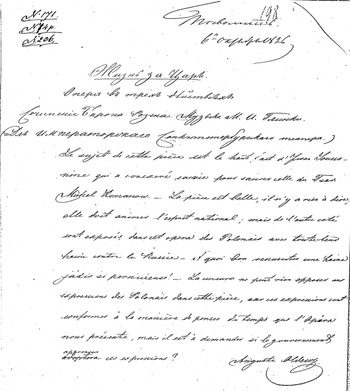
During Nicholas's reign, the state systematically cultivated Russian opera only in the years 1827–42. Much of that period coincides with the tenure of Nicholas's first and longest serving dramatic censor, Christian August Wilhelm (‘Yevstafiy Ivanovich’) Oldecop.Footnote 36 Like most intellectuals in Russia of the 1820s and 1830s, Oldecop considered musical theatre to be primitive, dramatically ineffective and stylistically low, and he despised opera. In his reports he habitually criticised the dramatic and literary qualities of opera librettos and added other kinds of commentary – an approach that was prohibited in the Statute of 1828. Even the opera that epitomised Official Nationality and had already received the tsar's blessing could not escape some censure. Writing his report on the libretto of Georg von Rosen and Mikhail Glinka's A Life for the Tsar (the original report in FrenchFootnote 37 is reproduced in Figure 1),Footnote 38 Oldecop first praised its high subject, but then added further reflections:
The subject of this play is the great feat of Ivan Susanin who gave his life to save that of Tsar Mikhail Romanov. The play is beautiful, there is nothing [more] to say; [and] it must animate the national spirit; but, on the other side, exposed in this opera are the Poles with all their hatred against Russia – and what good is it to resurrect a hate once so pernicious? The censorship can do nothing to oppose the [kinds of] expressions [used] by the Poles in this piece, because these expressions are consistent with the thinking of the time with which the opera presents us, but it should be asked whether the government approves such expressions?Footnote 39
Dramatic Censor's Report for Rosen and Glinka's A Life for the Tsar (RGIA, fond 780, opis’ 1, no. 12, f. 198).

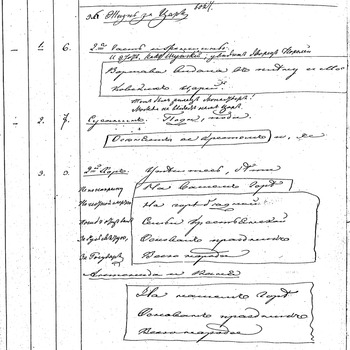
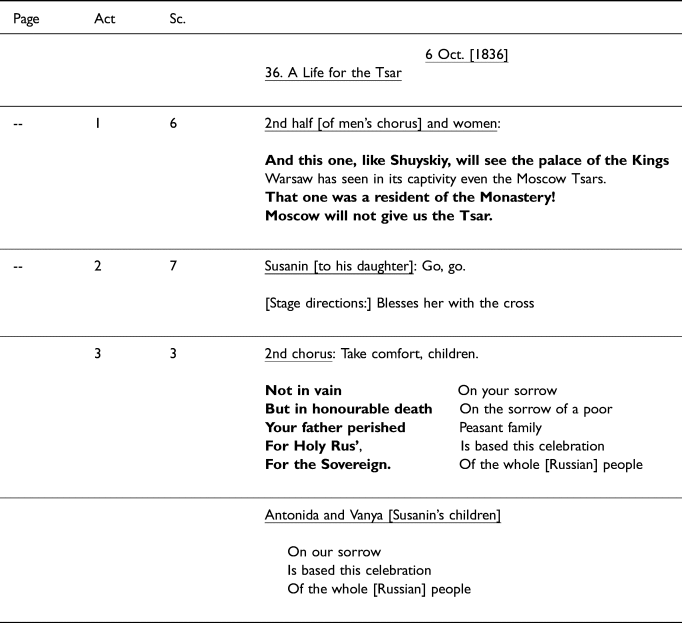
Oldecop's concerns about the kind of language used were ignored by his superiors, who approved the opera. Nor did these concerns manifest themselves in the form of censorial intrusions in the poetic text. To be sure, Oldecop demanded a few changes, but the modifications are unrelated to the points he raised and are more representative of standard censorial emendations, as can be seen from the censor's protocols. (Figure 2 reproduces the section of the protocols devoted to A Life for the Tsar,Footnote 40 which I have transcribed and translated from Russian in Table 1.Footnote 41)
The entry from the Dramatic Censor's protocols devoted to A Life for the Tsar (RGIA, fond 780, opis’ 1, no. 45, f. 9).

Transcription and translation of Figure 2

The censor was required to keep track of all the passages he identified as unacceptable and the changes ‘suggested’ to the author, so that these could be verified when the revised libretto was resubmitted for final approval. The boxed text indicates the unacceptable passages in the original. The smaller text above, below and to the side (in boldface in my transcription) indicates the replacements made subsequently, presumably by Rosen himself, and submitted by Glinka for reconsideration.Footnote 42
These changes underscore the fact that one could not reference a Russian tsar's imprisonment or mention the tsar in any other unfavourable context and that even the most common of religious symbolism was not permissible onstage. The modifications also bring out the propagandistic message already emphasised in the censor's report: Susanin did not die for the people, he died for Rus’ and for his tsar. On the surface, the request for this last change – the only substantial one – seems arbitrary, as it does not appear to be driven by censorial concerns. But the deletion of the reference to the Russian narod (people) was political: any suggestion of the empowerment of the common folk was impermissible (as exemplified also by removal before publication of the dangerous narod in the original version of Pushkin's Boris Godunov).Footnote 43
The censor's report on the opera and the changes demanded in his protocols (both reproduced here in full) have long been presumed lost; the recovery of these documents should put to rest the Soviet myth about extensive censorship befouling Glinka's first opera.Footnote 44 The few changes seen here were the only modifications demanded by the state from Rosen and Glinka. Indeed, the quantity and types of interventions one sees in A Life for the Tsar are representative of most opera librettos, whatever their language. Small-scale intrusions in the poetic text were common enough; large-scale redactions were rare, except for French grand operas (more on which later). In the case of Russian operas, such sparsity might be attributed to ‘positive’ censorship. The libretto was conceived from the start to meet the requirements imposed by the censorship statute, by which the authors were bound. A Life for the Tsar furnishes an extreme case because the very creation of its libretto was likely nurtured by Nicholas himself.Footnote 45 But in other cases positive censorship proved effective: for the entirety of Nicholas's reign, not a single Russian opera was banned and few were modified. In other words, creative activity and censorship in Russia (as elsewhere in Europe) existed in a symbiotic relationship: the authors knew what they could and could not do and conceived and realised their artworks within the constraints imposed by the system; the job of the censor, then, was to ensure that the requirements were successfully upheld and to add the seal of approval. By this means, censors provided quality control for Russian operas.
The situation with imported operas was more complex. This politically too-liberal new repertoire could inspire unrest – or so Nicholas and his subordinates feared. Censorial vigilance was a must. However, the general approach to censoring foreign works varied according to the operatic tradition in question and often to the language in which the opera was performed in Russia.
Italian opera
Italian opera in St Petersburg always received preferential treatment from the Russian censors because it represented an enormous investment of state resources. To restrict it in any way risked creating unfavourable conditions, and one might argue that the hands-off approach was essential to the success of the entire enterprise. The process was made easier by the fact that almost all Italian operas that were performed by Italians in Russia were based on librettos already censored, and sometimes re-censored, abroad. Usually, the Theatres Directorate would submit printed librettos (censored and published in Milan, Rome, Venice, London and elsewhere) to the Russian censors for consideration, and these librettos would receive approval for staging without any modifications.Footnote 46 The libretto would subsequently be translated into French (the language of Russian aristocracy) and, if approved by Print Censorship, would be published in St Petersburg in a dual-language (Italian–French) booklet, available for purchase. It is not insignificant that Italian librettos performed by the Italian opera company were never printed with a Russian translation. Italian opera in St Petersburg – the whole enterprise conceived as opera of the nobility – maintained rigorous social divisions, both through ticket prices and languages used.
Nicholas attempted his first experiment with Italian opera in St Petersburg in the years 1827–31.Footnote 47 There had been no Italian opera company in the city since 1807, and he now aimed to establish a permanent Italian opera presence. Much of the troupe was imported directly from Italy, gathered there piecemeal in 1827–8 by Nicholas's personal envoy. With the exception of the summer months, the troupe performed exclusively at the Bol'shoy Theatre, accompanied there by a superb orchestra of fifty created especially for it. During the three years of the troupe's activity (beginning in January 1828), only one opera out of eighteen reviewed gave the censor pause, and that was Mosè in Egitto. Gioachino Rossini's opera with its original libretto was never up for consideration – its biblical characters and story would be prohibited by default. The libretto that reached the censor's desk in October 1828 was already an adaptation: ‘La Vestale sedotta, osia [sic] I Prodigi di Numa [sic]. Dramma Tragico-Istorico in tre atti. Musica di Rossini. Argomento surrogato al Mosé [sic]’.Footnote 48 Rather than being banned altogether, it seems that the libretto was returned to the Italian troupe with the request that a substitute libretto be submitted in its place, for only a month later a new text was before the censor. This time, Oldecop was reviewing a libretto likely published in London (apparently for the 1827 revival of the opera there): ‘Pietro l'Eremita or Peter the Hermit, a serious opera in three acts, adapted to the music of Mosé [sic].’Footnote 49 Retaining the Egyptian setting, that adaptation transposes the characters and action to the time of the crusades, with the Egyptian pharaoh as sultan Noraddin, Moses as Peter the Hermit, and biblical Hebrews as imprisoned Christians. Permission was granted and the opera was duly accepted. As this example demonstrates, and as others confirm, Italian librettos that presented challenges within the environment of Russian censorship were frequently reviewed and approved in the form already adapted and (re)censored elsewhere.Footnote 50
The censorial treatment of Italian opera was only slightly different a decade later,Footnote 51 when Nicholas tried the Italian experiment again, this time most successfully.Footnote 52 Between 1843 (the year when the new Italian opera company began to operate in St Petersburg) and 1855 (when Nicholas died), approximately 120 distinct librettos in Italian were reviewed, with only four requiring changes to their text or action – and most of these were relatively minor modifications.Footnote 53 Salvatore Cammarano and Gaetano Donizetti's Maria di Rohan lost its final page, including the opera's scena ultima, in which a character (Chalais) commits suicide. In 1850, L'Ebrea (Eugène Scribe and Fromental Halévy's La Juive in Italian) required substantial changes to its stage directions and text, together with priest-to-civilian changes in the dramatis personae. Here the censor used the German-language version of the opera previously approved for performance in St Petersburg to adjust the Italian text. In Giulio Alary's Sardanapalo – an opera apparently composed specifically for St Petersburg in 1851 – the censor found the last moments of its finale, with the Assyrian king dying, his throne engulfed in flames, to be neudobnïm (‘inconvenient’ or ‘uncomfortable’).Footnote 54 How exactly the burning of the throne – the aspect troubling the censor the most – was ‘excluded’ remains unclear. By far, the most extensive modifications of any Italian opera were demanded of Francesco Maria Piave and Giuseppe Verdi's Rigoletto in 1853, to address its pervasive and multifaceted immorality (more on which shortly).
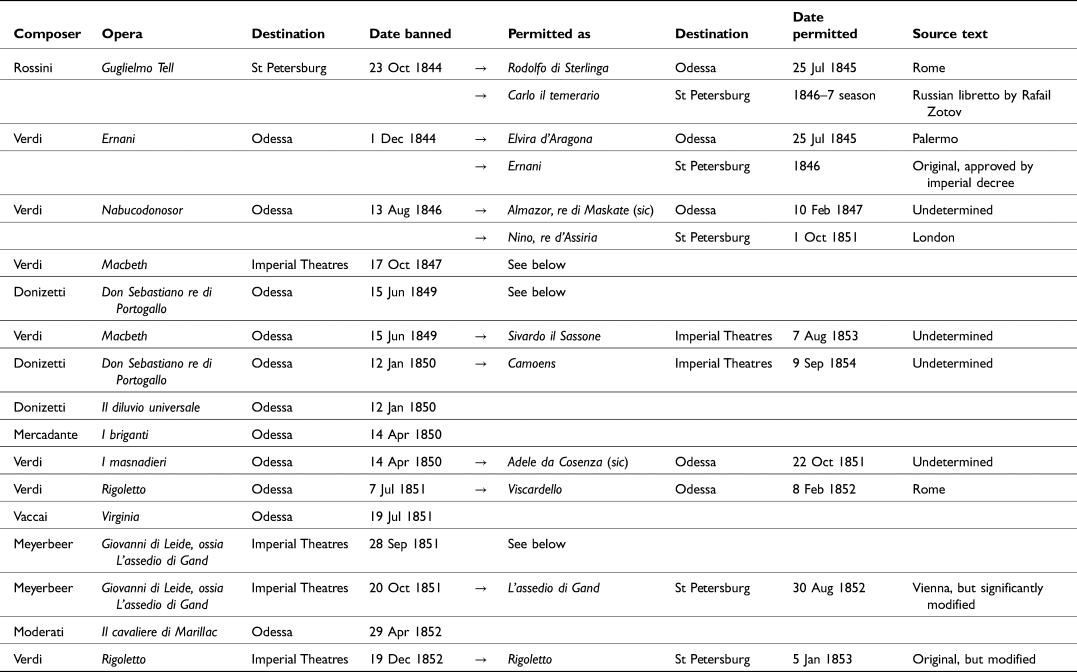
During the same period (1843–55), twelve operas in Italian (roughly ten percent of all reviewed) were banned initially. (Table 2 presents those operas and summarises their eventual fate.) Of these, three were French grand operas in Italian translation: Rossini's Guglielmo Tell, Donizetti's Don Sebastiano re di Portogallo and Giacomo Meyerbeer's Giovanni di Leide, ossia L'assedio di Gand (an adaptation of Le prophète). Their stories belong to the censorship history of grand opera in Russia. Of the remaining nine, five were subsequently approved in another form. The onus for finding an appropriate substitute for a banned libretto rested with those trying to mount the opera, not with the censor. And frequently, following the initial ban, the theatre would submit a modified libretto, but one that originated abroad, almost always in an Italian state where local censorship also found the original version of the opera to be problematic. In 1844, Verdi's Ernani – sent for consideration from Odessa – was prohibited because it presented the King of Spain on the stage, the target of conspiracy.Footnote 55 Eight months later the same censor had no reservations recommending a modified version, noting that Don Carlo had been replaced with a nobleman general and the title changed to Elvira d'Aragona.Footnote 56 The libretto submitted was likely either identical to or based on the one performed in Palermo earlier in the same year (1845). When no satisfactory existing substitute could be found, then the agency submitting the original libretto appears to have got more directly involved in its modification. Verdi's Nabucodonosor was prohibited because of its biblical subject matter.Footnote 57 However, as soon as the character of Nabucco became the (invented) Prince Almazor and the Hebrews turned into Phoenicians, under the new title Almazor, re di Maskate (sic), the opera was approved.Footnote 58
Operas in Italian prohibited upon initial review between 1843 and 1855, and their eventual fate (data compiled from an analysis of documents in RGIA, fond 780, opis’ 1, no. 19)

In these cases, as in others, the operas in question were Verdi's. By the early 1850s, his illustrious status guaranteed that even his most ideologically problematic works would be heard in some form. Only a handful of operas was permanently prohibited, including Donizetti's Il deluvio universale, because of its biblical story, and Saverio Mercadante's I briganti, because it was based on Friedrich Schiller's Die Räuber – the play banned in any realisation by Nicholas's personal decree. However, Verdi's I masnadieri – adapted from the same play and according to the censor set to music by Verdi ‘with the addition of some republican excesses [vïkhodok]’Footnote 59 – was eventually permitted, transformed with a new libretto and title.Footnote 60
These exceptional cases notwithstanding, the majority of Italian operas did not trouble the censors unduly. Their librettos were often censored en masse, the censor's opinion channelled into the one-liner, ‘These pieces contain nothing reprehensible.’Footnote 61 The general attitude of the censors towards Italian librettos can be summarised simply, if crudely, as ‘stupid but safe’. A sample of Oldecop's remarks suffices to illustrate the trend, which hardly changed with his successors:
This famous opera … contains nothing reprehensible, and without obstacle could be presented in the Italian Theatre here. (Rossini, Otello, 1828)Footnote 62
This opera is a most pathetic but utterly innocent creation. (Sapienza, Tamerlano, 1828)Footnote 63
The whole thing – like all nonsense – is innocent. (Rossini, Zelmira, 1830)Footnote 64
The piece is innocent through and through. (Bellini, Il pirata, 1836)Footnote 65
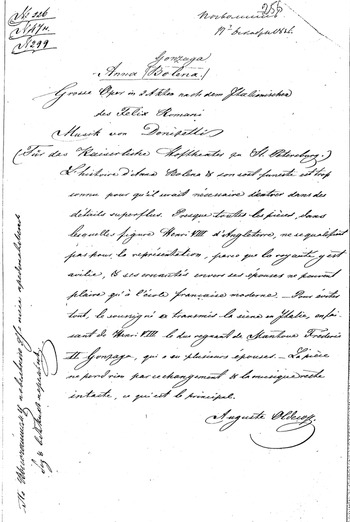
Even when a libretto was not as ‘innocent’, the censor would frequently recommend strategic adjustments. In 1836, during the absence of Italian opera in Italian in St Petersburg, Donizetti's Anna Bolena seemed headed for rejection. The city's German Theatre troupe was trying to mount the opera, its libretto reaching the theatre censor in May in printed form in German.Footnote 66 Having read the text, noting that it was ‘yet another Italian libretto, as absurd as its brethren’, Oldecop wrote a brief summary.Footnote 67 Since he knew that the opera would be banned, because of the established tradition that prohibited depiction of any monarch on the operatic stage, he did not even have to mention the fact, but he did close his report with a caveat: ‘To save the music of this opera I take the liberty of proposing an alteration, changing the King of England into the Duke of Ferrara; since the whole text [already] makes no common sense, the music will lose nothing through this metamorphosis.’Footnote 68 Despite the proposed changes, the opera was banned. Affixing this prohibition to the censor's report, the head of the Third Section nevertheless suggested a solution: ‘The piece cannot be performed as it now stands; but if for the same music one were to make another text that is [better conceived?], I will then see if the new piece may be allowed’ – by Nicholas, presumably.Footnote 69
Seven months later, Oldecop reviewed the opera again (see Figure 3). Whether the libretto had changed in any way is unclear; it is possible that the Theatres Directorate, after doing a bit of lobbying at the government's highest level, simply resubmitted the original printed libretto. This time, Oldecop offered a rationale for the ban, and, rather than make suggestions, actually imposed changes upon the text to make the libretto permissible. He wrote:
The story of Anna Bolena and her disastrous fate are too well known to require one to go into any unnecessary detail. Almost none of the plays, in which Henry VIII of England is featured, qualify for performance [in Russia], because the royalty there is debased, and his cruelty towards his wives can please only the modern French school. To avoid all of that, the undersigned has moved the setting to Italy, making Henry the reigning Duke of Mantua, Federico II Gonzaga, who had several wives. The opera does not lose anything by this change and the music remains intact, which is the most important thing.Footnote 70
Dramatic Censor's Report for Romani and Donizetti's Anna Bolena (RGIA, fond 780, opis’ 1, no. 12, f. 256).

It would have been unprecedented for the censor to thus reconfigure the libretto, since the law prohibited him from doing so. Nevertheless, permission to perform the opera in its altered form and retitled Anna Gonzaga was granted on 17 December.Footnote 71 A week later, however, the Minister of the Imperial Court (Nicholas's chief of staff) informed the Third Section that the emperor ‘deigned’ to have ‘Anna Boulen’ performed as it was, without any of the changes proposed by the censor.Footnote 72 That instruction subsequently made its way into the margins of the censor's report (see Figure 3), in the form of a terse note by Oldecop: ‘By the Highest decree, this piece is to be performed without any alterations.’Footnote 73 Nicholas wanted to hear Anna Bolena in its original form. No censorship codes, or censorship tradition or censor's concerns mattered, because Nicholas, of course, could override any decision.Footnote 74
No Italian opera demanded as much direct intervention on the part of the censor, both fitting and defying the patterns just sketched, as did Verdi's Rigoletto – the opera that in the eyes of Russian censorship was especially loaded with moral impropriety. In July 1851, only months after the opera's Venetian premiere, the Odessa Theatre forwarded the libretto for censoring. Having written a detailed and fair synopsis of the opera, censor Alexander Hederstern added his reflections:
In this melodrama, the young Duke, who has a wife, is presented as a desperate philanderer, who spares no woman; and all the other courtiers are depicted in the same colours. The circumstances of the abduction and dishonouring of the daughter of the jester, and the latter's bloody revenge against his sovereign Duke, are wholly obscene.Footnote 75
The opera was banned. Nor did the censor change his mind when the Odessa Theatre resubmitted the opera's libretto in February of next year in the form of the Roman adaptation, called Viscardello Footnote 76 – the adaptation that Verdi himself so abhorred.Footnote 77 Although the action was moved to sixteenth-century Boston (in Lincolnshire, England, presumably), with the Duke of Mantua transformed as the Duke of Nottingham, Rigoletto as Viscardello, other main characters renamed, and the overall dramatic situation significantly sanitised, Hederstern did not find the changes sufficient: ‘The Censorship [office] believes that this melodrama, because of its content, is subject to prohibition.’Footnote 78 His admonition was ignored by his superiors, who granted approval – the new libretto's remaining moral problems were mitigated by the Italian language (not readily accessible to Russian audiences) and by the fact that the opera was destined for a provincial theatre.
By the end of the year, however, the Imperial Theatres Directorate in St Petersburg, too, was eager to mount Rigoletto, submitting the Piave–Verdi libretto to the censor in December 1852.Footnote 79 Rather than write a full report, Hederstern simply noted that the performance of this opera in its original form had been prohibited already for the Odessa Theatre, and sent his report up to his superiors. The resolution on the report indicated another ban; however, the word ‘why?’ had been added next to it in pencil. It is unclear what specifically precipitated the query or who was doing the asking (the head of the Third Section – Count Aleksey Orlov – or his chief of staff, or Nicholas himself), but one might deduce that in the likely oral exchange that ensued between the censor and his superiors, the censor was instructed to annotate the libretto under review, striking all of the unacceptable passages, situations and character names, and return the text to the Theatres Directorate for modification. The substantive changes the censor demanded are preserved in the copy of the original printed Italian libretto, published by Ricordi in Milan, which Hederstern used as his source text.Footnote 80 The same copy of the libretto also contains inserted handwritten pages featuring the substitute texts, which were submitted for re-censoring.Footnote 81 Taken together, the expurgated passages and their subsequent modifications allow one to glean what the censor found objectionable and how these objections were redressed.
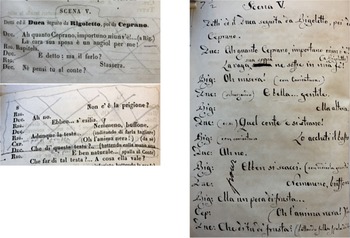
In Act I scene 5, the censor demanded that a portion of the scene with Count Ceprano – the segment featuring an intense exchange between the Duke and Rigoletto – be reworked.Footnote 82 (Figure 4 reproduces both the original crossed-out text and its replacement.)
Verdi, Rigoletto, Act I scene 5. Changes demanded by the Dramatic Censor and the replacement text (Sankt-Peterburgskaya Gosudarstvennaya Teatral'naya Biblioteka, IIa-V41-42499; pp. 7–8 and f. 7½).

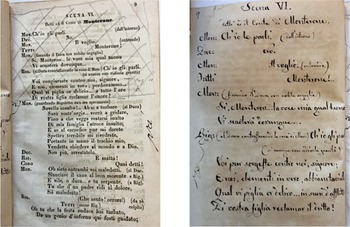
Two concerns are apparent. One related to the Duke's illicit interest in Ceprano's wife and to Rigoletto's suggestion that they kidnap her. If this was a moral concern, the other was more political: the form of Ceprano's potential punishment was deemed unacceptable, and the intensity of the exchange between the Duke and Rigoletto seems to have contributed to the censor's apprehension. The jester's suggestion of imprisonment, exile and beheading in the original was neutralised as beating, casting out and whipping in the new version. In the very next scene (6), the censor marked for modification Rigoletto's affront – speaking for the Duke – with Monterone (Figure 5).Footnote 83 Here, political and moral concerns converged, as Rigoletto referenced both Monterone's conspiracy against the Duke and the ‘dishonouring’ of Monterone's daughter – neither of which was acceptable within Russian censorial context.
Verdi, Rigoletto, Act I scene 6. Changes demanded by the Dramatic Censor and the replacement text (Sankt-Peterburgskaya Gosudarstvennaya Teatral'naya Biblioteka, IIa-V41-42499; p. 9 and f. 9).

If Rigoletto's mock offensive against Ceprano and Monterone could not stand, it is certainly unsurprising that Hederstern singled out Rigoletto's aria of real rage against the courtiers and their depraved behaviour, ‘Cortigiani, vil razza dannata’, in Act II scene 4. But though the censor crossed out some seven lines of text, from the end of Rigoletto's scena and into the first quatrain of the aria proper, ultimately only one word was emended, ‘Cortigiani’ (‘Courtiers’) mutating to ‘O perversi’ (‘Oh perverts’).Footnote 84 Something similar happened to the text of Rigoletto's final monologue (Act III scene 9), in which the censor marked the entire scene, but only a single line was altered in the end. Arguably, the line was one of the opera's most potent. Addressing what he believes to be the corpse of the Duke, Rigoletto proclaims: ‘Ora mi guarda, o mondo … / Quest’è un buffone, ed un potente è questo!’ (‘Now look upon me, oh world … / This is a buffoon, and a mighty [prince] is this!’). In the reworked libretto, the latter line transformed into the banal ‘Quest’è l'offeso e l'offensore è questo!’ (‘This is the offended one, and his offender is this!’).Footnote 85
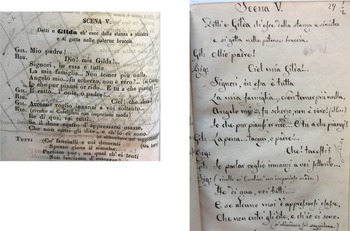
In the scene that follows Gilda's emergence from the Duke's chamber (Act II scene 5), the censor demanded text changes both to minimise the gravity of Gilda's accusation (and consequently the immorality of the entire situation) and to remove any mention of the Duke (as shown in Figure 6). Throughout the revision process, an attempt was made to conceal any indication of the Duke's high status. For instance, Monterone's ‘O Duca’ in the very next scene was replaced with ‘signore’.Footnote 86
Verdi, Rigoletto, Act II scene 5. Changes demanded by the Dramatic Censor and the replacement text (Sankt-Peterburgskaya Gosudarstvennaya Teatral'naya Biblioteka, IIa-V41-42499; p. 24 and f. 24½).

The sack, in which the mortally wounded Gilda was eventually to be carried out, vexed the censor in particular, and all references to it had to be suppressed.Footnote 87 Act III scene 6, featuring an exchange between Maddalena and Sparafucile, observed by Gilda, shows several alterations. Instead of instructing Maddalena to mend the sack, which he throws her way, Sparafucile tells his sister to mend the drape, with the word ‘manto’ (‘cloak’) pencilled over the ‘drappo’, perhaps by the censor, as a more logical alternative.Footnote 88 To Maddalena's query of ‘why?’ Sparafucile originally responded that ‘Entr'esso il tuo Apollo, sgozzato da me, / Gettar dovrò al fiume’; in the altered version, ‘sgozzato da me’ (‘slaughtered by me’) became ‘involto da me’ (‘bundled by me’), with the cloak assuming a practical function and allowing the elimination of the graphic comment. The censor likewise crossed out references to the sack in the stage directions. When Rigoletto comes to collect the Duke's body (Act III scene 8), instead of ‘torna trascinando un sacco’ (‘returns dragging a sack’), Sparafucile now ‘torna conducendo sul limitare della porta il ferito, che crede estinto, coperta di un mantello’ (‘returns carrying to the doorway the wounded, whom he believes to be dead, covered in the cloak’).Footnote 89 In the penultimate scene, ‘il sacco’, which Rigoletto is about to drag to the river, again becomes ‘il ferito’ (‘the wounded’), and, upon hearing the Duke's voice in the distance, instead of cutting the sack open, Rigoletto unwraps the cloak.Footnote 90
As these last few examples already demonstrate, if the censor concerned himself with the sung text, he also became involved in the details of the staging. Thus he crossed out the scenic instruction for the opening of Act II, which had to be rewritten, eliminating one of the two wall portraits specified, namely that of the Duke's wife.Footnote 91 Although the reference to her character remained in the sung text, her presence had to be de-emphasised by other means. Similarly, the mentions of the courtiers in the stage directions turned into the more neutral ‘Nobile’,Footnote 92 ‘Coro’Footnote 93 or ‘Cavalieri’Footnote 94 (the last two can be seen in Figure 6). In the case of courtiers, the audiences would have no sense of what was in the original, unless the libretto was printed (censoring of printed librettos, however, was outside of the dramatic censor's job description – that was a prerogative of Print Censorship).Footnote 95 Originally, the censor marked the entire cast of characters and the opera's setting for modification, presumably with the intent of addressing the more pressing concern of the socio-political status of the dramatis personae. In the end, however, only the Duke of Mantua was demoted to an abstract ‘Il Duca’ – a nobleman to be sure, but no longer an absolutist ruler. All other characters remained the same, as did the setting. The censor could never make a decision of this magnitude unilaterally, and one could speculate with some confidence that since the opera was ultimately approved, the permission to leave the characters and setting intact was granted by Nicholas himself.
Most of the changes here catalogued, which comprise virtually the entirety of the modifications undertaken, are remarkably similar to the changes that Austrian censorship in Venice demanded of Piave and Verdi two years earlier, and which Verdi was successful in rebutting on both dramatic and musical grounds.Footnote 96 What these changes reveal are nearly identical mindsets and concerns over morality and decency between the censors of the two empires. Where Russian censorship went further was in its attitude towards the depiction of the nobility, and in particular the presence of a sovereign ruler.
Who made the adjustments to the libretto demanded by the censor remains unclear. It was unlikely to have been the censor himself (though there are pencilled-in word replacements in the text, which might have originated with him); rather, it was probably a functionary at the Imperial Theatres Directorate or someone attached to the Italian opera troupe. At some point in the process, the censor and the adaptor of the text must have collaborated, clarifying and negotiating which of the changes demanded were essential and which could be ignored. Evidence pointing to this includes the fact that Hederstern struck out some seventy-seven poetic lines from the original libretto, but in the end only twenty-four lines were altered, in most cases affecting single phrases or words.
More notable still is the fact that almost none of the replacements originated with the censor or the adaptor: they were instead borrowed from the 1851 Roman libretto of Viscardello. Footnote 97 Comparison of the parallel scenes in Viscardello with those of the ‘Russian’ Rigoletto reveals that the censor or adaptor of the latter chose to borrow from Viscardello with extreme selectivity, opting to preserve much of Piave and Verdi's original text instead – something that the Roman censors did not do. The Roman adaptation was far more comprehensive in its intrusions, with changes more numerous than anything attempted by Russian censorship, including in those very spots targeted by the Russian censor. Since the concerns of Russian censorship generally aligned with those of other intrusive regimes, this begs the obvious question: why not simply use the ready-made libretto of Viscardello? The answer might hide in the censor's report on the modified libretto.
Writing the report – dated 5 January 1853, and thus drafted only two weeks after the original prohibition – Hederstern highlighted some of the changes while also directly addressing the earlier question of ‘why’ the opera was banned in the first place, echoing his own report from 1851:
The libretto of this opera was banned because the sovereign Duke of Mantua and his courtiers are presented as shameless and criminal philanderers and because the Duke's jester, Rigoletto, whose daughter Gilda was abducted and seduced, makes an attempt on the life of his Prince, having hired an assassin, who, however, by mistake, which happens because of Gilda's self-sacrifice, stabs her and passes on her dead body, in a sack, to jester Rigoletto for the agreed-upon fee.
Now the [Theatres] Directorate has forwarded to the 3rd Section the aforementioned libretto in a reworked form. The Duke is no longer the Prince of Mantua, but a nobleman; the courtiers are transformed into his friends, and Gilda is not seduced but is only taken away, and, because of her love for the Duke, sacrifices herself to save him. Her dead body is brought on stage not in a sack but wrapped in a mantle.
In its current form, the plot of this opera presents nothing contrary to the rules of censorship.Footnote 98
The first paragraph of the report rehearses all elements that Russian censorship normally would find unacceptable: the Duke's absolutist status; the negative depiction of his court; the immorality of Gilda's seduction, abduction and rape; her self-sacrifice (with its implication of suicide); Rigoletto's attempt on the Duke's life; and, finally, the sack. The second paragraph purports to summarise the changes made, but there is something fraudulent about the censor's characterisation of the modifications imposed. Although the Duke of Mantua was demoted and direct references to him suppressed, none of his and his courtiers’ behaviour was neutralised. The Duke remained the libertine that Piave and Verdi wanted him to be, and the depravity of his court was equally on display. At least up to this point, the censor is truthful about what was done, pro forma though those changes might have been. With his reference to Gilda's situation, he crosses into the territory of falsehoods, as there is nothing in the new libretto that would corroborate his declaration.
Even when taken collectively, then, the changes demanded and accepted by the censor are superficial. To be sure, they demonstrate some semblance of interference, as if to prove that an effort was made to identify and rectify the offences, but the effort itself was never serious enough to begin with, as witnessed by the elements in the libretto left unmodified. The curse, la maledizione, appears to have been of no concern to the censor; nor did he find the treatment of Gilda by others or her self-sacrifice problematic enough to warrant any real action; and the misogyny of the original drama remained, too, as did the characters affected by it. That the opera was allowed to be staged, almost certainly with Nicholas's approval, only confirms that these concerns could be set aside when expedient. In this case, the exigency was to have Verdi's new masterpiece staged in St Petersburg, with its original title and largely in its original form, which, apparently, far outweighed any potential social risks.
French grand opera
If the treatment of Italian opera exemplifies the lax side of censorship, then practices for French grand opera expose Russian censorship's most aggressive side. With the genre's emphasis on history, political and religious conflict, and bourgeois sensibilities, grand opera should not have had a place in Nicholas's Russia. And at first it did not: Nicholas resisted the importation of that particular tradition for several years. Early attempts to stage Daniel-François-Esprit Auber's La muette de Portici and Rossini's Guillaume Tell – operas that deal with popular uprisings against hegemonic powers – were quashed by Nicholas's personal decrees. His 1835 resolution for Tell, already sanitised in Vienna and reworked there into Andreas Hofer, stated: ‘To be prohibited both in the German language and in Russian translation.’Footnote 99 Since French grand opera could never be sung in French, such prohibitions would bar public access to the genre altogether.
Nicholas appears to have realised, however, that this clashed severely with his vision to modernise the operatic repertoire. The solution was the wholesale rewriting of the librettos as part of the translation process. He devised the solution in February 1833, in response to yet another attempt by the Theatres Directorate to stage La muette, issuing a directive instructing that any French dramatic work should be sent to him in the form of a programme or scenario for review before the Directorate began to consider it for staging.Footnote 100 If he approved, the next step would be the translation based on that programme, with the resulting adaptation requiring further authorisation. The first opera to be subjected to the process was La muette itself, which eventually reached the stage performed in German under the title of Fenella.Footnote 101 An attempt to stage the work in Russian in 1835 prompted the ever-vigilant Nicholas to resolve that ‘he does not want to see Fenella in Russian either in translation or in adaptation’.Footnote 102 The same fate awaited other operas. As realised in Russia, Rossini's Tell, Halévy's La Juive, Meyerbeer's Les Huguenots and Le prophète have little in common with their French originals. Censorship of each of these operas merits its own story, and collectively they deserve a history.Footnote 103 But for now, Les Huguenots, the most notorious case of repeated prohibitions and eventual reversal, will give a sense of the dynamics at play.
The saga of Les Huguenots in Russia began in June 1836, only months after the opera's hugely successful Parisian premiere, when Nicholas instructed his ambassador in France to acquire three copies of the opera's score.Footnote 104 The emperor was clearly interested in having it staged in Russia. While the ambassador was executing the order, in July the Moscow Theatres Director submitted the original French libretto to the office of Dramatic Censorship for review. Since the Moscow opera troupe performed operas exclusively in Russian, the Director wanted to see if he could receive permission to initiate the process of translation and adaptation.Footnote 105 Oldecop's report on the opera presents a mild but detailed summary, with only two personal observations. After discussing Act I, the censor added: ‘I must note that during the feast, Marcel, a servant of Raoul, sings a Church hymn, composed by Luther himself, to distract his young master from the group of Catholics.’Footnote 106 Oldecop was referring to Martin Luther's ‘Ein feste Burg ist unser Gott’, the chorale that permeates the opera, in evolving transformations. His other comment referenced the ‘Consecration of the Swords’ tableau in Act IV: ‘In case that the piece will be permitted, the fifth scene of this act must be restricted: [after all,] those are monks who bless the swords of the Catholics [intended] to kill the Huguenots.’Footnote 107 Stage depictions of the clergy of any denomination were always strictly prohibited by censorship, and its presence in this specific context would guarantee a ban.
Oldecop dictated his report to a scribe (or perhaps had the scribe transcribe from his draft), and then added a brief note of clarification in his own hand:Footnote 108
Since the Russian translation of the opera Les Huguenots will be subject to Censorship [review], I have marked in the French original all the passages that in the translation will need to be modified. As to the so-called Luther hymn, I do not remember having heard the music in the church, but I believe that it is one of those songs that during the Thirty-Years’ War the Swedish troops would intone before starting a battle. Besides, we already have so many prayers in several of our operas that this hymn should be no obstacle [to staging].
The first sentence of the note confirms that Oldecop's review of the French original was only the first step in what might become a multi-phase process of Russian-language adaptation. That adaptation would then be submitted for another censorial evaluation. The remainder of Oldecop's note is more informative still, for it hints at the censor's attitude towards the work and might indicate his attempt to guide his superiors in their decision-making. Oldecop, it seems, encouraged approval. Being Lutheran, it is almost certain that he would have known ‘Ein feste Burg’ as one of the foundational hymns in the Lutheran church. His claims that he could not recall hearing it or that it was something that Swedish soldiers would have sung come across as disingenuous and, perhaps, even deliberately misleading. The final sentence of the note would corroborate such a reading: generic prayers in opera were common enough; specific texts and music that rise to the status of liturgy were not. Oldecop's demotion of ‘Ein feste Burg’ is certainly suggestive of his true intentions. Whatever the case may be, his note was of no use: the opera was banned.
When the scores of Les Huguenots that Nicholas ordered finally arrived in October, he retained one copy and distributed the others for consideration to the Director of Military Music and the Director of the Imperial Theatres.Footnote 109 But having reviewed the opera himself in November, Nicholas apparently banned Les Huguenots in all languages, the bloody religious conflict and the immoral behaviour of some of its characters clearly not to his liking. Despite this nationwide prohibition, submitting some variant of Les Huguenots for censorial review became something of a ritual: every few years, one theatre or another would request permission for its staging.
Thus in September 1840, the governor of the northwestern province of the Empire, with its centre in Riga, forwarded to the Third Section a libretto of ‘Die Welfen und Gibellinen’Footnote 110 – most likely the 1839 Viennese adaptation of Les Huguenots. Under normal circumstances, the censorship process would be completed within about two weeks; but in this case it took two full months. The response from the Third Section came only in December, informing the governor that ‘the piece titled Welfen und Gibellinen was presented to his Imperial Majesty for consideration and was not granted the Highest permission for its performance in Russia’.Footnote 111
The following summer, the Director of the Imperial Theatres in St Petersburg, Alexander Gedeonov, decided to try his luck with the same opera. On 14 August 1841 he submitted a request to the Minister of the Imperial Court, his immediate superior and the emperor's chief of staff:
I have the honour of presenting for consideration by your Highness the libretto of the opera Die Welfen und Gibellinen, written for the music of Meyerbeer's opera Les Huguenots. The strict – both in moral and political respects – Viennese Censorship would not permit the opera Les Huguenots for the stage; consequently, the attached libretto was created and immediately approved in Vienna.Footnote 112
Highlighted here, and confirmed by other sources, is the fact that when adapting French operas, Russian theatres often based their librettos not on the French originals but on the librettos previously censored in another (foreign) cultural centre, with preference given to Vienna. The libretto, which Gedeonov appended but which does not survive, was likely identical to that submitted earlier by the Riga Theatre, namely the 1839 Viennese adaptation of the text. So what did the strict Viennese censorship do to Meyerbeer's opera, according to Gedeonov?
Everything that could appear to be impermissible in the opera Les Huguenots is completely eliminated here. The fanatical and religious character is replaced with a feud between two factions, there are no monks on the stage, no slaughter of the protestants; in its general sense, the opera Die Welfen und Gibellinen entirely resembles the opera I Capuleti e i Montecchi, which has been performed in Russia both in Russian and German languages.Footnote 113
The Viennese censorial requirements were clearly on a par with those of Russia. To turn the opera's original violent religious clash of the St Bartholomew's Day massacre into a Romeo and Juliet story, with all religious symbolism suppressed, would require some serious intervention. Gedeonov next deliberately references the audiences, which censorship is meant to protect, in effect anticipating their reaction:
I can in no way foresee that the performances of this opera could have any harmful effect on our public, and thus I humbly ask that your Highness obtain His Imperial Majesty's Imperial permission for the performance of this opera on the St Petersburg stage by the Russian or German troupes, whichever works better in terms of voices.Footnote 114
The mention of either troupe confirms that unlike Russian operas, which were censored as they were already being mounted, permission for French operas was sought well in advance of any prospective production.
Having neutralised the possibility that the opera might be perceived by his superiors as containing anything that could instigate public unrest or corrupt morals, Gedeonov turns to the public good, the opera's entertainment value. But he also reminds his superiors that operatic repertoire in Russia is lacking precisely because of censorship: ‘Our operatic repertoire has not been enlivened for some time now by any important new opera, and that is because the most significant new [European] compositions as originally composed cannot be permitted on our stage.’Footnote 115
Gedeonov's letter was intended for Nicholas, who remained unmoved by the plea, but decided to shift the blame for the negative decision onto the dramatic censor. The Minister of the Imperial Court informed the Director of the Imperial Theatres that his Majesty wished to have the libretto submitted to the censor for review first, before he considered it, and have him informed of the decision.Footnote 116 The Director immediately contacted the Third Section, asking whether it would be possible to have the opera performed in St Petersburg, adding that ‘anything that might have appeared to be impermissible in the opera Les Huguenots was completely eliminated in the proposed libretto’.Footnote 117 The Third Section responded that it was already familiar with Die Welfen und Gibellinen, having reviewed it only the previous April at the request of the Riga Theatre.Footnote 118 The chief of staff to the Director of secret police continued: ‘The censorship [office] does not consider this opera to be contrary to the accepted rules and intended to approve it, but following its report to the Tsar-Emperor, his Majesty's approval for this work was not granted.’Footnote 119 Although the Censorship office ‘sees no obstacles to its staging’, it could not grant permission for the opera's performance.
The Third Section, then, would approve the opera, but Nicholas would not (and eventually did not).Footnote 120 Perhaps more than any example considered thus far, this brief exchange of documents vividly paints the reality of censorship in Russia. The process and the mechanism worked well, and those entrusted with guarding the public and the state did exactly what they were expected to do. But in the end, the system was ineluctably capricious because of Nicholas's personal involvement. The situation of Meyerbeer's Les Huguenots serves as another reminder that in the Russian Empire there were censors and there was The Censor.
Four years later, in June 1845, the theatre in Riga made another attempt to see Les Huguenots performed, this time in the form of Margarethe von Navarra, an adaptation by one Ludwig Meyer. Censor Gedeonov reported:
This is a translation of the banned opera Les Huguenots. Eliminated in the translation is the religious fanaticism; however, the massacre of St Bartholomew's Night is retained in its entirety. Several similar adaptations were already presented for the Highest approval, and were all subjected to prohibition.Footnote 121
No exception was made now either. Undeterred by the decision, within three months the Riga Theatre had submitted a variant of Die Welfen und Gibellinen. This time, the censor simply noted that any performance of the opera was already prohibited.Footnote 122
In October of 1848, the new governor of Riga, Prince Alexander Suvorov, writing on behalf of his theatre director, begged the chief of the Third Section Count Orlov to permit a new adaptation of Les Huguenots, now called Raoul und Valentine. The governor noted that both the title and the entire content of the opera were changed. Appealing to Orlov, the governor explained that there was paucity of good operas in Riga and that the public desired to see this particular work. He also reminded Orlov of other examples of problematic operas, such as Rossini's Guillaume Tell, which were granted permission when completely rewritten. And he concluded his letter by insisting that ‘in the current piece, the most important role is played not by the words but by Meyerbeer's music, and the narration of the text is borrowed from I puritani, which in itself contains nothing reprehensible, in my opinion’.Footnote 123 On 12 January 1849, Orlov's assistant responded that his Imperial Majesty granted his permission for the performance of ‘Raoul und Valentine’.Footnote 124
What prompted Nicholas's acquiescence is not known, but the reason must have been political. In light of the discontent sweeping across Europe in 1848–9, one wonders whether this move was strategic: to score points with his subjects in the Empire's unstable western-most periphery during a turbulent time and to keep them distracted. It was a strategy of which Nicholas was fond. After all, despite its many controversial themes, political uprising is not one that is highlighted in Les Huguenots.Footnote 125
Whatever the case may be, with the emperor's shocking change of heart, the Director of the Imperial Theatres rushed to have the opera also staged in St Petersburg. Permission for that staging was granted on the 18 November and was communicated by the Minister of the Imperial Court to the Theatres Director:
I have the honour of informing your Excellency that the Tsar-Emperor Imperially permits the staging, in Italian, of the opera I guelfi ed i ghibellini based on the attached libretto, which I am returning, should this libretto be permitted by the censorship [office].Footnote 126
Forwarding the libretto to the Third Section, the Theatres Director echoed that ‘the Tsar-Emperor has imperially permitted the performance in Italian of the opera I guelfi ed i ghibellini, if it contains nothing contrary to the censorship provisions’.Footnote 127 The opera smoothly sailed through Dramatic Censorship and was performed in Russia's capital without further changes in 1850, fourteen years after its Parisian premiere. The variant of the opera that was sung was the Italian text by Calisto Bassi, as printed by Ricordi in Milan in 1843,Footnote 128 which itself was a reworking of the German-language adaptation created in Vienna in 1839 (discussed earlier). What Nicholas would not permit for the Russian and, earlier, German troupes, he would allow for the Italian. Different standards applied to different companies and languages. Still, he prohibited the publication of the opera's full libretto: one could buy only a synopsis.Footnote 129 The libretto would not be published in Russia until after Nicholas's death in 1855. And it would take another thirteen years before Russia would hear Meyerbeer's opera in its more-or-less original form in 1868. But by then the Empire had a very different Censor-in-Chief at its helm.
* * *
This study has constructed a panorama of opera censorship for the entire reign of Nicholas I. Despite total codification of censorship in this period, censorial interventions in operatic texts varied greatly, based on the censor's interpretation of the statutes, Nicholas's own multifarious involvement in the process, the practical needs of the Imperial Theatres, the international status of the composer, the contemporaneous political climate and much else besides. But, as I have shown, the greatest variable was the geographic point of origin of the operatic work. In order for the story of opera censorship to become more comprehensive, it would need to be integrated within a broader account of the intersection of opera and politics in Russia (which, by extension, would also have to situate Russia in the greater context of European operatic politics). Such an account might expand the very definition of censorship, for there were additional checks on opera not considered in the present study at all – for example, state control over published opera criticism. Manipulating critical reception of artworks was censorship by other means. Opera in Russia had never experienced such ubiquitous social control before Nicholas and would not experience it again until the 1930s, but that parallel is a story all its own.