The way mothers reminisce with their young children is critical for children's autobiographical memory development, as well as for a host of other skills (see Fivush, Haden, & Reese, Reference Fivush, Haden and Reese2006; Reese, Reference Reese2013; Salmon & Reese, Reference Salmon and Reese2016, for reviews). The long-term benefits of an elaborative maternal reminiscing style for a range of developmental outcomes have now been established through longitudinal correlational and experimental studies. When adults discuss shared past events with young children in elaborative ways, by providing many factual and emotional details about the past event, and by asking open-ended questions, children later remember past events in more detail (Haden, Ornstein, Rudek, & Cameron, Reference Haden, Ornstein, Rudek and Cameron2009; Jack, MacDonald, Reese, & Hayne, Reference Jack, MacDonald, Reese and Hayne2009; McGuigan & Salmon, Reference McGuigan and Salmon2004, Reference McGuigan and Salmon2006; Reese, Haden, & Fivush, Reference Reese, Haden and Fivush1993; van Bergen & Salmon, Reference van Bergen and Salmon2010). Children of mothers coached in elaborative reminiscing develop more accurate and detailed autobiographical memories, better emotion understanding, and more advanced theory of mind abilities (Reese & Newcombe, Reference Reese and Newcombe2007; Taumoepeau & Reese, Reference Taumoepeau and Reese2013; van Bergen, Salmon, Dadds, & Allen, Reference van Bergen, Salmon, Dadds and Allen2009). They also tell higher quality narratives about their own and others’ experiences (Peterson, Jesso, & McCabe, Reference Peterson, Jesso and McCabe1999; Reese, Leyva, Sparks, & Grolnick, Reference Reese, Leyva, Sparks and Grolnick2010; Reese & Newcombe, Reference Reese and Newcombe2007).
Mothers do adapt their reminiscing styles to individual children's attention and language skill and to their temperaments, such that mothers engage in more elaborative and emotional reminiscing with children who are more attentive during conversations, who possess better language skills, and who have high levels of effortful control (attentional self-regulation; Bird, Reese, & Tripp, Reference Bird, Reese and Tripp2006; Farrant & Reese, Reference Farrant and Reese2000; Laible, Panfile Murphy, & Augustine, Reference Laible, Panfile Murphy and Augustine2013; Rothbart, Ahadi, Hershey, & Fisher, Reference Rothbart, Ahadi, Hershey and Fisher2001). Mothers also differ in their elaborative reminiscing as a function of children's attachment security, such that mothers later become more elaborative and emotional in their reminiscing with children who were securely attached as toddlers (e.g., Newcombe & Reese, Reference Newcombe and Reese2004; Raikes & Thompson, Reference Raikes and Thompson2006). These differences in maternal reminiscing as a function of attachment security are more pronounced for negative than positive emotions (Laible, Reference Laible2004). It is maternal reminiscing about negative events that is most closely linked to children's socioemotional functioning, both concurrently (Laible, Reference Laible2011) and predictively (Laible et al., Reference Laible, Panfile Murphy and Augustine2013).
Despite these adaptations to children's characteristics and skills, mothers largely adopt a stable style of reminiscing across their different children (Haden, Reference Haden1998), with the same children over time (Haden et al., Reference Haden, Ornstein, Rudek and Cameron2009; Jack et al., Reference Jack, MacDonald, Reese and Hayne2009; Reese et al., Reference Reese, Haden and Fivush1993), and across different types of past events (Reese & Brown, Reference Reese and Brown2000; Reese & Neha, Reference Reese and Neha2015). Mothers who are more elaborative when reminiscing with their children, however, are not necessarily more elaborative in their talk about the here-and-now (Haden & Fivush, Reference Haden and Fivush1996) or in other more abstract conversations, such as their extratextual talk during shared book reading (Laible, Reference Laible2004; Leyva, Sparks, & Reese, Reference Leyva, Sparks and Reese2012). Mothers are, however, consistently elaborative in their talk about past and future events (Hudson, Reference Hudson2002). This pattern suggests that maternal reminiscing style is specific to talk about events displaced in time, both past and future.
Although more highly educated mothers tend to engage in more elaborative reminiscing, some mothers with lower levels of education are highly elaborative in their reminiscing (Reese & Newcombe, Reference Reese and Newcombe2007). Moreover, mothers in a diverse range of cultures reminisce with their children (Miller, Potts, Fung, Hoogstra, & Mintz, Reference Miller, Potts, Fung, Hoogstra and Mintz1990), although at times they elaborate about different aspects and types of past events. For instance, Māori mothers are particularly elaborative about children's birth stories in comparison to their talk about everyday past events (Reese, Hayne, & MacDonald, Reference Reese, Hayne and MacDonald2008), and Chinese mothers are particularly elaborative about children's role in appropriate social interactions compared to European American mothers (Wang & Fivush, Reference Wang and Fivush2005). Individual differences in mothers’ reminiscing style exist within all cultures studied to date (e.g., Reese & Neha, Reference Reese and Neha2015; Schröder et al., Reference Schröder, Keller, Kärtner, Kleis, Abels, Yovsi and Papaligoura2013; Tõugu, Tulviste, Schröder, Keller, & De Geer, Reference Tõugu, Tulviste, Schröder, Keller and De Geer2011; Wang & Fivush, Reference Wang and Fivush2005).
Thus, reminiscing appears to be a special context of conversation that is distinct from other forms of talk. Although maternal reminiscing is shaped by cultural values and by education levels, individual differences exist within cultures and within social classes. Given the apparent importance of reminiscing for children's development, it is vital for us to better understand the origins of maternal reminiscing style, and in this way shed light on the reasons for individual differences among mothers in their reminiscing style. Little research to date has explored maternal characteristics linked to mothers’ reminiscing style. In a notable exception, Laible et al. (Reference Laible, Panfile Murphy and Augustine2013) investigated the role of mothers’ personality traits and caregiving representations for their reminiscing style with preschoolers. Mothers who reported higher levels of openness and more positive caregiving representations were more elaborative when reminiscing with their preschoolers at ages 3.5 and 4 years. The main aim of the present study was to identify even earlier origins of mothers’ reminiscing styles with their very young children, after controlling for critical child characteristics and skills.
Several factors arise as potential explanations of individual differences in maternal reminiscing style. First and foremost, mothers’ own mental states and moods may contribute to their reminiscing style. In particular, mothers who are depressed engage in less sensitive and more negative interactions with their children (see Lovejoy, Graczyk, O'Hare, & Neuman, Reference Lovejoy, Graczyk, O'Hare and Neuman2000, for a meta-analysis). With respect specifically to reminiscing, Wareham and Salmon (Reference Wareham and Salmon2006) theorized that maternal depression would be associated with less frequent, sensitive, and elaborative reminiscing with children, accompanied by higher levels of negative affect. To our knowledge, only one reminiscing study has explored the role of maternal depression. In a low-income sample, Raikes and Thompson (Reference Raikes and Thompson2006) found that maternal depression when children were 2 years old was directly associated with children's lower emotion understanding at age 3, but this association was not mediated by mother–child talk about past emotions of happiness, anger, and sadness. Maternal depression was not significantly associated at either time point with mother–child references to past emotions. Instead, mother–child emotion talk was predicted by attachment security at age 2. However, this study did not examine maternal and child elaborative reminiscing, but only the frequency of the dyads’ emotion words in the conversations.
In related research, several studies have been conducted on mothers’ and fathers’ reminiscing with anxious and nonanxious preadolescent children about worried, angry, and happy past events (Suveg, Zeman, Flannery-Schroeder, & Cassano, Reference Suveg, Zeman, Flannery-Schroeder and Cassano2005; Suveg et al., Reference Suveg, Sood, Barmish, Tiwari, Hudson and Kendall2008). The findings varied as a function of the valence of the event. Overall, parents of anxious and nonanxious children were similar when discussing a happy event, but parents of anxious children talked less elaboratively about negative events of worry and anger. Maltreating mothers also exhibit lower levels of elaborative reminiscing with their preschool children about emotional events compared to nonmaltreating mothers (Valentino et al., Reference Valentino, Hibel, Cummings, Nuttall, Comas and McDonnell2015), but maltreating mothers can be coached to engage in more elaborative and emotional reminiscing with their children (Valentino, Comas, Nuttall, & Thomas, Reference Valentino, Comas, Nuttall and Thomas2013). To extrapolate from these related studies, we predicted that depressed mothers would reminisce less elaboratively than nondepressed mothers about emotional events, and that these differences would be exacerbated when discussing a negative experience. In community samples, this exploration entails examining the extremes of the distribution in order to compare depressed mothers to nondepressed mothers. In the present sample, we were also able to track changes in depressive symptoms over time. Those mothers who experience depressive symptoms at only one time point may be quite different from those mothers who experience stably high or increasing/decreasing levels. We wanted to capture these patterns in a person-centered way by examining stability of depression over time. Thus, it is the most comprehensive examination to date of the role of maternal depression in mother–child reminiscing.
Second, mothers who are highly elaborative when talking about past events with their children may be better at taking the perspective of others. When talking about a past event, one must rely on an internal representation of the event in order to discuss it with another person. Ideally one would be able to imagine the other person's perspective on an event, for both objective and subjective details (Fivush & Nelson, Reference Fivush and Nelson2006; Reese & Cleveland, Reference Reese and Cleveland2006). One marker of mothers’ ability to take the perspective of their children is mind-mindedness (Meins, Reference Meins1997). Mind-mindedness is assessed in infancy in terms of caregivers’ tendency to comment in an appropriate versus nonattuned manner on their infants’ internal states (Meins et al., Reference Meins, Fernyhough, de Rosnay, Arnott, Leekam and Turner2012; Meins, Fernyhough, Fradley, & Tuckey, Reference Meins, Fernyhough, Fradley and Tuckey2001). Appropriate mind-related comments indicate an accurate interpretation of the infant's putative internal state (e.g., “You want that toy” if the infant gestures or reaches toward it), whereas nonattuned comments index misinterpretations of the infant's thoughts or feelings (e.g., “You're bored with that toy” while the infant is still actively involved in playing with it). Individual differences in mothers’ mind-mindedness are relatively stable across early childhood (McMahon, Camberis, Berry, & Gibson, Reference McMahon, Camberis, Berry and Gibson2016; Meins, Fernyhough, Arnott, Turner, & Leekam, Reference Meins, Fernyhough, Arnott, Turner and Leekam2011; Meins et al., Reference Meins, Fernyhough, Wainwright, Clark-Carter, Das Gupta, Fradley and Tuckey2003) and may emerge even before the infant is born (Arnott & Meins, Reference Arnott and Meins2008; McMahon et al., Reference McMahon, Camberis, Berry and Gibson2016). Thus, individual differences in mind-mindedness predate any engagement in mother–child reminiscing, which begins around the middle of the second year of life when children start verbally referencing the past (Reese, Reference Reese1999; Sachs, Reference Sachs1983). Mothers who are more likely to impute mental states to their infants may be more willing later on to elaborate on their children's personal experiences, including their subjective experiences.
Third, elaborative reminiscing also entails a certain level of sensitivity about what the child does and does not wish to remember or talk about. Parents and children are often interested in dramatically different parts of the same experiences (e.g., Reese, Reference Reese1999). For instance, when discussing a past visit to the zoo, the parent may want to talk about the exotic animals that they saw, but the child is only interested in talking about a crushed worm she found on the footpath. Parents will be more successful in reminiscing with their children if they are sensitive to the aspects of the events that children want to discuss, and if they follow in on these aspects in their conversations. Children recall the greatest detail in past event conversations when mothers elaborate in an autonomy-supportive rather than a controlling way (Cleveland & Reese, Reference Cleveland and Reese2005). Thus, mothers who are generally more autonomy supportive and sensitive to their children in their everyday interactions from infancy may later become highly elaborative in their reminiscing. Nevertheless, although maternal mind-mindedness is correlated with maternal sensitivity, the two are distinct constructs, with mind-mindedness a better predictor than maternal sensitivity of children's social understanding (Meins, Fernyhough, Arnott, Leekam, & de Rosnay, Reference Meins, Fernyhough, Arnott, Leekam and Rosnay2013; Meins et al., Reference Meins, Fernyhough, Wainwright, Das Gupta, Fradley and Tuckey2002, Reference Meins, Fernyhough, Wainwright, Clark-Carter, Das Gupta, Fradley and Tuckey2003).
Fourth and finally, we acknowledge the important role that children play in shaping mothers’ reminiscing style. Although mothers are stable in their reminiscing over time and across different children, they are more elaborative when children have higher language levels (Farrant & Reese, Reference Farrant and Reese2000). Some research also demonstrates differences as a function of child gender, with mothers reminiscing more elaboratively with girls than with boys (e.g., Reese & Fivush, Reference Reese and Fivush1993; but cf. Laible, Reference Laible2004). Children's interest in reminiscing and in conversing in general is apparent from a young age. For instance, mothers became more elaborative over time when their toddlers (19 months) were more attentive during the conversations, sharing eye contact with their mothers and engaging in appropriate conversational turns during reminiscing (e.g., “Mmm” and “I dunno”; Farrant & Reese, Reference Farrant and Reese2000). Farrant and Reese hypothesized that this attentive turn taking was akin to joint attention in reminiscing, such that both mother and child were jointly attending to the memory conversation, and perhaps to the memory representation. This shared interest in maintaining the conversation may have its roots in joint attention processes in infancy, with mother and child sharing a gaze upon objects and referencing them nonverbally and verbally. Yet no research to date has explored the link between joint attention in infancy and later mother–child reminiscing. Thus, we hypothesized that another important child factor in shaping maternal reminiscing style is the level of joint attention in infancy.
The Present Study
The main aim of this study was to explore early predictors of mothers’ reminiscing style with their preschool children. By the time Western children are 3.5 years of age, they are regularly engaging with their mothers in reminiscing conversations at a rate of around five times per hour (Mullen & Yi, Reference Mullen and Yi1995). Our primary interest was in the role of maternal depression in predicting levels of maternal and child elaboration about a positive (happy) and a negative (fear) past event. We chose a fear event instead of sadness or anger because fear is a common experience for preschoolers, and because past research has not identified differences in maternal elaboration about fear events as a function of child gender (see Fivush, Brotman, Buckner, & Goodman, Reference Fivush, Brotman, Buckner and Goodman2000). We also considered the role of maternal factors (mind-mindedness, sensitivity, and socioeconomic status), child factors (gender and language), and dyadic factors (joint attention and attachment security) in predicting reminiscence. Our analyses were exploratory because several of these factors have never been examined empirically, but we hypothesized that maternal depression would be negatively associated with elaborative reminiscing, and that maternal mind-mindedness and sensitivity would be positively associated with elaborative reminiscing, even after taking into account socioeconomic status and child and dyadic characteristics. We expected these differences to be greatest when mothers reminisced about the negative event of fear compared to the positive event of happiness.
Method
Participants
Participants were 206 mothers and their children (108 girls). Families were recruited into a longitudinal study via local healthcare professionals and mother-and-baby groups when their children were aged 8 months. The majority of the children were firstborn (42%) and White (98%). Families came from widely ranging socioeconomic status (SES) backgrounds as assessed using the Hollingshead scale (Hollingshead, Reference Hollingshead1975), based on parental education and occupation, with scores ranging from 11 to 66. Ninety families were classed as low SES (parents with no post-16 education and unemployed or in unskilled/menial or semiskilled/manual employment). Ethical approval was obtained from university and local health authority committees, and participants provided informed consent at all stages of the study. At the beginning of the study, mothers were between 17 and 42 years of age (M = 28.90, SD = 5.54), with teenage mothers comprising 5.8% of the sample.
At Phase 1, children were aged 8 months (M = 8.52, SD = 0.48, range 7.0–10.2); at Phase 2, children (n = 204) were 15 months (M = 15.50, SD = 0.60, range 13.7–17.3); at Phase 3, children (n = 203) were 26 months (M = 26.04, SD = 0.86, range 24.1–28.9); and at Phase 4, children (n = 170) were 44 months (M = 44.06, SD = 0.83, range 42–46).
Procedure
Testing at all phases was conducted at the university's developmental laboratories. Maternal depression was assessed at all phases, maternal mind-mindedness and sensitivity at Phase 1, dyadic joint attention and attachment security at Phase 2, children's language at Phase 3, and mother–child reminiscing at Phase 4. All measures requiring interrater reliability between coders were performed with a main coder who was unaware of all other measures, with interrater reliability established on a random selection of 20%–25% of the data by a second coder who was also unaware of all other measures in the study.
Maternal mental health
Maternal depression was assessed at all phases using the Beck Depression Inventory (BDI: Beck, Ward, Mendelsohn, Mock, & Erbaugh, Reference Beck, Ward, Mendelson, Mock and Erbaugh1961). The BDI comprises 21 items, each rated on a scale ranging from 0 to 3. Participants were asked to complete the questionnaire to indicate their mood in the past 2 weeks. Potential scores range from 0 to 63, with higher scores signifying higher levels of depression. Scores between 0 and 13 indicate minimal levels of depression, between 14 and 19 indicate mild levels of depression, between 20 and 28 designate moderate depression, and scores of 29 and above indicate severe depression.
Mind-mindedness
When infants were 8 months of age, mother–infant dyads were filmed in a 20-min free-play session in the university's developmental laboratories. Mothers were simply instructed to play with their infants as they would if they had spare time together at home. The observation room was equipped with a range of age-appropriate toys; mothers and infants were free to move around as they chose, but all dyads began the session sitting on a play mat in the center of the room. Mothers’ speech during the session was later transcribed verbatim. Using the transcripts in conjunction with the filmed observations, each comment in which the mother made a reference to the infant's internal state (mind-related comments) was coded as appropriate or nonattuned using Meins et al.’s coding procedures (Centifanti, Meins, & Fernyhough, Reference Centifanti, Meins and Fernyhough2016; Meins et al., Reference Meins, Fernyhough, Fradley and Tuckey2001, Reference Meins, Fernyhough, de Rosnay, Arnott, Leekam and Turner2012). Appropriate mind-related comments are those that (a) accurately reflect the current infant's internal state, (b) link the infant's current internal state with similar events in the past or future (e.g., remembering or recognizing), (c) suggest new activities that the infant would like or want after a lull in the interaction, or (d) voice what the infant would say if she or he could talk. In contrast, nonattuned mind-related comments are those that misinterpret the infant's internal state through attributing an internal state that appears at odds with the infant's current behavior or the referent of which is not clear.
Mind-mindedness was assessed by a trained researcher who was blind to all other measures and to the study's hypotheses, and a randomly selected 25% of observations were coded by a second blind researcher; interrater agreement for dichotomously coding mind-related comments as appropriate or nonattuned was κ = 0.70. Mothers received scores for total appropriate and nonattuned mind-related comments. Scores were expressed as a percentage of the total number of comments to control for maternal verbosity. The percentage scores for appropriate mind-related comments were used in the analyses to index mind-mindedness.
Maternal sensitivity
The 20-min free-play sessions described above were also coded for maternal sensitivity. Each mother received a score between 1 and 9 to index her sensitivity according to Ainsworth, Bell, and Stayton's (Reference Ainsworth, Bell, Stayton and Richards1974) scale; higher scores indicate higher sensitivity. Sensitivity was coded by a trained researcher who was blind to all other measures and to the study's hypotheses. A second trained researcher who was blind to the study's hypotheses coded a randomly selected 25% of the sessions. Neither researcher was involved in coding mind-mindedness. Interrater reliability (intraclass correlation) was 0.83.
Attachment security
At 15 months, infants and mothers participated in the Strange Situation Procedure (Ainsworth, Blehar, Waters, & Wall, Reference Ainsworth, Blehar, Waters and Wall1978) to assess infant–mother attachment security (see Meins, Fernyhough, Arnott, Vittorini, et al., Reference Meins, Fernyhough, Arnott, Vittorini, Turner, Leekam and Parkinson2011). Infants were classified into one of four categories: secure, insecure-avoidant, insecure-resistant, or insecure-disorganized (Ainsworth et al., Reference Ainsworth, Blehar, Waters and Wall1978; Main & Solomon, Reference Main, Solomon, Brazelton and Yogman1986, Reference Main, Solomon, Greenberg, Cicchetti and Cummings1990). A trained and reliable researcher who was blind to all other measures and to the study's hypotheses coded the Strange Situations, with a second reliable researcher, also blind to other measures and hypotheses, coding a randomly selected 25%. Interrater reliability using the four-way classification system was κ = 0.82; a consensus was reached on all disagreements. The attachment distribution was as follows: 18% insecure-avoidant, 68% secure, 5% insecure-resistant, and 9% insecure-disorganized. Because we did not have specific predictions for differences in reminiscing as a function of type of insecurity, we used the two-way system (secure vs. insecure) for analyses.
Joint attention
At 15 months, joint attention between mother and child was measured in the baseline phase of the Strange Situation (see Meins, Fernyhough, Arnott, Vittorini, et al., Reference Meins, Fernyhough, Arnott, Vittorini, Turner, Leekam and Parkinson2011). The total number of child initiations of joint attention for social sharing purposes over the 3-min period was the final measure. A trained and reliable researcher who was blind to all other measures and to the study's hypotheses coded for joint attention initiations, with a second reliable researcher, also blind to other measures and hypotheses, coding a randomly selected 20%. Intraclass correlations on the five subcategories of initiations (single gaze check; alternate gaze check; show; point; and give; see Meins, Fernyhough, Arnott, Vittorini, et al., Reference Meins, Fernyhough, Arnott, Vittorini, Turner, Leekam and Parkinson2011) ranged from 0.92 to 1.0.
Children's language
At 26 months, a researcher administered the Preschool Language Scales-3 UK (Boucher & Lewis, Reference Boucher and Lewis1997) to children in the lab. Standardized total language scores, combining receptive and expressive subscales, were used in analyses.
Mother–child reminiscing
At 44 months, mother and child discussed a positive (happy) and negative (scared) past event together. Recall that we chose the negative emotion of fear because it is a common emotion for preschoolers. Instructions to mothers were “Can you and your Mum tell me about a time not very long ago where you felt happy/were scared?” The positive event conversation always occurred first as a way of engaging children, and the negative event conversation always occurred second. Researchers remained in the room during the conversations, which lasted for as long as the mother and child wished. The conversations were audiotaped and later transcribed for coding. Mothers’ and children's utterances during each event conversation were coded for frequency of elaborations (utterances containing new information about the event; M: What animals did we see at the zoo? C: We saw tigers.), as well as other codes that are not used in the analyses (see Farrant & Reese, Reference Farrant and Reese2000, for more details). Two coders who were blind to the hypotheses of the study and to all other measures independently coded a random selection of 25% of the transcripts for reliability: happy event (κ = 0.84 for mothers and κ = 0.87 for children); scared event (κ = 0.80 for mothers and κ = 0.84 for children). The two coders independently coded the remaining transcripts.
Results
At Phase 1, 5 mothers did not complete the depression measure. Mind-mindedness and sensitivity data were not available for 1 participant due to a technical recording difficulty, and 3 Strange Situations were terminated due to the infant becoming overly distressed. The joint attention measure was also missing for those 3 children. Three children did not complete the language assessment due to attention difficulties. A total of 19 positive and 27 negative event conversations were missing because the task was not administered (10 positive/10 negative), because of video and audio recorder malfunction (1 positive/1 negative), because the dyad couldn't generate an event to discuss (0 positive/6 negative), or because the child was uncooperative (3 positive/4 negative). Other conversations were excluded (5 positive/6 negative) because the dyads discussed emotions other than happy and scared. Analyses comparing dyads who did and did not have reminiscing data revealed no significant differences on any of the maternal or child variables (all ps > .06).
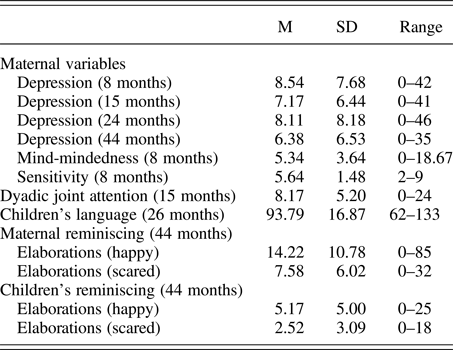
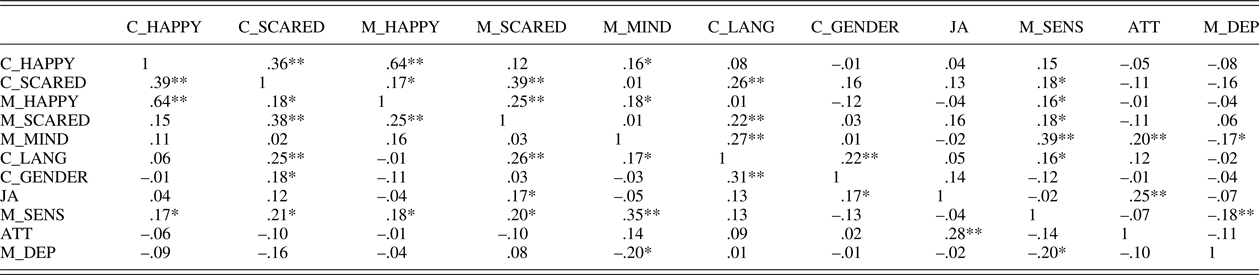
Our main aim was to explore the predictors of maternal and child elaborations when reminiscing about a positive (happy) and a negative (scared) event, with a specific focus on maternal depression. In this community sample, we needed to look at the extremes of the distribution, and to capture patterns of change in depressive symptoms over time, in order to compare depressed to nondepressed mothers. We used full information maximum likelihood because we used raw data with some missingness at Phases 3 and 4. The full information maximum likelihood techniques provide less biased estimates than listwise or pairwise deletion, and are used even when data are not missing at random (Schafer & Graham, Reference Schafer and Graham2002). Schafer and Graham argue that one can achieve adequate performance from likelihood estimates in psychology without necessarily modeling probabilities of missingness, because the consequences from these departures from random missingness tend not to be serious when compared to other research fields; however, admittedly this depends on the sample size, where larger samples are preferred. Yet, in Mplus, we examined proportions of missing data via a covariance “coverage,” and coverage ranged from .95 to 1.00; the minimum coverage is recommended at .10 (Muthén & Muthén, Reference Muthén and Muthén2013). In addition, we examined whether missingness on reminiscing was related to our early measures of attachment, mind-mindedness, and depression, and none were significant predictors of missingness. In preliminary analyses, child gender was significantly associated with three variables: dyadic joint attention, child language, and child reminiscing for the negative event, with girls demonstrating higher levels than boys for these variables. In contrast, SES was not significantly associated with mother–child reminiscing (rs between SES and reminiscing variables ranged from .02 to .14, ns). Thus, in the final model, we did not include SES, but we retained child gender. See Table 1 for descriptive statistics for all variables included in analyses, and Table 2 for bivariate correlations among variables in the final model.
Descriptive statistics for maternal and child variables

Bivariate correlations among variables in final model
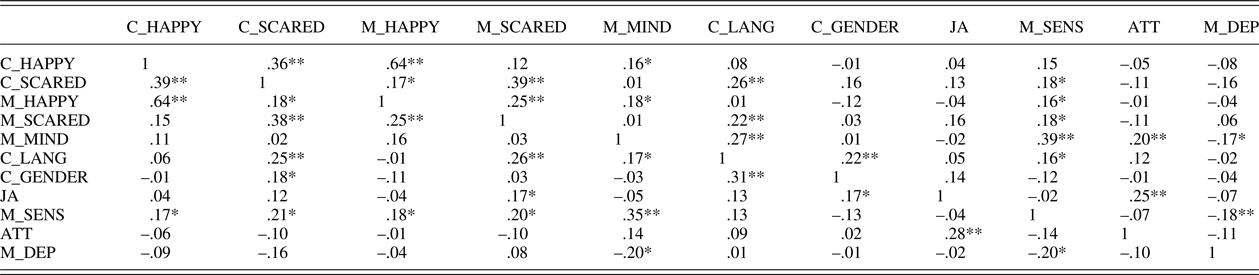
Note: C_Happy = child elaborations about happy event (44 months); C_Scared = child elaborations about scared event (44 months); M_Happy = mother elaborations about happy event (44 months); M_Scared = mother elaborations about scared event (44 months); M_Mind = maternal mind-mindedness (8 months); C_Lang = children's language (26 months); C_Gender = child gender, 0 = male and 1 = female; JA = joint attention with mother (15 months); M_Sens = maternal sensitivity (8 months); Att = attachment security with mother (15 months), 0 = insecurely attached and 1 = securely attached; M_Dep= depression status based on latent profile analysis, 0 = nondepressed and 1 = increasing depression; correlations below the diagonal based on n = 140 with complete reminiscing data; correlations above the diagonal based on pairwise deletion with full sample. *p < .05; **p < .01.
Latent profile analysis (LPA)
LPA is a group-based trajectory model, which is based on approaches developed by Nagin (Nagin, Reference Nagin1999, Reference Nagin2005; Nagin & Tremblay, Reference Nagin and Tremblay1999). It is an extension of latent class analysis but accommodates continuous indicators. LPA identifies heterogeneous latent classes by decomposing the covariance matrix to create distinct subgroups that are assumed to be homogenous with regard to change over time: individuals are assumed to follow a particular trajectory together that indicates a shared psychopathological longitudinal trajectory for a subgroup of individuals (Bauer & Curran, Reference Bauer and Curran2004). In this study, we were interested in tracing the trajectories of mothers based on maternal depression levels reported from the time their children were 8 to 44 months. In this community sample, we expected to find groups of mothers who reported low levels of maternal depression across time, relatively high levels across time, and possibly decreasing or increasing levels. At the start of the study, mothers’ scores on the BDI were distributed into the following categories: 166 (82%) minimal depression, 24 (12%) mild depression, 4 (2%) moderate depression, and 7 (4%) severe depression.
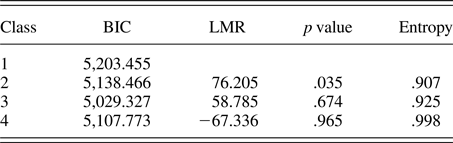
To identify the number of groups or classes deemed to have separate trajectories, we specified models with different numbers of expected classes using Mplus 7.3 (Muthén & Muthén, Reference Muthén and Muthén2013). We then tested the fit and likelihood ratios to guide our selection of the best model. Separate LPA models that differ in the number of classes were specified, which allows for the identification of the optimal number of groups with different trajectories (e.g., high, low, decreasing, and increasing). We used the Bayesian information criterion (BIC), the Lo–Mendel–Rubin (LMR) statistic, and the entropy value as statistical criteria for model comparisons (Nylund, Asparouhov, & Muthén, Reference Nylund, Asparouhov and Muthén2007). The model with lower BIC is preferred. The LMR statistic tests k – 1 classes against k classes, and a nonsignificant chi-square value (p > .05) suggests that a model with one fewer class is preferred (Lo, Mendell, & Rubin, Reference Lo, Mendell and Rubin2001).
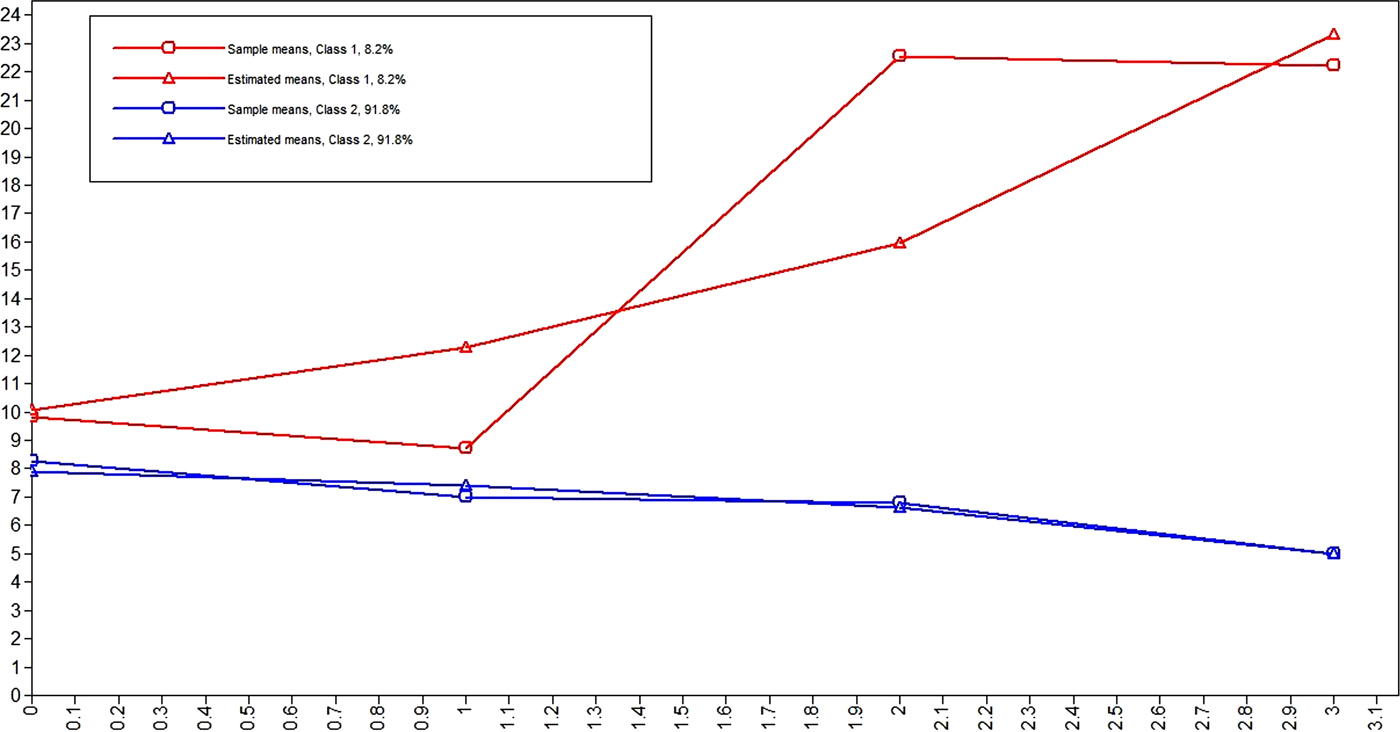
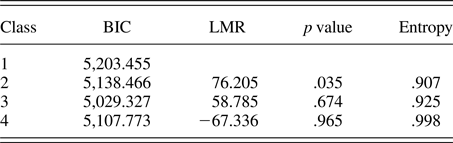
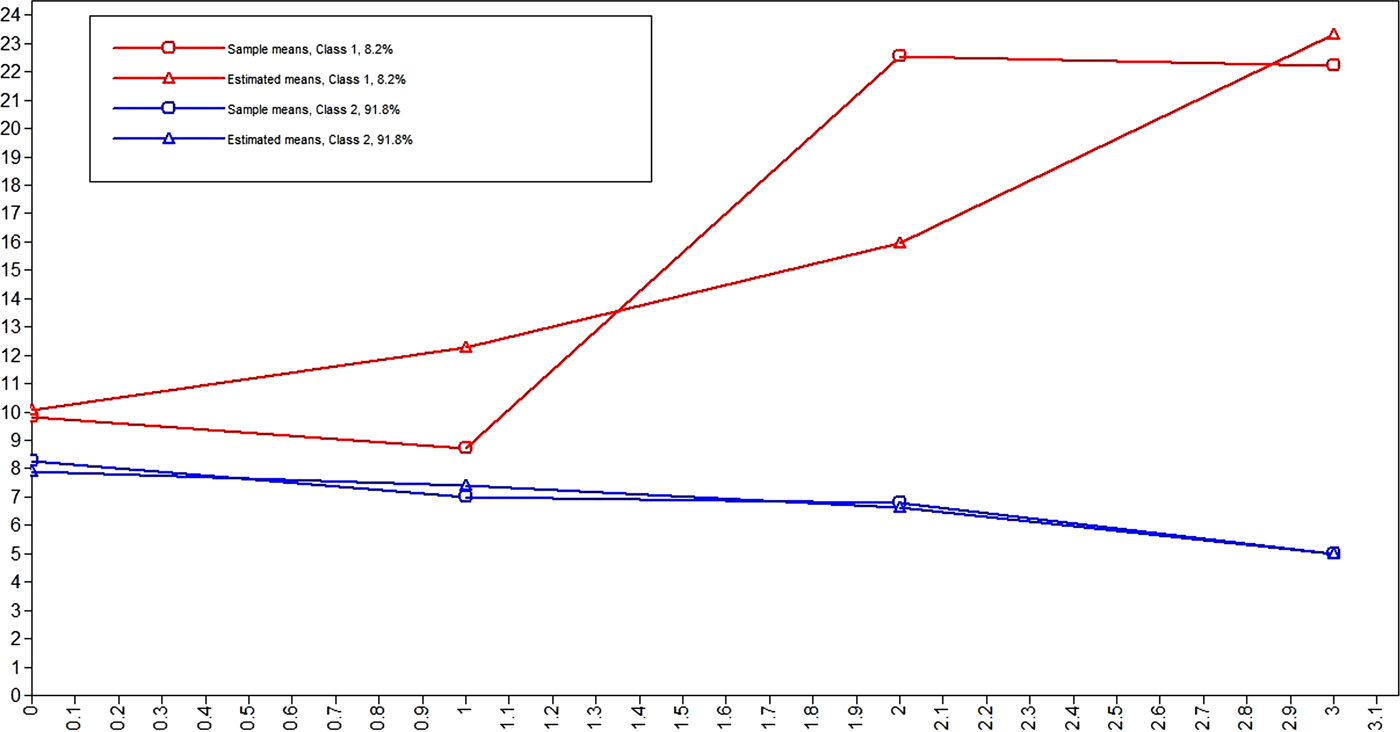
We estimated four separate LPA models to compare from one to four classes of trajectories. Each model specified how many classes to extract: one through four. The models were bootstrapped at 100 initial stage random starts and 20 final stage optimizations. Vuong–Lo–Mendell–Rubin likelihood ratio for two versus three indicated that two classes could not be rejected as being favored over three classes: –2,513.927. –2LLΔ = 62.462, df = 3, p = .6616; LMR = 58.785, p = .6744. However, the Vuong–Lo–Mendell–Rubin likelihood ratio for one versus two classes indicated two classes was favored: –2,585.744. –2LLΔ = 80.973, df = 3, p = .0288; LMR = 76.205, p = .0349. As shown in Table 3, the BIC statistic decreased from testing one-class models to three-class models, and the LMR statistic fell below significance for the three-class model, again along with Vuong–Lo–Mendell–Rubin likelihood ratio, suggesting the model with only two classes (i.e., low and increasing) was preferred. Thus, the two-class model fit the data better than the one-class, homogenous-sample model where no distinct classes exist. Although the three-class model had a lower BIC and better entropy than the two-class model, these improvements in fit were not significant, as indicated by a nonsignificant LMR. The LMR also suggests that the three-class solution is not a significant improvement over the two-class solution. Thus, the two-class model was retained as the entropy indicated good cohesion within classes/profiles and good separation among classes/profiles. The average probability scores for the two identified groups were .91 and .99, respectively, with an entropy value of .91. The classes were well separated (heterogeneous) from each other, yet homogenous within their grouping. The two classes identified are shown in Figure 1. One group typified mothers who were stably low on depressive symptoms (91.8%) and the other typified mothers who were increasing in depressive symptoms over time (8.2%). For this latter group, mothers’ scores on the BDI were in the “moderate depression” range by Phases 3 and 4 of the study.
Latent profile analysis of maternal depression over time (8 to 44 months).
Results of latent profile analysis of maternal depression across infant ages of 8, 15, 24, and 44 months with Bayesian information criteria (BIC) and the Lo–Mendel–Rubin (LMR) likelihood ratio test as main criteria for selection of the number of latent classes to retain
We tested the validity of the classes extracted and retained. A fully saturated model (χ2 = 0.00, df = 0, p = .00, comparative fit index = 1.00, Tucker–Lewis index = 1.00, root mean square error of approximation = 0.00) with no latent variables estimated, only observed variables, was tested using binary regression in Mplus 7.3. We present unstandardized estimates, standard errors (SEs), and 95% confidence intervals (CIs) as indicators of the size of the effect. As expected, the maternal depression classes identified (low vs. increasing) differed on maternal sensitivity, estimate = –1.07, SE = 0.40, p = .008, 95% CI [–1.86, –0.28], and mind-mindedness, estimate = –2.20, SE = 0.99, p = .027, 95% CI [–4.15, –0.25], with the increasing group showing less sensitivity and fewer appropriate mind-related comments when infants were 8 months old than the low group. However, they did not differ significantly on children's attachment security at 15 months, estimate = –0.23, SE = 0.12, p = .07, 95% CI [–0.47, 0.02], although the association was in the direction of insecure attachment for children whose mothers were in the increasing depression group. This pattern suggests the classes identified are valid subgroups that show meaningful differences in the quality of mother–infant interaction, despite the overall low levels of depression in this sample.
To test reminiscing by depressive grouping, we conducted two regressions. In the first, we included only the depression classes (but controlling for child gender). Thus, we regressed the four reminiscing variables (maternal elaborations and child elaborations for scared and happy events) onto the depressive classes, controlling for gender. The total R 2 values for the happy event were .04 (SE = 0.03, p = .23) for children's elaborations and .05 (SE = 0.04, p = .16) for mothers’ elaborations. The total R 2 values for the scared event were .11 (SE = 0.05, p < .05) for children's elaborations and .09 (SE = 0.05, p = .06) for mothers’ elaborations. We found that the group with increasing maternal depression was associated with fewer child elaborations for scared events at 44 months, estimate = –1.86, SE = 0.94, p = .047, 95% CI [–3.70, –0.03]. No other significant effects were found.
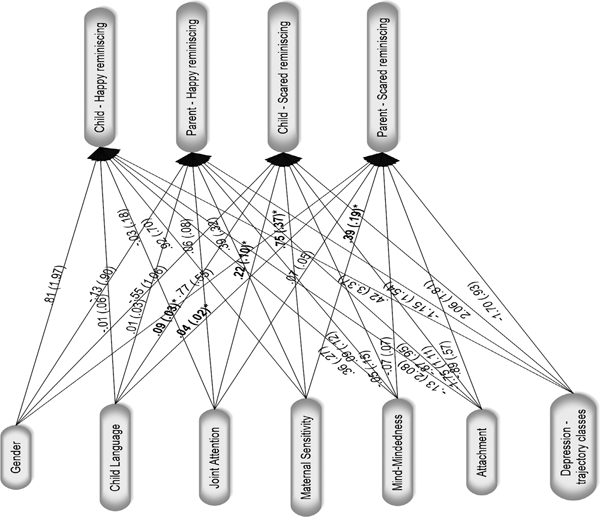
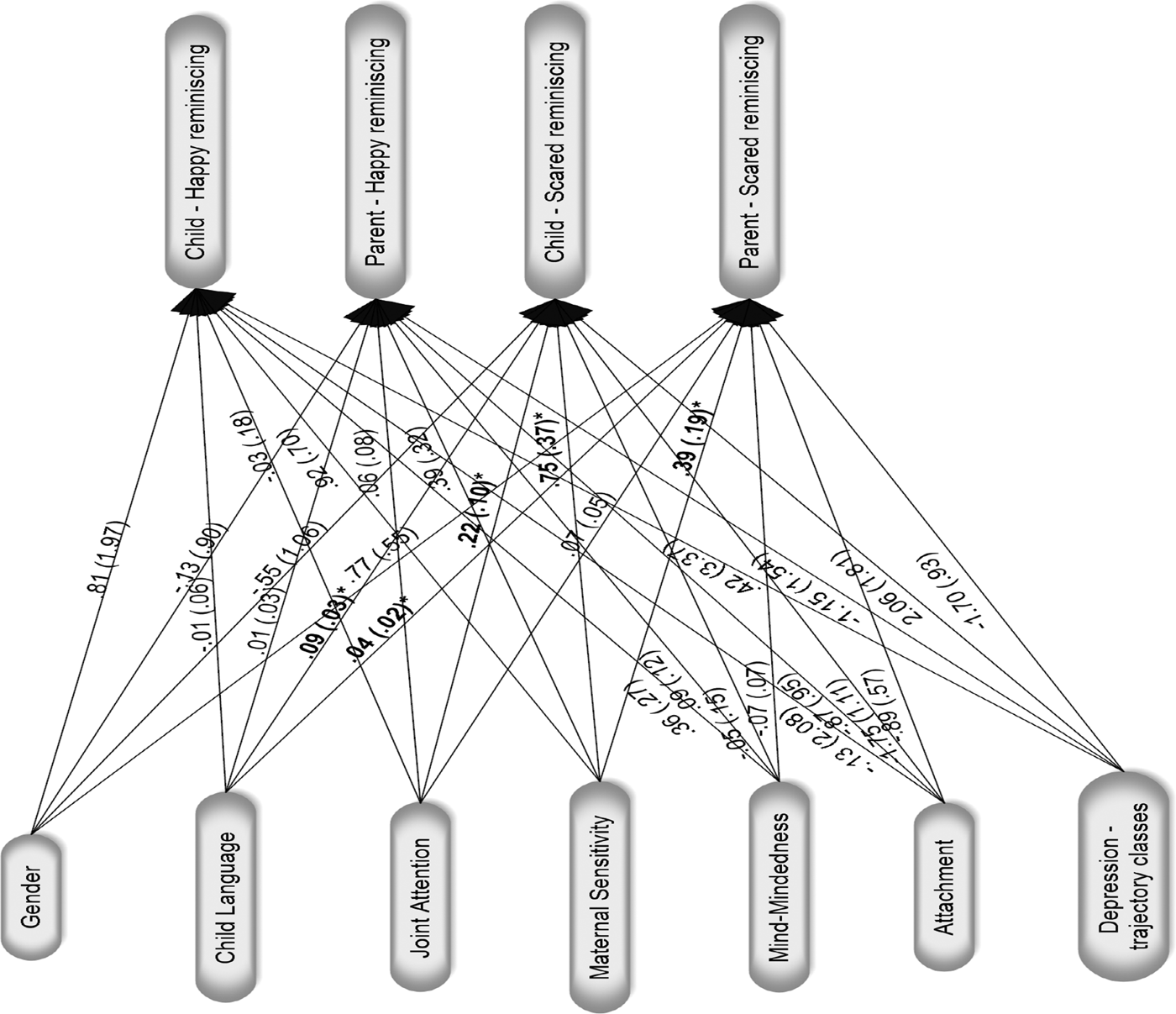
In the second regression, we tested whether the depression classes would still be significant predictors of reminiscing when included in the same model as the other hypothesized predictor variables: maternal sensitivity, mind-mindedness, joint attention, attachment security, and language. We regressed the four reminiscing measures onto child gender, child language, the dichotomous depression group variable, maternal sensitivity, mind-mindedness, attachment, and joint attention. Figure 2 shows the results of this final model including all measures. The total R 2 values for the happy event were .04 (SE = 0.03, p = .20) for children's elaborations and .05 (SE = 0.04, p = .16) for mothers’ elaborations. The total R 2 values for the scared event were .16 (SE = 0.06, p < .01) for children's elaborations and .15 (SE = 0.06, p < .01) for mothers’ elaborations. The depression classes were no longer significant predictors. Instead, as expected, children's language significantly predicted child and maternal elaborations, specifically for scared events, estimate = 0.04, SE = 0.02, p = .035, 95% CI [0.00, 0.07]; estimate = 0.09, SE = 0.03, p = .010, 95% CI [0.02, 0.15], respectively. Child elaborations for scared events were additionally predicted by joint attention, estimate = 0.22, SE = 0.10, p = .028, 95% CI [0.02, 0.42], and maternal sensitivity, estimate = 0.46, SE = 0.19, p = .012, 95% CI [0.10, 0.83]. Maternal sensitivity also predicted maternal elaborations for scared events, estimate = 0.90, SE = 0.36, p = .013, 95% CI [0.19, 1.61]. Maternal sensitivity thus predicted greater mother–child elaboration for scared events, and this effect remained when including other mother–child relationship variables, child variables, and depressive class trajectories.
Results of full model predicting mother–child reminiscing.
Discussion
In exploring the origins of mother–child reminiscing, our main finding was that maternal sensitivity in infancy was the strongest maternal predictor of mother–child elaborative reminiscing about a negative past event (feeling scared) at age 3.5. Mothers who showed more sensitivity during play interactions with their 8-month-old infants were later more elaborative when reminiscing about a fear event with their preschoolers, and their children were also more elaborative about feeling scared. Maternal depression in turn was related to maternal sensitivity and mind-mindedness, such that depressed mothers were less sensitive and used fewer appropriate mind-related comments about their children in infancy. Although mothers’ increasing depression also predicted lower child elaborations about a past fear event in the initial model, this link became nonsignificant in the full model. In contrast, the link between maternal sensitivity and mother–child reminiscing about a fear event held even after controlling for children's language, which also predicted greater mother–child elaborations, in line with prior research (e.g., Farrant & Reese, Reference Farrant and Reese2000). Children's joint attention bids with mothers in infancy predicted child elaborations about a fear event.
These findings highlight the potentially unique importance of early maternal sensitivity in shaping mother–child reminiscing, particularly when discussing shared negative past events such as fear. There were no significant mother or child predictors of mother–child reminiscing about a happy event, in line with other research showing no differences between typical and atypical samples when discussing positive events (e.g., Suveg et al., Reference Suveg, Sood, Barmish, Tiwari, Hudson and Kendall2008). Instead, the full models explained significant variance for mother–child reminiscing about the negative event of fear. Reminiscing about negative events is critical for children's socioemotional functioning (Laible, Reference Laible2011; Laible et al., Reference Laible, Panfile Murphy and Augustine2013; Salmon & Reese, Reference Salmon and Reese2016), so it is vital to understand its origins in infancy and early childhood. Past research shows that maternal elaborative reminiscing is conceptually and statistically independent of maternal sensitivity. For instance, Cleveland and Reese (Reference Cleveland and Reese2005) found that some mothers elaborated in a controlling way during past event discussions by focusing on their own agenda in the conversation, whereas other mothers elaborated in an autonomy-supportive way by focusing in on children's interests. When mothers in that study elaborated about past events in an autonomy-supportive way, which we argue is more sensitive, their children were more engaged and recalled more in the same conversations and over time.
It is possible that maternal sensitivity is the key to developing an elaborative and autonomy-supportive style of reminiscing, particularly when discussing negative events, and our current results suggest this relation holds notwithstanding maternal depression. To firmly establish the effect of maternal sensitivity for elaborative reminiscing, however, interventions could be aimed at enhancing maternal sensitivity and observing effects on reminiscing in comparison to a control group. Our findings can also inform more direct reminiscing interventions. It is not enough to teach mothers to elaborate on past events; elaborations must be delivered in a sensitive way that follows on children's interests in order to engage children in reminiscing conversations (see Reese & Newcombe, Reference Reese and Newcombe2007; Valentino et al., Reference Valentino, Comas, Nuttall and Thomas2013; van Bergen et al., Reference van Bergen, Salmon, Dadds and Allen2009). At present, however, our recommendations are constrained to community samples experiencing low levels of depression overall. Longitudinal research with samples experiencing clinical levels of depression would further inform the design of interventions with those populations.
Maternal depression was also an important predictor of mother–child reminiscing, but a supplementary one. Maternal sensitivity was instead the unique maternal predictor of later maternal reminiscing style. This finding fits to some degree with the only other reminiscing study to explore maternal depression as a factor. Raikes and Thompson (Reference Raikes and Thompson2006) found that maternal depression when children were 2 years old was not directly linked to mother–child emotion talk during reminiscing when children were 3 years old, but that maternal depression was linked to lower levels of attachment security, and attachment security was in turn the best predictor of dyadic emotional reminiscing. Our study is the first to explore maternal depression in relation to maternal and child elaborations about past emotional events, and to incorporate such a wide range of mother and child variables from the first 2 years of life. Our findings do not support Wareham and Salmon's (Reference Wareham and Salmon2006) hypothesis that depressed mothers would be less elaborative, generally: maternal depression status was not a significant predictor of maternal elaborations about either positive or negative events. However, children of depressed mothers were less elaborative about the negative event, possibly indicating less frequent reminiscing about negative events in the families with depressed mothers. We did not assess frequency of reminiscing, but we suggest that diary methods could be used to assess reminiscing frequency in future research. Wareham and Salmon also predicted that depressed mothers would show more negative affect when reminiscing. In future research, videotapes of mother–child reminiscing interactions about a more diverse range of negative events, including sadness and anger as well as fear, could be coded to assess this possibility. Similar to Lovejoy et al.’s (Reference Lovejoy, Graczyk, O'Hare and Neuman2000) meta-analytic finding, however, the differences in mother–child reminiscing between depressed and nondepressed mothers were less evident for positive behaviors, or in this case, for talk about a happy event.
Although our sample was community based rather than clinical, with low levels of maternal depression overall, the findings have implications for work with atypically developing children and their parents. For instance, mothers of children diagnosed with an anxiety disorder are less likely to lead and encourage conversations about negative events with their children compared to mothers of typically developing children (Suveg et al., Reference Suveg, Zeman, Flannery-Schroeder and Cassano2005). In our research, less sensitive mothers were later less elaborative when discussing scared events with their preschool children, who in turn were also less elaborative about feeling scared. Thus, it is useful to know that maternal sensitivity in early childhood predicts later elaborative conversations about a negative event, even in families in which mothers’ depressive symptoms are increasing.
In contrast to past research (e.g., Fivush & Vasudeva, Reference Fivush and Vasudeva2002; Laible, Reference Laible2004, Reference Laible2011; Newcombe & Reese, Reference Newcombe and Reese2004; Raikes & Thompson, Reference Raikes and Thompson2006), however, we did not find that children's attachment security predicted mother–child reminiscing about positive or negative events. The prior research has used maternal or observer sorts of the Attachment Q-Set (Waters & Deane, Reference Waters and Deane1985). To the best of our knowledge, the present research is the first reminiscing study to use the Strange Situation assessment to measure attachment security. Our measure of attachment security also occurred at a younger age than in previous reminiscing research, which has often used concurrent measures of attachment security (but see Newcombe & Reese, Reference Newcombe and Reese2004). We recommend further reminiscing research with a diverse range of negative events and with a range of measures of attachment security, at younger and older ages, to explore the reasons for these differences. It is also possible that the link between attachment security and reminiscing is bidirectional, such that open and elaborative mother–child reminiscing, especially about negative events, is important in maintaining or even fostering a secure attachment across the preschool years (see Bowlby, Reference Bowlby1988; Bretherton & Munholland, Reference Bretherton, Munholland, Cassidy and Shaver1999, for related ideas). Nor did we find gender differences in mother–child reminiscing in the full model after controlling for children's language skill. Past research has produced mixed results, but in some studies, parents are more elaborative with daughters about sadness and with sons about anger (e.g., Fivush, Reference Fivush1989; Suveg et al., Reference Suveg, Sood, Barmish, Tiwari, Hudson and Kendall2008). We instead focused on the negative emotion of fear. Finally, we did not find any significant associations between SES and mother–child reminiscing, which is in line with previous studies of the development of reminiscing in community samples, for whom SES is a weak correlate of mother–child elaboration (e.g., Reese & Newcombe, Reference Reese and Newcombe2007). We note, however, that Langley, Coffman, and Ornstein (Reference Langley, Coffman and Ornstein2017) found significant differences in mother–child reminiscing when comparing families living below and above the poverty line in the United States.
Another significant predictor of children's elaborative reminiscing about scared events was dyadic joint attention at 15 months. This study is the first to demonstrate a link between joint attention in infancy, prior to the age at which children begin talking about the past, and their later reminiscing. Children were later more elaborative about fear events when they had initiated more bids during play with their mothers at 15 months. Of course, children of sensitive mothers may already have learned by the second year of life that their bids at attention are more likely to be met; however, the role of joint attention at 15 months in children's reminiscing was a unique association, even after controlling for maternal sensitivity at 8 months. Farrant and Reese (Reference Farrant and Reese2000) noted a related phenomenon in mother–child reminiscing at 19 months: mothers were more elaborative in their reminiscing 6 months later when children showed more interest in the conversation, through eye contact and empty conversational turns (e.g., Aaaahhh and Ohhhh). Related research has also noted that mothers are more elaborative in their reminiscing with their children who were rated as having a more sociable temperament (Lewis, Reference Lewis1999) and higher levels of effortful control (Bird et al., Reference Bird, Reese and Tripp2006). However, our finding in the current sample was that infants’ joint attention predicted their own later memory elaborations, but not their mothers’ elaborative reminiscing. It could be that any effects of joint attention on maternal reminiscing happen earlier in development, when mothers are first adjusting to the child as a conversational partner. In the current study, we did not assess reminiscing until 3.5 years, an age at which mothers’ and children's styles are already established (Farrant & Reese, Reference Farrant and Reese2000). It is also worth noting that children's joint attention was measured in the baseline phase of the Strange Situation, which is a context targeted at unsettling children. Therefore, we may have maximized the possibility of finding a link between joint attention in this potentially scary situation and children's later reminiscing about feeling scared.
Children's language ability emerged as a final predictor of both maternal and child reminiscing. This finding is in line with prior research identifying children's language as a correlate, predictor, and outcome of maternal reminiscing style and children's autobiographical memory (Farrant & Reese, Reference Farrant and Reese2000; Haden et al., Reference Haden, Ornstein, Rudek and Cameron2009; Peterson et al., Reference Peterson, Jesso and McCabe1999; Reese & Newcombe, Reference Reese and Newcombe2007; Taumoepeau & Reese, Reference Taumoepeau and Reese2013). Children's ability to talk about the past is dependent on their verbal ability, and children who talk more proficiently encourage mothers to become more elaborative in their reminiscing. In future research, we will explore the role of children's language in their independent autobiographical memory with a researcher. We will also explore the role of early maternal sensitivity and reminiscing for children's later emotion understanding.
Limitations
Our findings are based on a community sample with low overall rates of maternal depression, so these patterns need to be tested with clinical samples prior to engaging in interventions. Moreover, although our sample was socially diverse, it was culturally homogenous, so these findings need to be extended to families from other cultural and ethnic groups. However, our community sample did include a wide range of socioeconomic levels, with around half of the sample being disadvantaged in terms of educational qualifications or employment, so our findings can be applied to European mothers from poorer and wealthier households.
We note that like most other research on parental reminiscing, we focused on the frequency of elaborations rather than proportions, because the sheer number of memory cues that mothers offer, and the sheer amount of memory information that children provide, is important from an autobiographical memory perspective (see Farrant & Reese, Reference Farrant and Reese2000, for a similar argument and for comparable means for mother and child elaborations about happy events with 40-month-old children from a longitudinal community sample). Autobiographical memory research tends not to correct for maternal talkativeness with the use of percentages. A reminiscing conversation containing 3 elaborations out of 5 total utterances (60% elaborative) is not expected to be as helpful for children's autobiographical memory as a reminiscing conversation containing 6 elaborations out of 10 total utterances (also 60% elaborative).
Many of the maternal predictors we included did not significantly predict mother–child reminiscing; the overall proportions of variance accounted for in mother–child reminiscing were low, especially for positive events. It is likely that there are other unmeasured contributors that should be assessed in future research. One possibility is maternal personality; others include mothers’ concurrent sensitivity and mind-mindedness. Finally, the overlap in the timing of our depression measures with those of maternal sensitivity and mind-mindedness precluded testing of mediation models. Future research could test maternal depression as an indirect contributor to mother–child reminiscing as mediated by maternal sensitivity, mind-mindedness, and attachment security.
Conclusions
Our main aim was to discover some of the early contributors to mother–child reminiscing about positive and negative events. We established that the earliest and strongest precursor to mothers’ elaborative reminiscing about negative events with preschoolers is the sensitivity of mothers’ interactions when playing with their infants. This knowledge will help inform interventions with typical samples of mothers experiencing mild to moderate depression to encourage both maternal sensitivity and elaborative reminiscing, and ultimately to foster children's socioemotional development.