Introduction
Species delimitation in lichen-forming fungi has changed recently (Lumbsch & Leavitt Reference Lumbsch and Leavitt2011) with readily available DNA sequence data and the discovery of distinct lineages that were either morphologically indistinguishable or shown to differ in subtle, previously overlooked characters and hence are referred to as cryptic or sometimes semi-cryptic species (e.g. Crespo & Pérez-Ortega Reference Crespo and Pérez-Ortega2009; Vondrak et al. Reference Vondrak, Riha, Arup and Søchting2009; Crespo & Lumbsch Reference Crespo and Lumbsch2010; Otálora et al. Reference Otálora, Martínez, Aragón and Molina2010; Hodkinson & Lendemer Reference Hodkinson and Lendemer2011; Leavitt et al. Reference Leavitt, Fankhauser, Leavitt, Porter, Johnson and St. Clair2011, Reference Leavitt, Esslinger, Divakar and Lumbsch2012, Reference Leavitt, Fernández-Mendoza, Sohrabi, Lumbsch and St. Clair2013; Lumbsch & Leavitt Reference Lumbsch and Leavitt2011; Molina et al. Reference Molina, Del-Prado, Kumar Divakar, Sanchez-Mata and Crespo2011; Nuñez-Zapata et al. Reference Nuñez-Zapata, Divakar, Del-Prado, Cubas, Hawksworth and Crespo2011; Parnmen et al. Reference Parnmen, Rangsiruji, Mongkolsuk, Boonpragob, Nutakki and Lumbsch2012; Wirtz et al. Reference Wirtz, Printzen and Lumbsch2012). Environmental factors have been shown to influence phenotypic characters in various groups of lichens (Culberson et al. Reference Culberson, Culberson and Johnson1983; Fernandez-Mendoza et al. Reference Fernandez-Mendoza, Domaschke, Garcia, Jordan, Martin and Printzen2011; Pérez-Ortega et al. Reference Pérez-Ortega, Fernández-Mendoza, Raggio, Vivas, Ascaso, Sancho, Printzen and De Los Ríos2012). Also, a remarkable amount of morphological disparity within clades of lichenized fungi has been shown (Wedin & Döring Reference Wedin and Döring1999; Blanco et al. Reference Blanco, Crespo, Elix, Hawksworth and Lumbsch2004; Högnabba Reference Högnabba2006; Tehler & Irestedt Reference Tehler and Irestedt2007; Lumbsch et al. Reference Lumbsch, Parnmen, Rangsiruji and Elix2010; Parnmen et al. Reference Parnmen, Rangsiruji, Mongkolsuk, Boonpragob, Elix and Lumbsch2010). This suggests that morphological characters have limited taxonomic value, at least in some groups of lichenized fungi. However, there are also cases in which similar species that were only recently distinguished based on morphological characters, which were previously interpreted as intraspecific variation, have been confirmed by molecular data. Examples include Cladia moniliformis Kantvilas & Elix as distinct from C. aggregata (Sw.) Nyl. (Parnmen et al. Reference Parnmen, Rangsiruji, Mongkolsuk, Boonpragob, Nutakki and Lumbsch2012, Reference Parnmen, Leavitt, Rangsiruji and Lumbsch2013), Punctelia jeckeri (Roum.) Kalb as being distinct from P. subrudecta (Nyl.) Krog (Crespo et al. Reference Crespo, Divakar, Arguello, Gasca and Hawksworth2004, Reference Crespo, Kauff, Divakar, del Prado, Pérez-Ortega, Amo de Paz, Ferencova, Blanco, Roca-Valiente and Núñez-Zapata2010; Lendemer & Hodkinson Reference Lendemer and Hodkinson2010) or Usnea lambii (Imshaug) Wirtz & Lumbsch and U. sphacelata R. Br. (Wirtz et al. Reference Wirtz, Printzen and Lumbsch2008, Reference Wirtz, Printzen and Lumbsch2012; Lumbsch & Wirtz Reference Lumbsch and Wirtz2011).
Here we focus on the interpretation of morphotypes within Ramalina celastri (Spreng.) Krog & Swinscow, which is a pan-subtropical lichen species with flattened yellow-green strap-like branches and numerous laminal and marginal apothecia. It is found in Australia (Stevens Reference Stevens1987), New Zealand (Blanchon et al. Reference Blanchon, Braggins and Stewart1996), Africa (Krog & Swinscow Reference Krog and Swinscow1976), India (Pant & Awasthi Reference Pant and Awasthi2003) and South America (Kashiwadani & Kalb Reference Kashiwadani and Kalb1993). Stevens (Reference Stevens1987) and Blanchon et al. (Reference Blanchon, Braggins and Stewart1996) also recognized a subspecies, R. celastri subsp. ovalis (J. D. Hook. & Taylor) N. Stevens, for Australasia, although later treatments of the New Zealand species (Bannister & Blanchon Reference Bannister and Blanchon2003; Bannister et al. Reference Bannister, Bannister and Blanchon2004; Galloway Reference Galloway2007) did not recognize the subspecies for New Zealand. Ramalina celastri s. str. appears to be a very variable taxon, with Stevens (Reference Stevens1987) reporting two morphotypes for Australia and Blanchon et al. (Reference Blanchon, Braggins and Stewart1996) noting a wide range of thallus forms, particularly an inland, fine, narrow thallus form and a coastal rock form with robust and broad thalli. In New Zealand, the species is widespread and common on a range of native and introduced trees and shrubs in urban, rural and natural areas. This paper addresses two objectives: 1) to compare morphological variation, substratum preference and molecular data for a range of specimens of Ramalina celastri collected from selected areas of New Zealand; and 2) to evaluate the taxonomic status of Ramalina ovalis J. D. Hook. & Taylor in Australasia.
Materials and Methods
Taxon sampling
A total of 105 specimens from the Ramalina celastri complex were collected from sites in the North and South Islands of New Zealand, including a range of land use types (urban, agricultural, native forest, coastal) and substrata (native and introduced trees and shrubs, and rocks). A specimen from Victoria, Australia was included in this study and samples of R. inflexa and R. glaucescens were collected from New Zealand as outgroups. Voucher specimens are deposited in the herbarium, Unitec Institute of Technology (UNITEC).
Chemical examination
Standard methods were used for thin-layer chromatography (TLC) using the solvent system A and C (Culberson & Ammann Reference Culberson and Ammann1979).
DNA extraction and PCR amplification
DNA was extracted from medullary hyphae from whole thalli of recently collected specimens (less than one year old). Hyphae were dissected from washed thalli, soaked in acetone, dried and DNA was extracted using a Qiagen DNeasy Plant Mini Kit, following the manufacturer's instructions. Two loci were amplified: nuclear ITS rDNA using primer pairs ITS1F (Gardes & Bruns Reference Gardes and Bruns1993) and ITS4 (White et al. Reference White, Bruns, Lee, Taylor, Innis, Gelfand, Sninsky and White1990), and a fragment of the 3′-end of the nuclear IGS rDNA using primer pairs IGSf and IGSr (Wirtz et al. Reference Wirtz, Printzen and Lumbsch2008). PCR was carried out in an Eppendorf Mastercycler Personal. The amplification programs were: initial denaturation for 2 min at 95°C, followed by 30 cycles of 30 s at 95°C, 30 s at 48°C, 1 min at 72°C; with a final elongation of 10 min at 72°C for both ITS and IGS. PCR products were purified using the Qiagen MinElute PCR purification kit. Sequencing was performed by the Massey Genome Service (Massey University, Palmerston North, New Zealand) using an Applied Biosystems model 3730 automated capillary DNA sequencer, using the same primers as for PCR.
Sequence editing and alignment
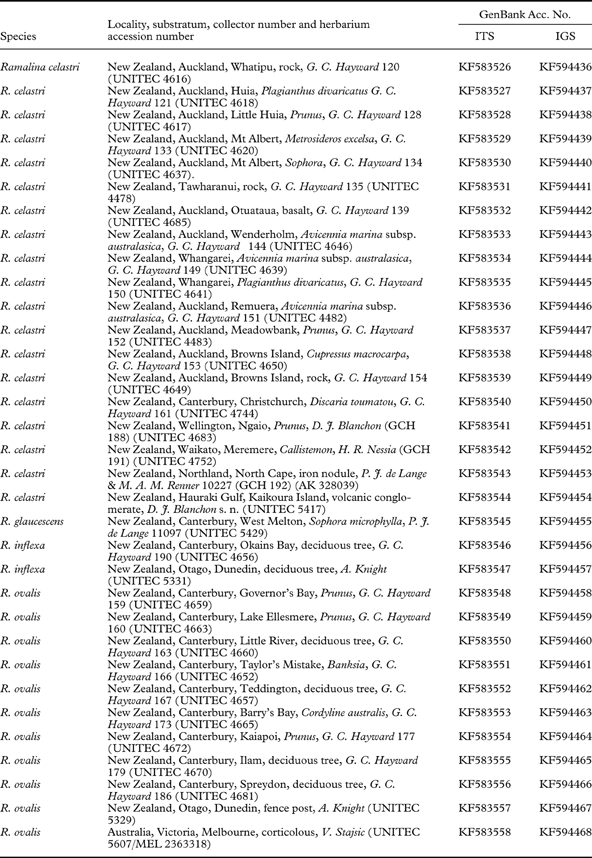
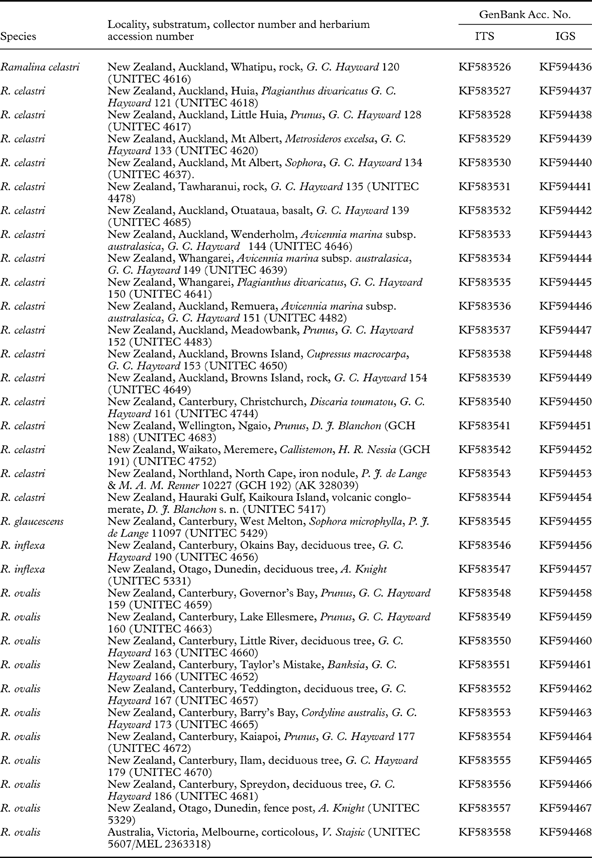
Sequences were assembled, edited and aligned using Geneious Pro 5.5.6 (Drummond et al. Reference Drummond, Ashton, Buxton, Cheung, Cooper, Heled, Kearse, Moir, Stones-Havas and Sturrock2011). Sequences of 33 specimens (Table 1) were aligned separately for the two loci.
Material used in this study. Vouchers, their geographical origin, substratum, herbarium accession numbers and GenBank accession numbers for ITS and IGS sequences are listed.
Phylogenetic analyses
The data sets were analyzed separately and combined using maximum likelihood (ML) and a Bayesian approach. ML analyses were performed using the single-locus and concatenated data sets as implemented in RAxML (Stamatakis Reference Stamatakis2006) with 2000 bootstrap replicates. Tree searches were performed with 1000 replicates, using the GTR+G model. Bayesian tree inference was carried out for the concatenated data set using MrBayes version 3.2.1 (Huelsenbeck & Ronquist Reference Huelsenbeck and Ronquist2001; Ronquist & Huelsenbeck Reference Ronquist and Huelsenbeck2003). Two parallel MCMCMC runs were performed, each using four chains and 5 000 000 generations, sampling trees every 1000th generation. A 50% majority-rule consensus tree was generated from the combined sampled trees of both runs after discarding the first 25% as burn-in. Conflicts were assumed to be significant if two different relationships for the same set of taxa were supported with ML bootstrap values above 75%.
Results
We generated 33 new nuITS rDNA, and 33 nuIGS rDNA sequences for this study (Table 1). The matrix of the nuITS data set had 546 unambiguously aligned nucleotide position characters, while the nuIGS data set had 416 unambiguously aligned nucleotide position characters. A total of 739 positions were constant in the combined data set.
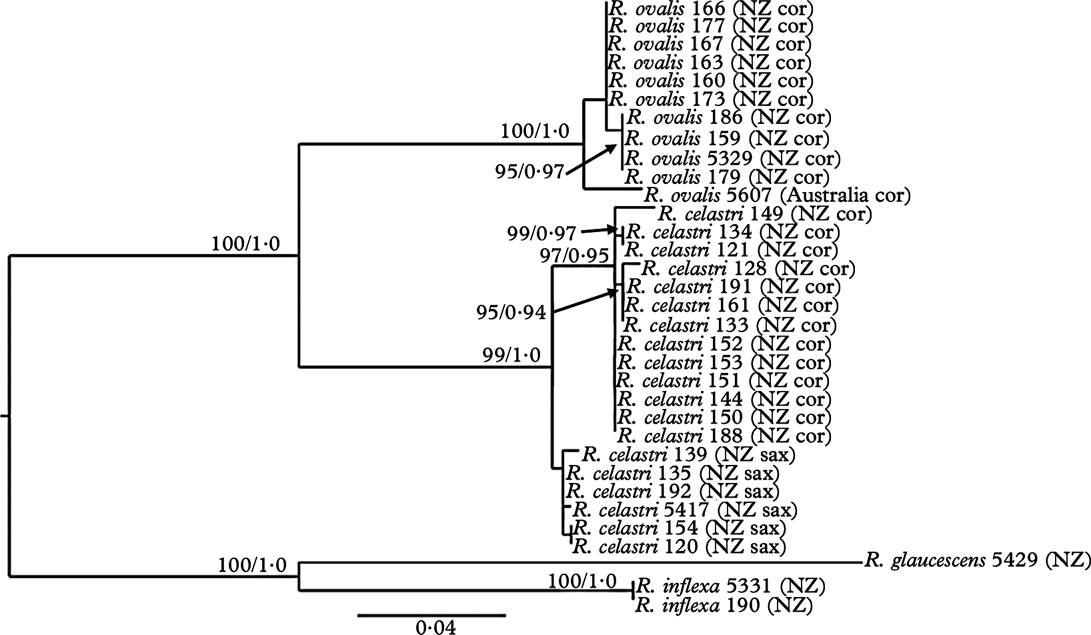
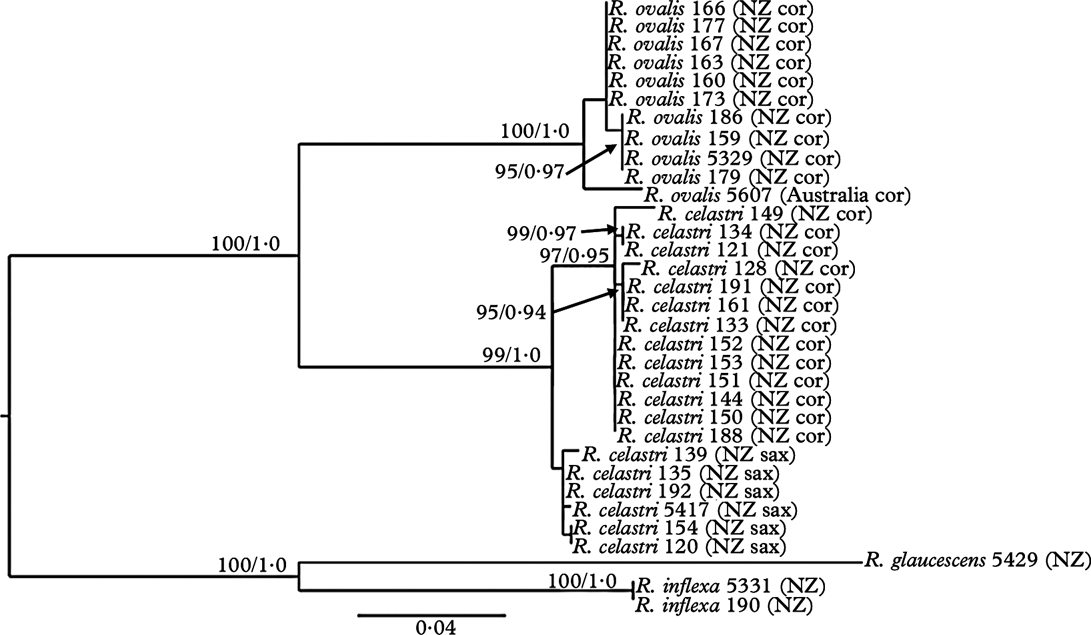
The two single locus ML trees did not show any incongruence and hence combined analyses were performed. The Bayesian and ML trees generated from the combined data set had an identical topology and so only the ML tree is shown here (Fig. 1). The Ramalina celastri samples in the tree form two well-supported clades. One of the clades includes specimens which morphologically fit into the concept of Ramalina celastri subsp. ovalis. The other clade represents Ramalina celastri s. str. These two clades are separated with high bootstrap support (100) and high posterior probability in a Bayesian framework (1·0). The latter clade is further separated into corticolous and saxicolous individuals but this is not well supported in our analysis. Within the corticolous R. celastri subclade there was no apparent correlation with geography or substratum tree species, with samples from seven native and six non-native tree substrata from rural, urban and natural areas interspersed.
Phylogenetic relationships of Ramalina celastri s. lat. samples based on a maximum-likelihood analysis using two ribosomal loci (ITS, IGS). Most likely tree obtained with RAxML; ML-bootstrap support equal or above 70% are indicated first, and posterior probabilities equal or above 0·95 as the second number at branches. The country in which the sample was collected and the substratum (sax=saxicolous, cor=corticolous) are indicated in brackets.
Discussion
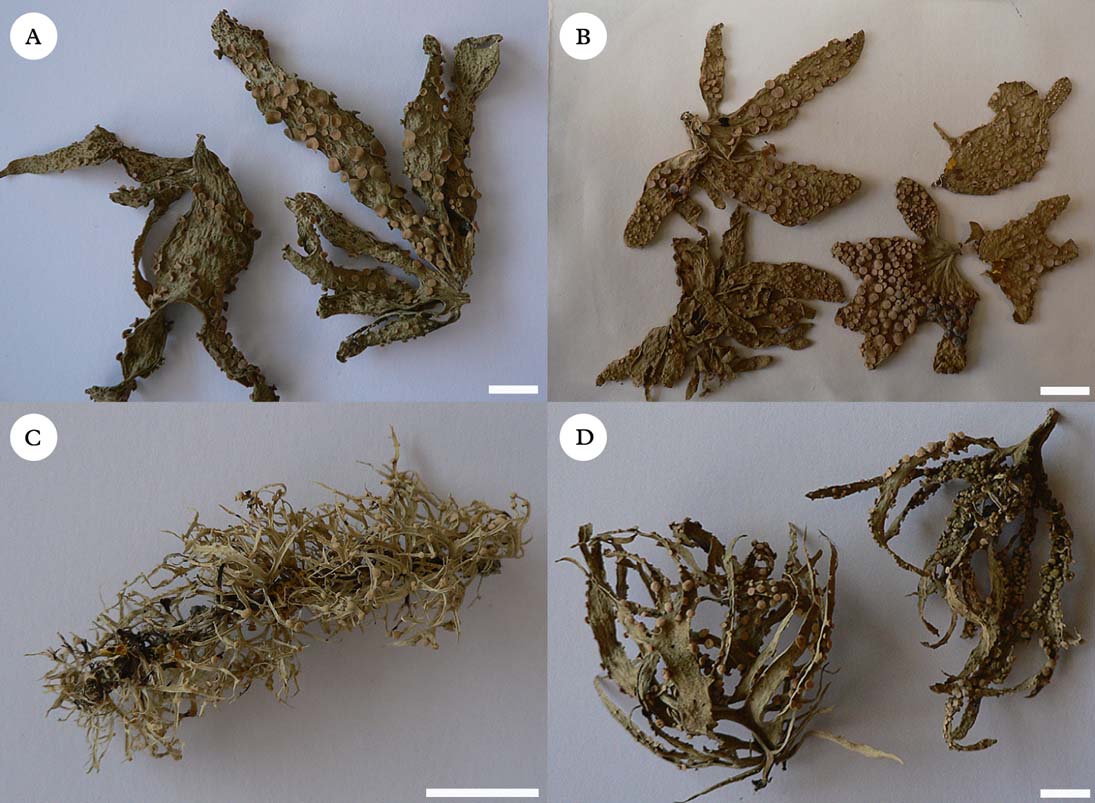
The separation of R. ovalis from R. celastri s. str. is strongly supported by the molecular data in our study. There are also morphological and geographical differences between these two groups, previously reported by Stevens (Reference Stevens1987) and Blanchon et al. (Reference Blanchon, Braggins and Stewart1996). Ramalina ovalis has blunt or rounded apices, laminal apothecia and one or a few broad branches (Fig. 2A & B). In contrast, Ramalina celastri s. str. is morphologically variable, but tends to have narrower branches which are sometimes canaliculate, marginal and laminal apothecia and densely branched thalli (Fig. 2C). In combination, we regard these differences as significant enough to recognize Ramalina ovalis at the species rank.
A & B, Ramalina ovalis, habit; A, New Zealand; G. C. Hayward 185 (UNITEC); B, Australia; J. A. Elix 21335 (MEL). C & D, R. celastri, habit; C, corticolous specimen, New Zealand; G. C. Hayward 121 (UNITEC); D, saxicolous specimen, New Zealand; G. C. Hayward 154 (UNITEC). Scales: A–D=10 mm. In colour online.

Ramalina ovalis appears to be a strictly corticolous species from the drier, cooler parts of southern and south-eastern Australia and south-eastern New Zealand. Stevens (Reference Stevens1987) recorded this species (as R. celastri subsp. ovalis) from East Africa (Uganda and Tanzania) and a specimen from Kenya (AK 310393) examined by us shows the morphology of R. ovalis, as does an image published by Krog & Swinscow (Reference Krog and Swinscow1976; fig. 2, p. 160). Additional studies on fresh material from East Africa are needed to confirm the presence of that species on the African continent, but a disjunction of species between East Africa and Australasia has been reported for other species of Ramalina, including R. exiguella Stirt., R. fimbriata Krog & Swinscow (Stevens Reference Stevens1987) and R. luciae Molho et al. (Bannister & Blanchon Reference Bannister and Blanchon2003), and other groups of lichens (Kantvilas Reference Kantvilas1991). Ramalina celastri s. str. is either corticolous or saxicolous and is more common in warmer, wetter parts of Australia (New South Wales and Queensland) and northern New Zealand.
Saxicolous specimens of Ramalina celastri s. str. were found in the North Island in strictly coastal habitats and differed morphologically from corticolous specimens by being more robust with broader, longer thalli (Fig. 2D). In cross-section, the medulla in saxicolous specimens was thicker. The samples from the two different substrata were not randomly distributed (Fig. 1) and further studies are needed to understand the relationships between populations on different substrata. There are several published examples of lichen species displaying a correlation between molecular differences and substratum preferences. This includes corticolous populations of Parmelia saxatilis (L.) Ach. s. lat. in the Mediterranean that were found to be genetically distinct and accommodated in a separate species, P. serrana, despite displaying only subtle morphological differences (Molina et al. Reference Molina, Crespo, Blanco, Lumbsch and Hawksworth2004). Similarly, molecular data supported the delimitation of Bacidina arnoldiana (saxicolous) and B. sulphurella (corticolous), despite these species being very similar morphologically (Czarnota & Guzow-Krzeminska Reference Czarnota and Guzow-Krzeminska2012). More research is required before assigning any taxonomic significance to our results of the potential of substratum specificity.
Taxonomy
Ramalina ovalis Hook. f. & Taylor
Lond. J. Bot. 3: 655 (1844).—Ramalina calicaris var. ovalis (Hook. f. & Taylor) Church. Bab., Flora Tasmaniae 3: 344 (1860).—Ramalina ecklonii var ovalis (Hook. f. & Taylor) F. Wilson, Pap. Proc. R. Soc. Tasm. 1892: 159 (1893).—Ramalina yemensis var ovalis (Hook. f. & Taylor) Zahlbr., Cat. Lich. Univ. 6: 529 (1930).—Ramalina celastri subsp. ovalis (Hook. f. & Taylor) G. N. Stevens, Bull. Br. Mus. Nat. Hist. (Bot.) 16: 184 (Reference Stevens1987); type: Australia, Gunn s.n. (BM—holotype).
Thallus corticolous, green-grey, erect, 1·0–5·0(–8·5) cm long; branching sparse with usually only one or a few branches making up the whole thallus; branch width 4–25 mm, flat, apices blunt or rounded, small branchlets often occurring at the apices; surface matt, occasionally having longitudinal ridges; pseudocyphellae usually present, short linear or labriform; holdfast present. Soredia absent.
Apothecia laminal only, numerous; disc 0·4–2·5 mm diam., plane to convex; margin entire. Ascospores ellipsoid, mostly curved, occasionally straight, 10–16(–18)×4–6 µm.
Chemistry
Usnic acid. Medulla K−.
Notes
The type material of R. ovalis from Australia (Van Dieman's Land) has the oval branch form seen in most Australasian specimens. Material that is correctly placed within R. ovalis has blunt or rounded tips, laminal apothecia only, one or a few branches and is corticolous. Coastal, saxicolous specimens of R. celastri from northern New Zealand can be differentiated from R. ovalis by the pointed tips, marginal and laminal apothecia, multiple branches, branching along the entire thallus, and canaliculate branches. Ramalina inflexa can be distinguished from R. ovalis by its dichotomous branching, canaliculate branches and marginal and subterminal spurred apothecia. Ramalina glaucescens often co-occurs with R. ovalis in New Zealand and Australia, but can be distinguished by its chemistry (usually sekikaic and/or divaricatic acids), narrower branches, the presence of side branchlets, and generally marginal and subterminal apothecia (some thalli have some laminal apothecia, but not to the extent seen in specimens of R. ovalis).
Distribution and habitat
Ramalina ovalis is common in the drier areas of the eastern South Island of New Zealand, including inland Canterbury, Otago and Southland, and also occurs, but is less commonly found, in Marlborough, Nelson, Wellington, Palmerston North and New Plymouth (Blanchon et al. Reference Blanchon, Braggins and Stewart1996; Bannister et al. Reference Bannister, Bannister and Blanchon2004). Stevens (Reference Stevens1987) also recorded this species (as R. celastri subsp. ovalis) from southern Australia (New South Wales, Victoria, South Australia, Western Australia and Tasmania) and the higher altitude areas of Africa (Tanzania and Uganda), although Swinscow & Krog (Reference Swinscow and Krog1988) did not recognize the taxon for Africa. This species is corticolous, and grows on a wide range of native and introduced trees and shrubs. The most common substrata in New Zealand are Carmichaelia spp. (broom), Coprosma crassifolia, Crataegus monogyna (hawthorn), Malus x domestica (apple), Prunus x domestica (plum), Salix spp. (willow), and Sophora microphylla (kowhai), and in Australia species of Acacia. In Australia it may be found growing with R. glaucescens and in New Zealand with R. glaucescens and R. inflexa.
Selected additional specimens examined. New Zealand: Otago: Dunedin, Sawyer's Bay, A. Knight (UNITEC). Canterbury: Banks Peninsula, Little Akaloa, G. Hayward 162 (UNITEC); Christchurch, Mona Vale, G. Hayward 178 (UNITEC); Christchurch, Bexley Reserve, G. Hayward 181 (UNITEC).—Australia: South Australia: Mount Lofty Ranges, Springton, J. A. Elix 21335 (MEL). Victoria: Otway Ranges, Yeodene, A. C. Beauglehole (MEL). Tasmania: Stanley, The Nut, J. H. Willis (MEL).
Ramalina celastri (Spreng.) Krog & Swinscow
Norw. J. Bot. 23: 159 (1976).— Parmelia celastri Spreng., Syst. Veget. 4 (2): 328 (1827); type: South Africa, Cape of Good Hope, Eklon (S—holotype; FH—isotype; usnic acid).
Thallus corticolous or saxicolous, pale green to grey-green, occasionally blue-grey, erect or pendulous, 1–12(–30) cm long; branching trichotomous, subdichotomous or irregular, small branches at right angles to the main branch usually present; branch width (1–)3–10 mm, occasionally to 20 mm, branches ranging from narrow and canaliculate with fine apices to broad and flat with blunt or tattered tips; surface matt, smooth to ridged or rugose, thin to coarse and thick, torn or fenestrate in older thalli, sometimes producing small lobules from torn areas; pseudocyphellae common, short and linear or punctiform; holdfast present. Soredia absent.
Apothecia numerous, marginal on narrow branches, marginal and laminal on broader branches; disc 0·3–2·0(–4·0) mm diam., plane to convex; margin narrow, entire, smooth or incised, often occluded with age. Ascospores oval, ellipsoid, straight, 9·5–15·5(–17·5)×4–6 µm.
Chemistry
Usnic acid. Medulla K−.
Notes
The holotype of R. celastri is from South Africa and consists of three small thalli, and these resemble New Zealand material. The isotype from FH is in better condition, and this also closely resembles typical New Zealand specimens.
A wide range of thallus forms can be seen in nature, ranging from the very robust and broad thalli found on coastal rocks, to fine narrow thalli which appear to be almost geniculate and are found at more inland locations and in mangrove swamps. New Zealand material is very similar to the Australian thalli, and both possess the same chemistry, usnic acid and occasionally one or more faint unknowns. A wide range of names has been applied to herbarium material of R. celastri, and these are covered elsewhere (Krog & Swinscow Reference Krog and Swinscow1976; Stevens Reference Stevens1983, Reference Stevens1987; Blanchon et al. Reference Blanchon, Braggins and Stewart1996).
Other species which could be mistaken for R. celastri include R. inflexa, a species which differs from R. celastri by having subterminal or terminal spurred apothecia; R. glaucescens, which can be distinguished from R. celastri by its chemistry and (usually) subterminal or terminal apothecia; and R. exiguella, which can be mistaken for morphotypes of R. celastri, but the former species is truly terete and has subterminal or terminal apothecia.
Distribution and habitat
Ramalina celastri is found throughout New Zealand and its offshore islands, including the Chatham Islands and Stewart Island. This species is gradually replaced by R. ovalis from Canterbury southwards, but can still be found on the coast as far south as Otago and Stewart Island. It is usually the only species of Ramalina present on the west coast of the South Island. Ramalina celastri is pan-subtropical in its distribution, and is found in Australia (Stevens Reference Stevens1987), Africa (Swinscow & Krog Reference Swinscow and Krog1988), India (Pant & Awasthi Reference Pant and Awasthi2003) and South America (Kashiwadani & Kalb Reference Kashiwadani and Kalb1993). It is the most common of the New Zealand Ramalina taxa, and is a very effective colonizer. In New Zealand it is often found on introduced trees such as fruit trees, Salix spp. (willow), Crataegus monogyna (hawthorn), ornamental trees, as well as fence posts. It is also common on Avicennia marina subsp. australasica (mangroves), Metrosideros excelsa (pohutukawa), Sophora microphylla (kowhai), Leptospermum scoparium (manuka), Agathis australis (kauri), Plagianthus divaricatus, and rocks of various types (andesite, argillite, basalt, greywacke, iron nodules and rhyolite). In a number of northern New Zealand sites, R. celastri is found growing with R. pacifica, R. australiensis and R. geniculata (on mangroves), or R. meridionalis (rocky coastal areas). Further south it may be found with R. inflexa or R. glaucescens. In Australia, Stevens (Reference Stevens1987) recorded R. celastri commonly growing on species of Acacia, often in association with R. inflata subsp. inflata, R. inflata subsp. perpusilla and R. reducta.
Additional specimens examined. New Zealand: Northland: Waipu, G. C. Hayward 148 (UNITEC). Auckland: Kaipara Harbour, Mt Rex, D. J. Blanchon & N. W. Blanchon (UNITEC); Kawau Island, Vivian Bay, G. C. Hayward (UNITEC). East Cape: Pokara, Lottin Point, P. J. de Lange 11593 (UNITEC). Wairarapa: Cape Palliser, D. J. Blanchon (UNITEC).—Australia: Queensland: Moreton, Lamington National Park, T. Hand (MEL). New South Wales: 20 mi S of Batemans Bay, G. C. Bratt 1020 (MEL).
The authors would like to thank colleagues for collecting fresh material, notably Dr Allison Knight (Otago collections), Val Stajsic, Hayley Nessia, Dr Peter de Lange and Dr Bruce Hayward. We would like to thank Dr Sittiporn Parnmen, Dr Jessica Hayward, Dr Bevan Weir and Dr Steve Chambers for advice. Technical or field support was supplied by Mary Yan, Odette Rizk, Hayley Nessia, Hohepa Cooper, Dr Bruce Hayward, Cathie and Mike Boyle. Glenys Hayward was supported by the New Zealand Science, Mathematics and Technology Teacher Fellowship Scheme (funded by the New Zealand Government, administered by the Royal Society of New Zealand and hosted by Unitec Institute of Technology). Further funding was provided by the Unitec Institute of Technology Faculty of Social and Health Sciences Research Fund and Professor Peter Lockhart, Massey University. We thank the staff at MEL and AK for access to specimens and herbarium support.