INTRODUCTION
More than anything else, two features have characterized the postreform Chinese economy: social networks (guanxi) and government intervention. Due to cultural factors, as well as uncertainty caused by weak institutions, guanxi ties, which may be seen as a form of social capital, are generally held to be important for firms operating in China. While the economic development since the early 1980s has resulted in privatization, the Chinese government – both central and local – continues to exert considerable influence over companies (Walder, Reference Walder2010). Of course these two characteristics overlap: The literature shows that social ties to government may be crucial for companies both as a means of obtaining information and of getting some form of protection in lieu of legal and other forms of institutional safeguards (Chen, Chen, & Huang, Reference Chen, Chen and Huang2013; Li & Zhang, Reference Li and Zhang2007; Li, Meng, Wang, & Zhou, Reference Li, Meng, Wang and Zhou2008; Wank, Reference Wank2001).
However, the value of political ties cannot be assumed to be historically constant. China is an emerging market where market institutions still are in transition. As the market institutions develop and the Chinese government, at least to some degree or in some respects, loosens its control over business operations, the importance of social ties generally, and political ties specifically, may diminish or at least change (Luo, Huang, & Wang, Reference Luo, Huang and Wang2012). This does not imply, however, that market development in China will result in a market without political interference and subsequently no value in political ties (Chen et al., Reference Chen, Chen and Huang2013). What it does mean is that we must uncover which ties are important in which stages of transition. This article is an attempt to address this question.
By focusing on the different stages of market development across regions in China, the current study investigates whether market development moderates the effect of political ties on firm performance. While the role of political ties on firm performance has been thoroughly investigated in the existing literature, very few studies have explored the contingencies and mechanisms that may help explain when, why, and not least which types of political ties have value. Especially we find the question on the types of political ties to have been ignored in the literature so far. It is common knowledge that the Chinese economy to a large extent is government controlled (Lin, Reference Lin2011), though this control is not necessarily centralized. Not only the central government but also province, prefecture, and district governments were, and to a considerable extent still are, heavily involved in economic activities in China (Walder, Reference Walder1995). At the same time, the central government has sought to retain control particularly over large firms in strategically important industries. However, whether market and economic development primarily reduces central or local government influence is not known. Therefore, there is good reason to distinguish between these levels of political ties.
This article contributes to the existing literature in several ways. First, it suggests that rather than being a uniformly beneficial asset, the value of political ties is to some extent context dependent. While this is not a new point (it has, for instance, been shown that domestic firms are better at profiting from ties than foreign ones [Li, Zhou, & Shao, Reference Li, Zhou and Shao2009]), studies with a direct focus on the differences in market institutional development across China's regions are rare (Li, Poppo, & Zhou, Reference Li, Poppo and Zhou2008). Second, because of the multilayered nature of government in China – with a powerful central authority as well as quite autonomous provincial and local governments – political ties to government are far from being homogenous phenomena. We suggest that company ties to central and local government entities may fulfill different needs and potentially constitute very different resources. Insight, thus, can be achieved by investigating them separately. Overall these contributions inform the market transition debate by illuminating the dynamic and complex mechanisms through which Chinese firms derive benefit from political connections.
THEORETICAL BACKGROUND AND HYPOTHESES
Ties and Market Transition
The literature on the economic effect of guanxi ties and social capital more generally in Chinese business is rich (Chen & Chen, Reference Chen and Chen2004; Davison & Ou, Reference Davison and Ou2008; Gao, Reference Gao2006; Luo & Chen, Reference Luo and Chen1997; Park & Luo, Reference Park and Luo2001; Wang, Reference Wang, Clegg, Wang and Berrell2007). Theoretical accounts of how Chinese markets are structured around networks are well established (Boisot & Child, Reference Boisot and Child1996). Such network structures consist of ties both between individuals and between firms embedded in business groups (Keister, Reference Keister2001, Reference Keister2004, Reference Keister2009; Zeng, Xie, Tam, & Wan, Reference Zeng, Xie, Tam and Wan2009; Zhou, Li, Zhao, & Cai, Reference Zhou, Li, Zhao and Cai2003).
While the results of empirical analyses are somewhat conflicting, some general knowledge of the performance effect of social ties has been established. A recent meta-study based on 53 studies reports that the effect of guanxi on firm performance is positive and significant (Luo et al., Reference Luo, Huang and Wang2012). The study finds that there is a significant and positive effect of both business ties and political ties. The study also finds that type of ownership moderates the effect of political ties with state-owned companies benefitting relatively more from political ties than privately owned companies. In the present context, it is worth noting that the performance benefits of political ties are found to be waning, which may indicate that the development of legal and other institutions reduces the importance of government protection through ties.
Some of the studies included in the meta-study contradict these overall findings. Park and Luo (Reference Park and Luo2001) find that privately owned companies benefit from political ties. Li et al. (Reference Li, Zhou and Shao2009) find that the benefit that foreign companies gain from political ties becomes detrimental beyond a point, while Li et al. (Reference Li, Meng, Wang and Zhou2008) find no effect of ties for foreign companies, suggesting a liability of foreignness in terms of (in)ability to exploit such ties. A study by Fan, Wong, and Zhang (Reference Fan, Wong and Zhang2007), which is not included in the meta-study, finds no positive effects of political connections for newly listed companies. These conflicting results indicate that a range of unresolved issues regarding the mechanisms through which political ties bring benefits to firms still remains. Digging deeper, distinguishing between different types of political ties and analyzing the heterogeneous circumstances in which political ties work or fail, will hopefully contribute to answering some of these questions.
Much of the discussion concerning the value of political ties touches directly on important theoretical questions, which currently frame studies of Chinese markets and their transition (see Fligstein & Zhang, Reference Fligstein and Zhang2010; Keister & Zhang, Reference Keister and Zhang2009 for reviews of the debates). Key among these is whether the Chinese economic institutional structure is on a trajectory toward a more generic Western model (Guthrie, Reference Guthrie1999; Nee, Opper, & Wong, Reference Nee, Opper and Wong2007; Wank, Reference Wank2001). In the present context, this translates into whether guanxi ties are a temporary necessity given the weak institutional frameworks or whether they are so deeply engrained in the Chinese cultural fabric that guanxi will remain important also when formal institutions are developed (Luo et al., Reference Luo, Huang and Wang2012), as well as whether the diversity of Chinese regions and cities makes is difficult to talk of just one Chinese model (Fligstein & Zhang, Reference Fligstein and Zhang2010; Krug & Hendriscke, Reference Krug and Hendriscke2008). We add the question of whether central or local government will be the main government force in later stages of economic development, and we propose that ties to each level of government yield distinct benefits making them valuable under different market conditions.
Guanxi and Social Capital
There is general consensus that guanxi may be seen as a form of social capital (Adler & Kwon, Reference Adler and Kwon2002; Dahles, Reference Dahles, Clegg, Wang and Berrell2007; Luo et al., Reference Luo, Huang and Wang2012; Peng & Luo, Reference Peng and Luo2000). According to social capital theory, companies can reduce uncertainty and transaction costs in market environments with weak institutional frameworks by developing ties to, among others, government (Gamble, Reference Gamble, Clegg, Wang and Berrell2007; Peng & Luo, Reference Peng and Luo2000). We draw on social capital theory to highlight two characteristics of ties to government actors. We also draw on resource dependency theory for additional insight, as there are significant overlaps between these two theories.
Trust and exclusive information. Following mainstream theory on social capital (Adler & Kwon, Reference Adler and Kwon2002; Lin, Reference Lin2001; Moran, Reference Moran2005), social capital essentially denotes a resource based on goodwill (or trust) between individuals. Still following the same theories, this goodwill may lead to gains in information or to influence or mutual solidarity. The gains may benefit an individual or the organization to which an individual belongs. According to the literature, guanxi has traits that narrow this definition of social capital somewhat. Guanxi ties are highly personal; they are not rooted solely in instrumental or opportunistic behavior but have a base and are effective (Chen & Chen, Reference Chen and Chen2004; Luo, Reference Luo2011). The base may be relatives, regional belonging, or shared education or work background. Furthermore, guanxi ties have an effective rooting (Song, Cadsby, & Bram, 2012). They consist of more than information exchange between distant acquaintances. Many social network studies have shown the (information) benefits of having a large and diverse network of people with whom Ego is only weakly connected (Granovetter, Reference Granovetter1985). But studies of Chinese social networks, for example Bian's work on strong ties (Bian, Reference Bian1997), indicate that guanxi ties tend to facilitate more than mere information exchange through networks constituted by weak ties between multiple individuals in heterogeneous social settings. Seemingly guanxi consists of strong dyadic ties underpinned by norms of loyalty and reciprocal exchange of favors, also in a business context (Kriz & Kealing, Reference Kriz and Kealing2010; Li, Yao, Sue-Chan, Xi, 2011; Luo, Reference Luo2011; Rhee & Chai, Reference Rhee and Chai2010). That is to say that social capital resulting from guanxi ties is of a bonding, rather than a bridging, type (Wang, Reference Wang, Clegg, Wang and Berrell2007).
It should be noted that such bonding ties do not rule out information exchange but that such information exchange would tend to be of a privileged or exclusive nature (conveyed as a form of favor) as opposed to ‘bridging tie information’, which is not exclusive. From this we draw that political ties constitute a form of social, guanxi-based, capital, which can facilitate either trust (solidarity, loyalty) or information – or both The information, however, would tend to be exclusive in nature. For firms, trust would help reduce transaction costs or gain key support (financial or otherwise). Information would be a strategic asset.
General hierarchical position or context specific resource dependence. The second point relates to power and resources. Social capital is a resource, at least partially, due to the power or other resources held by the Alter(s) to which Ego has ties (Bourdieu, Reference Bourdieu and Richardson1986). Therefore (and quite evidently), the value of political ties, at least partially, hinges on the power, influence, and other resources that Ego can tap into by having a tie to Alter. Bourdieu's concept of capital comprises both ‘soft’ and ‘hard’ types of power, but he goes on to distinguish between different subcategories of capital (economic, cultural, political, etc.). In this regard, social capital is a unique type of capital as it provides access to other forms of capital. Other forms could be ‘soft’ symbolic forms of capital, for example, reputation, or ‘hard’ capital, such as financial capital. It follows from this that political ties are social capital in that they provide access to political power and various resources controlled by political actors.
It can also be derived from this theory that the value of Ego's political ties may result from them providing access to two different types of power. The first one is where power simply is defined by Alter's overall position in a hierarchy; the second is more context dependent where power is a result of Alter possessing particular resources on which Ego depends, or Alter having leverage over Ego in other ways. This approach constitutes an important overlap between theories of social capital and resource dependence theory. According to resource dependence theory, firms may handle their dependence on a political system by various means, for example, by having ex-politicians serving as board members (Hillman, Withers, & Collins, Reference Hillman, Withers and Collins2009). Based on this approach, Hillman (Reference Hillman2005) finds that ex-politicians on the board can enhance financial performance. Drawing, in turn, on social capital theory, Wang (Reference Wang, Clegg, Wang and Berrell2007) has shown that political ties are a major resource for Chinese companies in markets with high levels of government intervention. Our preliminary conclusion is that the value of a political tie depends on the degree of political involvement and dependence. Later in the article, this notion will be developed further.
Government Ties
To summarize, guanxi ties to government provide gains in information, influence, or solidarity, gains that may provide access to key resources, information of strategic importance, preferential treatment, or similar benefits. As also mentioned above, at least some of the gains derived from government ties are a function of the hierarchical position of the dyadic Alter. Adopting a core-periphery approach to hierarchical power would make central government ties the most valuable. Even if much economic activity is influenced or controlled by local governments (see below), central government remains strongly involved in strategically important sectors and is able to control key companies through, among other things, systems of patronage and personnel rotation, pyramidal business groups, and not least the creation of SASAC (Naughton, Reference Naughton, Brandt and Rawski2008).
Proximity and access to, and possible favors from, key central government officials are under such circumstances key in that they may help secure business dealings with central government-owned firms. Social capital can also be a resource thanks to the information that ties provide (Adler & Kwon, Reference Adler and Kwon2002: 18; 30). In this regard, central government ties may be particularly important. Even companies with some form of tie to, or collaboration with, local government may reap an additional benefit from central government ties in terms of information about potentially important government policies, and close ties may even help firms to influence such policies. Finally, as central government largely controls the banking industry, this would make central government ties beneficial for securing bank loans and other financial support (Shi, Markóczy, & Stan, Reference Shi, Markóczy and Stan2014). In concurrence with the above, Zhang (Reference Zhang2006) finds that the value of political ties varies according to hierarchical nesting; this (and this contrasts with the local corporatism thesis), in turn, correlates with a distribution on a central-to-local continuum: ties to central government are advantageous, while local ties have much less value. Central government ties provide information about, and possibly influence on, high-level political decision making in a society with a high degree of political leverage over economic affairs. Based on this, we can formulate our first hypothesis:
Hypothesis 1a: Firms with central government ties will be associated with higher performance than firms without such ties.
A key finding in several studies of the Chinese economy is that local governments are pivotal in the economy. Nee (Reference Nee1992) writes about interorganizational relationships (in other words, ties) between firms and local governments, and Krug and Hendriscke (Reference Krug and Hendriscke2008) argue that local governments and firms together, integrated through networks (again, ties), exploit assets. Hybrid firms operating under local government control or influence are often efficient and competitive, because they can mitigate institutional voids (Nee, Reference Nee1992). Thus, the close relations between business and local government often result from, or are a response to, institutional voids and uncertainties that make operating purely on market-based rules difficult or expensive (Li et al., Reference Li, Meng, Wang and Zhou2008). Faced with such uncertainties, firms can use local government ties to ensure that property rights and contracts are enforced or, alternatively, to establish informal contracts. Moreover, local government connections may ensure access to key resources such as land, production facilities, and skilled labor. Also, local government-controlled firms are often efficient, because they are not under soft budget control as would normally be expected for government-owned enterprises (Walder, Reference Walder and Milor1993, Reference Walder1995).
Some of the benefits of local government ties may be diminishing as a result of institutional reforms, but it is worth noting that local governments still control key resources, particularly land (Batjargal & Liu, Reference Batjargal and Liu2004). Since the 1988 constitutional amendment, local governments have been acting as holders and sellers of land use rights (Zhang, Reference Zhang2012). This role has been pivotal mainly because economic development in China to a large extent has hinged on urban development (Hsing, Reference Hsing2010). Local governments have substantial incentives to support local businesses as they are important sources of tax revenue, so firms may not necessarily need political ties to obtain support and goodwill. Nevertheless, local political ties may create channels of access and influence, which may be important regardless of institutional development. For example, while developed institutions may improve market-based economic coordination and curb political nepotism, local government connections may still secure fast tracking through bureaucratic and legal procedures and generally serve as risk-mitigating devices in firms’ day-to-day activities (Batjargal & Liu, Reference Batjargal and Liu2004). While the influence of local governments as holders of resources may be waning, local governments may still, for example, facilitate new ventures (Li & Zhang, Reference Li and Zhang2007; Shi et al., Reference Shi, Markóczy and Stan2014).
Several of these theoretical aspects are reflected in a case study by Meyer and Lu (Reference Meyer and Lu2004), who show how a successful Chinese business group enters into ‘land-use-rights-for-dividend’ swaps with local governments that are minority shareholders in companies controlled by the business group. The same study illustrates the close cooperation between subsidiaries and local governments.
These considerations together lead us to hypothesize effects of local government ties similar to those of central government ties:
Hypothesis 1b: Firms with local government ties will be associated with higher performance than firms without such ties.
Market Development and Its Moderating Effects
While we argued above that ties to central and local governments might both be valuable, it is also evident that they may be so for somewhat different reasons. Although the potential benefits of central and local ties overlap to a significant degree, generally, the benefits of central government ties are more linked to gains in information and policy influence. Local ties were to a significant extent theorized to bring gains through access to key resources such as land and through various forms of day-to-day operational support. Thus, while the two types of ties overlap in many ways, there also are many differences. These differences, we argue, manifest themselves in local government ties being more contingent on institutional development, so that the value of local government ties decreases as market institutions develop.
Above we highlighted that political dependence could be rooted in a need for protection due to weakly enforced property rights. At least one side in the continuing debate on the trajectory of China's economic transition (e.g. Nee, Reference Nee1992; Nee et al., Reference Nee, Opper and Wong2007) argues that the degree of market development moderates the effect of political ties, so that the effect of political ties diminishes as market institutions develop. Relatively strong empirical support for this can be found in the literature, for example, the earlier mentioned study by Luo et al. (Reference Luo, Huang and Wang2012). Li et al.'s (2008) findings show that connections to the Communist party are beneficial for company performance especially in regions with relatively high institutional uncertainty. In a slightly different context, which however is highly relevant for our study, Chen (Reference Chen2007) has shown how private firms in initial phases of market transition often adopted a ‘red hat’ strategy, that is, sought to register their private businesses (which tended to be seen as pariahs) as government owned in order to secure protection in the face of uncertain property and other legal rights. That strategy, Chen shows, becomes increasingly irrelevant with institutional development.
Both Nee's theoretical argument and Chen's empirical findings center on local governments. Nee's description of cadre entrepreneurs refers to local government officials (Nee, Reference Nee1992: 14). His argument that hybrid enterprise forms lose importance largely concerns local government involvement in business. Originally, red hat enterprises were largely businesses partly or totally controlled by local government, especially, of course, the many town and village enterprises (Oi, Reference Oi1995). To be sure, local governments are still involved in business activities, and as was mentioned above, they still control key resources such as land. However, with the development of market institutions, the protective effect of ties to local government will probably decrease.
Government protection (in lieu of legal protection) and access to resources – where we expect at least protection to lose importance with market development – hinges on a gain of social capital, which was theoretically categorized above as solidarity. This does not give immediate rise to the assumption that the value of ties to central government is negatively impacted by institutional development. Central government ties, we theorized above, are not as important for obtaining protection if property and other legal rights are inefficiently enforced. Rather, such ties are expected to be valuable for obtaining favors (also linked to solidarity), for example, the possibility of doing business with large state-owned enterprises, and for obtaining strategically important information. Such benefits from ties are expected to be less affected by institutional development. These considerations lead us to the following hypothesis:
Hypothesis 2: The performance effect of political ties to local government will be moderated by market development so that, in those regions where the degree of market development is high, the effect of local government ties is smaller.
Access to resources and influence on political actors provide impetus for distinguishing between central and local government ties in another context. Presumably, economic development and, consequently, higher growth rates or wealth in a particular region would make that region less of a target for central government's economic policies and investment schemes, as the central government's strategic interest in economic development will lead it to turn its focus to other, comparably less developed, regions. On balance, economic development, therefore, will diminish the importance of central government and, in turn, lower the benefits of having ties to central government. Reversely, the central government may initiate development projects in lesser-developed regions. Also, when local markets lack affluent costumers – businesses or individuals – central government ties may provide access to alternative markets through government contracts or access to export markets. The moderating effect here is not due to (market) institutional development but simply economic volume. Local governments, on the other hand, by default do not have this role as national distributors of capital. Therefore, we formulate the following hypothesis:
Hypothesis 3: The performance effect of political ties to central government will be moderated by gross domestic product (GDP) so that in those regions where GDP is comparably high, the effect of central government ties is smaller.
METHOD
Sample
To test the hypotheses, we obtained a sample of 858 firms listed at the stock exchanges in Shanghai and Shenzhen in 2009 (a random selection of 50% of the firms listed on each exchange was made). This sampling strategy is well suited for this study, as firms from all regions in China are listed and can be included in the analysis. Another advantage is the availability of annual reports (required for listed firms), enabling the extraction of data related to political ties. It should be noted that listed firms do not constitute a random sample of Chinese firms. Firms may be listed exactly because of their government relations. However, in the present study, we are primarily interested in the differential value of different types of ties and in how the effect of such ties may be moderated by regional differences in institutional and market factors.
Dependent Variable
Firm performance is measured by a financial indicator: return on assets (ROA). We obtained data for 2010 to better reflect causality for our political tie variables measured in 2009. We obtained this data from the Wind database. ROA is used as a performance indicator in other similar studies (Li et al., Reference Li, Meng, Wang and Zhou2008; Li et al., Reference Li, Zhou and Shao2009). Because ROA is sensitive to industry-specific dynamics as well as historic values, we include industry dummies as well as a lagged value of the dependent variable in the analysis (see below).
Independent Variables
The main independent variable is political ties. Different approaches have been taken to measure ties from Chinese firms’ top management to their political environment. Some studies rely on subjective measures obtained through questionnaire methodologies (Li et al., Reference Li, Meng, Wang and Zhou2008; Peng & Luo, Reference Peng and Luo2000), whereas others focus on the relation formed when a top executive has a work background in a government body (Fan et al., Reference Fan, Wong and Zhang2007). In order to investigate the possible contingent effect of institutional development on political ties, it was necessary to obtain a measure of ties, independent of their cultural and institutional realms. Therefore, we adopted the latter approach focusing on the political connections formed when a firm chief executive officer (CEO) or board chairman has a background in central or local government (see Fan et al., Reference Fan, Wong and Zhang2007; Wang & Qian, Reference Wang and Qian2011 for similar approaches). We obtained data on the work backgrounds of firm CEOs and board chairmen from the biographical information in the sampled firms’ annual reports. According to our definition, a political tie exists when a company CEO or the chairman has previously worked in either central or local government. Data on such ties were generated by coding for central and local government background as two separate variables. We also coded for chairman and CEO, but in our analysis, these two are collapsed into one group to get a comprehensive measure of political ties (we also report secondary results where they are split up).
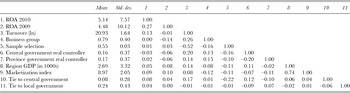
In Hypotheses 2 and 3, the positive effect of political ties is posited to be contingent on the degree of institutional and market development in China's regions. We employ two measures as indicators. To test whether the effect of ties to local government is moderated by the degree of market development (Hypothesis 2), we use the NERI Index for regional market development in China published by the National Economics Research Institute (Fan & Wang, Reference Fan and Wang2010). The index provides comparable annual data about the market development in each of China's regions based on five overall categories further subdivided into 23 individual measures. The data were collected from statistical sources as well as household and business surveys (Fan & Wang, Reference Fan and Wang2010). The five dimensions are government and market relations, development of the nongovernment enterprise sector, development of commodity markets, development of factor markets, and market intermediaries and the legal environment of the market. The index provides a comprehensive and detailed assessment of market development. Because of the large number of indicators, measurement errors, which could be harmful, are likely to be less influential. The index has frequently been used in previous research (Chen, Firth, & Xu, Reference Chen, Firth and Xu2009; Li, Yue, & Zhao, Reference Li, Yue and Zhao2009). To test Hypothesis 3, we use regional GDP per capita as a measure of regional economic development and wealth. GDP is correlated with marketization (see Table 1 below), but not more than a distinction between them is still meaningful. To test the hypothesized conditional effects, interaction terms were constructed by multiplying the measure of regional GDP and the marketization index score with the political connection variables. The variables were mean centered around zero before the interactions were computed (Aiken & West, Reference Aiken and West1991).
Descriptive statistics and correlations

Note: Coefficients ≥ |0.07| significant at p < 0.07.
Control Variables
To isolate the hypothesized effects, a number of control variables were included. To control for firm size, we included turnover (log transformed). Because membership of a business group may be related to performance as well as political ties, we also included a variable indicating membership of such groups coded from the annual reports. We included controls for six industry types: manufacturing, information technology, retail, real estate, financials, and conglomerates. Together, these industries account for more than 80% of the firms in our sample. As stated above, we also included a lagged measure of the dependent variable. This means that we estimated performance in 2010 controlling for the value in 2009. Further, we included variables indicating state ownership and a dummy variable indicating listing on the Shanghai Stock Exchange.
Analysis
Endogeneity may be a point of concern, as unobserved factors may be related to the likelihood of firms having political ties as well as their performance. In particular, there may be a selection problem, as firms are not ‘assigned’ political ties randomly. To account for this, we employ a two-stage model. In the first stage, we use a probit regression to estimate the probability that a given firm has a political tie. From this estimation, we calculate the inverse Mill's ratio, which we include in all the second-stage analyses to account for sample selection bias. Ideally, the first stage should include instrumental variables, which are related to the probability of having a tie but not to firm performance. We suggest the number of board members as a variable with these properties. This is supported by a significant and positive bivariate correlation with government ties (p < 0.05) and no correlation with ROA. Besides number of board members, to improve the fit of our first-stage regression, we include variables indicating firm size, real controller, and geographical location. The following are independent variables in the first-stage regression: board size, number of employees, turnover, real controller, and dummy variables indicating location.
Due to the fact that we have data at the firm level as well as at the regional level, we initially estimated all models as multilevel models. However, for all models, likelihood ratio tests showed that multilevel models were not preferable to ordinary-least-squares (OLS) regressions. As a result, we estimated OLS regression models with robust standard errors. It should be noted that results of multilevel models are substantially similar. Multicollinearity may be a concern. We calculated variance inflation factors and found no values exceeding 3.30 in the models presented. We also inspected condition indices and again found no indications of multicollinearity.
RESULTS
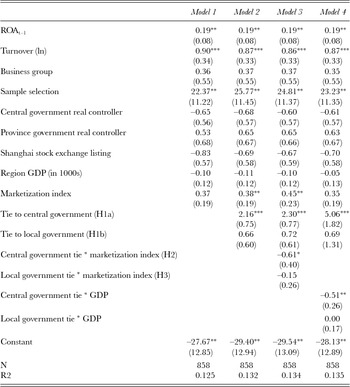
In Table 1, descriptive statistics and correlations are presented. Table 2 presents the results of regression analyses with ROA as the dependent variable. In total, four models are presented. The first model includes only the control variables. Models 2–4 test the three hypotheses by sequentially adding variables of interest. We add the interaction terms in two blocks in Models 3 and 4, as multicollinearity otherwise would become a problem (if all interaction variables were to be included in one model, variance inflation factor values would exceed 10). In Model 2, the relation between political ties and firm performance is scrutinized. This model indicates that ties to central government are related to positive performance outcomes, while no such effect is present for ties to local government. This supports Hypothesis 1a but not 1b (but see Table 3 below).
The relation between political ties and firm performance

Notes: N = 858. Industry dummies included. Likelihood ration tests indicate that models 2–4 represent improvement to model 1 (p < 0.05). ***p < 0.01, **p < 0.05, and *p < 0.1. Two-tailed tests for control variables; one-tailed tests for hypotheses.
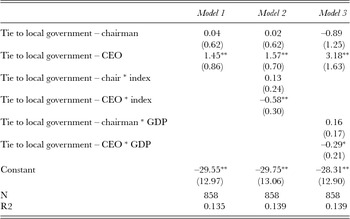
The relation between local government political ties and firm performance

Notes: Robust standard errors in parentheses. Two-sided tests. *p < 0.1, **p < 0.05, and ***p < 0.01. All control variables from Table 2 included.
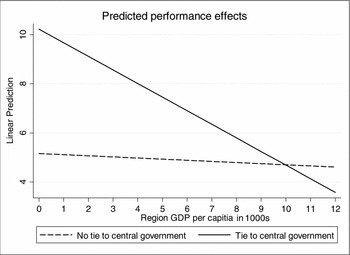
Models 3 and 4 investigate how the positive effect of political ties is contingent on regional factors. We hypothesized that the benefit of ties to different levels of government would be differently moderated by market and economic development, respectively. In Model 3, we investigate how the effect of ties to local and central government is moderated by the degree of marketization measured by the NERI Index. We find no evidence that the effect of local government ties is moderated by market development, thus finding no support for Hypothesis 2 (but see additional analysis below). Hypothesis 3 stipulated that the effect of ties to central government is affected by the wealth of the region. In Model 4, we find that central government ties indeed are negatively affected by regional GDP. The coefficient is negative and significant (p < 0.05). Local government ties are not found to be affected by GDP. This supports Hypothesis 3. To further scrutinize this finding, in Figure 1, we have plotted the marginal effects of a tie to central government over different values of GDP.
Interaction between central government ties and regional GDP

The figure reveals a positive effect of ties to central government for lower values of regional GDP. This effect declines for higher values of GDP.
The results reported above suggest central government ties to be more important than local government ties. To further examine the role of political ties to local government, we carried out additional analyses where we distinguished between having a CEO and a chairman of the board with a background in local government. These results are reported in Table 3. Table 3 shows only the coefficients of interest, but all control variables are included in the models. The three models in Table 3 are similar to models 2–4 in Table 2, the only difference being that ties to local governments are further specified.
Model 1 shows a positive and significant coefficient, suggesting that firms indeed may benefit from local government ties when ties are formed by the CEO. Model 2 shows that this positive effect is negatively moderated by the degree of marketization in the region, as suggested in Hypothesis 2. In Model 3, there is marginal indication that this effect is also moderated by regional GDP. In all models, it is only CEO ties that show significant relations – not ties formed by the chairman of the board. This explains why the aggregate measure used in Table 2 did not show any effect for local government ties. The additional evidence in Table 3 offers moderate support for Hypotheses 1b and 2.
DISCUSSION
We found evidence that political ties constitute a resource for Chinese listed firms. This finding is in line with most other studies of guanxi networks and social capital in China. Results indicated that the direct effect of ties is contingent on the government level to which the tie is related. A positive effect of central government ties was suggested, while no primary effect was found for ties to local government (but see above for results of additional analyses). Hypotheses 2 and 3, concerning the moderating effects of ties, were based on a theoretical distinction between different gains of social capital. We argued that ties to local government mostly created protection in lieu of property rights enforcement and access to key resources, above all land. We argued that ties to central government created access to information and to various financial resources as well as access to markets and business opportunities. According to our theorizing, the benefit of local government ties would decrease with institutional development. This led us to Hypothesis 2. However, we only found weak evidence that the effect of local government ties is moderated by market development. In the theorizing leading to Hypothesis 1b (and, in turn, Hypothesis 2), we also argued that while local government ties may be less valuable in terms of securing property rights and otherwise reducing uncertainty due to institutional voids, they nevertheless may be useful in the day-to-day operations of firms in that such ties, for example, can ensure fast tracking through various bureaucratic processes. Our additional finding, namely, that CEOs benefit from ties to local government, seems to lend credence to that reasoning in that CEOs would be more involved than chairmen in day-to-day operations. Finally, we also theorized that one of central government's roles is to help stimulate economic growth in regions with limited economic volume. This led to Hypothesis 3, which was supported by results showing central government ties to be moderated by regional differences in GDP.
Our finding – that ties to central government can create significant strategic advantages for Chinese firms – runs counter to a body of work (Walder Reference Walder and Milor1993, Reference Walder1995; Wank Reference Wank2001) that has stressed relations with local governments as a pivotal feature of Chinese economic development. Our findings are more in line with the argument that local government ties were of high importance in earlier phases of China's transition, but that institutional development increasingly has rendered such (primarily local) government ties less consequential for, or even detrimental to, performance (Nee, Reference Nee1992; Nee, Opper, & Wong Reference Nee, Opper and Wong2007). The declining importance of local government ties can easily lead to the conclusion that guanxi ties to political actors generally are losing importance for Chinese firms (Luo et al., Reference Luo, Huang and Wang2012). However, our findings show that central government ties remain consequential. Perhaps, more importantly, these central government ties are relatively unaffected by institutional development. Their importance is, we suggest, instead moderated by the degree of central government's strategic interest and involvement in the region, meaning that as long as the Chinese economy remains subject to (central) government control and intervention, (central) government ties will remain important.
Our results underline the importance of distinguishing between different levels of government in studies of political ties. Yet they also hint that further knowledge can be gained by more detailed analysis, for instance, by exploring differences between effects of ties at different managerial levels. Also, it should be noted that our sample consists of relatively large and well-functioning listed firms. Local government ties might be of greater value to smaller firms (Peng & Luo, Reference Peng and Luo2000). Future research should further explore the complexity of how and when firms benefit from such ties.
Limitations and Future Research
The most obvious limitation of our study is that the definition of local government is rather coarse, covering a variety of government levels (province, prefecture, and district). It would be helpful to be able to distinguish between different levels of local government – and, for that matter, also different levels of central government. At present, it cannot be ascertained if the executive has a background at the level of local government on which the firm is the most dependent. However, having a local government background, in any case, may be used to gain access to key stakeholders through referrals and other mechanisms (Li et al., Reference Li, Yao, Sue-Chan and Xi2011). Also, generally, having political ties to departments or bureaus outside the circle of direct influence on the firm may offer clout and leverage when dealing with government officials.
A second limitation is that firms naturally may operate across regions and, thus, not be confined by the region of their headquarters. For local government ties, this points back to the just mentioned limitation. For example, it implies that ties to a local government other than the ‘home’ one would be an important resource if a firm does business in regions other than its home region. However, our data cannot differentiate between home and foreign regional ties and activities. Theoretically, this may create enough noise in the dataset to explain the missing effects of local government ties. If that were true, however, then the same would apply to central government where the degree of firm activity in other regions is unascertainable (which may not be targeted by central government to the same degree as the home region). In that case, this would also create enough noise that at least the moderating effect of GDP on the effect of central government ties would be lost, which is not the case.
Research on political ties of Chinese firms has reached an advanced stage where focus should not only be on the moderating effect of market and economic development but also on differences between various kinds of political ties. This study has taken one step in this direction. However, our study also indicates that the type (level) of manager holding the political ties can be important. This points to one avenue of future research. Another question, which has not really been explored, is whether political ties matter only in terms of firm performance. We believe that future studies should investigate the effects of political ties on firm strategy and managerial actions more broadly (see Jia & Zhang, Reference Jia and Zhang2013), for example, by researching such things as financial leverage and general risk taking, investment and growth strategies (perhaps most importantly in relation to internationalization), and innovation.
CONCLUSION
This article has shown that the moderating effect of economic development on the benefits of political ties varies depending on the type of political tie. The main finding is that ties to central government constitute a significant resource for Chinese firms. The benefit of local government ties, on the other hand, is not evident from this study. Further, the results indicate that firms in less economically developed regions benefit more from central ties, probably because these regions enjoy the attention of central government's development policies.
Many of the theories on the economic transition in China have focused on the role of government. Our findings offer an important contribution by highlighting how the benefits that firms can accrue from political ties are contingent on the level of government to which they are connected. That finding also indicates that China's economic transition, at least so far, cannot be described simply as government's slow retreat from the economy due to institutional development, which diminishes the value of political ties. Such a retreat may well be an important element of China's transition, but the state maintains a large degree of control over (at least sectors of) the economy. As long as that remains the case, ties to central government remain important, especially in those areas where the central government actively promotes growth and development. However, the influence of local government is still a relatively unexplored area awaiting future studies.