Concept Mapping Analysis of Social Skills Camp Experience for Children with Disabilities
Children with disabilities often face difficulties with social adjustment and behavioural issues (Reed, McIntyre, Dusek, & Quintero, Reference Reed, McIntyre, Dusek and Quintero2011). Children with physical disabilities, for instance, have been shown to have difficulty maintaining friendships and tend to be viewed as different by peers without disabilities, which can often result in peer rejection (Briery & Rabian, Reference Briery and Rabian1999; Reed et al., Reference Reed, McIntyre, Dusek and Quintero2011). Children with disabilities can also find themselves more isolated than their non-disabled counterparts, and often experience loneliness (Lindsay & McPherson, Reference Lindsay and McPherson2012; Reed et al., Reference Reed, McIntyre, Dusek and Quintero2011; Vreeman & Carroll, Reference Vreeman and Carroll2007). Bullying is a pervasive problem for children with disabilities. In some situations, children with disabilities are targeted for victimisation or bullying by their peers without disabilities (Nadeau & Tessier, Reference Nadeau and Tessier2006; Son, Parish, & Peterson, Reference Son, Parish and Peterson2012; Wang, Iannotti, & Nansel, Reference Wang, Iannotti and Nansel2009). Children who are neglected and rejected by their peers often face adjustment problems in later life such as academic difficulties, depression, and aggression (Mrug et al., Reference Mrug, Molina, Hoza, Gerdes, Hinshaw, Hechtman and Arnold2012).
Modern society tends to advocate for the inclusion of people with disabilities by providing opportunities for community engagement, as well as other privileges and rights. This is as a result of the inequalities people with disabilities are perceived to face due to social exclusion in society and policy (Popay, Reference Popay2010). For instance, in the United States, the passage of federal laws in the 1980s and 1990s supported inclusive community recreational movements (Miller, Schleien, & Lausier, Reference Miller, Schleien and Lausier2009). Advocates supported the use of a therapeutic recreation (TR) process in community recreation (Carter & LeConey, Reference Carter and LeConey2004; Skulski, Reference Skulski2007) as a form of community engagement for people with disabilities. Furthermore, evidence supports the short-term benefits of TR camps for children with disabilities. Although the origin of these camps can be traced to North America, TR camps have also been conducted in other regions, including Thailand (Santiprabhob et al., Reference Santiprabhob, Likitmaskul, Kiattisakthavee, Weerakulwattana, Chaichanwattanakul, Nakavachara and Nitiyanant2008) and Europe (Bekesi et al., Reference Bekesi, Torok, Kokonyei, Bokretas, Szentes and Telepoczki2011), supporting the universality of camping as a viable therapeutic activity for community engagement for individuals with disabilities.
The basic purpose of TR camps is to enhance the quality of life and wellbeing of individuals through the use of recreational and leisure experiences (Barr et al., Reference Barr, Silva, Wong, Frid, Posgate and Brown2010). The TR process, as defined by Carter and LeConey (Reference Carter and LeConey2004), facilitates comprehensive understanding of the strengths, interests, needs and goals of campers with disabilities. In addition, the authors stress the systematic development of individualised support plans, as well as opportunities to document participant outcomes. Underpinning TR is the idea that children with disabilities should have the same leisure and social experiences of camping as other children as a way of normalising their childhood activities and experiences.
Current debates continue regarding specialised camps (for campers with disabilities only) versus inclusive camps (for campers with and without disabilities) in terms of determining the most efficacious model for children with disabilities (Devine & O’Brien, Reference Devine and O’Brien2007; Devine & Parr, Reference Devine and Parr2008). For instance, although the intention of the inclusive camp model is to promote understanding of disabilities and interaction between peers with disabilities and those without disabilities, evidence has shown that rejection, loneliness, marginalisation, and disempowerment may still be experienced among children with disabilities (Bedini, Reference Bedini2000; Devine, Reference Devine2004; Goodwin & Watkinson, Reference Goodwin and Watkinson2000; Sable & Gravnik, Reference Sable and Gravnik2005). Researchers contend that the failure of inclusive practice, at least within the recreational setting, is largely due to the lack of relatedness (Devine & O’Brien, Reference Devine and O’Brien2007; Devine & Parr, Reference Devine and Parr2008; Hough, Reference Hough2010). By the same token, strong evidence indicates that specialised camps benefit children with disabilities because they facilitate relatedness and offer successful role models to follow. This increases children's comfort level and their engagement in therapeutic camp activities, thus improving their self-esteem, interpersonal skills, independence, mastery, and skill building capacity, as well as other life skills (Devine & Dawson, Reference Devine and Dawson2010; Hough, Reference Hough2010; Moola, Faulkner, White, and Kirsh, Reference Moola, Faulkner, White and Kirsh2013).
Advocates and researchers, including Miller et al. (Reference Miller, Schleien and Lausier2009), have provided best practice guidelines for inclusive recreation for agencies that adopt inclusive service delivery practices. Specifically, Miller et al. provide guidelines for the effective implementation of inclusive recreation that cover participant assessment, accommodation plans, behavioural interventions, adaptation, inclusion support staff, personal care, on-site technical support for general recreation staff, preparation for non-disabled peers, facilitation of peer interaction, and documentation and programme evaluation. In order to facilitate positive interaction among campers with and without disabilities, Devine and Parr (Reference Devine and Parr2008) also note that the social impact of disability must be taken into consideration. Drawing on Allport's contact theory (Reference Allport1954), they identify the quality of the contact (formal vs. informal, opportunities for shared activities and interests that are meaningful and mutual), disability awareness (for peers without disabilities), equal status, and role modelling by camp leaders as imperative elements for positive outcomes (Devine & O’Brien, Reference Devine and O’Brien2007; Devine & Parr, Reference Devine and Parr2008).
For instance, children with and without disabilities should be afforded the chance to explore common social goals or interests, and disability awareness should be raised so that opportunities are provided for peers without disabilities to learn about different disability experiences. When given equal status to children without disabilities, children with disabilities can feel more at ease to share and relate to others. Therefore, inclusive camps can serve as places to encourage positive social interaction, fun and learning (Devine & O’Brien, Reference Devine and O’Brien2007; Devine & Parr, Reference Devine and Parr2008).
Regardless of the type of camp, there seems to be some preliminary evidence to support the effectiveness of both schools of thought. In their systematic review, Moola et al. (Reference Moola, Faulkner, White and Kirsh2013) identified 21 studies of specialised therapeutic camps for children with chronic illnesses. The authors reported that in general, TR experiences tended to have some positive effects on the children with disabilities, including reduced aggression (Barr et al., Reference Barr, Silva, Wong, Frid, Posgate and Brown2010), improved wellbeing, self-perception, and emotional outlook (Bongiovanni, Clark, Garnett, Wojcicki, & Heyman, Reference Bongiovanni, Clark, Garnett, Wojcicki and Heyman2010), improved social and communication skills (Cushner-Weinsteine et al., Reference Cushner-Weinstein, Berl, Salpekar, Johnson, Pearl, Conry and Weinstein2007), increased self-esteem (Devine & Dawson, Reference Devine and Dawson2010; Torok, Kokonyei, Karolyi, Ittzes, & Tomcsanyi, Reference Torok, Kokonyei, Karolyi, Ittzes and Tomcsanyi2006), improved self-management skills (Hunter, Rosnov, Koontz, & Roberts, Reference Hunter, Rosnov, Koontz and Roberts2006), higher peer acceptance (Meltzer & Rourke, Reference Meltzer and Rourke2005), better general physical and mental health functioning (Moons et al., Reference Moons, Barrea, De Wolf, Gewillig, Massin, Mertens and Sluysmans2006), better coping skills (Nicholas, Williams, & MacLusky, Reference Nicholas, Williams and MacLusky2009), higher self-competence (Pulgaron, Salamon, Patterson, & Barakat, Reference Pulgaron, Salamon, Patterson and Barakat2010), better quality of life (Shepanski et al., Reference Shepanski, Hurd, Culton, Markowitz, Mamula and Baldassano2005), and general life satisfaction (Wu, Prout, Roberts, Parikshak, & Amylon, Reference Wu, Prout, Roberts, Parikshak and Amylon2011). A range of other studies on specialised camps have also identified positive impacts for children with disabilities, including greater self-competence (Dawson & Liddicoat, Reference Dawson and Liddicoat2009; Hill & Sibthorp, Reference Hill and Sibthorp2006), independence (Dawson & Liddicoat, Reference Dawson and Liddicoat2009), social competence and sense of belonging (Dawson & Liddicoat, Reference Dawson and Liddicoat2009; Lopata et al., Reference Lopata, Thomeer, Volker, Toomey, Nida, Lee and Rodgers2010), positive parent–child communication skills (Walker, Barry, & Bader, Reference Walker, Barry and Bader2010), care giving appreciation (Dawson & Liddicoat, Reference Dawson and Liddicoat2009), ADHD symptom reduction (Hantson et al., Reference Hantson, Wang, Grizenko-Vida, Ter-Stepanian, Harvey, Joober and Grizenko2012), diminished autism symptoms (Lopata et al. Reference Lopata, Thomeer, Volker, Toomey, Nida, Lee and Rodgers2010), reduction in anxiety (Briery & Rabian, Reference Briery and Rabian1999), and general physical and emotional empowerment, well-being, and satisfaction (Nettina, Donnelly, & Florio, Reference Nettina, Donnelly and Florio2003).
Evidence also exists to support the benefits of inclusive camps. Inclusive camps focus on including children with disabilities in mainstream activities (e.g. hiking, campfires, and sports) alongside their counterparts without disabilities (Kiveal, Reference Kiveal2013; McAvoy, Smith, & Rynders, Reference McAvoy, Smith and Rynders2006; Mishna, Michalski, & Cummings, Reference Mishna, Michalski and Cummings2001; Scholl, McAvoy, Rynders, & Smith, Reference Scholl, McAvoy, Rynders and Smith2003; Walker et al., Reference Walker, Barry and Bader2010). Children with and without disabilities therefore interact in a single camp setting (McAvoy et al., Reference McAvoy, Smith and Rynders2006).
Kiveal (Reference Kiveal2013) conducted a programme evaluation of the Summer Camp Inclusion Programme (SCIP) for children with developmental, cognitive and physical disabilities. Supporting the applicability and practicability of the programme, the authors reported that children with disabilities benefit socially, and to a lesser extent, develop independence and life skills. McAvoy et al. (Reference McAvoy, Smith and Rynders2006) studied an “adventure camp” outdoor experience for 23 people with cognitive disabilities, with each camper accompanied by one “support person” who they were already familiar with. Results from follow-up interviews showed an overall increase in social skills after the camp experience. Similarly, Scholl et al. (Reference Scholl, McAvoy, Rynders and Smith2003) investigated an inclusive camp experience involving children with disabilities and their families. Results from interviews revealed that children reported an increase in the connections between families and better family dynamics.
In an earlier study, Sable (Reference Sable1995) investigated three different camp groups with 66 adolescents between 11 and 16 years of age. The first camp was an inclusive group of campers including children with and without disabilities. The second group (not inclusive) was exposed to a disability awareness programme for the duration of the camp, and the third group (not inclusive) participated in an “adventure programme”. Both the disability awareness programme and adventure programme comprised 15 one-hour workshops administered over the course of the weeklong camp. The authors found that although the physical integration did not change perceived attitudes toward children with disabilities, disability awareness education did significantly improve non-disabled peers’ attitudes toward children with disabilities. This suggests that inclusive camp settings may be helpful in changing attitudes, provided there is an educational component involved in the process (Devine & O’Brien, Reference Devine and O’Brien2007).
Purpose of Study
Given earlier studies indicate that TR camps show some benefits for children with disabilities, the current study sought to examine how campers with disabilities perceive the benefits of such a camp experience. A unique contribution of the present study is its examination of the campers’ own perspectives using a mixed (qualitative/quantitative) methodology. Concept mapping was used to generate and examine the beneficial concepts or themes identified by campers with disabilities at a therapeutic camp setting located in a northeast state in the United States.
The inclusive camp was organised by a non-profit community organisation dedicated to the provision of recreational experiences for students with disabilities and students from economically disadvantaged backgrounds. Their mission was to provide education and training via a recreational camp, thus meeting the definition of TR. The parent organisation provides multiple programmes (some long, some short) that serve, in a given year, over 800 children with disabilities and those that are socially disadvantaged. About 72% of the children and adolescents who attend the organisation's summer programme live at or below the poverty line. Nearly 36% are students of ethnic minorities. The typical gender breakdown for students is 55% male and 45% female. For the camp as a whole, approximately 66% of the campers have some type of disability and about 47% have multiple disabilities. Although camp counsellors were not exclusively trained as inclusive camp counsellors, the leadership team was composed primarily of master's degree level school teachers who have experiences working with students with disabilities. These teachers had also been provided with training by senior staff and senior camp counsellors to deliver the intervention systematically following the guidelines set by the community organisation.
Method
Participants
The present study was reviewed and approved by the Institutional Review Board of the research team's local institution to ensure the study met ethical standards for research with at-risk populations (i.e., children with disabilities). Among the total of 166 campers who participated in this camp at the designated time period, 42 (25%) of them had disabilities. For the current study, only the 42 campers with disabilities participated as the authors intended to investigate the unique experience faced by children with disabilities. Among the campers with disabilities, there were 27 (64%) males and 15 (36%) females who ranged in age from 8 to 16 years (M = 12.25, SD = 2.51). Ethnicity of the sample included the following: 26 (62%) European descent, 5 (12%) African descent, 8 (19%) of multiracial descent, 1 (2%) of Native descent, 1 (2.3%) Hispanic descent, and 1 (2%) listed their ethnicity as “Other”. In terms of disability types, the distribution was as follows: 16 (38.0%) had ADHD, 8 (19.0%) had multiple disabilities, 7 (16.7%) had learning disabilities, 5 (11.9%) had physical disabilities, 2 (4.8%) had a speech impairment, 2 (4.8%) had an intellectual developmental disability, and 2 (4.8%) had bipolar disorder.
Information was also collected about parents’ education levels. The breakdown of fathers’ education level was as follows: 1 (2.3%) completed middle school, 14 (33%) completed high school, 10 (24%) completed college education, and 5 (12%) completed graduate education. In 11 instances, data for fathers’ education was not available. As for mothers’ level of education, the breakdown was as follows: 13 (31%) had completed high school, 16 (38%) completed college education, and 8 (19%) completed graduate education. In 5 instances, mothers’ education data was not available. Given that some children were younger than the others, an effort was made to make the demographic questionnaire age appropriate. In addition, children with reading difficulties or difficulties with comprehension were assisted by their camp counsellors during the data collection phase.
Procedure
This study utilised Trochim's Concept Mapping methodology (Kane & Trochim, Reference Kane and Trochim2007; Trochim, Reference Trochim1989). Concept mapping is an integrated mixed method that begins with generation of qualitative data and concludes with multivariate statistical analysis. The method typically involves six steps: (1) Planning; (2) Generating Statements; (3) Structuring the Statements; (4) Analysis; (5) Interpretation, and (6) Utilisation (Kane & Trochim, Reference Kane and Trochim2007; Trochim, Reference Trochim1989).
In the first step of “planning”, the research team generated a specific prompt in order to obtain detailed data from the children about their perceptions of camp benefits. The prompt generated by the research team, which included the Camp Director and six faculty members, was: “A kid should come to camp because. . .”. This prompt was thought to be easily understood by children and able to produce a diverse list of statements about the benefits of attending the therapeutic camp.
Brainstorming in response to this prompt was conducted on the last day of camp, by teams of two or three researchers with the 42 campers and the counsellors in small groups in their cabin residences. The last day of camp was chosen because participants had just completed the programme and could reflect on the totality of their camp experiences. The brainstorming sessions consisted of campers aged 8 to 11, or 12 to 16. Participants read the prompt on paper and on a large flipchart. A researcher began the brainstorming session by reading the prompt and giving each of the participants an opportunity to verbally generate at least one response. The campers’ verbal responses were restated by the researcher in front of the whole group and then written on the flipchart. In addition, graduate students assisted the researchers by taking notes of the campers’ responses, which resulted in the “generating statements”. The pool of statements was then examined by the research team in order to consolidate it into a list of unique statements about therapeutic camp benefits. This process involved identification of duplicate items and very idiosyncratic items (i.e., items that were meaningful to an individual child, but would not be understood by children in general). This process, known as idea synthesis, continued until 100 unique items had been identified, as recommended by Kane and Trochim (Reference Kane and Trochim2007), who suggest that item sets be limited to 100 because larger item pools become difficult for participants to sort.
Once the pool of 100 items had been edited, “structuring the statements” by sorting and rating could be conducted. Sorting and rating were completed by a second group of campers who attended a subsequent session later in the summer. The sample of campers (n = 42) was asked to categorise the items by sorting the statement cards into piles. They were instructed that there should be at least two piles and no statement could be considered its own pile (i.e., a pile must have at least two index cards in it). The piles were fastened with rubber bands and collected by the researcher team. The sorting step was immediately followed by the rating step. Each child was asked to rate the statements using a 5-point importance rating scale: 1 = Very Unimportant to 5 = Very Important. Participants were instructed to circle the number based on its importance to their camp experience.
Data Analysis
The following steps involved “analysis”, “interpretation”, and “utilisation” of the data. The sorting and rating data were entered into The Concept System software (version 4.0.175, http://www.conceptsystems.com) for analyses. The sorted statements were analysed using Multidimensional Scaling (MDS) and Hierarchical Cluster Analysis (HCA). MDS is an exploratory technique with roots in psychometrics (Kruskal & Wish, Reference Kruskal and Wish1978), especially suited to studies that attempt to identify the underlying structure of a phenomenon – in this case, the benefits of a summer therapeutic camp. The MDS programme calculates distances between the items based on an aggregated matrix of all of the card sorts provided by the participants. The distances are measures of conceptual similarity of the individual items. In two-dimensional MDS, each item is given an X–Y value, which can be examined in a plot called a point map. Item statements that were more frequently sorted together appear closer together on the map, while those less frequently sorted together appear farther apart on the map. The individual items and regions on the point map are inspected to give the analyst an initial idea of the conceptual judgements of the participants.
The programme also produces a “goodness of fit” indicator known as a stress value (Kruskal's Stress Formula 1, Trochim, Reference Trochim1989). The stress value ranges from 0 to 1, with lower values indicating better fit. Stress values below .35 are considered acceptable (Kane & Trochim, Reference Kane and Trochim2007). Assuming an acceptable stress value, the X–Y map coordinates are then examined in hierarchical cluster analyses. The analyst chooses the number of clusters to be displayed. In a hierarchical analysis, cluster solutions are typically examined sequentially from a low number (2 being the lowest) to a relatively high number (in some cases up to 20 clusters). Clusters are examined for conceptual clarity by inspecting the individual items in the cluster and identifying the concept they represent. In the process of examination, the bridging value is also studied. Bridging values are calculated for each statement and averaged for each cluster. Bridging values range from 0 to 1.0, based on the proportion of times a statement was sorted with items in its current cluster versus other clusters. Lower bridging values reflect more consistent sorting with the current cluster, and are used as anchor items in interpretation. That is, an item with a low bridging value was consistently sorted with the other items in its cluster, suggesting it is a key item in the cluster. This interpretative process is analogous to examination of loadings in factor analysis, except that here low values are more indicative of the underlying concept. The cluster bridging values (the mean of the item bridging values in the cluster), are utilised in determining the optimal number of clusters, again with lower values being preferable.
As the cluster maps are studied, concepts begin to emerge and their relationships (near or distant) with one another become clearer. A total of six researchers examined all clusters independently and then discussed them as a group to determine the appropriate number of clusters that were driven by both statistical support and clinical judgement. The researchers also came to a consensus regarding the labelling of the seven clusters.
Results
The MDS analysis of the similarity matrix produced a final stress value of .31. Lower values indicate a stronger relationship between the optimal and actual configurations (Kruskal, Reference Kruskal1964). In this case, the value provides evidence of an acceptable fit between the configuration and the actual data, confirming the accuracy of the concept map in presenting the way the group of participants organised the items (Kane & Trochim, Reference Kane and Trochim2007).
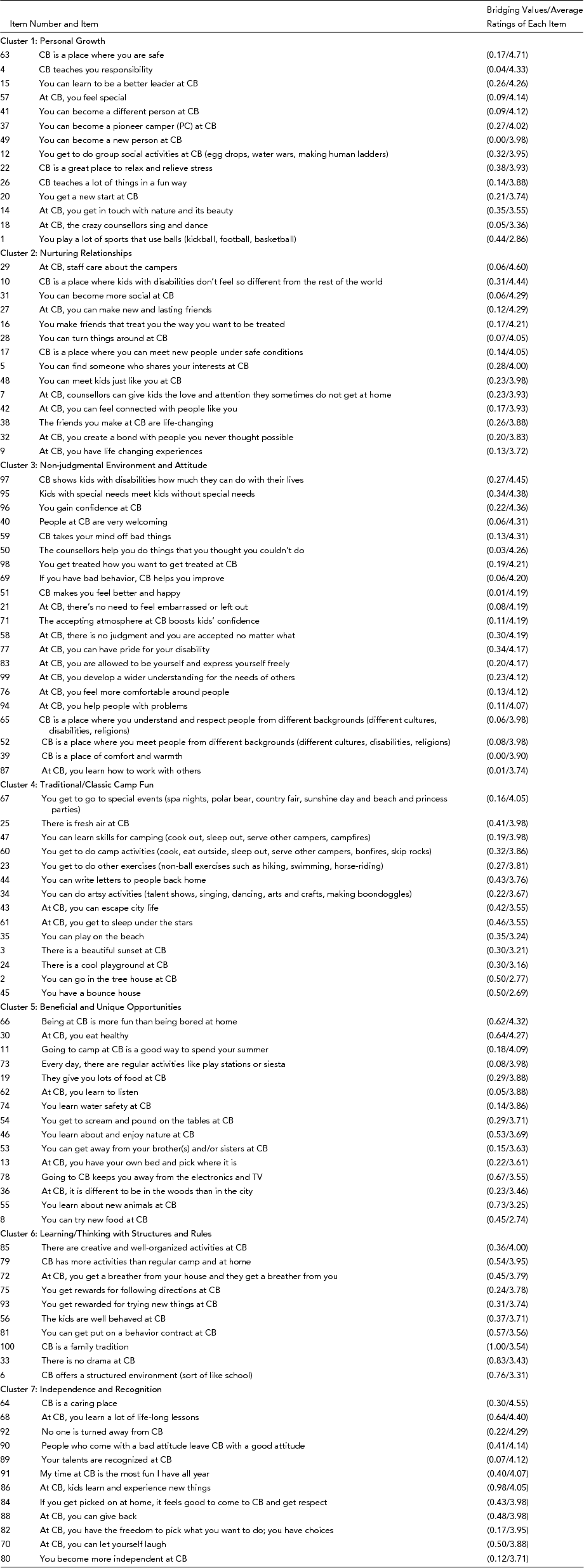
In the current study, maps of 2 to 14 clusters were produced and examined by each of the six researchers independently and then as a group. Ultimately, the researchers concluded that a seven cluster map provided the optimal solution. The bridging values for each cluster were reasonably low, indicating relatively strong internal consistency of the items in most of the clusters (Table 1).
Items, bridging values, average importance ratings of clusters.

Clusters 1 to 4 have very low bridging values, indicating very good internal consistency. For instance, in Cluster 1 (Personal Growth), bridging values ranged from .00 to .44. Similarly, Cluster 2 (Nurturing Relationship), bridging values ranged from .06 to .31. Bridging values for Cluster 3 (Non-judgemental Environment and Attitude) ranged from .00 to .34, and Cluster 4 (Traditional/Classic Camp Fun) ranged from .16 to .46. Cluster 5 has relatively higher bridging values than Clusters 1 to 4, indicating moderate internal consistency. Cluster 5 (Beneficial and Unique Opportunities) ranged from .05 to .73. Clusters 6 and 7 have the highest bridging values, thus indicating the least in terms of their internal consistency among the 7 clusters. For Cluster 6 (Learning/Thinking with Structures and Rules), bridging values ranged from .24 to 1.00 and Cluster 7 (Independence and Recognition) ranged from .07 to .98. Each cluster formed a set of items that conveyed easily identifiable sets of benefits associated with this therapeutic camp experience.
Concepts Generated
HCA generated a map of seven distinct domains, representing the thematic breakdown of the children's responses. The incorporation of the importance rating created a three-dimensional representation of the seven distinct domains. Note that individual items refer to “CB”, the initials of the camp programme.
As indicated in Table 1, some clusters are relatively large and consist of diverse concepts (e.g., Cluster 5) while others are small which indicate narrower concepts (e.g., Cluster 2). The number of items per cluster ranged from 10 in the “Learning/Thinking with Structures and Rules” cluster to 21 in the “Non-judgmental Environment and Attitude” cluster. A complete listing of all of the items by cluster with bridging values is presented in Table 1.
Items that were most frequently sorted together represent more similar ideas than those that were seldom or never sorted together. For instance, “I get to play outside” is conceptually similar to “I can do outdoor activities”. The statement “I get to play outside” and “I get to do new things” could converge to the concept of doing something new, but each statement could belong to two different clusters.
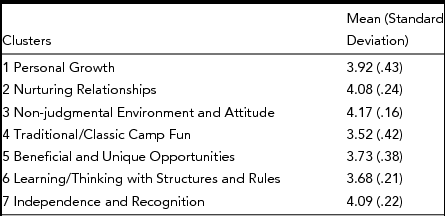
Table 2 reports the means and standard deviations of the importance ratings on the seven clusters. Higher ratings represent participants rating those benefits as more important than those with lower ratings.
Means and standard deviations of importance ratings of the seven clusters.
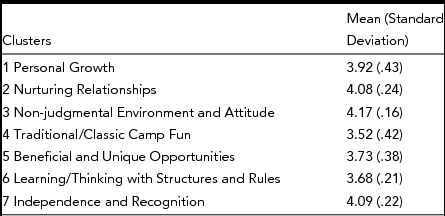
The highest average importance rating was 4.17 (Cluster 3: Non-judgmental Environment and Attitude) of 3.92, indicating that among all 42 participants, this category was rated as the most important and beneficial for them. The second highest importance rating was Cluster 7 (Independence and Recognition; 4.09), followed by Cluster 2 (Nurturing Relationships; 4.08), Cluster 1 (Personal Growth; 3.92), Cluster 5 (Beneficial and Unique Opportunities), Cluster 6 (Learning/Thinking with Structures and Rules; 3.68), and Cluster 4 (Traditional/Classic Camp Fun).
The average importance rating within each of the clusters is shown in descending order in Table 1. These numbers are helpful in identifying the specific elements that are more important than the others in the specific cluster. For instance, in Cluster 1 (Personal Growth), “CB is a place where you are safe” was rated the most important, while “You play a lot of sports that use balls (kickball, football, basketball)” was the least important under this cluster.
Basic Dimensions Underlying the Seven Cluster Model
Cluster 1 (Personal Growth)
Cluster 1 consists of 14 items that relate to the theme “Personal Growth”, including statements such as “You can become a new person at CB” and “At CB, you feel special”. The average importance rating in this cluster is 3.67. The items with the lowest bridging values and highest importance ratings were “You can become a new person at CB” (.00 and 3.98, respectively) and “CB is a place where you are safe” (.13 and 4.71, respectively). These items indicated that, after spending time engaging in group and social activities, the participants felt transformed in a positive way. Specifically, they felt they had learned to become better leaders and to take responsibilities (“CB teaches you responsibility”). Participants also experienced transformation through engagement in novel activities that made participants feel like new and different people (for example, “You can become a Pioneer Camper at CB”).
Cluster 2 (Nurturing Relationships)
Cluster 2 consists of 14 items that relate to the theme “Nurturing Relationships”. Examples of such items include “At CB, the staff care about the campers”, “You can become more social at CB”, and “At CB, you can feel connected with people like you”. The average importance rating in this cluster was 4.08. The items with the lowest bridging values and highest importance ratings were “You can become more social at CB” (.06 and 4.29, respectively) and “At CB, the staff care about the campers” (.06 and 4.60). These items all centred on the value of fulfilling social connections with peers and counsellors. These items indicated that the camp enabled children to develop positive relationships with one another with greater frequency than may naturally occur in the home or school situation.
Cluster 3 (Non-judgmental Environment and Attitude)
Cluster 3 consisted of 21 items that relate to the theme of “Non-judgmental Environment and Attitudes”. Examples of such items included “At CB, there is no judgement and you are accepted no matter what”, and “CB is a place where you understand and respect people from different backgrounds (different cultures, disabilities, religions)”. The average importance rating in this cluster was 4.17. The items with the lowest bridging values and highest importance ratings were “CB is a place of comfort and warmth” (.00 and 3.90, respectively) and “CB shows kids how much they can do with their lives” (.13 and 4.45). These items focused on how the counsellors and other campers provided a safe environment for children with disabilities to be who they are. At the same time, counsellors and other campers developed a welcoming and non-discriminative attitude toward others who are different, such as those with a disability.
Cluster 4 (Traditional/Classic Camp Fun)
Cluster 4 consisted of 14 items reflecting the theme “Traditional/Classic Camp Fun”. Those items related to the range of activities that are traditional and enjoyable camp activities. Examples of such items included “There is a cool playground at CB”, and “You have a bounce house”. The average importance rating in this cluster was 3.52. The item with the lowest bridging value and highest importance rating was the item “You get to go to special events” (.16 and 4.05, respectively). These items included activities that might not be available to campers at home (e.g., the opportunity to play in a tree house and on the beach).
Cluster 5 (Beneficial and Unique Opportunities)
Cluster 5 consisted of 15 items that relate to the theme “Beneficial and Unique Opportunities”. Campers found they were engaged in activities, experiences or learning opportunities that are different than their usual experiences. Examples of items included in this cluster were “Going to camp at CB is a good way to spend your summer” and “You get to scream and pound on the tables at CB”. The average importance rating in this cluster was 3.73. The items with the lowest bridging values and highest importance ratings were “At CB, you learn to listen” (.05 and 3.88, respectively) and “Being at CB is more fun than being bored at home” (.62 and 4.32). These items focused on certain beneficial aspects of this therapeutic camp that made it a novel environment for the campers. It differed from the last cluster in that it included items that do not necessarily refer to traditional organised camp activities. For instance, banging on tables, playing siesta, or learning about water safety may not be tasks that campers are exposed to do on a regular basis while enjoyable or beneficial, these things do not necessarily fit under the heading “camp activities”.
Cluster 6 (Learning/Thinking with Structures and Rules)
Cluster 6 consisted of 10 items that conveyed the theme “Learning/Thinking with Structures and Rules”. These items relate to the structure and rules provided at CB. Examples of such items included “You can get put on a behaviour contract at CB” and “There is no drama at CB”. The average importance rating in this cluster was 3.68. The items with the lowest bridging values and highest importance ratings were “You get rewards for following directions at CB” (.24 and 3.78, respectively) and “There are creative and well-organised activities at CB” (.36 and 4.00) These items concerned incentives for good behaviour, disincentives for bad behaviour, and actual behavioural change that occurs at this camp. This cluster was especially valuable because it demonstrates that campers take meaningful lessons with them, even after the camp ends.
Cluster 7 (Independence and Recognition)
Cluster 7 conveyed the theme “Independence and Recognition”. It consisted of 12 items that related to campers’ sense of independence and recognition of talents. Examples included “You become more independent at CB”; “If you get picked on at home, it feels good to come to CB and get respect”; “Your talents are recognised at CB”. The average importance rating in this cluster was 4.09. The average importance rating in this cluster was 3.68. The items with the lowest bridging values and highest importance ratings were “Your talents are recognised at CB” (.07 and 4.12, respectively) and “CB is a caring place” (.26 and 4.55). These items conveyed themes about how children felt recognised, became independent, and had a sense of positive self.
Discussion
Careful examination of the cluster analysis reveals two overall important themes about this therapeutic camp experience. First, the themes generated by campers were largely positive and quite diverse. The focus prompt used in this study was oriented to benefits, but the volume and breadth of the ideas generated suggests a comprehensive impact that was readily articulated by the participants. Second, our findings are consistent with the benefits documented in inclusive camps literature (Kiveal, Reference Kiveal2013, McAvoy et al., Reference McAvoy, Smith and Rynders2006; Mishna et al., Reference Mishna, Michalski and Cummings2001; Scholl et al., Reference Scholl, McAvoy, Rynders and Smith2003, Walker et al., Reference Walker, Barry and Bader2010). These include social skills (Cushner-Weinsteine et al., Reference Cushner-Weinstein, Berl, Salpekar, Johnson, Pearl, Conry and Weinstein2007; Dawson & Liddicott, Reference Dawson and Liddicoat2009, Lopata et al., Reference Lopata, Thomeer, Volker, Toomey, Nida, Lee and Rodgers2010; Walker et al., Reference Walker, Barry and Bader2010), competence, and independence (e.g., Dawson & Liddicoat, Reference Dawson and Liddicoat2009; Hill & Sibthorp, Reference Hill and Sibthorp2006; Pulgaron et al., Reference Pulgaron, Salamon, Patterson and Barakat2010).
The categories produced by the cluster analysis highlight a number of encouraging themes that campers with disabilities experienced. Two of the seven clusters relate directly to positive interpersonal fulfilment (Nurturing Relationships, and Non-judgmental Environment and Attitude). These themes are consistent with literature with the positive social interaction and communication (e.g., Bongiovanni et al., Reference Bongiovanni, Clark, Garnett, Wojcicki and Heyman2010, Cushner-Weinsteine et al., Reference Cushner-Weinstein, Berl, Salpekar, Johnson, Pearl, Conry and Weinstein2007; Kiveal, Reference Kiveal2013; McAvoy et al., Reference McAvoy, Smith and Rynders2006), acceptance (e.g., Meltzer & Rourke, Reference Meltzer and Rourke2005), general satisfaction, fulfilment and wellbeing for campers with disabilities (Moons et al., Reference Moons, Barrea, De Wolf, Gewillig, Massin, Mertens and Sluysmans2006; Nettina et al., Reference Nettina, Donnelly and Florio2003, Wu et al., Reference Wu, Prout, Roberts, Parikshak and Amylon2011). In addition to the social aspects, campers also report a sense of personal growth and empowerment, as in the “Independence and Recognition” and “Personal Growth” clusters. Similarly, prior studies have identified benefits including increased self-esteem (Devine & Dawson, Reference Devine and Dawson2010; Torok et al., Reference Torok, Kokonyei, Karolyi, Ittzes and Tomcsanyi2006), emotional empowerment (Nettina et al., Reference Nettina, Donnelly and Florio2003), self-efficacy (Hill & Sibthorp, Reference Hill and Sibthorp2006; Pulgaron et al., Reference Pulgaron, Salamon, Patterson and Barakat2010), and competence (Dawson & Liddicoat, Reference Dawson and Liddicoat2009; Devine & Dawson, Reference Devine and Dawson2010; Hill & Sibthorp, Reference Hill and Sibthorp2006).
Furthermore, results from the current study showed that campers enjoyed opportunities for unique and fun activities in the “Traditional/Classic Camp Fun” and “Beneficial and Unique Opportunities” clusters. Physical activities available at the camp appear to be beneficial because they are in a supervised environment that might not be otherwise available to them in their daily home or school life. This theme is consistent with the purpose of TR, in which children with disabilities are provided the opportunity to enjoy recreational and leisurely activities similar to their non-disabled peers (Barr et al., Reference Barr, Silva, Wong, Frid, Posgate and Brown2010). In their thematic analysis of a camp experience for children with Cerebral Palsy, Dawson and colleagues (Reference Dawson and Liddicoat2009) noted similar themes of being able to enjoy fun activities outdoors. This is comparable to what was reported in our study, with items reflecting similar themes, such as “a place to have fun”, and “the opportunity to experience outdoor leisure activities”.
Finally, in addition to the positive social and personal benefits, as well as the unique and fun aspects of the physical activities, campers also benefit from learning appropriate skills, knowledge, and behaviours. This finding is evident in three of the seven clusters, including “Traditional/Classic Camp Fun”, “Benefits and Unique Opportunities”, and “Learning/Thinking with Structures and Rules”. Prior studies have supported the idea that camps allow participants to learn the necessary knowledge and skills in managing their medical or other symptoms (Briery & Rabian, Reference Briery and Rabian1999; Hantson et al., Reference Hantson, Wang, Grizenko-Vida, Ter-Stepanian, Harvey, Joober and Grizenko2012; Hill & Sibthorp, Reference Hill and Sibthorp2006; Lopata et al., Reference Lopata, Thomeer, Volker, Toomey, Nida, Lee and Rodgers2010), social and communication skills (Lopata et al., Reference Lopata, Thomeer, Volker, Toomey, Nida, Lee and Rodgers2010; Walker et al., Reference Walker, Barry and Bader2010), general life and self-management skills (Hunter et al., Reference Hunter, Rosnov, Koontz and Roberts2006) as well as coping skills (Nicholas et al., Reference Nicholas, Williams and MacLusky2009).
Among the seven clusters three higher order domains can be delineated from the seven cluster map: (1) social, (2) psychological, and (3) learned behavioural/skill building aspects.
Social Aspects
Four themes support the social benefits of the TR camp experience. These include the “Non-judgmental Environment and Attitude” cluster along with the “Nurturing Relationships” cluster, which demonstrate social connections and engagement as a result of the positive atmosphere created. The themes “Traditional/Classic Camp Fun” and “Beneficial and Unique Opportunities” include a sense of normal social activities in the context of acceptance by others.
The “Non-judgmental Environment and Attitude” items reflect a welcoming environment so that campers with disabilities feel respected and safe to be who they are. Items such as “You get treated how you want to get treated at CB”, “the accepting atmosphere at CB boosts kids’ confidence”, and “At CB, there is no judgement and you are accepted no matter what” reflect the accepting social environment. Similarly, several items described a strong support system. Examples include “People at CB are very welcoming”, “The counsellors help you do things that you thought you couldn't do”, “CB shows kids with disabilities how much they can do with their lives”, and “At CB, you help people with problems”.
In the “Nurturing Relationships” cluster, items conveyed a sense of collegiality and friendship. Examples include “At CB, you can make new and lasting friends”, “CB is a place where you can meet new people under safe conditions”, “The friends you make at CB are life-changing”, and “You can find someone who shares your interests at CB”. These clusters appear to align well with some of positive social outcomes demonstrated in the existing literature. For instance, Cushner-Weinstein et al. (Reference Cushner-Weinstein, Berl, Salpekar, Johnson, Pearl, Conry and Weinstein2007) found that a 3-week camp for children with epilepsy resulted in long-term gains in social interaction, communication and social responsibility. Similarly, Devine and Dawson (Reference Devine and Dawson2010) found an increase in feelings of social acceptance following a week-long camp experience for children with craniofacial differences. Hanston et al. (Reference Hantson, Wang, Grizenko-Vida, Ter-Stepanian, Harvey, Joober and Grizenko2012) showed an increase in social interaction among children with ADHD. Kiveal's (Reference Kiveal2013) SCIP reported that children benefit socially in their camp for children with cognitive and intellectual developmental disabilities.
The “Traditional Camp Fun” cluster, taken along with the “Beneficial and Unique Opportunities” cluster indicate that the camp provided the campers with disabilities the opportunity to engage in activities with other children that might not be available to them outside of the camp setting. The spirit of community engagement in recreational activities for individuals with disabilities was apparent in these clusters. Participation in recreational activities normalises the experience for children with disabilities (Carter & LeConey, Reference Carter and LeConey2004; Miller et al., Reference Miller, Schleien and Lausier2009; Skulski, Reference Skulski2007). For instance, in “Traditional/Classic Camp Fun”, campers experienced the outdoor activities of a camp, such as “You get to do camp activities (cook, eat outside, sleep out, serve other campers, bonfires, skip rocks)”, and “At CB, you get to sleep under the stars”. Similarly, the “Beneficial and Unique Opportunities” cluster included items that conveyed unique physical aspects of the camp like “At CB, you eat healthy”, “You learn water safety at CB”, and “Going to CB keeps you away from the electronics and TV”.
Psychological Aspects
In the current study, two clusters conveyed that this therapeutic camp enhanced personal wellbeing. Specifically, items in the “Personal Growth” and “Independence and Recognition” clusters captured a sense that the new life skills helped them grow as individuals. Examples in the “Personal Growth” cluster included “CB teaches you responsibility”, “You can become a new person at CB”, “You get a new start”, “At CB, you feel special”, and “You can learn to be a better leader at CB”. The “Independence and Recognition” cluster included such items as “At CB, you learn a lot of life-long lessons”, “People who come with a bad attitude leave CB with a good attitude”, “Your talents are recognised at CB”, “At CB, you can give back”, and “You become more independent at CB”. These findings are consistent with prior studies demonstrating positive impact of camp programmes on psychological wellbeing of children with disabilities. For example, Devine and Dawson (Reference Devine and Dawson2010) found that a specialised camp experience for children with craniofacial differences led to increases in self-esteem and social inclusion. In addition, Ashton-Shaeffer, Gibson, Autry, and Hanson (Reference Ashton-Shaeffer, Gibson, Autry and Hanson2001) showed that participants in a sports camp for children with disabilities found the experience “empowering”. Bongiovanni and colleagues (Reference Bongiovanni, Clark, Garnett, Wojcicki and Heyman2010) found that participants exhibited an improved emotional outlook and wellbeing after the weeklong camping experience. Moons and colleagues (Reference Moons, Barrea, De Wolf, Gewillig, Massin, Mertens and Sluysmans2006) also showed that campers who attended a 3-day camp reported significant improvement in their mental health.
Learning of Skills/Behavioural Aspects
The third major domain of camp benefits was behavioural skills, which was supported by three of the seven clusters: “Learning/Thinking with Structures and Rules”, “Traditional/Classic Camp Fun”, and “Beneficial and Unique Opportunities”. In “Learning/Thinking with Structures and Rules”, some of the items conveyed positive behaviours as a result of the camp experience, (e.g., “The kids are well behaved at CB”, “There is no drama at CB”, and “You get rewarded for following directions at CB”). Items that describe the structured learning environment include “You can get put on a behaviour contract at CB”, and “CB offers a structured environment (sort of like school)”.
Some items in “Traditional/Classic Camp Fun” and “Beneficial and Unique Opportunities” showed that campers with disabilities were able to learn various life skills such as cooking, helping others, water safety, and others. Example items include “You can learn skills for camping (cook out, sleep out, serve other campers, campfires)”, “You learn water safety at CB”, and “At CB, you learn to listen”.
Prior studies have demonstrated that structured learning can benefit children with disabilities that engage in therapeutic camp in terms of mastering knowledge and skills to improve their behaviours, and such skills can be social, interpersonal, life skills, and management of their symptoms.
Specialised camps typically include a psycho-educational aspect of their intervention that aim at building skills for participants (Hill & Sibthorp, Reference Hill and Sibthorp2006; Lopata et al. Reference Lopata, Thomeer, Volker, Toomey, Nida, Lee and Rodgers2010; Walker et al., Reference Walker, Barry and Bader2010). Hill and Sibthorp (Reference Hill and Sibthorp2006) demonstrated that intervention helped children with diabetes in increasing their competence in the management of their medical conditions. Walker et al. (Reference Walker, Barry and Bader2010) showed an increase in the communication and social skills of children with autism after their 4-week camp and this skill not only benefit the children but also their interaction with their families. Lopata et al. (Reference Lopata, Thomeer, Volker, Toomey, Nida, Lee and Rodgers2010) studied a 5-week summer camp that was based on behavioural principles of teaching children to learn a variety of skills, including social skills and pragmatic language skills. Kiveal (Reference Kiveal2013) also reported that children with cognitive and intellectual developmental disabilities showed some benefits on the mastery of life skills.
Strengths of Study
A major strength of the current study is the sample of school-age children with disabilities. The children directly identified specific benefits of participation in the camp programme and expressed them in their own words. In addition, the use of concept mapping allows the generation of results that combine the strength of qualitative and quantitative approaches of methodology. Specifically, the use of focus groups fulfilled the spirit of participatory action research with active engagement in the generation of study data (Kane & Trochim, Reference Kane and Trochim2007). Following the editing, sorting and rating of the items by the children, MDS and HCA provided rigorous quantitative analysis of the data.
Limitations of Study
While the present study had a number of strengths, it is not without limitations. A different sample may have produced other specific items or an altered configuration of item similarities in the MDS analysis. Larger sub-groups of children with specific disabilities would enable analysis of importance ratings by disability category. In addition, unique disability groups may benefit more or less from this inclusive therapeutic recreational camp in different psychosocial aspects of their life. Further, it is plausible that children with more visible disabilities may have had a less positive experience due to social stigma. Additionally, this study focused only on the benefits for children with disabilities. In order to further explore the value of specialised versus inclusive camps, the inclusion of campers without disabilities would enable comparison of benefits.
Clinical Implications
Results from the current study have clinical implications for professionals such as counsellors who work with children and families with disabilities. First, the results suggest that an inclusive therapeutic camp setting, with careful planning and supervision tasks, can foster positive experiences and growth among children with a disability. Participants enjoyed traditional camp activities as well as new learning opportunities, which may provide psychological, social and skills/behavioural growth among children with disabilities. Therefore, it is recommended that these broad therapeutic aims should be emphasised and be integrated in group interventions.
The spirit of inclusion, positivity and strength, rather than deficits related to disability, is consistent with the rehabilitation philosophy of empowerment. Results demonstrated that staff who provide a non-judgmental, supportive, and nurturing environment facilitate personal growth, independence, positive learning, and recognition of campers with disabilities. As suggested by previous studies and existing guidelines, inclusive therapeutic camps can be beneficial to both campers with and without disabilities, provided that staff and camp leaders are trained to provide the optimal interactive activities and environmental conditions (Devine & Parr, Reference Devine and Parr2008; Miller et al., Reference Miller, Schleien and Lausier2009). Staff training may be considered a potential causal variable in that staff in this camp may have provided role models that account for benefits the campers. Finally, at the system level, policies and guidelines can promote consistent implementation of inclusive TR camps, thus maximising the effectiveness of social inclusion and community engagement for children with disabilities.
Directions for Future Research
We can reasonably conclude that campers with disabilities benefited from their camp experience at this inclusive TR camp experience. A logical next step for research would be to develop and administer quantitative measures relating to constructs that we generated from this study, such as growth, independence, positive learning, increased sense of physical wellness, positive psychological wellness such as self-esteem, and positive social wellness. Programme evaluation efforts could utilise the items and clusters identified in the present study to specifically measure the relationship of benefits experienced to longer term outcomes including school and vocational achievement, as well as general quality of life and wellbeing.
Future research can focus on differential effects of camp on different types of disabilities. Furthermore, data collection on campers without disabilities would allow the investigation of the impact of the specialised and inclusive models of camp. Staff training models and protocols that identify specific types of activities, such as those outlined by Devine and researchers, is another area of research that potentially strengthen the delivery and effectiveness of inclusive therapeutic camp. Finally, a larger sample size with a more heterogeneous group in terms of demographic variables (e.g., age, socioeconomic status, ethnicity) may allow identification of additional themes on the benefits of attending this camp beyond results shown in the current study.