Introduction
Okra, belonging to the family Malvaceae is one of the most popular vegetable crops of tropics and sub-tropics across the world with a considerable area under cultivation in Asia and Africa (Shetty et al., Reference Shetty, Singh and Singh2013). It is gaining more importance due to multi-purpose uses of its tender and delicious green pods which are used either in raw, cooked, or canned form in India and other okra growing regions (Mihretu et al., Reference Mihretu, Wayessa and Adugna2014). The low fat with the presence of well-balanced essential amino acids especially lysine and tryptophan in seed protein also makes okra called the “perfect villager's vegetable’ (Kumar et al., Reference Kumar, Sokona, Adamou, Alain, Dov and Christophe2010). India is the largest producer of okra with an annual production of 9.62 mt from an area of 1.83 mha (FAOSTAT, 2014) but has poor productivity. One of the major causes of the reduction of yield in India is that it is highly susceptible to Yellow Vein Mosaic Virus Disease (YVMV) (Ghosh et al., Reference Ghosh, Ghosh, Chattarjee and Senapati1999) which cannot be controlled properly by chemical means. The unavailability of location-specific high yielding varieties is another major limitation for achieving higher productivity in okra. The resistance breakdown to YVMV has also been reported due to the emergence of B biotype of whitefly having a wider host range and mutation, multiplication and recombination events within the DNA of begomovirus. Therefore, the development of high yielding hybrids along with stable resistance to YVMV disease is a continuous process (Shetty et al., Reference Shetty, Singh and Singh2013) since when Vijayaraghavan and Warrier (Reference Vijayaraghavan and Warrier1946) first reported the presence of heterosis for yield and its contributing traits in okra.
In heterosis breeding, prediction about increased hybrid vigour for a specific trait fully depends on the choice of parents and to what extent the parents are diverse from each other. Therefore, the prevalence of genetic variation among the genotypes is a pre-requisite for the selection of the parents (Gupta et al., Reference Gupta, Nepolean, Shaikh, Rai, Hash, Das and Rathore2018). Evaluation of genetic variation only based on morphological traits is highly influenced by environmental factors. Hence, in these context DNA-based molecular markers especially, simple sequence repeats (SSRs) are widely used across the species (Schafleitner et al., Reference Schafleitner, Kumar, Lin, Hegde and Ebert2013). Further, analysis of combining ability is an alternative tool that aids in the selection of desirable parents for crossing and also specific cross combinations for further exploitation as hybrids based on their superior performance (Munshi and Verma, Reference Munshi and Verma1999). The idea of general combining ability (GCA) and specific combining ability (SCA) refined by Sprague and Tatum (Reference Sprague and Tatum1942) has a significant impact on the evolution of inbred lines. Knowledge about gene action also helps to predict whether one can go for recombination and selection or heterosis breeding.
With this aim, the present study was conducted using line × tester mating design (Kempthorne, Reference Kempthorne1957) to determine the genetic distance between the selected parents followed by the selection of best general and specific combiners, estimation of genetic components of variance and magnitude of heterosis over the mid parent (MP), better parent and commercial check for yield and its contributing traits as well as for coefficient of infection (CI) for YVMV disease.
Materials and methods
Experimental location, plant material, mating design
The present investigation was carried out at Vegetable Research Farm, Division of Vegetable Science, ICAR-Indian Agricultural Research Institute (IARI), New Delhi-110012 during late Kharif- 2017, Summer- 2018 and Kharif- 2018. The research farm is located at 28°40′ N latitude, 77°12′ E longitude, and at an altitude of 228.6 m above mean sea level (MSL) having sandy loam with neutral pH. The experimental material consisted of 10 lines and three testers which were crossed to generate 30 testcross progenies following line × tester mating design (online Supplementary Table S1). The F1 hybrids along with one commercial check (Shakti hybrid) were evaluated in Randomized Complete Block Design (RCBD) with three replications. The planting was done at a spacing of 60 cm between row-to-row and 30 cm from plant-to-plant following all the recommended cultural and agronomic practices to raise a healthy crop. Each of the treatments were evaluated for 10 quantitative traits i.e. days to first flowering, node to first flowering, days to 50% flowering, plant height (cm) at final harvest, CI for YVMV, fruit length (cm), fruit diameter (cm), average fruit weight (g), number of fruits per plant and yield per plant (g).
Molecular diversity analysis
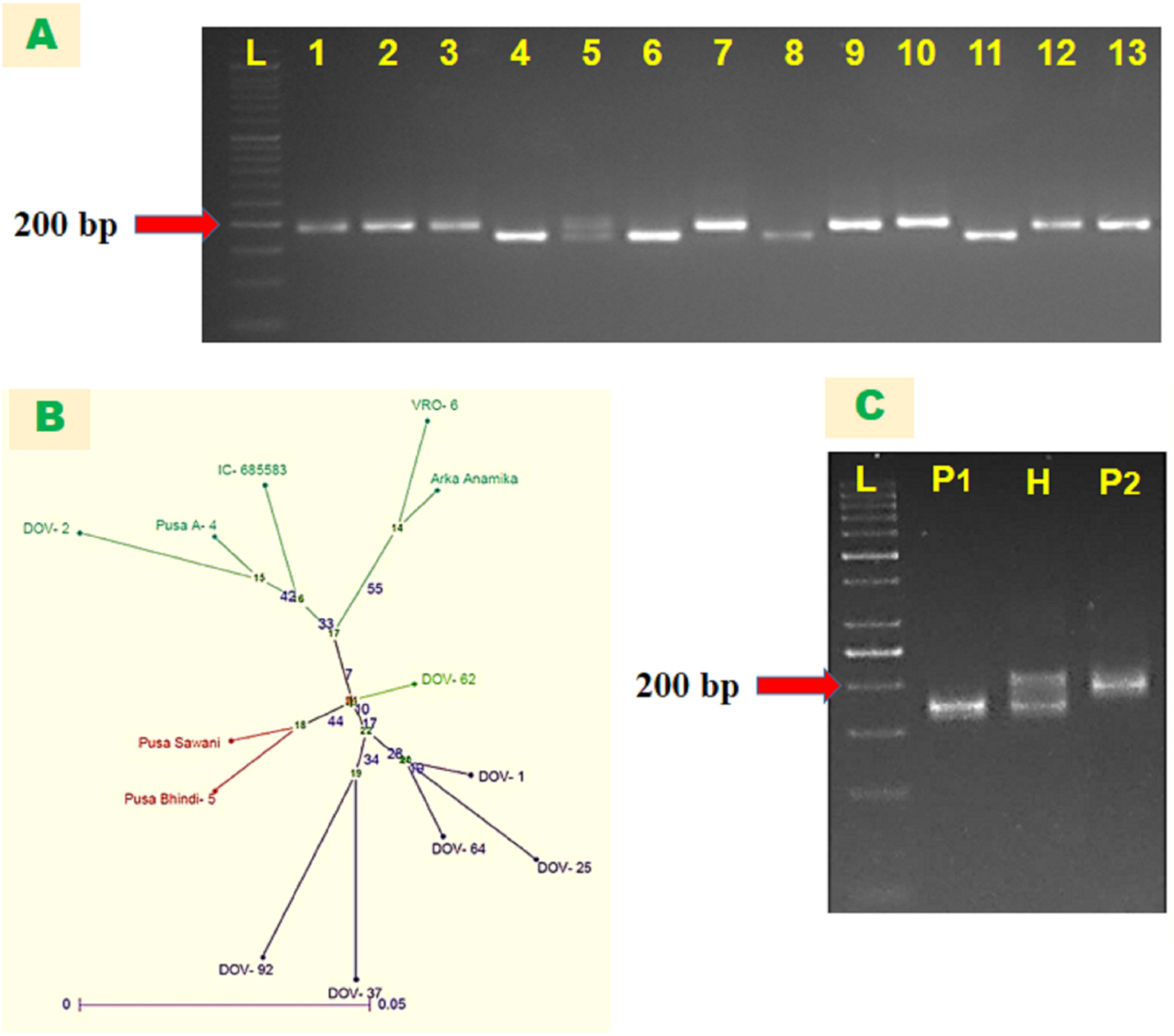
Cotyledonary leaves of 3–5 days young okra seedlings of all the parents of this program were used for DNA extraction using a modified CTAB method as suggested by Murray and Thompson (Reference Murray and Thompson1980) with some minor modifications. The quality of the DNA samples was checked using 0.8% agarose gel followed by nanodrop. Seeing the concentration of each DNA sample, concentration was adjusted to 20–50 ng/μl of water. A total of 50 SSR primers were used in this study to analyse genetic divergence among the parents (online Supplementary Table S3; Fig. 2A). Polymerase chain reaction (PCR) mixture consists of 10 μl solution made of 1 μl diluted DNA sample, 0.5 μl of each forward and reverses primers, 3 μl nuclease-free water and 5 μl master mix (onePCRTM of Genedirex, Inc.) and then, it is used for amplification purpose in Eppendorf master cycler. In total, 3.5% agarose gel electrophoresis was used for the separation of PCR amplified products which were visualized under the gel documentation system (Alpha imager 2200 of Alpha infotech corporation, California). The amplified bands were scored as ‘0’ for absence and ‘1’ for presence following the rules of binary matrix and finally, the phylogenetic tree was constructed with the help of Darwin v. 6.0 (Perrier and Jacquemoud-Collet, Reference Perrier and Jacquemoud-Collet2006) using unweighted neighbour-joining analysis (NJ).
Screening for YVMV
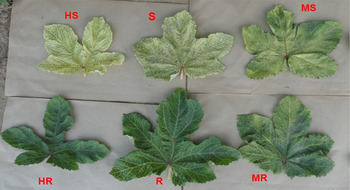
Screening for YVMV resistance was carried out at 15 days interval up to 90 days starting from the 30 days after sowing (DAS) based on plant phenotype. Based on the evaluation of previous years seven genotypes namely, DOV-92, DOV-62, DOV-37, DOV-2, Arka Anamika, VRO-6 and Pusa Bhindi-5 exhibited field-tolerance to YVMV disease and subsequently utilized as parents in the crossing program. No plant protection measures were taken during crop growth against sucking pest whitefly (Bemisia tabaci) and additional plants of YVMV susceptible variety Pusa Sawani was sown in infector row to maintain a sufficient load of virus inoculum. Further, intermittent rain with prevailing humid weather conditions during this course of investigation also favoured the reproduction of the whitefly population helping in the precise screening of the hybrids and the parents. The severity of infection to YVMV was assessed using per cent disease incidence (PDI) and disease severity grade. Based on the severity grade which varies from 0 to 4 (Fig. 1), corresponding response value (RV) was given for each treatment. The CI was calculated by multiplying PDI with RV assigned for each severity grade following standard methodology (Bag et al., Reference Bag, Gautam, Prasad, Pandey, Dutta and Roy2014).
•
 $ \eqalign{& {\rm Percentage \; Disease\; Incidence\; }\left( {{\rm PDI}} \right) = \cr & \displaystyle{{{\rm Number\; of\; plants\; infected}} \over {{\rm Total\; of\; plants\; observed\; }}} \times 100}$
•
$\eqalign{&{\rm Disease\; severity\; grade} = \cr & {\displaystyle{{{\rm Number\; of\; infected\; leaves\; within\; the\; plants}} \over {{\rm Total\; number\; of\; leaves\; of\; that\; corresponding\; plant}}}$•
${\rm Coefficient\; of\; Infection\; }\left( {{\rm CI}} \right) = {\rm PDI\; } \times {\rm RV}$


Scoring of YVMV diseases in six categories based on coefficient of infection (CI) Value. [HR = highly resistant (CI: 0–4); R = resistant (CI: 5–9); MR = moderately resistant (CI: 10–19); MS = moderately susceptible (CI: 20–39); S = susceptible (CI: 40–70), HS = highly susceptible (CI: 70–100)].

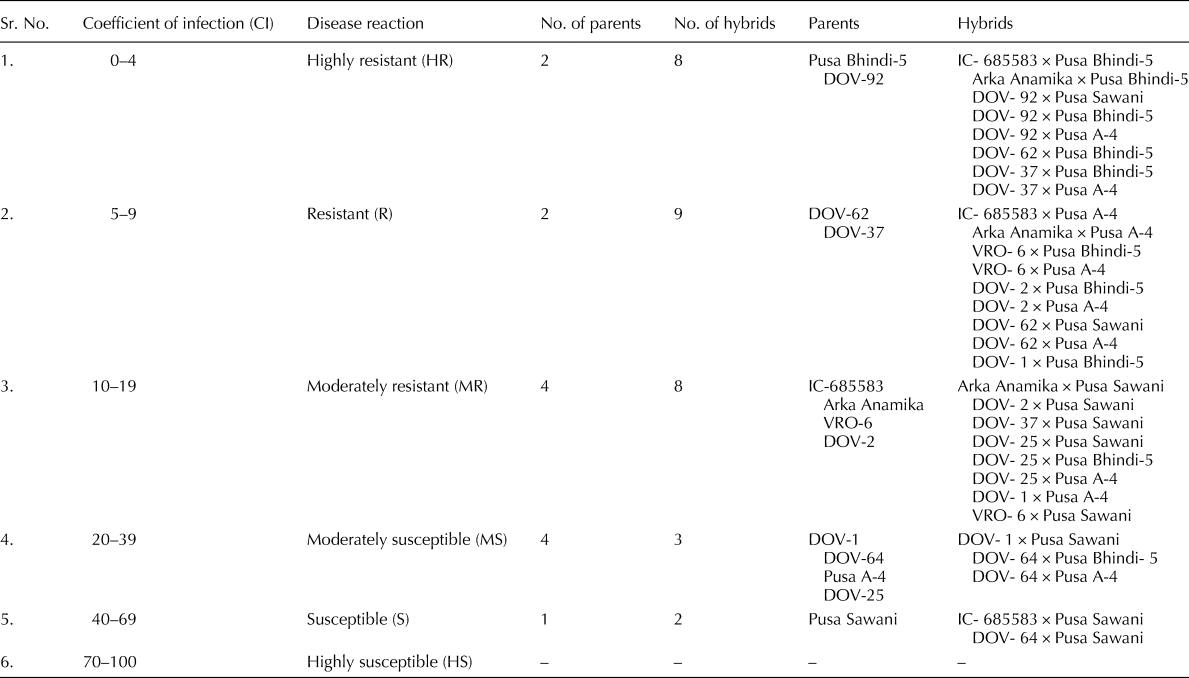
Based on the CI, the parents and their progenies were categorized for their response to disease into a total of six groups as given in online Supplementary Table S2.
Heterosis, heritability and gene action analysis
Relative heterosis, heterobeltiosis and standard heterosis were determined as per cent increase ( + ) or decrease (−) of F 1 over MP, better parent (BP) and standard control (SC) using the formulae (F 1-MP/MP × 100), (F 1-BP/BP × 100) and (F 1-SC/SC × 100), respectively (Singh, Reference Singh1973). The statistical significance of heterosis, heterobeltiosis and standard heterosis was assessed by the t-test (Wynne et al., Reference Wynne, Emery and Rice1970). The degree of dominance and predictability ratio was calculated using the following formulae: (V d/V a)1/2 and [V a/(V a + V d)] where, Additive variance, V a = 2 σ 2gca and Dominance variance, V d = σ 2sca. Contribution of lines, tester and their interaction were calculated by using the following formulae:
•
${\hbox{Contribution of lines}} = \displaystyle{{SS\; \left( {lines} \right)} \over {SS\; \left( {crosses} \right)}} \times 100$•
$\eqalign{&\hbox{Contribution of testers}} = \displaystyle{{SS\; \left( {testers} \right)} \over {SS\; \left( {crosses} \right)}} \times 100$•
$\eqalign{&{\hbox{Contribution of }}\left( {{\rm lines } \times {\rm testers}} \right) \,\,{\rm interaction} \cr & \quad= \displaystyle{{SS\; \left( {l\; \times \; t} \right)} \over {SS\; \left( {crosses} \right)}} \times 100$


Hybridity testing
The resulting testcross progenies were also subjected to hybridity testing using co-dominant markers to identify any material resulted from self-pollination. The amplification of heterozygous bands from both the parents in the testing progenies confirmed the hybrid purity of crosses (Fig. 2C).
Molecular diversity analysis of parental lines. (A) Amplification of parental genotypes (1–13) based on polymorphic loci AVRDC OKRA 9; 1: Pusa Sawani, 2: Pusa Bhindi-5, 3: DOV-92, 4: IC-685583, 5: Arka Anamika, 6: Pusa A-4, 7: VRO-6, 8: DOV-2, 9: DOV-62, 10: DOV-37, 11: DOV-25, 12: DOV-1, 13: DOV-64; L: 50 bp ladder (BR Biochem). (B) Phylogenetic tree based on neighbour-joining clustering. (C) Hybridity confirmation of representative cross IC-685583 × Pusa Bhindi-5 using marker AVRDC OKRA 9; P1: IC-685583, P2: Pusa Bhindi-5, H: IC-685583 × Pusa Bhindi-5; L: 50 bp ladder (G-biosciences).

Results
Molecular diversity
UPGMA-based neighbour-joining analysis revealed the presence of four clusters (Fig. 2B). Among the four clusters, Cluster I (blue) and Cluster III (light blue) comprised each of five genotypes namely, DOV-1, DOV-25, DOV-64, DOV-37, DOV-92 and DOV-2, Pusa A-4, IC-685583, VRO-6, Arka Anamika, respectively. While two testers namely, Pusa Sawani and Pusa Bhindi-5, remained together in Cluster II (red) and line DOV-62 alone remained as outliers in Cluster IV (green). Genetic distance calculated for all the combinations varied from 0.027 (DOV-1 and DOV-64) to 0.112 (DOV-2 and DOV-37) with an average of 0.066 (online Supplementary Table S4). These results indicated a sufficient amount of genetic variation among the parental lines to be utilized in the heterosis breeding.
Analysis of variance (ANOVA) and genetic components of variance
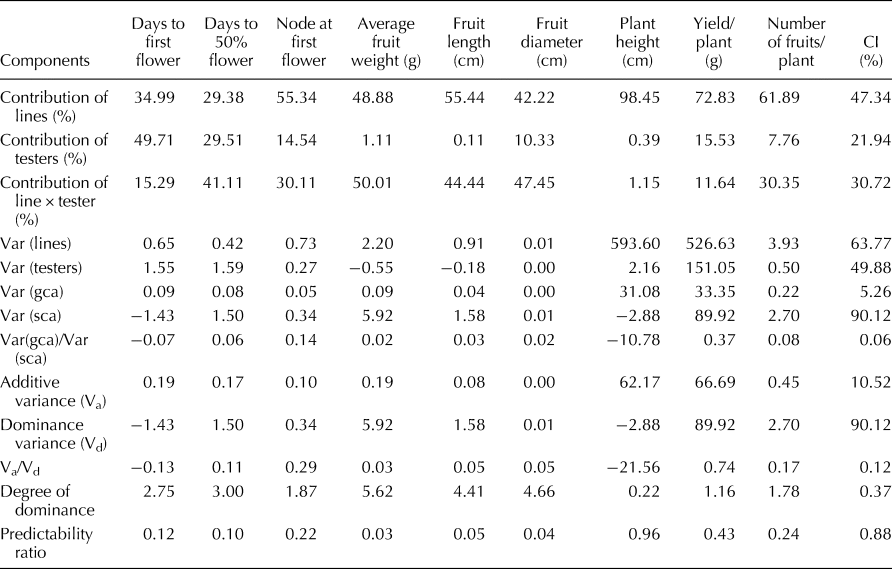
ANOVA revealed that all the treatments and the parents were significant for all the characters which are represented in Table 1. In the case of testcross, results were also significant for all the traits except for days to the first flower suggesting the role of non-additive gene action in controlling the traits (Table 2). Among the lines, most of the traits were significant except for days to the first flower whereas, except fruit length, all the traits were significant in the case of testers. Interaction between lines and testers was found to be significant for all the traits except for days to the first flower, plant height and node at first flower while, interaction between parents and crosses was found significant for most of the characters except for fruit diameter, node at first flower and fruit weight. Estimation of genetic components of variance includes the ratio of σ 2gca/σ 2sca, and Vd/Va variance, degree of dominance and predictability ratio. The higher value of σ 2sca than σ 2gca and also the ratio of Vd/Va less than unity revealed that dominance variance played a key role in the expression of traits. The value of the degree of dominance being greater than unity and predictability ratio lesser than unity also confirmed the presence of non-additive gene action for most of the traits except for plant height.
ANOVA for parents and hybrids for yield and its attributing traits in okra

*, ** significant at 5% and significant at 1% probability levels, respectively.
Estimation of genetic components and contribution of lines, testers and their interaction to the total variance for yield and its attributes in okra

Per se performance of parents and their hybrids
The trait-wise per se performance of parents and their hybrids is presented in online Supplementary Table S5. Among the parents, Pusa A-4 was earliest in both days to first (41 days) and 50% (45 days) flowering while among the hybrids, DOV- 92 × Pusa A-4, IC- 685583 × Pusa A-4 and Arka Anamika × Pusa A-4 (40 days) exhibited earliness based on days to first flowering. Based on average fruit weight, DOV-2 (19.86 g) showed the highest while, Pusa Sawani (9.26 g) showed the lowest fruit weight. However, among the hybrids, DOV- 64 × Pusa Bhindi- 5 (18.76 g) revealed the highest and IC-685583 × Pusa Bhindi- 5 (7.32 g) revealed the lowest fruit weight. Further, among the parents Arka Anamika (12.33 cm) exhibited longest and Pusa Sawani (7.33 cm) was the shortest in fruit length and within hybrids, DOV-92 × Pusa Bhindi-5 (13.33 cm) exhibited longest and IC-685583 × Pusa Bhindi- 5 (6.67 cm) was shortest in length. In addition to this, after 90 days of sowing DOV-92 remained highest (126.00 cm) and Pusa A-4 exhibited the shortest (56.67 cm) plant height among the parents, however, within testcross progenies, DOV-92 × Pusa Bhindi-5 (146.00 cm) showed highest and DOV-25 × Pusa Sawani (58.67 cm) remained shortest plant height. Further, based on yield per plant, among the parents, DOV-92 (200.00 g) and the hybrids DOV-92 × Pusa Bhindi-5 (240.00 g) exhibited the highest fruit yield compared to others.
Screening for YVMV disease resistance
YVMV is a major viral disease of okra and the identification of stable resistance sources is a continuous process to fight with this devastating menace. Thereby, screening of parents for YVMV was done on a phenotypic basis under open field condition and PDI was calculated. Finally, the CI value was calculated for parents and hybrids which were represented in online Supplementary Table S6. Based on the disease reaction category (Table 3; Fig. 1) out of 13 parents, two parents each were classified as highly resistant (DOV-92 and Pusa Bhindi-5) and resistant DOV-62 and DOV-37). Moreover, four parents each were found to be moderately resistant (IC-685583, Arka Anamika, VRO-6, and DOV-2) and moderately susceptible (DOV-1, DOV-64, Pusa A-4, and DOV-25). Only one parent i.e. Pusa Sawani was classified as susceptible. Further, most of the test cross progenies were classified under the resistant category (9) followed by highly resistant (8), moderately resistant (8), moderately susceptible (3) and susceptible (2). However, none of the parents and test cross progenies were classified under a highly susceptible category even after 90 days of sowing.
Screening of 30 hybrids and their parents for YVMV disease of okra

Identification of good general and specific combiners
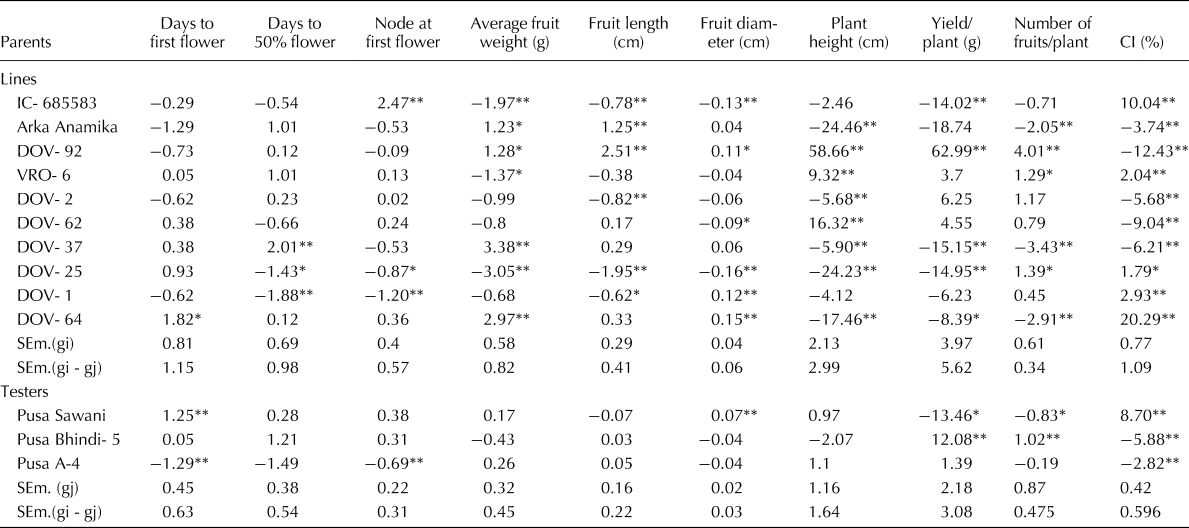
GCA is considered as a powerful tool to predict the genetic potentiality of the parents. Estimation of GCA effects (Table 4) revealed that based on days to the first flower, IC-685583 (−0.29), Arka Anamika (−1.29), DOV-92 (−0.73), DOV-2 (−0.62), DOV-1 (−0.62), and Pusa A-4 (−1.29) showed negative GCA effect which was desirable for early flowering. For fruiting characters, Arka Anamika, DOV-92, DOV-37, DOV-64 exhibited positive GCA effect for average fruit weight, fruit length and fruit diameter. However, Pusa Sawani (0.17) and Pusa A-4 (0.26) only for average fruit weight; DOV-62 (0.17), Pusa Bhindi-5 (0.03) and Pusa A-4 (0.05) only for fruit length and only for fruit diameter, DOV-1 (0.12) and Pusa Sawani (0.07) showed GCA effect in the desirable direction. Similarly, for plant height, DOV-92 (58.66), VRO-6 (9.32), and DOV-62 (16.32) showed significant and positive GCA effects. For yield per plant, DOV-92 and Pusa Bhindi-5 showed significant GCA effect in a desirable direction. Further Arka Anamika (−3.74), DOV-92 (12.43), DOV-2 (−5.68), DOV-62 (−9.04), DOV-37 (−6.21), Pusa Bhindi-5 (−5.88) and Pusa A-4 (−2.82) exhibited the GCA effect in a negative direction which is desirable for CI value for YVMV.
GCA effects of parents for yield and its attributing traits in okra

*, ** significant at 5% and significant at 1% probability levels, respectively.
SCA of hybrids helps to assess the performance of specific cross combinations to be identified and to estimate dominance variance. In this present study, the SCA effect of all the 30 hybrids for different traits is represented in online Supplementary Table S7. For earliness, none of the cross combinations showed significant SCA effect in desirable direction for both days and node to the appearance of the first flower, however, DOV- 2 × Pusa Sawani (−3.50) followed by VRO- 6 × Pusa Bhindi- 5 (2.54) showed highest significant SCA effect in desirable direction for days to 50% flowering. For average fruit weight, DOV- 1 × Pusa Bhindi- 5 (4.75) followed by IC- 685583 × Pusa Sawani (4.46), Arka Anamika × Pusa Sawani (2.89), DOV- 64 × Pusa Bhindi- 5 (2.28), and VRO- 6 × Pusa A-4 (2.17) showed significant SCA effect in a positive direction. Based on fruit length, DOV- 1 × Pusa Bhindi- 5 (2.04) exhibited the highest positive significant SCA effect followed by DOV- 37 × Pusa Sawani (1.44) and IC- 685583 × Pusa Sawani (1.31). Hybrid IC- 685583 × Pusa Bhindi- 5 (19.93) followed by DOV- 2 × Pusa Sawani (15.22) and VRO- 6 × Pusa A-4 (14.56) showed the highest positive SCA effect for yield per plant. Further, for CI for YVMV eight hybrids and only one hybrid for the number of fruits per plant revealed significant SCA effect in a desirable direction. However, none of the test cross progenies showed significant and positive SCA value for plant height.
GCA or SCA effect alone is not always a useful indicator to select the best parent or specific cross combination. Sometimes the parents or crosses which showed higher GCA or SCA effect might have low per se performance. Thereby, to identify the best parent or best cross combination not having high per se performance but exhibiting high GCA or SCA value, three best parents, as well as cross combinations, have been selected for each trait. Finally, common parent(s) and testcross progenies were selected giving priority to their GCA (online Supplementary Table S8) or SCA effect (online Supplementary Table S9), respectively. By following the above criteria, Pusa A-4 was selected as the most desirable genotype for days to first flower and days to 50% flower; DOV-92 and Arka Anamika for fruit length; DOV-92 and Pusa Bhindi-5 for yield per plant; DOV- 64 for fruit diameter and average fruit weight; DOV-37 for fruit weight; VRO-6 for the number of fruits; DOV-62 and DOV-92 for plant height and CI percentage for YVMV; However, none of the parents was identified for the node to the first flower based on both GCA effect and per se performance. Similarly, by combining both SCA effect and mean value for a particular trait, DOV- 2 × Pusa Sawani was selected for days to 50% flower; a cross combination of DOV- 64 × Pusa Bhindi- 5 for fruit diameter; DOV- 1 × Pusa Bhindi- 5 for average fruit weight, VRO- 6 × Pusa Bhindi- 5 for the number of fruits and DOV- 92 × Pusa Bhindi- 5 for plant height. None of the hybrid combinations was found best based on both per se performance and SCA effect for days to first flowering, node at the first flower, fruit length, fruit yield and CI for YVMV disease.
Heterosis analysis
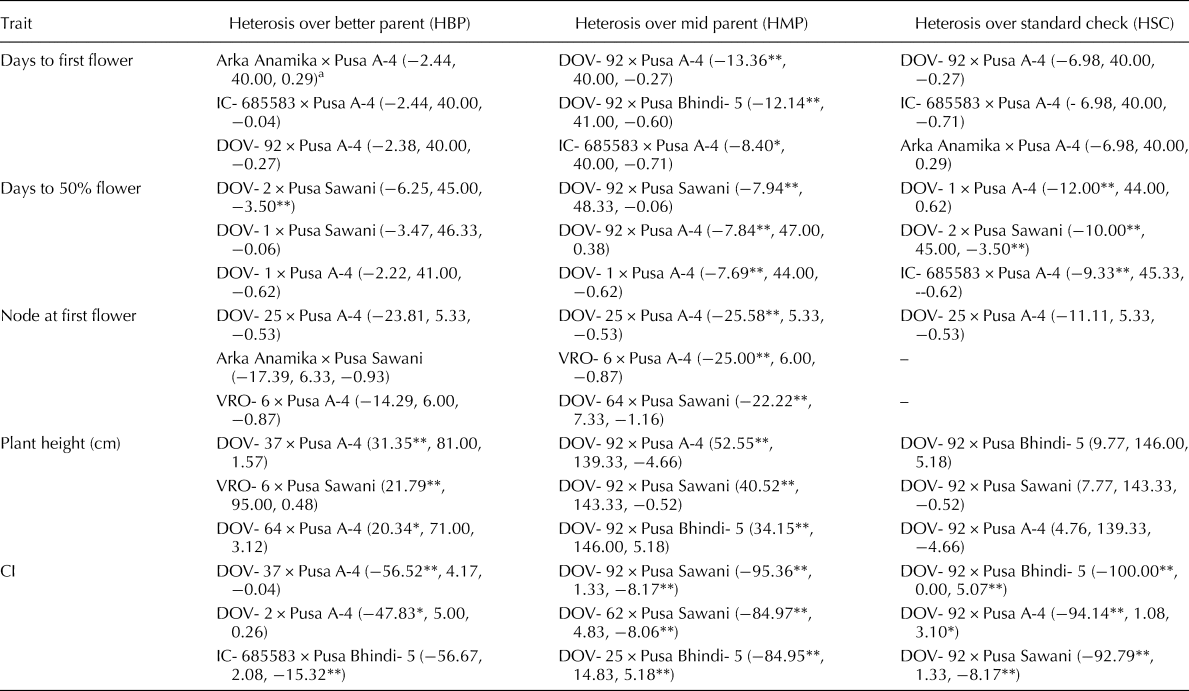
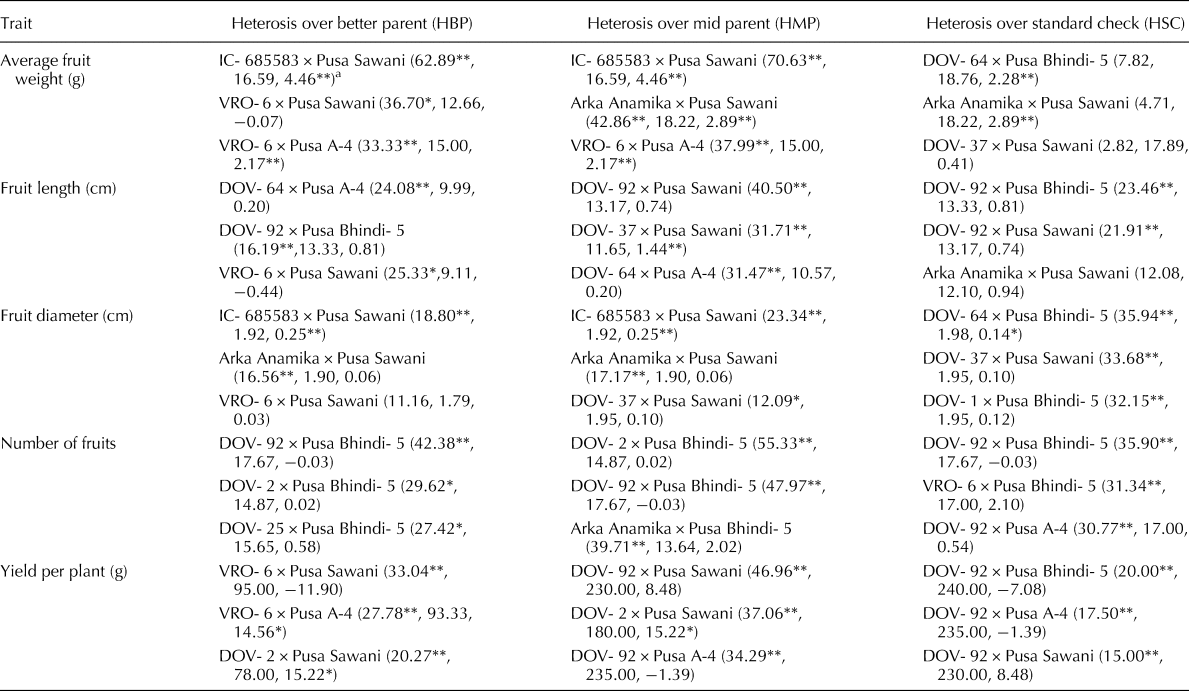
Heterosis was estimated for 10 morphological traits including the reaction of hybrids towards YVMV resistance. Based on heterosis percentage over the better parent, MP and standard check for all the traits, the top three best hybrid combinations have been selected (Tables 5 and 6). In this present investigation, none of the testcross progenies showed significant negative heterosis both over better parent (HBP) and standard check (HSC) for days to first flowering and node at which the first flower appears. However, in the case HMP, six and 12 crosses exhibited significant heterosis in a desirable negative direction for days to first flower and node to the first flower, respectively. Hybrid DOV- 92 × Pusa A-4 (−13.36) followed by DOV- 92 × Pusa Bhindi- 5 (−12.14) and IC- 685583 × Pusa A-4 (−8.40) for days to first flowering and hybrid DOV- 25 × Pusa A-4 followed by VRO- 6 × Pusa A-4 (−25.00) and DOV- 64 × Pusa Sawani (−22.22) for the node to the first flower were considered as top three best hybrids on the basis HMP. For days to 50% flowering, 12 crosses over MP and six crosses over commercial check revealed significant and negative heterosis but, none of the parents showed significant heterosis over the better parent.
Performance and heterosis of the top three F 1 hybrids for vegetative traits in okra

a Data in parentheses (positive and negative values) indicate heterosis percentage, the mean values of three replications, sca value, respectively.
*, ** significant at 5% and significant at 1% probability levels, respectively.
Performance and heterosis of the top three F1 hybrids for commercial traits in okra

a Data in parentheses (positive and negative values) indicate heterosis percentage, the mean values of three replications, sca value, respectively.
*, ** significant at 5% and significant at 1% probability levels, respectively.
For yield contributing traits namely, the number of fruits per plant, fruit length, fruit diameter and average fruit weight, heterosis in a positive direction is highly desirable. Out of 30 testcross progenies, four crosses over better parent and 11 crosses over MP showed significant heterosis for average fruit weight but none of them exhibited significant heterosis over commercial check in a desirable direction for the same trait. However, for fruit length six crosses, 14 crosses, and two crosses exhibited positive significant heterosis over the better, mid, and standard check, respectively. Hybrid DOV- 92 × Pusa Sawani (40.50) followed by DOV- 37 × Pusa Sawani (31.71) and DOV- 64 × Pusa A-4 (31.47) over MP and DOV- 92 × Pusa Bhindi- 5 (23.46) followed by DOV- 92 × Pusa Sawani (21.91) over check showed positive significant heterosis and considered as best cross combinations for fruit length. Based on fruit diameter, two crosses over the better parent, four crosses over the MP, and 19 crosses over commercial check revealed significant heterosis in a desirable direction. For the number of fruits per plant two crosses, 11 crosses and four crosses revealed significant heterosis over the better, mid, and standard parent. For HMP and HSP, hybrid DOV- 2 × Pusa Bhindi- 5 (55.33) followed by DOV- 92 × Pusa Bhindi- 5 (47.97) and Arka Anamika × Pusa Bhindi- 5 (39.71) and hybrid DOV- 92 × Pusa Bhindi- 5 (35.90) followed by VRO- 6 × Pusa Bhindi- 5 (31.34) and DOV- 92 × Pusa A-4 (30.77) respectively, considered as top three best cross combination that exhibited significant positive heterosis. Further, for yield per plant nine crosses over the better parent, 17 crosses over the MP, and three crosses over check parent revealed significant heterosis in a desirable direction. Hybrid DOV- 92 × Pusa Sawani (46.96) followed by DOV- 2 × Pusa Bhindi- 5 (37.06) and DOV- 92 × Pusa A-4 (34.29) and hybrid DOV- 92 × Pusa Bhindi- 5 (20.00) followed by DOV- 92 × Pusa A-4 (17.50) and DOV- 92 × Pusa Sawani (15.00) exhibited significant positive heterosis over mid and check, respectively, and considered as top three best hybrid combinations for yield per plant.
The height of a plant is also an important growth parameter as it is directly correlated to the yield of the crop. In our experiment, six crosses, 11 crosses and three crosses showed positive and significant heterosis over better, mid and check parent, respectively, for plant height. Hybrid DOV- 92 × Pusa Bhindi- 5 (9.77) and DOV- 92 × Pusa A-4 (52.55) showed the highest positive as well as significant heterosis over the standard check and MP, respectively. Further, two crosses over the better parent, 20 crosses over the MP and 21 crosses over the commercial hybrid Shakti showed significant negative heterosis which is desirable for CI of YVMV disease. Therefore, for this trait hybrid DOV- 92 × Pusa Sawani (−95.36) followed by DOV- 62 × Pusa Sawani (−84.97) and DOV- 25 × Pusa Bhindi- 5 (−84.95) and hybrid DOV- 92 × Pusa Bhindi- 5 (−100.00) followed by DOV- 92 × Pusa A-4 (−94.14) and DOV- 92 × Pusa Sawani (−92.79) are considered as top three best hybrid combination due to prevalence of significant heterosis in a desirable direction.
Discussion
Since the discovery of the phenomenon of heterosis by Shull (Reference Shull1908), work on heterosis was carried out by several workers in different crops. The biological phenomenon of heterosis was dependent mainly on two hypothesis – Dominance theory (first proposed by Davenport (Reference Davenport1908) and was later expanded by Bruce (Reference Bruce1910) and Over-dominance theory (independently proposed by East (Reference East1908) and Shull (Reference Shull1908)). The prime objective of any okra breeding program is to identify inbred lines having a good combining ability and then to develop superior hybrid varieties ever since hybrid vigour has been reported by Vijayaraghavan and Warrier (Reference Vijayaraghavan and Warrier1946). As yield is a complex trait and for vegetable crops, the only improvement of yield is not the only priority to the breeders, the resistance to different biotic and abiotic stresses also needs to be considered simultaneously. Although the number of hybrids having resistance to YVMV, a major viral disease of okra is already developed by several public and private sector organizations, it should be done constantly, as resistance against viral diseases is not quite stable and cannot be controlled fully by chemical means (Shetty et al., Reference Shetty, Singh and Singh2013). With this aim, the present investigation was carried out to identify good combining parents through line × tester mating design followed by developing superior hybrids which not only exhibit high yield but also showing resistance against YVMV disease. The scanty reports are available regarding analysing genetic diversity among the Okra germplasm. In the current investigation, sufficient amount of genetic diversity was found concerning molecular DNA markers. The results are in line with the findings of Kumar et al. (Reference Kumar, Parekh, Fougat, Patel, Patel, Kumar and Patel2016) who also revealed the substantial genetic diversity in the Okra accessions utilizing microsatellite markers. The polymorphism detected in the okra genotypes can be attributed to the amphidiploidy nature of Abelmoschus and their vulnerability to further mutations being polyploid than diploids (Kumar et al., Reference Kumar, Parekh, Fougat, Patel, Patel, Kumar and Patel2016). It was further supported by variance analysis which revealed the significance for all the studied traits indicating the prevalence of a sufficient amount of genetic variation among the treatments.
For designing any plant breeding program, the presence of sufficient genetic variation within the selected lines is very crucial. In our study, the prevalence of a significant amount of variation for all the traits was revealed from the ANOVA. Similar results were also reported previously by Solankey et al. (Reference Solankey, Singh and Singh2013) and Reddy et al. (Reference Reddy, Sridevi, Salimath, Nadaf, Patil and Hosamani2013) in okra. Knowledge of combining ability is one of the powerful tools for identification and early evaluation as well as to predict the heterotic response of the parents in their hybrid combinations. Within combining ability, desirable parents are selected through analysis of the GCA effect while, testcross progenies are evaluated based on their SCA effect for the development of heterotic hybrids (Sprague and Tatum, Reference Sprague and Tatum1942). Additionally, the analysis of combining ability helps to predict the nature of gene action and variation of genetic components within the population (Singh et al., Reference Singh, Dey, Bhatia, Kumar, Sharma and Behera2019). The magnitude of the degree of dominance is greater than one and the value of predictability ratio less than 0.5 for most of the traits proved that non-additive gene action played a significant role and selection of parents were ideal for this study. In addition to this, the success of any breeding program strongly depends on the heritability of a particular trait which can be defined as the proportion of genotypic variation to total variation. Heritability for a character can be estimated either in a broad sense (H 2 = σ 2G/σ 2P) which is a ratio of genotypic variance (σ 2G = σ 2A + σ 2D + σ 2I) including the effect of additive (σ 2A), dominance (σ 2D) and epistatic gene action (σ 2I) to phenotypic variance (σ 2P = σ 2G + σ 2E) or in a narrow sense (h 2 = σ 2A/σ 2P) which is the proportion of additive variance to phenotypic variance. In this present study, the dominance of non-additive components lowering down the value of h 2 indicated to construct a strategy for heterosis breeding rather than selection for a specific trait. These findings are also in conformity with Singh et al. (Reference Singh, Bhatia, Kumar, Sharma, Dash and Dey2018).
Within combining ability analysis, estimation of GCA allows us to predict in which direction parents will perform well. As the selection of parents only based on the GCA effect is not an ideal decision, thus per se performance for the particular trait is also considered in this regard. Among the lines, based on both GCA effect and per se performance, DOV-92 was considered as the best parent for major commercial traits like plant height, fruit length, yield per plant and CI. Parent DOV-62 showed both high GCA and mean value for plant height and CI while DOV-64 for fruit diameter and average fruit weight. Further, DOV-37 and VRO-6 were regarded as third best for average fruit weight and the number of fruits, respectively. While among the testers, Pusa A-4 was considered best performing for earliness favouring traits i.e. days to first flower and node to the first flower followed by Pusa Bhindi-5. Thus, these can be utilized as a male parent for the development of early maturing hybrids. A report of the GCA effect for this trait is also in agreement with previous workers (Dahake and Bangar, Reference Dahake and Bangar2006; Kumar et al., Reference Kumar, Singh and Dubey2012). The SCA effect determines the performance of a testcross combination and the role of non-additive gene action for the prediction of the heterotic potential of the hybrids (Aditika et al., Reference Aditika, Priyanka and Singh2020). It was observed that most of the cross combinations which exhibited high significant SCA effect in desirable direction consists of at least one good combiner parents like hybrid DOV-92 (good) × Pusa Bhindi-5 (poor) for plant height and DOV-64 (good) × Pusa Bhindi- 5 (poor) for fruit diameter selected as best hybrid combination based on both SCA and mean value (online Supplementary Table S9). It might be attributed due to the presence of both additive and non-additive components especially, the epistatic gene action of good and poor combiner parents, respectively, which can be feasible for selection as well as heterosis breeding program in hybrid development. Further, very few testcross progenies consist of both good combiner parents and exhibited high SCA effects such as VRO-6 (good) × Pusa Bhindi-5 (good) which was selected as the best hybrid combination based on both SCA and per se performance for the trait number of fruits per plant. It proved that the cumulative effect of both additive and additive × additive gene action of both the parents enabled the transfer of desirable genes from parents to offspring with high frequency. Thereby, those parents can be utilized for a hybridization program to accumulate more favourable genes through recombination and selection (Fasahat et al., Reference Fasahat, Rajabi, Rad and Derera2016; Singh et al., Reference Singh, Bhatia, Kumar, Sharma, Dash and Dey2018). However, sometimes despite parents having both good combiners for a particular trait may not always possess significant SCA value such as in hybrid DOV- 92 (good) × Pusa Bhindi-5 (good) showed negative and non-significant SCA effect although parents carrying high GCA value. It might be due to the inability of parents to contribute with its favourable alleles or absence of interaction within its favourable alleles (Desale et al., Reference Desale, Mehta and Singh2014). Conversely, test cross combination consisting of both poor combiner parents sometimes also exhibited high SCA value which was observed in hybrid DOV-2 × Pusa Sawani for days to 50% flower that showed both high SCA effect and the mean value. High SCA effect derived from poor × poor parental combination might be due to the prevalence of non-allelic interaction in the form of dominance × dominance type of epistatic gene action (Wassimi et al., Reference Wassimi, Isleib and Hosfield1986). A significant value of the SCA effect for most of the characters was also revealed by several other workers in okra (Kumar et al., Reference Kumar, Sokona, Adamou, Alain, Dov and Christophe2010; Khatik et al., Reference Khatik, Chaudhary and Khatik2013). Some of the hybrids in our study also exhibited a low SCA effect but showing a significant amount of heterosis in a desirable direction. Concurrently, the high GCA was also helpful for the selection of the parents in the future heterosis breeding program. However, heterosis over both mid, better and standard parent in desirable direction for earliness favouring traits i.e. days to first and 50% flower, node to first flower (Jindal et al., Reference Jindal, Deepak and Ghai2009), for fruit yield contributing characters i.e. average weight, length and diameter (Jaiprakashnarayan et al., Reference Jaiprakashnarayan, Prashanth, Mulge and Madalageri2008), for fruit yield and plant height (Medagam et al., Reference Medagam, Kadiyala, Mutyala and Hameedunnisa2012) and CI for YVMV disease (Solankey et al., Reference Solankey, Singh and Singh2016) was found in our study.
In conclusion, the estimation of genetic distance and SSR-based clustering patterns revealed that a considerable amount of diversity existed among the selected parents. Analysis of combining ability also helps to identify good general combiners like Pusa A-4 for earliness, Pusa Bhindi-5 for yield per plant, DOV-62 for plant height and CI for YVMV and DOV-92 for fruit length, plant height, yield per plant and CI for YVMV. Further, the percentage of heterosis over commercial check Shakti aids in the selection of DOV-92 × Pusa Bhindi-5 followed by DOV-92 × Pusa A-4 and DOV-92 × Pusa Sawani as the top three best hybrid combinations for yield per plant as well as CI for YVMV disease. However, a significant SCA effect in the desired direction for both of these traits was observed only in hybrid DOV-92 × Pusa Sawani which needs further investigation for the investigating true causes. Selected top three testcross progenies also need to be evaluated further for multi-location and multi-environment trials. Finally, estimation of the degree of dominance and predictability ratio also indicated the dominance of non-additive gene action for the majority of the traits which proved that selected parents were ideal for this study and one can go directly for heterosis breeding rather selection for yield and its contributing traits in okra.
Supplementary material
The supplementary material for this article can be found at https://doi.org/10.1017/S1479262120000337.
Acknowledgements
The first author is highly thankful to the Division of Vegetable Science, ICAR-IARI, New Delhi-12 for providing all sorts of facilities and financial support to carry out this work. Authors are also thankful to Mr. Sanjib Kumar Das, Assistant Teacher (English), Tarai Tarapada Adarsha Vidyalaya, Siliguri-734004 (West Bengal), India for assisting in editing English language throughout the manuscript.