INTRODUCTION
The genus Brachycythara Woodring, Reference Woodring1928 has been re-described by Powell (Reference Powell1966) and comprises small Recent and Tertiary turrids that mostly occur in the Caribbean area. The type species of this genus, Cythara gibba Guppy, 1896, comes from the Oligocene of Jamaica (Guppy & Dall, Reference Guppy and Dall1896: p. 306, plate XXVII, figure 9) and was recombined by Woodring (Reference Woodring1928) as Brachycythara gibba (type specimen USNM 107144). The taxon Cythara atlantidea Knudsen, Reference Knudsen1952 was described on two shells collected during the ‘Danish Expedition to the Coasts of Tropical West Africa, 1945–1946'. The type locality of this species is at coordinates 10°22′N 016°22′W (Guinea) (Knudsen, Reference Knudsen1952: p. 172); its distribution in the eastern Atlantic Ocean has been subsequently enlarged, ranging from Senegal to Angola, by the report of Rolán & Otero-Schmitt (Reference Rolán and Otero-Schmitt1999: p. 21), who ascribed the species to the genus Brachycythara. Thereafter, B. atlantidea has been reported from the southern coast of Spain (Costa del Sol, Alboran Sea) by Smriglio et al. (Reference Smriglio, Di Giulio, Gubbioli and Mariottini2007). It was proposed that the Mediterranean shells of B. atlantidea were representatives of a pseudopopulation (sensu Bouchet & Taviani, Reference Bouchet and Taviani1992), derived from passively drifting larvae from the nearby Atlantic Ocean. The multispiral protoconch of this species (indicative of planktotrophic larval development) supports this hypothesis. Recently, a fresh specimen of this turrid has been found in Sicily, which is the first record of the species from the Italian coast.
In the present paper we compare B. atlantidea with the closest species, B. beatriceae (Mariottini, Reference Mariottini2007) and B. clarae Peñas & Rolán, 2008 (in Peñas et al., 2008), reviewing their taxonomic status, and updating their distribution in the Mediterranean basin.
Abbreviations used:
Ex, exx, specimen, specimens; MNHN, Muséum National d'Histoire Naturelle, Paris, France; MZB, Museo di Zoologia dell'Università di Bologna, Bologna, Italy; USNM, United States National Museum of Natural History, Washington, DC, USA; ZMUC, Zoologisk Museum, Copenhagen, Denmark.
MATERIAL EXAMINED
The following specimens of Bela atlantidea were examined: 1 ex was trawled off Carini, Palermo, Sicily (38°14′N 013°11′E), trawled at 75 m depth by the fishing net of the vessel ‘Annagaia'; 3 exx off Estepona (36°25′N 5°09′W), Spain, trawled at 150–250 m depth; 1 ex off Adra (36°45′N 3°01′W), Spain, trawled at 80–150 m depth; 2 exx off Malaga (36°33′N 4°22′W), Spain, trawled at 50 m depth; 2 exx off Marbella (36°28′N 4°52′W), Spain, trawled at 30–40 m depth; 2 exx from the coast of West Sahara, trawled at 30–60 m depth. All specimens, with the exception of the Sicilian record, were previously cited in Smriglio et al. (Reference Smriglio, Di Giulio, Gubbioli and Mariottini2007). The paratype MNHN-21396 of B. clarae was examined both by light microscopy and scanning electron microscopy (SEM). SEM photographs were taken at the Interdepartmental Laboratory of Electron Microscopy (LIME), Università Roma Tre, Rome, Italy. Current systematics is based on the classification proposed by Bouchet et al. (Reference Bouchet, Kantor, Sysoev and Puillandre2011).
TAXONOMY
Class GASTROPODA Cuvier, 1795
Family MANGELIIDAE P. Fischer, 1883
Genus Bela Gray, 1847
Type species (by subsequent designation) Murex nebula Montagu, 1803
Genus Brachycythara Woodring, 1928
Type species (by original designation) Cythara gibba Guppy, 1896
Bela atlantidea (Knudsen, Reference Knudsen1952) comb. nov.
Cythara atlantidea, Knudsen Reference Knudsen1952, Videnskabelige Meddelelser fra Dansk naturhistorisk Forening I Kjobenhavn 114, 172–173, plate III, figure 5;
Brachycythara atlantidea, Rolán & Otero-Schmitt Reference Rolán and Otero-Schmitt1999, Argonauta 1, 21, figures 73–78.
ORIGINAL DESCRIPTION
‘Shell turriform with a fairly low spire. About 8 whorls are present separated by a suture, which is not very deep. The protoconch consists of about 21/2 whorls completely without sculpture. The upper part of the adult shell is ornamented with faint close set ribs, which gradually become more distant and prominent. On the body whorl and to a lesser degree on the penultimate whorl the ribs are slightly flexuous across the subsutural band, being at the same time broader and less distinct. On the body whorl 10 ribs are present. A spiral sculpture consisting of 2–3 lines is seen on the uppermost part of the adult shell. The number of striae is gradually increased, they are most distinct across the ribs, but are also seen in the interstices between these. On the body whorl about 30 spiral lines are present, while 8–9 are seen on the penultimate whorl. Besides this spiral sculpture a very delicate granulose sculpture can be detected under the microscope. The sculpture is found all over the adult shell and consists of regular rows of rounded granules. On the subsutural band they are arranged in curved axial rows. On the remaining part of the whorl they are present only in the interstices between the spiral lines. They are here arranged in spiral rows of which two or three are found in each interstice. Aperture oblong. Columella slightly convex. Outer lip simple, convex. Sinus broad. Sipho short and very broad. Coloration: greyish white becoming faintly brownish towards the upper whorls. Measurements: Holotype: 7.3 × 3.0. Paratype: 6.0 × 2.6.'
TYPE LOCALITY AND TYPE MATERIAL
Guinea, 10°22′N 016°22′W, 41–55 m depth. Holotype and paratype in ZMUC.
DISTRIBUTION
Eastern Atlantic Ocean, from Senegal to Angola, Mediterranean Sea.
ITALIAN RECORD OF BELA ATLANTIDEA
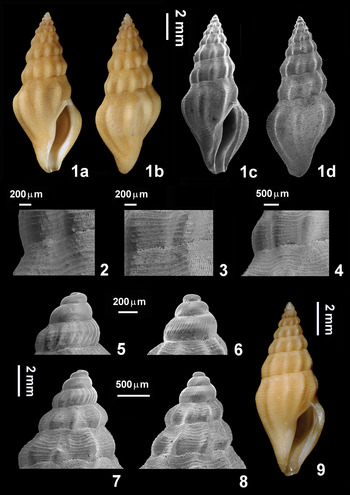
A specimen of B. atlantidea was collected from Sicily (Figures 1A–8) and compared to other material collected from the Atlantic Ocean and the Alboran Sea (Figure 9 and see MATERIAL EXAMINED) and it was unequivocally identified by means of SEM photographs.
Bela beatriceae (Mariottini, Reference Mariottini2007) comb. nov.
Brachycythara beatriceae, Mariottini Reference Mariottini2007, Nautilus 121,159–162, figures 1–9, 13–20.
Shells of Bela atlantidea (Knudsen, Reference Knudsen1952): (1A–8) off Carini (38°14′N 13°11′E), Palermo, Sicily, Italy, 75 m depth (12.1 × 5.1 mm). (9): off Marbella (36°28′N4°52′W), Spain, 30–40 m depth (10.5 × 4.3 mm).

ORIGINAL DESCRIPTION
‘Shell rather small, to 10.9 mm in length, holotype 8.6 × 3.4 mm, biconical, elongate–fusiform, solid, spire about half total height. Protoconch multispiral, dome shaped, of 3–3.5 strongly convex whorls, first 1.5–2 whorls smooth, remainder reticulated being composed of oblique axial costae crossed by spiral ribs of about equal width; protoconch indicative of a planktotrophic larval development. Diameter of protoconch about 700–750 µm. The protoconch–teleoconch transition not well marked. Teleoconch of 5–6 whorls, weakly angulate near middle of spire, sutural ramp gently concave, whorl sides gently convex; last whorl about 2/3 shell length. Axial sculpture consisting of 7–8 prominent, slightly opisthocline, flexuous, and narrowly rounded axial folds; folds regularly spaced, with much broader interspaces, reaching from suture to suture on spire but fading out after crossing the shoulder slope and at about the middle of the base. Spiral sculpture of numerous very fine threads that densely alternate with bigger interspaces; the subsutural thread shows well-marked axial denticles. At higher magnification, it can be observed that each interspace consists of several (up to five) rows of rounded tiny granules, each one linked axially to the upper and lower thread by a very fine connection. Aperture narrow, ovate, about one-third of the shell height. Siphonal canal short, narrow, and open. Inner lip with a moderately developed parietal callus pad. Outer lip thin or variced, according to the stage of growth, whether the lip coincides with an axial rib or an interspace. Anal sinus marked, arcuate on shoulder slope. Shell color white, with a brown band on lower half of body whorl (juvenile and subadult shells uniformly white); a darker spot present on the outer lip at the boundary of the white and the brown colors.'
TYPE LOCALITY AND TYPE MATERIAL
Alboran Sea, Spain, off Marbella, 36°28′N 4°52′W, 30–40 m depth. Holotype No. 31032 in MZB.
DISTRIBUTION
Alboran Sea (Costa del Sol, Spain) and eastern Atlantic Ocean (West Sahara).
BELA CLARAE TYPE MATERIAL
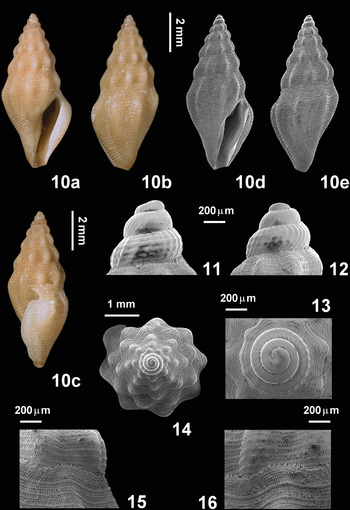
The paratype MNHN-21396 of Bela clarae (Figures 10–16) was analysed by light microscopy and SEM and the examination of its protoconch, consisting of 3 whorls, revealed a bigger diameter (650 µm) than the one reported for the holotype (476 µm). The general shell feature of this paratype (protoconch and teleoconch sculpture, 9 teleoconch axial folds of the last whorls, teleoconch length/width ratio of 2.4, shell colour uniformly yellowish-brown) are perfectly matching the ones re-described for B. atlantidea in Mariottini (Reference Mariottini2007).
Paratype MNHN-21396 of Bela clarae Peňas & Rolán, 2008, Vallcarca, Sitges, Barcelona, Spain, 45–60 m depth (7.4 × 3.2 mm).

DISCUSSION
Differences between the genera Brachycythara and Bela are quite faint and mainly refer to the following: Brachycythara shells are smaller (4.0–8.6 mm), turreted, stouter, with the outer lip slightly thickened and with a sculpture of stout axial folds barely overridden in respect to the shells of the genus Bela (Powell, Reference Powell1966: pp. 97, 117).
The turrid Brachycythara atlantidea was ascribed to the genus Brachycythara by Rolán & Otero-Schmitt (Reference Rolán and Otero-Schmitt1999) with a short and general comment: ‘The shells studied here have the typical characters of the genus, including the biconical profile'. In our opinion this taxon better fits the genus Bela, since it shows: a dome-shaped multispiral protoconch consisting of three whorls (first smooth, second with axial riblets, third reticulated with spiral rows of tubercles); teleoconch of medium size for the genus, with an elongate–fusiform shape, and with a spire about half of the total height; axial sculpture with 8–10 prominent, flexuous, and rounded axial and regularly spaced folds, with much broader interspaces; spiral sculpture of numerous very fine threads that densely alternate with bigger interspaces; subsutural thread shows well-marked axial denticles; aperture narrow, ovate, siphonal canal is short, narrow, and open; inner lip with a moderately developed parietal callus pad; outer lip thin or variced, according to the stage of growth, whether the lip coincides with an axial rib or an interspace; and shell colour uniformly yellowish-brown. Furthermore, the type species of Brachycythara (Cythara gibba Guppy, 1896) comes from the Miocene of the Caribbean area, while Recent species from the Caribbean, West Africa and the Mediterranean Sea are closer to those of the genus Bela. Therefore we are prone to consider Brachycythara as a fossil genus and to include Recent species in Bela.
Taken together all these morphological features prompted us to move Brachycythara atlantidea to the genus Bela and ranking this turrid as Bela atlantidea (Knudsen, Reference Knudsen1952) comb. nov. The recently described turrid Brachycythara beatriceae Mariottini, Reference Mariottini2007 shows a strong morphological shell similarity with B. atlantidea, reflecting a close relationship, while it differs in some diagnostic characters such as: more ovate–fusiform shell outline, bigger protoconch (700–750 µm); and the teleoconch colour which is invariantly white with a basal brown band. Interestingly, the distribution of B. beatriceae (Alboran Sea and West Sahara) represents a subset of that of B. atlantidea, suggesting that we are facing two sister species. The analyses carried out in this study that have driven the genus change of B. atlantidea, strongly suggest that B. beatriceae also be moved to the genus Bela. For this reason we changed the epithet to Bela beatriceae (Mariottini, Reference Mariottini2007) comb. nov. After a morphological shell comparison between several specimens of B. atlantidea and the paratype MNHN-21396 of Bela clarae Peňas & Rolán, 2008 (see material examined) we synonymized this taxon with B. atlantidea. Peňas et al. (Reference Peňas, Rolán and Ballesteros2008) described as diagnostic characters of B. clarae a small protoconch and a different sculpture of the third protoconch whorl, though they recognized a strong similarity in shape and size of the teleoconch of B. clarae with B. atlantidea. However, the present comparative study clearly demonstrated that the protoconch is identical to the one of B. atlantidea in terms of size and sculpture. The small protoconch diameter reported for the holotype of B. clarae (476 µm) seems likely to be erroneous, as resulting from the re-measuring of the SEM picture published by Peňas et al. (Reference Peňas, Rolán and Ballesteros2008: figure 27), showing a tilted protoconch.
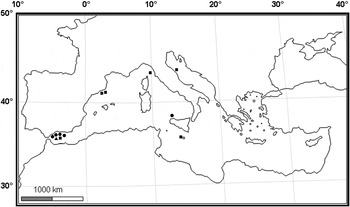
According to WoRMS (World Register of Marine Species, available at http://www.marinespecies.org/index.php) the Mediterranean (Alboran Sea) record of B. atlantidea is based on specimens brought in by fishing boats and requires confirmation. Albeit we report only one specimen of this turrid from Sicily, the freshness of the shell indicates that most probably this specimen was indeed living in the area sampled (Figure 17). Due to the synonymy between B. atlantidea and B. clarae, all the previous records of the latter one must be ascribed to B. atlantidea. From this new perspective, it results that the distribution of B. atlantidea is currently covering a wider range in the Mediterranean basin, including two other Italian spots (Gorgona Island, Tuscany Archipelago; off Pesaro, Adriatic Sea) and Malta as reported by Peňas et al. (Reference Peňas, Rolán and Ballesteros2008) (Figure 17). Since the presence of B. atlantidea within the Mediterranean Sea is confirmed, this taxon can be added to the list of the Italian Mangeliidae.
Mediterranean records of Bela atlantidea (Knudsen, Reference Knudsen1952) and B. beatriceae Mariottini, Reference Mariottini2007. B. atlantidea, circles; B. clarae, squares; B. beatriceae triangle.

CONCLUSIONS
This study focused nearly exclusively on shell characters of three mangeliine species that we considered related:
-
(1) we included Brachycythara atlantidea (Knudsen, Reference Knudsen1952) and Brachycythara beatriceae Mariottini, Reference Mariottini2007 within the genus Bela sensu lato, so we proposed Bela atlantidea comb. nov. and Bela beatriceae comb. nov.;
-
(2) we proposed the synonymy between B. atlantidea and Bela clarae Peňas & Rolán, 2008; and
-
(3) the distribution of B. atlantidea in the Mediterranean basin was therefore updated including records of B. clarae.
ACKNOWLEDGEMENTS
The authors gratefully acknowledge Giuseppe Lucido (Palermo, Italy) who helped S.C. to collect molluscs by trawling with his fishing boat ‘Annagaia'. We are indebted to Ermanno Quaggiotto (Longare, Vicenza, Italy) and Giuseppe Bonomolo (Palermo, Italy) for their useful suggestions and to Ferdinando Meli (Capaci, Palermo, Italy) for cooperation and technical support. We express our gratitude to Virginie Heros (curator of the Mollusca section of MNHN) for the loan of the paratype of B. clarae and to two anonymous referees for their helpful comments that greatly improved the manuscript.