Introduction
Dementia presents one of the most challenging healthcare issues in present and will be in future. The decline of cognitive functioning is a central part of this neurodegenerative disease. In an advanced stage of dementia, the incidence of behavioral and psychological symptoms is regarded to be more challenging for caregivers than the cognitive impairment itself. Behavioral and psychological symptoms of dementia (BPSD) include “symptoms of disturbed perception, thought content, mood, or behavior that frequently occur in patients with dementia” (Draper et al., Reference Draper, Finkel, Tune, Draper, Brodaty and Finkel2015, p. 1.5). Behavioral symptoms include physical aggression, screaming, restlessness, agitation, wandering, culturally inappropriate behaviors, sexual disinhibition, hoarding, cursing, and shadowing; Psychological symptoms include anxiety, depressive mood, hallucinations, and delusions (Draper et al., Reference Draper, Finkel, Tune, Draper, Brodaty and Finkel2015, p. 1.5). Especially in advanced stages of dementia, BPSD often lead to hospitalization or admission into long-term care nursing homes (Zuidema et al., Reference Zuidema, Derksen, Verhey and Koopmans2007). Institutionalization is associated with a high incidence of falls due to cognitive impairment, frailty, instability, or BPSD with consecutive psychopharmacological treatment (Eriksson et al., Reference Eriksson, Strandberg, Gustafson and Lundin-Olsson2009). In addition to patients’ mobility impairment and high risk of falling, clinicians are confronted with aberrant motor behavior symptoms, i.e. restlessness or circadian rhythm disturbances (Lyketsos et al., Reference Lyketsos2011).
There is a plethora of evidence concerning serious side effects of antipsychotic medication in the treatment of BPSD. Thus, there is an urgent need for tailoring non-pharmacological treatment approaches in patients suffering from dementia (Kales et al., Reference Kales, Gitlin and Lyketsos2015). Tailored interventions require appropriate clinical assessment tools as well as objective data on patients’ motor behavior. These data are often not available in these patients. The frequency and severity of motor behavior symptoms are usually rated on the basis of ordinal ranking scales or dichotomized estimations, and often there is no objective classification of the severity of symptoms, since the assessment is commonly based on direct observation, video-monitoring or proxy-assessment (King-Kallimanis et al., Reference King-Kallimanis2010). According to previous studies, the use of these subjective assessment methods can lead to an over- or underestimation of aberrant motor behavior (King-Kallimanis et al., Reference King-Kallimanis2010), thereby limiting its clinical use (Halek and Bartholomeyczik, Reference Halek and Bartholomeyczik2012).
Motion sensors fixed to the body can be used to objectively assess aspects of motor behavior associated with BPSD, like general restlessness, wandering behavior, and circadian rhythm disturbances of patients’ motor behavior (Zijlstra and Aminian, Reference Zijlstra and Aminian2007; Zijlstra et al., Reference Zijlstra, Becker, Pfeiffer and Ziefle2011). Regarding their use in clinical care, current motion sensors are smaller and allow for unobtrusive assessments in comparison to previous devices with cable-based data traffic and an external data storage as well as power source. Therefore, these current sensor-devices may present an interesting, new approach to assess motor behavior disturbances in dementia care and clinical research. Until now, uni- and multi-axial accelerometers have most commonly been used to log patients’ motor behavior in relation to time of the day. Widely used types are actigraphs (Morgenthaler et al., Reference Morgenthaler2007), commonly used in sleep medicine and chronobiological research to assess circadian motor behavior. Actigraphs accumulate raw activity counts of body or limb movements (Morgenthaler et al., Reference Morgenthaler2007; Van Someren, Reference Van Someren2011). The small watch-like devices are attached on the patient's wrist to log the periodicity of limb movements. These actigraphic data do not enable detecting specific motor behavior patterns in relation to posture, acceleration, or movement direction. Actigraphs can only record the presence or absence of motor activity. Additional objective methods include the use of pedometers, attached to the patients’ ankle or waist, in order to log a patient's step count over several days (Algase et al., Reference Algase, Beattie, Leitsch and Beel-Bates2003; Kirste et al., Reference Kirste2013). The success of applying devices on the limb or waist for several days is limited in patients with dementia because these devices are often removed especially by patients suffering from advanced dementia (Camargos et al., Reference Camargos, Louzada and Nóbrega2013).
The application of motion sensor systems fixed on the patient's lower back may be a more successful approach if patients get used to them and the presence of the sensor remains unnoticed. Based on three-dimensional hybrid motion sensors on the lower back, patients’ body posture can be recorded over several days, which allows the analysis of individual mobility patterns as an indication of the patients’ motor behavior (Zijlstra and Aminian, Reference Zijlstra and Aminian2007; Zijlstra et al., Reference Zijlstra, Becker, Pfeiffer and Ziefle2011). However, at present it is unclear whether patients suffering from dementia tolerate the attachment of sensors on the lower back for several days. Hence, our aim was to investigate (a) the feasibility of using a sensor on the lower back in patients with dementia during a period of at least 72 consecutive hours; and (b) patterns of mobility-related (in)activity in these patients during their hospital stay in specialized dementia care wards.
Methods
Study design
Cross-sectional study as part of a clinical RCT (German Clinical Trial Register: DRKS00006740; Fleiner et al., Reference Fleiner, Zijlstra, Dauth and Haussermann2015). Ethical approval was obtained by the ethics commission of the German Sport University Cologne and the ethics commission of the North-Rhine Medical Chamber.
Setting and participants
Patients were recruited from three specialized dementia care units of a geriatric psychiatry hospital. These were admitted to this hospital because of an acute exacerbation of BPSD – e.g. aggressive behavior, apathy, or circadian rhythm disturbances that lead to increased endangerment of themselves and others, or extremely increased caregiver burden. Inclusion criteria are as follows: primary form of dementia according to ICD-10 classification (World Health Organisation, 1997), exclusion of delirium (Inouye et al., Reference Inouye, van Dyck, Alessi, Balkin, Siegal and Horwitz1990); ability to perform the Timed Up and Go-Test (TuG) (Podsiadlo and Richardson, Reference Podsiadlo and Richardson1991) without personal assistance – the use of a walking aid was no exclusion criteria. Written approval for participation either by the patient or the legal guardian was required. In accordance with the ethical approval, the following consent for participation was conducted: If the cognitive impairment as measured by the Mini-Mental Status Examination (MMSE) (Folstein et al., Reference Folstein, Folstein and McHugh1975) was less than 20 points, the legal guardian of the patient had to approve the participation. If a patient had reached 20 points or more and was able to explain the content and target of the project in his own words, his decision for participation was considered as accountable.
Instruments
Cognitive functioning was assessed via MMSE (Folstein et al., Reference Folstein, Folstein and McHugh1975), Demtect (Kalbe et al., Reference Kalbe2004), and the Clock Drawing Test (CDT) (Sunderland et al., Reference Sunderland1989). Cognitive reserve capacity was quantified according to Stern (Stern, Reference Stern2002). Patients’ mobility and capability to perform activities of daily living were measured via TuG, 10 m gait speed (Ries et al., Reference Ries, Echternach and Gagon Blodgett2009) and the Bayer instrumental activities of daily living (Hindmarch et al., Reference Hindmarch, Lehfeld, Jongh and Erzigkeit1998). The patients’ neuropsychiatric symptoms were measured by the Neuropsychiatric Inventory (Cummings et al., Reference Cummings, Mega, Gray, Rosenberg-Thompson, Carusi and Gornbein1994) and the Cohen-Mansfield Agitation Inventory (Cohen-Mansfield and Billing, Reference Cohen-Mansfield and Billig1986). In order to monitor the patients’ motor behavior, uSense sensors (FARSEEING EU-Consortium, 2015) were attached on patients’ lower back with waterproof adhesive foil (Opsite FlexiFix, Smith & Nephew Medical Ltd., Hull, Eng). This attachment allows to remove the sensor by the patient himself. The uSense sensor is a 3D hybrid motion sensor with integrated tri-axial accelerometer, gyroscope and magnetometer. Data were sampled at 100 Hz and stored on an internal storage medium. Each patient was advised to wear the sensor for 72 consecutive hours. If a patient perceived the sensor-attachment as uncomfortable or painful, the nursing staff was given one additional try to motivate the patient. If the patient repeated his unwillingness to tolerate the sensor device, the nursing staff removed the sensor device. In order to assess the feasibility of the sensor attachment in these patients, occurrence of adverse events within each assessment period were logged in a clinical protocol. Furthermore, dermatological tolerance was clinically monitored.
Data-analysis
Based on the sensor data, patients’ body-postures over three consecutive days were analyzed by means of a hierarchical classification approach: activity counts at intervals of 1 sec were calculated according to Sasaki et al. (Reference Sasaki, John and Freedson2011) and the cut-points on the intensity of physical activity were used for distinguishing between “sedentary” and “active” periods. In “sedentary” time intervals the interval was labeled as “lying” if the angle between the vertical axis of the sensor/trunk and the horizontal plane was below 15° for a prolonged period of time. Otherwise, it was defined as “sedentary” sitting or standing. In “active” time intervals a step detector was used for selecting walking bouts, labeled as “gait,” otherwise time intervals were labeled as “active” sitting or standing. Due to circadian rhythm disturbances in patients’ motor behavior, only complete days of measurement, from 00:00 on the first day to 24:00 on the second day have been included in the analysis. If two complete measurement days were available, averages of both recorded days were calculated and included in further analyses.
The results of the sensor-recordings of each patient were checked upon consistency with the observations of the nursing stuff based upon the routine clinical protocols. The measures of central tendency were realized via means, standard deviations, minima, and maxima within the descriptive statistics. The feasibility of the sensor-based assessment method and the daily activity levels were analyzed based on these descriptive statistics. All of the aforementioned analyses were carried out in MATLAB (Release 2012b, The MathWorks, Inc., Natick, MA), subsequent statistical evaluation of the data was done in MS EXCEL (Excel 2007, Microsoft, Inc., Redmond, WA).
Results
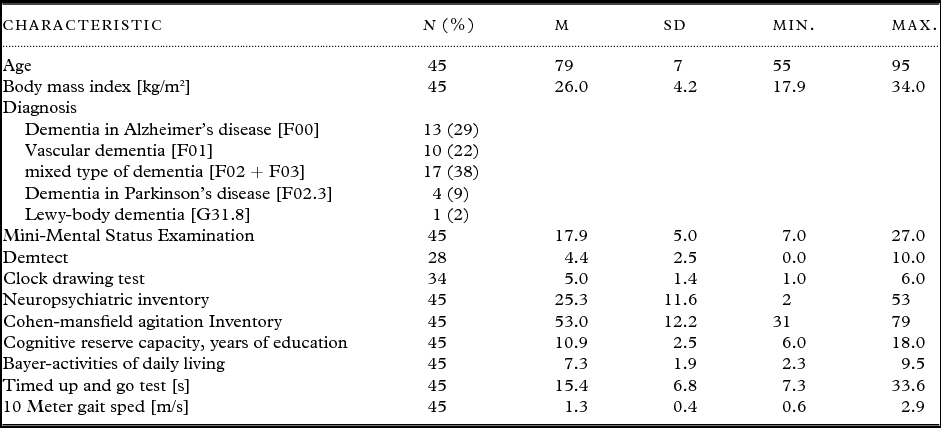
A group of 45 patients (26 women and 19 men) was included in this cross-sectional investigation. Group characteristics are presented in Table 1.
Patient characteristics (N = 45; 26 w/19 m)

M = mean; SD = Standard deviation; Min. = Minimum; Max. = Maximum
The basic screening tool for dementia in our study was the MMSE. All included patients, managed to perform the MMSE. Cognitive performance of all patients ranged from mild to severe cognitive impairment, with a mean MMSE score of 17.9 points. Some of the more severely demented patients were not able to perform the Demtect and CDT as they did not understand the basic test-instructions.
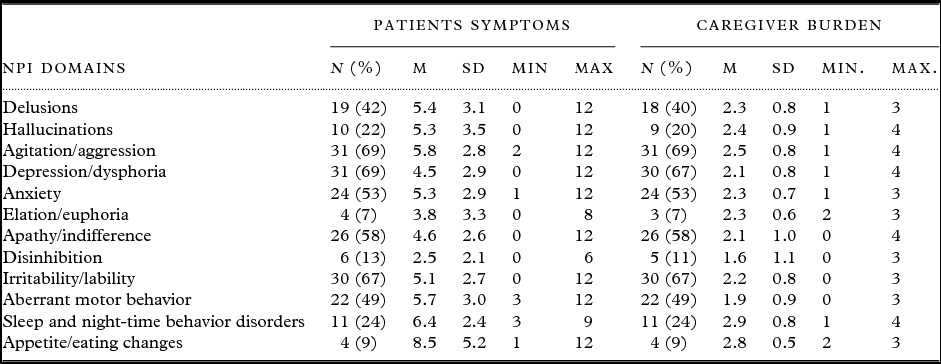
The specific underlying types of dementia are presented in Table 1, the neuropsychiatric symptoms are illustrated in Table 2.
Neuropsychiatric symptoms measured by the NPI (N = 45)

Patients symptoms: frequency*severity scores (0–12; 0 meaning absent); caregiver burden (0–5; 0 meaning not at all); M = mean; SD = Standard Deviation; Min. = Minimum; Max. = Maximum
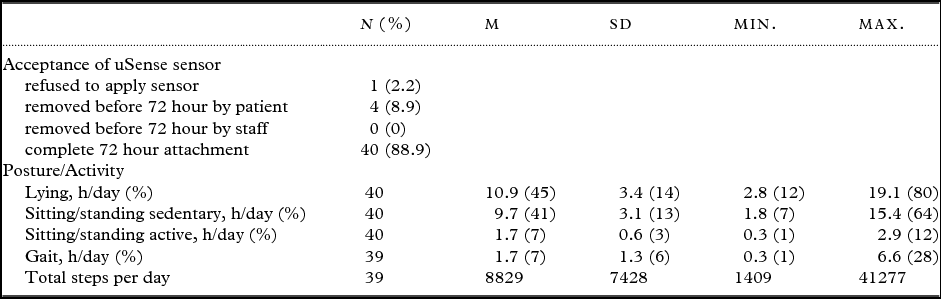
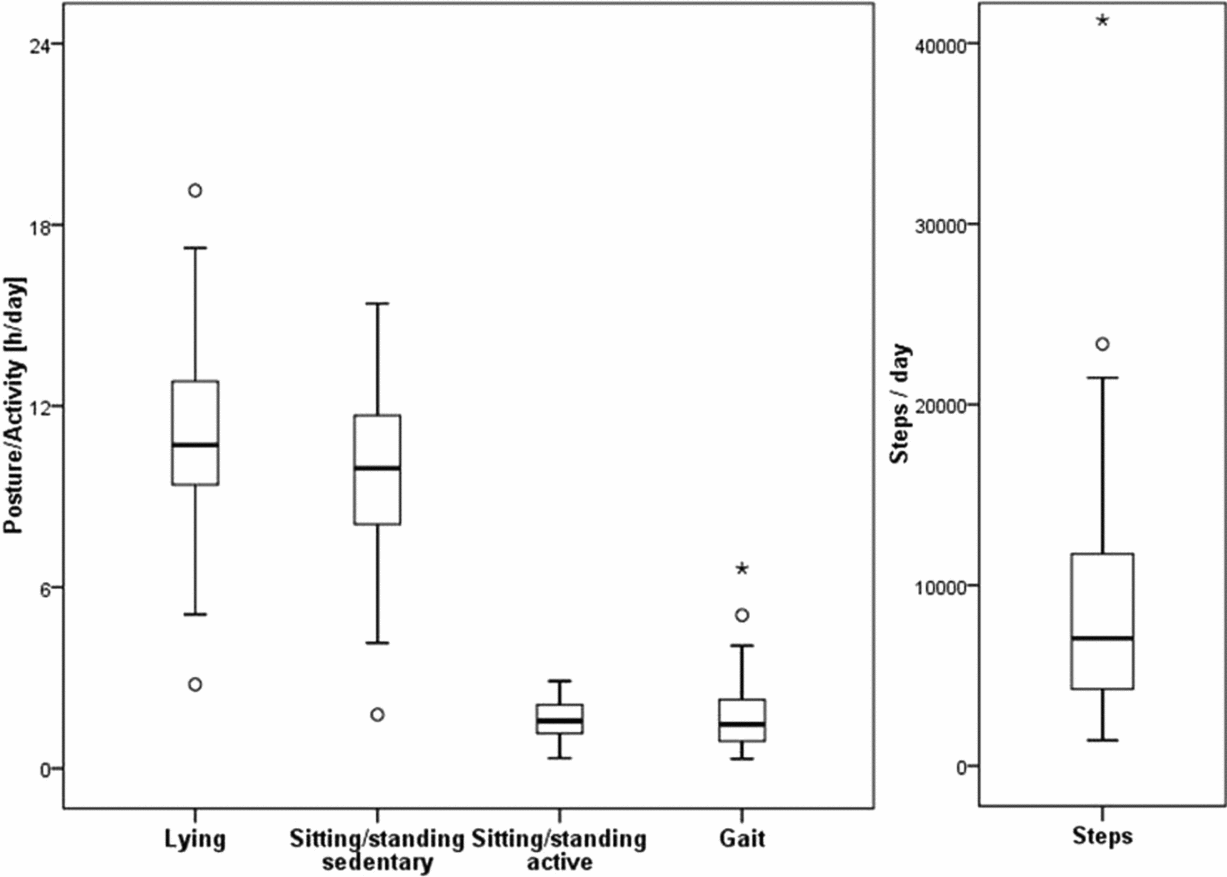
According to the clinical protocol (Table 3), 44 patients (97.8%) accepted and one patient refused the initial attachment of the uSense sensor device. Five patients removed the sensor device before the end of the three day period. Sensors were found in the patients’ bathroom (n = 2), the social room of the ward (n = 1) or were handed in to the nursing staff (n = 2). During the 72 hours, there was no need to remove the sensor due to adverse skin reaction, pressure ulcer or intercurrent exacerbation of psychiatric symptoms, e.g. advanced persecution mania. Two out of the 44 raw data sets were incomplete or deficient, hence the technical feasibility of acquiring sensor data was 95.5%. The analysis of the patients’ motor behavior is presented in Table 3. Due to self-removal of the sensor, measurement days of two patients were missing. In consequence the patients’ body postures were analyzed based on the remaining 40 data sets. One patient using a 4-wheeled-walker for locomotion was excluded in the analysis of gait-phases and steps per day, as this prevented an adequate step-detection. Apart from this patient, the characteristics of patients’ motor behavior are consistent with clinical observations reported within nursing protocols (see Table 3 and Figure 1). The following two cases further illustrate the usefulness of the sensor-based analyses:
-
1. Male, 79 years, mixed type of dementia; MMSE: 17/30
-
Nursing-protocol: “general restlessness on ward; patient has to be brought back to the table, because he permanently rises from the chair and walks around during lunch; can't sit longer for more than one minute”
-
Sensor-analysis: 6.6 h/day walking; 1 h/day sitting; 41,277 steps/day
-
2. Female, 74 years, Alzheimer's disease; MMSE: 15/30
-
Nursing-protocol: “from 04.45 a.m - 08.45 a.m.: disorientation and nightly psychomotor agitation; patient lays down in different beds because of disorientation; stressed behavior”
Feasibility aspects and average sensor-based measures of patients' motor behavior

M = mean; SD = Standard Deviation; Min. = Minimum; Max. = Maximum
Box-Plot illustration of uSense-derived patients’ mobility-related motor behavior [mean total hours/posture/day] (N = 40; N = 39 for Gait and Steps (see text for further explanation)).

Sensor-analysis: from 04:45 a.m–08:45 a.m.: 2.6 hour walking, 14,950 steps
Discussion
This cross-sectional study's aim was to investigate the feasibility, acceptance, and relevance of hybrid motion sensors when assessing motor activity patterns in patients with of dementia during their hospital stay in an acute hospital setting.
This is the first investigation in this patient population monitoring patients’ physical activity derived from body-worn sensor data based on the analyses of the sequence of specific body postures rather than actigraphy. The overall success rate in realizing the 72 hour measurements with motion sensors attached with adhesive foil on the patients’ lower back was generally high (i.e. 88.9%; see Table 3). This may be due to the aspect that the sensors attached on the patients’ lower back with adhesive foil were not obtrusive and most of the patients did forget that they have attached anything on their back. The adherence to wearing the sensor and the absence of adverse skin reactions in our participants demonstrate that the attachment of the sensor device on the patients’ lower back offers a unique chance to monitor motor behavior in patients suffering from dementia. In previous studies, using wrist-worn actigraphs removal or total refusal have been a major problem in patients with dementia (Camargos et al., Reference Camargos, Louzada and Nóbrega2013). Serfaty et al. (Reference Serfaty, Kennell-Webb, Warner, Blizard and Raven2002) reported that more than one third of their patients suffering from dementia refused to wear the device or had them removed. We found the lower-back attached hybrid sensors to be more accepted than wrist-worn accelerometers that have previously been applied in dementia research.
The analysis of the sensor data reveals a wide spectrum of activity patterns (Table 3; Figure 1). Comparing the average daily sedentary time of 20.6 hour (85.8%), including sedentary sitting or standing as well as lying, to 3.4 hour (14.2%) of active time, including active sitting or standing and gait, indicates a very low level of physical activity in general in hospitalized patients with exacerbated BPSD. These results are comparable to a trial by Schwenk et al. (Reference Schwenk, Hauer, Zieschang, Englert, Mohler and Najafi2014), who investigated patients’ physical activity when discharged from a geriatric rehabilitation ward either to their home (88.3%) or to a nursing home (11.7%). These patients had worn an inertial sensor device, similar to our sensor-set-up, attached on the chest for 24 consecutive hours. With over 80% of sedentary time during daytime (lying + inactive sitting or standing), there is a comparable level of physical activity seen in both studies. Patients in our study spent more time during the day walking (7.2% vs. 4.5% in Schwenk et al.) with a wider spectrum of this walking behavior respectively (SD 6% vs. 3% in Schwenk et al.). These differences may be caused by the more advanced stage of cognitive impairment in our study sample (mean MMSE = 17.9/30 compared to 22/30 in Schwenk et al.), as well as the different stage of dementia care (i.e. patients in an acute hospital setting vs. community-dwelling patients).
We were surprised to see most patients with an exacerbation of BPSD lying and sitting sedentary for most time of the day. Whether this is due to psychopharmaceutical (over-) sedation, lack of therapeutical stimulation, or simply caused by the hospital setting itself needs further clarification. The fact that most patients had immanent severe geriatric and other somatic problems, with sarcopenia, dehydration, and gait disturbances frequently observed, might be important. Some of the patients had periods of gait instability or immobility. This might have contributed to the sedentariness seen most of our patients. However, all patients initially managed to perform the TuG-test, indicating an overall good mobility.
Some of our patients were generally restless and hyperactive, e.g. patients with more than 40,000 steps/day going straight up and down the floor or patients taking 15,000 steps on the floor within 150 minutes in the early morning hours. Clinicians and hospital staff often face such problematic motor behavior symptoms in patients with dementia. The analysis of objectively assessed motor activity patterns might, in future, help to better plan and control pharmacological as well as non-pharmacological treatment approaches. The consistency of the sensor-derived physical activity patterns and the clinical protocol indicates a good basis for the use of such body-worn sensors as an objective tool in clinical routine.
Our data acquisition and analysis protocol presently requires additional personnel in comparison to common clinical care – e.g. to initialize and start the sensor recording requires multiple steps; downloading and converting data requires two hours; and the first steps in data analysis can only be conducted with specific knowledge. However, less personnel is needed if parts of the sensor handling in clinical use (e.g. resetting the memory and starting the data acquisition) and data processing are being further automated. The detection of shuffling while leaning on a walker remains a challenge: During this type of locomotion there are only marginal vertical trunk accelerations. Hence, the accelerations measured at the lower back do allow for step detection when the patient is shuffling. In these patients, the use of sensors attached to the ankle or thigh might be a more appropriate method.
As this trial reports the results of a new assessment method in hospital dementia care, it is important to state the following limitations for this investigation: Patients with different types of dementia have been included in the sample (see Table 1). Thus a heterogeneous patient sample has been included, i.e. patients with advanced motor symptoms as well as patients without motor behavior symptoms. Furthermore, it is important to note that only descriptive data analyses have been conducted. We did not yet analyze the patients’ motor behavior in relations to diagnoses, symptoms, or clinical ratings. Besides these aspects, the length of the recording period is a key issue; due to a limited data storage and power supply, a recording phase of 72 hour has been applied for this trial. This recording period is in accordance with Ward et al. (Reference Ward, Evenson, Vaughn, Rodgers and Troiano2005) who state a minimum period of 3 days is required to analyze patterns of motor behavior. Since, there was no indication of the acceptability of our method in this population, our study took the 72 hour as a starting point. Our study shows the feasibility of our sensor-based assessment of motor behavior in hospital dementia care over 72 hour. However, depending on specific goals, further analyses of the patients’ mobility related motor behavior may require a longer period of data recording.
Beside these limitations, our study indicates an excellent feasibility of using lower back fixed sensor devices in clinical dementia care. The assessment of motor behavior, especially mobility, is currently a key aspect in geriatric healthcare and will continue to be in the future. In many countries national guidelines for mobility facilitation are being prepared or have yet to be established (The German Network for Quality Development in Nursing, 2014) focusing on mobility and motor behavior in cross-sectoral healthcare and explicitly including patients with dementia. Furthermore, the application of body-fixed sensors could provide reliable data in the assessment and objective rating of mobility-related neuropsychiatric symptoms in patients suffering from dementia (Kirste et al., Reference Kirste2013; Pan et al., Reference Pan2013). The analysis of the patients’ body postures over long time periods (days/week) offers a valuable progress in the assessment of circadian motor behavior in patients with dementia. This approach has more potential compared to the wrist-worn actigraphy (van Someren, Reference van Someren, Magjarevic, Dössel and Schlegel2009) and the commonly used geriatric assessment rating scales (King-Kallimanis et al., Reference King-Kallimanis2010). Along with advanced analysis methods, the use of hybrid body-fixed motion sensors may provide a basis for tailoring and evaluating innovative therapeutic approaches more effectively in hospital care with patients suffering from dementia.
Conflict of interest
The authors declare no conflict of interest. Sabato Mellone owns a share in the company mHealth technologies srl, Bologna, Italy. mHealth technologies srl, among other things, develops wearable solutions for monitoring, assessment, and rehabilitation of the motor function.
Description of authors’ roles
Fleiner: study concept, data acquisition, statistical analysis, interpretation of data, draft, and revision of the manuscript. Haussermann: study concept, data acquisition, clinical interpretation of data, draft, and revision of the manuscript. Mellone: analysis of the sensor raw data, revision of manuscript. Zijlstra: study concept, further data analysis, interpretation of data, draft, and revision of the manuscript.
Acknowledgments
The authors would like to thank all participants, caregivers, and legal guardians for their willingness to take part in this investigation. We also thank the board of directors of the LVR-hospital cologne and the staff of the department of geriatric psychiatry for their support in this trial. This investigation was partly funded by a young researchers funding of the German Sport University Cologne (TF), SFB 654, Teilprojekt 14 (PH), FARSEEING (TF, SM, WZ) and the institutional budgets of the authors. The funding agencies did not play any active role in the scientific investigation and reporting of the study. All authors had complete independence in this study.