Ebstein’s anomaly is a rare congenital cardiac malformation that affects mainly the right-sided chambers, caused by interrupted delamination of the septal leaflet of the tricuspid valve during fetal life.Reference Dearani and Danielson 1 – Reference Ebstein 3 Given the complexity of this delamination process, it can be interrupted at numerous time points, causing great variability in the anatomic features and clinical manifestations of Ebstein’s anomaly. Ultimately, the severity of the defect is largely determined by three anatomic parameters: the extent of the apical displacement of the tricuspid valve leaflets, the degree of tricuspid valve regurgitation, and the degree dilation and dysfunction of the right ventricle.
Although patients with Ebstein’s anomaly are often free of symptoms at rest, cardiopulmonary exercise test results frequently show abnormally low peak oxygen consumption and oxygen pulse at peak exercise values.Reference Kipps, Graham, Lewis, Marx, Banka and Rhodes 4 As advanced imaging techniques with dedicated protocols become increasingly available, evidence of a close relationship between cardiopulmonary exercise test parameters, right ventricle anatomy,Reference Tobler, Yalonetsky and Crean 5 and overall prognosis continues to emerge.Reference Trojnarska, Szyszka and Gwizdała 6 Consequently, contemporary follow-up protocols of patients with Ebstein’s anomaly mandate regular evaluation of exercise capacity with cardiopulmonary exercise test to evaluate forhemodynamic progression and possible need for intervention.Reference Warnes, Williams and Bashore 7 – Reference Bhatt, Foster and Kuehl 9
Individuals with normal cardiac anatomy and severe tricuspid regurgitation were also shown to have diminished exercise capacity, likely as a result of low cardiac output reserve along with pathologic diastolic ventricular interaction.Reference Andersen, Nishimura and Borlaug 10 Whether the presence of tricuspid regurgitation and its severity further lowers cardiac performance during exercise among patients with Ebstein’s anomaly is unknown, since few studies have attempted to address this question.
Our aims were thus to evaluate for a relationship between tricuspid regurgitation severity and exercise parameters, as evaluated during standard cardiopulmonary exercise test in patients with unrepaired Ebstien’s anomaly, and to check for potential clinical implications by assessing the occurrence of adverse cardiac events during a mid-term follow-up period.
Methods
This analysis consisted of retrospective data collection from 30 consecutive patients with Ebstein’s anomaly aged > 18 years without prior surgical intervention who were evaluated at our institution between January 2009 and July 2016. As one of the aims of this study was to correlate between imaging and exercise data, all patients underwent a cardiopulmonary exercise test and an echocardiogram within 6 months of each other.
Exclusion criteria included intracardiac or pulmonary vascular shunts, anomaly of the tricuspid valve as part of other congenital heart defects, patients with severe form of Ebstein’s anomaly (i.e. lesion severity grade of 4, see later), and patients whose complete follow-up data was not available. Clinical and demographic data were collected from medical records. Adherence to medical therapy and New York Heart Association (NYHA) class were confirmed at the time of the cardiopulmonary exercise test as part of a standard questionnaire. Records of cardiac-related hospital admissions were evaluated and the diagnosis was recorded. Echocardiographic studies were reviewed and measurements were performed in a fashion blinded to the original interpretation. The protocol, including waiver of consent for retrospective medical records, imaging studies and cardiopulmonary exercise test reviews, was approved by the Institutional Committee for Clinical Investigation.
Imaging studies
Transthoracic echocardiographic studies were performed by experienced sonographers and cardiologists using 2.5 MHz probe and 2D, M and Doppler modes. Ebstein’s anomaly was defined based on the conventional criteria.Reference Ammash, Warnes, Connoly, Danielson and Sevard 11
For each of the study patients, the “anatomic Ebstein lesion severity grade” was calculated by the ratio of the combined area of the right atrium and the atrialised right ventricle over the combined area of the functional right ventricle, left atrium, and left ventricle as estimated at the end of diastole from the apical four chamber view. The anatomic severity was graded in the following manner: grade 1, ratio < 0.5; grade 2, ratio 0.5–0.99; grade 3, ratio 1.00–1.49; and grade 4, ratio ≥ 1.50.Reference Celermajer, Cullen, Sullivan, Spiegelhalter, Wyse and Deanfield 12 , Reference Celermajer, Bull and Till 13
Right ventricular systolic function was evaluated using visual ejection fraction estimation, Doppler tissue imaging and tricuspid valve annulus plane systolic excursion. Right ventricular ejection fraction > 45%, S′ at the free wall side of > 9.5 cm/second, and tricuspid valve annulus plane systolic excursion > 17 mm were defined as normal. Tricuspid regurgitation was graded in four echocardiographic views: parasternal long and short, apical 4, and subcostal. Grading was based on the colour flow appearance of the regurgitant jet: mild tricuspid regurgitation was defined as either central jet area of < 5 cm2, severe tricuspid regurgitation was defined as either central jet area > 10 cm2 or with a vena contracta > 0.7 cm, and moderate tricuspid regurgitation was defined as central jet area 5–10 cm2 or with a vena contracta <0.7 cm.Reference Nishimura, Otto and Bonow 14 Left ventricular sphericity index was calculated as the end-diastolic ratio of the long axis length to the short axis diameter.
Cardiac magnetic resonance imaging (MRI), which is commonly used for the imaging of patients with Ebstein’s anomaly, was not used in this study mainly due to availability constrains. However, this is unlikely to result in inaccurate evaluation of tricuspid regurgitation severity, as a good correlation between echocardiography and MRI for this purpose has been previously reported.Reference Attenhofer Jost, Edmister and Julsrud 15
Cardiopulmonary exercise testing
Patients performed a maximum, symptom-limited treadmill exercise test according to modified Balke protocol (the treadmill speed was set at 5 km/hour at 0.0% incline. After 1 minute, the grade increased to 2.0% while maintaining the same speed. At the start of the third minute and each minute thereafter, the grade increased by 1.0%, maintaining the speed at 5 km/hour). The system was calibrated with a standard gas mixture of known concentration before each test. Spirometry was performed in all subjects before the initiation of the cardiopulmonary exercise test, with measurement of forced vital capacity and forced expiratory volume in 1 second, which were both calculated as percentage of predicted values, taking into account age, sex, and body weight. Blood pressure and rating of perceived exertion (Borg scale) were documented every 2 minutes and a standard 12-lead electrocardiogram was continuously recorded. Patients were encouraged to exercise at least until their respiratory quotient exceeded 1.1.
The maximum oxygen consumption, carbon dioxide production, and the end-tidal carbon dioxide at peak exercise were measured using breath by breath gas analysis (Omnia, version 1.3, Cosmed, Italy). Peak oxygen consumption was defined as the highest VO2 achieved during the test and was expressed in ml/minute and the percentage of predicted peak oxygen consumption. The ventilatory anaerobic threshold was measured by the V-slope method when it could be accurately determined.
The ventilatory efficiency, as expressed by the slope of the minute ventilation versus carbon dioxide relationship was calculated automatically from all exercise data obtained from the exercise tests via the V-slope method. To exclude deviation from linearity that typically occurs above the respiratory compensation point at peak exercise, the slope of the minute ventilation versus carbon dioxide relationship was calculated from the linear portion of the slope only. Heart rate reserve was calculated as heart rate at peak exercise minus the heart rate at rest.
Data on cardiopulmonary exercise tests and imaging studies were collected retrospectively and critically reviewed separately in a fashion that was blinded to the original interpretation. The cardiopulmonary exercise tests and imaging studies were reviewed without knowledge of the other tests results.
Statistical analysis
Continuous data were presented as median (minimum–maximum) and categorical data were presented as frequency (%). Comparison of categorical ordinal data to the tricuspid regurgitation severity was performed using the Kruskal–Wallis test. The t-test or Mann–Whitney–Wilcoxon tests were used to compare between continuous variables by tricuspid regurgitation severity. To assess the relationship between > two continuous parameters (i.e. exercise results within each lesion severity grade) and tricuspid regurgitation degree, multiple logistic regression analysis was used.
The Pearson correlation coefficient was used to determine the relationships between imaging parameters (i.e. volumes, function, and lesion severity grade) and parameters from cardiopulmonary exercise testing (peak oxygen consumption and ventilatory efficiency) as well as between age in years and exercise tests parameters. Results are presented as coefficient of correlation (r). Percent peak oxygen consumption and ventilatory efficiency values were divided into quartiles (>100, 99–75, 74–50, < 50%, and < 30, 30–35.9, 36–44.9, > 45, respectively) for this analysis.Reference Guazzi, Arena, Halle, Piepoli, Myers and Lavie 16
For time to cardiac-related hospitalisation analyses, the Kaplan–Meier method was used and groups were stratified by the degree of tricuspid regurgitation (equal to or greater than moderate versus mild or none) and compared using logrank statistics. Time 0 was defined as the first cardiopulmonary exercise test.
A p value < 0.05 was used to denote statistical significance and all analyses were done with SPSS (SPSS Statistics V.21, IBM, USA).
Results
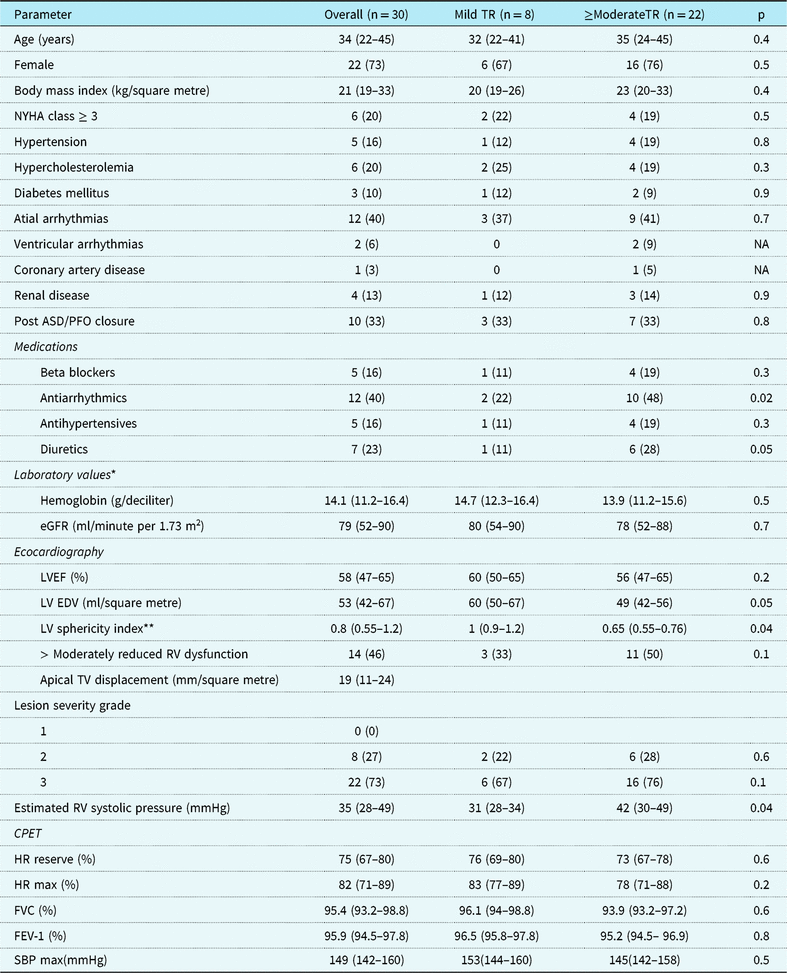
Thirty patients with Ebstein’s anomaly for whom complete data was available were included. Baseline characteristics of the study patients stratified by tricuspid regurgitation severity are presented in Table 1. Median age at the time of the cardiopulmonary exercise test was 34 years (range 22–45) and 10 patients (33%) underwent prior percutaneous closure of an inter-atrial septal defect (secundum atrial septal defect, n = 8, patent foramen ovale, n = 2). None of the patients carried a permanent pacemaker or an implantable cardioverter defibrillator. The median time between the cardiopulmonary exercise tests and the echocardiogram study was 3.5 months (2 weeks–6 months).
Demographic, clinical, and imaging characteristics by tricuspid regurgitation degree

ASD = atrial septal defect; CPET = cardiopulmonary exercise test; eGFR = estimated glomerular filtration rate; ESD = end systolic diameter; LVEF = left ventricular ejection fraction; LV EDD = left ventricular end diastolic diameter; NYHA = New York Heart Association; PFO = patent foramen ovale; RV= right ventricle; TR = tricuspid regurgitation; TV = tricuspid valve.
Values n (%), or median (interquartile range).
* As obtained at the closest date to the CPET.
** At the end of diastole.
Imaging studies
Select parameters from the echocardiographic studies are shown in Table 1. Left ventricular function and the estimated systolic pulmonary artery pressures were normal in all patients, while 14 patients (46%) had >moderate right ventricular dysfunction. None of the patients had lesion severity grade of 1, 22 (73%) had a lesion severity grade of 3, and 22 patients (73%) had >moderate tricuspid regurgitation.
There was a trend for correlation between tricuspid regurgitation degree and lesion severity grade: of the 22 patients who had >moderate tricuspid regurgitation, 6 had lesion severity grade of 2 and 16 had a lesion severity grade of 3 (p value for correlation = 0.1). No statistically significant correlation was noted between tricuspid regurgitation degree and functional right ventricular ejection fraction or left ventricular ejection fraction (Table 1).
Cardiopulmonary exercise tests
Pulmonary function tests were normal in all patients, and during exercise only three patients reached a respiratory quotient that was lower than 1.1. These patients were still included in this analysis, however, as all reached >90% of their predicted peak heart rate (92, 93, and 93%) and their respiratory quotient values were all > 1 (1.05, 1.07, and 1.07).
As expected, peak oxygen consumption levels achieved by the study patients were depressed, with only two patients reaching peak oxygen consumption values higher than 90% predicted (median value for the study cohort, 69.5% predicted, range, 47.2–91.0). Most of the study patients had concomitant depressed oxygen pulse (median, 72% predicted, range, 51.5–98.3%) with normal or near normal maximal heart rates (median maximal heart rate for the entire study cohort, 91% predicted, range, 71–108%), indicating a limited ability to increase forward stroke with exercise rather than chronotropic incompetence as the cause for the depressed peak oxygen consumption. Ventilatory efficiency was also reduced in most of the study patients, with a median ventilatory efficiency slope value of 35.6 (range, 26.2–41.9). Notably, % predicted peak oxygen consumption did not differ significantly by patient’s age (r = −0.30, p = 0.1).
Cardiac structure and exercise capacity
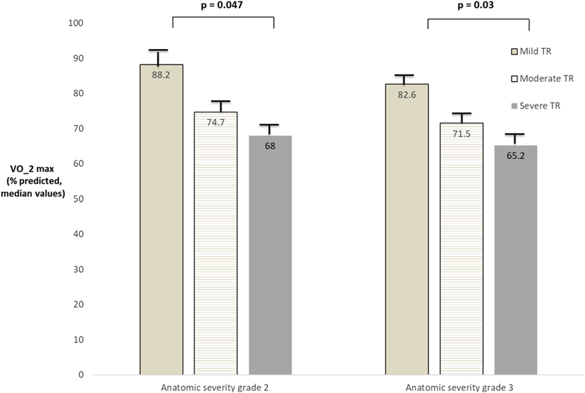
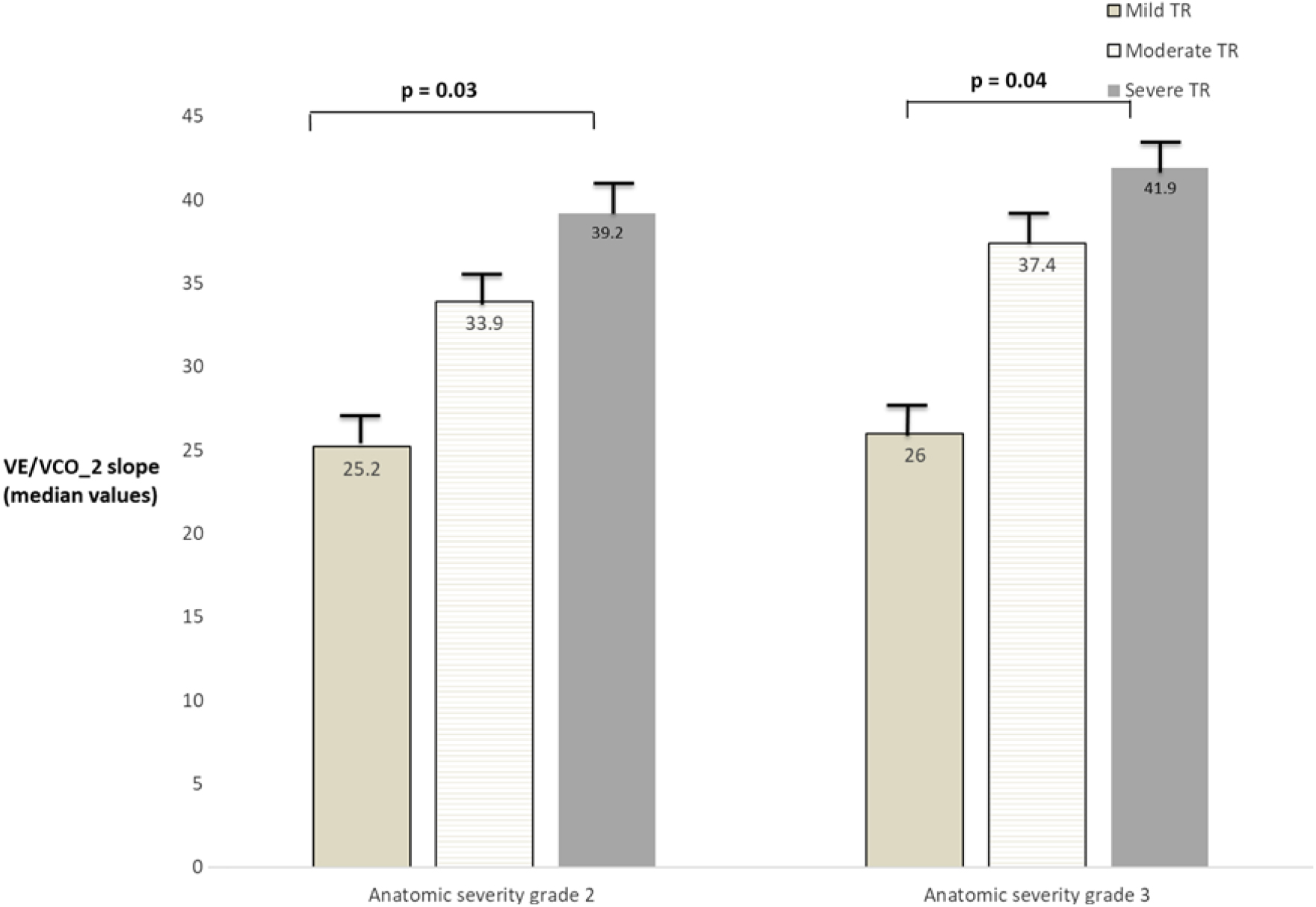
Both greater lesion severity grade and tricuspid regurgitation severity correlated with reduced exercise capacity in the cohort: the relationships between tricuspid regurgitation severity and peak oxygen consumption and ventilatory efficiency are displayed in Figure 1, showing that > moderate tricuspid regurgitation was associated with lower peak % predicted oxygen consumption and higher ventilatory efficiency slopes. Lesion severity grade showed similar correlation with peak % predicted peak oxygen consumption values (correlation coefficient = −0.7, p value = 0.02). To evaluate the effect of tricuspid regurgitation severity within each lesion grade group, patients were stratified by lesion severity grade and tricuspid regurgitation severity. As shown in Figure 2, a stepwise increase in tricuspid regurgitation grade was associated with a statistically significant inverse decrease in % peak oxygen consumption values among patients with either lesion severity grades 2 or 3. A similar reverse relationship was present between tricuspid regurgitation degree and ventilatory efficiency (Fig 3), which was again present in patients with either lesion severity grades 2 or 3.
VE/VCO2 slopes (top) and % of the predicted peak VO2 (bottom) by TR severity as evaluated at cardiopulmonary exercise tests. Box plot demonstrating the median (solid line). Boxes indicate the 25th and 75th percentiles and whiskers represent the 10th and 90th percentiles. VO2 max denotes peak oxygen consumption; TR, tricuspid regurgitation; VE/VCO2 slope, minute ventilation versus carbon dioxide slope. p values determined by the student’s t-test.

Peak oxygen consumption (median values) stratified by TR severity among patients with severity lesions grades 2 and 3. p values determined by the multiple regression analysis.

Ventilatory efficiency, as expressed by the median values of the VE/VCO2 slope, stratified by TR severity among patients with severity lesions grades 2 and 3. p values determined by the multiple regression analysis.

Resting left ventricular ejection fraction did not correlate significantly with peak oxygen consumption or ventilatory efficiency (r = 0.3 and 0.4; p values 0.1 and 0.08, respectively). Lower resting functional right ventricular ejection fraction showed a borderline correlation with both parameters (r = 0.6 and 0.5; p values 0.05 and 0.07, respectively). Age, sex, beta blocker/antiarrhythmic usage, and peak heart rate were not associated with peak oxygen consumption at exercise (p = 0.1, 0.55, 0.08, and 0.08, respectively) or with ventilatory efficiency (p = 0.09, 0.7, 0.2, and 0.2, respectively). Chronotropic incompetence was present in 28 of the study patients (93%). A linear regression analysis revealed a borderline statistical relationship between the peak heart rate and % predicted peak oxygen consumption (p = 0.08).
Tricuspid regurgitation degree and cardiac-related hospital admissions
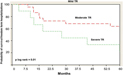
During a median follow-up of 4.6 years (interquartile range, 2.5–7), 11 cardiac-related hospitalisations occurred for seven of the study patients (23%). Seven hospitalisations were due to heart failure exacerbations, two due to chest pain, and two due to atrial arrhythmias. None of the study patients died during the follow-up period. Four of those who were hospitalised for heart failure exacerbation subsequently had cardiac surgery, all in the form of tricuspid valve replacement or reconstruction. The cumulative probability of freedom from hospitalisation was 38% in patients with severe tricuspid regurgitation, 69% in patients with moderate tricuspid regurgitation, and 100% in patients with mild tricuspid regurgitation (logrank p = 0.01 for the overall difference in event rates during follow-up) (Fig 4). These differences were similar among patients with lesion severity grades 2 and 3 (p = 0.8, data not shown)
Kaplan–Meier estimates of the probability of freedom from cardiac-related hospitalisations by TR severity. p value determined by the logrank test.

Discussion
In this single centre study, we evaluated the hemodynamic effects of tricuspid regurgitation during exercise in the unique anatomic setup of non-operated Ebstein’s anomaly and investigated the association between tricuspid regurgitation degree and clinical outcomes during follow-up. Notable findings from this analysis include the following:
(1) There was an inverse relationship between % predicted peak oxygen consumption and tricuspid regurgitation degree, with a stepwise decrease in the peak oxygen consumption and in the ventilatory efficiency at cardiopulmonary exercise test occurring in patients with greater tricuspid regurgitation degrees.
(2) This correlation existed in patients with both anatomic lesion severity grades 2 and 3, indicating that the contribution of tricuspid regurgitation remained significant regardless of the lesion severity.
(3) There was a stepwise decrease in the probability of survival without clinical events (consisting mainly of clinical heart failure hospitalisation and arrhythmias) with greater tricuspid regurgitation degree.
Tricuspid regurgitation and other contributors to decreased peak oxygen consumption in Ebstein’s anomaly
When considering the underlying pathophysiologic mechanisms of exercise intolerance in patients with Ebstein’s anomaly, it is commonly conceived that the chief contributor is the right ventricle’s inability to augment forward stroke during exercise. This, in turn, is due to the right ventricle’s inherent dysfunction in Ebstein’s anomaly and the chronic volume overload imposed on it by the incompetent tricuspid valve. Our findings may indicate that the contribution of tricuspid regurgitation to exercise intolerance is greater than previously postulated, as greater tricuspid regurgitation degree was associated with lower peak oxygen consumption and ventilatory efficiency within each separate lesion severity grade group in the study cohort. The most feasible explanation for this is the exaggerated diastolic inter-ventricular interaction of patients with severe tricuspid regurgitation during exercise, which further contributes to left ventricular under-filling, as previously reported by Andersen et al.Reference Andersen, Nishimura and Borlaug 10 Although not part of the current analysis, this mechanism is ideally demonstrated via invasive hemodynamic monitoring during exercise. It is plausible to assume that this effect is even more prominent in patients with Ebstein’s anomaly, given the already compromised contribution of the small functional right ventricle to left ventricular filling in this constellation.
Chronotropic incompetence was reported to be associated with lower % predicted peak oxygen consumption in Ebstein’s anomaly in prior reports, and was a common finding in our cohort. In a study conducted by Chen et al, the authors reported that peak oxygen consumption and peak heart rate correlated well, suggesting that chronotropic incompetence accounted for the reduced cardiac index which in turn correlated with peak oxygen consumption as well.Reference Chen, Dimopoulos, Sheehan, Gatzoulis and Kilner 17 In our cohort, we showed that although chronotropic incompetence was prevalent, the main driver for depressed peak oxygen consumption was the lower forward stroke, as noted earlier, rather the chronotropic incompetence, as peak oxygen pulse was normal or at least higher than the peak oxygen consumption achieved by the study patients. We did note a borderline statistical relationship between the peak heart rate and % predicted peak oxygen consumption (p value of 0.08), and we suggest that differences in patients characteristics as well as other differences between the studies, including younger age at the time of the exercise, different prevalence of chronotropic incompetence, and differences in medical therapy may account for these disparate findings, which need to be further elucidated in future studies.
Prior data on the hemodynamic effects of tricuspid regurgitation in Ebstein’s anomaly
In addition to the present report, two prior studies evaluated the relationships between structural cardiac parameters and exercise hemodynamics in Ebstein’s anomaly: Kipps et alReference Kipps, Graham, Lewis, Marx, Banka and Rhodes 4 studied 23 patients with unrepaired Ebstein’s anomaly with a median age of 17.9 years for associations between cardiac structural parameters and peak oxygen consumption, both at baseline and after a median follow-up of 3.3 years, during which the patients performed additional cardiopulmonary exercise tests. No association between MRI-evaluated baseline tricuspid regurgitation fraction and peak oxygen consumption was identified, while a statistically significant inverse association was found between the echocardiographically evaluated lesion severity grade at baseline and the baseline peak oxygen consumption. There was also no relationship identified between the trend (i.e. the change between baseline and the end of the follow-up period) of the peak oxygen consumption and lesion severity grade or the tricuspid regurgitation fraction over the follow-up period. We speculate that these discrepancies can be attributed to several key differences between the two study populations, most notably the nearly double age of the patients in our study and the higher prevalence of higher lesion severity grades (73% of the patients in our study had a grade 3 severity lesions versus 18%). Right ventricular dysfunction was also common in our cohort, and although it was not directly reported in Kipp’s study, based on the relatively high prevalence of grade 1 and 2 lesions, we speculate it was less common. It is likely that these differences underlie the importance of the right ventricle’s deterioration over time as a result of the continuous volume overload imposed on it by the regurgitant tricuspid valve, a hypothesis which was also entertained by Kipps et al. As mentioned earlier, as the failing right ventricle further dilates, the interventricular interaction during exercise becomes more prominent, and the contribution of the tricuspid regurgitation (which also likely worsens over time with annular dilatation) to exercise intolerance becomes more prominent.
In the second study published by Chen et al,Reference Chen, Dimopoulos, Sheehan, Gatzoulis and Kilner 17 structural cardiac characteristics of patients with either repaired tetralogy of Fallot or Ebstein’s anomaly were studied by MRI and evaluated for associations with exercise parameters. The authors found no statistically significant associations between the tricuspid regurgitation degree and the peak oxygen consumption. Again, differences between the studies should be accounted for when considering the discrepancies in the results, the notable of which are differences in ventricular function and imaging modalities (i.e. MRI versus echocardiography). Further investigations, ideally in studies that incorporate both MRI and echocardiography as imaging modalities to evaluate tricuspid regurgitation degree and right ventricular function in patients with Ebstein’s anomaly are warranted.
Potential implications for clinical practice
Notwithstanding the relatively small cohort and the retrospective fashion of this analysis, our findings, which indicate that greater tricuspid regurgitation degree is associated with both decreased peak oxygen consumption and increased risk of cardiovascular events in patients with Ebstein’s anomaly, may bear considerable clinical implications, specifically on the follow-up protocol and on the decision on referral to surgery in this patient population.
Contemporary position statements indicate that progressive impairment in peak oxygen consumption is a key factor in the decision-making process towards surgery referral in patients with Ebstein’s anomaly, whereas among those with severe tricuspid regurgitation, surgery is indicated when symptoms are present.Reference Warnes, Williams and Bashore 7 – Reference Bhatt, Foster and Kuehl 9 The findings reported here suggest that a more proactive follow-up routine for patients with moderate or severe tricuspid regurgitation, regardless of the lesion severity, is warranted. Such follow-up routine should consist of cardiopulmonary exercise tests performed at pre-specified time points, with changes in oxygen consumption and ventilatory efficiency serving as the parameters to follow in patients with moderate or severe tricuspid regurgitation. Given our finding that patients with moderate and severe tricuspid regurgitation have higher rates of clinical events, surgical intervention should be at least contemplated in patients with moderate/severe tricuspid regurgitation and reduced peak oxygen consumption, although larger and prospective studies are needed to determine whether such patients will indeed benefit from earlier intervention.
Our study bears several limitations: this was a retrospective study, and as such, selection bias as to the reason the patients who were included did not undergo surgery may be a factor. The study population consisted of patients with relatively advanced form of Ebstein’s anomaly, and thus our findings may not apply to individuals with milder form of the disease. Complex interplay exists between left ventricular filling, ventricular diastolic interaction, lower pre-load, and severe tricuspid regurgitation in patients with Ebstein’s anomaly; the optimal method to provide more in-depth insight to these interactions is via invasive hemodynamic evaluations, which were not a part of this study. Cardiac MRI is an important imaging tool for the evaluation of right ventricular size and function as well as for tricuspid regurgitation grading, which was not used in this study. As mentioned in our study, however, one study did compare tricuspid regurgitation severity grading between MRI and echo, and found that echo was slightly more accurate in tricuspid valve evaluation (15). Finally, although our data suggested a significant association between the severity of tricuspid regurgitation and adverse cardiac outcomes, without longitudinal data elucidating the natural history of the tricuspid regurgitation or the exercise function of patients or data documenting that a surgically induced reduction in tricuspid regurgitation fraction results in an improvement in exercise function the relationship between exercise function and tricuspid regurgitation cannot be confidently incorporated into the clinical decision-making process.
In conclusion, we report that among adult patients with non-repaired/non-palliated Ebstein’s anomaly, tricuspid regurgitation severity across the various lesion severity grades was associated with worse peak oxygen consumption values, worse ventilatory efficiency, and higher occurrence of adverse cardiovascular adverse events during follow-up. Based on these potentially detrimental hemodynamic and prognostic implications, a future direction of considerable interest is the establishment of a structured follow-up protocol and decision-making algorithm towards surgery in patients with Ebstein’s anomaly, which will be based on the combination of tricuspid regurgitation severity and cardiopulmonary exercise test parameters, as performed in this study.
Financial Support
This research received no specific grant from any funding agency, commercial or not for profit sectors.
Conflicts of Interest
None.