Introduction
Within the near future, the commercialization of spaceflight will lead to an unprecedented surge in travelers to space.
Reference Waisberg, Ong and Paladugu1
The large increase of individuals travelling to space will create a population that is more diverse, both in terms of age and in medical comorbidities (such as vasculopathic risk factors).
Reference Ong, Tavakkoli and Zaman2
The understanding of space medicine and potential physiological risks of spaceflight will only become more important for doctors to understand in the future.
Physiology is one of the key underpinnings of medicine, and can be investigated at a variety of levels, from cells, to organs, or the entire body. Physiology attempts to explain the mechanisms that are fundamental to human life and their associated interactions. This knowledge is essential to understand how to better treat disease states. A practical example of harnessing physiology for a treatment benefit would be the recent development of a non-invasive method of lowering intra-ocular pressure to treat glaucoma.
Reference Waisberg, Ong, Masalkhi, Lee and Berdahl3
Physiology knowledge is also highly important to further understand the possible associations between diseases or conditions. For example, the recently-drawn link between idiopathic intracranial hypertension and anemia can possibly be explained by theories based on human physiology, such as anemic hypoxia.
Reference Yu, Waisberg, Kwok and Micieli4,Reference Waisberg, Yu, Sverdlichenko and Micieli5
The altered human physiology in space provides many interesting learning points for medical students. These interesting learning points also provide practical examples of human physiology which may lead to a better understanding of these concepts by medical students. Astronauts are exposed to a wide variety of risks that have been extensively studied, including skeletal muscle atrophy, bone density loss, neuro-ophthalmic changes, and behavioral changes.
Reference Patel, Brunstetter and Tarver6
Astronauts are also exposed to high doses of radiation exposure from galactic cosmic rays (GCRs) and solar particle events (SPEs).
Reference Onorato, Di Schiavi and Di Cunto7
These forms of radiation can not only cause cellular damage, but also potentially cause significant damage to organs. For example, from an ophthalmic point of view, increased radiation to the eye can cause cataracts, cotton-wool spots, radiation maculopathy, and radiation retinopathy.
Reference Waisberg, Ong, Masalkhi, Lee and Berdahl8
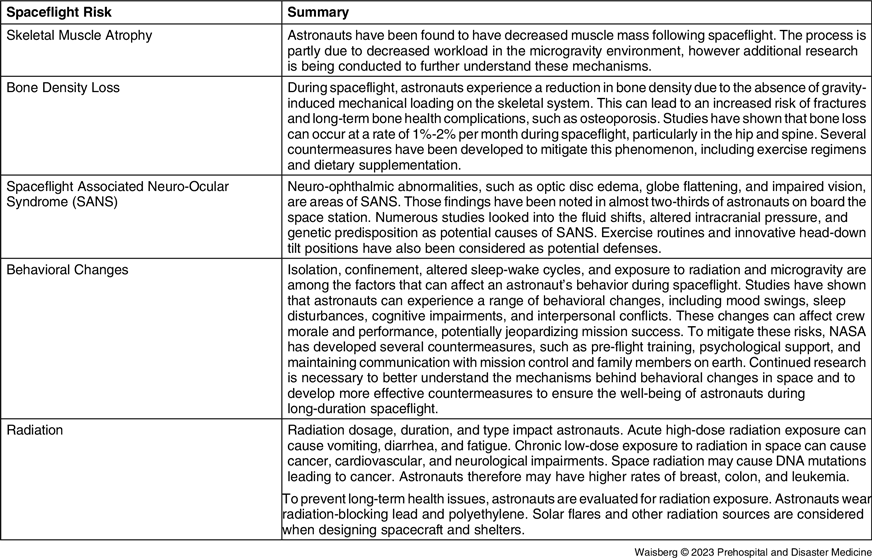
Table 1 provides an overview of these physiological and pathological risks that astronauts face in this extreme environment.
Table 1.
Summary of Various Physiological Spaceflight Risks
Following exposure to microgravity, hypovolemia can occur. This can occur due to a multitude of factors, including: (1) fluid shifts into the interstitial space (due to a decrease in transmural pressure); (2) alterations in urine output; (3) decreased fluid intake; and (4) erythrocyte loss.
Reference Diedrich, Paranjape and Robertson9
These same factors can be responsible for hypovolemia terrestrially, and this can serve as an additional learning opportunity for medical students to grasp these concepts.
Microgravity in space can lead to rapid increase in muscle deterioration due to a lesser force exertion required without the terrestrial gravitational field. As a countermeasure, astronauts have detailed exercise regimens that focus on resistance training. Muscle wasting is a common issue terrestrially, seen in nearly every patient in the hospital, and understanding how to combat this issue is essential to improve patient outcomes during long hospital stays.
Current Space Medicine Initiatives for Future Physicians
Space medicine education continues to accelerate towards training future physicians to understand and manage various risks during prolonged microgravity. There are multiple education pathways that are involved in different levels of training, including medical school educational courses, elective rotations, and board-certified space medicine residencies for flight surgeons. In this section, we provide an overview of all these medical education pathways.
Programs for Residents
The United States Air Force School of Aerospace Medicine (USAFSAM; Wright-Patterson Air Force Base, Dayton, Ohio USA) offers the Flight Medicine Residency Program, which trains medical professionals in the management of aircrew members and the medical facets of aviation. The course offers rotations in subjects including aircraft physiology, aerospace medicine, and operational medicine and is available to both Air Force medical personnel and civilian physicians. Also, residents engage in studies in aeronautical medicine.
Programs for Rotation
The National Aeronautics and Space Administration (NASA; Washington, DC USA) has a curriculum called the Space Medicine Rotation Program that trains medical professionals on the medical effects of spaceflight, including radiation, isolation, and microgravity. Medical students, residents, fellows, doctors, and other health care professionals can all enroll in the program. Participants finish a one-month rotation at the NASA Johnson Space Center in Houston, Texas USA where they collaborate with NASA flight surgeons and take part in mock medical situations seen during space travel.
Course Offerings
The University of Texas Medical Branch (UTMB; Galveston, Texas USA) offers a Space Radiation Course Program that examines how space radiation affects people’s health and safety in space. The training is intended for those who work in the field of space radiation protection, including medical professionals, radiation safety officials, and others. Participants gain knowledge about the biological impacts of radiation exposure, the sources of space radiation, and methods for reducing radiation dangers in space.
Also, UTMB offers a course on the fundamentals of aerospace medicine, which includes information on space medicine, aviation safety, and the physiological impacts of flying. Medical students, residents, fellows, doctors, and other health care professionals with an interest in the subject of aerospace medicine are all intended audience members for the course. Participants gain knowledge of the numerous medical standards and criteria for aircrew personnel, as well as the medical difficulties that come with flying and space travel.
A third course option is the University of Colorado School of Medicine (Aurora, Colorado USA) offers a course program called Space Medicine and Extreme Environment Physiology that covers both the physiological effects of extreme environments like high-altitude, deep-sea diving, and polar exploration as well as the medical aspects of spaceflight. The training is intended for medical professionals, scientists, and engineers who work on the development and management of space missions as well as for people who want to work in space medicine. Participants gain knowledge of how severe settings affect their bodies and minds as well as the medical issues that must be considered while designing and carrying out space missions.
At the home institution of one of the authors (AGL), Baylor College of Medicine (Houston, Texas USA) provides a Space Medicine Pathway course within the Center for Space Medicine. The program consists of two didactic electives and a space medicine research elective. To our knowledge, this is currently the only in-course pathway in the world for space medicine. This pathway is extremely popular and enjoyed by students, demonstrating the growing need for and interest in space medicine.
Conclusion
All things considered, the addition of space medicine to the medical curriculum would not only benefit future space medicine doctors, but also may potentially benefit future doctors as a whole. We look forward to humanity reaching new frontiers, in both medicine and in spaceflight in the coming years.






 You have
Access
Introduction
Within the near future, the commercialization of spaceflight will lead to an unprecedented surge in travelers to space. Reference Waisberg, Ong and Paladugu1 The large increase of individuals travelling to space will create a population that is more diverse, both in terms of age and in medical comorbidities (such as vasculopathic risk factors). Reference Ong, Tavakkoli and Zaman2 The understanding of space medicine and potential physiological risks of spaceflight will only become more important for doctors to understand in the future.
Physiology is one of the key underpinnings of medicine, and can be investigated at a variety of levels, from cells, to organs, or the entire body. Physiology attempts to explain the mechanisms that are fundamental to human life and their associated interactions. This knowledge is essential to understand how to better treat disease states. A practical example of harnessing physiology for a treatment benefit would be the recent development of a non-invasive method of lowering intra-ocular pressure to treat glaucoma. Reference Waisberg, Ong, Masalkhi, Lee and Berdahl3 Physiology knowledge is also highly important to further understand the possible associations between diseases or conditions. For example, the recently-drawn link between idiopathic intracranial hypertension and anemia can possibly be explained by theories based on human physiology, such as anemic hypoxia. Reference Yu, Waisberg, Kwok and Micieli4,Reference Waisberg, Yu, Sverdlichenko and Micieli5
The altered human physiology in space provides many interesting learning points for medical students. These interesting learning points also provide practical examples of human physiology which may lead to a better understanding of these concepts by medical students. Astronauts are exposed to a wide variety of risks that have been extensively studied, including skeletal muscle atrophy, bone density loss, neuro-ophthalmic changes, and behavioral changes. Reference Patel, Brunstetter and Tarver6 Astronauts are also exposed to high doses of radiation exposure from galactic cosmic rays (GCRs) and solar particle events (SPEs). Reference Onorato, Di Schiavi and Di Cunto7 These forms of radiation can not only cause cellular damage, but also potentially cause significant damage to organs. For example, from an ophthalmic point of view, increased radiation to the eye can cause cataracts, cotton-wool spots, radiation maculopathy, and radiation retinopathy. Reference Waisberg, Ong, Masalkhi, Lee and Berdahl8 Table 1 provides an overview of these physiological and pathological risks that astronauts face in this extreme environment.
Summary of Various Physiological Spaceflight Risks
Abbreviations: SANS, Spaceflight Associated Neuro-Ocular Syndrome; NASA, National Aeronautics and Space Administration.
Following exposure to microgravity, hypovolemia can occur. This can occur due to a multitude of factors, including: (1) fluid shifts into the interstitial space (due to a decrease in transmural pressure); (2) alterations in urine output; (3) decreased fluid intake; and (4) erythrocyte loss. Reference Diedrich, Paranjape and Robertson9 These same factors can be responsible for hypovolemia terrestrially, and this can serve as an additional learning opportunity for medical students to grasp these concepts.
Microgravity in space can lead to rapid increase in muscle deterioration due to a lesser force exertion required without the terrestrial gravitational field. As a countermeasure, astronauts have detailed exercise regimens that focus on resistance training. Muscle wasting is a common issue terrestrially, seen in nearly every patient in the hospital, and understanding how to combat this issue is essential to improve patient outcomes during long hospital stays.
Current Space Medicine Initiatives for Future Physicians
Space medicine education continues to accelerate towards training future physicians to understand and manage various risks during prolonged microgravity. There are multiple education pathways that are involved in different levels of training, including medical school educational courses, elective rotations, and board-certified space medicine residencies for flight surgeons. In this section, we provide an overview of all these medical education pathways.
Programs for Residents
The United States Air Force School of Aerospace Medicine (USAFSAM; Wright-Patterson Air Force Base, Dayton, Ohio USA) offers the Flight Medicine Residency Program, which trains medical professionals in the management of aircrew members and the medical facets of aviation. The course offers rotations in subjects including aircraft physiology, aerospace medicine, and operational medicine and is available to both Air Force medical personnel and civilian physicians. Also, residents engage in studies in aeronautical medicine.
Programs for Rotation
The National Aeronautics and Space Administration (NASA; Washington, DC USA) has a curriculum called the Space Medicine Rotation Program that trains medical professionals on the medical effects of spaceflight, including radiation, isolation, and microgravity. Medical students, residents, fellows, doctors, and other health care professionals can all enroll in the program. Participants finish a one-month rotation at the NASA Johnson Space Center in Houston, Texas USA where they collaborate with NASA flight surgeons and take part in mock medical situations seen during space travel.
Course Offerings
The University of Texas Medical Branch (UTMB; Galveston, Texas USA) offers a Space Radiation Course Program that examines how space radiation affects people’s health and safety in space. The training is intended for those who work in the field of space radiation protection, including medical professionals, radiation safety officials, and others. Participants gain knowledge about the biological impacts of radiation exposure, the sources of space radiation, and methods for reducing radiation dangers in space.
Also, UTMB offers a course on the fundamentals of aerospace medicine, which includes information on space medicine, aviation safety, and the physiological impacts of flying. Medical students, residents, fellows, doctors, and other health care professionals with an interest in the subject of aerospace medicine are all intended audience members for the course. Participants gain knowledge of the numerous medical standards and criteria for aircrew personnel, as well as the medical difficulties that come with flying and space travel.
A third course option is the University of Colorado School of Medicine (Aurora, Colorado USA) offers a course program called Space Medicine and Extreme Environment Physiology that covers both the physiological effects of extreme environments like high-altitude, deep-sea diving, and polar exploration as well as the medical aspects of spaceflight. The training is intended for medical professionals, scientists, and engineers who work on the development and management of space missions as well as for people who want to work in space medicine. Participants gain knowledge of how severe settings affect their bodies and minds as well as the medical issues that must be considered while designing and carrying out space missions.
At the home institution of one of the authors (AGL), Baylor College of Medicine (Houston, Texas USA) provides a Space Medicine Pathway course within the Center for Space Medicine. The program consists of two didactic electives and a space medicine research elective. To our knowledge, this is currently the only in-course pathway in the world for space medicine. This pathway is extremely popular and enjoyed by students, demonstrating the growing need for and interest in space medicine.
Conclusion
All things considered, the addition of space medicine to the medical curriculum would not only benefit future space medicine doctors, but also may potentially benefit future doctors as a whole. We look forward to humanity reaching new frontiers, in both medicine and in spaceflight in the coming years.
Conflicts of interest/funding
The other authors declare no conflicts of interest or funding.