INTRODUCTION
It has been 115 years since W. E. B. Du Bois introduced the Veil as an organizing principle for understanding race and racism in the United States of America. In The Souls of Black Folk, Du Bois ([1903] 1994) articulated some of the most important conceptualizations for identifying the features of race, racial identity, and racism in U.S. society. Due to the intellectual contributions of such sociologists as Earl Wright II (2016), Aldon Morris (Reference Morris2015), Tukufu Zuberi (Reference Zuberi2012), Phil Zuckerman (Reference Zuckerman2004), Sandra L. Barnes (Reference Barnes2003), and others, Du Boisian theory and methodology are currently receiving unprecedented attention in sociological circles and beyond. His prescient insight and the present-day utility of his theoretical concepts are demonstrated by our use of the Veil as an analytical device, applicable to the contemporary phenomena of racial microaggressions, racial battle fatigue, and African American motherwork.
The Veil, as a construct, offers a lens for better understanding the ways that racial microaggressions and racial battle fatigue function and are related. We aim to demonstrate the relevance of the Veil to everyday African American life and existence through an examination of African American mothers who have young daughters attending predominantly White schools. Footnote 1 In this instance, the phenomenon of interest is situated within metropolitan Detroit, middle-class suburbia. Major demographic shifts are occurring in many urban centers, such as Detroit, across the United States. Black families are leaving the urban center for the surrounding suburban, White communities. The children of these families are entering predominantly White schools, a reality most likely quite different from the one they faced in the inner-city schools. As mothers are the ones who spearhead the gendered-racial socialization process—the transmission of messages concerning race, racism, personal identity, and management of intra- and interracial relations—they more often navigate, negotiate, and advocate within White spaces on behalf of their daughters (Bailey-Fakhoury Reference Bailey-Fakhoury2014; Harris and Graham, Reference Harris and Graham2007; Thomas and King, Reference Thomas and King2007). When experiencing racial microaggressions within the context of predominantly White schools and communities, mothers actively combat them utilizing a set of strategies known as African American motherwork. These strategies, when activated, induce racial battle fatigue. The Veil protects the Black psyche by detecting racial microaggressions and by developing strategies to combat them; however, such agency can also lead to the onset of racial battle fatigue. Rather than simply identifying experiences with and examples of racial microaggressions African American women are often faced with, the purpose of the present analysis is to contribute to what is known about consequences associated with racial microaggressions experienced by African American mothers when raising young daughters attending predominantly White schools. To do so, we use the dialectical (Winant Reference Winant2004) Du Boisian Veil to understand the linkages between racial microaggressions and racial battle fatigue through exploration of African American motherwork.
THEORETICAL FRAMEWORK
To expand what is known about the sociological features of the racial microaggressions concept, within this article we demonstrate how its sociological features are inextricably linked to the psychological state of the microaggressed. We do this by examining the experiences of Black mothers with young daughters attending predominantly White schools and African American motherwork strategies, grounding their experiences in Du Bois’ ([1903] 1994) sociological concept the Veil, Derald Sue and colleagues’ (2007) conceptualization of racial microaggressions, and Smith and colleagues’ (2007) articulation of racial battle fatigue.
The Veil
In The Souls of Black Folk, Du Bois ([1903] 1994) refers to the existence of a barrier prohibiting genuine understanding and equality between Black people and White people as the Veil. The Veil is conventionally understood to signify the color line. However, we attempt to deepen this understanding as we agree with Richard Rath (Reference Rath1997) that, “For Du Bois the color line was not a problem of persons, but of the warped relations—power relations—that stood between white and black” (p. 485) (emphasis in the original). The contours of these power relations are manifold and complex, as exemplified by Du Bois ([1903] 1994) writing of existing “within and without the Veil” (p. v), going “within the Veil, raising it” (p. v), and seeking to “liv[e] above” (p. 2) or “dwell above the Veil” (p. 67). We assert that the Veil’s versatile functionality is not a mere literary device but has real-world application in understanding the African American experience within Black society, White society, betwixt, and beyond; it has a dialectical nature as it is a barrier that protects the Black psyche by grounding the racialized self while simultaneously sustaining racial oppression.
To be within the Veil is to experience life as an African American inside and outside Black society. Outside Black society the African American “is surrounded and conditioned by the concept which he has of white people and is treated in accordance with the concept they have of him” (Du Bois [1940] 1968, p. 73). For example, in Darkwater: Voices from Within the Veil, Du Bois highlights the psychological toll of living within a racial caste system, writing, “This is my life. It makes me idiotic. It gives me artificial problems. I hesitate, I rush, I waver. In fine,—I am sensitive!” ([1920] 2003, p. 224). Within the broader passage, Du Bois is transmitting the daily racialized experiences of an archetypal African American after a fictionalized White friend labels the African American as sensitive, demonstrating the White friend’s inability to understand the African American’s racialized experience because the friend lives without the Veil. Inside Black society the African American “is in direct contact with individuals and facts. He fits into this environment more or less willingly. It gives him a social world and mental peace” (Du Bois [1940] 1968, p. 173). As articulated by Judith Blau and Eric Brown (2001), the Veil highlights the need for African Americans to “maintain a critical perspective on the moral impoverishment of racism and the hypocrisy of racist practices” (p. 221). To be without the Veil is to experience life as a White American with limited knowledge of African Americans but also lacking knowledge of how whiteness is reified and how racial oppression is (re)produced such that “by emphasis and omission … children believe that every great soul the world ever saw … every great thought the world ever knew … every great deed the world ever did … every great dream the world ever sang was a white man’s” (Du Bois [1920] 2003, p. 57). Living within the Veil juxtaposed against living without the Veil reveals that Black folk understand well both life within and without while White folk’s understanding of both is generally less developed (Blau and Brown, Reference Blau and Brown2001; England and Warner, 2013; Rath Reference Rath1997). Essentially, living within the Veil means exploiting one’s knowledge of what life is like without the Veil in an attempt to subvert and undermine the power relations, institutions, structures, and systems that reify and (re)produce racial inequality and oppression.
Reflecting on the concept of the Veil, Howard Winant (Reference Winant2004) wrote, “Because the idea of the Veil helps explain the vast importance of racial identity, racial oppression and resistance, and racialized social structures in the creation and organization of the modern world” (p. 37) the concept remains a powerful analytic tool even in the 21st century. Given the theoretical usefulness of Du Bois’ articulation of the Veil, we employ it to understand the linkages between racial microaggressions and racial battle fatigue through exploration of African American motherwork. We contend that when viewed through the Veil, racial microaggressions and racial battle fatigue are especially perceptible, allowing us to better understand the ways that they function and are related.
Racial Microaggressions
Racism continues to plague the United States in various forms (e.g., individual, systemic, institutional). However, racist acts that are deemed deplorable and receive considerable attention are often those that are described as overt, individual acts against people of color (e.g., calling a Black person the N-word) (Sue et al., Reference Sue, Capodilupo, Torino, Bucceri, Holder, Nadal and Esquilin2007). Nevertheless, scholars have documented that overt acts of racism are often easier for people of color to handle; scholars also suggest that the more subtle and indirect forms of racism, referred to as racial microaggressions, have even greater detrimental effects on people of color (Sue et al., Reference Sue, Capodilupo, Torino, Bucceri, Holder, Nadal and Esquilin2007). Rooted in the large body of perceived racial discrimination research (e.g., Brody et al., Reference Brody, Chen, Kogan, McBride Murry, Logan and Luo2008; Harris Reference Harris2004; Sellers and Shelton, Reference Sellers and Shelton2003; Zubrinsky and Bobo, Reference Zubrinsky and Bobo1996), racial microaggressions—a term coined by Pierce—can be defined as “brief and commonplace daily verbal, behavioral, and environmental indignities, whether intentional or unintentional, that communicate hostile, derogatory, or negative racial slights and insults to the target person or group” (Sue et al., Reference Sue, Capodilupo, Torino, Bucceri, Holder, Nadal and Esquilin2007, p. 273). For example, when White people tell African American people they are intelligent or speak well, White people are subtly communicating a racial stereotype that African American people are not as smart as White people or are not as articulate as White people; these examples are considered racial microaggressions (Sue et al., Reference Sue, Capodilupo, Torino, Bucceri, Holder, Nadal and Esquilin2007). Sue and colleagues (2007) expanded what is known about racial microaggressions by identifying three forms: microassault, microinsult, and microinvalidation. According to Sue and colleagues:
A microassault is an explicit racial derogation characterized primarily by a verbal or nonverbal attack meant to hurt the intended victim through name-calling, avoidant behavior, or purposeful discriminatory actions …. A microinsult is characterized by communications that convey rudeness and insensitivity and demean a person’s racial heritage or identity. Microinsults represent subtle snubs, frequently unknown to the perpetrator, but clearly convey a hidden insulting message to the recipient of color …. Microinvalidations are characterized by communications that exclude, negate, or nullify the psychological thoughts, feelings, or experiential reality of a person of color (p. 274).
To advance what is known about the effects of racial microaggressions, Sterett Mercer and colleagues (2011) call for further research on the ways in which Black individuals organize self-relevant information. They note, “Gaining insight into how Black individuals think and feel about themselves may also allow researchers to better understand when microaggressions are likely to be perceived and how they will impact individuals” (p. 267).
Within this study, examining the influences of racial microaggressions on African American mothers and the ways in which they think and feel about them are especially relevant as “intersectional theory and research suggest that embodying subordinate racial and gender social categories influence how Black women are perceived and treated, creating lived experiences that are different from those of Black men and White women” (Donovan et al., Reference Donovan, Galban, Grace, Bennett and Felicié2012, p. 187). While African American women have written about their lived experiences for decades (e.g., see writings of Patricia Hill Collins, Bonnie Thornton Dill, and bell hooks), Kimberlé Crenshaw coined and first used the term intersectionality to articulate their lived experiences in 1989 (Mitchell Reference Mitchell, Mitchell, Simmons and Greyerbiehl2014). Intersectionality highlights the convergence of multiple marginalized identities (e.g., race, gender) and how systems of oppression (e.g., racism, sexism) converge to further marginalize those identities in exponential ways (Crenshaw Reference Crenshaw1989). Building upon intersectional theory and advancing Sue and colleagues work, Jioni Lewis and colleagues (2013, p. 54) define gendered racial microaggressions as “subtle and everyday verbal, behavioral, and environmental expressions of oppression based on the intersection of one’s race and gender,” reinforcing Mercer and colleagues (2011) call to explore the ways in which racial microaggressions are interpreted by and influence the lived experiences of the microaggressed.
Du Bois clearly articulated the connection between the racial microaggressions and racial battle fatigue concepts as he refined and deepened his explication of the Veil. In Darkwater: Voices from Within the Veil, Du Bois ([1920] 2003) writes, “Imagine spending your life looking for insults or for hiding places from them—shrinking (instinctively and despite desperate bolsterings of courage) from blows that are not always but ever; not each day but each week, each month, each year” (p. 225). Furthermore, he provides an even more wrenching articulation of the relationship between racial microaggressions and racial battle fatigue when he writes in Dusk of Dawn how when living within the Veil:
the people within may become hysterical. They may scream and hurl themselves against the barriers …. They may even, here and there, break through in blood and disfigurement, and find themselves faced by a horrified, implacable, and quite overwhelming mob of people frightened for their own existence (Du Bois [1940] 1968, p. 131).
Here we see how experiencing and combating racial microaggressions, essentially trying to lift the Veil or break the plate glass, can induce racial battle fatigue causing existential threats either self-inflicted or inflicted by White society, its structures and systems.
Racial Battle Fatigue
Racial battle fatigue “addresses the physiological and psychological strain exacted on racially marginalized groups and the amount of energy lost dedicated to coping with racial microaggressions and racism” (Smith et al., Reference Smith, Allen and Danley2007, p. 555). Racial battle fatigue symptoms can manifest themselves physiologically and psychologically. Some of the physiological and psychological symptoms are:
(a) tension headaches and backaches, (b) elevated heartbeat, (c) rapid breathing in anticipation of racial conflict, (d) an upset stomach or “butterflies,” (e) extreme fatigue, (f) ulcers, (g) loss of appetite, and (h) elevated blood pressure. The psychological symptoms of racial battle fatigue include (a) constant anxiety and worrying; (b) increased swearing and complaining; (c) inability to sleep; (d) sleep broken by haunting, conflict-specific dreams; (e) intrusive thoughts and images; (f) loss of self-confidence; (g) difficulty in thinking coherently or being able to articulate (confirming stereotype); (h) hypervigilance; (i) frustration; (j) denial; (k) John Henryism, or prolonged, high-effort coping with difficult psychological stressors; (1) emotional and social withdrawal; (m) anger, anger suppression, and verbal or nonverbal expressions of anger; (n) denial; (o) keeping quiet; and (p) resentment (Smith et al., Reference Smith, Allen and Danley2007, p. 556).
As African Americans cope with racial microaggressions, dealing with racial battle fatigue becomes a part of their life history (Smith et al., Reference Smith, Allen and Danley2007), and, they “use mental and emotional energy discerning the difference between individually supportive Whites and destructive actions by Whites as a collective” (Smith et al., Reference Smith, Hung and Franklin2011, pp. 65-66). While scholars have connected racial battle fatigue and racial microaggressions, we extend what is known about the relationship between the two concepts by connecting the constructs to Du Bois’ ([1903] 1994) Veil, as we argue they are inseparably linked.
Life within the Veil is paradoxical, contradictory, and has both adaptive and maladaptive features: it protects the Black psyche but can also injure it; it precludes racial equality but holds the key to achieving it (Winant Reference Winant2004). A racial microaggression becomes apparent when situated within the Veil; so too does its dialectical nature. Sue and colleagues (2007) write, “The power of racial microaggressions lies in their invisibility to the perpetrator and, oftentimes, the recipient …. microaggressions operate to create psychological dilemmas for both the White perpetrator and the person of color” (pp. 275-277). The dialectics of racial battle fatigue are also exposed when situated within the Veil. While it “addresses the physiological and psychological strain exacted on racially marginalized groups and the amount of energy lost dedicated to coping with racial microaggressions and racism …. social feelings of cohesion and moral trust are often retarded or broken between” African Americans and Whites (Smith et al., Reference Smith, Allen and Danley2007, pp. 555-556). We note Du Bois’ prescience for detailing facts of African American life that would be taken up and further developed by Chester Pierce (Reference Pierce and Arieti1974), Sue and colleagues (2007), and William Smith and colleagues (2007) some fifty-five to eighty-five years later.
African American Motherwork
The reproductive labor that Black women do to ensure their survival, the survival of their biological and community children, and the survival of the global village is known as motherwork (Collins Reference Collins, Glenn, Chang and Forcey1994). Black women with young daughters attending predominantly White schools engage in important work realizing, as demonstrated clearly by Du Bois ([1920] 2003), that:
[t]he day will dawn when mother must explain gently but clearly why the little girls next door do not want to play with ‘niggers’; what the real cause is of the teacher’s unsympathetic attitude …. Once the colored child understands the white world’s attitude, and the shameful wrong of it, you have furnished it with a great life motive (p. 208).
In the face of this great life motive, African American mothers with daughters attending predominantly White schools must ensure their daughters’ social, psychological, and academic survival. They do so by utilizing strategies to promote the development of a positive racial-gender identity in their young daughters to serve as protection against the real and perceived threats of gendered racism they may encounter in their White schools and classrooms (Brown et al., Reference Brown, Linver, Evans and DeGennaro2009; Sanders Thompson Reference Sanders Thompson2001). The three strategies which they use—termed African American motherwork—are presence, imaging, and code-switching.
Presence has three aspects: 1) the keen awareness of one’s aesthetic appearance and the role it plays as mothers advocate for their daughters (aesthetic presence); 2) maintaining visibility in the school and at school functions (visible presence); and 3) being strategic in interactions with school personnel to gain leverage that will benefit daughters (presence through strategic interactions) (Bailey-Fakhoury Reference Bailey-Fakhoury2014). Within the Veil aesthetic and visible presence reflect an understanding of the utility of performing White normative expectations regarding womanhood, comportment, self-presentation, and mothering in order to facilitate presence through strategic interactions: the procurement of information, knowledge, or favor for the benefit of one’s daughter.
Imaging means that mothers consciously seek out positive depictions/reflections of Black female identity as a counter-narrative to the negative portrayals of Black girl/womanhood in popular culture and the mass media (Bailey-Fakhoury Reference Bailey-Fakhoury2014). Within the Veil Eurocentric standards of beauty are well known, as are the negative effects associated with attempting to meet those standards. Imaging is acknowledgement of and active resistance to White standards by embracing more Afrocentric beauty ideals.
Code-switching is a skill mothers actively develop within their daughters. It involves modeling and reinforcing for daughters the ability to identify and apply the appropriate vernacular, prescripts, and norms specific to a cultural domain and the fluid transition between milieus (Bailey-Fakhoury Reference Bailey-Fakhoury2014). Within the Veil developing the code-switching skill has utility in both Black society and White society for transmitting and receiving cultural capital.
Du Bois comprehends the importance of African American motherwork as it is tied to the education of children. As he further explicates the Veil as a construct, he instructs that “the object of all education is the child itself not what it does or makes … [therefore] Colored Americans must then with deep determination educate their children in the broadest, highest way …. Wisdom is the principal thing. Therefore, get wisdom” (Du Bois [1920] 2003, pp. 212–213). African American motherwork serves the development of this wisdom, in particular the understanding of how the racialized world works and how one must not only survive but also thrive within it. Motherwork, and the strategies used to navigate, negotiate, and advocate on behalf of young daughters attending a predominantly White school, is integral to the “life task of the parent to guide and to shape the ideal [the wrong of racism]; to raise it from resentment and revenge to dignity and self-respect, to breadth and accomplishment, to human service; to beat back every thought of cringing and surrender” (Du Bois [1920] 2003, p. 209). As the daughter experiences gendered racial socialization, she develops a racial-gender identity that equips her with the tools to traverse the racialized world, and combat racial injustice with “a power and impulse toward good” (Du Bois [1920] 2003, p. 208).
The presence strategy is the one which mothers seemed to enact most often to combat racial microaggressions. It is precisely because mothers fear that their daughters attending White schools will be “met … with injustice and humiliation and discouraged [in] their efforts to progress” (Du Bois [1940] 1968, p. 201) that they must be hypervigilant and maintain a presence. But such hypervigilance is symptomatic of racial battle fatigue; it can be both antidote and venom. Racial microaggressions faced in the predominantly White school setting can be combated by presence, which simultaneously serves protective and debilitating functions. The Veil is the means by which African Americans—and for the purpose of this article, African American women—perceive and combat racial microaggressions, which in turn can induce racial battle fatigue.
METHOD
The data analyzed herein are drawn from a 2011 mixed methods study conducted by Chasity Bailey-Fakhoury in suburban, metropolitan Detroit. The purpose of the study was to identify strategies African American mothers used to promote a positive racial-gender identity in their young daughters attending a predominantly White school (Bailey-Fakhoury Reference Bailey-Fakhoury2014). The study was guided by the intersectional perspective—examining race, gender, and class—and social cognitive learning theory to create a sociopsychological framework (White Reference White, Koditschek, Cha-Jua and Neville2009). This orientation simultaneously privileges the systems, structures, and interpersonal interactions that sustain and reproduce race, racial identity, and gendered racial socialization in the everyday life of African American mothers. The mixed methods design of the study supports the sociopsychological framework by collecting quantitative and qualitative data reifying the macro- and micro-level processes involved in promoting a positive racial-gender identity.
Metropolitan Detroit as the Study Setting
The history of metropolitan Detroit reveals in stark relief what life is like within the Veil. Its history is one of deep racial divisions sown by racial animus, residential and school segregation, employment discrimination, income inequality, opposition to mass transit, and the geographic and symbolic demarcation that is 8 Mile Road (Darden et al., Reference Darden, Child Hill, Thomas and Thomas1987; Farley et al., Reference Farley, Danziger and Holzer2000; Frazier et al., Reference Frazier, Margai and Tettey-Fio2003; Sugrue Reference Sugrue1996). For African Americans, living south of 8 Mile Road is to be within the Veil, in predominantly Black society; to live north of 8 Mile Road is to be within the Veil, yet in predominantly White society. This geographic marker literally and figuratively separates majority Black Detroit from majority White Oakland and Macomb counties. Whether White or Black, to be “across” 8 Mile Road can induce fear and trepidation for real and perceived threats.
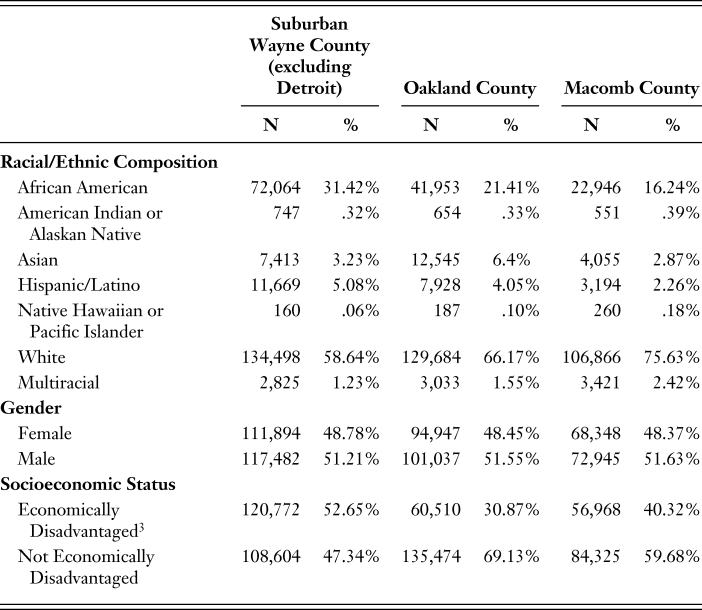
Metro Detroit’s environs consist of three counties—Wayne, Oakland, and Macomb—with the city of Detroit as the seat of Wayne. At the time the data for the study were collected, of the approximately 3.86 million people that resided in metro Detroit, 25.2% of the population identified as Black and 67.3% identified as White (U.S. Census Bureau 2010). During the same time, the percentage of Blacks residing in suburban Wayne, Oakland, and Macomb counties was 8.1%, 13.6%, and 8.6%, respectively. The 2011 racial and socioeconomic status (SES) compositions for the suburban Wayne, Oakland, and Macomb county schools represented in this study are reflected in Table 1.
2010–2011 Select Characteristics of Metropolitan Detroit Schools (MI School Data 2018)

It is important to note that Black suburbanization has increased over the past two decades and, as a consequence, the index of dissimilarity has decreased from 86 in 2000 to 75, making Detroit the fourth most segregated metropolitan region in the United States. Several studies utilizing various University of Michigan-Detroit Area Study datasets have examined racial residential housing patterns, attitudes, and preferences of Black and White metro Detroiters. Some of the earliest studies using the show-card method pioneered by Reynolds Farley and colleagues (1978, 1993) found that while Whites preferred whiter neighborhoods, Blacks preferred more racially integrated neighborhoods (Farley et al., Reference Farley, Danziger and Holzer2000). More recent research relying on Detroit Area Study data has advanced our understanding of Black and White residential housing preferences. Maria Krysan and Michael Bader (2007) conducted a multilevel analysis based upon asking about residential preferences relative to thirty-three real, existing metro Detroit communities. They determined that for Whites, racial composition of a community trumps social class considerations such that “the percent white in a community had a significant impact on whites’ likelihood of seriously or never considering [moving into] a community” (Krysan and Bader, Reference Krysan and Bader2007, p. 723). For Blacks it was determined that “percent white does not influence African Americans’ selection of a community as one to ‘seriously consider’ or to ‘never consider’ [moving into]” (Krysan and Bader, Reference Krysan and Bader2007, p. 724). Krysan and Bader’s findings reflect that when faced with real options, African Americans desire a diversity of community types. It is against this backdrop—Whites desire and move to whiter communities while Blacks desire and move to more racially heterogeneous ones—that the present study was conducted.
Participants
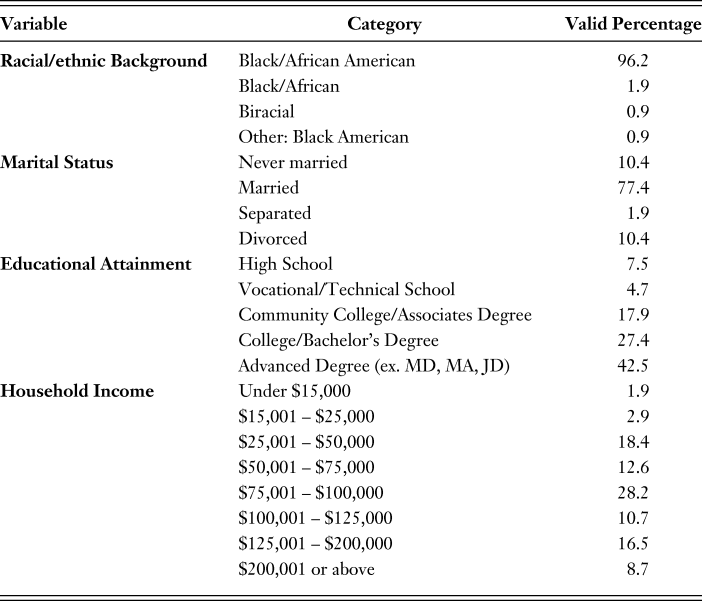
The participants self-identified as African American mothers with at least one elementary-age daughter attending a predominantly White school. They were residents of a predominantly White, middle-class suburb in Macomb, Oakland, or Wayne County that experienced an increase in its African American population from 2000–2005. They were recruited using convenience and snowball sampling techniques. Recruitment took place at places of worship, sororities, Parent Teacher Organizations/Parent Teacher Associations (PTOs/PTAs), and civic and social organizations located within metro Detroit (descriptive statistics are summarized in Table 2).
Select Descriptive Characteristics of Mothers in the Study (N = 106)

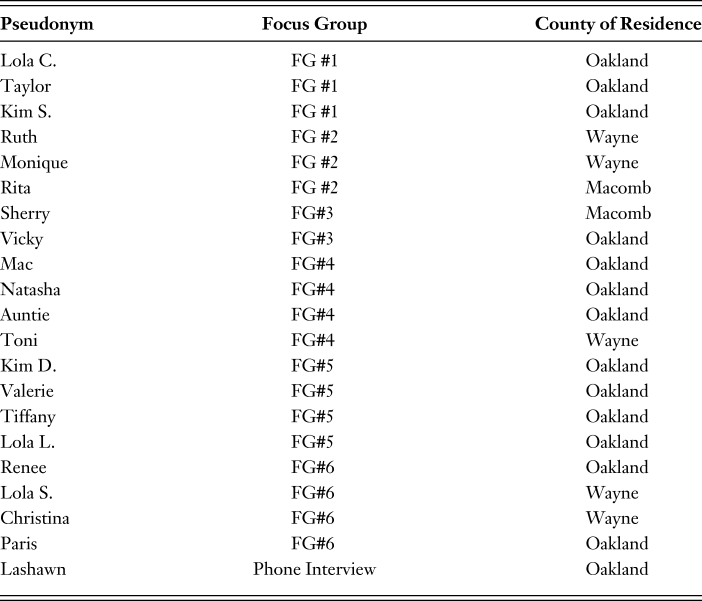
The study made use of surveys to measure mothers’ racial socialization practices, racial identity development, and gender identity development. 106 mothers completed the survey. Focus groups and an interview were then utilized to provide detail and description to aspects of the quantitative data. Of the 106 survey respondents, twenty-one mothers volunteered to participate; ultimately, six focus groups and one telephone interview were scheduled (see Table 3). Survey respondents and focus group participants received compensation. The average age of a study participant was thirty-nine years (SD = 6.22). 70% of mothers were professional women with at least a BA degree, 77% were married, and 64% reported a household income of $75,000–$100,000 or greater.
Mothers Participating in the Focus Groups and Interview (N = 21)

Data Collection and Analysis
Phase One: Survey
The survey instrument was deployed using an online portal with unique, one-time-only usernames and passwords or via a paper-pencil option with attached unique username and password for inputting into the online portal. It comprised three measures: the 53–item Parent Cultural and Racial Experiences of Socialization scale (Parent-CARES) (Stevenson and Bentley, Reference Stevenson and Bentley2007), the 30–item Cross Racial Identity Scale (CRIS) (Worrell et al., Reference Worrell, Vandiver and Cross2004), and the 43–item Womanist Identity Attitude Scale (WIAS) (Ossana et al., Reference Ossana, Helms and Leonard1992).
The Parent-CARES is a unified version of four older instruments. At the time the instrument was administered the internal consistency estimates for this revised instrument were forthcoming; the instrument’s reliability has now been reported as α = .93 (Bentley-Edwards and Stevenson, Reference Bentley-Edwards and Stevenson2016). The internal consistency estimates for scores on each of the CRIS subscales, based on Cronbach’s α and standardized coefficients from the confirmatory factor analysis, range from .79–.90 (Worrell et al., Reference Worrell, Vandiver and Cross2004). The WIAS, when its psychometric properties were tested by Bonnie Moradi and colleagues (2004), exhibited internal reliability estimates for each subscale ranging from .31–.76. In light of these findings, at the time the WIAS was the only instrument that measured womanist identity development, and it is believed that this model and its instrument provide a better fit for examining the Black-female identity than the feminist identity model developed by Nancy Downing and Kristin Roush (1985). Alicia Boisnier (Reference Boisnier2003) provides some evidence for this in her study distinguishing between feminism and womanism among Black and White women.
The combined survey was analyzed using the IBM SPSS Statistics software, version 17.0. The quantitative data presented within this article are largely descriptive in nature and reveal the presence of mothers’ microaggressive experiences, mothers’ reports of perceived microaggressive experiences of their daughters, and reports of racial battle fatigue symptoms.
Phase Two: Focus Groups and Interview
The focus group schedule was semi-structured and comprised sixteen questions informed by the theoretical framework, extant literature, and a priori propositions postulated. Sessions were audio-taped and transcribed with Nvivo 9 software aiding the qualitative analysis. The data analysis made use of Barney Glaser’s (1978) constant comparative method. Codes were initially identified based upon concepts that appeared immediately across several focus groups, then codes were established based upon connections to the constructs under study. Internal validity was ensured by triangulation of data; peer debriefing; rich, thick description (a journal detailing this phase of the study, including data collection and analysis procedures was kept); and member checking (Creswell Reference Creswell2003).
To determine which focus group transcript excerpts would comprise this analysis, Chasity Bailey-Fakhoury highlighted twenty-four excerpts that she believed exemplified racial microaggressions as reflected by the Sue and colleagues (2007) typology. Donald Mitchell, Jr. then reviewed these excerpts to address degree of agreement. Eleven of the twenty-four were confirmed by Mitchell, Jr. On all eleven, we agreed as to which one of the three forms of microaggressions the quote was to be attributed and to which of the eight themes (e.g., color blindness v. denial of individual racism) it reflected. We determined, independently and then in tandem, which of the eleven best demonstrated the link between racial microaggressions and racial battle fatigue. We looked for specific instances where mothers articulated experiencing a racial microaggression and the ensuing racial battle fatigue. The five excerpts that were derived from this process ground this analysis.
Our analysis demonstrates how the racial microaggressions the mothers experienced when encountering/interacting in White spaces—while advocating for their daughters—caused mothers to enact the African American motherwork strategy of presence in order to combat the racial microaggressions. In the course of enacting presence, racial battle fatigue is induced. Better understanding the features of racial microaggressions and racial battle fatigue requires them to be situated within the context of the Veil.
FINDINGS
Data Supports Existence of Racial Microaggressions Phenomenon
Quantitative Data
While it is our assertion that living within the Veil makes racial microaggressions perceptible, it is important to empirically establish that the mothers participating in this mixed methods study have indeed experienced racial microaggressions. Mothers provided several examples during the focus group and interview discussions of how they experience or cope with racial microaggressions, which can cause them to “perceive their environment as extremely stressful, exhausting, and diminishing to their sense of control, comfort, and meaning while eliciting feelings of loss, ambiguity, strain, frustration, and injustice” (Smith et al., Reference Smith, Allen and Danley2007, p. 554). Because the racial microaggressions theme emerged from the focus group conversations, items from the Parent-CARES and CRIS were reviewed to determine what quantitative data existed to complement the qualitative data. The items assessed were:
1. CRIS #35: During a typical week in my life, I think about racial and cultural issues many, many times.
2. Mother’s experiences with racism: Parent-CARES #8 & 9.
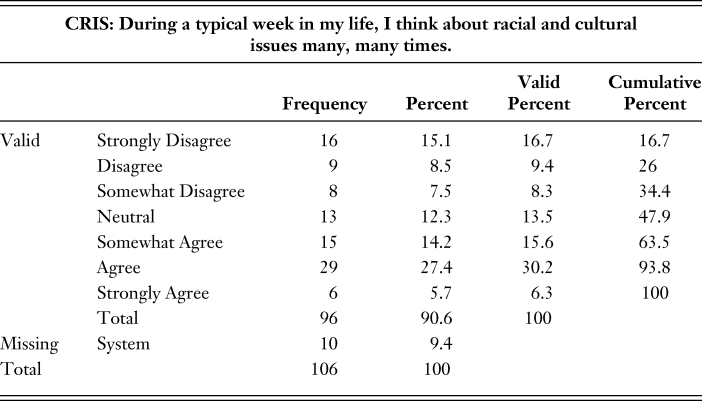
Table 4 reflects just how commonplace it is for these mothers to think about racial and cultural issues during a typical week. Over 52% of mothers reported that they agreed with the statement “During a typical week in my life, I think about racial and cultural issues many, many times.” Although “many, many times” may not be a precise descriptor, such a statistic demonstrates support for the salience of race in these mothers’ lives—as life analyzed within the context of the Veil would attest to. As mothers seek to navigate, negotiate, and advocate for their daughters in predominantly White schools and communities, it is no surprise that 52% of respondents think about racial and cultural issues so often. Race salience can be a conduit, providing “experiential evidence for the existence of racial microaggressions in everyday life” (Sue et al., Reference Sue, Capodilupo, Torino, Bucceri, Holder, Nadal and Esquilin2007, p. 273). If mothers are thinking quite a bit about racial and cultural issues, one can infer that one aspect of this thinking revolves around experiences with racial microaggressions. We believe that the data in Table 4 give credence to the racial microaggressions theme that emerged from the focus group conversations.
Percentages of Mothers Reporting Agreement with the Statement, “During a typical week in my life, I think about racial and cultural issues many, many times.” (N = 96)

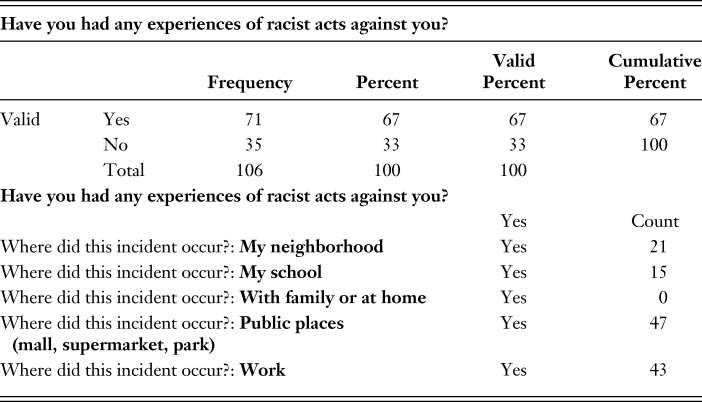
Table 5 reveals mothers’ experiences with racism. Seventy-one (67%) mothers answered affirmatively when asked whether or not they had experienced racist acts against them. Of those seventy-one mothers indicating that they had experienced such racist acts, the majority experienced these in public places (see Table 5). Work was the second most likely place mothers experienced racist acts against them. The majority of mothers had personal experiences with racism, which may have run the gamut from overt racist acts to aversive racist ones. Aversive racism characterizes racial microaggressions which are “ambiguous and nebulous and [therefore] more difficult to identify and acknowledge” (Sue et al., Reference Sue, Capodilupo, Torino, Bucceri, Holder, Nadal and Esquilin2007, p. 272). Later in this section we present focus group and interview narratives which reflect the nature of these racial microaggressions.
Frequencies of Mother’s Experiences with Racism (N = 106)

Qualitative Data
Being in close proximity to one of the largest, predominantly Black cities in the United States presents its own set of challenges for African American mothers with daughters attending predominantly White, suburban schools. In the eyes of many Whites, simply inhabiting a Black body indicates criminality and deviance. Detroit is deemed a dangerous, unsafe place simply due to the number of its Black residents. A fear of Detroit and a belief that danger lurks in every vector of its environs leads many suburban teachers and parents to warn children to stay away from Detroit. This represents what Sue and colleagues (2007) refer to as the clash of racial realities—the stark differences in perceptions between Blacks and Whites. Whereas some suburban Whites may see Detroit as being a dangerous place with a pervasive criminal element, when it comes to criminal activity many Blacks (particularly those who were raised in Detroit) see certain areas of Detroit being no different than other large, urban centers with impoverished neighborhoods, high unemployment, underfunded public schools, and an adversarial policing relationship. While many White suburbanites may not know the code of the street (Anderson Reference Anderson1999), many Black suburbanites hailing from Detroit do. It is these distinctions which underlie the clash of racial realities that is present in Christina’s recounting of an ascription of the criminal status microinsult experienced by her daughter at the hands of her teacher:
Her teacher last year, however, made a comment of—I guess they were talking about different cities and where everyone grew up, and first and third generation from here and everything. And one of the kids had mentioned something about Detroit. She [the teacher] was like, “Oh, well, you know, Detroit’s not a very safe place.” And of course, my daughter didn’t tell me this. She told my sisters and they told me. And I’m like, “What are you talking?” So I had to have that kind of—so it’s just stereotypes that people have of our community that are not necessarily true. But they’re kind of feeding it to the kids in ways that they may not know that they’re doing it because they’re [the teachers and suburban community] used to the majority not being Black, African American.
In this teacher’s microinsult we hear the Black criminality metanarrative. When placed within the context of the Veil, such tropes are rooted in the antebellum era when a Black body was equated with slave, and any free-roaming Black was suspected of being a runaway slave and therefore fugitive; the Reconstruction era of Black Codes prohibiting Black bodies from congregating after sunset and any number of activities entered into by Blacks being criminalized; and Jim Crow laws that institutionalized the separate but equal doctrine and made any manner of mundane actions taken by Blacks criminal offenses. As a result, today we have a criminal justice system (with policing modeled after the American slave patrols) that produces and sustains mass incarceration that disproportionately affects Black and Brown bodies and their communities. This is coupled with a mass media machine that reinforces our notions of Black criminality while sanitizing and normalizing White criminality. While the teacher’s microinsult may reflect unconscious bias on her part, it possible that this same teacher would not speak of Littleton, CO (home of the 1999 Columbine High School mass murder that claimed the lives of thirteen people), or Omaha, NE (2007 mass murder at an Omaha shopping mall where eight were killed), or Tucson, AZ (2011 mass murder of six people where U.S. Representative Gabrielle Giffords was shot in the head) as dangerous, unsafe places.
Just as the African American girl’s presence in the predominantly White school can lead to microinsults and microinvalidations, the presence of the Black body in the predominantly White community produces similar microaggressive acts. Sherry provides an instance of being treated like a second-class citizen and the racist double-standard that it invoked:
And trying to figure out a way to approach you or trying—a lot of times they [Whites] try to figure out your living situation, what you do for a living, how did you get this house or something like that. In my situation I just think it’s because our age, our house, and they’re probably wondering “how can they afford this” because I don’t work full time. I work part time. So my husband works part time also now, but he’s also starting a business on the side. So they’re probably wondering—I know they’re wondering probably, “Okay, both of their cars are in the driveway most every day so how are they affording this?” So, and a lot of times you have a lot of stay-at-home mothers that it’s okay for them [Whites] but for us it’s like, okay, is she getting assistance? No, it’s not anything like that. And I think that’s the first—‘cause the first thing they’ll ask, “Oh, what do you do for a living?” And I would never think to ask you that but you feel you had the need to ask me that.
As an African American stay-at-home mother living within the Veil, she is seen as less than the White stay-at-home mother by those living without. When Blacks do the same or similar things as Whites, like choosing to be stay-at-home mothers, it is not regarded as virtuous but is looked upon as laziness. The good mother ideal (Dillaway Reference Dillaway2006) is not extended to Black women. We have seen Black women attempting to secure better educational outcomes for their children and being criminally punished for being a good mother.Footnote 2 Such instances of Whites doing the same are seldom sensationalized, condemned, or criminally prosecuted. Very seldom is the White family questioned about their finances in a one-income household. However, for most African Americans in the same situation they are immediately assumed to be living off the public dole. To confirm these assumptions rude, inappropriate, and demeaning questions are posed without much regard for right of privacy or social etiquette. When confronted, Sherry’s White neighbors holding these assumptions would possibly “fail to see a pattern of bias, are defended by a belief in their own morality, and can in good conscience deny that they discriminated” (Sue et al., Reference Sue, Capodilupo, Torino, Bucceri, Holder, Nadal and Esquilin2007, p. 279). Research examining Whites’ residential and social segregation from Blacks does support such a contention (Bonilla-Silva and Embrick, Reference Bonilla-Silva and Embrick2007).
Quantitative Data Links Racial Microaggressions and Racial Battle Fatigue
While we assert that the Veil reveals the relationship between racial microaggressions and racial battle fatigue, it is important to empirically establish the connection. The survey items that were assessed to determine whether or not statistical support existed for linking racial microaggressions and battle fatigue were Parent-CARES #35, 25, & 11: Stress of talking about race and discrimination with daughter. Mothers reported talking, to some degree, to daughters about racism and discrimination against Black people. Table 6 reports the frequencies at which mothers reported talking to their daughters about racism and discrimination and the frequencies at which mothers reported their parents talked about racism and discrimination with them. Eighty-one (76%) mothers reported talking to their daughters to some degree about racism and discrimination. Three-fourths of mothers talking to their daughters about racism highlights the necessary and important gendered racial socialization work that they do to help daughters develop a positive racial-gender identity.
Frequency Mothers Report Talking with Daughters about Race and Discrimination Compared to Reports of Frequency Their Parents Talked with Them (N = 106)

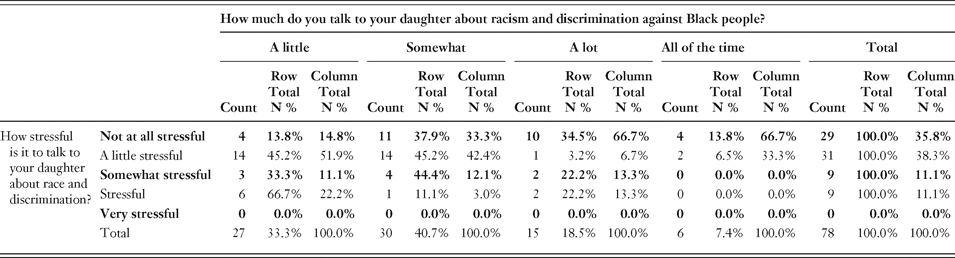
While the overwhelming majority (96%) of mothers reported that their parents had talked to them, to some degree, about racism and discrimination, Table 7 is a crosstabulation that represents the percentages of mothers who reported talking to their daughters about racism and discrimination and who also indicated how stressful they found it. This table presents support for the connection between the racial microaggressions experienced and the racial battle fatigue induced. It appears that the majority of mothers who talk to their daughters about racism and discrimination only do so “a little” (33%) or “somewhat” (41%). Of these fifty-seven mothers, forty-two (74%) find it to be stressful. Even for the mothers who talk to their daughters about racism and discrimination to a lesser degree, the majority still indicated that it is a stressful situation. One common symptom of racial battle fatigue is stress, which can manifest itself in a myriad of ways and is a social determinant of health (Franklin et al., Reference Franklin, Boyd-Franklin and Kelly2006; Jackson et al., Reference Jackson, McGibbon and Waldron2013; Pieterse et al., Reference Pieterse, Todd, Neville and Carter2012). It is likely that mothers experience elevated heartbeat, rapid breathing, rising blood pressure, guilt, agitation, or other depressive symptoms when discussing these subjects with their young daughters attending predominantly White schools. Mercer and colleagues (2011) found that reports of racial microaggressions experienced by Blacks were highly correlated with race-related stress, while Roxanne Donovan and colleagues (2012) found that racial microaggressions contributed to depressive symptoms in Black women.
Frequency Mothers Report Talking to Daughters about Racism & Discrimination x How Stressful It Is (N = 78)

From the descriptive statistics it is clear that racial microaggressions and racial battle fatigue are linked phenomena. When situated within the context of the Veil, talking to daughters about racism and finding it to be stressful in varying degrees is a testament to the psychological, and corresponding physiological, effects of racial battle fatigue. The mothers responding to the survey paint a picture that is more fully developed by the focus group and interview data presented next.
Qualitative Data: Racial Microaggressions Activate Presence and Induce Racial Battle Fatigue
Mothers with daughters attending predominantly White schools can encounter a bevy of racial microaggressions as they navigate the educational setting as well as the White, suburban communities in which they reside. These intentional “White places” (Feagin et al., Reference Feagin, Vera and Imani1996)—physical spaces (classrooms, cafeterias, and playgrounds, etc.)—become racialized, establishing who belongs and where, and who controls the space. This exercise in racial demarcation is played out through everyday microaggressions (e.g., avoidance, exclusion, being told one speaks well, and exposure to stereotypic images in media, etc.) or subtle actions of discrimination (Deitch et al., Reference Deitch, Barsky, Butz, Chan, Brief and Bradley2003; Masko Reference Masko2005; McCabe 2009; Smith et al., Reference Smith, Allen and Danley2007). Nonetheless, when microaggressions arrive in the form of microassaults they are conscious and explicit. Valerie relayed well a microassault she experienced:
And I had—I got involved in our school closings. And as a result of that I was interviewed by a newspaper and they put my picture and my daughter’s picture on the front page of the article. And I had people in the community who looked at me like they wanted to spit on me! They looked at me like they wanted to spit on me! And when you read the blog [comments] that’s underneath the article on mine, there were people telling me to go back where I came from … And you find those—you find those kind of comments in the local papers from time to time anyway about anything, burglaries or whatever it is, and they make these comments. And so I realized that I live in that type of community but me being me, I don’t care. You’re going to accept me one way or another. Either we can be friends that go along and do it or we can just work side by side and go our separate ways. And so I decided that I was going to continue to participate and I was going to continue to do whatever I was asked to do. I have somewhat of a strong personality, so you have to find a balance there. You know what I mean … Not to be so strong but then you don’t want to be overbearing because they [White people] do think you want to fight them. I had a school board member who thought I was gonna hurt her or something because I raised my voice on the phone. And when we [Black people] get excited we get loud and she doesn’t understand that. Really, they don’t.
The visceral response Valerie received as she advocated for not only her daughter, but all the children who would be negatively affected by the school closings, reflects the persistent notion that Black people only belong in certain (i.e., all Black) communities and their presence outside of those spaces upsets the “natural” order by causing disorder and dysfunction. The prevailing idea that she, as a Black woman in this predominantly White community, has no legitimacy and that her advocacy must be purely race-based (i.e., that Blacks always “play the race card”) negates the fact that she was speaking out in service of all children. Furthermore, Valerie’s description of her interaction with the school board member exemplifies the trope, propagated by those living without the Veil, of Black women as rabble-rousers, always expressing themselves violently, and known to be overly emotional beings (Lewis et al., Reference Lewis, Mendenhall, Harwood and Huntt2016; Morales Reference Morales2014). She comes to the conclusion that she will not be silenced (Lewis et al., Reference Lewis, Mendenhall, Harwood and Huntt2016); she admits that she will continue to enact visible presence as a strategy to combat such microassaults.
But what is the strain exacted on Valerie? Perhaps the psychological toll can be gleaned from her admonition that she will continue to be visibly present by “do[ing] whatever I was asked to do,” a type of hypervigilance to which Smith and colleagues (2007) allude. Another racial battle fatigue symptom may be found in her acknowledgement “Not to be so strong but then you don’t want to be overbearing because they do think you want to fight them.” This can lead to worrying about whether or not she is striking the balance she perceives is needed to allay White fears that disagreements will devolve into physical altercations, and/or other depressive symptoms as previous research has shown (Donovan et al., Reference Donovan, Galban, Grace, Bennett and Felicié2012). This mitigation of one’s self could induce a myriad of physiological symptoms, such as elevated heart rate and blood pressure, when Valerie interacts in the White spaces of her daughter’s school and her community. As Smith and colleagues (2007) note, “When racially oppressed groups are in situations where they experience environmental stressors as mundane events, the ramifications are as much a psychological and emotional burden as they are a physiological response” (p. 554).
Microinsults that ascribe criminal status or deviance to the Black daughter for particular actions can lead to microinvalidations whereby, when confronted, the perpetrator may invoke color blindness or deny their racism. Christina provides a situation her daughter faced which reflects such an experience:
But then there was a time where a little boy kept calling her awkward and I kept telling her blow it off. Don’t—he’s a boy. They’re annoying. And so I get an email from the teacher that [her daughter] had written a note to this boy and said, ‘I do not like you.’ She had just gotten to her boiling point, I think, and wrote him a letter. But she got in trouble. And so I spoke to the teacher and said this is what was going on. And so basically she [the teacher] was like, just let her know. And she [her daughter] was very apologetic for writing the note. And I said, ‘Well, she shouldn’t have to apologize for the note.’ I said, ‘Okay. Well she, again, apologized for expressing it the way that she did. She should have come to you. But from now on, based on our communication, she is to come to you and you handle it. And if not, then I will get involved’ … And so that was really the only—but the fact that she kind of went straight to her and punished her instead of getting the whole story kind of annoyed me in that respect.
In addition to the daughter being microinvalidated by her peer who referred to her as “awkward,” (perhaps speaking to his learned ideas of otherness and who belongs in these White places), her experience was further compounded by the teacher’s assumption of her deviance. It must be the little Black girl who is acting out and breaking the rules, as Black girls are often seen as aggressive troublemakers. But why see this little girl as the instigator, especially when there was no history of her getting into trouble before [per Christina’s retelling of the incident]? Why make an assumption without finding out both sides of the story? Perhaps it reflects a nullification of the young Black girl as victim because in U.S. society the perpetrator is often presented as Black. What does this treatment say to the young girl who obeyed her mother and continued to “blow off” the boy’s comment but found that she had “reached her boiling point” and retaliated by writing a note to her antagonist instead of taking harsher action? In her attempt to defend and protect herself we see Christina’s daughter’s frustration and resentment, perhaps the beginnings of her own racial battle fatigue.
Christina spoke to the teacher about the incident and clearly articulates her disappointment and concern that the teacher “went straight to her and punished her instead of getting the whole story.” This incident required Christina to enact presence on the behalf of her child. Because Christina understands the teacher’s White normative expectations and behavior, it was a strategic calculation for her to inform the teacher that “from now on, based on our communication, she is to come to you and you handle it. And if not, then I will get involved.” By stating the normative expectation, she demonstrates her understanding of living without the Veil. However, she also attempts to subvert this power dynamic by attempting to insert her enduring presence into her daughter’s classroom and in the mind of the teacher who neglected to get the whole story. Perhaps now, when the teacher is confronted with similar circumstances involving Christina’s daughter, she will tread more carefully and fairly. This strategic interaction serves to benefit Christina’s daughter in the future, when Christina is not able to be physically present to advocate on her daughter’s behalf. And what psychological and physiological toll do such calculative and orchestrated actions take on the mother utilizing them? Out of Christina’s annoyance, intrusive thoughts and images as well as anxiety and worrying may be born leading to the onset of various symptoms when one’s body is exposed to a chronically stressful state (Smith et al., Reference Smith, Allen and Danley2007).
According to Smith and colleagues (2007), “African Americans are constantly dedicating time and energy to determining if there was a stressor, whether that stressor was motivated by a racist purpose, and how or if they should respond” (p. 557). Paris’ account provides a powerful example of how racial battle fatigue can be induced when combating racial microaggressions as she recounted an experience with her daughter’s predominantly non-black Brownie (Girl Scouts) troop:
… like when she was with her Brownie troop after school and I saw some things or things on the playground …. I just more handled it with, with my daughter and just kind of talking to her about things and trying to stay objective and kind of weigh her [side]—is she being overly sensitive? Is there really something going on? And just kind of addressed it that way …. I mean, you know, it was just like—again, sometimes it’s just the cliquish things. As an example, and when I think about it and talk about it, it sounds very minor now, right? … And so we were—they were—we were leaving to go on a field trip and some of the parents were carpooling. And so the girls were figuring out who was gonna go with who. And no one wanted to go with my child, wanted to ride with us. And she was heartbroken, right? And so I’m like, she was the only Black girl that … There was another Black girl in the troop, but she was not going at that particular time. And I’m thinking, ‘Okay, is it because maybe they’re all more friends outside of school?’ And one of the things we did this past year is she had a lot more time outside of school play dates with some of the girls so that she could establish more of those relationships outside of school … But so I didn’t know if it was that, that they were just more—because they maybe had more time. You try to be, you know, you don’t want to just go to it’s a Black thing …. It was just more of her feelings were really hurt and my feelings were hurt. She was crying. I almost cried. You know, I, maybe I was just emotional that day. And I talk—it sounds very minor …. And you don’t want to see your child go through that …. And you don’t know with this … And being later we went on a field trip, a camping trip, and I went and chaperoned. It was two nights. And so then I could see over an extended period of time and there wasn’t any of that. She interacted and they interacted with her. So again, it may have just been—I don’t know what to attribute that to, but at least I know later I could see that it was, that didn’t happen again. [Emphases added throughout excerpt.]
Paris’ re-telling of this incident exemplifies the process that many persons of color go through as they attempt to analyze microaggressions to determine if they are racist in nature or not, especially as “African Americans are trying to transition into these historically White spaces and succeed, despite never knowing if or when they might be the targets of racial discrimination” (Smith at el., 2007, p. 556). Paris has an initial feeling that what she and her daughter experienced with the Brownie troop carpooling episode had a tinge of discrimination, and this is reflected in her query, “Is there really something going on?” She possibly felt the physical sensations of an elevated heart rate, queasy stomach, rapid breathing, and/or elevated blood pressure as she tried to unpack what was occurring. Paris attempts to rationalize what she and her daughter experienced by suggesting that perhaps she and her daughter were being overly “sensitive,” that she should “[try] to stay objective,” that upon reflection the episode probably “sounds very minor now,” and although her daughter was the “only Black girl” there at the time, maybe the reason none of the other girls chose to ride with her and her daughter was because they were all probably “more friends outside of school” because you “don’t want to just go to it’s a Black thing.”
Because Paris understands White middle-class normative expectations and behaviors, she decides that she is going to work hard to make her daughter more appealing to her fellow Brownies by arranging more “play dates” with some of the girls so that her daughter could establish those “relationships outside of school.” Her efforts at qualifying and explicating this experience most likely found her presenting psychological symptoms such as anxiety and worry, intrusive thoughts, denial, frustration, or resentment. As a way to monitor how her daughter was being received by her fellow Brownies, Paris makes a strategic decision to chaperone a camping trip. Her visible presence at the trip reassured her that perhaps what she had initially experienced was not necessarily racial discrimination, but just a manifestation of her daughter’s racialized status as an outsider-within. It is Paris’ hypervigilance that gives her some semblance of emotional comfort because “at least I know, later I could see that it was, that didn’t happen again.” One is left to wonder what symptoms Paris presents, physiologically and psychologically, when her daughter is among her fellow Brownies but she cannot be there. Even if Paris ultimately decided that what transpired during the carpooling incident was not racial discrimination, just look at the mental ruminations and lengths she went to assuage her doubts. This is emblematic of racial battle fatigue and highlights the insidious effects of racial microaggressions when one lives within the Veil.
DISCUSSION AND CONCLUSIONS
Racial Microaggressions and Racial Battle Fatigue Within the Veil
We Wear the Mask
We wear the mask that grins and lies,
It hides our cheeks and shades our eyes,—
This debt we pay to human guile;
With torn and bleeding hearts we smile
And mouth with myriad subtleties.
Why should the world be over-wise,
In counting all our tears and sighs?
Nay, let them only see us, while
We wear the mask.
We smile, but O great Christ, our cries
To thee from tortured souls arise.
We sing, but oh the clay is vile
Beneath our feet, and long the mile;
But let the world dream otherwise,
We wear the mask!
Paul Laurence Dunbar (Reference Dunbar1897) penned the poem “We Wear the Mask,” which speaks to the mask worn by African Americans living within White society. The mask represents the façade that covers one’s countenance, hiding/shielding the Black American’s true emotions and thoughts from the prying or indifferent eyes of White America. W. E. B. Du Bois used similar symbolism when discussing race and racism in America. Living with a mask or within an opaque veil is an experience to which practically every mother in this study alluded. For example, when discussing messages that mothers received from their parents about how to manage interracial relationships Rita stated, “Sure, I was told and I saw how white people have to be dealt with carefully …. So, you have got to keep them distant … yet near.” Within the Parent-CARES instrument are six subscales, one of which is Interracial Coping. Two of the statements measuring the frequency of Interracial Coping messages received are “You really can’t trust most White people” and “You have to watch what you say in front of White people.” 67% of mothers reported being told growing up that they really cannot trust most White people, while 78% of mothers reported being told to watch what they say in front of White people. Such sentiments reinforce the notion that living within the Veil can protect the Black psyche, yet it simultaneously sustains racial oppression.
Sociological Implications
Demonstrating the relevance of the Veil to everyday African American life and existence through the examination of African American mothers with young daughters attending predominantly White schools is of particular significance in the twenty-first century. Du Bois ([1920] 2003) offers in Darkwater: Voices from Within the Veil his understanding of the centrality of African American womanhood and motherhood when he includes Anna Julia Cooper’s famous 1892 pronouncement, “Only the black woman can say ‘when and where I enter … then and there the whole Negro race enters with me’” (as quoted in Du Bois, p. 180). Cooper (Reference Cooper1892) was one of the first sociologists to articulate the idea of the nexus between race and gender when she wrote those lines in A Voice from the South. Du Bois further explores Cooper’s articulation when he writes, “The uplift of women is, next to the problem of the color line and the peace movement, our greatest modern concern. When, now, two of these movements—woman and color—combine in one, the combination has deep meaning” (p. 187). The Veil as an analytical device takes on even more renewed significance as we come to understand how it is interlaced with gender and gender oppression, providing an intersectional perspective. This nexus is powerfully meaningful for the African American mothers participating in this study who are developing a positive Black-girl identity in their daughters, just as many of their own mothers did for them. Black-girl/woman identity is highly salient for these mothers.
Through this analysis we have attempted to support our contention that, when viewed through the Veil, racial microaggressions and racial battle fatigue are especially perceptible, allowing us to better understand the ways that they function and are related. By examining African American mothers with young daughters attending predominantly White schools, we sought to demonstrate the relevance of the Veil to twenty-first century, daily, African American life and existence. Within the context of predominantly White schools and communities, when experiencing racial microaggressions mothers actively combat them utilizing the African American motherwork strategy of presence—a strategy that can induce racial battle fatigue. Enacting presence is a gendered and class-specific means for claiming space or attempting to carve out belonging and representation in settings that are racially and culturally hostile. Yet, racially- and culturally-rooted strengths seem to be vital to confronting debilitating institutions, structures, and systems.
The experiences of these metro Detroit mothers provide important insight into the structural ramifications of racial microaggressions. Applying the Veil—a sociological construct—as an analytical device points to an aspect of racial residential segregation that has been given scant attention in the literature: how racial microaggressions, which have long been studied from a psychological standpoint, foster structural inequality. The perpetuation of and experience with racial microaggressions help to sustain racial housing preferences and residential segregation. As Whites prefer and move to whiter neighborhoods and communities (Krysan and Bader, Reference Krysan and Bader2007) they see this reality as being normative and not a reflection of their colorblind racial ideology (Bonilla-Silva and Embrick, Reference Bonilla-Silva and Embrick2007).
Sue and colleagues (2007) suggest that, “What is lacking is research that points to adaptive ways of handling microaggressions by people of color and suggestions of how to increase the awareness and sensitivity of Whites to microaggressions so that they accept responsibility for their behaviors and for changing them” (p. 279). Furthermore, Smith and colleagues (2007) intone that it is necessary “to identify possible mechanisms, processes, strategies, and informal or formal relationships that [African Americans] can better employ as adaptive coping resources” (pp. 572–573). We offer these experiences—or empirical evidence—of African American mothers with young daughters attending predominantly White schools and African American motherwork strategies as vehicles for advancing these calls. In the Du Boisian sense, we too have attempted to “raise” the Veil as there is much to be learned by more in-depth exploration of the African American motherwork phenomenon. Research that centers the experiences of these women will certainly lead to the discovery of other adaptive ways of coping that may be transferable across multiple settings. For instance, a topic that arose from this mixed methods study (and to be explored in the future) revealed the importance of Black Parent Associations that were present in various school districts represented in this study. These Black Parent Associations seem to be spaces for collective organizing, action, and empowerment. Member parents seem to devise ways to challenge normative whiteness while attempting to mitigate vulnerabilities their children may face in the racist, hegemonic U.S. institution of education.
Implications for Practice
While the primary purpose of this article was to root racial microaggressions and racial battle fatigue within the Du Boisian Veil, we would like to highlight some practical implications based on the gendered racial socialization experiences of African American women raising daughters in predominantly White community and school settings. As racial microaggressions in varying forms influenced the participants’ lives daily—confirming the existence and utility of the Veil—it remains important for White people, who are often perpetrators of racial microaggressions, to continuously challenge themselves by reflecting on their inherent biases towards African American women and, more broadly, people of color. As Sue and colleagues (2007) note with respect to racism, change can “only be accomplished when people are willing to openly and honestly engage in a dialogue about race and racism” (p. 283). Further, not only is internal reflection important to reduce racism that is often enacted through racial microaggressions, but when bystanders—White people and people of color alike—hear or see racial microaggressions, they must actively disarm the microaggressor by: 1) acknowledging the microaggressions 2) identifying the microaggressions, and 3) informing microaggressors that what they said was racist and offensive because of stereotypes or negative views associated with the statement or action.
African American motherwork—which we argue is a characteristic of the Veil—is often enacted when mothers are confronted with racial microaggressions, which consequently induce racial battle fatigue; however, moving from theory to practice is important in this work. As Phillip Bowman (Reference Bowman, Prince-Embury and Saklofske2012) and Ruby Mendenhall and colleagues (2013) note, documenting the ways in which African American mothers cope with role strain (such as that caused by racial battle fatigue), and are resilient in the face of racial microaggressions and racial battle fatigue are salient implications in this type of scholarship (see Bowman Reference Bowman, Prince-Embury and Saklofske2012 for articulation of role strain and resiliency).
Ultimately, strength-based approaches “through which protective factors [like African American motherwork] reinforce personal strengths to enable those faced with chronic risk exposure to avoid devastation, to struggle against the odds, and to even excel despite adversity” (Bowman Reference Bowman, Prince-Embury and Saklofske2012, p. 304) help to generate resiliency processes that lead to positive outcomes. In his role strain and adaptation model, Bowman (Reference Bowman, Prince-Embury and Saklofske2012) notes policy-relevant and preventive interventions are important components to using strengths-based approaches to resiliency as they “can inform innovative support strategies to boost resilient outcomes” (p. 308). As highlighted in previous research, cultural strengths or adaptive coping strategies, for African American mothers experiencing racial microaggressions and racial battle fatigue, may include extended family support, religious beliefs, and community-level supports (i.e., other African American women in the workplace or Black Parent Associations within predominantly White school districts) (Bowman Reference Bowman, Prince-Embury and Saklofske2012; Mendenhall et al., Reference Mendenhall, Bowman and Zhang2013). To add to previous research, this study highlights how racial-gender socialization or African American motherwork functions as a protective cultural strength “among Black women [promoting] personal resiliency, and in turn, [can] inspire more collective modes of sociopolitical coping across generations” (Mendenhall et al., Reference Mendenhall, Bowman and Zhang2013, p. 76).
In addition, as the participants raise their daughters in predominantly White communities and schools, their experiences highlight the need for teacher and educational leader preparation programs and school districts to emphasize intercultural training, cultural competence and proficiency, and culturally responsive teaching as part of professional development. This development must be sustained as educators progress through their careers, particularly White teachers and teachers in predominantly White settings. Infusing an assets-based curriculum into teacher and educational leader preparation programs means teacher educators must interrogate their own biases to acquire and promote accurate cultural knowledge so as to help teacher/leader candidates develop cultural competence and proficiency. Writing about mental health professionals, Sue and colleagues (2007) note, “It is important that training programs be structured and facilitated in a manner that promotes inquiry and allows trainees to experience discomfort and vulnerability” and “Trainees need to be challenged to explore their own racial identities and their feelings about other racial groups” (p. 283). We echo these sentiments for teachers and educational leaders as they go through professional development trainings to improve their intercultural competence and racial self-awareness and for teacher educators who may be leading these trainings.
Furthermore, we assert that to successfully infuse assets-based thinking into teacher/leader training will require educational researchers to take up Bowman’s (2012) call for “more systematically bridging basic scholarship on resiliency with more policy-relevant intervention research and assessment systems” (p. 317). In particular, there is a need to identify, understand, and promote best practices that foster children of color’s resilience in the face of adversity. In sum, our practical implications highlight the need for all to be involved in disarming racial microaggressions (particularly given the physical, mental, and emotional tolls they have on people of color); understanding cultural strengths; and promoting resilient outcomes for marginalized populations.