Introduction
Entomopathogenic nematodes (EPN) of the families Steinernematidae and Heterorhabditidae have a symbiotic association with bacteria which makes them virulent against insects (Shapiro-Ilan & Gaugler, Reference Shapiro-Ilan and Gaugler2002). Thus, EPNs have been developed as biological control agents, especially to control soil-dwelling insect pests (Shapiro-Ilan et al., Reference Shapiro-Ilan, Han, Qiu, Morales-Ramos, Rojas and Shapiro-Ilan2014). These nematodes carry the bacteria inside their gut. Once inside the insect host, the infective juvenile nematodes (IJs) release their bacteria, which are primarily responsible for killing the host, usually within 48 h (Hazir et al., Reference Hazir, Kaya, Stock and Keskin2003). The re-initiation of the nematode life cycle from its arrested infective stage (the IJ) is called recovery (Ferreira et al., Reference Ferreira, Addison and Malan2016). The nematodes feed upon the proliferating bacteria and the decomposing insect cadaver (Strauch & Ehlers, Reference Strauch and Ehlers1998). They complete 1–3 generations within the insect host and then exit to search for new insect targets (Stock, Reference Stock and Campos-Herrera2015). The IJ is the only free-living stage and is adapted to be durable and survive in the soil environment until it can find a suitable insect host (Lewis & Clarke, Reference Lewis, larke, Vega and Kaya2012; Shapiro-Ilan et al., Reference Kim, Kim, Yasunaga-Aoki and Yu2014).
More than 90 species of Steinernema and more than 20 of Heterorhabditis have been described (Shapiro-Ilan et al., Reference Shapiro-Ilan, Hazir and Glazer2016), but only about one dozen have been commercialized for use in biocontrol. EPNs have been commercialized for nearly three decades, but their successful implementation in biological control has been limited. In part, this is due to non-competitiveness of production costs compared with those of chemical insecticides, as well as inconsistent nematode quality (Gaugler, Reference Gaugler1997). Therefore, improvements in production technology will lead to wider adoption of EPNs in biocontrol programmes.
EPNs are mass produced using in vivo methods (by inoculating living insects) and in vitro methods, which use the bacterial culture as a food source for the nematodes (Ehlers, Reference Ehlers2001; Shapiro-Ilan et al., Reference Kim, Kim, Yasunaga-Aoki and Yu2014). In vitro methods include both solid and liquid fermentation. In vitro solid production has several advantages (Shapiro-Ilan et al., Reference Kim, Kim, Yasunaga-Aoki and Yu2014). It does not require high technology inputs and large investments relative to liquid culture. The effect of phase variation on the yields is less than in liquid culture (Han & Ehlers, Reference Han and Ehlers2001). However, when it comes to large-scale production, the disadvantages of solid culture can be overwhelming. In vitro solid production is labour intensive, vulnerable to contamination during upstream and downstream processing, and is difficult to monitor online. The uneven distribution of the nematode in the medium prevents systematic sampling, and thus improvement of technique is required (Shapiro-Ilan et al., Reference Kim, Kim, Yasunaga-Aoki and Yu2014). However, today, a few companies still produce EPNs in solid culture, including Bionema (www.bionema.se), Andermat Biocontrol AG (www.biocontrol.ch), Biologic (USA (www.bio-logic.us) and Guangzhoy Greenfine Biotechnology (China). In the three-dimensional solid media method, a liquid medium is mixed with foam, autoclaved, and then inoculated with bacteria followed by the nematodes. Nematodes are then harvested within 2–5 weeks (Bedding, Reference Bedding1981, Reference Bedding1984). Media for this approach was initially based on animal products such as pork kidney or chicken offal, but it was later improved and now may include various ingredients, including peptone, yeast extract, eggs, soy flour and lard (Han et al., Reference Han, Cao and Liu1992, Reference Han, Cao and Liu1993; Ehlers & Shapiro-Ilan, Reference Ehlers, Shapiro-Ilan, Grewal, Ehlers and Shapiro-Ilan2005; Shapiro-Ilan et al., Reference Kim, Kim, Yasunaga-Aoki and Yu2014). In developing countries, the in vitro solid culturing system is still superior to liquid culture technology, due to low costs of labour in these countries (Ehlers et al., Reference Ehlers, Niemann, Hollmer, Strauch, Jende, Shanmugasundaram, Mehta, Easwaramoorthy and Burnell2000). Similar to in vivo production, solid culture efficiency can be increased through mechanization (labour reduction) and enhancement of media (Gaugler & Han, Reference Gaugler, Han and Gaugler2002; Shapiro-Ilan & Gaugler, Reference Shapiro-Ilan and Gaugler2002). Nonetheless, media enhancement has been emphasized for liquid production more so than for solid culture (Shapiro-Ilan et al., Reference Kim, Kim, Yasunaga-Aoki and Yu2014).
For the most part, due to its economy of scale, in vitro liquid culture is generally considered the preferred technology for large-scale commercial mass production of EPNs (Friedman, Reference Friedman, Gaugler and Kaya1990; Ehlers & Shapiro-Ilan, Reference Ehlers, Shapiro-Ilan, Grewal, Ehlers and Shapiro-Ilan2005). In vitro liquid production starts with shake-flask cultures and is scaled up to various sizes of bioreactors until reaching the desired level of commercial production.
Research on in vitro liquid culture has focused on improving nematode recovery (which can be problematic when grown in vitro), production yield, quality and costs (Shapiro-Ilan et al., Reference Kim, Kim, Yasunaga-Aoki and Yu2014). Maximum yields can be achieved through optimizing medium and culture conditions. Essential nutrients for nematode culture, such as protein (Buecher et al., Reference Buecher, Hansen and Yarwood1970; Yoo et al., Reference Yoo, Brown, Cohen and Gaugler2001), lipids (Abu Hatab & Gaugler, Reference Abu Hatab and Gaugler1999; Yoo et al., Reference Yoo, Brown and Gaugler2000) and various growth factors (Hieb & Rothstein, Reference Hieb and Rothstein1968; Hieb et al., Reference Hieb, Stokstad and Rothstein1970; Vanfleteren, Reference Vanfleteren1974), have been studied. In addition, culture conditions, such as temperature (Ehlers et al., Reference Ehlers, Niemann, Hollmer, Strauch, Jende, Shanmugasundaram, Mehta, Easwaramoorthy and Burnell2000), inoculum size (Han, Reference Han1996) and aeration rate (Strauch & Ehlers, Reference Strauch and Ehlers2000; Neves et al., Reference Neves, Teixeira, Simoes and Mota2001), have been optimized. However, no research has been reported to-date to address the effect of inoculum age on the production of nematodes in liquid versus solid cultures, when using the same culture medium. Furthermore, no research has explored an alternative biphasic solid culture approach (modified from the more traditional ‘Bedding’ approach), which would entail growing the bacteria first in liquid medium and, then, soaking the culture into the sponge flakes with the purpose of providing a more homogeneous bacterial culture before nematode inoculation.
This study assessed the effect of nematode inoculum age on the production of Steinernema feltiae (Filipjev) in liquid, solid (i.e. the more traditional ‘Bedding’ approach) and biphasic (modified-solid) culture, as well as the effect of medium viscosity, flask size and aeration speed on the recovery and yield of IJs in liquid culture. The experiments were conducted using shaker flasks. The present study focuses on S. feltiae, which is one of the most studied nematodes among the EPNs and is used widely in biocontrol applications, such as for suppression of fungus gnats, an insect pest of ornamental, nursery plants and mushrooms of worldwide importance (Jess et al., Reference Jess, Schweizzer, Kilpatrick, Grewal, Ehlers and Shapiro-Ilan2005; Tomalak et al., Reference Tomalak, Piggott, Jagdale, Grewal, Ehlers and Shapiro-Ilan2005).
Materials and methods
Two experiments were conducted, first to assess the effect of inoculum age on the production of S. feltiae by liquid, solid and biphasic processes and, second, to assess the effect of medium viscosity, flask size and aeration speed on the recovery and yield of IJs in liquid culture.
Bacterial isolation and nematode axenization
Xenorhabdus bovienii isolation and S. feltiae axenization were done according to Leite et al. (Reference Leite, Shapiro-Ilan, Hazir and Jackson2016).
The medium for inoculum development, for subcultures with different inoculum ages and for physical parameter assessments contained, per litre: 23 g yeast extract, 6.25 g egg yolk, 6.25 g egg white, 25 g glucose, 5 g NaCl, 40 g peanut oil and 2 g agar. This was selected as the best medium to produce S. feltiae in previous studies (Leite et al., Reference Leite, Shapiro-Ilan, Hazir and Jackson2016).
Effect of inoculum age
Fifty-ml inoculum cultures were grown in 150-ml Erlenmeyer flasks. After autoclaving, the inoculum medium was inoculated with X. bovienii bacteria, previously grown in TSB + Y medium (4% tryptic-soy-broth + 0.5% yeast extract) for 2 days at 280 rpm and 25°C, by adding 1 ml (~4 × 10⁹ cells) to each flask to produce a final bacterial concentration of ~8 × 10⁷ bacteria per ml. A haemocytometer was used to determine bacterial concentrations. The inoculum flasks were incubated in a rotary orbital shaker (Innova 4300 Incubator Shaker, New Brunswick, New Jersey, USA) at 280 rpm and 25°C for 2 days. After this period, the bacterial cultures were inoculated with nematodes by adding (with a pipette) ~1.2 × 10⁴ first-stage juveniles suspended in 0.3 ml of TSB + Y medium to each flask. The inoculum cultures were incubated in a shaker incubator at 280 rpm and 25°C for various times to generate the different-aged inoculum treatments for the experiment, as described below.
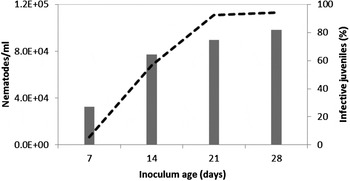
Inoculum-age treatments included liquid culture inocula that were at 7, 14, 21 and 28 days of growth, generating concentrations of 32,722, 77,361, 89,556 and 98,444 nematodes/ml, respectively. For each inoculum age, nematodes from the same liquid culture were added to one liquid medium (liquid culture) previously cultured with X. bovienii; one solid medium with bacteria previously grown on solid media as developed and described by Bedding (Reference Bedding1981) (solid culture); and a solid medium with bacteria previously grown in liquid media (biphasic culture).
For the liquid culture nematode production, X. bovienii was grown in the standard liquid medium for 2 days before nematode inoculation. Erlenmeyer flasks (150 ml) containing 50 ml of the standard liquid medium were inoculated with 1 ml of X. bovienii (4 × 10⁹ cells) grown in TSB + Y medium (for 2 days at 280 rpm and 25°C) and incubated at 280 rpm and 25°C in a rotary shaker incubator. After 2 days’ bacterial growth, 2 ml of nematodes at different ages of growth, with different nematode concentrations as described above, were added to the flasks.
For the solid culture nematode production, X. bovienii was grown in sponge flakes previously soaked with the standard liquid medium before nematode inoculation. Erlenmeyer flasks (250 ml) containing 2 g of sponge flakes previously soaked with 50 ml of the standard liquid medium were inoculated with 1 ml of bacteria (4 × 10⁹ cells) grown in TSB + Y medium (for 2 days at 280 rpm ad 25°C). The flasks were agitated manually and incubated for 2 days at 25°C; nematode inoculation (in 2 ml culture) followed subsequently. This inoculation method is similar to the original approach described by Bedding (Reference Bedding1981, Reference Bedding1984).
For the biphasic nematode production, bacteria were grown first in the standard liquid medium and then soaked into the sponge flakes before nematode inoculation. Erlenmeyer flasks (150 ml) containing 50 ml of standard liquid medium were inoculated with 1 ml of bacteria (4 × 10⁹ cells) grown in TSB + Y medium (for 2 days at 280 rpm and 25°C), and incubated at 280 rpm, under 25°C. After 2 days, the 50 ml of bacterial culture was transferred to Erlenmeyer flasks (250 ml), soaked into 2 g of sponge flakes, and inoculated with nematodes (in 2 ml culture).
Each culture regime (liquid, solid and biphasic processes) was inoculated with four nematode inoculum ages: 7, 14, 21 and 28 days old. For each culture regime (liquid, solid and biphasic) at each nematode inoculation age, three replicate flasks were established. Thus, there were 36 replicate flasks total (3 culture treatments × 4 inoculum ages × 3 replicates). After nematode inoculation, the flasks containing the soaked sponge flakes (solid and biphasic cultures) were shaken once manually and incubated at 25°C, while the flasks containing the liquid medium were incubated at 280 rpm and 25°C in a rotary shaker incubator (Innova 4300 Incubator Shaker).
In the flasks that generated different-aged inocula, the total nematode concentration and percentage of IJs were determined prior to the inoculation of the various culture treatments.
In liquid cultures inoculated with different inoculum ages, the numbers of nematodes and their stages of development were assessed weekly (over 4 weeks). One-millilitre samples were taken from each flask and diluted 1:500 in water. The nematode suspension was stirred while taking a 2-ml sample for counting nematodes and assessing their developmental stage in a nematode-counting chamber, using a stereomicroscope (16×). Counts were repeated twice.
For both solid and biphasic cultures, evaluation was done 28 days after each nematode inoculation by counting nematodes found inside the sponge flakes. To extract the nematodes from the sponge, all the flakes from each flask were squeezed 30 times in running water, inside a 3-litre beaker, until the water volume inside the beaker reached 3 l. The nematode suspension was stirred and 2-ml samples were taken and counted in a nematode-counting chamber, using a stereomicroscope (16×). Counts were repeated twice. The entire experiment was repeated two times.
Effect of aeration speed, flask size and viscosity
Eight treatments for liquid culture production of S. feltiae involved combinations among three factors: two media (with and without 0.2% agar), two Erlenmeyer flask sizes (250 and 150 ml) and two agitation speeds in the shaker (180 and 280 rpm). This experiment was conducted as a factorial designed experiment with agitation speed, flask size and viscosity as the main factors. The standard nematode medium described above was used for all treatments. Three replication flasks (150-ml Erlenmeyer containing 50 ml culture broth) were established for each treatment. The methodology for bacterial and nematode inoculation and culture were the same as described above.
The nematode production media were inoculated with X. bovienii bacteria previously grown in TSB + Y medium (for 2 days at 280 rpm ad 25°C), by adding 1 ml (5 × 10⁹ cells) of culture to each flask. The flasks were incubated for 2 days at 280 rpm and 25°C, for bacterial growth. Two days post bacterial inoculation, each flask was inoculated with IJs of S. feltiae by adding 2 ml of a 28-day-old nematode culture (obtained according to the inoculum culture) to each flask, resulting in a final concentration of 5000 IJs/ml of medium. Half the flasks were incubated at 280 rpm and half at 180 rpm.
Cultures were evaluated 2 days after bacterial inoculation by counting bacterial cells, 2 days after nematode inoculation by assessing nematode recovery, and weekly by counting nematode populations. For the bacterial counts, 25-μl samples were taken from each flask and diluted in 40 ml water inside a centrifuge tube (50 ml). After the tubes were closed and shaken, the bacterial suspensions were counted in a Neubauer chamber using a compound microscope (400×).
For assessing nematode recovery, 100-μl samples were taken from each flask 2 days after nematode inoculation, and diluted in 20 ml water inside a centrifuge tube (50 ml). After the tubes were closed and vortexed, the nematode suspension was observed in a nematode-counting chamber using a stereomicroscope (16×) and the recovery was assessed. IJ recovery was calculated according to Hirao & Ehlers (Reference Hirao and Ehlers2010) and represents the percentage of the sum of J3, J4 and adults relative to the total nematode population.
Nematode counts were assessed weekly, as described above in the previous experiment. The entire experiment was repeated once.
Data analyses
Data from repeated trials were pooled and variation among trials was treated as a block effect. For the first experiment (effect of inoculum age), data from the liquid cultures as well as from the two solid processes were analysed by regression analyses between yield and inoculum age. For the second experiment (effect of agar, flask size and agitation speed), if the main effects were found to act independently (no interaction detected between them) then the analysis focused solely on these effects and simple effects were not elucidated further (Cochran & Cox, Reference Cochran and Cox1957). For bacterial counts (2 days post inoculation), only two factors were considered, effect of agar and flask size, because speed was the same for all flasks (280 rpm) during the previous 2 days’ bacterial growth cycle, and changed to 180 rpm for half of the flasks after nematode inoculation. Treatment effects were detected using analysis of variance (ANOVA). If the F value was significant, then treatment differences were further elucidated with Tukey's test. Percentage data were arcsine transformed and numerical data were log transformed prior to analysis (Southwood, Reference Southwood1978); non-transformed means are presented in the Results section. All statistical comparisons were done using SAS version 9.0 software (SAS Institute Inc., Cary, North Carolina, USA), with a P value ≤ 0.05 indicating significance.
Results
Effect of inoculum age
Overall, a positive trend was observed between increased inoculum age and nematode yield (fig. 1).
Yields of Steinernema feltiae/ml (grey bars) and percentage of infective juveniles (dashed lines) in liquid cultures, up to 28 days post-inoculation.

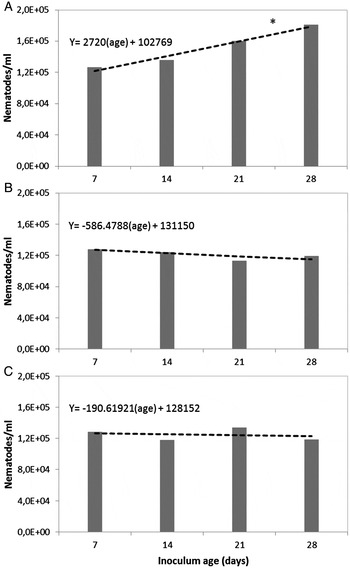
Indeed, for liquid culture production, the yield of nematodes increased significantly as the inoculum age advanced and the concentration increased up to 98,444 nematodes/ml (fig. 2), according to the regression analyses (r 2 = 0.17; P = 0.0105). For both solid and biphasic cultures, the yield of nematodes remained similar (no significant slope) when inoculated with the different inoculum ages (r 2 = 0.01; P = 0.5619 for solid culture; r 2 = 0.0008; P = 0.8739 for biphasic culture).
Yields of Steinernema feltiae/ml (grey bars) and regression line (dashed lines) in liquid (A), solid (B) and biphasic (C) cultures up to 28 days post-inoculation. *Significant increase in nematode yields (r 2 = 0.17; P = 0.0105).

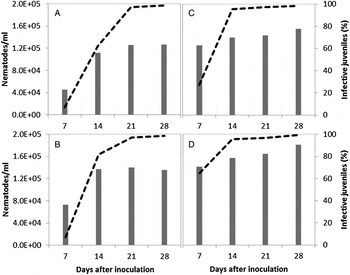
The liquid cultures inoculated with 28-day-old inoculum showed the highest yield, with 65% IJs formed in the first week after inoculation (fig. 3).
Yields of Steinernema feltiae/ml (grey bars) and percentage of infective juveniles (dashed lines) in liquid cultures, up to 28 days post-inoculation with (A) 7, (B) 14, (C) 21 and (D) 28-day-old nematode inocula.

Effect of aeration speed, flask size and viscosity
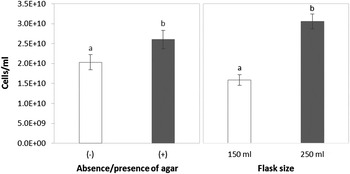
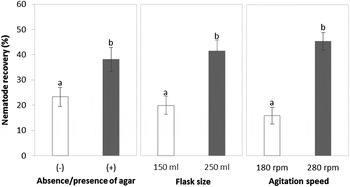
For the agar–flask–speed experiment, no interaction was detected between agar*flask (F = 0.4; df = 1, 43; P = 0.5283) for bacteria or between agar*flask (F = 0.84; df = 1, 40; P = 0.3659), agar*speed (F = 0.32; df = 1, 40; P = 0.5753) or flask*speed (F = 0.72; df = 1, 40; P = 0.4015) for recovery. The presence of agar in the medium and the use of a larger flask increased the bacterial yield (F = 5.03; df = 1, 43; P = 0.0301 for agar; F = 40.07; df = 1, 43; P < 0.0001 for flask) (fig. 4), while these two conditions as well as the use of higher agitation speed increased percentage nematode recovery (F = 24.83; df = 1, 40; P < 0.0001 for agar; F = 62.99; df = 1, 40; P < 0.0001 for flask; F = 118.36; df = 1, 40; P < 0.0001 for speed) (fig. 5).
Cell yields/ml of Xenorhabdus bovienii in liquid medium with absence (white bars) and presence (grey bars) of 0.2% agar, and also in two flask sizes of 150 ml (white bars) and 250 ml (grey bars). Different letters above bars indicate statistical differences (Tukey's test; P < 0.05).

Recovery of Steinernema feltiae (percentage of the sum of J3, J4 and adults relative to the total nematode population) in liquid media with absence (white bars) and presence (grey bars) of 0.2% agar, grown in two flask sizes, 150 (white bars) and 250 ml (grey bars), and incubated at two agitation speeds, 180 (white bars) and 280 rpm (grey bars). Different letters above bars indicate statistical differences (Tukey's test; P < 0.05).

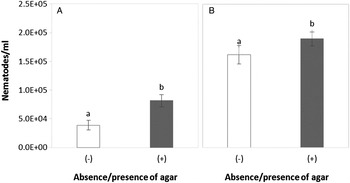
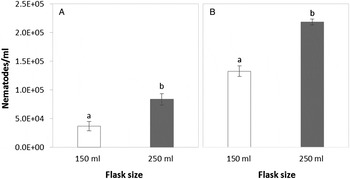
The analyses of nematode yield showed an interaction of agar*speed (F = 8.9; df = 1, 40; P = 0.0048) and flask*speed (F = 4.94; df = 1, 40; P = 0.0319), with a significant increase of yield by the addition of agar to the medium (F = 19.31; df = 1, 40; P < 0.0001) (fig. 6) and use of larger flask size (F = 36.83; df = 1, 40; P < 0.0001) (fig. 7), as well as by the use of higher speed irrespective of size of flask and addition of agar (F = 99.28; df = 1, 40; P < 0.0001) (figs 6 and 7).
Yields of Steinernema feltiae in liquid media with absence (white bars) and presence (grey bars) of 0.2% agar, incubated at two agitation speeds, (A) 180 and (B) 280 rpm. Different letters above the bars indicate statistical differences (Tukey's test; P < 0.05).

Yields of Steinernema feltiae grown in liquid medium in flasks of two sizes, 150 (white bars) and 250 ml (grey bars), and incubated at two agitation speeds, (A) 180 and (B) 280 rpm. Different letters above the bars indicate statistical differences (Tukey's test; P < 0.05).

Discussion
This study is the first to assess the effect of inoculum age on the growth and yield of EPN and the first to compare liquid culture with solid and biphasic cultures for nematode yield. While there was a significant increase of nematode yields in liquid cultures inoculated with older S. feltiae inocula, solid and biphasic production cultures were not affected by nematode inoculum age. The bacterial culture was not responsible for the different nematode yields between the liquid and both solid and biphasic cultures, since the bacterial inoculum concentration and culture condition were exactly the same for both the liquid and biphasic cultures. According to Han et al. (Reference Han, Cao and Liu1992, Reference Han, Cao and Liu1993), bacterial inoculum size does not appear to be important in yield determination for solid cultures.
For the liquid culture nematode production, flasks inoculated with 28-day-old inoculum afforded the highest yields because the inocula had the highest nematode concentration (98,444 nematodes/ml) and highest percentage of IJs (94%). The use of an inoculum with a higher concentration and higher percentage of IJs may have led to faster reproduction, with higher synchronism of copulation compared to inocula containing lower concentrations and larger variations of nematode stages (such as the 7- to 14-day-old inocula). By improving the synchronism of copulation, the inoculation with 28-day-old inoculum also increased the rate of IJ formation, providing 65% IJs in the first week. Inocula based on IJs have been used successfully for starting commercial production, because high concentrations of IJs can be obtained easily and stored, and may lead to increased nematode yields and rapid harvest within 2 weeks post inoculation (Strauch & Ehlers, Reference Strauch and Ehlers1998; Jeffke et al., Reference Jeffke, Jende, Matje, Ehlers and Berthe-Corti2000; Yoo et al., Reference Yoo, Brown and Gaugler2000; Hirao & Ehlers, Reference Hirao and Ehlers2010; Shapiro-Ilan et al., Reference Shapiro-Ilan, Han and Dolinski2012).
As for the solid and biphasic cultures, they showed stable yields irrespective of inoculum age, with concentrations of up to 98,444 nematodes/ml. The reason for the difference in results compared with those for liquid culture is not clear, but may be due to the distribution of nematodes. After the inoculations of the nematode on the sponge flakes, the flasks were shaken manually to improve the nematode distribution on the medium. However, the nematodes were mainly congregated near the surface of the sponge flakes, since the distribution inside the flakes is variable and may also depend on nematode locomotion to enter the pores. Consequently, early in the culture process, there might have been competition for food on the surface of the solid media. In contrast, the distribution of the nematodes in liquid medium is even, resulting in less competition for food. The impact of nematode inoculum rates on yield of solid cultures varies among nematode strains (Han et al., Reference Han, Cao and Liu1992, Reference Han, Cao and Liu1993; Wang & Bedding, Reference Wang and Bedding1998). For example, S. carpocapsae (Agriotos strain) produced optimal yield at an intermediate inoculum size (2000 IJs per g medium) (Han et al., Reference Han, Cao and Liu1993), whereas S. carpocapsae (CB2B strain) and H. bacteriophora (H06) were not affected by inoculum size (Han et al., Reference Han, Cao and Liu1992). Other factors play a crucial role in nematode development in solid cultures, such as temperature, culture time, media composition and innate reproduction capacities of different nematode species and strains (Shapiro-Ilan et al., Reference Kim, Kim, Yasunaga-Aoki and Yu2014).
Comparing the nematode production process in liquid culture with that in both solid and biphasic cultures, the liquid culture shows more advantages, especially in terms of labour demand during the nematode production process and harvesting (Shapiro-Ilan & Gaugler, Reference Shapiro-Ilan and Gaugler2002), as well as higher yields when a proper inoculum age is used. In contrast, the solid process does not require high technology inputs and large investments relative to liquid culture (Han & Ehlers, Reference Han and Ehlers2001; Shapiro-Ilan et al., Reference Kim, Kim, Yasunaga-Aoki and Yu2014), providing in the current study yields (>120,000 IJs/ml) that were similar to the 125,000 IJs/ml of S. feltiae obtained by Hirao & Ehlers (Reference Hirao and Ehlers2010) using liquid fermentation processes. In developing countries, the in vitro solid culturing system is still superior to liquid culture technology (Ehlers et al., Reference Ehlers, Niemann, Hollmer, Strauch, Jende, Shanmugasundaram, Mehta, Easwaramoorthy and Burnell2000).
Both solid and biphasic cultures showed the same trend of nematode yields and similar levels with the advance of the inoculum age. Therefore, the solid process that was developed by Bedding (Reference Bedding1981) is preferable, due to the lower labour demand required to grow the bacteria directly in the sponge flakes (previously soaked with liquid medium) compared to the biphasic process, growing in liquid medium before soaking the bacterial culture into the sponge flakes. Furthermore, the biphasic process would require larger fermenters to grow the bacteria before soaking the culture into the sponge, which would increase the costs required to implement the approach.
Media with agar and the use of a larger flask increased the bacterial population, while these two conditions (medium with agar and use of larger flask) as well as the use of higher agitation speed improved nematode recovery and yield. The higher nematode recovery rates found in the flasks kept at higher agitation speed may be related to the increased aeration (due to higher agitation) rather than to the bacterial culture. Bacterial concentration was the same in each flask size just after the nematode inoculation, since the agitation speed was the same (280 rpm) before nematode inoculation, providing the same conditions for bacterial growth in each flask size. Nematode recovery has been related to many causes but, prior to the present research, had not been attributed to aeration. According to Hirao & Ehlers (Reference Hirao and Ehlers2010), nematode recovery is a response to food signals in the insect haemolymph. During recovery, the bacteria are released, which accelerates the killing of the host (Han & Ehlers, Reference Han and Ehlers2000). Nematode recovery has also been enhanced by increasing the concentration of symbiotic bacteria, by providing CO2 and by advancing age of the IJs used as inoculum (Ehlers & Shapiro-Ilan, Reference Ehlers, Shapiro-Ilan, Grewal, Ehlers and Shapiro-Ilan2005).
Ehlers et al. (Reference Ehlers, Lunau, Krasomile-Osterfeld and Osterfeld1998) reported that low IJ recovery leads to a non-synchronous population development of H. bacteriophora, prolonged culture duration and unstable yields. In order to reach the necessary density also at low IJ recovery, higher numbers of IJs must be inoculated, which makes necessary additional scale-up steps, thus increasing the production costs. Consequently, the key to a successful and cost-effective liquid culture process is through the management of IJ recovery.
In the present study, the increased nematode recovery rates in the medium with agar and in larger flasks might have been caused by the increased viscosity and aeration, as well as by the increasing of bacterial concentration in these two conditions prior to nematode inoculation. Agar and larger flasks may have an important role on recovery, since agar improves the oil distribution in the medium and both agar and larger flasks may improve air distribution and dissolved oxygen, favouring nematode growth. Hassane et al. (Reference Hassane, Farah, Satrani, Ghanmi, Chahmi, Chahmi, Soidrow, Chaouch, Bhowon, Jhaumeer-Laulloo, Wah and Ramasami2012) used agar at 0.2% to obtain a homogeneous distribution of essential oils in culture media. Increasing viscosity may also increase aeration (Giese et al., Reference Giese, Azizan, Kümmel, Liao, Peter, Fonseca, Hermann, Duarte and Büches2013; Mascarin et al., Reference Mascarin, Jackson, Kobori, Behle, Dunlap and Delalibera2015). Giese et al. (Reference Giese, Azizan, Kümmel, Liao, Peter, Fonseca, Hermann, Duarte and Büches2013) demonstrated that high-viscosity media tend to adhere to the flask wall, thus increasing oxygen transfer by increasing the surface area of the medium. Thus, the same property of agar that increases oil distribution may also increase air distribution.
The recovery rates observed in the current study (up to 45%) are lower compared to the recovery rates of up to 94% for S. feltiae IJs in the study of Hirao & Ehlers (Reference Hirao and Ehlers2010), using a different liquid medium and incubating the nematodes at 180 rpm. However, the yields obtained in the present study (up to 225,167 IJs/ml) for the nematodes incubated at 280 rpm, are higher compared to the yields obtained in Hirao & Ehlers (Reference Hirao and Ehlers2010) (105,000 IJs/ml), suggesting that other factors may influence the final yield besides recovery, such as medium composition and aeration rate.
The three conditions (agar, larger flask and higher agitation speed) may favour growth of bacteria and nematodes by improving oil distribution and dissolved oxygen in the medium, as already indicated above for improvements in recovery. There are a few studies addressing the effect of aeration on production of EPNs, most of them involving production inside the fermenter (Strauch & Ehlers, Reference Strauch and Ehlers2000; Kim et al., Reference Kim, Kim, Yasunaga-Aoki and Yu2014); yet, clearly, oxygen demand can be important for flask culture as well.
In conclusion, the present results show an increase of nematode yield for liquid culture, but not for solid and biphasic cultures, with the advance of inoculum age up to 28 days. Furthermore, the addition of 0.2% agar in the medium and the increasing of aeration rate, by using larger flasks and higher agitation speeds, may increase nematode recovery and final yield. The experiments were conducted using shake flasks but the results may also be applicable for bioreactor conditions.
Acknowledgements
We thank Stacy Byrd for her valuable technical assistance.
Financial support
The authors would like to thank the São Paulo Research Foundation (FAPESP) (Grant 2014/00651-4) for supporting the first author. The research was partially supported by the USDA national program for Crop Production (Project Number: 6042-21220-012-00D).
Conflict of interest
None.