Introduction
The occurrence of an extra X chromosome in males, commonly referred to as Klinefelter syndrome or XXY, occurs in 1/500 to 1/1000 live male births (Bojesen, Juul, & Gravholt, Reference Bojesen, Juul and Gravholt2003; Nielsen & Wohlert, Reference Nielsen and Wohlert1990). Intellectual abilities of individuals with XXY generally fall within the average range (for a review, see Boada, Janusz, Hutaff-Lee, & Tartaglia, Reference Boada, Janusz, Hutaff-Lee and Tartaglia2009; Geschwind, Boone, Miller, & Swerdloff, Reference Geschwind, Boone, Miller and Swerdloff2000), but are often lower than those of siblings or typically developing individuals matched on socioeconomic status (Bender, Linden, & Robinson, Reference Bender, Linden and Robinson1991; Rovet, Netley, Bailey, Keenan, & Stewart, Reference Rovet, Netley, Bailey, Keenan and Stewart1995). Verbal IQ tends to be lower than performance IQ (Rovet, Netley, Keenan, Bailey, & Stewart, Reference Rovet, Netley, Keenan, Bailey and Stewart1996), and both language delays (Stewart, Bailey, Netley, Rovet, & Park, Reference Stewart, Bailey, Netley, Rovet and Park1986) and verbal learning disabilities are common (Bender, Linden, & Robinson, Reference Bender, Linden and Robinson1993; Pennington, Bender, Puck, Salbenblatt, & Robinson, Reference Pennington, Bender, Puck, Salbenblatt and Robinson1982; Rovet et al., Reference Rovet, Netley, Keenan, Bailey and Stewart1996).
Studies of executive function (EF), a collection of skills that includes working memory, planning, inhibition, and cognitive flexibility (Lezak, Howieson, & Loring, Reference Lezak, Howieson and Loring2004; Miyake et al., Reference Miyake, Friedman, Emerson, Witzki, Howerter and Wager2000), are sparse in XXY, particularly in childhood, despite their importance in predicting academic outcomes in typical populations (Blair & Razza, Reference Blair and Razza2007). Furthermore, research suggests that males with XXY experience heightened rates of attention-deficit/hyperactivity disorder (ADHD; Bruining, Swaab, Kas, & van Engeland, Reference Bruining, Swaab, Kas and van Engeland2009), a disorder that is also associated with EF difficulties (Barkley, Reference Barkley1997). Thus, investigating the presence and nature of EF difficulties in males with XXY with and without ADHD was the focus of the current study.
Research on EF skills in adults with XXY has documented more significant EF difficulties on tasks with pronounced verbal demands. Deficits have been reported in verbal inhibition (DeLisi et al., Reference DeLisi, Maurizio, Svetina, Ardekani, Szulc, Nierenberg and Harvey2005) and verbal working memory (Fales et al., Reference Fales, Knowlton, Holyoak, Geschwind, Swerdloff and Gonzalo2003) as well as composites comprised of several different verbal EF tasks (Boone et al., Reference Boone, Swerdloff, Miller, Geschwind, Razani, Lee and Paul2001). Studies of verbal fluency have been inconsistent, with one study documenting deficits (Bender, Linden, & Harmon, Reference Bender, Linden and Harmon2001) and one study failing to do so (DeLisi et al., Reference DeLisi, Maurizio, Svetina, Ardekani, Szulc, Nierenberg and Harvey2005). For nonverbal EF tasks, such as the Wisconsin Card Sorting Test (WCST), two adult studies did not find deficits (Bender et al., Reference Bender, Linden and Harmon2001; DeLisi et al., Reference DeLisi, Maurizio, Svetina, Ardekani, Szulc, Nierenberg and Harvey2005). In contrast, Boone et al. (Reference Boone, Swerdloff, Miller, Geschwind, Razani, Lee and Paul2001) reported impaired performance on a composite of nonverbal EF tasks (including the WCST, design fluency, Rey Tangled Lines, and Emotional Situations). However, because performance on individual tasks included in the composite was not reported for the group as a whole (just XXY subgroups with different IQ profiles), it is unknown whether the XXY group was impaired on all tasks or only tasks with social–emotional and motor demands, two areas of documented weakness in XXY (Ross et al., Reference Ross, Roeltgen, Stefanatos, Benecke, Zeger, Kushner and Zinn2008; van Rijn, Swaab, Aleman, & Kahn, Reference van Rijn, Swaab, Aleman and Kahn2006).
The few studies of EF in children with XXY report more consistent deficits on EF tasks with pronounced verbal and/or motor demands. Bender et al. (Reference Bender, Linden and Robinson1993) examined EF skills in 11 adolescents with XXY and 25 mixed-sex (12 male) controls. They reported intact performance on the WCST, but impaired performance on the Trail Making test. In a study of three children with XXY (Temple & Sanfilippo, Reference Temple and Sanfilippo2003), deficits on verbal inhibition were found; however, performance on other verbal EF tasks, including Verbal Fluency and Trail Making, was similar to controls. Performance on nonverbal EF tasks, including the Brixton, Tower of London, and Rey-Osterrieth Complex Figure Drawing, did not differ significantly from controls. A study of 50 boys with XXY (but no controls) suggested below average performance on a task of attention and low average to average performance on a task of verbal inhibition based on published norms (Ross et al., Reference Ross, Roeltgen, Stefanatos, Benecke, Zeger, Kushner and Zinn2008). More recently, Ross, Zeger, Kushner, Zinn, and Roeltgen (Reference Ross, Zeger, Kushner, Zinn and Roeltgen2009) compared performance of 93 boys with XXY with an all male control group (and males with XYY) and reported no differences from controls on verbal inhibition, but higher rates of omission errors on a continuous performance task and poorer organization scores on the Rey-Osterrieth.
Given the scarcity of EF studies in young males with XXY, further characterization of EF skills using multiple tasks is warranted. Furthermore, choosing an appropriate control group and in particular, a sex-matched group, is an important consideration when describing a male-specific disorder. Because the literature suggests small male/female differences on certain neuropsychological tasks, including a male disadvantage on verbal fluency and male advantage on some visuospatial tasks (Weiss, Kemmler, Deisenhammer, Fleischhacker, & Delazer, Reference Weiss, Kemmler, Deisenhammer, Fleischhacker and Delazer2003; but see Hyde, Reference Hyde1990), comparing performance to an exclusively male control group is most appropriate. Moreover, given the language difficulties and lower verbal IQs associated with XXY and the fact that certain EF tasks have significant verbal demands (e.g., Verbal Fluency), including a control group matched on verbal abilities may help to control for linguistic contributions to (particularly verbal) EF deficits. Thus, comparing performance of males with XXY to typically developing males matched on verbal ability was another goal of the current research.
In addition, the current research sought to examine how the presence of comorbid ADHD contributed to performance on EF tasks, as several studies have suggested that males with XXY have heightened rates of ADHD or attentional difficulties (DeLisi et al., Reference DeLisi, Maurizio, Svetina, Ardekani, Szulc, Nierenberg and Harvey2005; Theilgaard, Reference Theilgaard1984). One recent study of a self-selected sample of youth with XXY reported that 63% met criteria for ADHD (Bruining et al., Reference Bruining, Swaab, Kas and van Engeland2009). Given the well-established links between ADHD and EF deficits (Barkley, Reference Barkley1997), males with XXY and comorbid ADHD may have more severe EF difficulties. Thus, we sought to test this possibility directly.
The current study sought to improve upon and add to the existing literature by (a) comparing the performance of males with XXY to two all-male control groups using multiple EF tasks, including two tasks that have not been previously studied in XXY (the Cambridge Neuropsychological Test Automated Battery Spatial Working Memory and Stockings of Cambridge tasks); and (b) examining the contribution of comorbid ADHD to EF skills in XXY.
Regarding the two control groups, the first was matched pairwise on sex, age, and vocabulary performance. We chose to match on verbal abilities to lessen the impact of possible verbal disparities between the XXY and control groups on (particularly verbal) EF task performance. This approach is similar to IQ matching that is often used in the literature examining EF deficits in clinical groups (Pennington & Ozonoff, Reference Pennington and Ozonoff1996). The second group was matched on sex, age, and SES (group-wise) and served as a comparison to document how EF skills in males with XXY compare to typically developing peers who are likely to come from families in which the parents have similar levels of educational and occupational attainment (i.e., analogous to classmates). This group provided a clinical comparison that is relevant for families and professionals who serve children with XXY and also permitted an opportunity to demonstrate the extent of cognitive deficits associated with XXY, including the overall reduction in IQ that is associated with the syndrome. Furthermore, unlike the vocabulary-matched group, this group did not require participant matching based on a correlated aspect of the XXY cognitive phenotype. Matching on an aspect of a disorder's phenotype, such as IQ, has been discouraged by some researchers in the field (e.g., Dennis et al., Reference Dennis, Francis, Cirino, Schachar, Barnes and Fletcher2009), and thus, we believed that it would be conservative to include an SES-matched group in addition to the vocabulary-matched group. Lastly, we examined how the presence of comorbid ADHD impacted EF performance by stratifying the XXY group into those with XXY only and those with comorbid XXY + ADHD and comparing these groups to one another as well as the two control groups. We anticipated that the occurrence of comorbid ADHD would result in more significant EF skills in XXY; however, we sought to determine if this reduction in EF performance was task-specific or more general.
Method
Participants
A cohort of 59 individuals with non-mosaic XXY (confirmed by karyotyping) were recruited nationally with the help of two parent groups (Knowledge, Support & Action; American Association for Klinefelter Syndrome Information and Support) to participate in an ongoing study of brain development in XXY (Giedd et al., Reference Giedd, Clasen, Wallace, Lenroot, Lerch, Wells and Samango-Sprouse2007). Of these participants, 33 had complete data on the EF tasks examined in this study and we were able to match 27 to a control group of males on vocabulary performance. These 27 participants were included in all primary analyses. In addition, follow-up analyses were completed with the full XXY sample (n = 33, including the 6 participants whose vocabulary scores were too low to match to XY males) to examine performance of the entire XXY sample regardless of verbal ability.
The two all-male control groups were recruited locally and nationally as a part of an ongoing longitudinal study of typical brain development in children from single and twin births (Giedd et al., Reference Giedd, Lalonde, Celano, White, Wallace, Lee and Lenroot2009). The first group, called XY-VOC, included 27 XY males (12/27 were non-related twin pair members) who were matched pairwise on age (less than 2 years apart) and Vocabulary scores (within a standard deviation) to members of the XXY group. The second group, called XY-SES included 22 XY males (12/22 were non-related twin pair members) who were matched group-wise on age and SES to the XXY group. Because approximately half of the control participants were unrelated twins (co-twins and related family members were not included in control groups) and some research suggests that there is mild neurocognitive risk associated with twinning (Deary, Pattie, Wilson, & Whalley, Reference Deary, Pattie, Wilson and Whalley2005; but see Webbink, Posthuma, Boomsma, de Geus, & Visscher, Reference Webbink, Posthuma, Boomsma, de Geus and Visscher2008 suggesting a smaller or nonexistent effect), the following measures were taken. Twin and non-twin control participants were compared on IQ and EF tasks, and no statistically significant differences were found. However, a trend was noted for Verbal Fluency performance, such that twins received lower scores (t[47] = 1.66; p = .10). Thus, to control for any twin disadvantage in group comparisons, twin status was included as a covariate in secondary analyses.
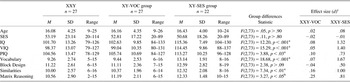
Table 1 summarizes demographic information. For the XY-VOC and XXY comparisons, the groups did not differ on age, SES, or any of the IQ variables, as desired. For XY-SES and XXY comparisons, the groups did not differ on age or SES as desired; however, the XY-SES group did outperform the XXY group on all IQ measures with the exception of the Block Design subtest. The majority of participants in the sample were Caucasian (>90%), and the racial composition of the XXY and control groups did not differ significantly [χ2 (2) = 1.66; p > .43]. With regard to SES, both the XXY and XY control groups came from families with relatively high levels of educational and occupational attainment. Seventy-six percent of the XXY sample, 72% of the XY-VOC sample, and 55% of the XY-SES sample had at least one parent with a college or advanced degree. Similarly, the vast majority of families had at least one parent who held a minimum of a managerial or semi-professional/professional position (most of which required at least a college education). This was the case for 73%, 64%, and 70% of the XXY, XY-VOC, and XY-SES groups, respectively. Consequently, many of the children in this study are likely to be more privileged than the average child living in the United States. Thus, it is not surprising that the IQ in the SES-matched control group (which was free to vary) was above average. Given that the XXY group's parents had similar (if not higher) levels of educational attainment, a similarly high IQ should be expected. However, consistent with other studies, the IQ of the XXY group was about a standard deviation below SES-matched typical peers (albeit in the average range). This IQ difference is consistent with earlier prospective studies of XXY in which participants were identified through consecutive newborn screenings (Bender, Puck, Salbenblatt, & Robinson, Reference Bender, Puck, Salbenblatt and Robinson1986; Ratcliffe, Butler, & Jones, Reference Ratcliffe, Butler and Jones1990).
Means, SDs, Ranges, and Effect Sizes of Group Differences on Demographic Variables in the XXY and XY Control Groups

aXXY, XY-VOC < XY-SES; p < .05.
bXXY < XY-SES; p < .05.
cCohen (1988).
Informed consent was obtained from adult participants and parents of child participants, and verbal assent was obtained from child participants. The National Institute of Mental Health Institutional Review Board approved the protocol.
Measures
Intellectual Functioning was measured using the Wechsler Abbreviated Scale of Intelligence (Wechsler, Reference Wechsler1999). Because the participants were enrolled in a longitudinal study, IQ testing was not always completed at the same visit as the EF tests (mean difference ∼2 years). However, IQ tests were generally completed within 4 years of EF testing (∼88% of cases), and the XXY and control groups did not differ in the length of time between IQ and EF testing, F(2,73) = 1.14; p > .33.
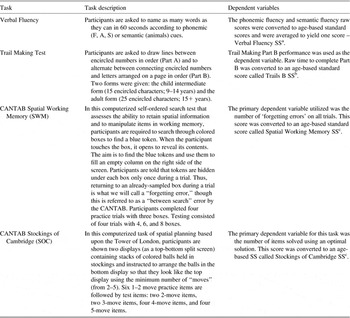
Executive Functioning Tasks, including Verbal Fluency, Trail Making, Spatial Working Memory, and Stockings of Cambridge, are described in Table 2. The first two tasks were included because they have been examined in other studies of adults and children with XXY. However, it is important to note that they have significant verbal and motor demands, two areas of documented weakness in XXY. In contrast, the Spatial Working and Stockings of Cambridge tasks do not have significant verbal or motor requirements, and thus, may be better measures of EF skills in XXY.
Executive Function Task Descriptions and Dependent Variables

aAge-based Z-scores were created based on means taken from Gaddes & Crockett (Reference Gaddes and Crockett1975), Halperin, Healey, Zeitchik, Ludman, & Weinstein (Reference Halperin, Healey, Zeitchik, Ludman and Weinstein1989), and Tombaugh, Kozak, and Rees (Reference Tombaugh, Kozak and Rees1999) and were converted to standard scores (SS) with a mean of 100 and SD of 15. For ages 13, 14, and 15, group means were interpolated based on available age norms.
bAge-based Z-scores were created based on means taken from Spreen and Gaddes (Reference Spreen and Gaddes1969) and Tombaugh, Rees & McIntyre (Reference Tombaugh, Rees and McIntyre1998) and were converted to SS.
cCambridge Neuropsychological Test Automated Battery; Age-based Z-scores were created based on means provided by Cambridge Cognition Limited (1999) and were converted to SS.
Attention-Deficit/Hyperactivity Disorder (ADHD) Symptomatology was assessed using the Kiddie-SADS-Present and Lifetime Version (Kaufman, Brent, Rao, & Ryan, Reference Kaufman, Brent, Rao and Ryan1996), a semi-structured psychiatric interview. Ratings were made based on report of caregivers for children under 14 and by a combination of caregiver and self-report for adolescents/young adults. Children with XXY were characterized as meeting criteria for ADHD using the Diagnostic and Statistical Manual of Mental Disorders, Fourth Edition (DSM-IV) criteria; 11 of the 27 children (41%) met criteria for either ADHD-Predominantly Inattentive type (n = 10) or ADHD-Combined Type (n = 1). The Kiddie-SADS was only completed with the XXY participants, as our control participants are screened to be free of psychiatric diagnoses. Thus, ADHD status was not free to vary in the control groups.
Socioeconomic Status (SES) was assessed using the Hollingshead Two-Factor Index (Hollingshead & Redlich, Reference Hollingshead and Redlich1958), which provides a single score that is an index of the educational and occupational level of the primary breadwinner in the family.
Data Analyses
Data were inspected for normality and outliers and then the following analyses were completed. First, a 3 × 4 mixed-model analysis of variance (ANOVA) with one between subjects factor (Group) and one within subjects factor (EF task) was completed to examine group differences in the pattern of scores on EF tasks for the XXY group and the two control groups. Second, to evaluate the impact of having a subsample of unrelated twins in our control groups, a 3 × 4 mixed-model analysis of covariance (ANCOVA) was completed with twin status covaried. Third, follow-up ANOVA analyses were completed with the full XXY sample (n = 33, including the 6 participants whose vocabulary scores were too low to match to XY males) to compare the performance of the entire group to controls regardless of verbal ability. Fourth, males with XXY with and without comorbid ADHD were compared with control participants using a 4 × 4 mixed model ANOVA to examine the impact of comorbid ADHD on EF performance in males with XXY.
Results
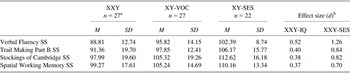
The results of the 3 × 4 mixed model ANOVA with one between-subjects factor (Group: XXY, XY-VOC, XY-SES) and one within-subjects factor (EF task: Verbal Fluency Standard Score [SS], Trail Making Part B SS, Stockings of Cambridge Perfect Solutions SS, Spatial Working Memory Forgetting Errors SS) revealed a main effect of EF task (F[2,219] = 9.14; p < .001) and a main effect of group (F[2,73] = 10.18; p < .001), but no group by task interaction (F[6,219] = 0.12; p > .90). Pairwise task comparisons (collapsed across group) revealed that participants received lower scores on both the Verbal Fluency and Trail Making tasks (ps < .01) than on the Stockings of Cambridge and Spatial Working Memory tasks overall. Pairwise group comparisons (collapsed across task) revealed that the XXY group performed less well than both the XY-VOC and XY-SES groups overall and the XY-VOC group performed less well than XY-SES group (ps < .05, FDR corrected; Benjamini & Hochberg, Reference Benjamini and Hochberg1995). Means and SDs for the EF tasks can be found in Table 3. A follow-up 3 × 4 ANCOVA was run with twin status covaried and the results were similar such that the main effect of group was maintained (F[2,72] = 9.17; p < .001). These results indicated that the XXY group performed less well than both control groups, but the pattern of scores on these tasks did not differ significantly as a function of group.
Next, analyses were run to (a) examine how the complete group of participants with XXY (n = 33), including those with the lowest vocabulary scores, compared with controls on the EF tasks, and (b) rule out the possibility that our findings for the XXY and XY-VOC groups were due to regression effects on the EF scores that can occur when matching two subgroups of participants with extreme scores on another measure (i.e., the most verbally talented XXY males and the least verbally talent XY males). These analyses were run with the complete sample of XXY males with all EF measures and the XY-SES group only. The 2 × 4 repeated measures ANOVA revealed a main effect of group (F[1,53] = 21.33; p < .001) but no group X task interaction (F[3,159] = 0.42; p > .70). (Means and SDs for the whole XXY group were quite similar to the smaller XXY subsample and are reported in the footnote of Table 3.) Follow-up 2 × 4 ANCOVA analyses revealed that the main effect of group was maintained when vocabulary was covaried (F[1,52] = 5.91; p < .02) and when Verbal and Performance IQ were covaried (F[1,51] = 8.03; p < .01). These results lessen concerns about regression effects accounting for our pattern of EF findings. Moreover, they provide further support that young males with XXY have EF deficits, and these deficits cannot fully be accounted for by verbal weaknesses or overall reductions in IQ.
Means, Standard Deviations (SD), and Effect Sizes (d) of Group Differences on Executive Function Task Standard Scores

aFor the whole unmatched XXY sample (n = 33), Ms (SDs) for Verbal Fluency, Trail Making Part B, Stockings of Cambridge, and Spatial Working Memory were as follows, respectively: 87.20 (12.85), 89.95 (20.47), 96.31 (19.84), 99.12 (19.34).
bCohen (1988).
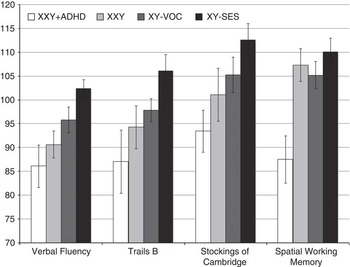
Lastly, the effect of comorbid ADHD status was examined. Based upon the Kiddie-SADs interview, 41% of the XXY group met DSM-IV criteria for ADHD. Thus, the group was stratified into those with (XXY + ADHD; n = 11) and without (XXY only; n = 16) ADHD, and ANOVA analyses were re-run. The 4 × 4 mixed model ANOVA with one between subjects factor (Group: XXY + ADHD, XXY only, XY-VOC, XY-SES) and one within subjects factor (EF Task: Verbal Fluency SS, Trail Making Part B SS, Stockings of Cambridge Perfect Solutions SS, Spatial Working Memory Errors Standard Score) revealed a main effect of task (F[3,216] = 7.81; p < .001), a main effect of group (F[3,72] = 9.34; p < .001), but no group by task interaction (F[9,216] = 0.62; p > .77). Pairwise group comparisons (collapsed across all EF tasks) revealed that the XXY + ADHD group performed less well than the other three groups (including their peers with XXY without comorbid ADHD; all ps < .05; FDR corrected). Both the XXY only and XY-VOC groups performed less well than the XY-SES group but did not differ significantly from one another. See Figure 1. (Results were maintained after adding twin status as a covariate.)
Mean standard scores (with standard error bars) for executive function tasks for XXY + ADHD (white bars), XXY-only (light gray bars), XY-VOC (dark gray bars), and XY-SES (black bars groups). Standard scores have a mean of 100 and SD of 15. Please see manuscript text for results of statistical analyses.

Furthermore, when vocabulary was included as a covariate, the main effect of group was maintained, and the XXY+ADHD group continued to perform less well on EF tasks than the other three groups (ps < .05, uncorrected; with FDR correction, XXY + ADHD vs. XXY only comparison falls short of statistical significance). Finally, when Verbal and Performance IQ were substituted as a covariates, the main effect of group was also maintained and the XXY + ADHD group continued to perform less well than the other three groups (ps < .05, uncorrected; with FDR correction, XXY + ADHD vs. XXY only comparison falls short of statistical significance).
Discussion
This study examined the performance of males with XXY on several EF tasks, including Verbal Fluency, Trail Making, and the CANTAB Stockings of Cambridge and Spatial Working Memory tasks. The XXY group performed significantly less well than two typically developing male control groups, one matched on socioeconomic status (XY-SES group) and one matched on approximate verbal ability level (XY-VOC group), on EF tasks overall. Effect sizes of EF differences relative to the XY-SES group were medium to large and were similar in magnitude to those found for Verbal and Nonverbal IQ when comparing these two groups in the present study. When the XXY group was compared with the XY-VOC group, a significant XXY EF disadvantage was also found; however, the effect sizes for individual tasks were considerably smaller.
Comparisons of the XXY groups with and without ADHD to the control groups indicated that the comorbid group was the most impaired, even performing worse than their peers with XXY only. These findings suggest that it may be beneficial for parents and teachers to target children with XXY and comorbid attentional difficulties early to encourage the development of EF, as research suggests that early EF skills are malleable (Diamond, Barnett, Thomas, & Munro, Reference Diamond, Barnett, Thomas and Munro2007) and strong predictors of academic outcome (Blair & Razza, Reference Blair and Razza2007). Furthermore, consultation with a psychiatrist or other medical professional may be considered to evaluate the appropriateness of a stimulant trial (or other appropriate medication). Research in chromosomally typical males with ADHD has demonstrated improvements in spatial working memory following the introduction of methylphenidate (Bedard, Martinussen, Ickowicz, & Tannock, Reference Bedard, Martinussen, Ickowicz and Tannock2004). Thus, treating ADHD symptoms may have implications for psychosocial, academic, and occupational outcomes for males with XXY.
This study adds to the literature on the cognitive phenotype in youth with XXY in several ways. First, it documents deficits in EF for young males with XXY using (a) a larger non-clinic referred sample than has been typically reported in the literature, and (b) two carefully selected all-male control groups. Second, this study used two CANTAB tasks that have not been used in studies of XXY before. These tasks may be useful for other investigators to consider when studying XXY, as they do not have significant verbal, motor, or processing speed demands. Lastly, this is the first study to examine the impact of comorbid ADHD on EF in youth with XXY, providing additional information about what factors influence variability in the XXY cognitive phenotype.
Limitations
Before closing, we will discuss the limitations of the current study. First, this study relied on recruitment of children from parent support groups rather than children who were prospectively identified through newborn screenings. As a consequence, this study included children who were diagnosed both prenatally (n = 11; 41%) and postnatally. Given that genetic screenings are not routinely completed in the United States and epidemiological studies suggest that many individuals with XXY go undiagnosed or are not diagnosed until adulthood (Bojesen et al., Reference Bojesen, Juul and Gravholt2003), it may be that our study's results were influenced by an ascertainment bias, such that only parents who were concerned about their child's cognitive functioning participated. This appears unlikely for two reasons. First, we compared the effect size of IQ score differences between our XXY and XY-SES group to those included in four prospectively studied samples (Bender et al., Reference Bender, Puck, Salbenblatt and Robinson1986; Graham, Bashir, Stark, Silbert, & Walzer, Reference Graham, Bashir, Stark, Silbert and Walzer1988; Netley & Rovet, Reference Netley and Rovet1984; Ratcliffe, Masera, Pan, & McKie, Reference Ratcliffe, Masera, Pan and McKie1994) using Cohen's d (Cohen, Reference Cohen1988). The current study's effect sizes of 1.40 and 0.73 for Verbal and Nonverbal IQ, respectively, fall within the 95% confidence interval of the mean effect sizes for prospective studies, which are 1.37 (95% confidence interval [CI] = 0.53–2.22) and 0.87 (95% CI = 0.06–.1.68), respectively. Second, we compared EF scores for the pre- and postnatally diagnosed XXY groups and found no significant group differences. Thus, we do not believe that our findings are driven by a subgroup of postnatally diagnosed participants with significant cognitive deficits.
Another limitation of this research is that both the XXY and control groups come from relatively privileged socioeconomic backgrounds and may not be representative of the average child with XXY or the average typically developing child in the United States. We have made an effort to deal with this limitation by comparing children with XXY to children who come from similarly privileged backgrounds. This at least evens the playing field, so to speak, and allows a comparison of males with XXY to males without an additional X chromosome who come from families with similar educational (and likely cognitive ability) levels. Thus, while performance of the XXY group fell within the average range on most tasks, including EF tasks, scores were approximately a half to a whole standard deviation below controls. While these may be considered statistically medium-large effects, these effects are not of the magnitude reported for disorders such as autism or intellectual disability where the clinical impact of EF deficits is likely to be far greater. Thus, evaluating the extent of EF deficits in XXY in the larger context of research on individuals with a range of developmental disabilities may be helpful. Furthermore, it is important to note that while overall EF weaknesses are somewhat mild in the XXY group, there is great variability in EF performance within the XXY group, such that some individuals are more significantly impacted than others. Furthermore, youth with comorbid XXY + ADHD appear to have the greatest EF deficits, and thus, may be most in need of support and intervention at school and in the community.
Lastly, while the XXY group in the current study performed less well than both control groups on tasks commonly referred to as EF tasks, it is essential to acknowledge that these tasks, particularly Verbal Fluency and Trail Making, place multiple cognitive demands on participants, demands that are likely to fall outside of what is traditionally considered the EF domain. For instance, Verbal Fluency and Trail Making have significant speed and motor/oral–motor components. Thus, a general processing speed or motor deficit could be contributing to lower task performance. Furthermore, performance on Verbal Fluency is likely to be influenced by dyslexia and other language-based learning difficulties that were not evaluated in this study. Thus, phonological processing or other linguistic processes could be contributing to performance deficits.
Future directions and conclusions
Further research is needed to isolate the underlying processes related to EF task performance in XXY. This will likely best be accomplished using experimental manipulation of language, motor, and speed demands in EF tasks. Furthermore, research linking EF skills to their corresponding neural substrates in XXY is desired. Structural (DeLisi et al., Reference DeLisi, Maurizio, Svetina, Ardekani, Szulc, Nierenberg and Harvey2005; Giedd et al., Reference Giedd, Clasen, Wallace, Lenroot, Lerch, Wells and Samango-Sprouse2007; Warwick et al., Reference Warwick, Doody, Lawrie, Kestelman, Best and Johnstone1999) and functional (Steinman, Ross, Lai, Reiss, & Hoeft, Reference Steinman, Ross, Lai, Reiss and Hoeft2009; van Rijn et al., Reference van Rijn, Aleman, Swaab, Vink, Sommer and Kahn2008) neuroimaging studies are under way. However, additional research may refine our understanding of the neuroanatomical/physiological underpinnings of deficits on EF tasks possessed by youth with XXY and those with attentional, linguistic, and processing speed deficits more generally. Finer-grained descriptions of the morphometric and physiological underpinnings of EF weaknesses and other neurocognitive dysfunction in XXY may be used as endophenotypes in genetic expression studies of candidate genes on the X chromosome thought to be associated with the cognitive deficits characteristic of the disorder. Such studies have implications not only for individuals with XXY, but also for individuals with other causes of learning, attentional, and intellectual disability deficits.
Acknowledgments
This research was supported by the Intramural Research Program of the NIH, National Institute of Mental Health. We thank the children and families who volunteered their time for this research.