INTRODUCTION
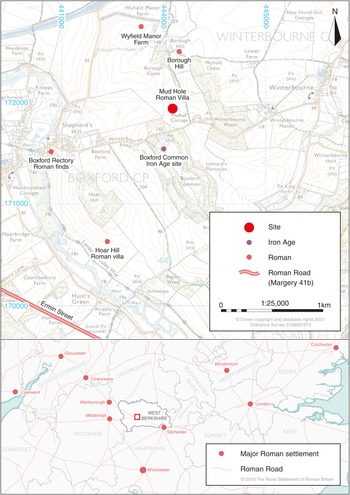
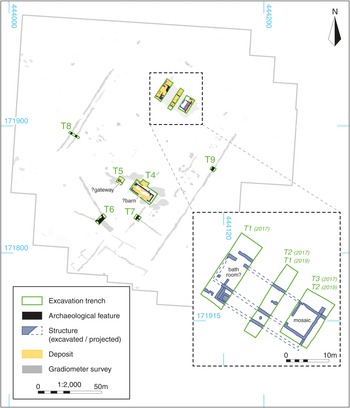
Community excavations undertaken in 2017 and 2019 at Mud Hole Roman villa, Boxford, West Berkshire (fig. 1), by the Boxford History Project (BHP) under the professional guidance of Cotswold Archaeology (CA), revealed part of a villa building, predominantly of fourth-century date but possibly extending into the fifth. The principal villa range was originally a simple strip building adapted to one of simple corridor plan with the corridor on the south-western side (fig. 2). It appeared to have been set on one side of a large enclosure with a rectangular structure of uncertain interpretation, but perhaps a barn, and a possible gateway, identified earlier by geophysical survey (fig. 2). The Mud Hole villa is one of three closely linked Roman sites around Boxford which have been investigated by a partnership of the Boxford History Project, the Berkshire Archaeology Research Group (BARG) and Cotswold Archaeology between 2013 and 2017. The Boxford History Project was set up in 2008 when little was known about Roman settlement in the area and has drawn upon substantial local interest and participation. A third- to fourth-century villa was investigated c. 1.3 km to the south-west at Hoar Hill in 2013 and 2015,Footnote 1 and a Roman agricultural complex, with Iron Age activity, was investigated at Wyfield Manor Farm c. 0.9 km to the north-west in 2016 (fig. 1).Footnote 2 The mosaic at Mud Hole villa was first revealed in 2017. These earlier phases of work were generously funded by the Heritage Lottery Fund and local sponsors. The works in 2019 to reveal fully the Mud Hole villa mosaic and further investigate the date and character of the villa generated even greater interest, with over 100 applications to take part from volunteers and an attendance of over 3,000 people on the site Open Day in August 2019. The 2019 work could not have happened without the generous support of a range of charitable organisations, including The Headley Trust, The Adrian Swire Charitable Trust, The Ardeola Charitable Trust, The North Wessex Downs SDF, The Greenham Common Trust, ASPROM, The Englefield Charitable Trust, Newbury Building Society and a major local fundraising effort.
Site location showing nearby archaeological sites. (© Cotswold Archaeology)

Suggested layout of the villa compound based on gradiometer survey and excavated trenches; inset shows main villa building trenches (from Bedford and Clark Reference Bedford and Clark2019, fig. 55). (© Lindsey Bedford and Steve Clark)

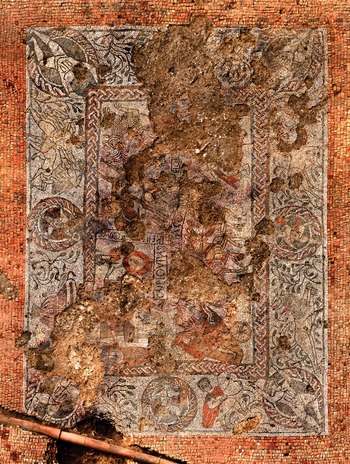
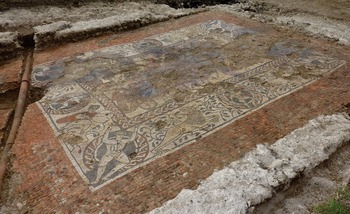
Partly revealed in 2017, and fully exposed in the 2019 season, a figured mosaic floor, located at the eastern end of the main range in a room measuring 6 by 5 m, survived in substantially intact condition and is of outstanding interest, both in terms of its rare mythological subject matter and as an example of Romano-British artistic expression (figs 3, 4, 5 and 6). An interpretation of the mosaic has been provided in recent publications but is further developed here.Footnote 3 The Boxford mosaic contains the finest depiction in Britain of the hero Bellerophon killing the monster Chimaera, Hercules slaying a centaur, a panel set in a king's court and four walking, and exceedingly rare, telamones or giants. Another rare feature for Britain is the existence of five damaged mosaic inscriptions. Not only are the subjects on the mosaic unique for Britain, but all appear to have mythological connections to Poseidon (Neptune), Pelops, Bellerophon or Atlas. There also appears to be a strong connection with horses and horse racing, the latter an invention of Poseidon. The main subject of the mosaic, the story of Pelops, involving a deadly chariot race, the subsequent funerary games of which in honour of the loser were to lead, in myth, to the founding of the Olympic Games, is known only from pavements from Shahba, Syria, and Noheda in Spain.Footnote 4 It is suggested therefore that the title of the mosaic must now be revised from that of previous articles to read ‘The Triumphs of Pelops and Bellerophon’.Footnote 5
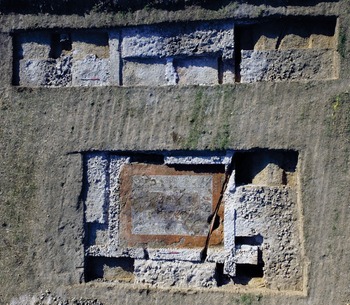
Aerial view of Trenches 1 and 2 following excavation (2019). (© David Shepherd)

Photogrammetric image of the mosaic (feature 2040) as revealed. (© Cotswold Archaeology)

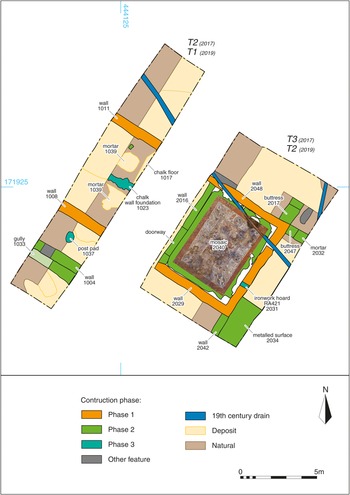
Trenches 1 and 2 (2019) showing principal features and phasing. (© Cotswold Archaeology)

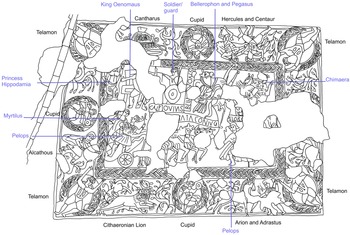
Key drawing of the mosaic (drawn by Lindsey Bedford). (© Lindsey Bedford)

PREVIOUS INVESTIGATION AND SURVEY
The discovery of the Mud Hole villa was made during the course of field drainage works in c. 1870–71 and was reported by S. Palmer, who described the remains of a ‘very large villa’, which extended ‘across a valley in the rear of Boxford Hill’.Footnote 6 Initial excavations traced ‘the foundations of some walls on the western side’, although there is no record of any further investigation after this time. H. Peake drew on Palmer's earlier report in his descriptions of the site and also listed surrounding Roman finds, including pottery and coins found at Boxford Rectory, approximately 1 km to the west (fig. 1).Footnote 7 Along with a surface scatter of tile, more recently recorded finds from the villa site have included two anvils, lead weights and a copper-alloy spatula handle in the form of a bust of Minerva.Footnote 8
In 2014, gradiometer and resistivity surveys revealed clear evidence of two rectangular-plan buildings, which were set on lower slopes on either side of the dry valley and within a large rectilinear ditched enclosure.Footnote 9 Weaker negative responses, on a north-east–south-west alignment, suggested internal room divisions, and two areas of highly magnetised responses suggested areas of burning, that at the north-western end possibly associated with a hypocaust.
The 2017 excavation targeted features detected by geophysical survey and revealed a rectilinear building plan, measuring approximately 26 by 9.5 m, with additional constructional elements, including a corridor or ‘portico’ (fig. 2), almost certainly at the front of the building which, on topographic grounds, would have faced south-west across the head of the valley. The solid walls were entirely constructed of flint courses, set in lime mortar. The north-western section of the villa (Trench 1) appeared to have comprised a later bath-suite, with a possibly associated stokehole to the rear, with evidence of a hypocaust and a well-preserved cold plunge-pool constructed within the western end of the corridor. At the south-eastern end of the building, in Trench 3, the figured mosaic featuring inscriptions was partly revealed (figs 3, 4 and 5).
The 2017 excavation suggested that the smaller rectilinear-plan structure previously identified by geophysical survey was an agricultural building, perhaps a barn (fig. 2). The ‘barn’ was located 80 m south-west of the principal villa building and immediately to the south-east of the remains of a substantial foundation, which was interpreted as an elaborate southern gateway.Footnote 10
THE SETTING
Mud Hole villa lies 1.25 km east of Boxford village within the head of a dry valley that extends south-eastwards in the direction of the Winterbourne stream (fig. 1). The site is located on gently sloping ground with good visibility to Boxford Common to the south and open downland to the north-west.
The geology comprises clay, silts and sands of the Lambeth Group, sedimentary deposits of the Palaeogene period and Seaford Chalk Formation bedrock overlain by superficial deposits in the dry valley running south-east.Footnote 11 The name ‘Mud Hole’ suggests that the dry valley has been poorly drained in historical times.
The villa was located not far from a major road, Ermin Street (Margary's Route 41b),Footnote 12 which passed 2.5 km to the south-west (fig. 1). Ermin Street ran between Silchester and Cirencester via a number of roadside settlements. Traces of the road agger have been noted in woodland to the west of Boxford.Footnote 13 The strong correlation of villa sites with roads is evident in the location of most within 1 km or less, with the incidence of villa settlement falling off rapidly beyond that distance.Footnote 14 The Boxford Roman settlements lay almost equidistant between Calleva Atrebatum (Silchester), some 21 km to the south-east, and the secondary towns of Durocornovium (Wanborough, Wiltshire), c. 26 km to the north-west along Ermin Street, and Cunetio (Mildenhall, Wiltshire), c. 22 km to the west. The roadside settlements at Thatcham Newtown, located 9 km to the south-east,Footnote 15 and Wickham, 4.5 km to west, presumably functioned as convenient rural market centres.Footnote 16
SUMMARY OF THE 2019 EXCAVATION By Matt Nichol with Richard Massey
The trenches excavated in 2017 were renumbered in the 2019 excavation to create separate records for cross-comparison (fig. 2). Deposits were excavated as far as the natural substrate only in limited areas. The entire mosaic was exposed, but deposits beneath it were not examined. Three main structural phases of late Roman activity were identified in Trenches 1 and 2 (fig. 5, Phases 1–3). On the basis of the pottery, the initial construction of the core villa walls took place after a.d. 250/300.
PHASE 1: THE CORE OF THE VILLA BUILDING
Walls 1008 and 1011 in Trench 1 and 2029 and 2048 in Trench 2 form the earliest structural phase of the building, defining a structure about 6 m wide (fig. 5). All the walls were of similar solid construction, built from roughly hewn flint, bonded with lime mortar and carefully dressed with flints on both sides. They were about 0.6 m wide and their surviving heights varied from 0.16 m (wall 1008) to 0.8–0.9 m (walls 1011 and 2048), generally being higher on the northern side. Where exposed, walls 1011 and 2048 showed three stepped flint courses at foundation level. Although the walls survived above foundation level there was no indication of a made floor in Trench 1 where deposits of mortar (1039) lying on the natural substrate suggest either destruction deposits or the remnants of mortar bedding.
PHASE 2: ADDITION OF CORRIDOR AND MOSAIC
In Trench 1 wall 1004 conformed to the alignment of the villa corridor wall recorded to the west in 2017 (fig. 2).Footnote 17 It was relatively poorly constructed, with irregular flint coursing, and bonded with a weak lime mortar. It was 0.55 m wide and survived to 0.3 m high with crude facing on both sides. A gully (1033) on the southern side is of uncertain interpretation.
In Trench 2 internal wall 2016 abutted the external walls forming a room about 4.5 by 6 m in size which contained the mosaic (figs 4 and 5). The wall was 0.41 m wide with a surviving height of 0.31 m. A 2-m wide opening without any in-situ stonework and a flat base of mortar is likely to have been a doorway, apparently of substantial proportions. The mortar bedding displayed two slightly raised areas at either end which may represent the bases for flanking stone columns or timber posts. A stone column-base fragment and a small hoard of iron door-fittings were found nearby, the latter presumably hidden items that were not recovered. Wall 2016 retained some surviving wall-plaster, which was largely absent from the other walls. The plaster abutted the edge of the underlying mosaic floor, indicating that the wall and mosaic can probably be considered part of the same phase of activity.
On the southern side, wall 2042 abutted wall 2029 and would have formed the end wall of the corridor. It was abutted to the east by a gravel metalled surface, 2034, likely to have been external to the building.
At the north-eastern corner of the villa building were two wall buttresses of different construction from that of the rest of the villa. Both buttresses (2017 and 2047) were of regularly coursed flint and tile bonded with lime mortar; they abutted existing wall 2048 at right angles to one another. Buttress 2017 was 0.8 m wide, surviving to 0.66 m high, and was exposed to a length of 1.6 m. Buttress 2047 was of similar dimensions and was shown to have been constructed on a foundation of flint and mortar which extended further south-east. The buttresses appear to have been intended to arrest the subsidence of this corner of the building, which may have been caused by an underlying feature, as the sunken surface of the mosaic in this corner suggests.
Mosaic 2040
Mosaic 2040, set within its tessellated floor frame, filled the eastern room within the core villa building. Burning had discoloured parts of the mosaic, possibly from post-Roman occupation or perhaps more probably, in view of the effects of fire evident on the column base and some of the window glass (below), destruction of the villa by fire. A field drain, perhaps that laid in 1870–71 that led to the villa's discovery, cut the north-eastern corner of the mosaic (fig. 4). The trench showed that the mosaic had been laid on a thin bedding of clay and sand. Here too the mosaic border had subsided into an underlying pit.
The Boxford mosaic is grouted into a thin layer of lime bonding cement above a compact layer of reddish sand 25–30 mm deep. Below this was recorded a foundation layer of compacted chalk and a light-brown silty clay layer of unknown depth that included some mortar fragments and small rounded pebble inclusions. The sand bedding layer is extremely unusual. Remarkably, in two places on the floor (in Pegasus and the chariot horses) heavy objects falling from the roof of the decaying building punched depressions into the sand without breaking the tesserae. The compacted chalk and sand layer may represent an attempt to stop rising damp in a room on a site where the modern name of Mud Hole is clearly evocative of natural wetness.
The tesserae used in the floor have been identified by Kevin Hayward as dark-blue/grey and buff-grey dolostone from the Upper Jurassic beds at Kimmeridge Bay, or from an adjacent outcrop along the Dorset coast.Footnote 18 Similar tesserae from the same source appear at Silchester. Brownstone tesserae have been identified also. This Devonian brownstone originates from the Forest of Dean and was used for mosaics at both Silchester and the Groundwell Ridge complex near Swindon.Footnote 19 The white tesserae are indurated (hardened) chalk from Upper Cretaceous beds, originating possibly from the Dorset or Hampshire Downs, and also white Lias, a fine white limestone from the Triassic beds of Somerset. The red tesserae are made from terracotta building material and are used both in the coarse border and the main pavement. The pink tesserae present in some areas of the mosaic are chalk altered by heat.
The mosaic was completely covered by a sequence of layers, beginning with a thin silt layer, followed by destruction layers, consisting of two successive roof-tile deposits, and two flinty deposits resulting from episodes of wall collapse. The mosaic itself, however, was markedly well preserved.
PHASE 3: LATER AND POST-ROMAN CHANGES
There was no artefactual material, nor any form of direct dating, to indicate a post-Roman occupation at the villa. However, a few features are difficult to account for as part of the Roman period villa. The absence of any material diagnostically earlier than the later third century suggests that an earlier or pre-villa construction is unlikely and a very late, or post-Roman, date appears to be the best explanation for these features. In Trench 1 were a possible chalk wall foundation, 1023, and a post-pad, 1037 (fig. 5); both were of unusual form and materials in the context of the villa, where the walls were constructed of flint and evidence of posts was lacking.
Chalk ‘wall foundation’ 1023 was irregular in plan, had a thickness of just 0.08 m and bisected the villa room longitudinally. It rested upon natural clay, implying the removal of any pre-existing floor, and may have provided a base for supporting central roof timbers. It was abutted by a charcoal-rich occupation layer (1022) and a later chalk ‘floor’ (1017), the complete extent of which was unclear, together with deposits of roof-tiles and material derived from collapsed walls.
‘Post-pad’ 1037 comprised a cluster of broken imbrex roof-tile fragments, bonded with chalk and clay. It measured 0.65 by 0.56 m, with a surviving height of 0.06 m. The post-pad was located centrally within the corridor and, given that the corridor was only 2 m wide, it is unlikely to have been part of its original design. It may have provided a base for a timber post, again possibly to support failing roof timbers.
A deposit of iron hinge fittings was found in a small recess within wall 2029. The recess measured 0.58 by 0.2 m, with a depth of 0.1 m. These items would appear to have been concealed in the wall, but the reason for this is unclear.
A summary and analyses of the finds from the 2017 and 2019 excavations can be found in the full archive reports of the excavations.Footnote 20 The finds include over 25 kg of pottery; this assemblage is dominated by coarsewares, of which the Alice Holt industry was the major supplier, with Dorset Black-burnished Ware also common. The finewares are mostly represented by Oxfordshire red-slipped wares and other similar pottery types. Imported pottery is rare but includes a sherd of Mayen ware of late fourth-century date. Other than seven sherds of Samian, none of the pottery needs be earlier than the later third century. Also found were ceramic building material (tegulae, imbrices and box flue tile), worked stone (including two architectural fragments and roof slates), wall-plaster (some painted), mortar, glass from windows and vessels, ironwork and a small number of late Roman coins, including three Theodosian issues. The animal-bone assemblage is unusual in terms of the high numbers of pig and deer bones. Moderate amounts of charred crops, principally spelt wheat and barley, identified from soil samples, perhaps suggest crop processing nearby. Much of this material appears to have been dumped after occupation of the building ceased.
THE MOSAIC By Anthony Beeson
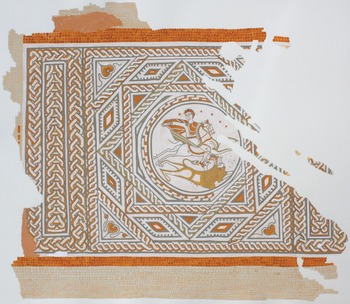
The mosaic, in the eastern room of the villa range, was a little over 4 by 3 m in size, positioned centrally within a border formed of red tesserae (figs 4 and 5). The principal subject of the mosaic would have been viewed from the western side in a series of panels starting from the court panel at the top left (fig. 6). This tells the story of Pelops and his suit for the hand of Hippodamia, daughter of King Oenomaus, who is shown seated on his throne presenting his daughter with his right hand. The story continues in the lower panel which depicts the fatal chariot race in which Oenomaus, betrayed by his servant Myrtilus through the substitution of a wax linchpin in the wheel of his chariot, is killed. On the right, the victorious Pelops poses in a red cloak. The south-eastern quarter within the central guilloche-bordered frame shows the scene of Bellerophon riding Pegasus and killing the monster Chimaera, and is viewed from the southern side. The outer border of the mosaic depicts four telamones at the corners, supporting the guilloche frame to the central panels, and a series of hunting and mythical action scenes and other motifs.
THE TRIUMPH OF BELLEROPHON
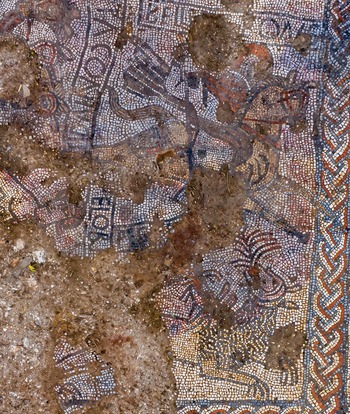
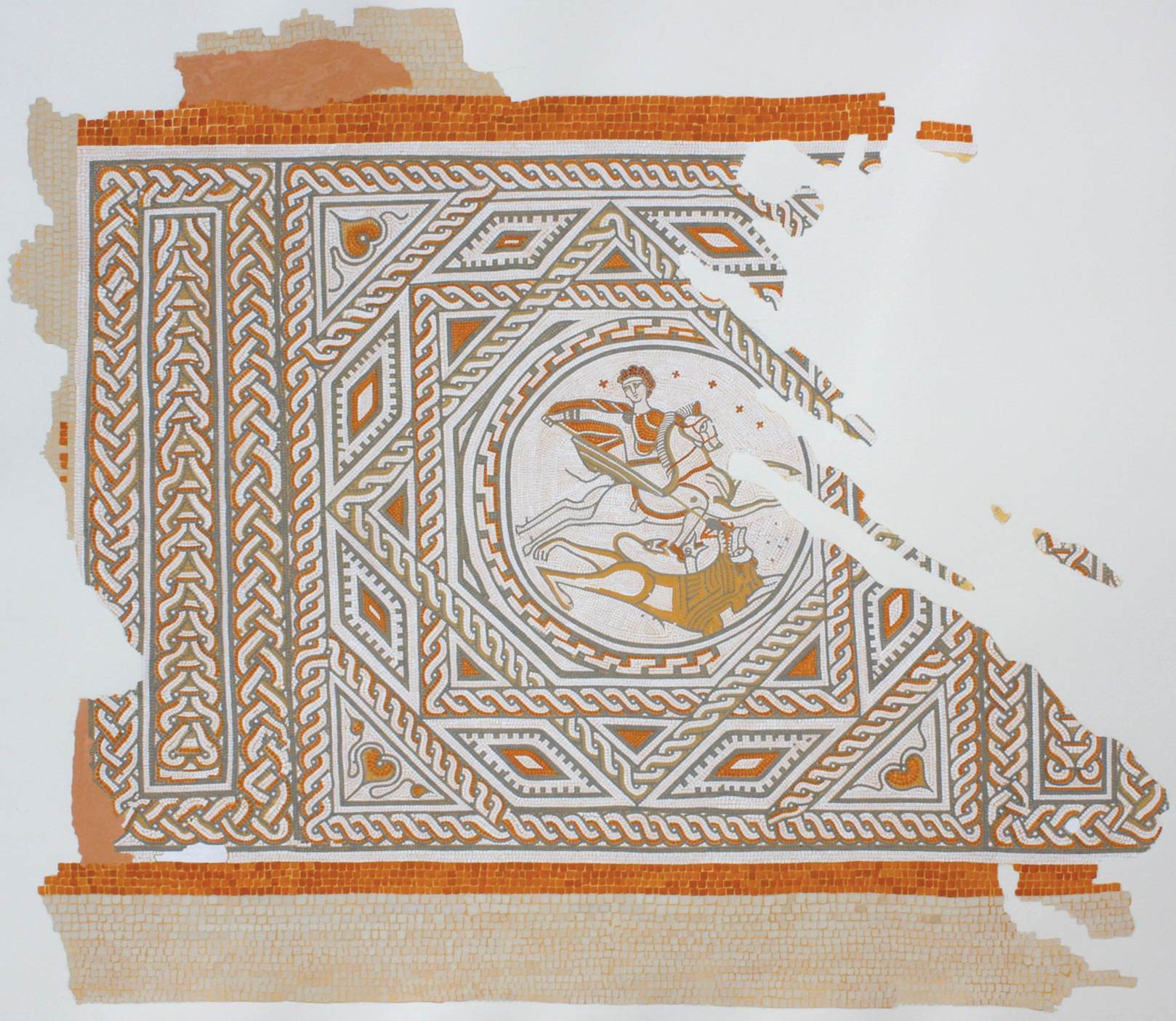
Surface wear and the layout of the subjects on the mosaic suggest that at least one entrance into the chamber was from the south and that, on arrival, the visitor would have been confronted by the panel showing Bellerophon on Pegasus killing the monster Chimaera (figs 6 and 7).
Aerial view of the Bellerophon and Chimaera panel (photo by David Shepherd). (© David Shepherd)

It is important to remember that Poseidon/Neptune was not only Bellerophon's father but also the sire of Pegasus and Chrysaor (whose son, Geryon, was later slain by Hercules). Bellerophon's story was particularly popular in Britannia and this is the fifth depiction of his fight with Chimaera to have been discovered here.Footnote 21 Others are known from Lullingstone, Kent,Footnote 22 Hinton St Mary and Frampton, Dorset,Footnote 23 and Croughton, Northamptonshire.Footnote 24 Janet Huskinson in 1974 could number 15 known Roman Bellerophon mosaics throughout the Empire and, with subsequent discoveries, the number must still be well under 30. Footnote 25 The fact that five are British is interesting. The iconography of Bellerophon defeating Chimaera gradually developed into that of St George and the Dragon, so it seems particularly pertinent that the myth was popular in Britain.Footnote 26 Bellerophon was ultimately a flawed hero and guilty of hubris, but the latter part of his life was ignored by Rome.
An ancient belief saw Pegasus as the sun and Chimaera as winter.Footnote 27 Bellerophon, as the active power of the sun, attacks winter and thus arranges the sequence of the seasons, which accounts for their presence on some mosaics such as that at Lullingstone. The image also came to be seen as the power of good conquering evil, and as such it was adopted into early Christian art. Bellerophon almost becomes a sky god with his connection to the sun and seasons, and his transition to Christianity is displayed on an early fifth-century cut-glass bowl made either in Constantinople or Rome and found in Jesuitengasse, Augsburg (Römisches Museum inv. no. 1983, 2325). It depicts a triumphant, weaponless Bellerophon, complete with nimbus and adopting the orans pose of a Christian worshipper, on Pegasus flying above the dead Chimaera, while a spring-nymph pours water in front of the steed in tribute to his spring-making qualities.Footnote 28 Bellerophon appears almost to represent Christ himself, although the nimbus appears behind the heads of royalty as well as divinities, as illuminations from the Vergilius Romanus illustrate.Footnote 29
The image of Bellerophon and Chimaera could be interpreted differently by pagans and Christians. In late antiquity a landowner might have wished to be flatteringly identified with the hero before his tenants and clients. Interestingly, the emperor Justinian is portrayed in just such a Bellerophon pose with a spear (spearing nothing!) on an ivory diptych dating to a.d. 527 and now in the Louvre.Footnote 30 Boxford's Bellerophon holds a spear in his right hand that ends above Chimaera's goat's head. Unfortunately, Bellerophon's head has been destroyed beyond one blue tessera indicating the position of his chin, but most of the composition remains, although in places discoloured by burning. Most representations of Bellerophon by this period have him looking ‘off-stage’ towards the spear, and not at Chimaera, and that is how one must imagine Boxford's hero.Footnote 31
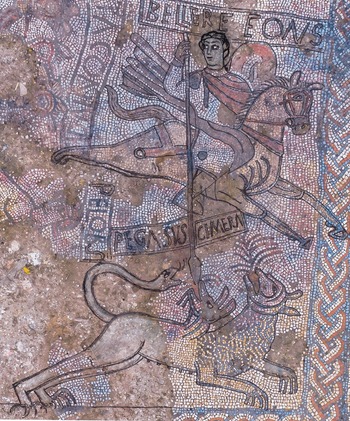
Boxford's Bellerophon is fully clothed in a fashionable fourth-century white tunic, complete with blue wrist bands, decorative orbiculi (roundels) and clavi (stripes) (figs 7 and 8). The latter decorate the tunic's neckline, and the orbiculi appear at the shoulder as well as the thigh. In Britain, only the mosaic from Croughton (tentatively dated to around a.d. 360 and closest in spirit to Boxford's) features a clothed Bellerophon. The heel of Bellerophon's boot survives below Pegasus’ belly and a row of white tesserae defines the shape of Bellerophon's left shoulder for the viewer, as the mosaicist used this technique to clarify edges. The shoulder is covered by a red chlamys (cloak) that billows out in front of him, displaying its lining. This feature consists of swirls of red and pink-brown, with a curved line of blue near the centre, indicating that billowing fabric is intended here and certainly not a shield, which would be incorrect iconographically. At Hinton St Mary, Dorset, Bellerophon's cloak also billows before him. Boxford's billows to the right, so as not to clutter the area behind Bellerophon occupied by Pegasus’ wings. Inscriptions on mosaics are rare in Britain, but above is a framed panel containing the name BELLE[RE]FONS. Only portions of the bracketed letters remain, but enough to be certain that this is correct (fig. 8). This spelling of the name is known only from a fourth-century a.d. Bellerophon mosaic from the villa de Puerta Oscura at Malaga, Spain.Footnote 32 It is notable that the letters LERE are reduced in size, probably to accommodate the head of Bellerophon intruding into the name box.
An interpretative reconstruction of the Bellerophon panel (reconstruction by Anthony Beeson). (© Anthony Beeson)

Pegasus
Boxford's Pegasus is the most spirited and beautiful depiction from Britain. His most notable feature is a mane composed of a series of long, and often tapering, blue and ochre tesserae laid in alternating colours (figs 7 and 8). This beautiful way of treating horses’ manes occurs elsewhere on this mosaic and is one of the most notable and singular techniques attributed to this mosaicist. The same technique is used for Pegasus’ long, sinuous tail composed of nine alternating blue and ochre strands. The wings comprise two sets of flipper-like objects that splay out behind Bellerophon. At the top of each wing is a long protruding flight feather and these are striped with blue, brown and white tesserae. The Boxford mosaicist joins those of Lullingstone and Croughton in giving Pegasus wings. The body of Pegasus is worked in ochre tesserae, with muscles outlined in blue. His muzzle is ochre with blue detailing, and once would have included a red nostril. The Boxford mosaicist generally employed triangular tesserae to form the whites of the figures’ eyes, and Pegasus is no exception. He sports a red bridle and breast-band, while a red haunch strap disappears beneath Bellerophon from a junction at Pegasus’ hindquarters. A red pendant strap with a circular ornament hangs from the junction, and a breeching strap continues under the tail. Uniquely, the mosaicist has attempted to give another dimension to Pegasus, as he is shown literally in a flying gallop leaping out of the panel with his left front leg reaching to the outer edge of the guilloche border. The triangular undersides of the hooves are displayed to aid the illusion. Similarly, his hind legs stretch out behind, crossing into the neighbouring panel with his fetlocks terminating its long inscription box. He is foreshortened to aid the illusion, so that only the tops of the back hooves are shown. His name box contains the letters PEGAS[VS]. Judging by the surviving S in the Pelops name box, the letters ‘S’ in Pegasus’ name are likely to have been both upright and perhaps ligatured to fit them into the available space. Roger Tomlin does not include the surviving sections of the AS in his recently published account because of their lack of clarity.Footnote 33 Pegasus was later catasterised by Zeus/Jupiter, and at Croughton a row of stars above the group commemorates this honour; this feature is absent from the Boxford example.
Chimaera
Chimaera is mostly drawn in blue outline. Damage and burning have obscured some detail but most survives up to the animal's lower back, and her similarity to the lion in the western border (see below) enables an easy restoration (figs 6 and 7). The back claws and part of her outstretched legs survive on a mosaic island stretching into the open zone of the adjacent panel. Vigorously drawn, she is depicted as running at high speed with outstretched limbs and drooping claws, but also turning and defiantly attacking her tormentors, as does the Croughton monster. Rays of fire shoot from her mouths. Much of the lion head survives, despite having suffered damage. Likewise, the goat head is discoloured and damaged at its neck, but details can be made out. It looks backwards at the attacker and has rectangular ears and, below its chin, a double beard. Of the serpent tail only a section of the throat and lower jaw, together with some flames, survives to the upper right of the goat head, but it places it and enables a restoration.Footnote 34 On the remaining part of her belly, two of a series of spaced teats survive, each formed from a single blue tessera. Chimaera's inscription has been lost, but was probably situated above the fire-burst from the lion head and below Pegasus’ front-right leg where the corner of a rectangular frame remains.
THE TRIUMPH OF PELOPS
The mosaic's principal subject, the story of Pelops’ suit for the hand of Princess Hippodamia, the fatal chariot race and his triumph over King Oenomaus of Pisa and Elis, remarkably occurs on only two other known mosaics in the entire Roman Empire. One is from Shahba, Syria, and the other floors a late Roman palace at Noheda, Spain.Footnote 35 The former compact depiction shows Pelops’ introduction to Oenomaus and Hippodamia, and the victorious hero and his prize in the foreground, while the race and the death of the king is shown on a smaller scale behind.Footnote 36 The Noheda Pelops mosaic was produced on a monumental scale, with nearly life-sized figures, and the story unfolds from left to right across a great landscape-shaped panel.Footnote 37 Sole depictions of Pelops and Hippodamia as lovers have been recognised at the Spanish villa of Arellano and on a Syrian mosaic in a private collection in Beirut.Footnote 38 In almost all depictions Pelops may be recognised by his full Phrygian costume and the attribute of a scutica (chariot whip).
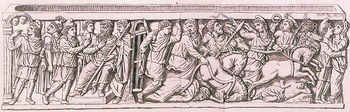
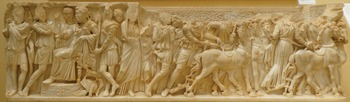
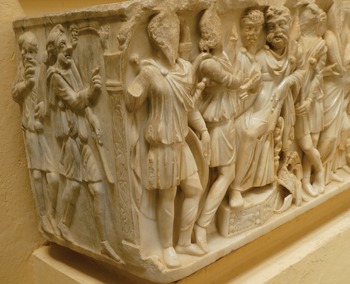
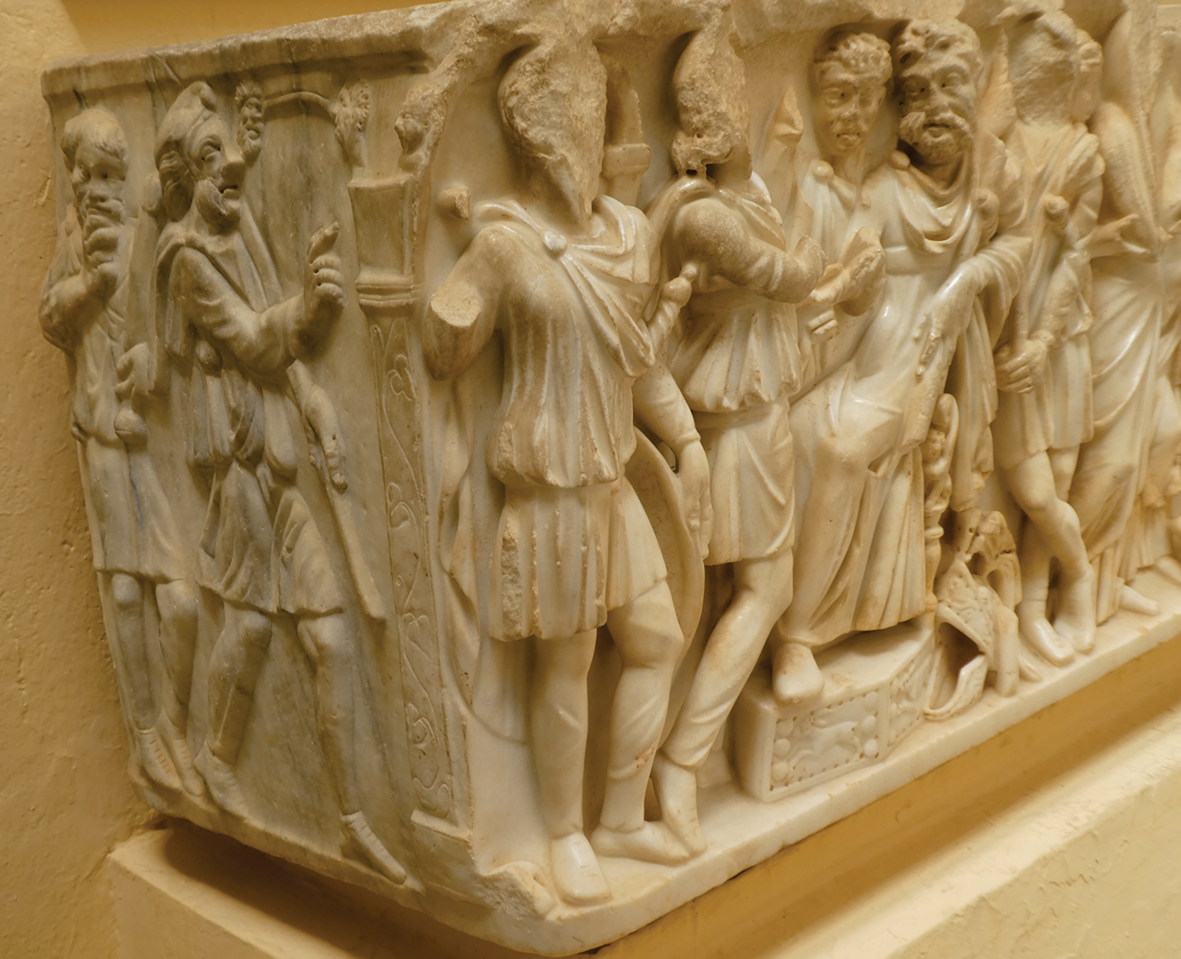
Boxford's mosaic is not a slavish copy of any other composition but interprets the myth in its own original and condensed manner (figs 9 and 10). It is L-shaped in layout and surrounds the Bellerophon panel on two sides. The Boxford mosaic may be based on the same original as Noheda's or, at least, more or less follows the same traditional artistic formula inherited from the earlier use of the story on sarcophagi.Footnote 39 Several examples believed to date from Antonine times perhaps focus more on the death of the betrayed Oenomaus, the son of Ares, rather than the triumph of Pelops, although a rather static second-century a.d. example from Tipasa, Algeria (not recorded in the lists of Pelops sarcophagi in Zanker and Ewald Reference Zanker and Ewald2012 and Grassinger Reference Grassinger, Galinier and Baratte2019), is closer to the Boxford mosaic in spirit than any other.Footnote 40 It was not until the middle of the third century a.d. that the subject became more popular for sarcophagi, and a new artistic formula condensed the story into a romantic three-scene composition concentrating on the Triumph of Pelops. The first scene depicts the court of the horse-loving Oenomaus with the arrival from Lydia of Pelops, the beauteous former child cup-bearer and lover of Poseidon, to sue for the hand of Princess Hippodamia in sight of the severed heads of earlier suitors (fig. 10). The second depicts the fatal chariot race against the seemingly unbeatable Oenomaus for her hand and Pelops’ life. Oenomaus perishes through Pelops’ bribed treachery of Myrtilus, the king's charioteer and son of Hermes, who substitutes a wax linchpin for the metal one in the king's chariot. At high speed the wheel flies off and the king is dragged to his death. The final panel of the sarcophagus cycle depicts the triumphant lovers who would found a dynasty and expand the kingdom that became the Peloponnese. No known representations portray the fate of Myrtilus and his murder at Pelops’ hand. His dying curse haunts the royal family for generations.
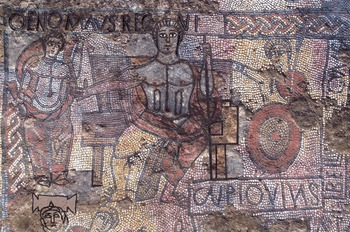
The court panel with Hippodamia, Oenomaus and a guard (photo by Chris Forsey). (© Chris Forsey)

An interpretative reconstruction of the court panel (reconstruction by Anthony Beeson). (© Anthony Beeson)

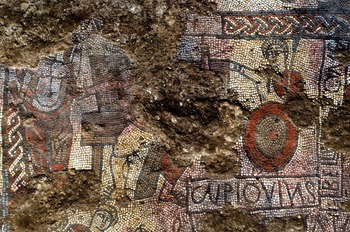
Boxford's Pelops’ mosaic was designed to be viewed from the western side of the room (fig. 5). A doorway is present on the south-western side, but there are grounds for suspecting that it is earlier than the mosaic. Any guest entering from the south, and past Bellerophon, would have been led to face the court panel and the possible seat of the master of the house. The court panel, partially uncovered in 2017, and then believed to show the court of Iobates in the Bellerophon myth, is reinterpreted here as depicting the enthroned Oenomaus, king of Pisa and Elis. The king sits god-like below a cantharus, a subtle visual aid to his identification and a play on the meaning of his name, ‘Man of Wine’ (see figs 4 and 26). This reading is not universally accepted, particularly in view of the very partial survival of the inscription above the court panel. This was provisionally interpreted by Tomlin (pers. comm.) as […].AV[…]NI and possibly reading: [OENO]MAV[S] REGNI (Oenomaus of the kingdom), although this is not a reading he now favours and Katherine Dunbabin concurs that this would be an odd phrase to use. Footnote 41
However, the author's initial thoughts were that the left-hand section of the inscription probably named Hippodamia herself, as it appeared to read ]IA and to be closed by the end stroke of a name box and not a letter. Tomlin believed that there was not sufficient room for the name, but did not realise that the guilloche border finishes below Hippodamia's right hand and does not continue to the corner above her figure where the inscription began.Footnote 42 What then appeared above the figure of Oenomaus ending with ]?NI becomes problematic; as it is apparently a genitive termination, it could be a patronymic, i.e. the name of […]IA's father in the genitive.
Oenomaus is portrayed larger than his companions, reflecting his importance (figs 9 and 10). Much of his upper body and face are destroyed, but enough evidence remains to provide a sensible general reconstruction.Footnote 43 The remaining tesserae giving the line of his neck suggest that his head probably intruded into the inscription above and, uniquely, there is no sign of the beard that most representations of Oenomaus generally show, although, in view of the damage, there must be a degree of uncertainty about this. It is notable that the accompanying guard is the only remaining figure on the mosaic to be portrayed with a striped hairstyle similar to that found on imperial coinage, portrait sculpture and court representations of this period and, most notably in Britain, on the head of Christ or an emperor on the Hinton St Mary mosaic. It is highly likely that Oenomaus’ hair was similarly treated, and that his unbearded face thus reflects contemporary portrayals of an emperor. The composition of ruler and armed companion reflects the sort of imperial imagery seen on the Missorium of Theodosius of a.d. 388, and it is on such an official image that the mosaicist has based this.Footnote 44 In his left hand Oenomaus holds a staff of office. A red and buff robe cascades in folds down between his legs and his feet sport remarkably long and spread toes. Again, his pose reflects contemporary portrayals of emperors, such as that of Constantius II as Consul of the Year in the Bibliotheca Vaticana's codex-calendar of a.d. 354.Footnote 45 Oenomaus sits on a wide-backed and panelled throne, the finest representation of a piece of furniture to be found on a British mosaic. He holds out his right arm with his open palm and upright thumb in a gesture of presentation, to direct the viewer to Pelops’ prospective prize, the Princess Hippodamia (figs 9 and 10). Her name means ‘Horse tamer’ and reflects Oenomaus’ passion for horses. She wears red armlets and bracelets, holds up a billowing scarf and is naked to the groin. Her red and buff garment is covered in complicated blue folds. Both her feet and most of her face are missing, and she intrudes into the surrounding northern guilloche border, which ends below her right hand. Hippodamia's semi-nudity is unique to this mosaic. All other representations depict her fully and modestly draped, but here she is naked down to her navel and echoes the depiction of Princess Alcestis on the mosaic of Admetus and Alcestis from Nimes.Footnote 46 The Boxford depiction perhaps displays an old-fashioned artistic romanticism, based on images of Venus, and portrays the heroine as heroically semi-naked.
The figure to the right of Oenomaus sports a fashionably striped hairstyle and holds a spear and shield. He wears a white tunic decorated with bands at the wrist and with clavi at the neck. A red chlamys is draped across one shoulder, and his spear intrudes far into the border above (figs 9 and 10). A bossed oval shield in red and buff rests before him. It is notable that the mosaicist has not bothered to portray him below his chest, suggesting that he is a subsidiary figure in the narrative. Nevertheless, this figure is important for being the only representation of an armed man with a shield in contemporary mid-fourth century dress to be found in Britain. He points and looks towards either Hippodamia or Oenomaus, as if directing the viewer's gaze to the king's magnificence or the princess’ beauty. Armed companions appear with Oenomaus on sarcophagi representations of the scene, but Pelops is never shown with weapons. Artistic composition and lack of space reduce Oenomaus’ companions to just the one figure here. It might be suggested that this shield-bearing figure again represents Bellerophon, and that the scene portrays his betrothal to Philonoe;Footnote 47 it is intentionally placed to face west and flows naturally into the composition below, and the long inscription hardly intrudes into the flow of the action and does not cut it off.Footnote 48 This idea, however, is based on the misinterpretation of Bellerophon's chlamys being a shield in the Pegasus panel. Careful comparison of the guard's shield with the chlamys shows they are portrayed quite differently. The shield has bands of blue and a red circular boss, whereas the garment employs red and purple and has a sinuous blue central line. The half-figure of the guard points and does not adopt the gesture of acceptance that appears on the Bellerophon and Philonoe mosaic from Nabeul. It also makes no compositional sense whatsoever to imagine that the upper court scene refers to the Bellerophon story, and so this idea must be rejected.
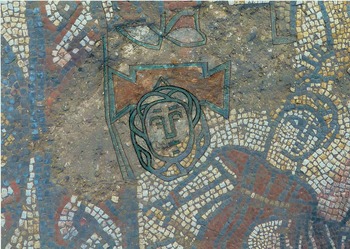
Below the court panel, the western half of the Boxford mosaic depicts the expected traditional second scene: the fatal chariot race. Only two other mosaic versions of this episode are known from across the entire Roman Empire. One from Shahba in Syria, featuring the race in the background, is now in the National Museum in Damascus and the other monumental piece floored a late antique palace at Noheda (Villar de Domingo García) near Cuenca in Spain.Footnote 49 Their major difference from Boxford's is that, like most sarcophagi depictions, they show the race in progress whereas the Boxford chariot is about to depart, as on the second-century Tipasa sarcophagus (fig. 13)Footnote 50 and on the pedimental sculpture of the Temple of Zeus at Olympia. Boxford's scene begins at the far left with the remains of the bearded head of one of the previous 18 failed suitors. It hangs from an ansate panel, below Hippodamia and above the figure of the corrupted Myrtilus (fig. 11). The lower part of the bearded head and a sharp-angled corner of the panel survive and betray its original form. It echoes a similar panel bearing three heads at Noheda. Generally on sarcophagi, the suitors’ heads are nailed up outside the palace or become part of the court scene, and are viewed by Pelops on his arrival at the gates, which may explain the unusual presence of the head here, in being closer to the viewer and ‘outside’ the court scene. The presence of the ansate panel compressed the width of the northern guilloche border before it finished above, blocked by the figure of Hippodamia. Myrtilus is given a prominence here not found on sarcophagi, where his presence is often a matter of guesswork amongst attending figures. He is named at Shahba and a damaged figure regarding the dead king at Noheda is claimed to be him.Footnote 51 Indeed, it was the fact the Boxford figure is depicted as secreting or exchanging the linchpin behind his back that originally suggested the subject of the mosaic to the author, as it was uncovered from its north-western corner. Myrtilus wears the traditional long and high-waisted striped classical charioteer's robe, the xystis. The P-shaped linchpin shown is the most common Roman type and known as a ‘Manning 2b’.Footnote 52
An interpretative reconstruction of the bearded head on an ansate panel, with the figure of Myrtilus (reconstruction by Anthony Beeson). (© Anthony Beeson).

Myrtilus appears in conversation with an auriga (charioteer) whose identity is problematic, but whom the author originally believed to be Oenomaus. The fact that Myrtilus’ arms are behind his back, holding the linchpin, suggested that he was hiding it from his master. The charioteer's face is depicted in profile, and he is clean shaven. Against convention, it seems that Oenomaus in the court scene is also beardless, and Pelops is young and clean-shaven. As a contrasting example, an Antonine child's sarcophagus in the Vatican's Sala Della Biga that features only the race and death of the king uniquely has both Oenomaus and Pelops bearded and wearing the lorica musculata (muscle cuirass) while racing, and not their traditional costumes.Footnote 53
Although in myth the race takes place across country, depictions from Antonine times onwards on sarcophagi, such as that from Cumae (fig.12), and later on mosaics transfer it to the familiar circus, and one finds the scene set by such ubiquitous fittings as the metae (turning posts), carceres (starting gates) and decorated euripus (central ornamental spine of the circus). The Shahba mosaic has metae and Noheda an elaborate euripus. The Boxford mosaic lacks all such architectural allusions. Likewise, Hippodamia, whom Oenomaus was said to have placed as a handicap in suitors’ chariots, takes no part in the usual Roman contest, apart from being an onlooker and prize. On the Tipasa sarcophagus, her sole appearance, accompanied by her nurse, is to view both Pelops and his chariot before the race (fig. 13).
The late third-century Cumae sarcophagus, as recorded by Andrea Russo for an 1853 edition of the Bulletino Archeologico Napolitano (photo by Anthony Beeson).

The second-century sarcophagus in Tipasa Museum, with its scenes of the court and the preparation for the race, is the closest parallel to the Boxford depiction (photo by Marigold Norbye). (© Marigold Norbye)

Boxford's charioteer stands in a racing quadriga, wields a scutica (whip) and wears a short, striped tunic and a misunderstood, striped Phrygian cap. His chariot is ornamented internally with a red and blue zig-zag decoration. Red reins are attached to his belt and spread out over the front of the vehicle.
When first uncovered, it was assumed that the figure was Oenomaus and that, possibly as a consequence of condensing the figures from a more elaborate original composition, the mosaicist may have misunderstood and mixed the iconography of the scene and given him a Phrygian cap and a whip, both of which are the usual attributes in art of the Lydian Pelops. An alternative, and now the author's preferred interpretation of this composition, is to see the whole of the left-hand side of the mosaic treated as one scene, with Oenomaus and his court above and Pelops as the charioteer outside the palace door, gazing at the severed head, while instructing Myrtilus in his treachery. It should be noted that the quadriga is stationary, and this composition does strongly remind one of that on the second-century Tipasa sarcophagus that features only the court and the preparation for the race scenes. It is the most ‘stationary’ of the sarcophagi scenes and the closest to the Boxford portrayal (fig. 13). On it, Pelops, on his golden chariot drawn by the four flying horses sent by Poseidon to his ex-lover, turns to talk to a companion, while behind and between them Myrtilus gazes down at the wax linchpin that he removes from a mould held in his left hand (fig. 14). At Boxford, this scene may encapsulate the arrival at Pisa and viewing of the heads, the audience with Oenomaus, the corrupting of Myrtilus and the preparation for the race, all cleverly and succinctly presented in one composition.
The Tipasa sarcophagus: the viewing of the suitors’ heads outside the palace and the court scene (photo by Marigold Norbye). (© Marigold Norbye)
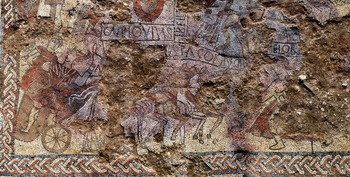
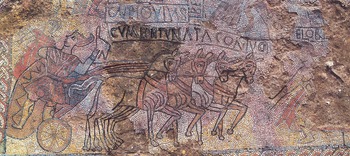
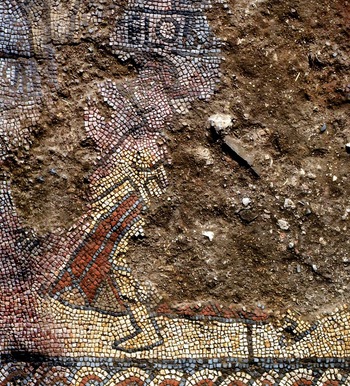
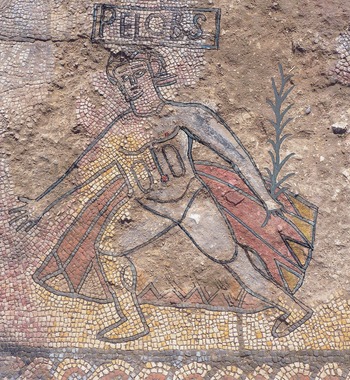
The tail of the first horse of the chariot team is formed of long thin tesserae, outlined for clarity in white. It flows across the front of the ‘golden’ chariot (figs 15 and 16). The colours of the equine chorus-line are white (turned pink by heat), buff, white and buff. The horses mirror Pegasus in terms of execution, with their splendid manes and red nostrils, and wear wide red girth straps and breast bands. Although only one quadriga appears on the mosaic, it visually guides the eye to the victorious Pelops at the finishing line; thus the actual race takes place in the viewer's head through knowledge of the story. Pelops wears a Roman charioteer's helmet with a ridged neck guard,Footnote 54and an open and elaborately decorated robe falls from his shoulders to allow him to achieve heroic nudity; a unique state not known on any other depiction of Pelops (figs 17 and 18). He strides forward across the line with his right hand thrust out and palm spread, as if to say, ‘I am the victor!’. His left hand may have held a victor's palm frond. Above his head is the panel for his name, misspelled as PELOBS Only five tesserae of the loop of the first letter survive, making the reading unclear.Footnote 55 There is no room here for him to be accompanied by Hippodamia, as generally occurs, and thus it seems that the message of the mosaic is his victory above all else. His stance is rather reminiscent of that of two circus staff on the Noheda mosaic: one appears above Oenomaus’ wrecked chariot and the other partially survives above the group of the triumphant Pelops and Hippodamia; again, a lost original may have furnished the model.Footnote 56 The funerary games given by Pelops in honour of Oenomaus are credited as being the mythical origins of the Olympic Games, and the preparations for the fatal race were immortalised in their only known monumental form on the eastern pediment of the temple of Zeus at Olympia. The murdered Myrtilus was catasterised by his father, Hermes, to become the constellation of Auriga.
Pelops corrupting Myrtilus and the preparations for the race (photo by Chris Forsey). (© Chris Forsey)

Interpretative reconstruction of the chariot panel (reconstruction by Anthony Beeson). (© Anthony Beeson)

Pelops the victor straddling the finishing line (photo by Chris Forsey). (© Chris Forsey)

Interpretative reconstruction of Pelops the victor (reconstruction by Anthony Beeson). (© Anthony Beeson)

The mosaic's major inscription runs above the chariot and is interpreted by Tomlin (pers. comm.) as reading:
Caepio vivas
c[um Fo]r[tu]nata coniuge
‘Long life to you, Caepio, with your wife Fortunata’
Caepio is presumably the name of the owner of the villa, and the mosaic may possibly have been a wedding present from Fortunata's parents.Footnote 57 Inscriptions are rare survivals on Romano-British mosaics, as are the names of individuals connected to them. The inscription may have extended to a third line and had an additional short word in the space between the charioteer and the neck of the first horse. The charioteer's whip trails downward and finishes at what might be the letter N or M. Unfortunately, a patch of burning here made it impossible to be certain on site whether this is actually a letter or part of the thong, and studying photographs after the excavation has failed to clarify this point. Furthermore, a straight line beneath it may either represent the chariot's pole or match those underlining the inscription above (fig. 16). If this is an extra word, then it would be the only inscription on the floor not to be composed entirely within a dialogue box (there is no indication of either end or top lines). Its detached position away from the figure of Myrtilus makes it unlikely to refer to him, as all the other name tags are positioned with their figures.
THE OUTER BORDER
The outer border of the mosaic is filled with action and scenes of triumph that take place amidst the bushes of a landscape set between the four corner telamones.
The telamones
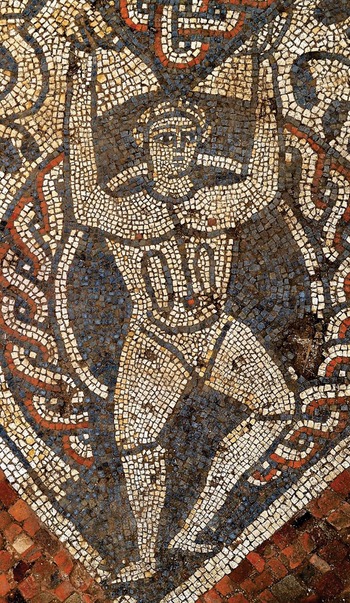
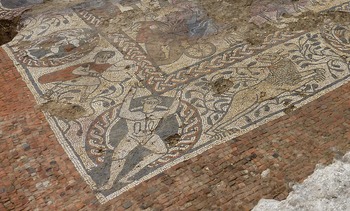
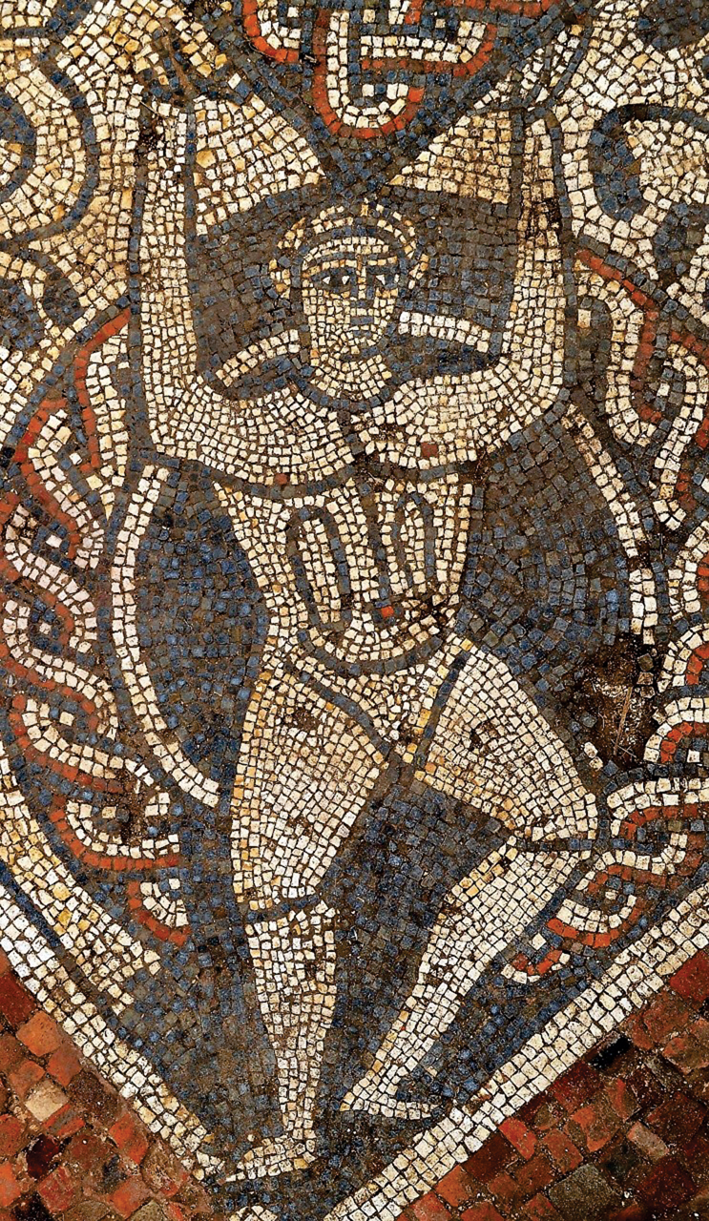
The Boxford mosaicist attempted to give his pavement a trompe l'oeil effect. At each corner stands a telamon holding up a rectangular pergola decorated with a guilloche pattern that frames the central panels (fig. 6). It is notable that the mosaicist treated the guilloche as expendable and abandons it where it will interfere with inscriptions or figure work. Telamones, or atlantes, are based on the figure of the giant Atlas, who held up the sky. The reason for their inclusion here may be the fact that both Pelops and Oenomaus’ wife, Sterope, were considered by some to be his children. By coincidence, the daughter of Pelops’ son Alcathous married an unrelated hero named Telamon. Two of the Boxford telamones retain most of their features; the northern one is beautifully intact (figs 19 and 21).
View from the northern corner of the mosaic, showing the best-preserved telamon. The combination of walking telamones and guilloche-bordered mandorlas appears to be unique to this mosaic (photo by Anthony Beeson). (© Anthony Beeson)

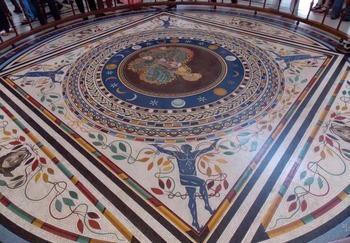
The telamones are foreshortened, to give the appearance of standing upright, and they step out of blue guilloche-bordered mandorlas that are treated similarly. The guilloche breaks at the top and bottom of the mandorlas as the telamones emerge. Proof that the mosaic's coarse border was laid first survives at the south-western corner, where the mosaicist found there was insufficient space left to complete the mandorla's guilloche and to include the telamon's left foot comfortably (fig. 4, bottom left). The figures predate those of Christ stepping from an oval blue mandorla that appear in early Christian art. The famous miniature of the Ascension in the Rabbula Gospels, illuminated around a.d. 586, which features such a scene, has a painted ‘tessellated’ border and is itself believed to be copied from a mosaic.Footnote 58 Depictions of telamones in mosaic are remarkably rare, and these walking versions are seemingly matched only by four on a restored third-century a.d. mosaic in the Greek Cross Hall at the Vatican, found at Tusculum in 1741 (fig. 20).Footnote 59 The Boxford combination of telamones and mandorlas appears to be unique. The corner placement of the telamones is reminiscent of a battered but fine second- or third-century a.d. example of a garden fountain from Avenches, now in the Musée Romain d'Avenches (inv. no. 1862/196).Footnote 60 This fountain features four abraded corner telamones supporting the roof of a structure that perhaps represents a garden pergola or pavilion, but once had the practical function of being the fountain's reservoir.Footnote 61
The third-century a.d. walking telamones mosaic from Tusculum. The Medusa lunettes were added to turn it into a circular mosaic when it was set into the Greek Cross Hall at the Vatican (photo by Steve Clark). (© Steve Clark)

The Boxford figures lack the artistic subtlety of having terracotta or other coloured tesserae as an inner lining to their outlines in order to soften and provide an element of solidity and dimension to their forms, as is most often found on figured mosaics (figs 19 and 21). The telamones’ hair is formed by intersecting arcs of blue tesserae, and, like all unclothed figures on this floor, they have red nipples and navels. Their white skin has somewhat crude joint and muscle lines and no genitals, which the mosaicist seems not to have considered necessary for any of the pavement's naked figures. This lack of genitalia occurs elsewhere on other Romano-British mosaics, such as those at Horkstow, North Lincolnshire,Footnote 62 and Lenthay Green, Dorset,Footnote 63 and is not significant. The technique used on these figures replicates in ‘positive’ the ‘negative’ depictions (namely, black figures with white anatomical detailing) so often encountered in Roman mosaic. The telamones of the Tusculum mosaic are treated in this manner, as are the famous static ones shown as supporting a city on a mosaic at the Baths of the Cisiarii, in Ostia Antica.Footnote 64
The northern telamon remains in perfect condition and seems to have been the most accomplished of the four (photo by Anthony Beeson). (© Anthony Beeson)
The triumphal amorini
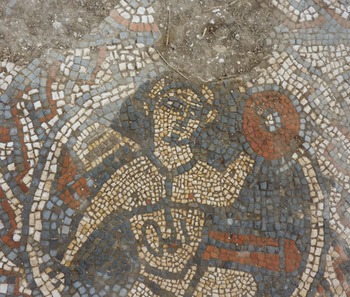
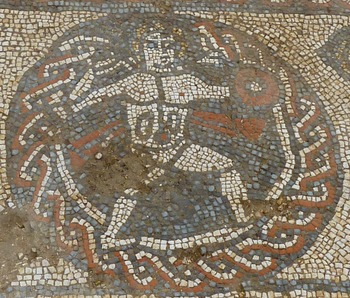
In the centre of the border on each side of the mosaic are blue-backed, guilloche-bordered circular mandorlas out of which leap amorini (winged cupids) (figs 4, 6, 22 and 23). When the eastern one was uncovered in 2017 it was thought to represent a season, such as Spring or Summer, holding a floral wreath.Footnote 65 The seasons are often found in association with Bellerophon mosaics, as Pegasus and Bellerophon formed the impetus to set the year rolling. However, it was found that all bore the same attribute of a quoit-like wreath in their left hands. Only part of the border of the southern roundel now remains, but the others are mostly intact. The amorini are naked but backed by red sashes that are not wound around the waist, as usually occurs. The mosaicist's usual red nipples and navels are evident, and the oddly drawn muscles of the amorini give them remarkably smiling torsos. Their wings rather resemble toy flags in shape.
The western amorino is the most beautiful and includes 2 mm2 tesserae. He holds a linchpin in his right hand and a victory wreath in the other (photo by Anthony Beeson). (© Anthony Beeson)

The yellow-haired northern amorino is by a less-accomplish mosaicist (photo by Anthony Beeson). (© Anthony Beeson)

The finest one, incorporating tiny tesserae and with its head in a classically tilted pose, is that on the western side, below the chariot race (fig. 22). It has a sensitive face and its right hand clasps a linchpin through the loop (a reference to the panel above). This is the only amorino holding something in its right hand. Their white hands appear at the centre of each red wreath. The crudely drawn eastern amorino has a white wreath, but whether by mistake or intention is unknown. Echoing the triumphal theme of the mosaic, the interpretation is that they each hold a golden victory wreath: a corona triumphalis. An amorino in the same pose and holding a wreath appears on the Byzantine ivory Veroli casket in the Victoria and Albert Museum, which celebrates Bellerophon's taming of Pegasus.Footnote 66 A victory wreath also appears on the Pelops sarcophagus from Cumae (fig. 12),Footnote 67 as well as that in the LouvreFootnote 68 and the lid in the Museo Nazionale Romano, Rome.Footnote 69
Hercules and the centaur
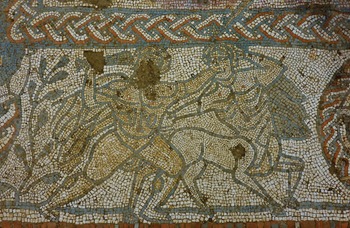
The Hercules group occupies the southern half of the eastern border (figs 6 and 24). In some accounts, Alcmene, Hercules’ mother, was the granddaughter of Pelops and Hippodamia, so linking Hercules to Pelops. Hercules cleaned the stables of Augeus in Pelops’ old kingdom of Elis and is credited with having established the violent boxing and wrestling contest called the pancratium at Olympia, in honour of his kingly ancestor. He also slew the child of Chrysaor (Bellerophon's half-brother) and was connected to Arion and Adrastus (see below). Although rarely encountered on Roman mosaics in Britain, Hercules occurs widely in other forms of Romano-British decorative art. This is the first British mosaic depiction of this scene. Mosaics showing all or some of the 12 Labours of Hercules occur throughout the Empire, but thus far none has been discovered in Britain, beyond a mosaic at Bramdean of Hercules and Antaeus, a story attached to the 11th Labour.Footnote 70 The Boxford mosaic shows another episode, probably attached to the fourth Labour, the fight against the centaurs at the cave of Pholus, or a variant of his killing of Nessus.
Hercules killing a centaur in the eastern border. The centaur adopts the fatal pose (photo by Anthony Beeson). (© Anthony Beeson)

The mosaicist endowed the group with great energy, and the figure of Hercules lunges forward, adopting a classic and vibrant pose of conflict often encountered in Graeco-Roman art (fig. 24). The perspective and modelling of his thighs and legs are well handled and only spoiled by the position of his right foot. His figure steps out of the panel's surrounding blue fillet and stands upon the red border. Hercules raises his right arm behind his head in order to deal the death blow with a club that is solidly portrayed in grey tesserae. Although the lower part of his face is now destroyed, his eyes survive, looking towards the centaur's torso. His abdominal muscles are stylised into two elongated blue circles, and the joints and calf muscles are also indicated. Red tesserae mark his nipples and navel but, again, the mosaicist did not consider it important to depict genitals. From his right shoulder, the famous Nemean lionskin streams out, indicating the violent motion of the hero.
The drawing of the centaur is less fluid than that of Hercules but is, nonetheless, well handled. Like his aggressor, the centaur's hair is formed by overlapping arcs of blue tesserae on the white field. He leans backwards, and the powerful muscles of his torso are indicated and stressed by blue lines. Again, red tesserae indicate his nipples and navel. A shaggy fur cloak of grey tesserae, layered by lines of blue, streams out from his left side as he turns. It is decorated with a fashionable orbiculus (ornamental circle). In his right hand he holds a rock, a centaur's traditional weapon. Below it, his tail flows away and curls between Hercules’ legs. The hero grabs his victim by the hair, while the centaur's left arm bends backwards and his hand comes to rest on the victor's wrist. This is the ‘fatal pose’ that was developed in the fifth century b.c. and used in classical art to indicate to the viewer that the victim is doomed and death imminent.Footnote 71 The unbearded centaur here is dragged backwards, and his front legs bow outwards and stray beyond the blue border fillet as he looks towards his slayer.
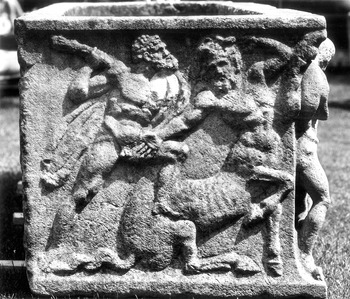
Currently, the closest parallel to the Boxford group occurs on a side panel of the late second-century a.d. Hercules sarcophagus once at the Villa Borghese and subsequently held in the Astor Collection at Hever Castle, Kent (fig. 25).Footnote 72 The Boxford image is quite remarkable as perhaps the latest example of the fatal pose yet found. It seems to have gone out of fashion in battle scenes, perhaps because of its theatricality, and has not been traced on any of the Trajanic monuments or later battle sarcophagi of the second and third centuries a.d. On imperial monuments it perhaps last appears on the Hercules pilasters of the Severan basilica and the column pedestals of the temple of the Gens Severa at Leptis Magna, of around a.d. 216. The latter, now in Room 9c of the Tripoli Museum and Room 11 at the Leptis Museum, are based on a gigantomachia inspired by the Pergamum altar of 180 b.c. The pose appears again in Britain on the Achilles and Penthesilea panel of the third- or fourth-century Horkstow Medallions mosaic.Footnote 73 The popularity of the scene of Hercules and the centaur continued, and a different version of the battle is found on the reverse of a fifth-century a.d. Hercules contorniate (medallion) issued during the reign of Valentinian III.Footnote 74
The second-century a.d. Hercules sarcophagus formerly at the Villa Borghese, Rome, and subsequently in the Astor Collection at Hever Castle is a close parallel to the Boxford group. (© Warburg Institute Photographic Collection)

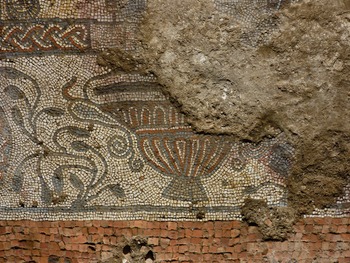
The cantharus
To the right of the eastern triumphal cupid is a wide-mouthed cantharus or wine cup decorated with elaborate tendril handles and gadrooning (figs 6 and 26). Framed by bushes, it appears to be simply a garden ornament, alluding to Bacchus and the pleasures of wine. However, its symbolism and placement in the border are very subtly significant, as it sits directly above the head of the enthroned figure of Oenomaus in the court panel below it. Oenomaus’ name translates as ‘man of wine’, so its presence cleverly confirms the identification of the subject on the throne in the viewer's mind. Subtleties such as this suggest that the decorative scheme of this mosaic was planned carefully. Possibly, the owner's chair was placed here on the eastern coarse border, and visitors addressed him across the court panel.
The cantharus of the eastern border (photo by Anthony Beeson). (© Anthony Beeson)

Alcathous of Elis and the Cithaeronian Lion
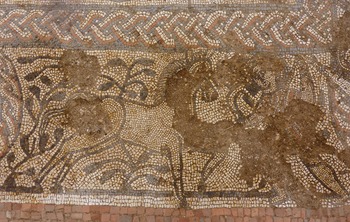
Apart from the triumphal amorino and the telamones the only figure found in the northern border is that of an archer who the author identifies as Alcathous of Elis, the son of Pelops and Hippodamia, who slew the Cithaeronian Lion to gain a bride and a kingdom (fig. 27). Dunbabin, however, questions whether the story would have been known in Britannia and by a British patron, although, of course, one cannot know the nationality of the owner of the property or how widespread knowledge of Greek mythology was amongst the wealthy classes in the province. One might equally question the illustration of the Pelops myth.Footnote 75 The importance of this figure in British mosaics cannot be overstressed as, uniquely, it affects and connects with a subject in the western border. Such a connection of action between separate borders is certainly unique in British mosaics, and an extreme rarity elsewhere in the Empire. The concept at Boxford seems based on the sort of decoration one might find in the borders of illuminated manuscripts. The action at this beautifully preserved corner adds to the three-dimensional effect attempted by the mosaicist, as the archer fires an arrow from the bushes, behind the back of the north telamon and into the throat of a fleeing lion in the western border. Two damaged panels, separated by a roundel holding a bust, in the western border of Room 11 at Dewlish villa in Dorset may also have been designed to connect visually, as a charging boar in one heads towards a lunging hunter with a spear in the other.Footnote 76
View of the northern corner of the mosaic, showing Alcathous shooting the Cithaeronian Lion behind the back of the telamon (photo by Anthony Beeson). (© Anthony Beeson)

At Boxford, Alcathous is dressed in a fashionable fourth-century a.d. tunic (fig. 27). On his shoulder he wears a red chlamys that streams behind him and his feet are clad in cross-laced hunting boots called cothurni. He may be wearing a pointed petasus hat or Phrygian cap, but this is unclear. He pulls a recurvant bow, which disrupts the flow of the guilloche border surrounding the central panels. Alcathous’ fleeing target in the western border is to be identified with the Cithaeronian Lion. Similar in design to the lion-headed Chimaera, and illustrative of the lost areas of that figure, the animal turns to snarl at his tormentor as an arrow enters his throat and blood spurts forth. He is provided with a large red tongue and splendidly sharp teeth. The mosaicist playfully added odd leaves to the arrow and the lion's tail.
Arion and Adrastus
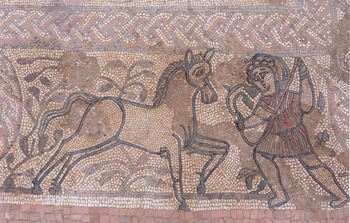
The final group in the western border depicts a young man dressed in a knee-length red, white and blue striped tunic moving towards a horse and is plausibly identified as the triumph of Adrastus, king of Argos, in taming the fabulous horse Arion, another son of Poseidon by Demeter (Ceres) (fig. 28). Arion could both fly and talk. At first glance, Adrastus appears to be holding a grey sceptre, staff or spear, but the object is held at its extremity in his raised left hand and so is unlikely to be a weapon. Unfortunately, a large section of the lower figure is lost and with it the end of the object. What remains near the border consists of leaves, a stem and one isolated blue tessera. The figure's right hand exists and is clasping something, although large-leafed foliage seems to be growing through or behind it and also in the area around his head (figs 28 and 29). This, of course, may again be an example of the mosaicist adding leaves to an object, as in the case of the arrow and lion's tail noted above. The horse has lost most of its neck and the top of its raised left leg. He is unbridled, and that may be a clue to the action.
Arion tamed by Adrastus, king of Argos (photo by Anthony Beeson). (© Anthony Beeson)

Interpretative reconstruction of the Arion and Adrastus panel (reconstruction by Anthony Beeson). (© Anthony Beeson)

The figure appears to be about to tether or bridle the horse with the object in his hand, which, presumably, curved around either to his other hand or to the horse's neck. The animal is naively drawn and executed, and, although following the technique used for the other horses, is obviously not by the same mosaicist. In startling contrast to this is the figure of Adrastus, which is by the same hand as the western amorino and along with it uses the smallest tesserae found anywhere on the floor (and possibly in Britain); some of the tesserae forming his arms are less than 2 mm2.
Hercules gave Arion to Adrastus after a campaign in Elis, and this links the panel with that opposite; the horse was also half-brother to Bellerophon, Pegasus and Chrysaor. The group bears a great resemblance to a famous third-century b.c. southern Italian tomb painting known as The Foal or Horse Tamer from Egnazia.Footnote 77 Arion appears with his parents, Poseidon and Demeter, and with a young Pelops as a cup-bearer on several bas-reliefs.Footnote 78
DISCUSSION
Whereas many provinces favour mosaics illustrating everyday life or scenes from the amphitheatre, Romano-British figural mosaics draw heavily on mythological characters and stories, particularly those recounted in Ovid's Metamorphoses or Hesiod's Theogony, which suggests a widespread knowledge and appreciation of such classics.
The Boxford mosaic is one of the most important examples of late Roman art to have been discovered in Britain. This assessment lies not in the technical or artistic abilities of the mosaicists but in the remarkable choice of subjects depicted and what that implies about the mosaic's patron and viewers, the innovative approach of the mosaicists and their attempts to produce a trompe l'oeil design. The great number of figures on the mosaic, and the spread of the Pelops myth across it, is more reminiscent of the design of Mediterranean mosaics rather than those of Britain, where the mythological subjects depicted are generally confined to two or three figures firmly set within framed panels. The choice of images, all seemingly subtly connected to Pelops, Bellerophon or Poseidon, is of great interest and originality; they must surely have been chosen with care by the patron. They display the subtlety of thinking and the longevity of classical culture in the Britain of the late fourth century. The chamber itself resembles an audience or a formal reception room. It appears to have been remarkably lavish in decoration considering the utilitarian appearance of the rest of the excavated rooms, although the loss of floor levels in the other rooms and the near-complete absence of surviving wall-plaster make an assessment of the decorative appearance of the villa somewhat conjectural. The inscriptions in themselves are highly unusual for Britain and provide the names of the main characters featured, together, possibly, with the owner's name (figs 9 and 10). Only on the mosaic at ThruxtonFootnote 79 do we have other owners’ names, although one may have featured at HawkesburyFootnote 80 and another may be hidden in the inscription at Lullingstone.Footnote 81 The apparent childlike naivety of the figures should be viewed in the context of what little is known of contemporary manuscript illumination. Indeed, the fifth-century Vergilius Romanus, in the Vatican, believed by many to be a Romano-British manuscript, displays a great similarity in the naivety of its figures.Footnote 82 It may well be that the patron of the Boxford mosaic requested the panels to be copied from a favourite manuscript in his collection, as is suspected also for the Dido and Aeneas mosaic at Low Ham, Somerset.Footnote 83 We know that the story of Pelops was covered in the works of Sophocles, Euripides, Accius and Pherecydes, to name but a few, and other works such as the Fabulae of Hyginus and the Bibliotheca of Pseudo-Apollodorus may have provided inspiration. Certainly, the subjects chosen for the lively borders suggest this.
The similarities with some aspects of the Pelops panel at Noheda might suggest that both mosaics are based on a once-famous original. However, a closer affinity exists between Boxford and the second-century Tipasa sarcophagus (figs 13 and 14), and other romantic aspects of the mosaic's depictions, such as the heroically undressed hero and heroine, the importance of the figure of Myrtilus, the walking telamones and the presence of the ‘fatal pose’, might suggest an older second- or third-century source, adapted by the mosaicists to reflect contemporary trends such as striped hairstyles, modern costume and imperial imagery.
The Boxford version of Pelops’ story follows a recognised artistic convention of this rarely portrayed myth, in combining a tableau at Oenomaus’ court with the major composition of the race, but in its own way. It is no slavish copy of any other known depiction, nor is it simply an elaborate transition of the traditional sarcophagus representations to mosaic, as is the monumental Noheda pavement. If the court and chariot scenes at the northern end are merged into one upright panel, then the design is remarkably novel and clever, combining Pelops’ arrival at Elis, his viewing of the severed head, his meeting with Oenomaus and Hippodamia, his corruption of Myrtilus and the preparation for the race into one composition. That the scene is the preparation for the race, and not the race itself, is significant, as the latter takes place in the viewer's mind. It will be remembered that the Tipasa sarcophagus covers only the court and preparations for the race, and does not feature the outcome. That the viewer was expected to have sufficient knowledge of the story to imagine the actual race, the outcome of which is represented here by the hero at the finishing line, suggests again the high level of cultural awareness and knowledge of mythology amongst the Romano-British villa-owning class. The final emphasis seems wholly directed at Pelops’ triumph in winning the contest rather than the more usual union with Hippodamia.
The existence of the Noheda mosaic and the singular spelling of ‘Bellerefons’ on the Boxford mosaic, which is known elsewhere only from the Malaga mosaic, raise the issue of a possible Iberian connection. Could there have been such a connection through the mosaic's designer, patron or mosaicists? Was the cartoon that the possibly illiterate mosaicist worked from, or the codex that it might have been based on, of Spanish origin, or can we really believe that he, the designer or the patron was of Iberian origin? The work of the Boxford mosaicists has, thus far, not been identified elsewhere in Britain, but that does not necessarily mean that they were from another province of the Empire. Differences in the treatments of such elements as hands and eyes suggest that two or possibly three mosaicists worked on the pavement. The one responsible for Adrastus and the western amorino was obviously highly accomplished whereas the author of the eastern cupid was not. Another gives his figures distinctively stump-like hands with one or two fingers. Interestingly, the Croughton (Northamptonshire) Bellerophon mosaic seemingly retains simplified elements of the figure-work at Boxford but at a far remove and may be a later work by the least talented of the craftsmen or another mosaicist using the same cartoon or copying the Boxford technique (fig. 30). The design of the hero's face with its rectangular nose brings to mind those of the Boxford example, although this is a common enough treatment in mosaic. More significantly, elements of the Croughton Pegasus (the mane, eye and musculature) also display echoes of the treatment of horses at Boxford, especially that of the figure of Arion. However, the tail, composed of a single line of tesserae, is a poor substitute for Boxford's splendid tails.
The Croughton Bellerophon, dating from around the a.d. 360s, is the closest British parallel to the Boxford depiction, although by an inferior hand (painted and recorded by David Neal). (© David S. Neal)
Unquestionably, one of the most notable and apparent eccentricities of the Boxford mosaic is that figures are not contained by their borders but overlap or break out of them. This overlapping is similar to that sometimes encountered in sculptural friezes and in late Roman manuscript illumination. It is worth noting that the Vergilius Romanus’ famous illumination showing Dido and Aeneas sheltering from a downpour in a cave has a guard sitting above their refuge with a spear that pierces the border, imitating that of the Boxford attendant.Footnote 84 This overlapping occurs with other items on other pages of the manuscript. Indeed, by the fifth century the overlapping of borders by figures and objects carved on the ivory diptychs that once ornamented the covers of codices was also frequent. Thus, despite basing the mosaic on an earlier source, in their apparent disregard for the sanctity of borders the mosaicists at Boxford adopted a contemporary fashion found in other artistic media that was not at the time recognised in British mosaics.Footnote 85 This is perhaps another clue linking the inspiration for the Boxford mosaic to a codex that was possibly owned by the patron and perhaps copied from an earlier edition. The similarities of draughtsmanship and the overlap with aspects of late antique manuscript illumination and ivory diptych panels, such as the fifth-century Bellerophon panel in the British Museum (inv. no. 1856.6-23.2),Footnote 86 raise the possibility that such a source was the inspiration for the Boxford mosaicists. Dunbabin suggests that sketches of subjects circulated amongst mosaicists,Footnote 87 but it is of course also possible that the codices copied earlier designs in mosaics and other media. The dating of mosaics is always problematic. Current thinking might place it in the latter part of the fourth century a.d. However, its singularity of design and strong connections with aspects of fifth-century art suggest that it may rather date from the first quarter of the following century.
CONCLUSIONS
The Mud Hole villa displays a modest size and ground-floor plan that make it similar to examples such as the villa at Barton Court Farm, Oxfordshire.Footnote 88 Many small villas of fourth-century date reveal a greater emphasis on interior decoration than earlier examples, with opulent reception rooms, and the Mud Hole villa appears to be no exception in also including a bath suite. The relatively small size of Mud Hole villa is consistent with a trend detected more widely, where the provision of higher-quality interior decoration in the fourth century was accompanied by a decrease in villa size when compared with earlier villa establishments.Footnote 89 It might be suggested that the principal villa building functioned as a largely recreational facility catering for a visiting dominus, along with guests and dignitaries, during a short stay.Footnote 90 The mosaic room is most likely to have functioned as a reception room separated from an entrance, most likely by an array of columns or half-columns (pilasters) perhaps furnished with retractable doors or portières. Even so, mosaics were not necessarily a pre-eminent indicator of status at this time; that at Mud Hole, ambitious as it is in terms of content and cultural import, was laid upon a crude, insubstantial bedding of clay and sand, suggesting that it was constructed relatively cheaply and quickly, perhaps to mark some temporary event or celebration.
The role of the villa as a social setting for the receiving and entertaining of guests was conspicuously enlivened in this case by the mosaic and its mythological content, which ostentatiously demonstrated the Romanitas and cultural pretensions of its owner.Footnote 91 Villas constitute only 1 per cent of all known Romano-British settlement types,Footnote 92 although a large proportion of them developed from earlier settlements, generally non-villa farmsteads. Whether the Mud Hole villa developed from an earlier establishment is currently an open question. While the current excavation of the villa building has produced very little material that is earlier than the later third century, the dating of the complex as a whole is tentative.Footnote 93 An association with another building might indicate an alternative domestic focus, perhaps preceding the corridor villa, as found elsewhere.Footnote 94 However, the status and dating of the rectangular structure at Mud Hole is still uncertain and the corridor villa itself has yet to be fully examined. Despite the eventual demise of the villa complex, the principal building appears to have remained occupied until floors within the central room and front corridor had been robbed of useful building material. Remarkably, the mosaic itself survived in largely intact condition, until buried by the eventual collapse of the villa structure.
An assessment of the iconography of the mosaic and its possible relationship to contemporary manuscript illustration suggest a late date, perhaps not earlier than the last two decades of the fourth century AD. The presence of later structural features (Phase 3) might indicate continuing or renewed occupation into the post-Roman period, although the problems associated with secure dating for this time have long been recognised.Footnote 95 The evidence for late occupation in this case invites speculation regarding the eventual abandonment and destruction of the villa. To the extensive evidence of burning on the mosaic should be added that of fire-affected window glass and stone, although the destruction layers sealing the mosaic included surprisingly little charcoal. The substantial survival of the mosaic appears all the more remarkable in the light of the floor-robbing activity evident in Trench 1 and the later effects of modern cultivation.
ACKNOWLEDGEMENTS
Fieldwork was led by Cotswold Archaeology Senior Project Officer Matt Nichol assisted by supervisors Agata Kowalska and Sam Wilson, and undertaken by the volunteers of the Boxford History Project. The success of the excavation project was in no small part due to Joy Appleton of Boxford History Project, who co-ordinated the work of volunteers and professional specialists. Aerial drone photography was undertaken by several volunteers, and particular thanks are due to David Shepherd and Richard Miller. Anthony Beeson's research has enabled the wider significance and interest of the Mud Hole villa mosaic to be fully realised, and the assistance of Sam Moorhead in identifying and cataloguing the coins is also greatly appreciated. Thanks are also due for the observations and advice offered by Peter Warry and Kevin Hayward on the ceramic building material and stonework, respectively, and by Lorraine Mepham of Wessex Archaeology on the pottery. Other experts who have contributed to the analysis include Matilda Holmes (animal bones) and Dana Challinor (wood charcoal), along with Cotswold Archaeology staff Ed McSloy (wall plaster, mortar, glass and metalwork), Jacky Sommerville (ceramic building material) and Sarah F. Wyles (plant macrofossils and molluscs).