INTRODUCTION
The studied area where the two species in question were collected is characterized by rough seafloor and continuous sharp slopes in some places. It is surrounded by rocky ridges, median sea canyons and sea escarpments. The shelf slope varied in width from 1 to 50 km offshore, with some live patchy coral complexity, mostly ramose and massive forms (Kemp & Benzoni, Reference Kemp and Benzoni1999).
For over a century, the ichthyofauna of the Gulf of Aden has been the subject of research by several authors (Lloyd, Reference Lloyd1907; Druzhinin, Reference Druzhinin1973; Fischer & Bianchi, Reference Fischer and Bianchi1984; Anonymous, 1987). Most of these studies used as reference the three comprehensive publications on fish of the Gulf of Aden (Kemp, Reference Kemp1998, Reference Kemp2000; Kemp & Benzoni, Reference Kemp and Benzoni1999). Several significant works were published during the 20th Century reporting on the benthopelagic and deep water species (Gjosaeter, Reference Gjosaeter1984, Reference Gjosaeter1989; Kinzer et al., Reference Kinzer, Bottger-Schnack and Schultz1993).
In this paper we report the first record of Neoharriotta pinnata and the second record of the armoured sea robin, Satyrichthys adeni from the Gulf of Aden, Republic of Yemen. Identification of the two species concerned is based on Diedier (Reference Didier1995) and Diedier & Stehmann (Reference Didier and Stehmann1996) for N. pinnata, and Heemstra (1986) for S. adeni. The specimens are deposited in the fish collection of the Faculty of the Environmental Sciences and Marine Biology, Hadhramout University, Yemen.
MATERIAL EXAMINED
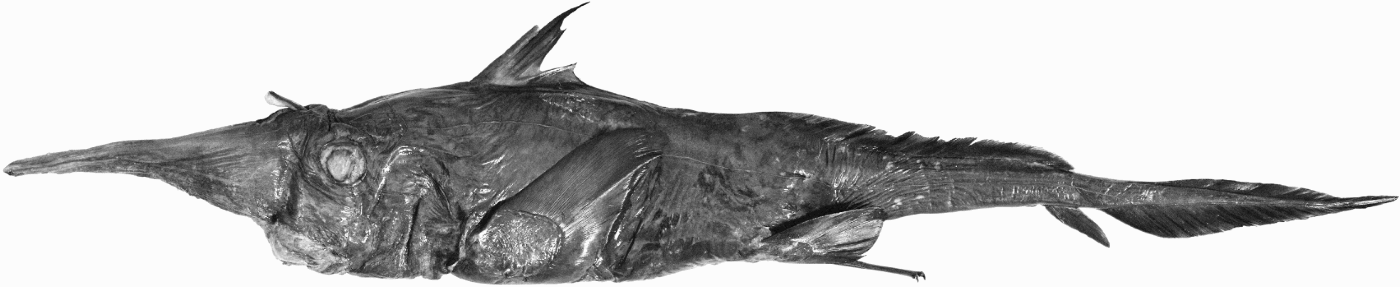
(10) 880–1280 mm total length (TL), 2000–4500 g, 10 August 2006–February 2007, coasts of Mukalla and Shehir cities (Hadhramout coast, N13°40″ E49°20″), collected with drop line during morning (Figure 1).
Neoharriotta pinnata, total length 885 mm.

DESCRIPTION
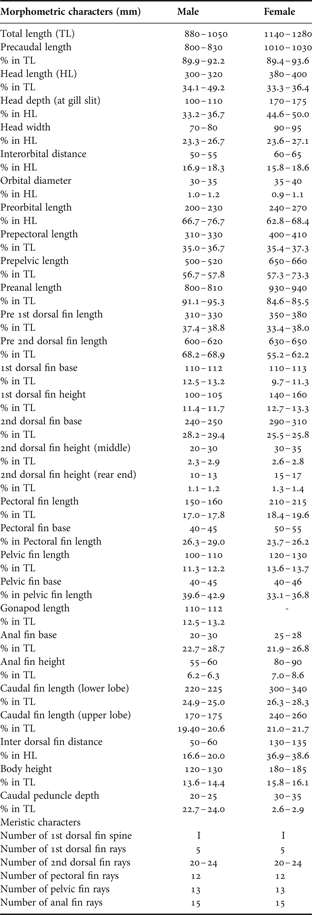
Body elongated. Snout long, pointed moderately flaccid with large tentaculum on its mid-dorsal surface and pair of grasping prepelvic tentacula. Males with pair of long cylindrical gonapods behind origin of pelvic fins surrounding anus. Well defined rectangular shape first dorsal fin equipped with moderate frontal erectile spine originating opposite pectoral fin base. Second dorsal fin with long base, smooth margins originating vertically beyond pelvic fin. Pectoral fin moderate in size, broad. Pelvic fin oval, moderate in size. Lateral line well defined, comprising straight, closely arranged sensory hillocks. Colour (fresh) dark brown. Morphometric and meristic details following Didlier (1995) and Didier & Stehmann (Reference Didier and Stehmann1996) are given in Table 1.
Morphometric and meristic characters of Neoharriotta pinnata.

REMARKS
The members of the genus Neoharriotta were previously known from the Atlantic Ocean (Manilo & Movchan, Reference Manilo and Movchan1989). Consequently, the range of their distribution extended to include western and southern coasts of Africa and Indian subcontinent coasts of the Indian Ocean (Bigelow & Schroeder, Reference Bigelow, Schroeder and Tee-Van1953; Compagno et al., Reference Compagno, Ebert and Smale1986; Krefet, Reference Krefet, Quero, Hureau, Karr, Post and Saldanha1990; Didier & Stehmann, Reference Didier and Stehmann1996). The presence of chimaeras in the north Indian Ocean is not an unusual phenomenon if we consider the local hydrography and the circulation pattern of water masses emanating from the south-east African continental slopes in the Arabian Sea during summer and autumn (Cohen, Reference Cohen, Zeitzschel and Gerlach1973; Wyrtki, Reference Wyrtki, Zeitzschel and Gerlach1973; Prasannkumar et al., Reference Prasannkumar, Ramaiah, Gauns, Sarma, Muraleed, Raghukumar, Dileep and Madhupratar2001; Shankar et al., Reference Shankar, Vinayachandran and Unnikrishnan2002). Moreover, the depth and structure of the seafloor of the Gulf of Aden provides suitable habitat for such fish species (Prasannkumar et al., Reference Prasannkumar, Ramaiah, Gauns, Sarma, Muraleed, Raghukumar, Dileep and Madhupratar2001). The present record of N. pinnata from the Gulf of Aden constitutes a substantial westward extension of the distribution of this species. The finding of ten specimens from the Gulf of Aden suggests that the wide spread in the ichthyological sampling in the area has ended the rarity of this species successfully.
MATERIAL EXAMINED
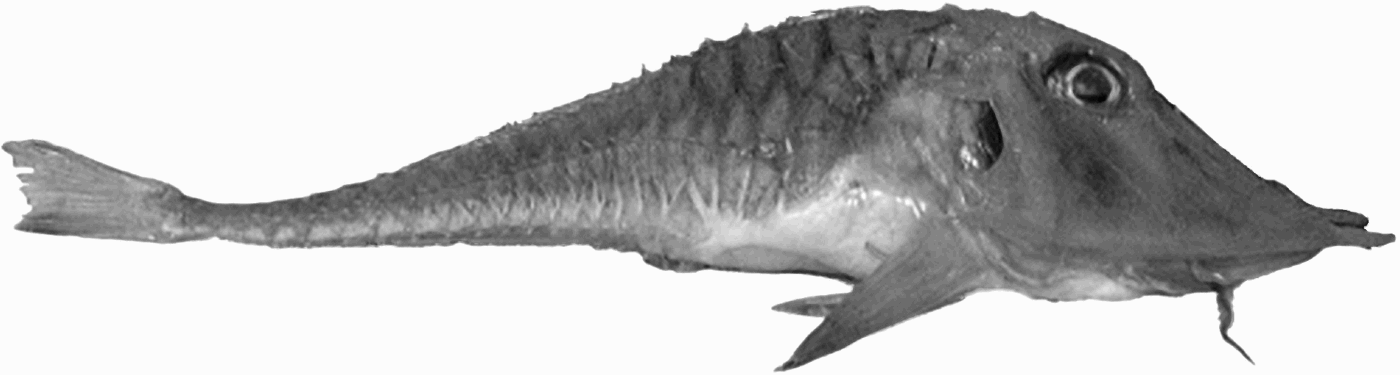
(26) 330–400 mm TL, 600–820 g, December 2005–April 2007, coast of Mukalla city (Hadhramout coast, 48°14″ to 50°00″E and 13°50″ to 14°40″N), collected with drop line during morning (Figure 2).
Satyrichthys adeni, total length 335 mm.

DESCRIPTION
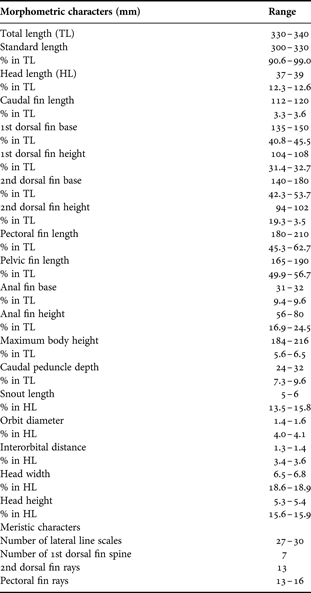
Entire body covered with firmly set, conspicuous, rhomboidal, spiny ctenoid scales. Two horny jaw outgrowths forming snout. Two large rays behind pectoral fin with conspicuous long lower jaw barbels. Forehead covered with elongated parallel plates. Eyes medium-sized, protruding dorsolaterally. Operculum large, ending with long spine that extends parallel to lower base of head, two additional short spines at upper corner. Mouth large inferior, lacking teeth. Caudal fin small with slightly concave rear margin. Ventral fins originating in the front of pectoral fin base. Body scales in three lateral rows starting from back of operculum to posterior edge of caudal peduncle, developed into distinct thorn directed backward with additional very small spines at rear scale margin. Lateral line comprising 27–30 spiny scales originating from postero-dorsal corner of operculum. Scales small in anterior part of lateral line, enlarging posteriorly. Lower jaw with three pairs of barbels, anterior lateral pair branched, middle and posterior pairs short. Morphometric and meristic details are given in Table 2.
Morphometric and meristic characters of Satyricthys adeni.

REMARKS
Members of the family Peristediidae are deep water fish of all seas particularly in the south-east Atlantic and Indo-Pacific. This family is represented in the Indian Ocean by one genus, Satyrichthys (Kaup, 1873). Published information about this group is scarce. Satyricthys adeni was described for the first time as Peristedion adeni by Lloyd (Reference Lloyd1907) from the north-west part of the Gulf of Aden. Since then there have been no reports in the literature except for the record of Peristedion cataphractum (Linnaeus, 1758) recently recorded from the Gulf of Aden (Jawad & Al-Badri, Reference Jawad and Al-Badri2004). Therefore, the present report constitutes the second record from the Gulf of Aden and provides evidence that the original record by Lloyd (Reference Lloyd1907) over a century ago was not based on stray specimens. The finding of twenty-six specimens of this species from the Gulf of Aden suggests that this species may be overlooked and the lack of sampling in the area prevents its regular detection in the Gulf of Aden.
ACKNOWLEDGEMENTS
Our sincere thanks to Bruce Marshall for reading the manuscript and for his valuable advice and suggestions, and to Raymond Coory (Te Papa Tongarewa, Wellington, New Zealand) for his technical assistance in producing the images.