During the nineteenth and early twentieth centuries, many churches in Britain made a notable contribution to the education not only of children but also of adults. Although the activities of Sunday schools are well known and reasonably well documented, those of parallel organizations for adults – mutual improvement societies, programmes of public lectures, literary and debating societies and adult Sunday schools – have attracted less attention. That said, Simon Green and Stephen Yeo, in their studies of religion in West Yorkshire and Reading respectively, do highlight the contribution of churches and chapels to adult education in the second half of Victoria's reign and the Edwardian era.Footnote 1 Likewise, from a more secular perspective, Roger Fieldhouse, in his history of modern British adult education, gives due recognition to the involvement of churches in collaboration, or competition, with non-religious providers such as mechanics’ institutes, working men's institutes, women's colleges and university extension classes.Footnote 2 This was undoubtedly a crowded field of activity, with many nineteenth-century initiatives paving the way for those of the twentieth.
For Nonconformist churches and chapels, adult education provision was one of the most conspicuous manifestations of the doctrine of the ‘institutional church’, that is, the belief that church premises should be social centres as well as places of worship.Footnote 3 This had a pervasive influence as the nineteenth century gave way to the twentieth. As Keith Robbins observes, ‘the “institutional church”, as a notion, with variants, was widely taken up … [with] the result … [being] a formidable array of activities and organizations conducted under church auspices’.Footnote 4 In his history of Congregationalism, Tudur Jones comments that application of the institutional principle ‘had been growing in popularity during the last quarter of the nineteenth century and reached its high-water mark in the early years of the twentieth’.Footnote 5 Indeed, it was the ‘ecclesiological phenomenon’ of the age.Footnote 6
For Michael Watts, the institutional church was
the practical expression of the theological liberalism of the late nineteenth century: of the emphasis on the immanence of God and the incarnation of Christ, which saw … the goal of the Christian not so much [as] the attainment of eternal life in heaven but the establishment of the kingdom of God on earth … .Footnote 7
In a chapter devoted to the subject, he demonstrates the many ways in which Nonconformist churches contributed to every aspect of the ‘social and intellectual well-being’ of their members and others who came within their sphere of influence.Footnote 8 Advocates of the institutional doctrine argued that it was ‘the Church's duty to teach by practice as well as by precept, that religion covers the whole of life’.Footnote 9 Such a holistic approach to ministry inevitably led to a weakening of traditional theological dichotomies, such as body and soul or mind and spirit, and blurred the boundary between the sacred and the secular. As Peter Yalden points out, one of the foremost champions of the institutional church, the influential Congregationalist, Revd Sylvester Horne, believed that churches should aim to ‘help people develop all their capabilities, not only the soul but the mind and body as well’.Footnote 10 In so doing, enhancing the intellectual prowess of members and adherents had a high priority.
For Richard Mudie Smith, the journalist and editor of The Religious Life of London, the institutional church was ‘the centre of active, aggressive, social work. Open seven days a week, it … aim[ed] at the redemption and development of body, mind and soul’.Footnote 11 In this way, it embodied the business-like and hard-headed approach which, as David Bebbington argues, was one feature of the Enlightenment which profoundly influenced evangelicals. It was a ‘significant expression … of their pragmatic temper’.Footnote 12
Involving extensive lay participation in establishing and sustaining ‘a wide variety of subsidiary associations and activities’, it was hoped that these ‘would help to attract people’ of many different backgrounds into the churches.Footnote 13 From an evangelistic perspective, these can be seen as a counterbalance to the aggressive campaigns of the first half of the nineteenth century, those of Moody and Sankey in the 1870s, and the simultaneous Free Church missions of the early months of 1901. In other words, the institutional church was seen as a form of outreach more in keeping with the less emotional and more cerebral spirit of the age symbolized by improvements in the provision of educational opportunities for all. However, as Jeremy Morris observes in a study of religion and urban change in nineteenth- and twentieth-century Croydon, while reinforcing ‘the ties between church membership and the wider circle of potential church members’, church-based organizations were not ‘very effective in recruiting from outside this periphery’. This was partly because they were not sufficiently proactive, relying ‘on some initial interest in the life of the church’, but also, and pertinently, because they required ‘some level of educational and intellectual attainment as well’.Footnote 14 Moreover, as Dominic Erdozain has cogently argued, in pursuing pleasure and recreation in its many forms, including adult education, churches risked undermining their primary rationale, the saving of souls.Footnote 15 Indeed, at the time some shared these concerns.Footnote 16
Nevertheless, the institutional church can be seen as a rational response to the increased leisure time and proliferation of secular pastimes enjoyed by many in society at large. Churches felt they had to compete and offer their members something similar, thereby cementing their loyalty by meeting most of their needs ‘from the cradle to the grave’, fearing that if they did not do so they would lose support. Activities intended to be more edifying than many offered by secular providers were embedded within the life of most Edwardian churches, echoing the call to ‘seriousness and high mindedness’ that had invigorated the evangelical Christianity of the Victorian age.Footnote 17 Green, discussing what he refers to as the ‘associational ideal’, argues that this held out ‘the genuine possibility of meaningful self-improvement’, coupled with ‘divine social activity’ and ‘the ultimate sacred goal of personal salvation’.Footnote 18
Furthermore, by this stage church premises were often extensive, incorporating, in addition to the main worship area, schoolrooms and spaces for larger gatherings. It was often felt, from both moral and economic points of view, that they were a valuable resource, the potential of which needed to be fully realized by utilizing them throughout the week and not simply on Sundays. Their use for adult education was seen as one means by which churches could respond to the interests – and the needs – of the community more widely.
This article examines the character and format of adult education provision on the basis of the experiences of two Congregational initiatives in Edwardian Hampshire: the London Street Mutual Improvement Society and a public lecture programme, the Avenue Lectures. Their contribution to what today is known as ‘lifelong learning’ is assessed. From surviving evidence, found mainly in church magazines and local newspapers, what emerges is a gradual weakening of their commitment as churches were superseded by secular providers. By concentrating on the Congregationalists of Hampshire it is not intended to imply that they were unique as adult education providers. Indeed, as Green, Yeo and Watts illustrate, members of other denominations were also involved in such programmes. However, Congregationalists developed a particularly high profile in this respect and arguably exerted an influence beyond their denominational boundaries. Similarly, while this is primarily a local, ‘microscopic’, study, engagement with secondary sources enables a number of broader, ‘microcosmic’ points to be made, particularly with regard to the changing environment within which churches were operating as facilitators of adult education and in relation to the doctrine of the institutional church.Footnote 19
London Street Mutual Improvement Society
In promoting adult education, some of the larger Congregational churches in Hampshire formed mutual improvement societies. As their title suggests, these were intended to be, as Fieldhouse puts it, a ‘collective form of … self-education’.Footnote 20 This was to be achieved through the presentation of papers to stimulate debate and constructive criticism. Although such societies were by no means the exclusive preserve of churches,Footnote 21 they were often, as Watts and others attest, a key feature of the institutional church.Footnote 22
In the north-east Hampshire market town of Basingstoke, London Street Congregational Church ran, for approximately fifty years from the mid-Victorian era,Footnote 23 a well respected Mutual Improvement Society (LSMIS). Unlike the position in Croydon, where Morris indicates that ‘mutual improvement societies … have left behind too little evidence to merit much more than a passing reference’, primary source material for the LSMIS has survived.Footnote 24
Although the precise origins of the LSMIS are unknown, it seems likely that it was a successor organization to Basingstoke Literary Association (1859–64), in which a leading figure was London Street's minister, Revd John Mark Wilks.Footnote 25 In 1889, the aim of the LSMIS was ‘to turn out its members as genuine, frank and free members of society – worthy to be equal to other people and able to win that position’.Footnote 26 Underlying this aspiration was the notion of what Anne Rodrick has characterized as ‘citizenship by debate’.Footnote 27 Through participation in LSMIS activities, members would gain self-confidence as their knowledge increased and their analytical and oral communication skills developed, thereby helping them to become better informed and more engaged citizens. Such hopes echoed those of ‘a pedagogic and ethical’ nature highlighted by Green, with ‘public-speaking, collective discipline and individual seriousness’ being to the fore.Footnote 28
The LSMIS was still flourishing at the beginning of the twentieth century, as a reference to it in a local newspaper of 1902 indicates: ‘this excellent society … has behind it a record in which it might take pride, and before it, we hope, a career of further usefulness in the stimulation of … [members] to improve their powers of thought and of speech’.Footnote 29 Taking these comments at face value, it would seem that the goal of self-improvement and, by implication, a more active mode of citizenship had been achieved.
By 1902 the LSMIS was open to people of both sexes and all ages. This contrasts markedly with the societies studied by Green which were exclusively male and targeted at young people. Indeed, for Watts, they were part of the attempt ‘to retain the interests of young people … once they became too old for Sunday school’.Footnote 30 Although there is no direct evidence, this may have been an earlier aim of the LSMIS. However, by the early twentieth century, it had a broader purpose.
There was ‘an annual subscription’, one shilling for the 1901–2 session, ‘payable in advance by each member’, which secured admittance to ‘all ordinary meetings’.Footnote 31 The rules specified how debates were to be conducted and listed the officers. Although all office holders were men, seven of the ten committee members for the 1901–2 session were single women and nearly two-thirds of the 69 members were women.Footnote 32 This calls into question the accuracy of Barry Doyle's assertion, based on his study of Congregationalism in Edwardian Norwich, that ‘in most churches female members were offered little in the way of literary, civic or political education’.Footnote 33
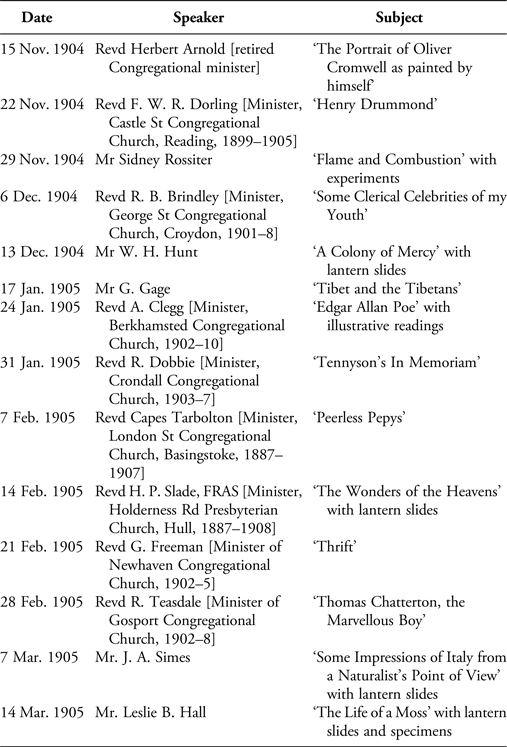
In Basingstoke, the minister took a leading role in the LSMIS, serving as its president. London Street's well-respected minister from 1887 to 1907, Revd Capes Tarbolton, was ideally suited to this role since he maintained a lively ‘intellectual interest in modern movements of thought … and had considerable literary gifts of which he was most modest … [and] as … [a] speaker he was original and incisive’.Footnote 34 Additionally, other Congregational ministers often made a contribution, as can be seen in the programme of lectures for 1904–5 (Table 1). Comprising an eclectic mix of topics and incorporating various pedagogic techniques, such as experiments, visual aids, illustrative readings and lantern slides (seen as ‘adding interest’ and immediacy to the proceedings), the programme was designed to have widespread appeal.Footnote 35
London Street Congregational Church Mutual Improvement Society Programme of Lectures, 1904–5

Source: HBG, 5 November 1904, 6.
However, the LSMIS faced a number of challenges. At the opening soirée in 1902, ‘even under the influence of music and refreshments, the company did not altogether relax its stiffness, and seemed strangely shy of one another’.Footnote 36 More seriously, two years later it was reported:
Some members might be disappointed that they had not got more debates – in fact they had none. For that the members themselves were to be blamed entirely. The Secretary would have only been too pleased if the members had been willing to come and scratch [out] each other[’]s eyes, but they all seemed to be blessed with such unanimity that they could not even get up sufficient differences of opinion for a debate. They might have amongst them budding orators … but at present they were practising in private. Perhaps at some future time they would resume those debates which in the past had been found to be so interesting and exciting.Footnote 37
The absence of debates clearly undermined a key principle of mutual improvement societies which was, as Green puts it, ‘for members to seek to teach each other to the mutual advantage of all’.Footnote 38
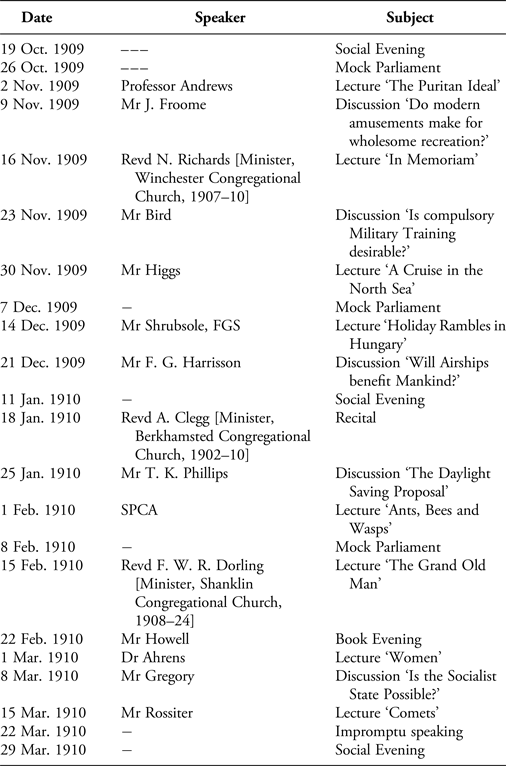
For reasons which are unclear, the LSMIS went into hibernation during the middle years of the decade, being successfully resuscitated for the 1907–8 session. As it was put in the January 1908 issue of the church magazine: ‘One hundred and sixty-three persons of both sexes have been candid and true enough to come out boldly and say they mutually desire to be improved!’Footnote 39 There was also renewed emphasis on appealing to the young: ‘[the LSMIS] is practically the only means of mental culture and improvement that is easily accessible to young people and while the style of meeting aims at more than amusement only, yet it is by no means of the dry as dust variety’.Footnote 40 To this end, as the 1909–10 programme indicates (Table 2), the academic components were supplemented with regular social evenings and a recital. Moreover, the inclusion of discussions, some in the form of mock parliaments, suggests that the earlier appeal had borne fruit.
London Street Congregational Church Mutual Improvement Society Programme of Events, 1909–10

Source: LSMIS Membership Card, 1909–10.
Thus, by the end of the first decade of the twentieth century the LSMIS was still very much alive and served as an exemplar of London Street's embrace of the doctrine of the institutional church and its desire to reach out to the community at large. For the 1909–10 session, twelve of the twenty-three committee members were women, eight single and four married. However, since details of the membership are unknown, it is not possible to determine whether it had any success in drawing in those who had no other connection with the church, or the age and gender balance at this time.
In early 1910 it was reported that the LSMIS had ‘well sustained its reputation during the past few weeks in the variety and interest of its meetings’.Footnote 41 A year later, however, it is clear that all was not well. As reported in the Church Manual,
at the commencement of Session 1911/12 it was thought advisable to bring the Society into line with kindred organizations by changing its old title of ‘Mutual Improvement’ … [to that of ‘Literary Society’] and to hold meetings fortnightly instead of weekly as a concession to the increased multiplicity of ‘full’ evenings.
Furthermore, membership and attendance were ‘not as good as the interest and high quality of the programme’ deserved. Thus, the question arose as to whether the society had ‘finally fulfilled the need it was originally started to meet’.Footnote 42 Although it struggled on until 1914, it would seem to have been but a shadow of its former self.
In seeking to explain the LSMIS's demise, a key consideration concerns competition from other adult education providers. Basingstoke had a very active Mechanics Institute and although this had coexisted with the LSMIS for many years, it appears to have sustained a higher level of interest in the years leading up to the outbreak of the First World War.Footnote 43 In addition, the first decade of the twentieth century saw the emergence of new adult education providers, one of the most significant being the Workers’ Educational Association (WEA) founded in 1903. As recounted by Yeo, the branch of the WEA in Reading, only fifteen miles from Basingstoke, was ‘proud of its … pioneer status’.Footnote 44 Its formation was emblematic of the ‘shift in the centre of gravity of activities away from churches and chapels into the town’.Footnote 45 Thus, in the field of adult education, churches can be seen as victims of their own success, laying foundations on which secular providers could build. Put a little differently, it seems likely that the LSMIS and similar societies stimulated a thirst for ‘lifelong learning’ within the community at large which outgrew the confines of a particular church. Indeed, through the attention the LSMIS received in the local press, its impact on the intellectual life of the community may well have extended beyond the membership.
One final consideration concerns the extent to which adult education had to contend with newer leisure pursuits, particularly the cinema. As McKernan highlights, film was ‘an entertainment form of unprecedented social impact’.Footnote 46 It is perhaps no coincidence that Basingstoke's first purpose-built cinema, the Electric Palace, opened in October 1910.Footnote 47
Avenue Lectures
Within Hampshire, arguably the most distinguished Congregational adult education initiative was the very popular annual programme of lectures arranged by Southampton's Avenue Congregational Church. This was somewhat different from a mutual improvement society in that all its events took the form of lectures, with eminent speakers imparting their knowledge of specialist subjects to a relatively passive audience. There was no attempt to inject any element of mutuality, as Avenue also sponsored a Literary and Debating Society for this purpose.
Founded in 1892, the Avenue Congregational Church was located in a newly developed ‘select suburb’ for the middle classes.Footnote 48 Responsibility for organizing the lecture programme was exercised by the church's Lectures and Entertainments Committee, which was set up in 1895. The aim was to ‘deal principally, with some of those problems – National, Social, Literary, which at the present time are prominently engaging public attention’.Footnote 49 Lectures were held monthly between September and March, there was an admission fee and tickets were initially sold at a number of outlets in Southampton.
As the church magazine commented regarding the 1902–3 programme:
For many years Southampton has not had such men as Dr Dallinger and Dr Andrew Wilson on the lecture platform and although the privilege of hearing these and other front rank men in their various special subjects entails considerable expense, yet we understand the Committee are fully confident that as long as a first-class series of Lectures is provided they will have the cordial support of the Congregation and also of the outside public.Footnote 50
Thus there was a desire to provide opportunities for Southampton residents to learn directly from those at the forefront of their area of expertise. In this respect, the approach was unapologetically elitist; in putting together such an illustrious programme, Avenue can be said to have followed in the footsteps of the Institute attached to Westbourne Park Baptist Church. As Watts records, for twenty years around the turn of the century,
[this] institute's public lectures attracted large audiences and an impressive array of distinguished speakers: H. M. Stanley described his African travels, Professor Flinders Petrie talked about Egyptology, Fridtjof Nansen spoke of his pioneer journey across the Polar ice cap, and Winston Churchill related his experiences in the Boer War. The world of science was represented by Oliver Lodge and the astronomer Sir Robert Ball; that of music by Sir Hubert Parry; and literature by Arthur Conan Doyle and Jerome K. Jerome.Footnote 51
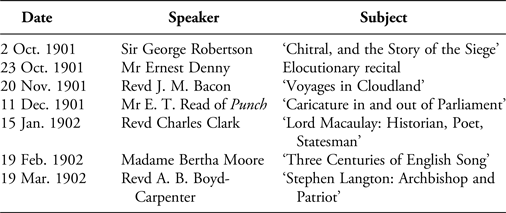
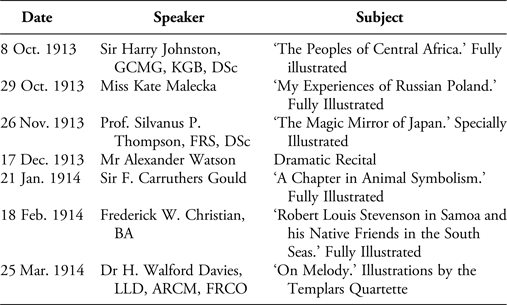
Although not as well known or of quite the same calibre as the Westbourne Park lecturers, something of the standing of those who contributed to the Avenue Lecture series and the variety of topics covered can be gained from the programmes for 1901–2 and 1913–14 (Tables 3 and 4).
Avenue Congregational Church Programme of Lectures, 1901–2

Source: AFC 4/7 (1901), vi.
Avenue Congregational Church Programme of Lectures, 1913–14

Source: AFC 16/9 (1913), 4.
Avenue's lecture programme received considerable publicity in the local press, thereby keeping the church in the public eye.Footnote 52 This undoubtedly helped to broaden the programme's appeal well beyond the congregation and to maximize the audience. While such a venture was in keeping with the spirit of the institutional church, it would have been seen by critics as a distraction from the spiritual aspects of church life. Moreover, as with mutual improvement societies, competition from other providers could not be ignored. Indeed, during the early months of 1914, Avenue's lecture hall was hired by Hartley University College as the venue for its extension lectures, with Professor G. K. Sutherland giving a series of three talks on evolution.Footnote 53 The hall was also used by Southampton Literary and Philosophical Society.
Nonetheless, following their suspension during the war, lectures were resumed from the 1919–20 session and initially the demand for tickets exceeded the availability of seats.Footnote 54 Their popularity continued until the mid-1920s, when ‘there was a serious falling off of patrons’ from both the congregation and the public at large. This was attributed to the keenness of the ‘competition … [from] the entertainment and scholastic world’, with free lectures at the University College and Celebrity Concerts at the Central Hall, but also the advent of the wireless, being specifically mentioned.Footnote 55 Indeed, the organizers may have had in mind the emergence of radio listening groups as a contribution to adult education.Footnote 56 Concern was also expressed over the cost of the lectures. In 1929, it was decided not to organize them for the following season, with what proved to be the forlorn hope that they would be revived the following year with ‘great enthusiasm’.Footnote 57
Conclusion
In many respects, locally based adult education provision of the kind offered by Congregational churches and those of other denominations reflected the Zeitgeist of Victorian and Edwardian Britain. Encapsulating notions of intellectual curiosity and self- improvement, participation by the churches reflected a desire not to be left out, and a reluctance to cede to the secular world a monopoly in this sphere. If Christianity was to apply to the whole of life then it was essential to respond to an increasing demand for cerebral pursuits arising from improvements in education more generally. As Jones has observed, ‘the progressive and successful Congregational church of the early twentieth century was a community in which the creation of a bright and happy fellowship had first priority’.Footnote 58 For many churches, it was also one in which the pursuit of intellectual fulfilment was a critical ingredient of the mutually supportive fellowship to which they aspired.
Nevertheless, although both understandable and laudable, neither the concept of the institutional church in general nor adult education provision in particular were unproblematic. For churches there were risks attached to being stallholders in the market place of secular pursuits, and in many instances they were, in competitive terms, ultimately the losers. Moreover, as some argued at the time, such activities undermined the principle of being in, but not of, the world.
That said, in the sphere of adult education churches can take credit for, and perhaps some comfort from, helping to lay foundations on which other generalist and specialist bodies have subsequently built. Today, these include the University of the Third Age, book groups, local history societies and a myriad of voluntary organizations catering for particular interests, with church members often contributing time, energy and expertise. In addition, many churches maintain a commitment to adult education through the running of courses, albeit with a strong religious orientation, of which Alpha and Christianity Explored are the best known. Here there are echoes of the adult school movement which, as Mark Freeman observes, managed with some success during the inter-war years to merge evangelism with education.Footnote 59 Furthermore, although the doctrine of the institutional church waned after the First World War, ‘the idea that the successful church … [was a] busy church’ continued to hold sway.Footnote 60 The fact that mutual improvement societies and lecture programmes disappeared from a busy church's programme of activities by no means diminishes their valued and valuable contribution to adult education during the Victorian and Edwardian eras.