Introduction
The terrestrial ecosystem of our planet has long served as a rich source of novel drugs and lead compounds for traditional pharmacotherapy (Mushtaq et al., Reference Mushtaq, Abbasi, Uzair and Abbasi2018). However, the challenges of treatment limitations and therapeutic resistance associated with conventional herbal remedies have broadened the horizons of drug discovery to the remarkable domain of the marine biodiversity (Malve, Reference Malve2016). Similar to terrestrial and microbial sources, marine organisms represent a valuable resource with immense biomedical potential (Malve, Reference Malve2016). Life in the ocean dates back approximately 3.7 billion years, which is three times longer than the life on land and it boasts vast evolutionary biodiversity (Blasiak et al., Reference Blasiak, Wynberg, Grorud-Colvert, Thambisetty, Bandarra, Canário, da Silva, Duarte, Jaspars, Rogers, Sink and Wabnitz2020). Indeed, 33 out of the 34 major animal phyla are found in the ocean, with around 90% of marine species still undescribed (Rogers et al., Reference Rogers, Appiah-Madson, Ardron, Bax, Bhadury, Brandt, Buttigieg, De Clerck, Delgado, Distel, Glover, Gobin, Guilhon, Hampton, Harden-Davies, Hebert, Hynes, Lowe, MacIntyre, Madduppa, Mazzuco, McCallum, McOwen, Nattkemper, Odido, O'Hara, Osborn, Pouponneau, Provoost, Rabone, Ramirez-Llodra, Scott, Sink, Turk, Watanabe, Weatherdon, Wernberg, Williams, Woodall, Wright, Zeppilli and Steeds2023). This richness in oceanic species is complemented by the extreme environmental conditions found in the marine environment, including temperatures spanning from −2 to 400°C, salinity from 0 to 36 ppt, atmospheric pressure from 1 to 100 ppt, and the presence of chemicals such as CH4, heavy metals, H2S, and anthropogenic pollutants (Yasuhara et al., Reference Yasuhara, Cronin, deMenocal, Okahashi and Linsley2008). These attributes make the ocean a significant component of the biosphere, with enormous resources such as fish, fungi, and algae preparations, being used medicinally since ancient times (Ślusarczyk et al., Reference Ślusarczyk, Adamska and Czerwik-Marcinkowska2021).
In the realm of drug discovery, natural products are favoured for their lower toxicity, with nearly half of the clinically-approved drugs being derived from these sources (Atanasov et al., Reference Atanasov, Zotchev, Dirsch and Supuran2021). Marine-natural products (MNPs) have shown an even higher success rate, up to four times than that of the other naturally-derived compounds (Pereira, Reference Pereira2019). The marine ecosystem is a rich source of nutraceuticals, featuring diverse chemical classes, including terpenes, triterpenes, aliphatic compounds, polyketides, saponins, carbohydrates, amino acids, and alkaloids which are generally secondary metabolites (Petersen et al., Reference Petersen, Kellermann, Schupp, Simon, Viola and Maya2020). The first MNP used therapeutically was alginate, a polysaccharide discovered in 1881, and used as a sodium salt for treating gastro-oesophageal reflux (Leiman et al., Reference Leiman, Riff, Morgan, Metz, Falk, French, Umscheid and Lewis2017; Bi et al., Reference Bi, Yang, Yao, Hu, Li, Xu and Lu2022). Since then, research on marine-derived compounds has led to significant discoveries, such as spongins from the sponge Tethya and cephalosporin C from the seawater samples, which paved the way for the discovery of the cephalosporin antibiotics (Bo, Reference Bo2000; Thomas et al., Reference Thomas, Kavlekar and LokaBharathi2010). Another notable discovery was turbinmicin, a polyketide from a marine microbe with potent anti-fungal activity, specifically against virulent and drug-resistant yeasts (Zhang et al., Reference Zhang, Zhao, Braun, Ericksen, Piotrowski, Nelson, Peng, Ananiev, Chanana, Barns, Fossen, Sanchez, Chevrette, Guzei, Zhao, Guo, Tang, Currie, Rajski, Audhya, Andes and Bugni2020). Thus, due to their bioactive and biomedical potentials, MNPs have gained significant interest in modern pharmacopeia.
Cancer, characterized by uncontrolled growth and proliferation of neoplastic cells, remains one of the most life-threatening diseases worldwide (Anand et al., Reference Anand, Dey, Chandel, Sanyal, Mishra, Pandey, De Falco, Upadhyay, Kandimalla, Chaudhary, Dhanjal, Dewanjee, Vallamkondu and Pérez de la Lastra2023). By 2024, an estimated 2,001,140 new cancer cases and 611,720 deaths are projected in the United States alone (Rl et al., Reference Rl, An and A2024). In India, the GLOBOCAN 2020 estimates project a 57.5% increase in cancer cases by 2040, with one in nine people likely to develop cancer (Sathishkumar et al., Reference Sathishkumar, Chaturvedi, Das, Stephen and Mathur2022). Glioblastoma multiforme (GBM), a lethal brain tumour originating from glial cells, serves as an illustrative case study for the potential of marine bioactive compounds against cancer. The current cutting-edge treatment strategy for GBM comprises maximal surgical resection of the tumour mass followed by radio- and chemotherapy with the synthetic drug, temozolomide (TMZ) (Shergalis et al., Reference Shergalis, Bankhead, Luesakul, Muangsin and Neamati2018). Despite these advancements, tumour recurrence is almost inevitable, with a median overall survival rate of less than 5%; Moreover, chemotherapy is associated with multiple side effects, necessitating a dire need for more effective alternatives with fewer side effects (Nowak et al., Reference Nowak, Rogujski, Janowski, Lukomska and Andrzejewska2021).
In this context, while plant-derived and marine-derived compounds represent promising alternatives to conventional chemotherapeutics in the fight against cancer, the economic burden of developing plant-derived anti-cancer drugs remains high. For example, the monthly cost for managing lymphoma with brentuximab exceeds USD 30,000 (Papon et al., Reference Papon, Copp and Courdavault2022). In contrast, MNPs offer a more cost-effective option, with the market growth rate projected to exceed 8% by 2026 (Papon et al., Reference Papon, Copp and Courdavault2022). Despite high discovery costs, MNPs provide cost-effective medication development alternatives due to their unique properties. Key example is ziconotide, produced from Conus magus, is 1000 times more powerful than morphine, decreasing long-term production costs through small dosages (Staats et al., Reference Staats, Yearwood, Charapata, Presley, Wallace, Byas-Smith, Fisher, Bryce, Mangieri, Luther, Mayo, McGuire and Ellis2004). Interestingly, the US FDA has approved 11 marine drugs, five of which namely halaven, cytarabine, trabectedin, plitidepsin, and brentuximab vedotin have demonstrated anti-cancer potential. Additionally, a significant number of marine compounds are currently being tested for their anti-cancer activity in vitro, in vivo, and in clinical trials, including plocabulin, lurbinectedin, marizomib, and plinabulin (Jimenez et al., Reference Jimenez, Wilke, Branco, Bauermeister, Rezende-Teixeira, Gaudêncio and Costa-Lotufo2020).
However, there is a lack of detailed studies on the therapeutic potential of marine biodiscovery for deadly tumours such as GBM. In this viewpoint, it is crucial to emphasize that MNPs have shown greater cytotoxic effects against GBM than the standard drug TMZ, making them promising candidates for chemotherapy (Alves et al., Reference Alves, Costa, Pinto, Ferreira and Correia-da-Silva2021; Peng et al., Reference Peng, Zhang, Wang, Zhou, Yu, Zhong, Zhang, Chen, Claret, Elkabets, Wang, Sun, Wang, Liang, Lin and Kong2023). Disappointingly, research on MNPs against GBM is still in its early stages, and no marine-derived drug has been approved specifically for GBM treatment to date. Hence, the current review aims to provide an overview of the ‘current status and challenges of marine drug discovery’, with a specific focus on the ‘potential of marine-derived compounds for GBM treatment’. Additionally, it discusses the ‘strategies to accelerate translation of anti-cancer marine leads to bedside applications’, to catalyse the progress of these underexplored compounds in the fight against this formidable brain cancer.
Marine biodiscovery: current status and challenges
Since its inception, the marine environment has been a rich catalogue of bioactive products with significant biomedical potential (Karthikeyan et al., Reference Karthikeyan, Joseph and Nair2022). Advances in the marine biodiscovery have led to an increase in the known number of marine species and compounds. Since 2008, over 1000 new MNPs have been discovered annually (Liu et al., Reference Liu, El-Hossary, Oelschlaeger, Donia, Quinn and Abdelmohsen2019). For instance, the microbe Thermus aquaticus, which is crucial for DNA amplification via polymerase chain reaction, was originally isolated from hot water springs, now being found in marine hydrothermal vents (Counts et al., Reference Counts, Zeldes, Lee, Straub, Adams and Kelly2017; Gurunathan et al., Reference Gurunathan, Rathinam, Hwang and Dahms2021). The blood of the horseshoe crab, Limulus polyphemus contains copper-based haemocyanin, commonly employed to ensure the safety of intravenous drugs and other injectables (Harrington, Reference Harrington2015). Additionally, the green fluorescent protein, used extensively to tag proteins, is derived from the jellyfish Aequorea victoria (Remington, Reference Remington2011). Moreover, the very first antiviral drug, Ara-A, effective against herpes infections was obtained from a marine sponge (Sagar et al., Reference Sagar, Kaur and Minneman2010). Besides, the red seaweed, Griffithsia, has demonstrated strong activity against coronaviruses, hepatitis, HIV, and encephalitis (Lomartire and Gonçalves, Reference Lomartire and Gonçalves2022). In response to the COVID-19 pandemic, the haemoglobin of the lugworm, Arenicola marina was shown to function as an effective ‘molecular respirator’ and therapeutic carrier of O2 (Batool et al., Reference Batool, Delpy, Zal, Leize-Zal and Huck2021). In cancer context, halven, a recently approved breast cancer drug, disrupts microtubule dynamics; its structure is based on halichondrin B, a compound isolated from a deep-water sponge (Huyck et al., Reference Huyck, Gradishar, Manuguid and Kirkpatrick2011). Other marine-derived anti-cancer drugs and their current status in the drug discovery pipeline are summarized in Table 1.
Marine-derived anti-cancer drugs and their current status in the drug discovery pipeline

Despite these benefits, the marine landscape remains under-explored. What steps can be taken to elevate the marine domain within the frontiers of drug discovery? The first and foremost bottleneck in marine biodiscovery is complex biological research, which includes identifying MNPs with novel chemistry and bioactivity. This can be bypassed through intensive research focused on gaining insights on the chemical composition and biological exploitation potential of these compounds. Fortunately, technological advancements now allow for the search of lead compounds using only a few grams of samples, rather than kilograms. By leveraging chemoinformatic tools and genome scanning, biosynthetic gene clusters can be identified, providing the path for the discovery of metabolites with novel chemistry (Meesil et al., Reference Meesil, Muangpat, Sitthisak, Rattanarojpong, Chantratita, Machado, Shi, Bode, Vitta and Thanwisai2023). Furthermore, screening using cell-based assays can provide detailed insights into their mechanistic activity (Wei et al., Reference Wei, Wang and Gou2021). Once biologically active compounds are identified, they can be purified from their biomass and produced on a large-scale using medicinal chemistry approaches, followed by subclinical and clinical trials.
While technological advances can generate convincing data in large volumes, it is disappointing that it takes an average of 20 years for a newly identified species to be formally published with its scientific name in the biodiscovery pipeline (Fontaine et al., Reference Fontaine, Perrard and Bouchet2012) (Figure 1). This delay is primarily due to the ‘risk tilts’ associated with new marine drug discovery in the early stages, leading to low funding priority.
Marine drug discovery pipeline.

Given this pitfall, we hypothesize several strategies to enhance marine discovery. Firstly, recognizing the unique biodiversity of the ocean, funding agencies should prioritize and support high-risk, fundamental research on marine organisms. Secondly, pharmaceutical industries have stepped-back on investing in natural products research. While there is ongoing sponsorship for marine biotechnology in areas such as nutraceuticals and cosmetics, investment in discovering anti-cancer agents from marine sources has diminished. Therefore, fostering strong collaborations between academia and industry, particularly during the early stages of discovery, could improve the success rate of MNPs in the market. Last but not least, conserving marine resources is crucial for inspiring new discoveries. For instance, after the discovery of novel species in Australia's sponge diversity, knowledge about these species has increased threefold since 1970 (Van Soest et al., Reference Van Soest, Boury-Esnault, Vacelet, Dohrmann, Erpenbeck, De Voogd, Santodomingo, Vanhoorne, Kelly and Hooper2012). Protecting the resilience of marine ecosystem from threats such as climate change, commercial mining, and pollution is essential. Furthermore, genetic diversity in marine conservation is often overlooked. Hence, using genetic reference database (environmental DNA or eDNA) that list threatened and endangered species, scientists can collaborate with partners from regions with unique raw materials to identify novel MNPs from under-explored species. By addressing these issues, we can overcome the obstacles to marine biodiscovery and unlock the full potential of MNPs in cancer pharmacology.
Marine bioactive compounds against cancer: current progress
MNPs have shown promising anti-cancer effects through various mechanisms, such as inducing apoptosis, inhibiting angiogenesis, and disrupting the cell cycle (Ahmed et al., Reference Ahmed, Mendonca, Elhag and Soliman2022). Numerous compounds derived from marine bacteria, microalgae, and sponges have shown significant cytotoxicity against different cancer cell lines in preclinical investigations (Saeed et al., Reference Saeed, Su and Ouyang2021). For instance, yondelis (trabectedin), a compound derived from sponges, is used in the treatment of ovarian cancer and soft tissue sarcoma (D'Incalci et al., Reference D'Incalci, Badri, Galmarini and Allavena2014).
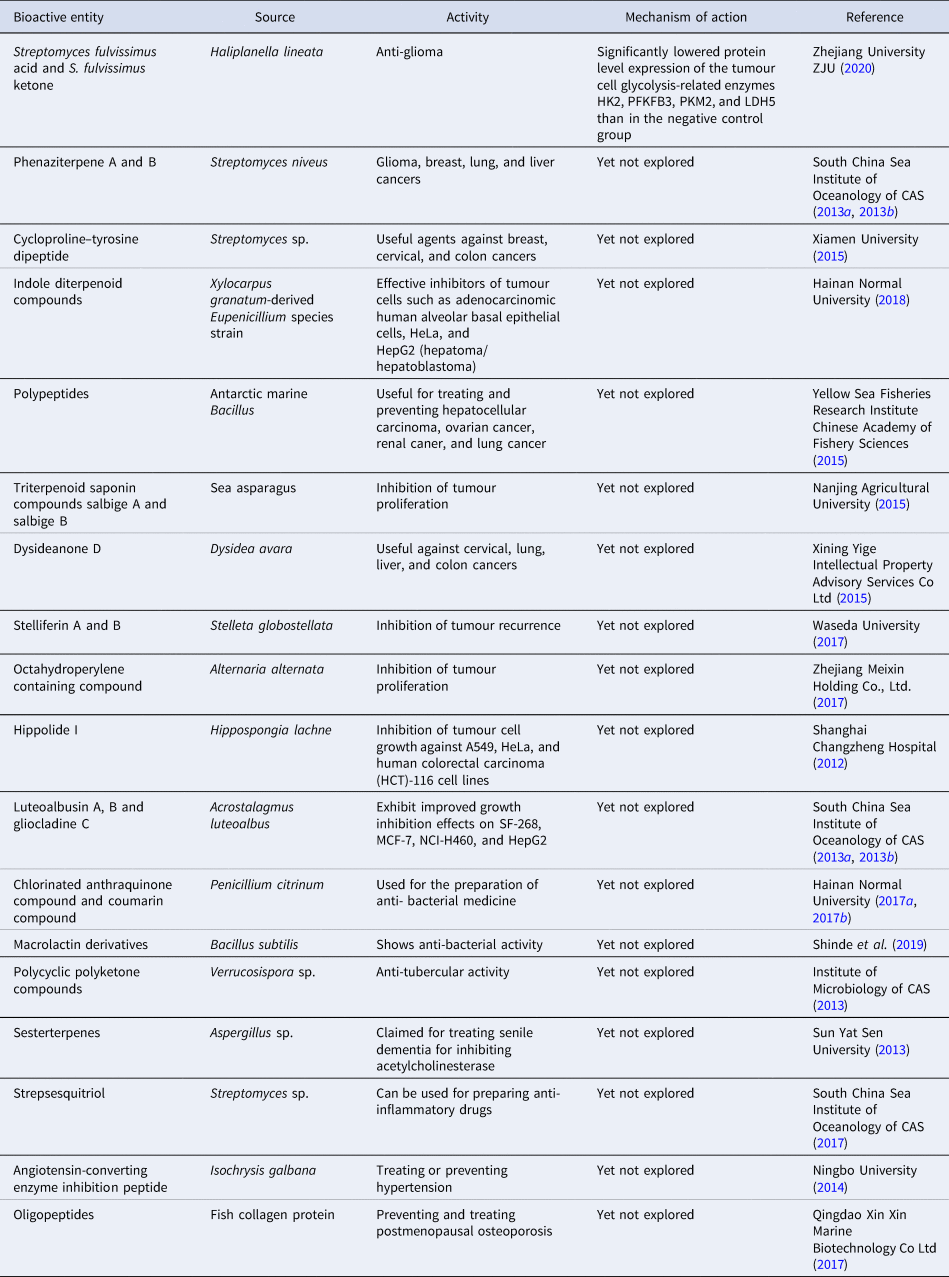
In developing new pharmaceutical products, clinical trial is conducted to address two key questions: (i) does the product or drug work? And (ii) if yes, is the patent secure enough to be approved? Many MNPs, including bryostatin-1, dolastatin-10, and kahalalide F, are currently undergoing clinical trials for various cancers, including leukaemia, lymphoma, and liver (Varterasian et al., Reference Varterasian, Mohammad, Shurafa, Hulburd, Pemberton, Rodriguez, Spadoni, Eilender, Murgo, Wall, Dan and Al-Katib2000; Hamann, Reference Hamann2004; Gao et al., Reference Gao, Wang, Hua, Li and Tang2021). Currently, around 20 compounds are in clinical trials, and over 1000 compounds are in subclinical trial stages (Pereira et al., Reference Pereira, Evdokimov, Lefranc, Valentão, Kornienko, Pereira, Andrade and Gomes2019). Surprisingly, over the past 50 years, more than 30,000 marine-derived compounds have been identified, with about 300 patents granted, underscoring the therapeutic potential of these compounds (Alves et al., Reference Alves, Silva, Pinteus, Gaspar, Alpoim, Botana and Pedrosa2018). A list of newly patented marine-derived bioactive entities with anti-cancer activity can be found in Table 2.
Patented marine-derived bioactive entities with anti-cancer activity

In addition to the previously mentioned compounds, several MNPs are currently being evaluated in vitro and in vivo for their anti-cancer efficacy:
In vitro and in vivo studies
• Curacin A, produced by the marine cyanobacterium Lyngbya majuscula, has shown significant cytotoxicity against a variety of cancer cell lines (Saeed et al., Reference Saeed, Su and Ouyang2021).
• Vitilevuamide, sourced from the marine ascidian Didemnum cuculliferum, exhibits anti-proliferative effects against human cancer cells (Youssef et al., Reference Youssef, Almagthali, Shaala and Schmidt2020).
• In animal models, pseudopterosin, a diterpene glycoside from the sea whip Pseudopterogorgia elisabethae, has demonstrated neuroprotective properties and potential as a neuromodulatory agent (Caplan et al., Reference Caplan, Zheng, Dawson-Scully, White and West2016).
• Marthiapeptide A, a cyclic peptide derived from the marine bacterium Marinactinospora thermotolerance, has shown anti-inflammatory activity in mouse models of both acute and chronic inflammation (La Manna et al., Reference La Manna, Di Natale, Florio and Marasco2018).
Case studies
• Trabectedin (yondelis), derived from the marine tunicate Ecteinascidia turbinate, was approved for the treatment of soft tissue sarcoma in 2007 and recurrent ovarian cancer in 2009 (Carter and Keam, Reference Carter and Keam2007). In phase III clinical trials, trabectedin demonstrated improved progression-free survival for patients with advanced soft tissue sarcoma compared to standard treatments (Peugniez et al., Reference Peugniez, Cousin and Penel2016).
• Ziconotide (Prialt), a synthetic peptide from the venom of the marine cone snail Conus magus, was approved in 2004 for severe chronic pain management. It has proven effective for patients with chronic pain conditions, including neuropathic and cancer-related pain (Miljanich, Reference Miljanich2004).
Thus, successful development of these licensed medications, coupled with a robust pipeline of compounds undergoing clinical trials for cancer and chronic pain, underscores the significant potential of marine-derived compounds (Cappello and Nieri, Reference Cappello and Nieri2021). The transition of unique and potent bioactive chemicals from the marine sources into approved therapies demonstrated their remarkable therapeutic potential (Banday et al., Reference Banday, ul Azha, Farooq, Sheikh, Ganie, Parray, Mushtaq, Hameed and Lone2024).
Potential of marine-derived compounds for GBM treatment: a case study
MNPs targeting GBM proliferation
Under pathological conditions, carcinogenesis is often initiated by chemical and environmental factors that lead to uncontrolled cellular proliferation (Figure 2A). Gliomas are primary tumours of the brain that are believed to arise from progenitor cells or neural stem cells that have genetic changes that cause tumours (Weller et al., Reference Weller, Wen, Chang, Dirven, Lim, Monje and Reifenberger2024). More than half of adult primary brain tumours are gliomas, with the most prevalent type being malignant gliomas, which include GBM and anaplastic astrocytomas (Deighton et al., Reference Deighton, McGregor, Kemp, McCulloch and Whittle2010). Significant interactions with the tumour microenvironment (TME) and cellular, epigenetic, and genetic alterations are hallmarks of their pathogenesis drive tumour initiation, progression, and resistance to therapy (Baghban et al., Reference Baghban, Roshangar, Jahanban-Esfahlan, Seidi, Ebrahimi-Kalan, Jaymand, Kolahian, Javaheri and Zare2020). Low-grade gliomas and subsequent glioblastomas frequently have mutations in the isocitrate dehydrogenase 1/2 genes. The oncometabolite d-2-hydroxyglutarate, which is produced as a result of these mutations, inhibits DNA demethylation and modifies cellular metabolism (Yan et al., Reference Yan, Parsons, Jin, McLendon, Rasheed, Yuan, Kos, Batinic-Haberle, Jones, Riggins, Friedman, Friedman, Reardon, Herndon, Kinzler, Velculescu, Vogelstein and Bigner2009). Recent studies have shown that chromosomal instability plays a role in tumour heterogeneity and it has the potential to be a therapeutic target. It also plays a key role in the evolution of gliomas and resistance to treatment (Mazzoleni et al., Reference Mazzoleni, Awuah, Sanker, Bharadwaj, Aderinto, Tan, Huang, Poornaselvan, Shah, Atallah, Tawfik, Elmanzalawi, Ghozlan, Abdul-Rahman, Moyondafoluwa, Alexiou and Papadakis2024). Glioma hypoxia triggers angiogenesis, which promotes tumour growth. The molecular mechanisms behind this process have been the subject of recent research, which has provided insights into possible therapeutic approaches (Lan et al., Reference Lan, Li and Zhang2024). Gliomas can use a variety of strategies to avoid immune reactions. The function of microRNAs (miRNAs) in regulating immune responses in the glioma microenvironment has become the focus of recent studies (Mafi et al., Reference Mafi, Rahmati, Babaei Aghdam, Salami, Salami, Vakili and Aghadavod2022). Both tumour recurrence and treatment resistance are influenced by glioma stem-like cells (GSCs). Recent studies have examined how miRNAs control GSCs, offering insights into possible treatment approaches (Mafi et al., Reference Mafi, Rahmati, Babaei Aghdam, Salami, Salami, Vakili and Aghadavod2022).
(A) Hallmarks of GBM (created with BioRender.com) and (B) marine natural compounds with potent anti-glioma efficacy.

Over the past decade, approximately 50 compounds with anti-glioma efficacy have been isolated from a diverse range of marine organisms, including invertebrates, seaweeds (red and brown algae), anemone, sponges, corals, fungi, and crustaceans (Khotimchenko et al., Reference Khotimchenko, Bryukhovetskiy, Khotimchenko and Khotimchenko2021). Among these, marine sponges have been the primary source, contributing about 27% of the compounds, followed by seaweeds (15%) and marine corals (13%) (Alves et al., Reference Alves, Costa, Pinto, Ferreira and Correia-da-Silva2021). These compounds exhibit a wide array of chemical structures, including peptides, chromones, sesquiterpenes, carotenoids, flavonoids, tannins, alkaloids, saponins, and pyrazolidines. Notably, sesquiterpenes, polyketides, and alkaloids have shown substantial anti-proliferative activity against various cancers.
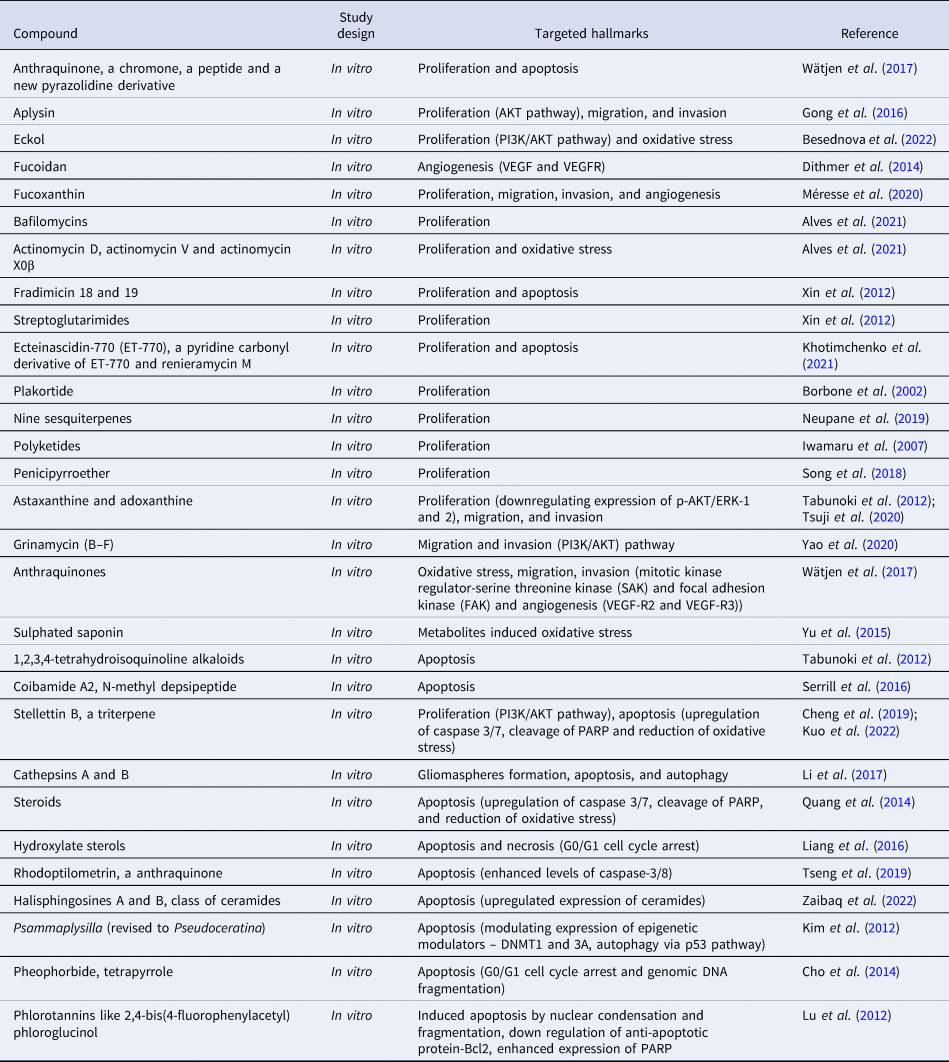
Regarding GBM, only a few preliminary in vitro studies have been conducted using cell lines such as C6, U-87 MG, T98G, U-251 MG, U373 MG, and SHG44. For example, a crude extract from sea-anemone-derived actinomycetes was found to effectively inhibit glioma proliferation and reduce lactate production in GBM cells (Chen et al., Reference Chen, Chai, Song, Ma, Yuan and Zhang2018). Analysis of this extract led to the discovery of four novel metabolites: an anthraquinone, a chromone, a peptide, and a new pyrazolidine derivative. Among these, the anthraquinone demonstrated significant anti-proliferative effects in SHG44, U-251, and U-87 MG glioma cells (Chen et al., Reference Chen, Chai, Song, Ma, Yuan and Zhang2018; Khotimchenko et al., Reference Khotimchenko, Bryukhovetskiy, Khotimchenko and Khotimchenko2021).
In seaweeds, aplysin, a bromo sesquiterpene, isolated from the red algae Laurencia tristicha, was shown to suppress invasion in U-251 MG and U-87 MG GBM cells (Alves et al., Reference Alves, Costa, Pinto, Ferreira and Correia-da-Silva2021; Khotimchenko et al., Reference Khotimchenko, Bryukhovetskiy, Khotimchenko and Khotimchenko2021). Furthermore, aplysin was reported to inactivate the A-kinase transforming (AKT) pathway, thereby hampering GBM proliferation. Cytotoxicity studies in normal cells, such as HCN2 (human cortical neuronal), HUV-EC-C (human umbilical vein endothelial cells), and MRC-5 (medical research council), revealed no significant toxicity at a concentration of 400 μg ml−1 (Gong et al., Reference Gong, Guo, Gong and Liang2016). However, additional in vivo studies are required to substantiate their anti-glioma efficacy. Additionally, three compounds isolated from brown algae – eckol, fucoidan, and fucoxanthin – demonstrated potent anti-glioma activity through distinct mechanisms. Among these, eckol, a phlorotannin component was reported to suppress the PI3K/AKT proliferation pathway (Besednova et al., Reference Besednova, Andryukov, Zaporozhets, Kuznetsova, Kryzhanovsky, Ermakova, Galkina and Shchelkanov2022). Fucoidan from Fucus vesiculosus, was found to inhibit glioma angiogenesis in vitro in T98G and THP-1 (Tohoku hospital pediatrics) cells (Lv et al., Reference Lv, Song, Shao, Gao, Mao, Lou, Qu and Li2012). Fucoxanthin, a carotenoid widely distributed in brown algae, inhibited both proliferation and angiogenesis in tumour cells (Méresse et al., Reference Méresse, Fodil, Fleury and Chénais2020). A methanolic extract from green algae-cultured Streptomyces sp. also showed significant inhibition of glioma cell proliferation. Four bafilomycins isolated from this extract were assessed for their anti-proliferative activity against C6, SHG44, U-251, and U-87 MG glioma cell lines, revealing profound effects against these cells (Alves et al., Reference Alves, Costa, Pinto, Ferreira and Correia-da-Silva2021).
Besides sea anemones and seaweeds, marine bacteria have also gained interest for their anti-glioma efficacy. For example, several families of compounds, such as fradiomycin, actinomycins (Santos et al., Reference Santos, Vitorino, Reyes, Vicente and Lage2020), and streptoglutarimides (Zhang et al., Reference Zhang, Yi, Ge, Zhang and Wu2019) have been isolated from marine bacteria. Three actinomycins namely, actinomycin D, actinomycin V, and actinomycin X0β, produced by the Streptomyces strain isolated from sea squirts, showed potent anti-proliferative effects against C6, SHG44, and U-251 glioma cells (Alves et al., Reference Alves, Costa, Pinto, Ferreira and Correia-da-Silva2021). Similarly, fradimicins 18 and 19, isolated from Streptomyces fradiae, exhibited significant growth inhibitory effects in C6 glioma cells, with fradimicin 19 inducing apoptosis (Xin et al., Reference Xin, Ye, Yu, Lian and Zhang2012). Streptoglutarimides from Streptomyces sp. ZZ741 also demonstrated potent anti-proliferative activity against U-251 and U-87 MG glioma cells (Xin et al., Reference Xin, Ye, Yu, Lian and Zhang2012).
Also, marine invertebrates have also been studied for GBM treatment. For instance, an anthraquinone from Comanthus, a marine echinoderm, was reported to hamper the proliferation of C6 glioma cells and increase caspase-3 and caspase-7 levels, paving way for apoptosis (Chen et al., Reference Chen, Chai, Song, Ma, Yuan and Zhang2018). Recently, three alkaloids namely ecteinascidin-770 (ET-770), a pyridinecarbonyl derivative of ET-770 and renieramycin M, isolated from Ecteinascidia turbinata, a Caribbean tunicate were tested for their anti-tumour activity in U-373 GBM cells. These alkaloids effectively induced apoptosis and suppressed the ErbB pathway, which promotes GBM proliferation and survival (Khotimchenko et al., Reference Khotimchenko, Bryukhovetskiy, Khotimchenko and Khotimchenko2021).
Interestingly, marine sponges have also contributed significantly to GBM research. Compounds such as alkaloids, sesquiterpenes, sphingosine, and plakortide have been isolated and tested for their anti-glioma efficacy (Alves et al., Reference Alves, Costa, Pinto, Ferreira and Correia-da-Silva2021). For instance, Borbone et al. had isolated alkaloids from Corticum sp. of South Pacific and evaluated their anti-proliferative activity in C6 glioma cells. Interestingly, the isolated alkaloid had depicted potent anti-proliferative effect against C6 and RAW 264 cell lines (Borbone et al., Reference Borbone, De Marino, Iorizzi, Zollo, Debitus, Esposito and Iuvone2002). Besides, plakortide, isolated from Plakortis halichondrioides of the Caribbean Sea, depicted profound anti-proliferative effect against U-373 MG and U-87 MG human GBM cells (Borbone et al., Reference Borbone, De Marino, Iorizzi, Zollo, Debitus, Esposito and Iuvone2002). Nine sesquiterpenes isolated from Dactylospongia elegans, a Hawaiian marine sponge, also significantly inhibited tumour proliferation in the U-251 human GBM cell line (Neupane et al., Reference Neupane, Parrish, Bhandari Neupane, Yoshida, Yip, Turkson, Harper, Head and Williams2019). Similarly, sphingosine isolated from Haliclona tubifera, was reported to inhibit the proliferation of human U-87 MG GBM cell lines with a low half-maximal inhibitory concentration (IC50) of <15 μg ml−1 (Biegelmeyer et al., Reference Biegelmeyer, Schröder, Rambo, Dresch, Carraro, Mothes, Moreira, Junior and Henriques2015).
Marine corals are another rich source of bioactive compounds with anti-tumour activity. For instance, seven polyketides isolated from Eunicea succinea showed moderate cytotoxic effects against U-373 MG and U-87 MG GBM cells in a dose-dependent manner (Iwamaru et al., Reference Iwamaru, Iwado, Kondo, Newman, Vera, Rodríguez and Kondo2007).
Marine fungi have contributed as well, with a single alkaloid named penicipyrroether from the marine fungal strain ZZ380 being investigated for its anti-proliferative activity against GBM. This alkaloid significantly inhibited the proliferation of C6, U-87 MG, SHG44, and U-251 GBM cell lines (Song et al., Reference Song, Chen, Chai, Zhang and Lian2018). Additionally, saponins isolated from the sea cucumber Holothuria moebii were found to have substantial anti-proliferative effects in C6, U-251, U-87 MG, and SHG44 GBM cells (Yu et al., Reference Yu, Ye, Huang, Peng, Su, Lian and Zhang2015).
Lastly, compounds from fishes and crustaceans have also been tested for their anti-glioma efficacy. For instance, astaxanthin, a red pigment found in fishes and crustaceans, was tested in U-251 MG and GL-261 GBM cell lines. Astaxanthin reduced cell viability at concentrations above 5 and 0.1 μM, respectively, in these cell lines and also decreased phosphorylated AKT and ERK-1/2 (extracellular signal-regulated kinase) levels, indicating its potential to reduce GBM proliferation (Tsuji et al., Reference Tsuji, Nakamura, Maoka, Yamada, Imai, Ohba, Yako, Hayashi, Endo, Saio, Hara and Shimazawa2020).
Numerous natural compounds mentioned above have demonstrated significant preclinical efficacy against glioma, with several currently undergoing clinical trials to evaluate their therapeutic potential. A prime example under clinical study is marizomib, a novel pan-proteasome inhibitor from marine bacterium Salinispora tropica that crosses the blood–brain barrier. The addition of marizomib to standard TMZ-based radiochemotherapy increased toxicity but had no effect on overall survival or progression-free survival in patients with newly diagnosed glioblastoma (Roth et al., Reference Roth, Gorlia, Reijneveld, de Vos, Idbaih, Frenel, Le Rhun, Sepulveda, Perry, Masucci, Freres, Hirte, Seidel, Walenkamp, Lukacova, Meijnders, Blais, Ducray, Verschaeve, Nicholas, Balana, Bota, Preusser, Nuyens, Dhermain, van den Bent, O'Callaghan, Vanlancker, Mason and Weller2024). Another natural compound, curcumin, has completed clinical trials that assessed the bioavailability of orally administered curcumin in the tumours of glioblastoma patients (NCT01712542).
MNPs targeting migration and invasion in GBM
In addition to their anti-proliferative effect, several marine-derived MNPs have demonstrated efficacy in targeting GBM invasion and migration. For example, aplysin, a bromo sesquiterpene isolated from the red algae L. tristicha, has shown notable anti-invasive activity in glioma cells such as U-87 MG and U-251, as well as in primary glioma cells, in a dose-dependent manner. Interestingly, aplysin does not exhibit cytotoxicity towards normal cells (Gong et al., Reference Gong, Guo, Gong and Liang2016). Similarly, a series of alkaloids isolated from marine tunicates have been shown to possess anti-invasive properties by inhibiting the PI3K/AKT/epidermal growth factor receptor (EGFR) pathway. This inhibition leads to apoptosis through the suppression of glycogen synthase kinase (GSK)-3β. Additionally, pigments such as astaxanthin and adonixanthin, derived from crustaceans and fishes, have demonstrated anti-migratory effects in both human and murine glioma cell lines (Tabunoki et al., Reference Tabunoki, Saito, Suwanborirux, Charupant and Satoh2012). Grincamycin (B–F) is another compound that has been found to reduce invasiveness in human GBM cell lines, such as U251 and 091214. It achieves this by inhibiting the PI3K/AKT pathway, thereby decreasing tumour sphere formation and invasion (Yao et al., Reference Yao, Sun, Cao, Mao, He, Gai, Qin, Yao, Lu, Chen, Wang, Luo, Zhang, Huang, Ju, Bian and Wang2020). Furthermore, fucoxanthin, a pigment extracted from brown algae, exhibits anti-migratory and anti-invasive activities in human and rat GBM cells, including GBM1, A172, and C6 (Méresse et al., Reference Méresse, Fodil, Fleury and Chénais2020). Another class of compounds, anthraquinones obtained from sea lilies, has been found to exhibit GBM cell invasion and migration by inhibiting expression of mitotic kinase regulator serine/threonine kinase (SAK) and the focal adhesion kinase (FAK), which regulates cell adhesion and spreading. These anthraquinones also exhibit significant anti-angiogenic activity via downregulating of VEGF-R2 and VEGF-R3 (Wätjen et al., Reference Wätjen, Ebada, Bergermann, Chovolou, Totzke, Kubbutat, Lin and Proksch2017) (Figure 2B).
MNPs in restoring cellular energetics in GBM
Given the challenge of treating GBM due to its disrupted cellular energetics, evaluating MNPs for their ability to restore cellular metabolism has provided valuable insights. For instance, eckol, a compound from brown algae, mitigates oxidative stress by scavenging free radicals and modulating the rat sarcoma (RAS)/rapidly accelerated fibrosarcoma (RAF) signalling pathway, thereby restoring metabolic stress (Alves et al., Reference Alves, Costa, Pinto, Ferreira and Correia-da-Silva2021). Similarly, Actinomycin D, isolated from Streptomyces sp. strain ZZ338 found in sea squirts downregulates the expression of several key metabolic enzymes including hexokinase (HK2), pyruvate kinase M2 (PKM2), glutaminase (GLS), and fatty acid synthase, which are crucial regulators of glycolysis and lipogenesis (Zhang et al., Reference Zhang, Ye, Chai, Lian and Zhang2016). Also, sulphated saponins from the sea cucumber, H. moebii, regulate glycolysis and glutaminolysis via modulating enzymes such as HK2, 6-phosphofructo-2-kinase/2,6-bisphosphatase 3 (PFKBP3), PKM2, and GLS, all of which play significant roles in GBM tumorigenesis (Yu et al., Reference Yu, Ye, Huang, Peng, Su, Lian and Zhang2015).
Furthermore, a peptide isolated from the crab, Tachypleus tridentatus, exhibited potent anti-glioma activity in U251 human GBM cell lines by downregulating glycolysis-related enzymes, including alpha-enolase (ENO1), gamma-enolase (ENO2), trios phosphate isomerase (TPI1), and phosphoglycerate kinase 1 (PGK1), disrupting normal metabolism in glioma spheres (Li et al., Reference Li, Dai, Tang, Li and Jin2017). Similarly, anthraquinones from actinomycetes Streptomyces sp. ZZ406, derived from the sea anemone Haliplanella lineata, significantly reduce the expression of glycolytic enzymes such as HK2, PFKFB3, PKM2, and LDH5, thereby halting glioma growth (Chen et al., Reference Chen, Chai, Song, Ma, Yuan and Zhang2018). Furthermore, 1′-deoxyrhodoptilometrin, an anthraquinone obtained from the sea lily Comanthus sp., induces lactate dehydrogenase (LDH) expression and disrupts the metabolic cycle in GBM (Khotimchenko et al., Reference Khotimchenko, Bryukhovetskiy, Khotimchenko and Khotimchenko2021). These findings clearly portray the potential of MNPs in targeting GBM and the treasure hunt remains to be explored more deeply to uncover their capabilities in metabolic restoration.
MNPs modulating apoptosis in GBM
Given that GBM is characterized by uncontrolled cell proliferation and resistance to apoptosis, exploring MNPs that induce apoptotic cell death in GBM has become a prominent area of research. Nevertheless, several MNPs have been reported to trigger apoptosis in GBM cells (Elmallah and Micheau, Reference Elmallah and Micheau2015; Fakhri et al., Reference Fakhri, Abdian, Moradi, Delgadillo, Fimognari and Bishayee2022). For example, fucoxanthin, a pigment derived from brown marine algae, has been shown to halt cell progression in an in vitro glioma model (U251) by modulating ataxia-telangiectasia mutated (ATM), ataxia telangiectasia and Rad3-related (ATR) protein, and p53 through phosphorylation of Ser1981-ATM, Ser428-ATR, and Ser15-p53, as well as by phosphorylating Ser139 of histone H2AX, leading to apoptosis (Méresse et al., Reference Méresse, Fodil, Fleury and Chénais2020). Similarly, fradimicins isolated from marine bacteria have induced apoptosis and necrosis in rat C6 glioma cells (Xin et al., Reference Xin, Ye, Yu, Lian and Zhang2012).
Anthraquinones extracted from the marine invertebrate Comanthus sp. have elevated levels of caspase-8 and caspase-3 in C6 glioma cells (Khotimchenko et al., Reference Khotimchenko, Bryukhovetskiy, Khotimchenko and Khotimchenko2021). Furthermore, 1,2,3,4-tetrahydroisoquinoline, an alkaloid from the Caribbean tunicate, E. turbinata, has triggered apoptosis in U-373 MG human glioma cells at nanomolar concentrations (4.83, 3.10, 1.70 nM), via inactivation of glycogen synthase kinase 3 beta (GSK3β) and activating cell division cycle 25 A (CDC25 A), which are crucial for apoptosis (Tabunoki et al., Reference Tabunoki, Saito, Suwanborirux, Charupant and Satoh2012). Another marine compound, coibamide A2, an N-methyl depsipeptide from marine cyanobacterium, induced apoptosis through G1 cell cycle arrest and significantly reduced tumour growth in a subcutaneous mouse model of GBM (Serrill et al., Reference Serrill, Wan, Hau, Jang, Coleman, Indra, Alani, McPhail and Ishmael2016). It also exerted angiogenic effects by modulating VEGFR2 (vascular endothelial growth factor receptor) expression in GBM animal models (Serrill et al., Reference Serrill, Wan, Hau, Jang, Coleman, Indra, Alani, McPhail and Ishmael2016). Alongside, fucoxanthin from brown algae was reported to trigger apoptosis in human and rat glioma cells by inducing mitochondrial depolarization, with notable anti-tumour activity in animal models (Xiao et al., Reference Xiao, Zhao, Fang, Cao, Xing, Li, Hou, Ji and Song2020). Similarly, stellettin B, a triterpene from the marine sponge Jaspis stellifera, induced apoptosis by increasing levels of caspase-3 and -7, cleavaging poly-(adenosine diphosphate-ribose) polymerase (PARP), and generating reactive oxygen species (ROS) in SF295 human GBM cells (Kuo et al., Reference Kuo, Jean, Shih, Cheng, Kuo, Lee, Lai, Tseng, Chen and Wen2022). This compound also inhibited Akt phosphorylation, suggesting its potential as a potent anti-GBM therapeutic agent (Cheng et al., Reference Cheng, Chen, Lin, Su, Chen, Kuo, Sung, Sung, Wen and Chen2019).
Additionally, specific peptides such as cathepsins A and B from horseshoe crab have demonstrated anti-glioma activity in U251-induced glioma spheres by inducing apoptosis (Li et al., Reference Li, Dai, Tang, Li and Jin2017). Besides the above-mentioned metabolites, steroids extracted from the starfish Ctenodiscus crispatus have shown to exhibit potent anti-glioma activity in U-87 MG human GBM cells by enhancing levels of cleaved caspase-3 and -9, PARP, and reducing Bcl2, an anti-apoptotic protein in a dose-dependent manner (Quang et al., Reference Quang, Lee, Han, Kim, Yim, Kim and Oh2014). Polycyclic quinones from marine bacteria Streptomyces 182SMLY also induced apoptosis and necrosis in U251 human GBM cell lines by arresting the cell cycle at G0/G1 (Liang et al., Reference Liang, Xie, Chen, Yan, Ye, Anjum, Huang, Lian and Zhang2016). Rhodoptilometrin, an anthraquinone from Himerometra magnipinna, exhibited profound anti-glioma activity in SF-268 glioma cell lines, by enhancing caspase-3 and -8 (Tseng et al., Reference Tseng, Lai, Kuo, Su, Sung, Feng, Lin, Chen, Tai, Cheng, Kuo and Wen2019). Halisphingosines A and B, a distinct class of molecules isolated from marine sponges, serve as substrates for ceramide synthase and sphingosine-1-phosphate. These compounds have been reported to induce apoptosis in glioma cells by increasing ceramide levels (Zaibaq et al., Reference Zaibaq, Dowdy and Larion2022). Furthermore, psammaplin A from marine sponge Psammaplysilla (now revised to Pseudoceratina), exhibited anti-glioma activity in U-373 human GBM cells by enhancing radiosensitization and modulating epigenetic regulators as DNA methyltransferase 1 and 3A (DNMT1 and 3A), as well as activating autophagic genes through a p53-dependent pathway (Kim et al., Reference Kim, Kim, Chie, Da Young, Kim and Kim2012).
Pheophorbide, a tetrapyrrole from red algae, induced apoptosis in U-87 MG human GBM cell lines through G0/G1 cell cycle arrest and DNA fragmentation (Cho et al., Reference Cho, Park, Kim, Amna, Lee and Shin2014). Besides, 2,4-bis(4-fluorophenylacetyl) phloroglucinol, a phlorotannin component from marine seaweed, triggered apoptosis in U-251, U-87, and C6 glioma cells through nuclear condensation, fragmentation, Bcl2 downregulation, enhanced PARP expression, and increased glucose-regulated protein 78 (GRP78) and C/EBP homologous protein (CHOP) levels due to ROS generation, leading to elevated caspase-3 and -8 levels (Lu et al., Reference Lu, Chang, Yeh, Tang, Cheung, Leung, Liu and Wong2012). Overall, these findings highlight the significant potential of MNPs in halting GBM progression and inducing cell death. However, further in vivo validations are required to conclusively affirm their apoptotic effect against GBM (Table 3).
Marine natural compounds as potent anti-glioma pharmacological leads

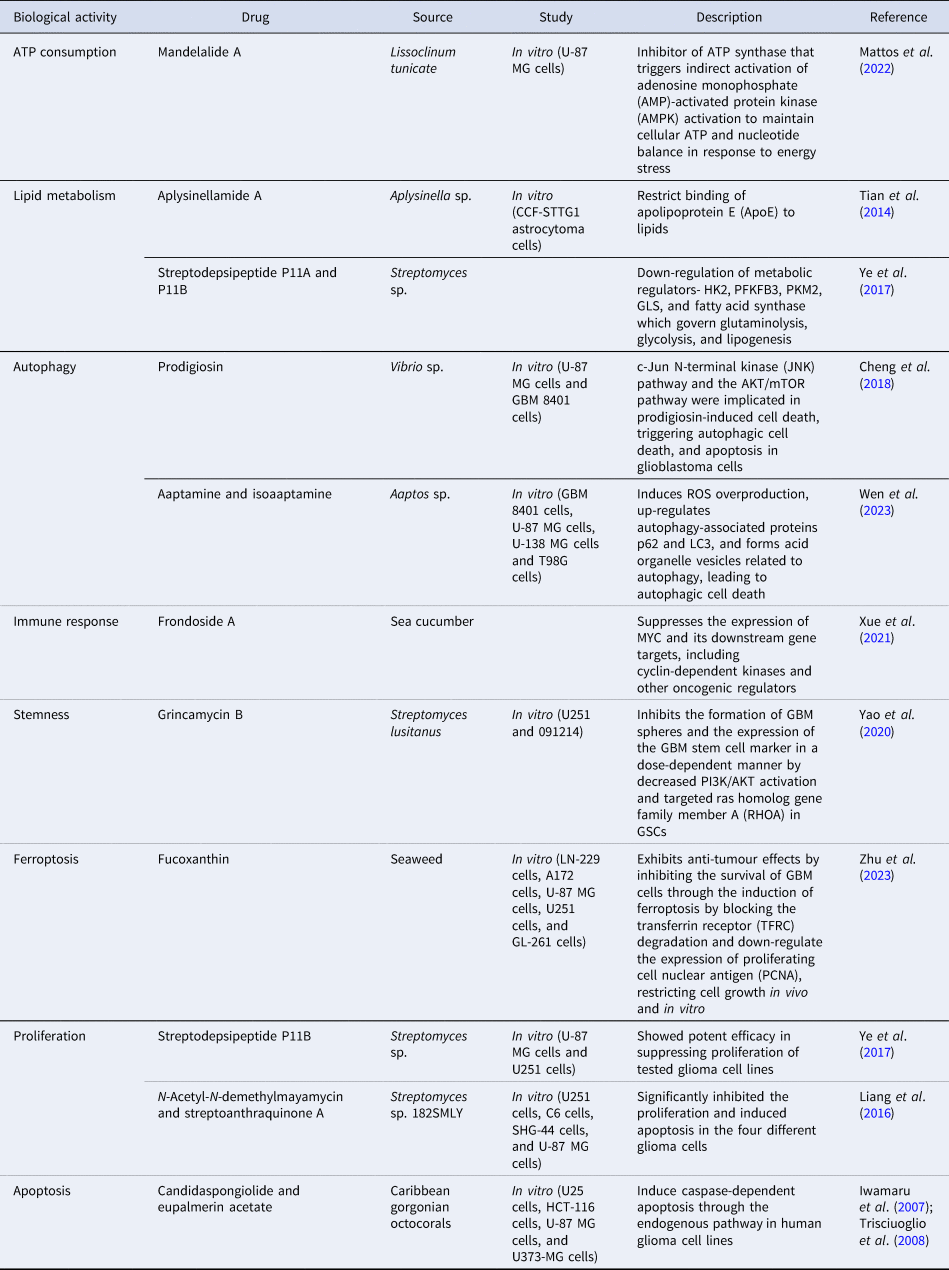
Besides, recent research has also documented that marine compounds and their derivatives regulate other key factors of GBM pathogenesis, including adenosine triphosphate (ATP) consumption, lipid metabolism, autophagy, immune response, stemness, and ferroptosis. A brief overview of studies examining the effects of MNPs on these various biological activities of GBM is listed in Table 4.
MNPs affecting various biological activities of GBM

From these studies, it is evident that marine-derived compounds are bestowed with inherent potency to suppress glioma growth and progression. Moreover, our previous research has demonstrated that combining these marine compounds with TMZ leads to more efficient suppression of glioma progression and improves the survival in glioma xenograft models compared to TMZ treatment alone (Precilla et al., Reference Precilla, Kuduvalli, Praveena, Thangavel and Anitha2022; Biswas et al., Reference Biswas, Precilla, Kuduvalli, Ramachandran, Akshaya, Raman, Prabhu and Anitha2023, Reference Biswas, Precilla, Kuduvalli, B, S and A2024; Daisy Precilla et al., Reference Daisy Precilla, Kuduvalli, Biswas, Bhavani, Pillai, Thomas and Anitha2023). Owing to their ability to cross the blood–brain barrier and affect glioma cell stemness, MNPs offer unique benefits for GBM treatment. However, most current studies rely on bioinformatics to estimate the IC50 values of these compounds. In this regard, in-depth mechanistic subclinical studies focusing on the mechanism of action of these compounds are the need of the moment to advance MNPs into viable therapeutic options against GBM.
Advancing anti-cancer marine leads to bedside: key strategies
The ocean's vast and diverse environment holds immense potential for discovering novel MNPs with significant therapeutic benefits. Despite the promising evidence suggesting that unexplored marine areas may yield a wealth of new compounds, realizing this potential requires advancements in technology. Effective sampling strategies, nanoscale nuclear magnetic resonance (NMR) for precise structural determination of lead compounds, and whole-genome sequencing to elucidate biosynthesis and therapeutic efficacy are essential.
With reference to their anti-cancer activity, MNPs have depicted effective inhibitory potential in vitro across various cancer cell lines, including melanoma, prostate, lung, bladder, and osteosarcoma (Tobeiha et al., Reference Tobeiha, Rajabi, Raisi, Mohajeri, Yazdi, Davoodvandi, Aslanbeigi, Vaziri, Hamblin and Mirzaei2021; Miri et al., Reference Miri, Zare, Saberzadeh, Baghban, Nabipour and Tamadon2022; Montuori et al., Reference Montuori, Capalbo and Lauritano2022, Reference Montuori, Hyde, Crea, Golding and Lauritano2023; Liu et al., Reference Liu, Jiang, Li, Yao, Song, Gao, Said, Gao, Lai and Shao2024). These compounds often exert their effects by inhibiting proliferation, inducing apoptosis or causing tumour cell lysis. However, challenges such as low production rates of bioactive compounds, difficulties in maintaining sustainable supply, structural complexity, inaccuracies in taxonomic classification, and variable efficacy have hindered the clinical development of these compounds. In this context, to address these challenges and advance the clinical application of marine drugs, we propose the following strategies:
Strategy 1: metagenome research, genetic manipulation, and advanced extraction techniques
A primary reason for the low production of bioactive compounds from marine sources is the difficulty in extracting or deriving these compounds, as many are produced by microbes associated with marine animals rather than the host itself. Since these microbes live in a symbiotic relationship with their host, they cannot be cultivated in isolation, and some genes may remain inactive in vitro, complicating the exploitation of the species' complete metabolic capacity.
To address this, metagenome research can be employed to analyse the genomic data of the entire microbial community, including those uncultivable microbes. This approach facilitates the discovery of new bioactive compounds, which can subsequently be enhanced through genetic manipulation. For instance, Potts et al. successfully increased the production of salinosporamide A, a proteasome inhibitor, by more than 100-fold (to 450 mg l−1) from the actinobacteria Salinispora tropica by optimizing fermentation conditions and culture media formulation (Potts and Lam, Reference Potts and Lam2010).
Additionally, the inefficiency of traditional extraction methods contributes to low production rates; while the conventional procedures extract MNPs to some extent, yet they result in low yields and high-energy consumption. Therefore, adopting advancing extraction methodologies such as pressurized-liquid extraction, enzyme-assisted extraction, microwave-assisted extraction, or supercritical fluid extraction can significantly improve both the yield and quality of MNPs.
Strategy 2: sustainable resupply of lead compounds through chemical synthesis, mariculture, or aquaculture
Following isolation and identification of a lead compound from a marine organism, ensuring a sustainable supply for further research presents another challenge. While small quantity may suffice for initial pharmacological evaluation, extensive characterization and clinical trials require much larger amounts. For example, while a few grams may be adequate for preclinical studies, clinical trials demand quantities in kg, raising concerns about supply.
In this context, sustainable resupply of these compounds can be achieved through various approaches. Chemical synthesis techniques such as total synthesis or semi-synthesis can be used to produce the compound in larger quantities. Alternatively, designing simpler pharmacophores or synthetic analogues with manageable and similar properties can ensure the large-scale production. For instance, halichondrin B has been produced via total synthesis, and eribulin was synthesized based on structure–activity relationship studies (Wang et al., Reference Wang, Habgood, Christ, Kishi, Littlefield and Yu2000; Huyck et al., Reference Huyck, Gradishar, Manuguid and Kirkpatrick2011). Nevertheless, these chemical synthesis approaches may sometimes lead to non-specific production of multiple analogues, which may retain the desired biological activity.
In addition to chemical synthesis, natural resources should be used under strict regulations to ensure consistent availability. Another viable approach is the cultivation of marine organisms either in their natural environments (mariculture) or under controlled conditions (aquaculture) (García-Poza et al., Reference García-Poza, Leandro, Cotas, Cotas, Marques, Pereira and Gonçalves2020; Lounas et al., Reference Lounas, Kasmi, Chernai, Amarni, Ghebriout, Meslem-Haoui and Hamdi2020). These strategies can help ensure a steady and sustainable supply of the target compounds.
Strategy 3: advanced spectroscopic and analytical methods for accurate structure assignment
Another factor that may contribute to the failure of production of marine compounds is their structural complexity. This complexity can sometimes lead to incorrect allocation of their structural formula, intramolecular bond configurations, planar connectivity, and stereocentres. Such inaccuracies can significantly impede drug development, especially when a continuous supply of the lead compound is essential. To address this, advancements in spectroscopic and analytical methods have been crucial. Techniques such as NMR and mass spectrometry enable the precise determination of a compound's structure de novo (Dias et al., Reference Dias, Coombes, Benstead, Whittaker, Ray and Xu2023). Infrared spectroscopy is effective for identifying functional groups and studying the molecular vibrations, that provides insights into both bond types and configurations (Kirschbaum et al., Reference Kirschbaum, Young, Greis, Menzel, Gewinner, Schöllkopf, Meijer, von Helden, Causon, Narreddula, Poad, Blanksby and Pagel2023). Furthermore, optical rotatory dispersion measures the rotation of plane-polarized light by chiral molecules to identify the presence of stereocentres, making it a valuable tool for studies. These methods allow for the accurate identification of novel compounds even when present in low concentrations, minimizing errors in structural characterization.
Strategy 4: genetic and computational techniques for accurate taxonomic identification
Challenges in drug development and marketing can also arise from incorrect identification of marine species. Traditionally, this process involved growing marine species under laboratory conditions and performing extensive physiological and morphological characterizations – a time-consuming and labour-intensive approach. Currently, genetic techniques such as phylogenetic analysis and sequencing allow more reliable identification of marine species. For example, these techniques have been used to identify marine microbes from sponges and sediments at various depths (Cleary et al., Reference Cleary, Polónia, Becking, de Voogd, Purwanto and Gomes2018). Additionally, amplifying mitochondrial DNA can provide genomic coverage for organisms that are present in low abundance. Shotgun metagenomic methods can be employed to study the metabolic functions of an entire genome (Aguiar-Pulido et al., Reference Aguiar-Pulido, Huang, Suarez-Ulloa, Cickovski, Mathee and Narasimhan2016). Furthermore, accurate taxonomic determination can be achieved by analysing secondary metabolites and gene clusters using computational tools such as the antibiotics and secondary metabolite analysis shell (antiSMASH) (Medema et al., Reference Medema, Blin, Cimermancic, de Jager, Zakrzewski, Fischbach, Weber, Takano and Breitling2011).
Strategy 5: enhancing anti-tumoural efficacy through target-first approaches
The effectiveness of marine drugs in treating tumours hinges on their ability to selectively target antigens that are overexpressed in cancer cells. While these marine drugs can elicit toxic effects to cancer tissues while being non-toxic to healthy tissues, their selectivity and specificity can be further improvised using the ‘target-first’ approach (Raies et al., Reference Raies, Tulodziecka, Stainer, Middleton, Dhindsa, Hill, Engkvist, Harper, Petrovski and Vitsios2022). This approach involves identifying druggable targets using chemoproteomics and activity-based protein profiling, which can map proteome-wide targets (Spradlin et al., Reference Spradlin, Zhang and Nomura2021; Porta and Steel, Reference Porta and Steel2023).
Another effective approach to enhance targeting is to conjugate marine drugs with antibodies that specifically bind to target antigens, creating antibody–drug conjugates (ADCs) (Jiang et al., Reference Jiang, Li and Xu2024). These ADCs exert potent anti-tumour effect than their untargeted counterparts. For instance, the ADC brentuximab vedotin (MMAE-CD30), which combines the anti-CD30 antibody with monomethyl auristatin E (a synthetic analogue of dolastatin 10), has been approved for treating lymphoma (Deng et al., Reference Deng, Pan and O'Connor2013). This conjugate (MMAE-CD30) has depicted higher potency, stability, and cytotoxicity against CD30+ Hodgkin lymphoma compared to its parent compound (Francisco et al., Reference Francisco, Cerveny, Meyer, Mixan, Klussman, Chace, Rejniak, Gordon, DeBlanc, Toki, Law, Doronina, Siegall, Senter and Wahl2003). Similarly, conjugating marine drugs with cell-penetrating peptides can also increase their anti-tumour efficacy by facilitating their delivery through cellular membranes (Saraswat and Chugh, Reference Saraswat and Chugh2024). Additionally, tumour-homing peptides can also be used to increase higher accumulation of the drugs at the target site, thereby improving therapeutic responses (Nezir et al., Reference Nezir, Khalily, Gulyuz, Ozcubukcu, Küçükgüzel, Yilmaz and Telci2021). Although these strategies have not yet been explored exclusively to marine drugs, they represent promising avenues for future research.
Another promising strategy to enhance the efficacy of marine drugs is through nanoparticle encapsulation. This technique can enhance drug stability, extend half-life, enhance tumour-targeting, and reduce immunogenicity (Jeong et al., Reference Jeong, Khan, Tabassum, Khan and Kim2022). Nano-encapsulation technique can also be deployed to combine marine drugs with other chemotherapeutic agents to enhance their anti-tumour activity. For example, Tardi et al. co-encapsulated daunorubicin and cytarabine in liposomes at a 1:5 molar ration. Interestingly, this co-encapsulated complex (CPX-351) exhibited superior therapeutic efficacy and survival against leukaemia compared to the free-drug cocktails both in vitro and in vivo (Tardi et al., Reference Tardi, Johnstone, Harasym, Xie, Harasym, Zisman, Harvie, Bermudes and Mayer2009). Encouraged by these preclinical data, CPX-351 advanced to phase III clinical trials, where it demonstrated a significant overall survival benefit compared to conventional daunorubicin and cytarabine treatments for patients with secondary acute myeloid leukaemia. Similarly, fucoidan-based nanoparticles encapsulating the PI3K inhibitor BYL719, targeting the cell adhesion molecule P-selectin, were assessed against head and neck squamous cell carcinoma. The P-selectin-targeted delivery of BYL719 had effectively suppressed the tumour growth without adverse on-target effects (Mizrachi et al., Reference Mizrachi, Shamay, Shah, Brook, Soong, Rajasekhar, Humm, Healey, Powell, Baselga, Heller, Haimovitz-Friedman and Scaltriti2017).
Strategy 6: strategic planning for market entry and commercial success
Successfully bringing marine drugs to market is a crucial phase in the drug development process. While the regulatory and market entry conditions for marine drugs are similar to those for terrestrial drugs, they require significant capital investment (around $900 million on average) and an extended development timeline (approximately 8–15 years) (Lindequist, Reference Lindequist2016). Furthermore, the high market value of marine drugs presents another challenge that is often overlooked during development.
To improve market value and commercial success, several factors must be considered. These include the potential industrial applications of the drug, the final cost per kg, the preferred administration route, the desired formulation, the manufacturing process, and the sustainability of the supply chain. Addressing these actors effectively can help optimize the market potential and overall success of marine drugs.
Future of marine drugs in cancer therapy
The ocean's vast diversity presents exceptional opportunities for drug discovery. Recent advancement in cancer therapy and cutting-edge technologies has provided a valuable platform for exploring the therapeutic potential of MNPs. To enhance the application of marine drugs in cancer treatment, the following strategies may offer new avenues for development:
• Target-first approach: Traditionally, drug discovery relied heavily on phenotypic screening. However, with deeper understanding of cancer's molecular alterations, a shift towards target-based screening is now favoured. Adopting a target-first approach can make marine drug discovery more efficient, specific, and cost-effective by focusing on molecular targets rather than broad phenotypic effects.
• Multi-target mechanisms: Cancer's heterogeneous nature often requires more than a single-target approach to achieve an optimal therapeutic response. Marine drugs, with their multi-faceted mechanisms of action (MoA), are well-suited to address this complexity. Hence, integrating both targeted and phenotypic assays to explore multiple targets can reveal the optimal therapeutic potential of MNPs.
• Integrating AI: Artificial intelligence (AI) can address challenges in MNP discovery and understanding their MoA. Machine learning algorithms can assist in recognizing MNPs, predicting their activity, and simulating their conformations, helping to resolve complex marine drugs and their bioactivity.
• Understanding microbiome and immune system interplay: The gut microbiome significantly impacts tumorigenesis and anti-tumour immunity. Emerging evidence suggests that natural compounds, including MNPs, can influence the microbiota and alter the TME either through microbiota-dependent or -independent manner. Thus, understanding this interplay could open new opportunities to harness the anti-cancer potential of MNPs.
• Combination therapy: Combining marine drugs with other chemotherapeutic agents can enhance therapeutic efficacy while minimizing drug dosages and reducing adverse effects. Hence, this strategy may offer a valuable platform for more effective and safer cancer treatments.
Additionally, advancements in nanotechnology can facilitate the drug delivery systems, while synthetic biology and aquaculture can ensure their sustainable supply of marine drugs. Integrating these innovative techniques with the unique properties of MNPs holds promise for advancing their therapeutic efficacy against cancer.
Conclusion
Exploring marine biodiversity for anti-cancer drug discovery has unveiled a vast reservoir of potential that remains largely untapped. In this view point, we have compiled instances related to GBM, to limelight how the therapeutic intervention of MNPs could hamper cancer progression. To accelerate the translation of marine biodiscovery in effective cancer treatments, it is crucial to foster collaborations between academic researchers and industry, enhance funding, and prioritize on the conservation of marine ecosystems. By overcoming the existing barriers and leveraging technological advancements, we can unlock the novel anti-cancer potential of marine drugs. Ultimately, the journey from ocean to pharmacy promises innovative therapies that could significantly improve patient outcomes in the battle against GBM and other malignancies.
Data
Data availability is not applicable to this article as no new data were created or analysed in this study.
Acknowledgements
We acknowledge the faculty of Department of Biochemistry and Molecular Biology, Pondicherry University and MGM Advanced Research Institute, Sri Balaji Vidyapeeth (Deemed to-be University), for their support in drafting this review article.
Author contributions
Daisy Precilla S.: data curation, writing – original draft preparation, and writing – reviewing and editing, Megha Prasanth: data curation, Nivedita Jha: data curation, Sivachandran R.: visualization and investigation, Anupam R.: scientific language correction, and Anitha T. S.: conceptualization, analysis of data, and investigation.
Financial support
This review received no specific grant from any funding agency, commercial or not-for- profit sectors.
Competing interests
None.