Introduction
Most people with mental illness are not treated (Thornicroft, Reference Thornicroft2007). Even in developed countries roughly half of those with severe psychiatric disorders and about two-thirds with less severe disorders do not receive professional help (Wang et al. Reference Wang, Aguilar-Gaxiola, Alonso, Angermeyer, Borges, Bromet, Bruffaerts, de Girolamo, de Graaf, Gureje, Haro, Karam, Kessler, Kovess, Lane, Lee, Levinson, Ono, Petukhova, Posada-Villa, Seedat and Wells2007; Thornicroft, Reference Thornicroft2012), a cause of personal suffering and socioeconomic costs (King et al. Reference King, Knapp, Patel, Amaddeo, Tansella, Schene, Koeter, Angermeyer and Becker2013). Potential sources of treatment or support include professional help, with general practitioners often acting as gate keepers to specialist services such as psychotherapy or psychiatric medication (Huxley, Reference Huxley1996), and informal help such as ministers from one's faith community or friends and family. Among members of the general public, friends and relatives as sources of help are often seen more positively than mental health services (Jorm & Wright, Reference Jorm and Wright2007). As a consequence, different studies have investigated attitudes to one particular treatment, e.g. psychiatric medication or general practitioners (Rüsch et al. Reference Rüsch, Todd, Bodenhausen, Weiden and Corrigan2009c , Reference Rüsch, Evans-Lacko, Henderson, Flach and Thornicroft2011), to professional help in general (Schomerus et al. Reference Schomerus, Auer, Rhode, Luppa, Freyberger and Schmidt2012a ) or to both professional and informal sources of help (Jorm & Wright, Reference Jorm and Wright2007).
So far most research in this field has used a variable-centred approach, examining attitudes towards different kinds of help-seeking as single variables. However, both the general public and people with mental illness probably show substantial heterogeneity in the patterns or profiles of their attitudes. Findings based on a heterogeneous overall sample may be of little value to predict attitude patterns and behaviours in more homogeneous subgroups, limiting the utility of such variable-centred approaches. Therefore, person-centred analytic approaches have attracted increasing attention in recent years (von Eye & Bergman, Reference von Eye and Bergman2003), among them latent profile analysis. This method partitions a large sample into latent, or unobserved, categorical classes, determining homogeneous subgroups of respondents in the larger heterogeneous population. Findings from this approach can be applied to interventions: Specific homogeneous subgroups, such as persons with more negative attitudes towards seeking professional help, could be the focus of interventions that aim to increase service use (von Eye & Bergman, Reference von Eye and Bergman2003).
Three barriers to help-seeking have attracted increasing attention to explain low rates of service use: stigma of mental illness and shame as its emotional consequence; knowledge about mental health or mental health literacy; and satisfaction with one's mental health, a concept related to perceived need for treatment. Stigma and discrimination associated with mental illness are common (Angermeyer & Dietrich, Reference Angermeyer and Dietrich2006; Rose et al. Reference Rose, Willis, Brohan, Sartorius, Villares, Wahlbeck and Thornicroft2011; Schomerus et al. Reference Schomerus, Schwahn, Holzinger, Corrigan, Grabe, Carta and Angermeyer2012b ; Lasalvia et al. Reference Lasalvia, Zoppei, van Bortel, Bonetto, Cristofalo, Wahlbeck, Bacle, van Audenhove, van Weeghel, Reneses, Germanavicius, Economou, Lanfredi, Ando, Sartorius, Lopez-Ibor and Thornicroft2013) and can act as barriers to help-seeking and prevention in different ways (Corrigan & Rüsch, Reference Corrigan and Rüsch2002; Phelan et al. Reference Phelan, Yang and Cruz-Rojas2006; Schomerus & Angermeyer, Reference Schomerus and Angermeyer2008; Clement et al. Reference Clement, Brohan, Jeffery, Henderson, Hatch and Thornicroft2012; Lanfredi et al. Reference Lanfredi, Rossi, Rossi, van Bortel, Thornicroft, Quinn, Zoppei and Lasalvia2013). People with mental illness may avoid help-seeking due to fear of being discriminated against by others (public stigma) or because they agree with negative stereotypes and turn them against themselves (self-stigma) (Vogel et al. Reference Vogel, Wade and Haake2006; Rüsch et al. Reference Rüsch, Corrigan, Wassel, Michaels, Larson, Olschewski, Wilkniss and Batia2009a ; Evans-Lacko et al. Reference Evans-Lacko, Brohan, Mojtabai and Thornicroft2012). Shame about one's mental illness is strongly related to self-stigma and can therefore be considered self-stigma's emotional side (Rüsch et al. Reference Rüsch, Hölzer, Hermann, Schramm, Jacob, Bohus, Lieb and Corrigan2006, Reference Rüsch, Lieb, Göttler, Hermann, Schramm, Richter, Jacob, Corrigan and Bohus2007b ). Shame and embarrassment were identified as barriers to help-seeking in a number of recent studies (Edlund et al. Reference Edlund, Wang, Berglund, Katz, Lin and Kessler2002; Barney et al. Reference Barney, Griffiths, Jorm and Christensen2006; Jorm et al. 2007a, Reference Jorm, Wright and Morgan b ; Jagdeo et al. Reference Jagdeo, Cox, Stein and Sareen2009; Schomerus et al. Reference Schomerus, Matschinger and Angermeyer2009).
A second barrier is poor mental health literacy or the lack of knowledge about mental illnesses, including their recognition, prevention and available treatments (Jorm, Reference Jorm2012). Jorm et al. (Reference Jorm, Medway, Christensen, Korten, Jacomb and Rodgers2000) have found accumulating evidence for the link between better mental health literacy and more positive attitudes to seeking professional help and service use. So far, mental health literacy has been measured as objective knowledge of mental health-related facts. It is unclear whether perceived knowledge about mental health, or subjective mental health literacy, plays a similar role for help-seeking.
Third, in order to seek help, people with mental illness need to be dissatisfied with their mental health and to perceive need for help. Research has shown that two thirds of people with mental disorders do not feel they need help (Codony et al. Reference Codony, Alonso, Almansa, Bernert, de Girolamo, de Graaf, Haro, Kovess, Vilagut and Kessler2009). A recent pilot study found that the negative effect of stigmatizing attitudes on help-seeking was partly mediated by not appraising their present difficulties as mental health problems (Schomerus et al. Reference Schomerus, Auer, Rhode, Luppa, Freyberger and Schmidt2012a ). Last, psychiatric symptoms often lower the satisfaction with one's mental health and increase perceived need for help, but are also associated with shame (Rüsch et al. Reference Rüsch, Corrigan, Bohus, Jacob, Brueck and Lieb2007a ). Measuring psychiatric symptoms allows us to examine predictors of attitudes towards help-seeking in two equally important groups: the general public v. those respondents with high levels of psychiatric symptoms.
Given these findings, this study had three aims: (i) to identify subgroups of participants with homogeneous profiles of attitudes towards seeking help from different sources, ranging from professional mental health services to help from family and friends; (ii) to examine how these different subgroups are characterized by the shame associated with mental illness, perceived knowledge about and satisfaction with one's mental health; (iii) to assess the direct and indirect effects of psychiatric symptoms on help-seeking attitudes. We studied these three issues both in a large general population sample and in a subgroup with high symptom levels, controlling our analyses for age, gender and education level.
Methods
Participants
The data were collected in the epidemiological project of the Zürich Program for the Sustainable Development of Mental Health Services (www.zinep.ch). In a representative epidemiological survey of young to middle-aged adult Swiss citizens in the canton of Zürich, Switzerland, with a total population of about 1.4 million, N = 8875 individuals (50.1% male) were interviewed by a social research company using computer assisted telephone interviews. All municipalities within the canton of Zürich were contacted and within each a specific number of addresses was randomly selected. The current study was designed as a cross-sectional survey, different from the longitudinal Zürich Study which started in 1978 and included a representative sample of subjects who were then 19 (males) or 20 (females) years old, respectively, following them up for over thirty years in altogether seven assessments (Angst et al. Reference Angst, Dobler-Mikola and Binder1984, Reference Angst, Gamma, Rössler, Ajdacic-Gross and Klein2009). The current study recruited a cross-sectional sample comparable in age and gender to the Zürich Study, limited to its first six assessments (Ajdacic-Gross et al., submitted). Therefore six female (n = 846, 22 years; n = 669, 24 years; n = 672, 29 years; n = 819, 31 years; n = 639, 36 years; n = 782, 42 years) and six male (n = 966, 21 years; n = 720, 23 years; n = 677, 28 years; n = 619, 30 years; n = 742, 35 years; n = 724, 41 years) subsamples of corresponding age groups were included. The study was approved by the ethics committee of the canton of Zürich.
Measures
Attitudes towards help seeking
Respondents were asked whether they thought the following seven types of help seeking could be recommended for someone in psychological distress, from 0 (not at all) to 4 (very much): go to general practitioner; go to psychiatrist/psychologist; take psychiatric medication; go to minister/priest; talk to partner and family; talk to friends and acquaintances; wait and do nothing. Finally, respondents were asked whether they themselves would use mental health services in case they felt down or low about a longer period (1 = probably not, 2 = undecided, 3 = probably yes).
Predictor variables
Shame about a potential mental illness was examined in response to the question ‘Would you feel ashamed if you had a mental illness?’, from 1 (not at all) to 5 (very much). Participants rated their perceived knowledge about mental health answering the question ‘What do you think, how good is your knowledge about mental health and stress?’, with 1 (rather bad), 2 (average) or 3 (rather good). Satisfaction with one's mental health was assessed by the response to the question ‘How satisfied are you specifically with your mental health?’, from 1 (not satisfied at all) to 5 (very satisfied). The level of psychiatric symptoms in the past week was assessed by the 27-item version of the Symptom Check List (SCL-27; Hardt, Reference Hardt2008), yielding a mean score between 0 and 4. Analyses were controlled for age, gender and education as potential confounder variables. Education was assessed ranging from the minimum number of 8 years in school (lowest) to a completed university degree (highest), yielding an eight-level ordinal variable.
Statistical analyses
All analyses were done separately for the entire group of participants (n = 8875) and for those with high symptom levels (n = 855), defined following the SCL-90-R Manual and its ‘caseness’ definition (Derogatis, Reference Derogatis1977) as in the previous research (Müller et al. Reference Müller, Vetter, Buchli-Kammermann, Stieglitz, Stettbacher and Riecher-Rössler2010). Thus participants with SCL-27 mean scores above the 90th percentile (among all 8875 participants) were considered high scorers. Analyses were conducted using MPlus statistical modelling software, version 6.0 (Muthén & Muthén, Reference Muthén and Muthén2011).
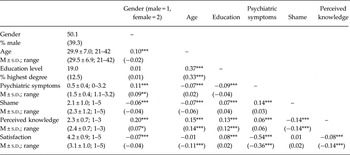
Proportions are provided for categorical variables or means and standard deviations for continuous variables, respectively. Associations between predictor variables were assessed by bivariate correlations (Table 1). The main analysis was conducted in two steps. The first step was intended to detect patterns of attitudes to help-seeking using the eight attitude items described above. We used Latent Profile Analysis (LPA; McLachlan & Peel, Reference McLachlan and Peel2000) to identify distinct patterns of attitudes towards help-seeking. LPA identifies homogeneous groups of individuals based on similarities of response patterns and has been described as person-centred counterpart to factor analysis which, unlike LPA, aims to find similar sets of variables (Muthén & Muthén, Reference Muthén and Muthén2002).
Descriptive statistics and bivariate correlations for the entire sample (n = 8875); in parentheses for participants with high levels of psychiatric symptoms (n = 855)

***p < 0.001, **p < 0.01, *p < 0.05.
LPA is ideally suited to explore possible sub-populations within a population-based sample because it simultaneously evaluates all items submitted to the analysis and yields fit statistics to test and compare multiple class solutions. Accordingly, starting with a single (total sample) class solution, we tested solutions with increasing numbers of classes and model fit statistics indicated the best fitting solution. For that purpose we evaluated the relative fit of different models by the Lo–Mendell–Rubin adjusted likelihood ratio test (LMR-A; Lo et al. Reference Lo, Mendell and Rubin2001), the Bayesian information criterion (BIC) and the sample-size-adjusted BIC (BIC-A), and the Aikaike information criterion (AIC; McLachlan & Peel, Reference McLachlan and Peel2000). Significant LMR-A values suggest that a model is preferable over another model with the next lower number of classes. A non-significant LMR-A value indicates that the solution includes too many classes (Nylund et al. Reference Nylund, Asparouhov and Muthén2007). For the sake of parsimony, solutions with one or several classes including less than 5% of all participants were rejected.
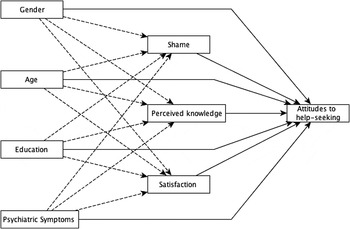
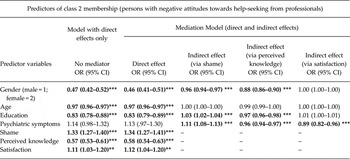
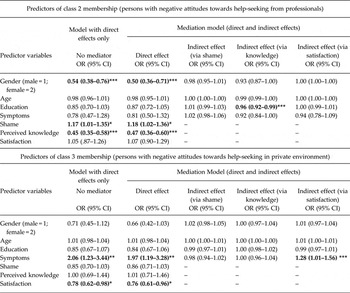
Following the latent profile analysis, we used class membership as categorical dependent variable in a multinomial logistic regression model. Since the class solutions were estimated based on responses to items that assessed attitudes to help-seeking, class membership indicates patterns or profiles of such attitudes. In all regressions, we determined predictors of membership in one class relative to the group with most participants as the majority reference class. We examined two groups of predictors: first, the level of psychiatric symptoms, controlling for sociodemographic variables as potential confounders (gender, age, education); second, shame, perceived knowledge and satisfaction associated with mental health. For the latter three predictors, we examined their direct effects as well as their role as mediators between sociodemographic variables/symptoms and class membership (Fig. 1). To estimate mediation, two models were calculated: first the unmediated direct effects of all seven variables on class membership; second, the indirect effects of symptoms or sociodemographic variables on group membership – mediated by shame, perceived knowledge and satisfaction – were added. Indirect effects are the products of two parameter estimates: (i) from the distal predictor (symptoms) or sociodemographic variable to the mediating variable (e.g., shame) and (ii) from the mediating variable to group membership. Probabilities of both direct and indirect effects are provided by odds ratios (OR) with 95% confidence intervals (95% CI), an indirect effect being significant if the 95% CI did not include 1.0 (Tables 3 and 4).
Model of sociodemographics and psychiatric symptoms (left column) as well as shame, perceived knowledge and satisfaction as predictors of attitudes to help-seeking. Dashed arrows indicate the first part of an indirect pathway from sociodemographic variables or symptoms (left) to help-seeking attitudes (right), mediated by shame, knowledge or satisfaction.

Results
Associations between predictor and sociodemographic variables
Summarizing findings with correlation coefficients greater than 0.10 (Table 1), in the entire sample higher symptoms were associated with female gender, more shame and less satisfaction about one's mental health. Better perceived knowledge was related to female gender, older age, better education and less shame. Among participants with high symptom levels, correlation patterns were similar (Table 1, numbers in parentheses) except for weaker associations of symptoms with shame and satisfaction.
LPA of attitudes towards help-seeking in the entire sample
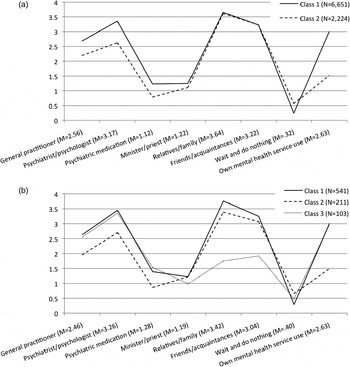
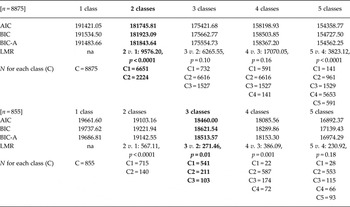
The LPA of all participants (n = 8875) yielded a two-class solution with a significantly better fit than the single-class solution, while the three-class solution was not superior to the two-class solution (upper half of Table 2). Solutions with four or five classes included at least one class with a very small number of participants (n < 150; <2%). Therefore the two-class solution was the best fit with an approximate 75 − 25% split (Fig. 2A ).
Subgroups/classes of participants with different patterns of attitudes towards help-seeking, determined by Latent Profile Analysis: Part A with a two-class solution in the entire sample (n = 8875); part B with a three-class solution among participants with high levels of psychiatric symptoms (n = 855). Higher scores (vertical axis) indicate stronger agreement that this source of help should be sought (help-seeking recommendations scored 0 to 4; personal help-seeking intentions from 1 to 3).

Latent Profile Analysis, goodness of fit statistics for the entire sample (n = 8875) in the top half of this table; and for participants with high levels of psychiatric symptoms (n = 855) in its lower half. From left to right, multiple solutions are presented with increasing numbers of classes. Bold print indicates the best fitting solutions, the basis of further analyses (Tables 3 and 4)

AIC: Aikaike Information Criterion; BIC: Bayesian Information Criterion; BIC-A: sample-adjusted BIC; LMR: Lo–Mendell–Rubin adjusted likelihood ratio test.
Class 1 represents the majority of participants with on average positive views (above the scale midpoint of 2, Fig. 2A ) about seeking help from a general practitioner, psychiatrist/psychologist, friends, family or about own mental health service use. On the other hand, majority attitudes on average were negative (well below the scale midpoint of 2) towards psychiatric medication, a minister/priest or doing nothing. Relative to class 1, class 2 as an approximate 25%-minority exhibited more negative attitudes towards professional help, including medication and towards own mental health service use.
Predictors of attitudes to help-seeking in the entire sample
To estimate the effects of predictor variables on membership in the class with more negative attitudes towards seeking professional help (class 2 in Fig. 2A ) as compared to the majority (class 1), we ran two regressions (Table 3). In a first model, we only assessed direct effects and found that persons in the subgroup with more negative attitudes towards seeking professional help were characterized by higher levels of shame, less perceived knowledge and higher satisfaction with their mental health as well as by being male, younger and less educated (Pseudo R-square = 0.10). In a mediation model assessing both direct and indirect effects (Table 3), all the direct effects remained significant.
Predictors of membership in the subgroup with more negative attitudes towards help-seeking from professionals (class 2; relative to class 1, see Fig. 2A), assessed by path modelling and multi-nomial logistic regression among all participants (n = 8875)

***p < 0.001, **p < 0.01, significant OR in bold print.
The indirect effects of symptoms on attitudes to help-seeking had different directions, suggesting inconsistent mediation (MacKinnon et al. Reference MacKinnon, Fairchild and Fritz2007) and explaining the lack of an overall correlation between symptoms and attitudes: more symptoms, mediated by increased shame, predicted more negative views on professional help-seeking; but more psychiatric symptoms were also associated with more positive views, mediated by decreased satisfaction and better perceived knowledge. Again showing inconsistent mediation, better education had different indirect effects on attitudes to professional help: via increased shame it was associated with more negative, but via better perceived knowledge with more positive attitudes. Finally, male gender was related to more negative attitudes, mediated by increased levels of shame and poorer perceived knowledge.
LPA among participants with high symptom levels
The three-class solution (Fig. 2B ) with an approximate 60–25–15% split of the high symptom group offered the best fit, significantly better than the two-class solution, which in turn was superior to the one-class solution (lower half of Table 2). The four- and five-class solutions were rejected due to classes with very few participants (n < 30; <4%). Classes 1 and 2 resembled the corresponding classes in the entire sample. Relative to class 1 as the majority, class 2 endorsed more negative attitudes towards professional help (Fig. 2B ). Class 3 represented a smaller group of participants with much less positive views specifically about help-seeking in one's private environment.
Predictors of attitudes to help-seeking among participants with high symptom levels
Because the profile analysis (Fig. 2B ) had yielded three classes, we ran two sets of regressions (see Table 4, upper and lower parts): to predict membership (i) in the subgroup with more negative attitudes towards help-seeking from professionals (class 2) and (ii) in the subgroup reluctant to seek help from one's private environment (class 3), both relative to the majority (class 1). Respondents with more negative attitudes towards professional help-seeking were independently characterized by more shame, less perceived knowledge and male gender (Table 4). Better education was indirectly associated with less negative attitudes, mediated by better perceived knowledge. Participants with greater scepticism to seek help among friends and family (class 3) were characterized by higher symptoms and less satisfaction with their mental health, with symptoms both having a direct and an indirect effect, the latter being mediated by lower satisfaction (Table 4).
Predictors of membership in subgroups with negative attitudes towards help-seeking from professionals (class 2) or in one's private environment (class 3; relative to class 1, respectively, see Fig. 2B) among participants with high levels of psychiatric symptoms (n = 855)

***p < 0.001, **p < 0.01, *p < 0.05, significant OR in bold print.
Discussion
Using latent profile analysis, we found two groups with homogeneous attitude patterns towards help-seeking. Compared to the majority, approximately one-in-four endorsed more negative views towards professional mental health services including psychiatric medication, both in terms of recommendations to others and of using mental health services themselves. It should be noted that help-seeking recommendations for others were closely related to personal help-seeking intentions. Overall, respondents expressed more negative attitudes towards psychiatric medication relative to other sources of help which is consistent with previous surveys (Lauber et al. Reference Lauber, Nordt, Falcato and Rössler2001; Riedel-Heller et al. Reference Riedel-Heller, Matschinger and Angermeyer2005; Schomerus et al. Reference Schomerus, Schwahn, Holzinger, Corrigan, Grabe, Carta and Angermeyer2012b ).
With respect to our second aim to examine shame, perceived knowledge and satisfaction with one's mental health as predictors of attitudes, we found more shame, less perceived knowledge and higher satisfaction with one's mental health to be independent predictors of more negative views about professional sources of help. Therefore (anticipated) shame as a proxy of self-stigma as well as perceived poor knowledge would be useful targets for initiatives to improve attitudes towards professional sources of help.
In terms of knowledge as a concept, there are detailed measures of mental health literacy and its specific aspects, for example the Depression Literacy Scale to assess knowledge about depression including its symptoms and available treatments (Griffiths et al. Reference Griffiths, Christensen, Jorm, Evans and Groves2004) or measures of more general knowledge about mental illness (Evans-Lacko et al. Reference Evans-Lacko, Little, Meltzer, Rose, Rhydderch, Henderson and Thornicroft2010). In our brief survey, it was not feasible to assess ‘objective’ mental health literacy which is a limitation of our study. Our measure could be considered an index of perceived knowledge or subjective mental health literacy. It does not indicate how much persons know, but whether they feel they know enough. The fact that perceived knowledge was associated with higher age, better education, more symptoms (increasing the likelihood of previous experience with mental illness) and with less shame would be consistent with this interpretation. However, our findings are preliminary and more research on subjective mental health literacy is needed.
As a third aim we examined the impact of symptoms on patterns of help-seeking attitudes. As summarized above, we found evidence for inconsistent mediation with different indirect effects. The pathway leading from more symptoms via increased shame to more negative attitudes is noteworthy. Anticipated shame about a potential own mental illness may become a less abstract emotional experience for respondents with high symptom levels. This process is analogous to self-stigma as a process that requires self-labelling as a person with mental illness so that stereotypes become relevant to oneself (Link, Reference Link1987; Corrigan & Watson, Reference Corrigan and Watson2002; Rüsch et al. Reference Rüsch, Corrigan, Wassel, Michaels, Olschewski, Wilkniss and Batia2009b , Reference Rüsch, Corrigan, Todd and Bodenhausen2010). Symptoms and their recognition as signs of a mental illness might thus be a two-edged sword: They can facilitate help-seeking, but also induce fear of stigma and self-stigma (Jorm, Reference Jorm2012).
Comparing our findings between the entire sample and participants with high symptom levels, we found two remarkably similar subgroups, with respect both to their attitudes towards help-seeking and to the one-in-four size of those with more negative views about professional help. Persons with very high symptoms were more likely to belong to a third subgroup more hesitant to seek help in their private environment. This is consistent with findings that many people, with good reasons, tend to seek help from friends and family during low rather than during high levels of distress (Jorm et al. Reference Jorm, Griffiths, Christensen, Parslow and Rogers2004).
Limitations of our study need to be considered. Our sample is representative of young and middle-aged adults in the Swiss region of Zürich and findings might differ among adolescents or the elderly or in other geographic regions. Data on perceived public and self-stigma (other than shame as its emotional proxy) as well as on previous social contact with persons with mental illness were not available. Since the label use affects help-seeking (Yap et al. Reference Yap, Reavley and Jorm2013), self-labelling should be assessed in future studies. It is unclear how closely recommendations and intentions to seek help are related to actual behaviour. We did not distinguish between attitudes to help-seeking for different disorders. Different items in the survey referred to ‘mental illness’, ‘psychological distress’ or ‘mental health’. Some variables were single items, precluding reliability tests. Our data were cross-sectional and do not allow conclusions on causality. Finally, the variance explained by our regression models was small. Other predictors were not accounted for and therefore future studies should include previous experiences with help-seeking as well as perceived quality and accessibility of services.
In conclusion, we found evidence for a sizeable subgroup of about one in four with distinctly more negative attitudes towards seeking help from professionals, both in the general population and among people with high symptom levels. This group was characterized by increased shame as a proxy of self-stigma and by poor subjective mental health literacy in addition to being male, younger and having lower education. Shame and perceived lack of knowledge about mental health could be barriers to service use and thus be useful targets for interventions meant to increase help-seeking rates. LPA is helpful for this purpose because it allows us to identify subgroups with homogeneous attitude patterns. Interventions are probably more efficient if they focus on members of a subgroup with consistently more sceptical views about professional sources of help who are more prone to underutilize available services. Initiatives that aim to increase service use by reducing (anticipated) shame about having a mental illness and by increasing perceived knowledge could consist of marketing campaigns addressing the general public (Jorm, Reference Jorm2012; Henderson et al. Reference Henderson, Evans-Lacko and Thornicroft2013), of more focused programs using education- and contact-based approaches with target groups (Corrigan et al. Reference Corrigan, Morris, Michaels, Rafacz and Rüsch2012), of selected or indicated prevention programmes for people at risk for mental illness (Compton, Reference Compton2010; de Girolamo et al. Reference de Girolamo, Dagani, Purcell, Cocchi and McGorry2012; Yap & Jorm, Reference Yap and Jorm2012), or of more clinically oriented interventions among diagnosed individuals who have already entered the mental health service system (Yanos et al. Reference Yanos, Roe and Lysaker2011; Luoma et al. Reference Luoma, Kohlenberg, Hayes and Fletcher2012; Corrigan et al. Reference Corrigan, Kosyluk and Rüsch2013).
Acknowledgements
We are grateful to all participants.
FINANCIAL SUPPORT
This study was supported by the Zürich Program for the Sustainable Development of Mental Health Services (www.zinep.ch).
ETHICAL STANDARDS
The authors assert that all procedures contributing to this work comply with the ethical standards of the relevant national and institutional committees on human experimentation and with the Helsinki Declaration of 1975, as revised in 2008.